Fighting Hepatitis B in North Korea: Feasibility of a Bi-modal Prevention Strategy
In North Korea, the prevalence of hepatitis B is high due to natural factors, gaps in vaccination, and the lack of antiviral treatment. Aid projects are urgently needed, however impeded by North Korea’s political and economical situation and isolation. The feasibility of a joint North Korean and German humanitarian hepatitis B prevention program was assessed. Part 1: Hepatitis B vaccination catch-up campaign. Part 2: Implementation of endoscopic ligation of esophageal varices (EVL) by trainings in Germany and North Korea.
By vaccinating 7 million children between 2010 and 2012, the hepatitis B vaccination gap was closed. Coverage of 99.23% was reached. A total of 11 hepatitis B-induced liver cirrhosis patients (mean age 41.1 yr) with severe esophageal varices and previous bleedings were successfully treated by EVL without major complications. A clinical standard operating procedure, a feedback system and a follow-up plan were developed. The bi-modal preventive strategy was implemented successfully. Parts of the project can serve as an example for other low-income countries, however its general transferability is limited due to the special circumstances in North Korea.
Keywords: Hepatitis B; Democratic People’s Republic of Korea; Mass Vaccination;
Esophagoscopy Markus Unnewehr1 and August Stich2
1Medizinische Klinik Nord, Klinikum Dortmund, Dortmund (Academic Teaching Hospital of the Westfälische Wilhelms-Universität Muenster, Muenster, Germany) and Medical Mission Institute, Wuerzburg; 2Medical Mission Institute, Wuerzburg, Germany
Received: 15 June 2015 Accepted: 7 August 2015 Address for Correspondence:
Markus Unnewehr, MD
Medizinische Klinik Nord, Klinikum Dortmund gGmbH, 240 Muensterstraße 44145 Dortmund, Germany Tel: +49.231-953-18846, Fax: +49.231-953-18199 E-mail: [email protected]
http://dx.doi.org/10.3346/jkms.2015.30.11.1584 • J Korean Med Sci 2015; 30: 1584-1588
INTRODUCTION
Hepatitis B is one of the most important public health problems the Democratic People’s Republic of Korea (DPRK, North Ko- rea) is currently facing, because of its high prevalence combined with an often deleterious chronic course leading to both physi- cal impairment and sufferings of the patients as well as causing a huge socio-economic burden (1).
Due to its present political and economical situation North Korea faces limitations in obtaining epidemiological data on diseases or health related problems (2). The prevalence of hep- atitis B in North Korea can thus only be estimated. Hepatitis B is endemic in the Korean Peninsula (3). The World Health Orga- nization (WHO) calculated a prevalence of 4.5% in 2003. Ac- cording to verbal statements on unpublished data from a sur- vey among North Korean refugees to South Korea, a prevalence of 9% is more realistic (4). Given the high natural prevalence in the region of up to 20% (5) and the North Korean deficits in vac- cination, the true prevalence can be assumed to be even higher.
In North Korea, it can be assumed the transmission of hepa- titis B to occur mostly vertical ante- or perinatally and sexually, however, there are no data on the exact transmission rates (6).
The younger the patients at the time of infection, the higher is the progression rate from acute to chronic hepatitis B infection, decreasing from 90% for an infection acquired perinatally to
lower than 5% in adults (6,7). The lifetime risk of liver-related death is about 40%-50% for men (8,9) and 15% for women (10).
Depending on their clinical situation and the portal venous pres- sure, between 30% and 85% of cirrhotic patients have esopha- geal varices (EV) (11,12). About 5%-15% of cirrhotic patients suffer from one bleeding per year with a 6-week mortality of 25% and a risk of re-bleeding of 60% in 1 yr (12).
The management of hepatitis B in North Korea has been very limited (13). There has been neither a comprehensive vaccina- tion until 2004 nor is there any effective treatment for ordinary people available until now. Only since 2004, the national im- munization program includes nationwide hepatitis B vaccina- tion of newborn, leaving a gap of 3.8 million unvaccinated chil- dren born before 2004.
Despite an extensive state-funded health care structure in North Korea with specialized “Hepatitis Hospitals” in each gov- ernmental district, the current treatment of hepatitis B and its complications, e. g. liver cirrhosis, consists of traditional herbal medicine. Antiviral agents such as tenofovir, entecavir, and in- terferon are known to some doctors, as well as spironolactone, lactulose, and other medications in case of liver decompensa- tion. However, no experience with these treatments and with any interventions such as endoscopy for esophageal varices can be assumed. Beta-blockers are not available for ordinary patients.
Due to the present isolated situation of the country, there is very limited access to current medical information (13). For or- dinary doctors, access to the internet is not available, there is no up to date foreign printed literature, and even domestic medi- cal textbooks are only rarely available. The main sources of in- formation are old textbooks and the occasional imported docu- ments. The English language barrier increases the knowledge deficit. Judging from the doctors’ behavior in their clinical work, there is low understanding of a scientific approach to medical problems.
While modern treatment and prevention strategies against hepatitis B in North Korea are needed, the implementation of new diagnostic and treatment techniques is extremely difficult.
The present study assessed the feasibility of the implementa- tion of a strategy to deal with hepatitis B and some of its associ- ated problems in the special political circumstances in North Korea.
MATEIRLAS AND METHODS
Caritas Germany, the Ministry of Public Health of North Korea (MoPH), and the Medical Mission Institute Wuerzburg, Ger- many (MMI) developed a joint strategy to deal with hepatitis B and its associated problems. A bi-modal approach was chosen focusing on the primary prevention of hepatitis B by vaccina- tion and the secondary prevention of esophageal variceal bleed- ings as a life-threatening complication. The humanitarian aid project was funded with donations from Germany and Repub- lic of Korea (South Korea).
The Hepatitis Prevention Hospital (HPH) in Pyongyang was selected as the project’s central health care facility. As a national hepatitis B reference center, the hospital is not only responsible for preventive measures but also for the care of severe cases of hepatitis B-induced liver cirrhosis referred from other hospitals.
Nationwide hepatitis B vaccination campaign
A hepatitis B vaccination catch-up campaign was initiated by Caritas Germany and the MoPH in 2010 according to WHO re- commendations (14). The program started in February 2010 with a first phase covering Pyongyang area. The campaign was subsequently extended to all North Korean provinces until Feb- ruary 2012. The target group included children in the age of 6 to 16 yr. Each child received three shots in time intervals of 0, 1, and 6 months.
Vaccine (1 mL of purified HBsAg 20 mcg, EUVAX B®, LG Life Science, Korea) and syringes were supplied from South Korea and shipped through China to North Korean district and pro- vincial stores. From here, the vaccination teams - at least two including a household doctor and a primary health facility work- er - picked up the vaccine in iced boxes to maintain the cooling chain. Before that, vaccination teams were instructed by local
health officials.
The children were vaccinated in their primary and secondary school classes. Parents and children were informed about the campaign beforehand and responded generally positively. Dur- ing the campaign, no cases of relevant negative side effects were reported. In total, 15 monitoring trips were made by a humani- tarian aid specialist from Caritas Germany during the campaign.
Implementing and training of endoscopic variceal ligation This part of the aid program consisted of two steps. In step one, two senior physicians from the HPH received endoscopy train- ing in the MMI in Germany. The objective was to familiarize the North Korean doctors with endoscopic technique and indica- tion, but also to get in contact with western science-based medi- cine. Endoscopic equipment, consisting of two video gastro- scopes (Pentax EG 2930 K), a video processor (Pentax EPK 700/
EPK) and a re-usable endoscopic ligation device (Euroligator®, Mandel und Rupp, Germany), were shipped to North Korea and installed in the HPH in Pyongyang. This is the first video endoscopy unit in North Korea.
The second step was a one-week training of doctors and nurs- es in gastroscopy and endoscopic intervention by an experienc- ed German endoscopist in the HPH in Pyongyang. After pre- sentations and discussions about hepatitis B, the general man- agement of liver cirrhosis, esophageal varices (EV) and the gas- troscopy techniques, a clinical standard operating procedure (SOP) on performing gastroscopies and EV ligation technique was established. The guidance derived step-by-step from the initial lectures, the group debates and the experiences during the procedures and was set up as much as possible according to international guidelines (12) and current medical evidence as well as to personal experience, and it took into account the local possibilities, e. g. traditional herbal medicine (15). A hand- over-hand training method was used according to the develop- ment of the performance in gastroscopy of the North Korean physicians.
Patient’s safety was a major concern, since only elective in- terventions were performed. Therefore, thorough local anes- thesia with topical lidocaine using a specially developed spray- ing tube and close patient contact was preferred over sedation.
In the rare cases sedation was necessary, it was done with mid- azolam in low and slowly increasing doses limited to a maximal amount under close oxymetric and clinical monitoring. First response to adverse reaction was explained and practiced.
Patients were carefully selected for the procedures under strict weighing of the presumed benefits and possible disadvantages of the treatment. Since patients with previous EV bleedings have the highest mortality from any re-bleeding, these patients were preferred (16). Informed consent according to local standards was obtained in each patient.
A database of the patients with all details of the interventions
was prepared and daily updated. A follow-up schedule was set up to maintain the care for the patients.
RESULTS
Nationwide hepatitis B vaccination campaign
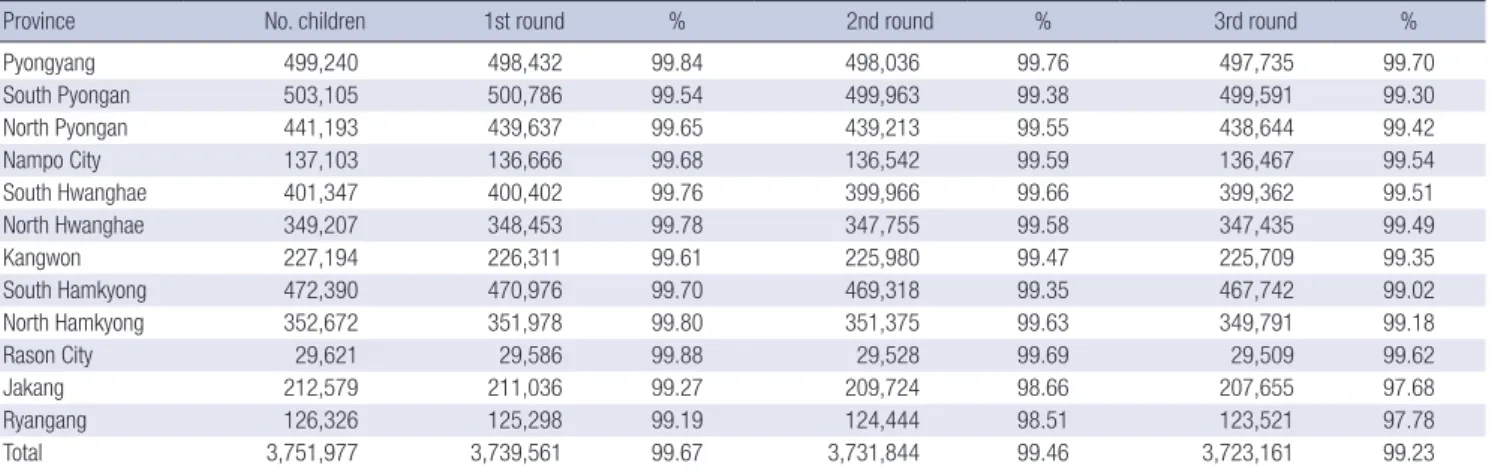
Eventually, 3.7 million unvaccinated children were vaccinated during the catch-up campaign, leading to a coverage of 99.23 % according to the MoPH (2012) (Table 1). It can be assumed that the huge gap of unvaccinated children left before the initiation of the national vaccination plan in 2004 is now closed.
Implementing and training of endoscopic variceal ligation During the week of the endoscopy training, a total of 30 gastros- copies were performed in 25 patients (23 men, 2 women) with liver cirrhosis due to hepatitis B. These diagnoses had previous- ly been established by clinical and sonographic signs, and posi- tive HBsAg and anti-HBc markers. Most of the patients had a history of recent gastrointestinal bleeding (60%). There were no patients suffering from alcoholism. Their mean age was 41.1 with range from 33 to 55 yr. The patients’ clinical condition was generally good; all were able to walk and had no clinical signs of cirrhotic decompensation. Any scoring, such as CHILD or MELD, was not possible due to lack of laboratory tests in North Korea.
The grading of the EV was done in 2 grades according to in- ternational recommendations (small, < 5 mm diameter, veins minimally elevated, completely collapsing when insufflating air; large ≤ 5 isn’t it ≥ 5 mm, largely occluding the esophageal lumen, curvy) (12,15). It was also noted if red wale marks and red cherry spots were present. Eventually, 11 EV ligations were successfully carried out (Table 2).
There were no major safety problems or adverse events dur- ing the endoscopies or in the days after, apart from mild chest pain in 3 patients after the ligation procedure. The combination of presentations, group discussions and the practical training with explanations and hand-over-hand training was highly ef-
fective, as measured by the course of the week. The whole team increased its self-confidence and speed, and diagnoses and treat- ment decisions were made more and more independently.
DISCUSSION
Developing a strategy against hepatitis B in North Korea is an extraordinarily challenging task because of the special political situation (13). The usual, mainly financial, technical, and logis- tic shortcomings of a low-income country had to be taken into account. The substantial lack of knowledge, experience, and materials in preventing and treating hepatitis B due to the isola- tion of the country created special problems. The almost ubiq- uitous political impacts that any foreign aid in North Korea im- poses had to be considered specifically (17). This is why further measurements, e.g. any antiviral treatment of hepatitis B pa- tients or beta-blocker therapy of patients with EV, were not con- sidered to be realistic in the current North Korean context. Scru- tiny of the literature revealed that there are no similar studies of our study could be compared with.
Humanitarian aid in health care focuses on cost-effective and large-scale improvements of widespread diseases. Prevention programs such as vaccinations thus have a high priority. Vacci- nation against hepatitis B has been a well-accepted method of primary prevention for decades. South Korea implemented full vaccination coverage about 25 yr ago (3). Its efficacy and cost- effectiveness in low-income-countries was proven by a vast Table 1. Vaccination coverage in North Korea’s regions during the campaign rounds 2010-2012
Province No. children 1st round % 2nd round % 3rd round %
Pyongyang 499,240 498,432 99.84 498,036 99.76 497,735 99.70
South Pyongan 503,105 500,786 99.54 499,963 99.38 499,591 99.30
North Pyongan 441,193 439,637 99.65 439,213 99.55 438,644 99.42
Nampo City 137,103 136,666 99.68 136,542 99.59 136,467 99.54
South Hwanghae 401,347 400,402 99.76 399,966 99.66 399,362 99.51
North Hwanghae 349,207 348,453 99.78 347,755 99.58 347,435 99.49
Kangwon 227,194 226,311 99.61 225,980 99.47 225,709 99.35
South Hamkyong 472,390 470,976 99.70 469,318 99.35 467,742 99.02
North Hamkyong 352,672 351,978 99.80 351,375 99.63 349,791 99.18
Rason City 29,621 29,586 99.88 29,528 99.69 29,509 99.62
Jakang 212,579 211,036 99.27 209,724 98.66 207,655 97.68
Ryangang 126,326 125,298 99.19 124,444 98.51 123,521 97.78
Total 3,751,977 3,739,561 99.67 3,731,844 99.46 3,723,161 99.23
Table 2. Distribution of varices and their features, and ligation treatment
Clinical features Esophageal varices Total
n (%) Small Large No varices
Grade, n (%) 5 (20) 12 (48) 8 (32) 25 (100)
Features
Red spots, n (%) 1 (4) 5 (20) 0 (0) 6 (24)
Red wale marks, n (%) 0 (0) 3 (12) 0 (0) 3 (12) Previous bleeding, n (%) 4 (16) 10 (40) 1 (4) 15 (60) EVL treatment, n (%) 1 (4) 10 (40) 0 (0) 11 (44)
amount of research studies (18). The implementation of our vaccination campaign was rather a logistic problem, taking into special account the recurrent political tensions in the region.
Two international political crises - the Cheonan warship sink- ing in March 2010 and the Yeonpyeong Island shelling in No- vember 2010 - interrupted the vaccination program twice for several months each.
According to official North Korean sources from the MoPH (2012), there is now a hepatitis B vaccination coverage of 99.23
% in the country. Due to the hierarchic structure of North Ko- rea’s health care system and the thorough vaccination observed in personal random visits in the countryside by Caritas Germa- ny experts, this high figure is likely to be correct. It can be assum- ed that after the vaccination campaign and given the current continuation of the vaccinations, the prevalence of hepatitis B must be dropping in the long term, as long as there is a sufficient supply of vaccines. Verbal feedback from primary care centers where patients with hepatitis symptoms usually present first confirms this impression. However, as the transmission of hep- atitis B in North Korea is mostly perinatal, an effect of the vacci- nation catch-up campaign can be expected in several years.
Most likely, the effect observed is to be attributed to the regular national vaccinations started in 2004. To gather reliable data, further prevalence studies are needed, however it is difficult to obtain due to the political situation in North Korea.
Modern technical assistance in health care in low-income countries is usually only reasonable under special circumstanc- es due to its costs and complexity. If a ‘high-tech’ method is im- plemented, it should be easy to perform and fast to learn, with- out side effects and with a good risk-benefit-ratio for the patients.
The functioning and maintenance of the equipment should be assured.
With its high prevalence of remarkably young hepatitis B pa- tients with advanced cirrhosis and its life-threatening esopha- geal bleeding complications, the situation in North Korea is most likely globally unique. This justifies a limited and well-planned approach in technical aid using gastroscopic treatment with a good clinical success of a low number needed to treat (19,20).
After considerable high initial costs for the endoscopy equip- ment, the maintenance costs are low, consisting mainly of rub- ber rings for the ligations. The side effects of esophageal varices ligation are low, mainly occasional post-interventional dyspha- gia and chest pain; and rarely bleedings from post-ligation ul- cers in no more than 5% of the patients (21).
Because the endoscopy training was short, special safety pre- cautions were taken. Adequate indications and a good techni- cal performance were assured by the SOP guidance, which was implemented during the training. In addition to that, a sustain- ed effect of the short training was ensured by feedback from the German endoscopist via a self-designed video capture software added to the endoscopy video processor to save procedure im-
ages and films. Sending the updated patient database to Ger- many to discuss cases also helped to maintain the training achi- evements.
Both parts of the project had a visible impact on the North Korean health care workers and patients involved. During the endoscopy training, the frequent visits from doctors from Pyong- yang medical university and other hospitals underlined the great interest in the technique, most likely a rare possibility for North Korea doctors to get in closer contact with practical ‘mod- ern medicine’. The whole endoscopy team, especially the physi- cians performing the gastroscopies, was highly motivated and eager to increase its knowledge and skills.
There are several conditions that explain the success of this bi-modal aid program. There is the exceptional situation of a non-existence of neither comprehensive hepatitis B vaccina- tion nor effective treatment. The hierarchically structured health care system in the totalitarian North Korean state, as problem- atic it may otherwise be, was now helpful to implement the com- plex nationwide vaccination campaign (22). The high affinity of North Korean health care workers to technology resulted in good gastroscopy training results in only one week and assures the maintenance of the technical equipment.
At the same time, these special circumstances limit the trans- ferability of our strategy to other low-income countries. Hepati- tis B vaccinations are clearly advisable (18), however the high vaccination rate in a broad program with millions of children is unlikely to be achieved because of organizational deficits. Also, technical problems with the gastroscopes might be more diffi- cult to solve in low-income countries with a cultural behavior of distance to medical technology. However, the training meth- od itself with its clinical guidance and safety measures can be regarded as a model for similar projects in other countries.
Further steps planned are a continuation of the EV ligations using the supervision and feedback mentioned above focusing especially on safety measurements. Referrals of patients from smaller hospitals in North Korea to the HPH are preferred and encouraged over the expansion of the endoscopy program to other hospitals. The treatment of gastric varices by injection of cyanoacrylate seems currently not feasible, given the low prev- alence of gastric varices and a low risk of life-threatening bleed- ings, the difficulties to obtain the expensive glue and its prob- lematic handling with a risk of damages of the endoscopes.
The hepatitis B project has no political objective and is a pure- ly medical humanitarian aid program. However, the unavoid- able positive personal contact of North Koreans with the world outside their country might be a tiny step to open North Korea’s devastating isolation. Eventually, in a long-term perspective this could be helpful to improve the living conditions for the general North Korean population.
ACKNOWLEDGEMENTS
Special thanks to the doctors and nursing staff of the Hepatitis Prevention Hospital (HPH) in Pyongyang whose names cannot be mentioned in this article. We are also thankful for the sup- port of the Ministry of Public Health of North Korea.
DISCLOSURE
The authors have no conflicts of potential interest to disclose.
AUTHOR CONTRIBUTION
Conception and coordination of the study: all authors. Data col- lection: Unnewehr M. Data review: all authors. Manuscript pre- paration: Unnewehr M. Critical review of the manuscript: Stich A. Manuscript approval: all authors. Agreement of accountabili- ty: all authors
ORCID
Markus Unnewehr http://orcid.org/0000-0003-2841-9076 REFERENCES
1. Lee YH, Yoon SJ, Kim YA, Yeom JW, Oh IH. Overview of the burden of diseases in North Korea. J Prev Med Public Health 2013; 46: 111-7.
2. Seung KJ, Linton SW. The growing problem of multidrug-resistant tuber- culosis in North Korea. PLoS Med 2013; 10: e1001486.
3. Chae HB, Kim JH, Kim JK, Yim HJ. Current status of liver diseases in Ko- rea: hepatitis B. Korean J Hepatol 2009; 15: S13-24.
4. Lee YH, Lee WJ, Kim YJ, Cho MJ, Kim JH, Lee YJ, Kim HY, Choi DS, Kim SG, Robinson C. North Korean refugee health in South Korea (NORNS) study: study design and methods. BMC Public Health 2012; 12: 172.
5. Nebbia G, Peppa D, Maini MK. Hepatitis B infection: current concepts and future challenges. QJM 2012; 105: 109-13.
6. Umar M, Hamama-Tul-Bushra, Umar S, Khan HA. HBV perinatal trans- mission. Int J Hepatol 2013; 2013: 875791.
7. Fattovich G, Bortolotti F, Donato F. Natural history of chronic hepatitis B:
special emphasis on disease progression and prognostic factors. J Hepa- tol 2008; 48: 335-52.
8. Dienstag JL. Hepatitis B virus infection. N Engl J Med 2008; 359: 1486- 500.
9. Aspinall EJ, Hawkins G, Fraser A, Hutchinson SJ, Goldberg D. Hepatitis B prevention, diagnosis, treatment and care: a review. Occup Med (Lond) 2011; 61: 531-40.
10. Mauss S, Berg T, Rockstroh J, Sarrazin C, Wedemeyer H. Hepatology: a clinical textbook. 5th ed. Düsseldorf: Flying Publisher, 2014.
11. Karadsheh Z, Allison H. Primary prevention of variceal bleeding: phar- macological therapy versus endoscopic banding. N Am J Med Sci 2013; 5:
573-9.
12. Garcia-Tsao G, Sanyal AJ, Grace ND, Carey W; Practice Guidelines Com- mittee of the American Association for the Study of Liver Diseases; Prac- tice Parameters Committee of the American College of Gastroenterolo- gy. Prevention and management of gastroesophageal varices and vari- ceal hemorrhage in cirrhosis. Hepatology 2007; 46: 922-38.
13. Goe LC, Linton JA. Community-based public health interventions in North Korea: one non-governmental organization’s experience with tu- berculosis and hepatitis B. Public Health 2005; 119: 347-52.
14. World Health Organization, Regional Office for Southeast Asia. WHO Country Cooperation Strategy: Democratic People’s Republic of Korea 2009 - 2013. 2009. Available at http://www.who.int/countryfocus/coop- eration_strategy/ccs_prk_en.pdf [accessed on 8 May 2015].
15. de Franchis R; Baveno V Faculty. Revising consensus in portal hyperten- sion: report of the Baveno V consensus workshop on methodology of di- agnosis and therapy in portal hypertension. J Hepatol 2010; 53: 762-8.
16. Girotra M, Raghavapuram S, Abraham RR, Pahwa M, Pahwa AR, Rego RF. Management of gastric variceal bleeding: Role of endoscopy and en- doscopic ultrasound. World J Hepatol 2014; 6: 130-6.
17. Lee H, Ahn DY, Choi S, Kim Y, Choi H, Park SM. The role of major do- nors in health aid to the Democratic People’s Republic of Korea. J Prev Med Public Health 2013; 46: 118-26.
18. Hendrickx G, Vorsters A, Van Damme P. Advances in hepatitis immuni- zation (A, B, E): public health policy and novel vaccine delivery. Curr Opin Infect Dis 2012; 25: 578-83.
19. Imperiale TF, Chalasani N. A meta-analysis of endoscopic variceal liga- tion for primary prophylaxis of esophageal variceal bleeding. Hepatolo- gy 2001; 33: 802-7.
20. Gluud LL, Krag A. Banding ligation versus beta-blockers for primary prevention in oesophageal varices in adults. Cochrane Database Syst Rev 2012; 8: CD004544.
21. Schepke M, Kleber G, Nürnberg D, Willert J, Koch L, Veltzke-Schlieker W, Hellerbrand C, Kuth J, Schanz S, Kahl S, et al.; German Study Group for the Primary Prophylaxis of Variceal Bleeding. Ligation versus pro- pranolol for the primary prophylaxis of variceal bleeding in cirrhosis.
Hepatology 2004; 40: 65-72.
22. Lan’kov AN. The real North Korea: life and politics in the failed Stalinist utopia. Oxford: Oxford University Press, 2013.