The Association between Self-reported Sleep Duration and Body Mass Index among Korean Adolescents
Previous research has shown that lack of sleep is related to Body Mass Index (BMI) in adolescence. This study was designed to investigate the association between sleep duration and BMI among Korean adolescents. We conducted a school-based cross-sectional study of 3,785 adolescents (males: 58.2%, females: 41.8%) in middle and high school between the ages of 11 and 18 years (mean age 15.26 ± 1.45). Using a self-reported questionnaire, we obtained information regarding weekday sleep duration, weekend sleep duration, height, weight, time spent at private tutoring institutes, socioeconomic status and scores on the Beck Depression Inventory (BDI). We investigated the association between self- reported sleep duration and BMI. After adjusting for confounding factors including age, gender, time spent at private tutoring institutes, academic performance, economic status and BDI scores, longer sleep duration on both weekdays and weekends was associated with decreased BMI (P = 0.002 and P < 0.001, respectively) for both genders. Increased weekend catch-up sleep duration was associated with decreased BMI in females (P = 0.038), but not in males (P = 0.343). The results of the present study indicated that longer sleep duration on weekdays and weekends in adolescents was associated with lower BMI. Longer weekend catch-up sleep may compensate effects of insufficient sleep on BMI for female adolescents.
Keywords: Adolescents; Sleep Duration; Body Mass Index; Catch Up Sleep Ban Hyung Lee,1* Seung-Gul Kang,2
Jae-Won Choi,3* and Yu Jin Lee3
1Seoul National University College of Medicine, Seoul, Korea; 2Department of Psychiatry, Gachon University School of Medicine, Incheon, Korea;
3Department of Psychiatry and Center for Sleep and Chronobiology, Seoul National University College of Medicine, Seoul, Korea
* Ban Hyung Lee and Jae-Won Choi equally contributed to this work.
Received: 16 March 2016 Accepted: 20 August 2016 Address for Correspondence:
Yu Jin Lee, MD
Department of Psychiatry and Center for Sleep and Chronobiology, Seoul National University College of Medicine, 101, Daehak-ro, Jongno-gu, Seoul 03080, Korea
E-mail: [email protected], [email protected] Funding: This research was supported by the Basic Science Research Program through the National Research Foundation of Korea (NRF), funded by the Ministry of Education, Science and Technology (2012R1A1A104359).
https://doi.org/10.3346/jkms.2016.31.12.1996 • J Korean Med Sci 2016; 31: 1996-2001
INTRODUCTION
Obesity is currently one of the most important indices of an un- healthy lifestyle, representing a medical concern and not mere- ly a cosmetic problem (1). Due to changes in lifestyle and eating habits, the obesity rate among children is increasing worldwide (2). Investigations in the USA and Brazil showed that an addi- tional 0.5% of the total pediatric population is becoming over- weight each year. In Canada, Australia, and Europe, the rates are even higher, with an additional 1% of the total pediatric popula- tion becoming overweight each year (3).
Korea is no exception to this phenomenon, due to western- ization and lifestyle changes. The prevalence of obesity among Korean middle school students has been reported to be 7.3% in 2010 (4), which was lower than 20.5% of USA in 2011-2014 (5).
However, the average Body Mass Index (BMI) in Korean ado- lescents has increased by 5.7 among males and 6.2 among fe- males over the past 23 years (6).
Korean adolescents are getting less sleep than they have in the past (7). High school students are at the greatest risk for in- sufficient sleep, since they are required to compete in university entrance examinations (8). A previous study compared sleep
duration in six countries including Korea, the USA, England, Germany, Sweden and Finland, and showed that Korean ado- lescents had the shortest sleep duration (7).
Several studies have demonstrated an association between body weight and sleep duration. In a cross-sectional study of Portuguese children, short sleep duration was related to weight gain (9). Another study took a longitudinal approach, studying a sample of the USA high school students aged 14 to 18 years and concluded that increased sleep for children in the 90th BMI percentile contributed to weight reduction (10).
However, several factors which can influence body weight or sleep duration in adolescents should be considered to assess the relationship between BMI and sleep duration. Korean ado- lescents also showed a high prevalence of depression. Accord- ing to research on Korean high school students, 18.5% of all stu- dents exhibited depression or a depressed mood, a rate that is higher than that observed among western adolescents (11). De- pression has been reported by several studies to be associated with being overweight and short sleep duration (12-14). A me- ta-analysis of longitudinal studies revealed a reciprocal link be- tween obesity and depression (15).
Adolescents do not have enough time to devote to exercise
due to academic loading, which may result in uncontrolled body weight and poor sleep quality (16). In addition, there have been evidences that low socioeconomic status is related to obesity among children and adolescents (17,18).
There is a lack of research investigating the association be- tween sleep duration and body mass index among Korean ado- lescents while for controlling academic factors and depressed mood. It is also difficult to evaluate sleep deficiency individual- ly for participants, such as students, who have fixed schedules on weekdays. Therefore this study was designed to investigate the relationship between BMI and sleep duration, categorized as sleep duration on weekdays, weekends and weekend catch- up sleep; the study controlled for significant confounding fac- tors, such as depressed mood, time spent at private tutoring in- stitutes, academic performance, and socioeconomic status.
MATERIALS AND METHODS Participants
Participants were recruited from middle and high schools in Incheon, Korea. Questionnaires were distributed to students at nine middle schools and seven high schools.
A total of 4,553 middle- and high-school students (grades 7-10) was recruited in this study. Finally 3,785 adolescents, of which 2,203 (58.2%) were males and 1,582 (41.8%) were females, completed entire questionnaires were included for analysis.
The ages of the participants ranged from 11 to 18 years (mean age 15.26 ± 1.45 years). We obtained information regarding week- day sleep duration, weekend sleep duration, height, weight, time spent at private tutoring institutes, academic performance, so- cioeconomic status, and BDI scores (representing depressed mood) from the self-report questionnaire.
Assessment
Sleep durations on weekdays and weekends were assessed us- ing a self-reported questionnaire. To determine sleep duration on weekdays, we included the question, “On average how many hours do you sleep on weekdays (Monday to Friday)?” The ques- tion used to determine sleep duration on weekends was “On average how many hours do you sleep on weekends (Saturdays or Sundays and holidays)?” Individual weekend catch-up sleep durations were calculated by subtracting the weekday sleep duration from the weekend sleep duration. BMI was calculated as weight/height2 (kg/m2). Both weight and height were obtain- ed by means of open questions in the questionnaire.
The Korean version of the 21-item Beck Depression Invento- ry (BDI) was administered to evaluate the students’ depressive symptoms. As in previous research, participants with a score of 10 or higher were defined as having depressed mood. The Ko- rean version of BDI has been standardized and shown to have adequate reliability (19).
In addition, the self-report questionnaire included an item regarding the amount of time spent at private tutoring institutes and a self-report of academic performance that consisted of a Likert scale of 1-4, where 1 = among the top ten students in the class, 2 = 10th-20th place in the class, 3 = 20th-30th place in the class, and 4 = below 30th place in the class. The total time spent daily at private tutoring institutes was determined by asking students how many hours per day they time spent at private tu- toring institutes.
Socioeconomic status (SES) was determined using a Likert scale of 1-5, where 1 = within the top 20 percent bracket for SES, 2 = in the 20%-40% bracket for SES, 3 = in the 40%-60% bracket for SES, 4 = in the 60%-80% bracket for SES, and 5 = within the bottom 20% bracket for SES.
Statistical analysis
Data analyses were performed using the Statistical Package for the Social Sciences (SPSS 16.0; SPSS Inc., Chicago, IL, USA).
Means and standard deviations were calculated separately for each gender group as well as for the total group of participants.
For comparisons between gender groups, independent t-tests were conducted for continuous variables, and the χ2 test was used for categorical variables.
To analyze the relationship between sleep duration (week- days, weekend and catch-up sleep duration) and BMI, we used a partial correlation analysis, controlling for age, gender, and BDI as confounding factors. Furthermore, a linear regression analysis was performed to investigate the relationship of week- day, weekend and catch-up sleep durations with BMI scores, controlling for the confounding factors of age, gender, BDI, so- cioeconomic status, academic performance, and time spent at private tutoring institutes. In all analyses, P values of less than 0.05 were considered to indicate statistical significance.
Ethics statement
Written informed consent was obtained from at least one par- ent of each participating student. Assent by participants was provided verbally. Before administering the questionnaires in the class, the school teachers distributed an information sheet that provided detailed information about our study to the par- ticipating students. Students were given the opportunity to ask any additional questions, and they were instructed to take their time to consider whether they wished to participate in the study and to indicate their decision. In the case of adolescents who were classified as high risk with respect to their mental health based on the self-report questionnaires, the participants them- selves and their parents were notified of the results, and further psychiatric evaluation was recommended. The institutional re- view board of Gachon University of Medicine and Science ap- proved the study protocol.
Table 1. Comparisons of sociodemographic data, sleep duration, BMI and BDI between males and females
Parameters Total (n = 3,785) Males (n = 2,203) Females (n = 1,582) T/χ2 P value
Age, yr 15.26 ± 1.453 15.39 ± 1.39 15.09 ± 1.52
Sleep duration on weekdays, hr/day 7.03 ± 1.29 7.16 ± 1.22 6.86 ± 1.37 7.05 < 0.001
Sleep duration on weekends, hr/day 8.86 ± 1.63 8.78 ± 1,66 8.97 ± 1.58 3.52 < 0.001
Weekend catch-up sleep duration, hr/day 1.83 ± 1.53 1.62 ± 1.54 2.11 ± 1.47 9.76 < 0.001
Time at private tutoring institutes, hr/day 2.97 ± 3.27 3.12 ± 3.41 2.76 ± 3.05 3.24 < 0.001
Academic performance, No. (%) 48.24 < 0.001*
Among the top ten students in the class 1,076 (28.79) 630 (29.87) 446 (28.68)
10th-20th in the class 1,261 (33.74) 766 (35.11) 495 (31.83)
20th-30th in the class 990 (26.49) 555 (25.44) 435 (27.97)
Below 30th in the class 409 (10.94) 231 (10.59) 178 (11.45)
Socioeconomic status, No. (%) 7.13 0.211*
In the top 20 percent bracket for SES 56 (1.49) 43 (1.97) 13 (0.83)
20%-40% bracket for SES 664 (17.69) 448 (20.49) 216 (13.78)
40%-60% bracket for SES 2,389 (63.64) 1,301 (59.52) 1,088 (69.39)
60%-80% bracket for SES 556 (14.81) 338 (15.46) 218 (13.90)
In the bottom 20% bracket for SES 89 (2.37) 56 (2.56) 33 (2.10)
BMI, kg/m2 20.26 ± 3.34 20.73 ± 3.62 19.61 ± 2.76 10.35 < 0.001
BDI 10.32 ± 7.43 9.01 ± 6.69 12.14 ± 8.01 13.03 < 0.001
Values represent means ± SD; Analysis of t-test, equal variances assumed (Same results in equal variances not assumed).
BMI = Body Mass Index, BDI = Beck Depression Inventory.
*χ2 test.
Table 2. The association between sleep duration and BMI for all participants
Variables Total (n = 3,785)
Sleep duration on weekdays Adjusted R2
β P
0.043 -0.064 0.002 Sleep duration on weekends
Adjusted R2 β P
0.044 -0.066
< 0.001 Weekend catch-up sleep
Adjusted R2 β P
0.041 -0.033 0.056
Multiple linear regression; Dependent variables: BMI; Independent variables: age, gen- der, BDI, economic status, academic performance, time spent at private tutoring in- stitutes.
BMI = Body Mass Index, BDI = Beck Depression Inventory.
RESULTS
Comparisons of socio-demographic variables, sleep duration, BMI and BDI between males and females Table 1 presents sleep duration (divided into weekdays, week- ends and weekend catch-up sleep duration), socioeconomic status, self-reported academic performance, BMI, and BDI for the total group. The mean age for the total group was 15.26 ± 1.45 years and the mean sleep duration (in hours/day) was 7.03 ± 1.29 on weekdays, 8.86 ± 1.63 on weekends, and 1.83 ± 1.53 for week- end catch-up sleep. Sleep duration on weekdays was significant- ly longer for males (average sleep duration: 7.16 ± 1.22 [males], 6.86 ± 1.37 [females]; t = 7.05, P < 0.001). Sleep duration on week- ends was significantly longer for females (average sleep duration:
8.78 ± 1.66 [males], 8.97 ± 1.58 [females]; t = 3.52, P < 0.001).
The weekend catch-up sleep duration was significantly longer for females (average sleep duration: 1.62 ± 1.54 [males], 2.11 ± 1.47 [females]; t = 9.76, P < 0.001).
The average BMI among all participants was 20.26 ± 3.34 and was significantly higher among males (average BMI [kg/m2]:
20.73 ± 3.62 [males], 19.61 ± 2.76 [females]; t = 10.35, P < 0.001).
The average score on the BDI was 10.32 ± 7.43 and was signifi- cantly higher among females (average BDI: 9.01 ± 6.69 [males], 12.14 ± 8.01 [females]; t = 13.03, P < 0.001). The average time spent at private tutoring institutes for all participants was 2.97 ± 3.27 (hours/day). Males exhibited significantly longer time spent at private tutoring institutes (3.12 ± 3.41 [males], 2.76 ± 3.05 [fe- males]; t = 3.24, P < 0.001). Academic performance was assessed using a Likert scale of 1-4 and the breakdown of scores for each gender was as follows: 1: 28.87%, 2: 35.11%, 3: 25.44%, 4: 10.59%
(males) and 1: 28.68%, 2: 31.83%, 3: 27.97%, 4: 11.45% (females).
Socioeconomic status was assessed using a Likert scale of 1-5 and the breakdown of scores for each gender was: 1: 1.97%, 2:
20.49%, 3: 59.52%, 4: 15.46%, 5: 2.56% (males) and 1: 0.83%, 2:
13.78%, 3: 69.39%, 4: 13.90%, 5: 2.10% (females) (Tables 1 and 2).
Correlations between sleep duration, scores on BDI and BMI controlling for age and gender
Weekday sleep duration, weekend sleep duration and weekend catch-up sleep were correlated with scores on BDI among the total group after controlling for age and gender (r = -0.130, P <
0.001; r = -0.040, P = 0.015; r = 0.052, P = 0.001, respectively). In males, weekday and weekend sleep duration were inversely correlated with BDI (r = -0.179, P < 0.001; r = -0.051, P = 0.016,
respectively). However, weekend catch-up sleep was positively correlated with BDI (r = 0.086, P < 0.001). In females, weekday and weekend sleep duration were inversely correlated with BDI (r = -0.175, P < 0.001; r = -0.088, P < 0.001, respectively). More- over, weekend catch-up sleep duration was correlated with BDI (r = -0.068, P = 0.007).
Weekday sleep duration, weekend sleep duration and week- end catch-up sleep were inversely correlated with BMI among the total group after controlling for age and gender (r = -0.051, P = 0.002; r = -0.066, P < 0.001; r = -0.034, P = 0.036, respective- ly). In males, weekday and weekend sleep duration were inverse- ly correlated with BMI (r = -0.045, P = 0.033; r = -0.046, P = 0.030, respectively). However, weekend catch-up sleep was not corre- lated with BMI (r = -0.018, P = 0.401). In females, weekday and weekend sleep duration were inversely correlated with BMI (r = -0.067, P = 0.008; r = -0.109, P < 0.001, respectively). More- over, weekend catch-up sleep duration was also inversely cor- related with BMI (r = -0.065, P = 0.010).
After controlling for age and gender, scores on BDI was cor- related with BMI (r = -0.030, P = 0.068) among the total group.
In males, scores on BDI was correlated with BMI (r = 0.055, P = 0.009). In females, scores on BDI was not correlated with BMI (r = 0.028, P = 0.259).
The association between sleep duration and BMI
Table 2 presents associations between sleep duration (divided into weekdays, weekends and weekend catch-up sleep dura- tion) and BMI for the total group. Sleep durations on weekdays and weekends were negatively associated with BMI for the total group of participants. However, weekend catch-up sleep dura- tion was not associated with BMI in the linear logistic regression models with the independent variables of age, gender, BDI, eco- nomic status, academic performance and time spent at private tutoring institutes (β = -0.064, P = 0.002; β = -0.066, P < 0.001;
β = -0.033, P = 0.056, respectively).
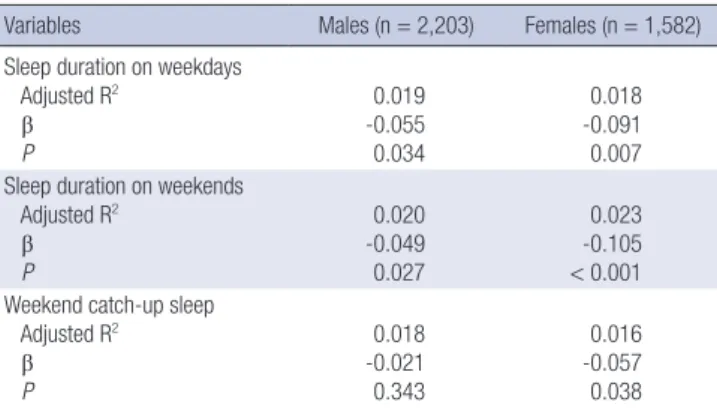
Table 3 presents the relationships between sleep duration and BMI in two groups divided by gender. In males, decreased weekday and weekend sleep durations were associated with high BMI (β = -0.055, P = 0.034; β = -0.049, P = 0.027; β = -0.021, respectively). Weekend catch-up sleep duration was not associ- ated with BMI (β = -0.021, P = 0.343).
In females, decreased weekday and weekend sleep durations were associated with high BMI (β = -0.091, P = 0.007; β = -0.105, P < 0.001, respectively). Moreover, increased weekend catch-up sleep was also associated with low BMI (β = -0.057, P = 0.038).
DISCUSSION
In present study, we found that adolescents with longer week- day and weekend sleep durations tended to have lower BMI.
Moreover, females with longer durations of weekend catch-up sleep tended to have lower BMI.
Several studies have investigated the relationship between sleep duration and being overweight (9,10,20). Our results are consistent with these previous studies. In a study of European adolescents, shorter sleep duration was associated with higher levels of adiposity markers including BMI, body fat, and waist circumferences (21). In the study of Norwegian adolescents, short sleep is associated with BMI, but the association was stron- ger in girls similarly to our results (22). Another study focused on the effect of weekend sleep compensation on weight with the results that increased weekend catch-up sleep may reduce the risk of overweight and obesity (23), which were partially con- sistent with the present results.
In spite of the fact that previous studies have been conduct- ed, there has been few research controlling for academic factors and depressed mood. The association between depression and sleep duration cannot be neglected due to the relatively high prevalence of depression among adolescents (11). A meta-anal- ysis of longitudinal studies reported the relationship between obesity and depression (15). Therefore, it is essential to investi- gate the relationship between sleep duration and BMI while adjusting for depressed mood. The current study may differ from those in that we focused on controlling for confounding factors that may affect both sleep duration and BMI in adoles- cents, such as time spent at private tutoring institutes, academic performance, socioeconomic factors, and BDI as a measure of depressed mood.
The relationship between short sleep duration and increased BMI may be explained by eating habits. Sleep restriction also affect adolescent by increasing appetite of sweet desserts which can contribute to body weight (24). In addition, students who sleep less tend to skip breakfast and this is also reported to be associated with an increase in BMI (25).
Furthermore, disturbances to natural circadian rhythms due to insufficient sleep may be another explanation for the link be- Table 3. The association between sleep duration and BMI for participants divided by
gender
Variables Males (n = 2,203) Females (n = 1,582)
Sleep duration on weekdays Adjusted R2
β P
0.019 -0.055 0.034
0.018 -0.091 0.007 Sleep duration on weekends
Adjusted R2 β P
0.020 -0.049 0.027
0.023 -0.105
< 0.001 Weekend catch-up sleep
Adjusted R2 β P
0.018 -0.021 0.343
0.016 -0.057 0.038 Multiple linear regression; Dependent variables: BMI; Independent variables: age, BDI, economic status, academic performance, time spent at private tutoring institutes.
BMI = Body Mass Index, BDI = Beck Depression Inventory.
tween sleep duration and BMI. Recent investigation suggests that habitual variation of sleep rhythms is associated with in- creased food consumption and disrupted metabolism (26). Ab- normal sleep patterns change circadian body clocks and con- tribute to greater variation in circulating levels of nutrients and hormones. As a result of this variation at the molecular level, subsequent changes to mechanisms involving adipocytes may lead to greater weight gain (27). Moreover, other studies have shown that longer sleep duration has a physiological effect on leptin, which is a hormone involved in the control of appetite (28). Longer sleep duration reduces nighttime eating habits and helps the metabolism to function well, which may explain the association between sleep duration and BMI.
We found gender differences in sleep duration. On weekdays, males slept for an average of 7.16 hours, and the females slept less, for an average of 6.86 hours in the present study. Meanwhile, males slept for 8.78 hours on weekends and females slept slight- ly more—8.97 hours. Other research that analyzed sleep dura- tion using time diaries reported similar results, indicating that females slept less on weekdays but more on weekends compared with males (29). They spend more time dressing and applying make-up and consequently have to get up earlier in the morn- ing, thereby exacerbating the sleep deficit on school days.
Gender differences were also found in the association be- tween sleep duration and BMI. Our results showed that week- end catch-up sleep was negatively associated with BMI for fe- males, but not for males. It is consistent with prior result (30).
There can be several possible reasons for this result. It is known that insufficient sleep heightens the activity of stress system (31). Stress may influence eating behavior and it also stimulates the production of a cortisol hormone that is related to obesity (32). Shorter sleep on weekdays in females may result in height- ened stress system. Longer weekend catch-up sleep may have played a critical role in reducing stress. This effect is thought to be why longer weekend catch-up sleep is negatively related to low BMI. However males slept relatively longer on weekdays, thereby causing less avidity of stress system due to sleep depri- vation, in addition to being generally more tolerant of stress than females (33). Moreover, the strongest gender differences among adolescents may be apparently derived from the effects of sex steroid hormones, which affect both metabolism and sleep quality (34,35). These hormonal differences may underlie the gender difference in the association between weekend catch- up sleep and BMI.
In contrast to this compensatory effect of weekend catch-up sleep on BMI in female adolescensts, some studies suggest that weekend catch-up sleep cannot mitigate the risk of psychologi- cal problem. In these studies, increased weekend catch-up sleep as an indicator of insufficient weekday sleep was associated with poor performance on attention tasks and with an increased risk of suicidality among adolescents (14,36). This suggests that there
may be important differences between the psychological and physical effects of insufficient sleep in adolescence such that short term sleep compensation may be effective in promoting recovery related to the physical metabolism, but not to psycho- logical problems.
This study has several limitations. First, the information on sleep duration gathered was by self-reported questionnaire rath- er than by objective measurement. Hence, we cannot rule out the possibility of recall bias. Second, our questionnaire did not address naps or daytime sleep. It would be helpful to design a questionnaire to take this issue into account. Third, height, wei- ght, and information on socioeconomic status was self-report- ed. This information may be considered to be sensitive to ado- lescents. Objective measures of height and weight would allow for greater precision and accuracy. In addition, information on socioeconomic status by parents would be more accurate.
Despite these limitations, the present study makes a valuable research contribution due to its presentation of data from a large number of participants. The association between BMI and sleep duration (divided into weekdays, weekends and catch-up sleep on weekends) is analyzed by gender. Moreover, this study ad- justs for time at private tutoring institutes, academic performance, socioeconomic factors, and BDI as significant confounders.
In conclusion, longer sleep durations on weekdays and week- ends in adolescents were associated with lower BMI while ad- justing for the confounding factors. Moreover, longer duration of weekend catch-up sleep correlates with decreased BMI for female adolescents. Weekend catch-up sleep may compensate effects of insufficient sleep on BMI for female adolescents.
DISCLOSURE
The authors have no potential conflicts of interest to disclose.
AUTHOR CONTRIBUTION
Study design and protocol: Lee YJ. Literature searches: Kang SG, Choi JW. Statistical analysis: Lee BH. Writing: Lee BH, Choi JW. Agreeing with manuscript results and conclusions: all au- thors.
ORCID
Ban Hyung Lee http://orcid.org/0000-0003-1629-9345 Seung-Gul Kang http://orcid.org/0000-0003-4933-0433 Jae-Won Choi http://orcid.org/0000-0002-4253-126X Yu Jin Lee http://orcid.org/0000-0001-5195-2579 REFERENCES
1. Kopelman PG. Obesity as a medical problem. Nature 2000; 404: 635-43.
2. Kosti RI, Panagiotakos DB. The epidemic of obesity in children and ado- lescents in the world. Cent Eur J Public Health 2006; 14: 151-9.
3. Lobstein T, Baur L, Uauy R; IASO International Obesity Task Force. Obe- sity in children and young people: a crisis in public health. Obes Rev 2004;
5 Suppl 1: 4-104.
4. Kim SH, Song YH, Park S, Park MJ. Impact of lifestyle factors on trends in lipid profiles among Korean adolescents: the Korea National Health and Nutrition Examination Surveys study, 1998 and 2010. Korean J Pediatr 2016; 59: 65-73.
5. Ogden CL, Carroll MD, Lawman HG, Fryar CD, Kruszon-Moran D, Kit BK, Flegal KM. Trends in obesity prevalence among children and adoles- cents in the United States, 1988-1994 through 2013-2014. JAMA 2016;
315: 2292-9.
6. Park YS, Lee DH, Choi JM, Kang YJ, Kim CH. Trend of obesity in school age children in Seoul over the past 23 years. Korean J Pediatr 2004; 47:
247-57.
7. Chang GY, Kim KH. The lifetime of Korean youth and their lifestyle. J Fu- ture Oriented Youth Soc 2009; 6: 139-55.
8. Hwang Y. Why do South Korean students study hard? Reflections on Paik’s study. Int J Educ Res 2001; 35: 609-18.
9. Padez C, Mourao I, Moreira P, Rosado V. Long sleep duration and child- hood overweight/obesity and body fat. Am J Hum Biol 2009; 21: 371-6.
10. Mitchell JA, Rodriguez D, Schmitz KH, Audrain-McGovern J. Sleep dura- tion and adolescent obesity. Pediatrics 2013; 131: e1428-34.
11. Ryoo KY, Shin YK, Eun BL, Park SH, Tocko YC. Adolescent depression in a provincial city. J Korean Pediatr Soc 2000; 43: 172-8.
12. Bjørngaard JH, Carslake D, Lund Nilsen TI, Linthorst AC, Davey Smith G, Gunnell D, Romundstad PR. Association of body mass index with de- pression, anxiety and suicide-an instrumental variable analysis of the HUNT study. PLoS One 2015; 10: e0131708.
13. Sanders RH, Han A, Baker JS, Cobley S. Childhood obesity and its physi- cal and psychological co-morbidities: a systematic review of Australian children and adolescents. Eur J Pediatr 2015; 174: 715-46.
14. Lee YJ, Cho SJ, Cho IH, Kim SJ. Insufficient sleep and suicidality in ado- lescents. Sleep 2012; 35: 455-60.
15. Mannan M, Mamun A, Doi S, Clavarino A. Prospective associations be- tween depression and obesity for adolescent males and females-a sys- tematic review and meta-analysis of longitudinal studies. PLoS One 2016;
11: e0157240.
16. Mendelson M, Borowik A, Michallet AS, Perrin C, Monneret D, Faure P, Levy P, Pépin JL, Wuyam B, Flore P. Sleep quality, sleep duration and phys- ical activity in obese adolescents: effects of exercise training. Pediatr Obes 2016; 11: 26-32.
17. Höglund D, Samuelson G, Mark A. Food habits in Swedish adolescents in relation to socioeconomic conditions. Eur J Clin Nutr 1998; 52: 784-9.
18. Drewnowski A, Specter SE. Poverty and obesity: the role of energy density and energy costs. Am J Clin Nutr 2004; 79: 6-16.
19. Hahn HM, Yeom TH, Shin YW, Kim KH, Yoon DJ, Chung KJ. A standard- ization study of Beck depression inventory in Korea. J Korean Neuropsy- chiatr Assoc 1986; 25: 487-500.
20. Jean-Louis G, Williams NJ, Sarpong D, Pandey A, Youngstedt S, Zizi F, Oge- degbe G. Associations between inadequate sleep and obesity in the US adult population: analysis of the national health interview survey (1977-
2009). BMC Public Health 2014; 14: 290.
21. Garaulet M, Ortega FB, Ruiz JR, Rey-López JP, Béghin L, Manios Y, Cuen- ca-García M, Plada M, Diethelm K, Kafatos A, et al. Short sleep duration is associated with increased obesity markers in European adolescents:
effect of physical activity and dietary habits. The HELENA study. Int J Obes 2011; 35: 1308-17.
22. Sivertsen B, Pallesen S, Sand L, Hysing M. Sleep and body mass index in adolescence: results from a large population-based study of Norwegian adolescents aged 16 to 19 years. BMC Pediatr 2014; 14: 204.
23. Wing YK, Li SX, Li AM, Zhang J, Kong AP. The effect of weekend and holi- day sleep compensation on childhood overweight and obesity. Pediat- rics 2009; 124: e994-1000.
24. Simon SL, Field J, Miller LE, DiFrancesco M, Beebe DW. Sweet/dessert foods are more appealing to adolescents after sleep restriction. PLoS One 2015; 10: e0115434.
25. Timlin MT, Pereira MA, Story M, Neumark-Sztainer D. Breakfast eating and weight change in a 5-year prospective analysis of adolescents: Proj- ect EAT (Eating Among Teens). Pediatrics 2008; 121: e638-45.
26. He F, Bixler EO, Berg A, Imamura Kawasawa Y, Vgontzas AN, Fernandez- Mendoza J, Yanosky J, Liao D. Habitual sleep variability, not sleep dura- tion, is associated with caloric intake in adolescents. Sleep Med 2015; 16:
856-61.
27. Bray MS, Young ME. Circadian rhythms in the development of obesity:
potential role for the circadian clock within the adipocyte. Obes Rev 2007;
8: 169-81.
28. Taheri S, Lin L, Austin D, Young T, Mignot E. Short sleep duration is asso- ciated with reduced leptin, elevated ghrelin, and increased body mass index. PLoS Med 2004; 1: e62.
29. Knutson KL, Lauderdale DS. Sleep duration and overweight in adoles- cents: self-reported sleep hours versus time diaries. Pediatrics 2007; 119:
e1056-62.
30. Kim CW, Choi MK, Im HJ, Kim OH, Lee HJ, Song J, Kang JH, Park KH. Week- end catch-up sleep is associated with decreased risk of being overweight among fifth-grade students with short sleep duration. J Sleep Res 2012;
21: 546-51.
31. Vgontzas AN, Tsigos C, Bixler EO, Stratakis CA, Zachman K, Kales A, Vela- Bueno A, Chrousos GP. Chronic insomnia and activity of the stress sys- tem: a preliminary study. J Psychosom Res 1998; 45: 21-31.
32. Rosmond R, Dallman MF, Björntorp P. Stress-related cortisol secretion in men: relationships with abdominal obesity and endocrine, metabolic and hemodynamic abnormalities. J Clin Endocrinol Metab 1998; 83: 1853-9.
33. Leal L, Weise SM, Dodd DK. The relationship between gender, symptoms of bulimia, and tolerance for stress. Addict Behav 1995; 20: 105-9.
34. Sowers MF, Zheng H, Kravitz HM, Matthews K, Bromberger JT, Gold EB, Owens J, Consens F, Hall M. Sex steroid hormone profiles are related to sleep measures from polysomnography and the Pittsburgh Sleep Quality Index. Sleep 2008; 31: 1339-49.
35. Agirbasli M, Agaoglu NB, Orak N, Caglioz H, Ocek T, Poci N, Salaj A, Maya S. Sex hormones and metabolic syndrome in children and adolescents.
Metabolism 2009; 58: 1256-62.
36. Kim SJ, Lee YJ, Cho SJ, Cho IH, Lim W, Lim W. Relationship between week- end catch-up sleep and poor performance on attention tasks in Korean adolescents. Arch Pediatr Adolesc Med 2011; 165: 806-12.