Trends and Patterns of Hepatocellular Carcinoma Treatment in Korea
Multiple therapeutic modalities are available for hepatocellular carcinoma (HCC) treatment.
We aimed to evaluate the trends for HCC treatment in Korea. Recent trends and patterns in treatment modalities were assessed in HCC patients who first registered for the Health Insurance Review Assessment Service between 2008 and 2012. From 2009 to 2012, 57,690 patients were diagnosed with HCC. Transcatheter arterial chemoembolization (TACE) was the most common treatment modality for initial treatment. Curative treatment modalities like hepatic resection, liver transplantation, and local ablation therapy increased gradually.
The 3 most common treatment modalities (hepatic resection, local ablation therapy, TACE) used after initial treatment in 2009 were studied. Following initial hepatic resection, 44.5% of patients required re-treatment. TACE was the most common modality (in 48.3%
of cases), while 15.0% of patients received local ablation therapy. After local ablation therapy, 55.4% of patients were re-treated, wherein 45.0% of patients received TACE and 31.5% received local ablation therapy. Following initial TACE, 73.9% patients were re- treated, most commonly with TACE (57.7%) followed by local ablation therapy (12.8%).
While there were no significant differences between the initial and re-treatment modalities, various multiple treatments followed the initial treatment. The treatment modalities were interchangeable.
Keywords: Carcinoma; Hepatocellular; Treatment; Trend; Korea Young Mi Hong,1 Ki Tae Yoon,1
Mong Cho,1 Dae Hwan Kang,1 Hyung Wook Kim,1 Cheol Woong Choi,1 Su Bum Park,1 Jeong Heo,2
Hyun Young Woo,2 and Won Lim2
1Department of Internal Medicine, Research Institute for Convergence of Biomedical Science and Technology, Pusan National University Yangsan Hospital, Yangsan, Korea; 2Department of Internal Medicine, Pusan National University Hospital, Busan, Korea
Received: 23 September 2015 Accepted: 9 November 2015 Address for Correspondence:
Ki Tae Yoon, MD
Department of Internal Medicine, Pusan National University School of Medicine, Pusan National University Yangsan Hospital, 20 Geumo-ro, Mulgeum-eup, Yangsan 50612, Korea E-mail: [email protected]
http://dx.doi.org/10.3346/jkms.2016.31.3.403 • J Korean Med Sci 2016; 31: 403-409
INTRODUCTION
Hepatocellular carcinoma (HCC) is the fifth most common can- cer and the third leading cause of cancer-related deaths world- wide (1,2). In Korea, HCC is the fourth and sixth most common cancer in men and women, respectively, and over 15,000 new cases occurred in 2009 (3). HCC accounts for 75%-90% of all primary liver cancers (3-5). HCC was the second leading cause of cancer mortality in Korea, but the overall 5-year survival rate of HCC patients has improved from 10.7% to 28.6% in 2013, ac- cording to the national cancer center (6).
There are various treatment options for HCC. The proportion of patients undergoing curative therapies including hepatic re- section, liver transplantation, and locoregional therapy has been increasing over the last decade. Several studies have demon- strated that transarterial chemoembolization (TACE) improves the survival rate (7,8). Radiotherapy for HCC has become more common as radiation technology has developed rapidly and high-dose radiotherapy without broad liver damage became available. The introduction of sorafenib, which lengthened sur- vival, opened a new era of chemotherapy for HCC patients (9,10).
The treatment of HCC is very complicated since HCC is het- erogeneous and treatable by various modalities in the same stage.
The Barcelona Clinic Liver Cancer staging system, which is used
commonly, is helpful for conceptualizing the different treatment options, but may not be applicable in all settings. Moreover, the Barcelona Clinic Liver Cancer staging system guideline is only for initial treatment. There are no re-treatment guidelines for HCC patients.
There is no large-scale population-based study on HCC treat- ment trends. We aimed to assess the trends of initial treatment and re-treatment modalities for Korean HCC patients on the basis of data taken from national data from the Health Insurance Review and Assessment Service (HIRA) between 2008 and 2012.
MATERIALS AND METHODS Data source
We used data from the Korean HIRA, which includes adjusted medical and pharmacy claims for almost the whole Korean pop- ulation. Korea has a health care system that is managed and su- pervised by the government; 97.0% of the population is legally obliged to register in the Korean National Health Insurance Pro- gram. All medical clinics and hospitals must submit data of in- patients’ and outpatients’ care, including diagnoses (coded ac- cording to the International Classification of Disease, Tenth Re- vision [ICD-10]), procedures, prescription records, demograph- ic information, and direct medical costs, to HIRA to claim back
medical costs from the government.
Patient selection
All HCC-related hospital visits or admissions were recorded in the aforementioned system using ICD-10 codes between Janu- ary 2008 and December 2012. To identify newly diagnosed HCC patients, ICD-10 codes (C220) were selected and patients with previously diagnosed HCC were excluded.
Data analysis
Data regarding age, gender, etiology, and underlying liver cir- rhosis were ascertained by a medical records’ review. The an- nual incidence was determined using the aforementioned pa- tient selection criteria and the annual HCC prevalence was de- fined as the number of patients who retained the C220 code for 1 year. The following 3 institutional types were defined accord- ing to the national medical law: the clinic was defined as a facil- ity with more than 30 beds, the general hospital was defined as a facility with more than 100 beds and a certain number of ex- perts, and the tertiary hospital was defined as a general hospital with highly trained medical practitioners specializing in severe diseases.
Patients received 1 of the following treatments: hepatic resec- tion, liver transplantation, radiofrequency ablation (RFA) ther- apy, percutaneous ethanol injection, transarterial chemoem- bolization (TACE) therapy, hepatic artery chemoinfusion ther- apy, external-beam radiation therapy, systemic cytotoxic che- motherapy, molecular-targeted therapy (sorafenib), and con- servative management. All hospitals and clinics were listed in the HIRA database and used the same procedure, medicine, and surgery codes. The initial treatment modality was defined as the first treatment modality after diagnosis and was analyzed annually. Combination treatment was defined as 2 different treat- ment modalities administered within 30 days.
Treatment trends after initial treatment were only available from 2009 because HIRA only provided data for the most recent 5 years and analysis was performed according to the 3 most com- mon modalities (hepatic resection, liver transplantation, and local ablation therapy). The follow-up period was 3-4 years.
Subgroup analysis of sorafenib therapy was performed in 2011 and 2012. The initial doses, 800 mg and 400 mg, were analyzed separately. The mean daily dose was calculated by dividing the total administration dose by the total number of patients and days. The median treatment duration was analyzed using each patient’s total prescription days.
Ethics statement
The study was reviewed and approved by the institutional review board of Pusan National University Yangsan Hospital (PNUYH 05-2015-063). Informed consent was waived by the board.
RESULTS
From January 2009 to December 2012, 57,690 persons were newly diagnosed with HCC, which constituted the final study population. During the study period, the annual incidence of HCC was approximately 14,000 cases per year and did not sig- nificantly change over time, while the prevalence gradually in- creased (Table 1).
The mean age was the late fifties (57-60 years) and the major- ity of the patients were men. More than half of the patients were diagnosed in tertiary hospitals. The main etiology of HCC was hepatitis B virus (HBV) infection (47.9%-50.2%) and this propor- tion did not significantly change over time. Half of the patients had accompanying liver cirrhosis. Overall, the extrahepatic me- tastasis rate was about 10% and the most common site was the lung, followed by the bones and the lymph nodes (Table 2).
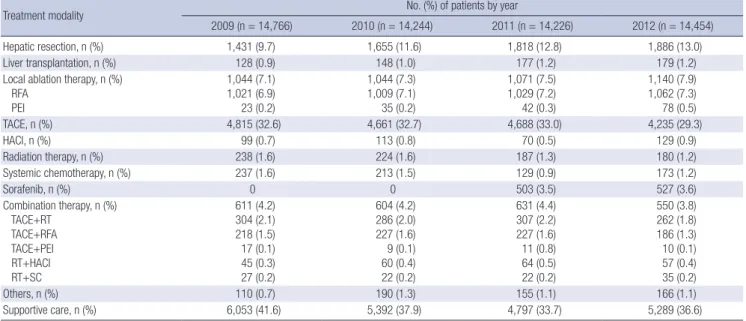
The initial treatment was usually performed in tertiary hospi- tals (approximately 70%) and there was no significant change during the study period. However, more patients visited tertiary hospitals after the diagnosis. The median period from diagnosis to initial treatment was 22 days (range 14-36 days). TACE was the most common initial treatment modality (29.3%-33.0%).
The use of curative treatment modalities (hepatic resection, liv- er transplantation, and local ablation therapy) gradually increas- ed from 17.6%-17.7% during the study period. Sorafenib thera- py has been used in about 3.5% of HCC patients since 2011.
Combination treatment accounted for about 4% of patients ev- ery year, and TACE plus radiotherapy and TACE plus RFA were performed commonly. The patients who did not receive treat- ment decreased over time, after the diagnosis (Table 3).
Re-treatment trends were evaluated in HCC patients who first received treatment in 2009 (Fig. 1). In patients who under- went hepatic resection initially, 44.5% of patients received the same or other treatments over the study period. The most com- mon treatment modality was TACE (48.3%), followed by local ablation therapy (15.0%) and radiotherapy (14.4%). Hepatic re- section was repeated in 6.8% of patients. In patients initially treated with local ablation therapy, 54.4% of patients received re-treatments during the study period. The most common mo- dality was TACE (45.0%), followed by local ablation therapy (31.5%) and radiotherapy (8.4%). Hepatic resection was per- formed in 5.3% of patients. In patients initially treated with TACE, 73.9% of patients were re-treated and the most common mo-
Table 1. Incidence and prevalence rates (per 100,000 people per year) of hepatocel- lular carcinoma
Incidence/prevalence 2009 2010 2011 2012
Incidence,
n (per 100,000) 14,766 (29.7) 14,244 (28.5) 14,226 (28.1) 14,454 (28.4) Prevalence,
n (per 100,000) 40,908 (82.4) 43,176 (86.4) 45,292 (89.4) 49,221 (96.8)
Table 2. Demographic features of newly diagnosed hepatocellular carcinoma patients
Parameters No. (%) of patients by year
2009 2010 2011 2012
Age, mean (standard deviation) 57 (11) 58 (12) 58 (10) 60 (8)
Gender, n (%) Men
Women 11,108 (75.2)
3,658 (24.8) 10,743 (75.4)
3,501 (24.6) 10,873 (76.4)
3,353 (23.6) 11,042 (76.4)
3,412 (23.6) Etiology, n (%)
Hepatitis B virus Hepatitis C virus Alcohol Fatty liver Others
7,118 (48.2) 1,561 (10.6) 1,449 (9.8)
258 (1.7) 4,380 (29.7)
6,926 (48.6) 1,430 (10.0) 1,435 (10.1) 202 (1.4) 4,251 (29.9)
7,148 (50.2) 1,516 (10.7) 1,544 (10.9) 177 (1.2) 3,841 (27.0)
6,926 (47.9) 1,532 (10.6) 1,600 (11.1) 247 (1.7) 4,149 (28.7)
Liver cirrhosis, n (%) 6,350 (43.0) 6,325 (44.4) 6,486 (45.6) 6,818 (47.2)
Extrahepatic metastasis, n (%) Lung
Bone Lymph node Adrenal gland Brain
586 (4.0) 464 (3.1) 276 (1.9) 50 (0.3)
-
593 (4.2) 454 (3.2) 271 (1.9) 48 (0.3) 11 (0.1)
593 (4.2) 433 (3.0) 252 (1.8) 52 (0.4) 71 (0.5)
574 (4.0) 405 (2.8) 244 (1.7) 45 (0.3) 59 (0.4) Institution, n (%)
Tertiary hospital General hospital Clinic
8,093 (54.8) 5,902 (40.0) 771 (5.2)
7,855 (55.2) 5,699 (40.0) 690 (4.8)
7,705 (54.2) 5,768 (40.6) 753 (5.3)
8,050 (55.7) 5,686 (39.3) 718 (5.0)
Table 3. Initial treatment modalities
Treatment modality No. (%) of patients by year
2009 (n = 14,766) 2010 (n = 14,244) 2011 (n = 14,226) 2012 (n = 14,454)
Hepatic resection, n (%) 1,431 (9.7) 1,655 (11.6) 1,818 (12.8) 1,886 (13.0)
Liver transplantation, n (%) 128 (0.9) 148 (1.0) 177 (1.2) 179 (1.2)
Local ablation therapy, n (%) RFA
PEI
1,044 (7.1) 1,021 (6.9) 23 (0.2)
1,044 (7.3) 1,009 (7.1) 35 (0.2)
1,071 (7.5) 1,029 (7.2) 42 (0.3)
1,140 (7.9) 1,062 (7.3) 78 (0.5)
TACE, n (%) 4,815 (32.6) 4,661 (32.7) 4,688 (33.0) 4,235 (29.3)
HACI, n (%) 99 (0.7) 113 (0.8) 70 (0.5) 129 (0.9)
Radiation therapy, n (%) 238 (1.6) 224 (1.6) 187 (1.3) 180 (1.2)
Systemic chemotherapy, n (%) 237 (1.6) 213 (1.5) 129 (0.9) 173 (1.2)
Sorafenib, n (%) 0 0 503 (3.5) 527 (3.6)
Combination therapy, n (%) TACE+RT
TACE+RFA TACE+PEI RT+HACI RT+SC
611 (4.2) 304 (2.1) 218 (1.5) 17 (0.1) 45 (0.3) 27 (0.2)
604 (4.2) 286 (2.0) 227 (1.6) 9 (0.1) 60 (0.4) 22 (0.2)
631 (4.4) 307 (2.2) 227 (1.6) 11 (0.8) 64 (0.5) 22 (0.2)
550 (3.8) 262 (1.8) 186 (1.3) 10 (0.1) 57 (0.4) 35 (0.2)
Others, n (%) 110 (0.7) 190 (1.3) 155 (1.1) 166 (1.1)
Supportive care, n (%) 6,053 (41.6) 5,392 (37.9) 4,797 (33.7) 5,289 (36.6)
RFA, radiofrequency ablation; TACE, transarterial chemoembolization; HACI, hepatic artery chemoinfusion; PEI, percutaneous ethanol injection; RT, radiation therapy; SC, syste- mic chemotherapy.
dality was TACE (57.7%), followed by local ablation therapy (12.8%) and radiotherapy (11.8%). TACE was performed 0.8 times/year. Hepatic resection was performed in 6.2% of patients who initially underwent TACE.
Sorafenib has been used widely since 2011, when the reim- bursement policy was applied. In 2011 and 2012, the majority of HCC patients received sorafenib in the general or tertiary hos- pitals. About 25% of patients had extrahepatic metastases. The majority of patients received the standard dose of 800 mg (81%).
The mean daily doses were 667 mg and 680 mg in 2011 and 2012,
respectively. The median treatment durations were 10.7 weeks and 8.7 weeks, respectively (Table 4).
DISCUSSION
This study is a nationwide cross-sectional study undertaken to evaluate the trends and patterns of HCC treatment in Korean patients. The prevalence of HCC has gradually increased from 40,908 in 2009 to 49,221 in 2012. The increasing prevalence of HCC seems to be caused by the increased survival time of Ko-
rean HCC patients according to the national cancer registry’s report (6).
The etiology of HCC was mostly HBV infection. HBV infec- tion caused 50%, while hepatitis C virus infection and alcohol caused 11% and 10%-11% of HCCs, respectively. The propor- tion of cases accounted for by HBV infection was lower than that reported by other studies (11,12). However, considering that the etiology for about 30% of cases was not known and that
HBV infection accounted for about 50% of the cases reported in this study, this study is not different from other reports. Extra- hepatic metastases of HCC occurred in 9%-10% of the patients and HCC frequently spread to the lungs, bones, lymph nodes, adrenal glands, and brain. The rate of metastasis was lower than that in other reports; about 30%-50% of patients presented with metastases (13). The lower rate might be due to lower recording as a result of physicians’ unawareness of clinically insignificant Fig. 1. Treatment trends after initial treatment in 2009. Treatment trends after initial treatment were analyzed for 3 of the most common initial treatment modalities (hepatic re- section, local ablation therapy, and transarterial chemoembolization [TACE]).
Hepatic resection
No treatment TACE
Local ablation therapy Radiotherapy Hepatic resection Others
55.5% 48.3%
44.5%
15%
14.4%
6.8%
15.5%
Initial treatment Retreatment
Local ablation therapy
No treatment TACE
Local ablation therapy Radiotherapy Hepatic resection Others 45.6%
45%
54.4% 31.5%
8.4%
9.8%5.3%
Initial treatment Retreatment
TACE
No treatment TACE
Local ablation therapy Radiotherapy Hepatic resection Others 26.1%
57.7%
73.9%
12.8%
11.8%
11.5%6.2%
Initial treatment Retreatment
metastatic lesions.
Initial treatment seems to start early in Korea. The period from diagnosis to initial treatment was 14-36 days. The majority of patients received initial treatment within 30 days of diagnosis.
The proportion of patients who received curative treatments (hepatic resection, liver transplantation, local ablation therapy) increased slightly from 17.7% in 2009 to 22.1% in 2012. At the same time, the proportion of patients who received supportive care decreased during the study period, from 41.6% to 36.6%.
The increase in curative treatment is probably caused by earlier HCC detection due to physicians’ awareness of HCC surveil- lance in high-risk patients and the nationwide check-up pro- gram.
TACE was the most common modality for initial treatment in Korea and is used more frequently than in other countries (14).
Generally, single drug chemotherapy was used with TACE. Dox- orubicin accounted for 80% and cisplatin for 15% of cases. TACE with 3 chemotherapeutic agents is routinely administered in other countries and a recent large randomized controlled trial showed that TACE with 3 chemotherapeutic agents increased the overall survival (15). The reimbursement policy permits the use of only 1 chemotherapeutic agent in Korea, which possibly led to a different practice environment.
Combination treatments accounted for about 4% of cases ev- ery year. TACE plus radiotherapy and TACE plus RFA were per- formed commonly. Combination therapies are expected to in- crease based on several recent studies, which report that com- bination therapies including TACE plus radiotherapy, showed better results for advanced HCC patients compared to mono- therapy and combination of TACE with RFA could improve the survival rate (16).
A small proportion of HCC patients received systemic cyto- toxic chemotherapy. The most frequently used monotherapeu- tic agent was 5-fluorouracil. Combination therapy with 5-fluo- rouracil and cisplatin, or cisplatin and gemcitabine was used most frequently. These chemotherapeutic agents have not dem- onstrated efficacy in HCC, although they reportedly increased Table 4. Subgroup analysis of sorafenib administration in 2011 and 2012
Parameters No. (%) of patients by year
2011 (n = 503) 2012 (n = 526) Age, mean (standard deviation) 57 (11) 56 (10)
Men, n (%) 435 (86.5) 434 (82.5)
Institution, n (%) Tertiary hospital General hospital Clinic
275 (54.67) 210 (41.74) 18 (3.57)
296 (56.3) 207 (39.2) 24 (4.5)
Liver cirrhosis, n (%) 126 (25.0) 165 (31.4)
Initial dose of 800 mg, n (%) 408 (81.1) 427 (81.2) Initial dose of 400 mg, n (%) 72 (14.3) 81 (15.4)
Mean daily dose, mg 667 680
Median treatment duration, weeks 10.7 8.7
survival time in several solid gastrointestinal tumors. Physicians still seemed to prefer systemic chemotherapy for treatment-re- fractory advanced HCC patients. This practice lasted until 2012, even after sorafenib, an effective molecular-target agent, was introduced in Korea. This study did not show whether systemic chemotherapies were administered in patients who were sora- fenib-naïve or sorafenib-refractory.
Sorafenib, a molecular target therapy, was introduced in 2007 in Korea, while the reimbursement policy has been implement- ed since 2011. According to the reimbursement policy data, sora- fenib accounted for about 3.5% of all treated patients in 2011 and 2012. Subsequently, sorafenib use has presumably become more common due to the expanded reimbursement policy in force since 2013.
In HCC patients, there are several treatment modalities that are curative or palliative. The curative treatment modalities are hepatic resection, liver transplantation and locoregional abla- tion therapy. Unlike other solid gastrointestinal tumors, multi- ple treatments are administered to HCC patients, and treatment modalities are not hierarchical. They can be used interchange- ably in the same patients. Although there are several guidelines for the treatment of HCC patients, they are limited to initial treat- ment. There is no study about how often and which treatment modalities are selected after initial therapy. Ignoring treatment modalities following initial treatment in HCC patients may lead to confusing results, as many studies that compared curative treatment modalities have demonstrated (17,18). The re-treat- ment rate was much lower in patients who initially underwent curative treatments such as hepatic resection and local ablation therapy than in patients who received TACE, a palliative treat- ment. TACE was the most common re-treatment modality re- gardless of the initial treatment modality. In a significant pro- portion of HCC patients, re-treatment modalities were selected interchangeably with the first treatment modalities, regardless of whether they were curative or palliative treatments. This study demonstrated the overall pattern of re-treatments 3-4 years af- ter initial treatment.
On analysis of sorafenib administration, we found that the majority of patients had received sorafenib in general or tertiary hospitals consistent with the institutional pattern of initial treat- ment; however, long-term follow-up was not possible. Most (70%-90%) HCC cases are known to involve underlying liver cirrhosis (19), but in the present report, only 25% and 31% of HCC cases were accompanied by liver cirrhosis in 2011 and 2012, respectively. The lower rate is believed to be because of the enrolled patients’ criteria, as unlike other studies, only Child Pugh-A patients were enrolled in this study. The majority of pa- tients received the recommended initial dose (800 mg) and mean daily dose (about 680 mg) of sorafenib. Thus, the majority of Korean physicians have tried to administer the recommended dose during HCC treatment. The median treatment duration in
our study was relatively shorter than that in Child-Pugh A pa- tients, as reported in the final analysis of the global investiga- tion of therapeutic decisions in HCC and of its treatment with sorafenib (20). This can be explained by a limited follow-up pe- riod in our study.
There are some limitations to this population-based study.
First, the HIRA database provided limited information about the patients. Because the available data are age, gender, year, diagnostic code, procedure code, and medication code, we could not identify associated diseases and treatment methods, such as combination treatment, accurately by reviewing medical re- cords. It is possible that clinicians had missed final diagnosis records such as underlying disease or extrahepatic metastasis sites. Second, the incidence of HCC may have been overesti- mated. Cases for 5 years (January 2008-December 2012) were obtained from the HIRA database. Although we excluded the same patient prior to the patient’s registration during the study period, we could not isolate the first diagnosed patients accu- rately, because the 5-year overall survival rate of HCC is greater than 20%.
Even though we could not identify the patterns of re-treat- ment accurately and sequentially due to these limitations, our study may highlight the current situation of HCC treatment.
There are no data on re-treatment trends after initial treatment or for the entire population. Therefore, our study may provide new insights regarding the patterns and trends of HCC treat- ment.
DISCLOSURE
The authors have no potential conflicts of interest to disclose.
AUTHOR CONTRIBUTION
Conception & design of the study: Hong YM. Drafting: Yoon KT.
Acquisition, analysis, interpretation of the data: Choi CW, Park SB, Heo J, Woo HY, Lim W. Critical revisions of the manuscript:
Cho M, Kang DH, Kim HW. Approval of the final manuscript:
all authors.
ORCID
Young Mi Hong http://orcid.org/0000-0001-5427-7505 Ki Tae Yoon http://orcid.org/0000-0002-8580-0239 Mong Cho http://orcid.org/0000-0002-0498-6300
REFERENCES
1. Jemal A, Siegel R, Ward E, Hao Y, Xu J, Thun MJ. Cancer statistics, 2009.
CA Cancer J Clin 2009; 59: 225-49.
2. Ferlay J, Shin HR, Bray F, Forman D, Mathers C, Parkin DM. Estimates of
worldwide burden of cancer in 2008: GLOBOCAN 2008. Int J Cancer 2010;
127: 2893-917.
3. Jung KW, Won YJ, Park S, Kong HJ, Sung J, Shin HR, Park EC, Lee JS. Can- cer statistics in Korea: incidence, mortality and survival in 2005. J Korean Med Sci 2009; 24: 995-1003.
4. Ahmed F, Perz JF, Kwong S, Jamison PM, Friedman C, Bell BP. National trends and disparities in the incidence of hepatocellular carcinoma, 1998- 2003. Prev Chronic Dis 2008; 5: A74.
5. Kim SR, Kudo M, Hino O, Han KH, Chung YH, Lee HS; Organizing Com- mittee of Japan-Korea Liver Symposium. Epidemiology of hepatocellular carcinoma in Japan and Korea. A review. Oncology 2008; 75 Suppl 1: 13-6.
6. National Cancer Information Center [Internet]. Available at http://www.
cancer.go.kr/mbs/cancer/ [accessed on 20 August 2015].
7. Llovet JM, Real MI, Montaña X, Planas R, Coll S, Aponte J, Ayuso C, Sala M, Muchart J, Solà R, et al. Arterial embolisation or chemoembolisation ver- sus symptomatic treatment in patients with unresectable hepatocellular carcinoma: a randomised controlled trial. Lancet 2002; 359: 1734-9.
8. Lo CM, Ngan H, Tso WK, Liu CL, Lam CM, Poon RT, Fan ST, Wong J. Ran- domized controlled trial of transarterial lipiodol chemoembolization for unresectable hepatocellular carcinoma. Hepatology 2002; 35: 1164-71.
9. Llovet JM, Ricci S, Mazzaferro V, Hilgard P, Gane E, Blanc JF, de Oliveira AC, Santoro A, Raoul JL, Forner A, et al. Sorafenib in advanced hepato- cellular carcinoma. N Engl J Med 2008; 359: 378-90.
10. Cheng AL, Kang YK, Chen Z, Tsao CJ, Qin S, Kim JS, Luo R, Feng J, Ye S, Yang TS, et al. Efficacy and safety of sorafenib in patients in the Asia-Pa- cific region with advanced hepatocellular carcinoma: a phase III rando- mised, double-blind, placebo-controlled trial. Lancet Oncol 2009; 10: 25- 34.
11. The Korean Liver Cancer Study Group [Internet]. Available at http://www.
klcsg.or.kr/ [accessed on 20 August 2015].
12. Kwak HW, Park JW, Nam BH, Yu A, Woo SM, Kim TH, Kim SH, Koh YH, Kim HB, Park SJ, et al. Clinical outcomes of a cohort series of patients with hepatocellular carcinoma in a hepatitis B virus-endemic area. J Gastro- enterol Hepatol 2014; 29: 820-9.
13. Terada T, Maruo H. Unusual extrahepatic metastatic sites from hepato- cellular carcinoma. Int J Clin Exp Pathol 2013; 6: 816-20.
14. Park JW, Chen M, Colombo M, Roberts LR, Schwartz M, Chen PJ, Kudo M, Johnson P, Wagner S, Orsini LS, et al. Global patterns of hepatocellular carcinoma management from diagnosis to death: the BRIDGE Study.
Liver Int 2015; 35: 2155-66.
15. Shi M, Lu LG, Fang WQ, Guo RP, Chen MS, Li Y, Luo J, Xu L, Zou RH, Lin XJ, et al. Roles played by chemolipiodolization and embolization in che- moembolization for hepatocellular carcinoma: single-blind, randomized trial. J Natl Cancer Inst 2013; 105: 59-68.
16. Meng MB, Cui YL, Lu Y, She B, Chen Y, Guan YS, Zhang RM. Transcathe- ter arterial chemoembolization in combination with radiotherapy for un- resectable hepatocellular carcinoma: a systematic review and meta-anal- ysis. Radiother Oncol 2009; 92: 184-94.
17. Wang Y, Deng T, Zeng L, Chen W. Efficacy and safety of radiofrequency ablation and transcatheter arterial chemoembolization for treatment of hepatocellular carcinoma: a meta-analysis. Hepatol Res 2016; 46: 58-71.
18. Yang HJ, Lee JH, Lee DH, Yu SJ, Kim YJ, Yoon JH, Kim HC, Lee JM, Chung JW, Yi NJ, et al. Small single-nodule hepatocellular carcinoma: compari- son of transarterial chemoembolization, radiofrequency ablation, and hepatic resection by using inverse probability weighting. Radiology 2014;
271: 909-18.
19. Okuda H. Hepatocellular carcinoma development in cirrhosis. Best Pract Res Clin Gastroenterol 2007; 21: 161-73.
20. Marrero JA, Lencioni R, Ye SL, Kudo M, Bronowicki JP, Chen XP, Dagher L, Furuse J, Geschwind JF, de Guevara LL, et al. Final analysis of GIDEON
(Global Investigation of Therapeutic Decisions in Hepatocellular Carci- noma [HCC] and of Its Treatment with sorafenib [Sor]) in >3000 Sor-treat- ed patients (pts): clinical findings in patients with liver dysfunction. J Clin Oncol 2013; 31: abstr 4126.