Prevalence of and Risk Factors for Sexually Transmitted Infections among Korean Adolescents under Probation
There is limited research on sexually transmitted infections (STIs) among adolescents in Korea. The objective of this study was to explore the prevalence of and risk factors for STIs among Korean adolescents under probation. A cross-sectional analysis was conducted in one juvenile-delinquent center and five probation offices in Korea to determine the prevalence of STIs caused by the following pathogens: Chlamydia trachomatis, Neisseria gonorrhoeae, Trichomonas vaginalis, herpes simplex virus (HSV), human
immunodeficiency virus (HIV), Treponema pallidum, Mycoplasma hominis, Mycoplasma genitalium, Ureaplasma urealyticum, and Ureaplasma parvum. Of the 237 (208 male and 29 female) participating adolescents, 152 (64.1%) had a history of coitus. Overall, 133 (56.1%) subjects tested positive for at least one microorganism in their genitourinary tract.
The most prevalent pathogen was U. urealyticum (24.7%, n = 65), followed by U. parvum (24.1%, n = 57), M. hominis (17.3%, n = 41), C. trachomatis (13.9%, n = 33), N.
gonorrhoeae (1.7%, n = 4), T. vaginalis (0.8%, n = 2), and HSV (0.8%, n = 2). The prevalence of syphilis was 0.8% (n = 2). There were no reported cases of HIV infection.
Fifty-four participants (35.5%) were positive with more than two pathogens. We did not find any significant difference between STIs and socioeconomic factors, behavioral factors or sexual practices. In conclusion, the prevalence of STIs among adolescents under probation was high. Systematic screening programs, more practical sexual education, and adequate provision of treatment are essential for the prevention and management of STIs among adolescents, especially those under probation.
Keywords: Adolescent; Chlamydia trachomatis; Mycoplasma; Neisseria gonorrhoeae Jin Ju Park,1 Yu Bin Seo,1 Sookyung Jeong,2
and Jacob Lee1
1Division of Infectious Diseases, Department of Internal Medicine, Hallym University Kangnam Sacred Heart Hospital, Hallym University College of Medicine, Seoul, Korea; 2Department of Nursing, Ansan University, Ansan, Korea
Received: 23 May 2017 Accepted: 21 July 2017 Address for Correspondence:
Jacob Lee, MD, PhD
Division of Infectious Disease, Department of Internal Medicine, Hallym University Kangnam Sacred Heart Hospital, Hallym University College of Medicine, 1 Singil-ro, Yeongdeungpo-gu, Seoul 07441, Korea
E-mail: [email protected]
Funding: This work was supported by the Research Program funded by the Korea Centers for Disease Control & Prevention (grant number: 2014-E31001-00).
https://doi.org/10.3346/jkms.2017.32.11.1771 • J Korean Med Sci 2017; 32: 1771-1778
INTRODUCTION
It is estimated that, worldwide, half a billion new controllable sexually transmitted infections (STIs) such as syphilis, chlamyd- ia, and gonorrhoea occur annually, with the highest rates ob- served among young persons aged 20–24 years, followed by those aged 15–19 years (1,2). Adolescents are potentially at greater risk of STIs as they tend to have multiple sex partners and en- gage in unprotected intercourse using condoms inconsistently because of delayed or inadequate sex education (3,4). STIs can lead to serious health problems including ectopic pregnancy, pelvic inflammatory disease, infertility, congenital infection, and cervical carcinoma (1,5). Most infected adolescents do not seek treatment due to financial and time constraints (1,6). Thus, adolescents are more vulnerable to the complications of STIs;
this can affect public health.
Adolescents who attend correctional facilities tend to engage in risky sexual behaviours and do not readily engage with medi- cal services (7-9). The United States’ Centers for Disease Control and Prevention (CDC) estimated that the prevalence of chlamyd- ial infection was 15.7% among female adolescents and 7.4%
among male adolescents in juvenile correctional facilities in 2011 (10), markedly higher than the prevalence of 1.8% in the general population of adolescents reported in 2014 (11); ado- lescents in correctional facilities are at a higher risk of STIs. Cur- rently, there is one reported prevalence survey of STIs targeting adolescents under probation in correction facilities in Korea.
That survey, conducted by Lee et al. (12) in 2004, reported that the prevalence of Chlamydia trachomatis among adolescents attending youth shelters was 12.6%. Thus, the prevalence among adolescents at higher risk in Korea was similar to that reported in the United States. However, there is no screening system for and no recent prevalence data on STIs in Korea.
As most STIs may be asymptomatic, it is important to screen for and prevent them (6). Prevalence surveys are essential for the establishment of screening and preventive strategies. There- fore, we examined the prevalence of STIs involving the follow- ing causative pathogens: C. trachomatis, Neisseria gonorrhoeae, herpes simplex virus (HSV), Treponema pallidum, human im- munodeficiency virus (HIV), and Trichomonas vaginalis among Korean adolescents under probation. Some studies have sug- gested that mycoplasma and ureaplasma can contribute to gen- Infectious Diseases, Microbiology & Parasitology
2017-03-16 https://crossmark-cdn.crossref.org/widget/v2.0/logos/CROSSMARK_Color_square.svg
itourinary infection and infertility (13-18). However, studies have only investigated the prevalence of Mycoplasma genitalium in adolescents (19,20). Therefore, we investigated the prevalence of Mycoplasma hominis, M. genitalium, Ureaplasma parvum, and Ureaplasma urealyticum. This study also examined current sexual behaviours, circumstances, and socioeconomic factors related to STIs.
MATERIALS AND METHODS Study design and participants
We conducted a prospective, cross-sectional study among ado- lescents aged ≤ 19 years who were under probation in two cit- ies in Korea. One juvenile-delinquent centre protecting male adolescents and five probation offices participated. The study took place from April to November 2014.
Data collection
An anonymous, self-administered, structured questionnaire prepared in Korean was used to collect data on the socioeco- nomic status of participants (age, residence type, economic sta- tus, and weekly allowance), behavioural factors (smoking, alco- hol use, hallucinogen use, and runaway experience), sexual prac- tices (age of sexual debut, condom use, number of sex partners over the preceding 3 months, and date of most recent sexual in- tercourse), and history of STIs. Weekly allowance was convert- ed into United States dollar (USD) at the exchange rate of May 2, 2017. To evaluate sexual knowledge, 45 questions were includ- ed in the questionnaire regarding safe sex and STIs. The ques- tionnaire about sexual knowledge was administered in combi- nation with a previously published sexually transmitted disease knowledge questionnaire (STD-KQ) and a Korean sex knowl- edge questionnaire developed for adults (21). The STD-KQ was translated into Korean and the questionnaire was distributed to all subjects. Correct answers were scored as 1 and “do not know”
or incorrect answers were scored as 0. The total score was cal- culated by adding the scores for all questions.
Urine specimens (50 mL of the first void) were collected in sterile screw-cap plastic bottles, and serum samples (10 mL) were obtained. A code number linked the urine and serum spec- imens to the questionnaire. All results were reported to partici- pants. All participants who received positive results requested treatment.
Laboratory tests and methods
The urine specimens were analysed to detect the presence of C.
trachomatis, N. gonorrhoeae, T. vaginalis, M. hominis, M. geni- talium, U. urealyticum, and U. parvum by nucleic acid amplifi- cation tests using multiplex real-time polymerase chain reac- tion (PCR) (AnyplexTM II; Seegene, Seoul, Korea). Multiplex re- al-time PCR showed sensitivity as 100% for C. trachomatis, N.
gonorrhoeae, T. vaginalis, M. genitalium, and M. hominis and 97.8% for U. urealyticum. Specificity of that was as follows: 100%
for C. trachomatis and M. genitalium, 99.9% for T. vaginalis, 99.3% for M. hominis and U. urealyticum and 99.2% for N. gon- orrhoeae (22). PCR was performed using a real-time PCR in- strument (CFX96 Real-time PCR System; Bio-Rad, Hercules, CA, USA) according to the manufacturer’s instructions, as fol- lows: 1) primary denaturation at 95°C for 15 minutes; 2) 50 cy- cles of denaturation at 95°C for 30 seconds, annealing at 60°C for 1 minutes and extension at 72°C for 30 seconds; and 3) final cooling down at 55°C for 30 seconds. The results were analysed using Seegene software, which interpreted results as positive or negative. Positive results were confirmed by single PCR using the Seeplex STD kit (Seegene).
The 10 mL serum samples were used for rapid plasma reagin (RPR) testing for syphilis, HSV-1 and HSV-2 immunoglobulin (Ig) G, and HIV antigen/antibody combination testing. Samples were tested by the Department of Laboratory Medicine in Hal- lym University Kangnam Sacred Heart Hospital. Syphilis was diagnosed based on RPR performed by latex suspension (Hita- chi, Tokyo, Japan). Mediace RPR ≥ 1.0 RU was considered pos- itive. HIV antibodies were detected by the chemiluminescent micro-particle immunoassay (Abbott Architect i2000SR; Abbott Laboratories, Chicago, IL, USA) and positive results were con- firmed by western blot. HSV IgG was tested by chemilumines- cent immunoassay (DiaSorin Inc., Stillwater, MN, USA) entrust- ed to Green Cross Laboratories, Korea.
Statistical analysis
The prevalence of STIs was calculated using positive rates, com- puted as the total number of positive tests divided by the total number of subjects tested. The association between STI positiv- ity and risk factors was assessed using χ2 tests. If the expected frequency was < 5% for ≥ 20% of categories, Fisher’s exact test was performed. Risk factors were examined in sex-experienced subjects. Odds ratios (ORs) with 95% confidence intervals (CIs) were calculated. Variables with a P value < 0.3 were included in a multivariate logistic regression model. In the model, a P value of < 0.05 was considered statistically significant. All statistical analyses were performed using IBM SPSS software, version 20 (IBM SPSS Inc., Armonk, NY, USA).
Ethics statement
Written informed consent was obtained from all subjects prior to enrolment. The study was approved by the Institutional Re- view Board (IRB) of Hallym University Kangnam Sacred Heart Hospital in Korea (IRB number: 2014-03-36).
RESULTS
A total of 237 adolescents (208 male and 29 female adolescents)
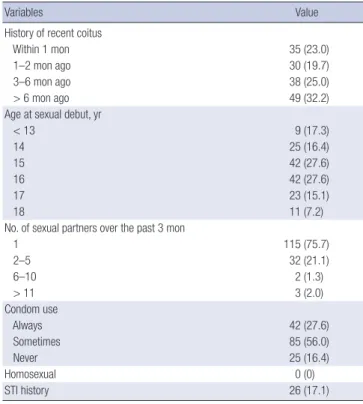
were enrolled. The mean age of participants was 16.1 ± 1.5 years (range, 12–19 years) (Table 1). Overall, 223 (94.1%) participants lived with their parents and eight (3.4%) lived in a day-care cen- ter. Most participants (32.1%, n = 76) received a weekly allow- ance of 10,000–30,000 won (8.8–26.5 USD); followed by those receiving > 50,000 won (44.2 USD) (26.2%, n = 62) and < 10,000 won (8.8 USD) (22.8%, n = 54). Overall, 186 (78.5%) adolescents reported having drunk alcohol, 211 (89.0%) had experienced smoking, and 104 (43.9%) had dropped out of school. Twenty participants (8.4%) had used hallucinogens and 27 (11.4%) had experienced running away from home. Despite the fact that al- most 60% (n = 142) of participants had received sex education, the average sexual knowledge score was 11.0 ± 7.7 points on a 45-point scale. A total of 152 (64.1%) participants had a history of coitus. Of these, 103 had had sexual intercourse within the preceding 6 months, representing 67.8% of sex-experienced subjects (Table 2). Most adolescents (55.3%, n = 84) reported an age of sexual debut between 15 and 16 years. The majority
(75.7%, n = 115) of participants had had a single sex partner over the preceding 3 months, although 24.3% (n = 37) had had multiple sex partners. Only 27.6% (n = 42) always used a con- dom during sexual intercourse; 16.4% (n = 25) never used a con- dom. There was no homosexual. Twenty-six (17.1%) participants gave a history of having had a STI.
In total, 133 (56.1%) participants had at least one of the mi- croorganisms tested for detected in their genitourinary tracts
Table 1. Baseline characteristics of enrolled adolescents (n = 237)
Characteristics Value
Sex
Male 208 (87.8)
Female 29 (12.2)
Age, yr 16.1 ± 1.5
Age category, yr
12 3 (1.3)
13 11 (4.6)
14 24 (10.1)
15 36 (15.2)
16 59 (24.9)
17 59 (24.9)
18 36 (15.2)
19 9 (3.8)
Residence type
With parents 223 (94.1)
With relatives 2 (0.8)
Boarding house/live apart from family 3 (1.3)
Day-care center 8 (3.4)
Other 1 (0.4)
Weekly allowance, won (USD)
< 10,000 (8.8) 54 (22.8)
10,000–30,000 (8.8–26.5) 76 (32.1)
30,001–50,000 (26.5–44.2) 45 (19.0)
> 50,000 (44.2) 62 (26.2)
Alcohol 186 (78.5)
Smoking 211 (89.0)
Dropped out of school 104 (43.9)
Runaway 27 (11.4)
Hallucinogen use 20 (8.4)
Sex education received 142 (59.9)
Sexual knowledge score*, points 11.0 ± 7.7
Coitus history 152 (64.1)
Values are presented as number (%) or mean ± SD.
SD = standard deviation, USD = United States dollar.
*On a 45-point scale.
Table 2. Sexual practices in sex-experienced adolescents (n = 152)
Variables Value
History of recent coitus
Within 1 mon 35 (23.0)
1–2 mon ago 30 (19.7)
3–6 mon ago 38 (25.0)
> 6 mon ago 49 (32.2)
Age at sexual debut, yr
< 13 9 (17.3)
14 25 (16.4)
15 42 (27.6)
16 42 (27.6)
17 23 (15.1)
18 11 (7.2)
No. of sexual partners over the past 3 mon
1 115 (75.7)
2–5 32 (21.1)
6–10 2 (1.3)
> 11 3 (2.0)
Condom use
Always 42 (27.6)
Sometimes 85 (56.0)
Never 25 (16.4)
Homosexual 0 (0)
STI history 26 (17.1)
Values are presented as number (%).
STI = sexually transmitted infection.
Table 3. Distribution of microorganism detection according to sex experience Variables
Positive test result Total
(n = 237) Sex-experienced
(n = 152) Sex-inexperi- enced (n = 85) Chlamydia trachomatis 33 (13.9) 33 (21.7) 0 (0)
Neisseria gonorrhoeae 4 (1.7) 4 (2.6) 0 (0)
Trichomonas vaginalis 2 (0.8) 2 (1.3) 0 (0)
HSV 1 (0.4) 1 (0.7) 0 (0)
Treponema pallidum 2 (0.8) 2 (1.3) 0 (0)
HIV 0 (0) 0 (0) 0 (0)
Ureaplasma urealyticum 65 (24.7) 53 (34.9) 12 (14.1) Ureaplasma parvum 57 (24.1) 50 (32.9) 7 (8.2) Mycoplasma hominis 41 (17.3) 37 (24.3) 4 (4.7)
Single pathogen 79 (33.3) 60 (39.5) 15 (17.6)
Two pathogens 35 (22.9) 35 (22.9) 4 (4.7)
Three pathogens 14 (9.2) 14 (9.2) -
Four pathogens 5 (3.3) 5 (3.3) -
Total 133 (56.1) 114 (75.0) 19 (22.4)
Values are presented as number (%).
HSV = herpes simplex virus, HIV = human immunodeficiency virus.
(Table 3). The most prevalent STI pathogen was U. urealyticum (24.7%, n = 65), followed by U. parvum (24.1%, n = 57), M. hom-
inis (17.3%, n = 41), and C. trachomatis (13.9%, n = 33). There were four cases (1.7%) of N. gonorrhoeae but no reported cases of HIV. The prevalence of T. vaginalis and HSV was 0.8% (n = 2) and 0.4% (n = 1), respectively. Two participants (0.8%) tested positive for Treponema pallium. At least one pathogen was de- tected in the 114 (75.0%) participants who were sex-experienced.
U. urealyticum was found in 53 (34.9%) of these participants’
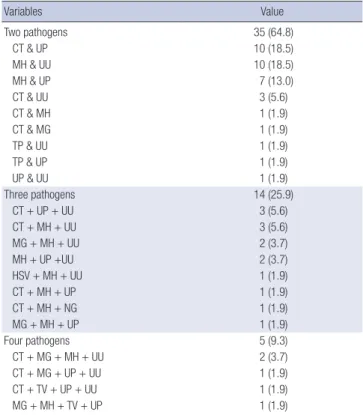
specimens, followed by U. parvum (32.9%, n = 50) and M. hom- inis (24.3%, n = 37). The total number of participants who had more than two pathogens was 54 (35.5%). Among these partici- pants, 35 (22.9%) and 14 (9.2%) tested positive for two different pathogens and three pathogens simultaneously. Five partici- pants (3.3%) had four different pathogens. Table 4 showed the distribution of microorganism positive with multiple pathogens.
Among the sex-inexperienced participants, 19 tested positive for at least one pathogen: 12 (14.1%) were positive for U. urea- lyticum, seven (8.2%) for U. parvum, and four (4.7%) for M. hom- inis. There were no cases of C. trachomatis, N. gonorrhoeae, T.
vaginalis, HIV, HSV, syphilis, and M. genitalium among sex-in- experienced subjects. Four participants (4.7%) were positive with two pathogens simultaneously. Three (3.5%) were positive with M. hominis and U. urealyticum and one (1.2%) was U. par- vum and U. urealyticum.
Factors associated with STIs in sex-experienced adolescents are shown in Table 5. In the univariate analysis, only STI history differed significantly between those with a STI relative to those without (OR, 4.5; 95% CI, 1.02–20.30; P = 0.032). We did not find any statistically significant differences in the variables relating to sexual practices, such as age of sexual debut, number of sex- ual partners in the preceding 3 months, and condom use dur- Table 4. Distribution of microorganism in positivity with multiple pathogens in sex-
experienced adolescents (n = 54)
Variables Value
Two pathogens 35 (64.8)
CT & UP 10 (18.5)
MH & UU 10 (18.5)
MH & UP 7 (13.0)
CT & UU 3 (5.6)
CT & MH 1 (1.9)
CT & MG 1 (1.9)
TP & UU 1 (1.9)
TP & UP 1 (1.9)
UP & UU 1 (1.9)
Three pathogens 14 (25.9)
CT + UP + UU 3 (5.6)
CT + MH + UU 3 (5.6)
MG + MH + UU 2 (3.7)
MH + UP +UU 2 (3.7)
HSV + MH + UU 1 (1.9)
CT + MH + UP 1 (1.9)
CT + MH + NG 1 (1.9)
MG + MH + UP 1 (1.9)
Four pathogens 5 (9.3)
CT + MG + MH + UU 2 (3.7)
CT + MG + UP + UU 1 (1.9)
CT + TV + UP + UU 1 (1.9)
MG + MH + TV + UP 1 (1.9)
Values are presented as number (%).
CT = Chlamydia trachomatis, UP = Ureaplasma parvum, MH = Mycoplasma hominis, UU = Ureaplasma parvum, MG = Mycoplasma genitalium, TP = Treponema pallidum, HSV = herpes simplex virus, NG = Neisseria gonorrhoeae.
Table 5. Associations between variables and STIs in sex-experienced adolescents
Variables Positive
(n = 114) Negative (n = 38)
Univariate analysis Multivariate analysis
OR (95% CI)* P value aOR (95% CI)† P value
Residing with family 109 (95.6) 35 (92.1) 0.5 (0.122–2.354) 0.413 - -
Weekly allowance < 50,000 won (44.2 USD) 81 (71.1) 25 (65.8) 1.3 (0.583–2.793) 0.541 - -
Runaway 11 (9.6) 4 (10.5) 0.9 (0.271–3.039) 1.000 - -
Alcohol use 97 (85.1) 32 (84.2) 1.1 (0.389–2.946) 0.896 - -
Smoking 105 (92.1) 35 (92.1) 1.0 (0.256–3.902) 1.000 - -
Hallucinogen use 11 (9.6) 2 (5.3) 1.9 (0.407–9.090) 0.519 - -
Dropped out of school 52 (45.6) 22 (57.9) 1.6 (0.781–3.443) 0.190 0.5 (0.230–1.089) 0.081
Sex knowledge score < 12 points 52 (45.6) 19 (50.0) 1.2 (0.572–2.486) 0.639 - -
Aged < 16 yr at sexual debut 53 (46.5) 23 (60.5) 0.6 (0.268–1.196) 0.134 2.06 (0.945–4.491) 0.069
Sexual intercourse in past 6 mon 79 (69.3) 24 (63.2) 1.3 (0.610–2.844) 0.483 - -
≥ 2 sex partners in the past 3 mon 26 (22.8) 11 (28.9) 0.7 (0.317–1.657) 0.445 - -
Condom use
Always 29 (25.4) 13 (34.2) - Ref - -
Sometimes 65 (57.0) 20 (52.6) 1.5 (0.639–3.321) 0.371 - -
Never 20 (17.5) 5 (13.2) 1.8 (0.552–5.825) 0.331 - -
Sex education received 75 (65.8) 28 (73.7) 1.5 (0.642–3.303) 0.367 - -
STI history 23 (20.2) 2 (5.3) 4.5 (1.020–20.299) 0.032 1.225 (1.216–25.721) 0.741
Values are presented as number (%).
CI = confidence interval, STI = sexually transmitted infection, OR = odds ratio, aOR = adjusted odds ratio, USD = United States dollar, Ref = reference category.
*Chi-square tests and Fisher’s exact test. †Logistic regression model adjusted for dropped out of school, aged < 16 years at sexual debut and STI history.
ing sexual intercourse. Previous sex education experience and sex knowledge scores were not significantly associated with the presence of an STI. No significant difference was found accord- ing to other socioeconomic and behavioural factors such as residence type, runaway history, smoking, alcohol use, halluci- nogen use, and history of having dropped out of school. On mul- tivariate analysis, we found no significant independent variable associated with the presence of microorganisms causing STIs.
We also evaluated factors in participants that tested positive ac- cording to multiple pathogens and single pathogen (Table 6).
In the univariate analysis, we did not find any statistically sig- nificant differences in the variables relating to sexual practices, other socioeconomic and behavioural factors.
DISCUSSION
Currently, the only available data on the prevalence of STIs among adolescents under probation in Korea comes from a single prev- alence survey conducted in 2004 among homeless adolescents attending a shelter (12). That study reported that 54.9% of ado- lescents had engaged in sexual intercourse and that 36.5% were younger than 16 years old at sexual debut. In our study, 152 (64.1%) participants had experienced sexual intercourse, and half of them had experienced their first sexual intercourse aged younger than 16 years. Sexual intercourse experience was com- parable to the 2004 study of homeless adolescents, but the pro- portion of adolescents reporting an earlier sexual debut was higher in the present study. A Korean study involving general middle and high school students revealed that approximately 4.2% adolescents had experienced sexual intercourse from 2007
to 2013 (23). Compared with the general population, a greater proportion of adolescents under probation had engaged in sex.
In the 2004 study, the prevalence of C. trachomatis and N. gon- orrhoeae was 12.6% and 15.4%, respectively (12). Based on a self-administered questionnaire, experience of any previous STI was 7.4% among boys and 7.5% among girls attending gen- eral middle or high school during 2007 to 2013 (23). In the pres- ent study, the prevalence of C. trachomatis and N. gonorrhoeae was 13.9% and 1.7%, respectively. Compared with the 2004 study on adolescents attending a shelter, the prevalence of C. tracho- matis in the present study was similar while the prevalence of N.
gonorrhoeae was lower. The prevalence of STIs in adolescents under probation is considerably higher than in the general pop- ulation.
In the United States, the CDC estimated that the prevalence of C. trachomatis among female and male adolescents in juve- nile correctional facilities was 15.7% and 7.4%, respectively, in 2011 (10), and the prevalence of N. gonorrhoeae was 1.2% and 4.4% among male and female adolescents, respectively. The prevalence of C. trachomatis and N. gonorrhoeae in our study was similar to that reported in the United States. The CDC rec- ommends the screening of all sexually active women younger than 25 years for C. trachomatis and N. gonorrhoeae. Despite the high prevalence of STIs among adolescents under proba- tion, there is no screening system for STIs targeting adolescents under probation in Korea. Although up to 80% of women and 50% of men infected with C. trachomatis are asymptomatic or have few symptoms, these infections can result in long-term sequelae, such as infertility and cervical cancer (1,24). Diagno- sis by means of a screening process is essential. Considering Table 6. Associations between variables and multiple infection in STI positive adolescents (n = 114)
Variables Single pathogen
(n = 60) Multiple pathogens (n = 54)
Univariate analysis
OR (95% CI)* P value
Residing with family 56 (93.3) 53 (98.1) 0.3 (0.029–2.440) 0.367
Weekly allowance < 50,000 won (44.2 USD) 41 (68.3) 40 (74.1) 1.3 (0.585–2.995) 0.500
Runaway 6 (10.0) 5 (9.3) 0.9 (0.264–3.200) 1.000
Alcohol use 52 (86.7) 45 (83.3) 0.8 (0.274–2.160) 0.618
Smoking 55 (91.7) 50 (92.6) 1.1 (0.289–4.469) 1.000
Hallucinogen use 5 (8.3) 6 (11.1) 1.4 (0.395–4.791) 0.616
Dropped out of school 27 (45.0) 25 (46.3) 1.1 (0.504–2.204) 0.890
Sex knowledge score < 12 points 25 (41.7) 27 (50.0) 1.4 (0.668–2.935) 0.372
Aged < 16 yr at sexual debut 28 (46.7) 25 (46.3) 1.0 (0.471–2.059) 0.968
Sexual intercourse in past 6 mon 40 (66.7) 39 (72.2) 1.3 (0.583–2.898) 0.521
≥ 2 sex partners in the past 3 mon 13 (21.7) 13 (24.1) 1.1 (0.478–2.751) 0.760
Condom use
Always 15 (25.0) 12 (22.2) - Ref
Sometimes 36 (55.4) 29 (53.7) 1.0 (0.408–2.484) 0.988
Never 9 (15.0) 13 (24.1) 1.8 (0.578–5.643) 0.308
Sex education received 22 (36.7) 17 (31.5) 0.8 (0.364–1.728) 0.560
STI history 9 (15.0) 14 (25.9) 2.0 (0.779–5.048) 0.147
Values are presented as number (%).
CI = confidence interval, STI = sexually transmitted infection, OR = odds ratio, USD = United States dollar, Ref = reference category.
*Chi-square tests and Fisher’s exact test.
the high prevalence of STIs among adolescents under proba- tion, it is advisable to screen such adolescents for STIs when they are admitted to correctional facilities.
Some studies have suggested that mycoplasma and ureaplas- ma can contribute to the development of genitourinary infec- tion and infertility (13-15,18). Despite studies on potential STI causative pathogens, there are no established guidelines on when to use diagnostic tools and when to treat mycoplasma and ureaplasma. Furthermore, few prevalence surveys of my- coplasma and ureaplasma have been conducted among ado- lescents and no prevalence studies of adolescents under proba- tion have been performed to date. To our knowledge, this is the first study researching the prevalence of STIs, including infec- tion with mycoplasma and ureaplasma, in adolescents under probation. In this study, the prevalence of M. hominis, M. geni- talium, U. urealyticum, and U. parvum was 17.3%, 4.2%, 27.4%, and 24.1%, respectively. There is no comparable study targeting the general adolescent population in Korea. However, accord- ing to a study involving female adolescents aged 14–21 years in the United States, the prevalence of M. genitalium was 22.4%
(19). A Korean study involving asymptomatic adults attending a clinic for a checkup found that the prevalence of M. genitalium was 1.0% and the prevalence of U. urealyticum was 11.8% (25).
In a comparable study targeting asymptomatic Korean adults, the prevalence of M. hominis, M. genitalium, and U. urealyti- cum was 11.6%, 0.3%, and 22.1%, respectively (26). Compared with studies conducted abroad, the prevalence of M. genitali- um among Korean adolescents under probation was lower; how- ever, compared to asymptomatic adults in Korea, the prevalence was higher. Interestingly, 22.4% of adolescents who had not ex- perienced sexual intercourse also tested positive for mycoplas- ma and ureaplasma. It is possible that adolescents under pro- bation tend to hide their sexual intercourse experience due to Korean culture which considers sexuality among adolescents as taboo. It is also possible that mycoplasma and ureaplasma, considered causative pathogens for STIs, can colonize the geni- tal tract at birth (following passage through the maternal vagi- nal tract). Therefore, it is difficult to decide when to consider the organisms as true pathogens and, thus, to decide when or whether to commence treatment. We must be cautious of treat- ing all adolescents who test positive for mycoplasma or urea- plasma. It may be appropriate to use a diagnostic tool to detect mycoplasma or ureaplasma and to commence treatment if there is no clinical improvement following treatment for common pathogens. However, further studies investigating the timing of investigating and treating these pathogens are needed.
We found no association between the variables investigated in this study and STI positivity. The distribution of variables con- sidered to be risk factors for STIs, such as residence type, weekly allowance, having run away from home, alcohol use, smoking, and having dropped out of school (27,28), were similar in both
groups. As we compared risk factors within a population of ad- olescents under probation, who by definition engage in higher- risk habits and live in riskier circumstances than the average adolescent, we could not identify any meaningful risk factors in this study. The sexual knowledge score was not significantly dif- ferent. Furthermore, the sexual knowledge score was very low, despite > 60% of adolescents having received sex education.
According to the middle school education regulations, it is man- datory to provide at least 15 hours of sex education per year. How- ever, in practice, this class is substituted for personal study time.
Also, it is doubtful that adolescents under probation are focused on education. Providing sex education in correctional facilities may be an effective strategy, but it is important to improve the content of sex education programmes. Surprisingly, > 20% of the adolescents who reported that they always used condoms during sexual intercourse tested positive for at least one exam- ined STI pathogen. Although adolescents under probation re- ported that they knew how to use condoms correctly, our results suggest that their knowledge was inadequate. A more practical approach is warranted, including information on the use of con- traceptive devices, methods to prevent STIs, and the symptoms of STIs.
There is also gap between theoretical knowledge and the prac- tical application thereof. In Korea, it is difficult for adolescents to obtain contraceptives such as condoms. According to the Korean Youth Protection Act, there is no restriction on purchas- ing condoms and it is possible to buy them at convenience stores or pharmacies. However, in practice, many adolescents cannot purchase condoms because of sales refusal and the surround- ing attention received. Contraceptives should be accessible to adolescents in environments such as schools or public health centres. In addition, it is difficult for adolescents to make use of medical institutions specializing in STIs for cultural reasons.
Despite recognizing the symptoms of an STI, adolescents are likely to miss the appropriate timing for treatment. There is a need to establish medical services that are free for adolescents and that are able to provide accurate information and treatment for STIs. Because the prevention and treatment of STIs in ado- lescents is crucial, it is important to understand adolescent sex- uality and behaviour and to publicize activities to raise aware- ness of STIs.
Our study has some limitations. First, we included only 29 (12.2%) female adolescents. However, according to the 2014 Crime Prevention Policy Bureau statistics, of the 140,572 ado- lescents under probation, 124,385 (88.5%) were male and 16,187 (11.5%) were female (29). This male-to-female ratio coincides with the ratio in our study. Second, sexual intercourse experi- ence might be underestimated because most adolescents avoid making their experience known due to social attention. Third, we could not collect data about the reason for entering the pro- bation office. It might act as a risk factor according to some crime
types such as sex crime but it was not investigated. Finally, we included probation offices and juvenile delinquent centres in only two metropolitan areas in Korea. Hence, our findings can- not reflect the general Korean regional characteristics. Thus, fur- ther surveys that include all regional Korean adolescents under probation should be performed.
In conclusion, the prevalence of STIs among adolescents un- der probation is high, and adolescents are currently exposed to more STI risks than they were in the past. More systematic screen- ing policies, use of more practical sex education, and the provi- sion of appropriate treatment for STIs are essential for the pre- vention and management of STIs in adolescents, particularly among those at risk. Furthermore, increased societal focus on adolescents is important.
DISCLOSURE
The authors have no potential conflicts of interest to disclose.
AUTHOR CONTRIBUTION
Conceptualization: Park JJ, Seo YB, Jeong S, Lee J. Data curation:
Lee J. Formal analysis:Jeong S. Investigation: Seo YB, Jeong S. Writ- ing - original draft: Park JJ. Writing - review & editing: Seo YB.
ORCID
Jin Ju Park https://orcid.org/0000-0002-5224-0837 Yu Bin Seo https://orcid.org/0000-0001-5183-1996 Sookyung Jeong https://orcid.org/0000-0001-7119-3039 Jacob Lee https://orcid.org/0000-0002-7041-065X REFERENCES
1. Dehne KL, Riedner G. Sexually Transmitted Infections among Adoles- cents: the Need for Adequate Health Services. Geneva, World Health Or- ganization, 2005.
2. World Health Organization. Report on Global Sexually Transmitted In- fection Surveillance 2013. Geneva, World Health Organization, 2014.
3. Chinsembu KC. Sexually transmitted infections in adolescents. Open In- fect Dis J 2009; 3: 107-17.
4. Carmine L, Castillo M, Fisher M. Testing and treatment for sexually trans- mitted infections in adolescents--what’s new? J Pediatr Adolesc Gynecol 2014; 27: 50-60.
5. Wallin KL, Wiklund F, Luostarinen T, Angström T, Anttila T, Bergman F, Hallmans G, Ikäheimo I, Koskela P, Lehtinen M, et al. A population-based prospective study of Chlamydia trachomatis infection and cervical car- cinoma. Int J Cancer 2002; 101: 371-4.
6. Choi JH, Jeung IC, Pak YG, Park DC. Prevalence and risk factors of Chla- mydia trachomatis and Neisseria gonorrhea among Korean women. Ko- rean J Obstet Gynecol 2007; 50: 1739-46.
7. Farley TA, Hadler JL, Gunn RA. The syphilis epidemic in Connecticut: re-
lationship to drug use and prostitution. Sex Transm Dis 1990; 17: 163-8.
8. Cates W Jr, Wasserheit JN. Genital chlamydial infections: epidemiology and reproductive sequelae. Am J Obstet Gynecol 1991; 164: 1771-81.
9. Harwell TS, Trino R, Rudy B, Yorkman S, Gollub EL. Sexual activity, sub- stance use, and HIV/STD knowledge among detained male adolescents with multiple versus first admissions. Sex Transm Dis 1999; 26: 265-71.
10. Centers for Disease Control and Prevention (US). 2011 Sexually transmit- ted diseases surveillance [Internet]. Available at http://www.cdc.gov/std/
stats11/corrections.htm [accessed on 25 September 2016].
11. Centers for Disease Control and Prevention (US). 2014 Sexually transmit- ted diseases surveillance. Available at http://www.cdc.gov/std/stats14/
adol.htm [accessed on 25 September 2016].
12. Lee SJ, Cho YH, Kim CS, Shim BS, Cho IR, Chung JI, Lee JG, Kim ME. Screen- ing for chlamydia and gonorrhea by strand displacement amplification in homeless adolescents attending youth shelters in Korea. J Korean Med Sci 2004; 19: 495-500.
13. Friberg J, Gnarpe H. Mycoplasmas in semen from fertile and infertile men.
Andrologia 1974; 6: 45-52.
14. O’leary WM. Ureaplasmas and human disease. Crit Rev Microbiol 1990;
17: 161-8.
15. Keck C, Gerber-Schäfer C, Clad A, Wilhelm C, Breckwoldt M. Seminal tract infections: impact on male fertility and treatment options. Hum Re- prod Update 1998; 4: 891-903.
16. Deguchi T, Yoshida T, Miyazawa T, Yasuda M, Tamaki M, Ishiko H, Maeda S. Association of Ureaplasma urealyticum (biovar 2) with nongonococ- cal urethritis. Sex Transm Dis 2004; 31: 192-5.
17. Anagrius C, Loré B, Jensen JS. Mycoplasma genitalium: prevalence, clini- cal significance, and transmission. Sex Transm Infect 2005; 81: 458-62.
18. Waites KB, Katz B, Schelonka RL. Mycoplasmas and ureaplasmas as neo- natal pathogens. Clin Microbiol Rev 2005; 18: 757-89.
19. Huppert JS, Mortensen JE, Reed JL, Kahn JA, Rich KD, Hobbs MM. Myco- plasma genitalium detected by transcription-mediated amplification is associated with Chlamydia trachomatis in adolescent women. Sex Transm Dis 2008; 35: 250-4.
20. Shipitsyna E, Krasnoselskikh T, Zolotoverkhaya E, Savicheva A, Krotin P, Domeika M, Unemo M. Sexual behaviours, knowledge and attitudes re- garding safe sex, and prevalence of non-viral sexually transmitted infec- tions among attendees of youth clinics in St. Petersburg, Russia. J Eur Acad Dermatol Venereol 2013; 27: e75-84.
21. Jaworski BC, Carey MP. Development and psychometric evaluation of a self-administered questionnaire to measure knowledge of sexually trans- mitted diseases. AIDS Behav 2007; 11: 557-74.
22. Choe HS, Lee DS, Lee SJ, Hong SH, Park DC, Lee MK, Kim TH, Cho YH.
Performance of AnyplexTM II multiplex real-time PCR for the diagnosis of seven sexually transmitted infections: comparison with currently avail- able methods. Int J Infect Dis 2013; 17: e1134-40.
23. Lee SY, Lee HJ, Kim TK, Lee SG, Park EC. Sexually transmitted infections and first sexual intercourse age in adolescents: the nationwide retrospec- tive cross-sectional study. J Sex Med 2015; 12: 2313-23.
24. Stamm WE. Chlamydia trachomatis infections: progress and problems. J Infect Dis 1999; 179 Suppl 2: S380-3.
25. Choi JY, Cho IC, Lee GI, Min SK. Prevalence and associated factors for four sexually transmissible microorganisms in middle-aged men receiv- ing general prostate health checkups: a polymerase chain reaction-based study in Korea. Korean J Urol 2013; 54: 53-8.
26. Kim SJ, Lee DS, Lee SJ. The prevalence and clinical significance of urethri- tis and cervicitis in asymptomatic people by use of multiplex polymerase chain reaction. Korean J Urol 2011; 52: 703-8.
27. Castillo Mezzich A, Tarter RE, Giancola PR, Lu S, Kirisci L, Parks S. Sub- stance use and risky sexual behavior in female adolescents. Drug Alcohol Depend 1997; 44: 157-66.
28. Slater C, Robinson AJ. Sexual health in adolescents. Clin Dermatol 2014;
32: 189-95.
29. Ministry of Justice (KR). 2014 Crime Prevention Policy Bureau statistics in Korean [Internet]. Available at http://www.cppb.go.kr/ [accessed on 30 September 2016].