INTRODUCTION
Liver transplantation is the well-established, life-saving therapeutic modality for children with end-stage liver dis- ease. With recent advancements in surgical techniques and immunosuppressive drugs, survival after liver transplantation has improved remarkably since the introduction of clinical transplantation by Starzl et al. 40 yr ago (1-5). Liver cirrhosis in children differs from that in adults because it is frequently accompanied by growth failure (6). Therefore evaluating a child’s growth following liver transplantation is used to mea- sure quality of life.
It is well established that liver transplantation results not only in long-term survival, but also in normal growth and development (7-12). However, most of these studies involved cadaveric donor liver transplantation. Therefore we performed this study in order to evaluate the long-term effect of living donor liver transplantation (LDLT) on child growth. We also assessed the influence of other factors on post-LDLT child growth such as the primary diagnosis, pre-transplantation growth retardation, liver graft function following transplan- tation, and immunosuppressive regimen.
MATERIALS AND METHODS
From a total of 43 children who had undergone LDLT at the Asan Medical Center from 1994 to 1999, 36 children (84%) who had survived over 5 yr were enrolled in this study.
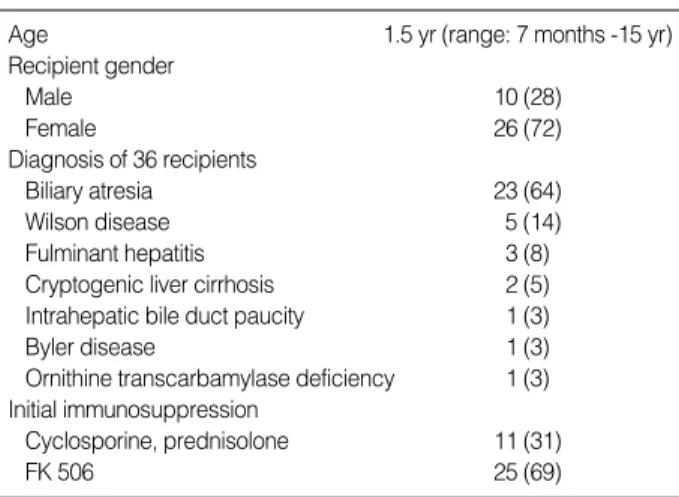
Profiles of these children are listed in Table 1. Median age at transplantation was 1.5 yr (range: 6 months-15 yr) and the median follow-up period was 6.5 yr (range: 5-9 yr). Twen- ty-three of the 36 children underwent LDLT for biliary atresia, 5 for Wilson disease, 3 for fulminant hepatitis of unknown etiology, 2 for unexplained liver cirrhosis, 1 for intrahepatic bile duct paucity, 1 for Byler disease, and 1 for ornithine tran- scarbamylase deficiency. Seven of the 36 children had fulmi- nant hepatitis. As for the immunosuppressive regimen, 11 children were initially treated with cyclosporin A (CyA) and a low dose corticosteroid while the other 25 children were treated with FK 506.
Follow-up evaluations occurred in 6-month-intervals on an outpatient basis, except during the 1st yr post-LDLT, when check-ups were more frequent. Medical records of pre-trans- plant and post-transplant examinations were reviewed retro- spectively.
For statistical evaluation, a repeated measures ANOVA was used. Data regarding height were expressed as mean height
Seong Jong Park, Sun-Hee Rim, Kyung Mo Kim, Joo Hoon Lee, Bo Hwa Choi, Seon Yun Lee, Soo Hee Chang, Young Joo Lee*, Sung Gyu Lee*
Departments of Pediatrics and Surgery*, Asan Medical Center, University of Ulsan College of Medicine, Seoul, Korea
Address for correspondence Kyung Mo Kim, M.D.
Department of Pediatrics, Asan Medical Center University of Ulsan College of Medicine, 388-1 Pungnap-dong, Songpa-gu, Seoul 138-736, Korea Tel : +82.2-3010-3390, Fax : +82.2-473-3725 E-mail : [email protected]
835
Long-term Growth of Pediatric Patients Following Living-Donor Liver Transplantation
In order to determine the influence of living donor liver transplantation (LDLT) on long-term growth, we studied the progress of 36 children who had survived more than 5 yr after LDLT from 1994 to 1999. The median age at the transplantation was 1.5 yr (range: 6 months-15 yr) and the median follow-up period was 6.5 yr (range:
5-9 yr). A height standard deviation score (zH) was analyzed for each patient accord- ing to medical records. Significant catch-up growth occurred within 2 yr after LDLT with a mean zH changing from -1.2 to 0.0 and was maintained for up to 7 yr post-trans- plantation (zH-0.1). Younger children (<2 yr) were more growth-retarded at the time of LDLT, but showed higher catch-up growth rates and their final zH was greater than that of older children. Children with liver cirrhosis were more growth-retarded at the time of LDLT, but showed significant catch-up growth and their final height was similar to children with fulminant hepatitis. Growth in children who experienced significant hepatic dysfunction after LDLT was not significantly different from those without graft dysfunction. There was no difference between the types of immuno- suppressants used. Our finding suggests that LDLT can result in adequate catch- up linear growth, and this effect can persist even after 7 yr post-transplantation.
Key Words : Living Donor; Liver Transplantation; Child; Growth
Received : 7 March 2005 Accepted : 26 April 2005
standard deviation scores (zH). zH was calculated according to the equation: zH=(X-mean height)/standard deviation, where X represents the actual measured height in centime- ters and the mean height and standard deviation (SD) repre- sent values of an age- and gender-matched mean height curve from the Korean Pediatric Society Reference published in 1997. Normal growth was defined as zH over -1.5 at the time of LDLT and having the same zH afterwards, essentially stay- ing on the same percentile line for height. Retarded growth at the time of transplantation was defined as zH under -1.5 for the patient’s age. Catch-up growth was defined as a gain in zH after LDLT, i.e., crossing the percentile lines for height (13). Lack of growth was defined as a decrease in zH after LDLT.
In order to get an impression of overall growth, we plotted the mean zH versus the number of months post-LDLT for all 36 patients. We then created a homogenous group by select- ing 29 of the 36 children who were younger than 6-yr-old at the time of transplantation which eliminated the variation due to pubertal growth spurt. We then examined the influ- ence of pre-transplant growth retardation, primary diagnosis of fulminant hepatitis or chronic cirrhosis, post-transplanta-
tion liver graft function, and immunosuppressive regimen.
RESULTS Post-LDLT linear growth of all children
Progression of zH, post-LDLT, of all 36 children is shown in Fig. 1. zH values (mean±SD) at the time of LDLT, and 2 and 7 yr after LDLT were -1.2±1.2, 0.0±0.9 and -0.1± 1.1, respectively, indicating that there was significant catch- up growth for the first 2 yr and a maintenance of continuous growth in height for up to 7 yr (p<0.01).
Post-LDLT linear growth of children under 6 yr of age
A more precise impression of growth post-LDLT is provided in Fig. 2, in which the mean zH is plotted against months post-LDLT for each of the 29 children who were younger than 6 yr at the time of transplantation. By only including children younger than 6 yr, we removed the compounding effect of pubertal growth spurt. zH values at the time of LDLT, and 2 and 7 yr after LDLT were -1.5±1.0, 0.0±0.8 and -0.3±1.1, indicating a similar pattern as was observed for the entire group (p<0.01).
Post-LDLT linear growth of patients exhibiting growth retardation at the time of transplantation
zH values (mean±SD) for the 15 children with retarded growth at the time of LDLT, and 2 and 7 yr after LDLT were -2.3±0.6, -0.4±0.8 and -0.8±0.8 respectively, suggesting zH runs to the zero baseline 2 yr after LDLT. It also implies that there was significant catch-up growth within 2 yr after LDLT (p<0.01) and the maintenance of continuous growth after catch-up growth in height for up to 7 yr. Furthermore, the zH values for the 21 children with normal growth at the time of LDLT, and 2 and 7 yr after LDLT were -0.4±0.9, 0.4±0.9 and 0.4±1.1, respectively, indicating that there
Values are number (%).
Age 1.5 yr (range: 7 months -15 yr)
Recipient gender
Male 10 (28)
Female 26 (72)
Diagnosis of 36 recipients
Biliary atresia 23 (64)
Wilson disease 5 (14)
Fulminant hepatitis 3 (8)
Cryptogenic liver cirrhosis 2 (5)
Intrahepatic bile duct paucity 1 (3)
Byler disease 1 (3)
Ornithine transcarbamylase deficiency 1 (3) Initial immunosuppression
Cyclosporine, prednisolone 11 (31)
FK 506 25 (69)
Table 1.Patient demographics (n=36)
zH
3 2 1 0 -1 -2 -3
0 0.5 1 2 3 4 5 6 7
Years after LDLT
N=36 N=36 N=36 N=36 N=36 N=36 N=36 N=23 N=15
Fig. 1.Post-transplantation mean height standard deviation scores (zH) of all children in the study.
zH
3 2 1 0 -1 -2 -3
0 0.5 1 2 3 4 5 6 7
Years after LDLT
N=31 N=31 N=31 N=31 N=31 N=31 N=31 N=19 N=13
Fig. 2.Post-transplantation mean height standard deviation scores (zH) of children under 6 yr of age at the time of transplantation.
is no stunting of growth after LDLT. The growth gap between the two groups was decreased at 2 and 7 yr post-LDLT from the time of LDLT, but still persisted, indicating that children with retarded growth improve after LDLT, but remain shorter than those with normal growth (Fig. 3).
Post-LDLT linear growth in children with retarded growth according to age
Eleven of the 15 children with retarded growth at the time of LDLT were younger than 2 yr and the remaining 4 were older. zH values (mean±SD) at the time of LDLT, and 2 yr and 5 yr after LDLT were -2.4±0.6, -0.1±0.5 and -0.4±0.7 for the younger group (<2 yr old) and -2.1±0.5, -1.3±1.1 and -1.9±0.9 for older group, respectively. The younger group showed more retarded growth at the time of LDLT, but showed significantly higher catch-up growth after LDLT (p<0.05) (Fig. 4).
Post-LDLT linear growth according to underlying disease at the time of LDLT
The mean zH for children with liver cirrhosis was signifi-
cantly different from those with fulminant hepatitis at the time of LDLT. The zH (mean±SD) for the 31 children with liver cirrhosis was -1.4±1.2, and -0.1±1.2 for the 5 chil- dren with fulminant hepatitis. At 2 yr after LDLT, the mean zH for children with liver cirrhosis was 0.0±1.0, and 0.5± 0.5 for those with fulminant hepatitis. After the 2-year fol- low-up there was no statistical difference between the two groups (p>0.05). This implies that children diagnosed with liver cirrhosis experienced catch-up growth after LDLT, while those with fulminant hepatitis showed maintenance of nor- mal growth after LDLT (Fig. 5).
Post-LDLT linear growth in patients experiencing chronic disease after liver transplantation
Seven of the 36 children experienced chronic diseases after LDLT such as chronic rejection or post-transplant lympho- proliferative disorder. There was no significant difference in the preoperative, 2 and 7 yr post-LDLT mean zH values bet- ween children who did and did not experience a chronic dis- ease (p>0.05) (Fig. 6).
zH
3 2 1 0 -1 -2 -3
0 0.5 1 2 3 4 5 6 7
Years after LDLT
N=36 N=36 N=36 N=36 N=36 N=36 N=36 N=23 N=15
Fig. 3.Post-transplantation mean height standard deviation scores (zH) of children with retarded ( ) and normal growth ( ).
zH
3 2 1 0 -1 -2 -3
0 0.5 1 2 3 4 5 6 7
Years after LDLT
N=15 N=15 N=15 N=15 N=15 N=15 N=15 N=10 N=7
Fig. 4.Post-transplantation mean height standard deviation scores (zH) of children with retarded growth in the younger (<2 yr) ( ) and older age ( ) groups.
zH
3 2 1 0 -1 -2 -3
0 0.5 1 2 3 4 5 6 7
Years after LDLT
N=36 N=36 N=36 N=36 N=36 N=36 N=36 N=23 N=15
Fig. 5.Post-transplantation mean height standard deviation scores (zH) of children with fulminant hepatitis ( ) and liver cirrhosis ( ).
zH
3 2 1 0 -1 -2
-3 0 0.5 1 2 3 4 5 6 7
Years after LDLT
N=36 N=36 N=36 N=36 N=36 N=36 N=36 N=23 N=15
Fig. 6.Post-transplantation mean height standard deviation scores (zH) of children with episodes of chronic graft dysfunction ( ) and normal hepatic function ( ).
Post-LDLT linear growth according to the type of immuno- suppression
Eleven children received cyclosporin A and a long-term low dose corticosteroid (CyA group) and the remaining 25 children received FK506 with a short-term corticosteroid (FK506 group). The mean height zH scores for the CyA group at preoperative, 2 and 7 yr after LDLT were -0.8±1.6, 0.4
±1.0 and 0.0±1.3, respectively, and for the FK506 group they were -1.4±1.0, -0.1±0.9 and -0.3±1.0. This result indicates that there was no significant difference in linear growth based on the type of immunosuppression (p>0.05) (Fig. 7).
DISCUSSION
The purposes of this study were to investigate post-trans- plantation linear growth in pediatric LDLT recipients and to examine several variables that may affect their linear growth after transplantation. In comparison to cadaveric donor liver transplantation (CDLT), LDLT has several advantages: it is usually performed electively, it requires a shorter waiting time, the operating environment is superior, and the patient’s condition can be controlled better (14-16). Therefore it is hypothesized that LDLT will result in improved linear growth, but only a few studies have investigated its influence (11-17).
We could not compare the linear growth between LDLT and CDLT patients because only two children received CDLT in our center during the study period. The scarcity of cadav- eric donors is the largest obstacle for solid organ transplan- tation in Korea, so LDLT has been vigorously adopted for children since 1994 (5, 18) and expanded to adult patients as well (4).
In our study, children after LDLT improved from a mean zH score of -1.2 at the time of transplantation to -0.1 seven years later. The patients in our study grew to almost normal heights in comparison with their age and sex-matched peers.
Contrary to our results, McDiarmid et al. (7) demonstrated in their recent study that even though orthotopic liver trans- plantation showed some potential for catch-up growth, pati- ents did not achieve normal height (from -1.7 to -1.4). The difference in our findings can be explained by a higher pro- portion of patients younger than 2 yr in our study (61 vs.
43%) at the time of transplantation. Younger children have shown better achievement of growth in several studies (7, 8, 17). Our findings can be further explained by the advantages of LDLT. The main advantage is its shorter waiting time, which can reverse the effect of chronic liver disease and restore the growth potential of young children. Our children also had a higher zH score (-1.19 vs. -1.72) at the time of transplan- tation, which can explain the LDLT in a better nutritional status. In a short-term study by Renz et al. (17), they report- ed that LDLT recipients had better mean zH at the time of transplantation as well as 1 yr after transplantation.
Factors that may affect growth after transplantation can be classified into pre-transplantation and post-transplanta- tion factors. Known pre-transplantation factors are nutrition- al status, growth retardation (10, 19, 20), age at transplan- tation (7, 17), and underlying disease (17, 21). Known post- transplantation factors are nutrition, intercurrent illness, im- pairment of liver function (20, 22), and immunosuppression (23).
As for pre-transplant growth retardation, our study showed that children with pre-transplant growth retardation had higher growth rates than those with normal growth. How- ever, those patients still had shorter heights 7 yr after trans- plantation. This suggests that children with initial growth retardation have greater catch-up growth (high growth veloc- ity) but the final height correlates with pre-transplant height for the same age group. When these findings were reevalu- ated according to age, our study showed that catch-up growth was more prominent in patients less than 2 yr old, which has been suggested in several other studies (7, 8, 17). This result suggests that LDLT can be considered for children at young ages who have chronic liver cirrhosis without definite indica- tion for transplantation, but have growth retardation.
Our findings on the influence of primary diagnosis on post- LDLT growth revealed that there was a remarkable difference in the level of the plotted mean zH curves in favor of the group with fulminant hepatitis. Apparently, there was stunt- ed growth at the time of transplantation in children with chronic liver cirrhosis (19) in contrast to children with fulmi- nant hepatitis. An explanation for this difference is the earlier onset of chronic liver cirrhosis and the often more complicat- ed course due to recurrent cholangitis. In contrast, children with fulminant hepatic failure often have good liver function with normal growth before the onset of disease.
Comparing the influence of liver graft function on height shows that poor graft function did not have a negative influ- ence on post-transplantation growth in this long-term follow- up study. This is interesting because our earlier study (24)
zH
3 2 1 0 -1 -2
-3 0 0.5 1 2 3 4 5 6 7
Years after LDLT
N=36 N=36 N=36 N=36 N=36 N=36 N=36 N=23 N=15
Fig. 7.Post-transplantation mean height standard deviation scores (zH) of children with prednisolone and cyclosporin ( ) or FK 506 ( ).
and other studies (19-21, 25) have shown that poor graft func- tion has a negative influence on post-transplantation growth.
In this study, we excluded children who died within 5 yr after liver transplantation. Therefore most of the children in our study did not have persistent poor graft function. This result suggests that even if children have occasional poor graft function, unless it is persistent, it will not affect height at long-term follow-up.
Our results show there is no difference in growth between the CyA and FK506 groups. Contrary to our results, several earlier reports identified immunosuppression, in particular, the use of steroids, as an additional variable that affects growth after liver transplantation (8, 19, 26). However, each of these previous reports used daily prednisone dosing of at least 5 mg/kg/day. We believe our lower pulse steroid regimen of 2 mg/kg/day with a rapid taper goal of 0.3 mg/kg/day by 1 week post-transplantation and adopting an alternative day regimen as soon as possible, even in children taking CyA, spared our transplant recipients of the negative effects of steroids on linear growth. This effect had been reported in recent studies (7, 10, 17) similar to ours, whereas an older study by Bartosh et al. (8) showed a long-term negative impact of steroids on post-transplantation growth.
Although this was not a comparative study including cadav- eric liver transplantation, this study showed that LDLT restored the growth in children with growth retardation by catch-up growth, and preserve adequate growth in non-growth-retard- ed children for up to 7 yr. Therefore LDLT appears to be a promising modality not only in long term survival, but also in long-term normal linear growth.
REFERENCES
1. Starzl TE, Marchioro TL, von Kaulla KN, Hermann G, Brittain RS, Weddell WR. Homotransplantation of the liver in humans. Surg Gynecol Obstet 1963; 117: 659-76.
2. Starzl TE, Iwatsuki S, Esquivel CO, Todo S, Kam I, Lynch S, Gor- don RB, Shaw BW Jr. Refinements in the surgical technique of liver transplantation. Semin Liver Dis 1985; 5: 349-56.
3. Goss JA, Shackleton CR, Christopher R, Swenson K, Satou NL, Nuesse BJ, Imagawa DK, Kinkhabwala MM, Seu P, Markowitz JS, Rudich SM, McDiarmid SV, Busuttil RW. Orthotopic liver trans- plantation for congenital biliary atresia. An 11-year, single-center experience. Ann Surg 1996; 224: 276-84.
4. Lee SG, Park KM, Hwang S, Lee YJ, Kim KH, Ahn CS, Choi DL, Joo SH, Jeon JY, Chu CW, Moon DB, Min PC, Koh KS, Han SH, Park SH, Choi GT, Hwang KS, Lee EJ, Chung YH, Lee YS, Lee HJ, Kim MH, Lee SK, Suh DJ, Kim JJ, Sung KB. Adult-to-adult living donor live transplantation at the Asan Medical enter, Korea. Asian J Surg 2002; 25: 277-84.
5. Kim KM, Lee SG, Lee YJ, Park KM, Kim SC, Chun HB, Yoo ES, Ko KS, Han SH, Lee MG, Choi GT, Ko JK, Moon HN. Living relat- ed donor liver transplantation in children: Indication and clinical
outcome. J Korean Pediatr Soc 1998; 41: 622-32.
6. Holt RI, Baker AJ, Jones JS, Miell JP. The insulin-like growth factor and binding protein axis in children with end-stage liver disease before and after orthotopic liver transplantation. Pediatr Transplant 1998;
2: 76-84.
7. McDiarmid SV, Gornbein JA, DeSilva PJ, Goss JA, Vargas JH, Mar- tin MG, Ament ME, Busuttil RW. Factors affecting growth after pedi- atric liver transplantation. Transplantation 1999; 67: 404-11.
8. Bartosh SM, Thomas SE, Sutton MM, Brady LM, Whitington PF.
Linear growth after pediatric liver transplantation. J Pediatr 1999;
135: 624-31.
9. Viner RM, Forton JT, Cole TJ, Clark IH, Noble-Jamieson G, Barnes ND. Growth of long-term survivors of liver transplantation. Arch Dis Child 1999; 80: 235-40.
10. Codoner-Franch P, Bernard O, Alvarez F. Long-term follow-up of growth in height after successful liver transplantation. J Pediatr 1994;
124: 368-73.
11. Asonuma K, Inomata Y, Uemoto S, Egawa H, Kiuchi T, Okajima H, Shapiro AM, Tanaka K. Growth and quality of life after living-related liver transplantation in children. Pediatr Transplant 1998; 2: 64-9.
12. Martin SR, Atkison P, Anand R, Lindblad AS. Studies of pediatric liver transplantation 2002: patient and graft survival and rejection in pediatric recipients of a first liver transplant in the United States and Canada. Pediatr Transplant 2004; 8: 273-83.
13. Boersma B, Wit JM. Catch-up growth. Endocr Rev 1997; 18: 646-61.
14. Raia S, Nery JR, Mies S. Liver transplantation from live donors. Lancet 1989; 2: 497.
15. Broelsch CE, Whitington PF, Emond JC, Heffron TG, Thistlethwaite JR, Stevens L, Piper J, Whitington SH, Lichtor JL. Liver transplan- tation in children from living related donors. Surgical techniques and results. Ann Surg 1991; 214: 428-37.
16. Tanaka K, Uemoto S, Tokunaga Y, Fujita S, Sano K, Nishizawa T, Sawada H, Shirahase I, Kim HJ, Yamaoka Y, Ozawa K. Surgical techniques and innovations in living related liver transplantation.
Ann Surg 1993; 217: 82-91.
17. Renz JF, de Roos M, Rosenthal P, Mudge C, Bacchetti P, Watson J, Roberts JP, Ascher NL, Emond JC. Posttransplantation growth in pediatric liver recipients. Liver Transpl 2001; 7: 1040-55.
18. Lee SG, Lee YJ, Park KM, Kwon TW, Choi KM, Ha HS, Kim KM, Kim SC, Kim IK, Kim SK, Han SH, Koh KS, Min PC. Living relat- ed donor liver transplantation: the Seoul experience. Transplant Proc 1996; 28: 2383-4.
19. Sarna S, Sipila I, Jalanko H, Laine J, Holmberg C. Factors affecting growth after pediatric liver transplantation. Transplant Proc 1994;
26: 161-4.
20. Moukarzel AA, Najm I, Vargas J, McDiarmid SV, Busuttil RW, Ament ME. Prediction of long-term linear growth following liver transplantation. Transplant Proc 1990; 22: 1558-9.
21. Holt RI, Broide E, Buchanan CR, Miell JP, Baker AJ, Mowat AP, Mieli-Vergani G. Orthotopic liver transplantation reverses the adverse nutritional changes of end-stage liver disease in children. Am J Clin Nutr 1997; 65: 534-42.
22. Becht MB, Pedersen SH, Ryckman FC, Balistreri WF. Growth and nutritional management of pediatric patients after orthotopic liver
transplantation. Gastroenterol Clin North Am 1993; 22: 367-80.
23. Balistreri WF, Bucuvalas JC, Ryckman FC. The effect of immunosup- pression on growth and development. Liver Transpl Surg 1995; 1:
64-73.
24. Rim SH, Yun HS, Guh YM, Choi BH, Kim KM, Lee YJ, Lee SG.
Analysis of linear growth in children after living-related liver trans- plantation. Korean J Pediatr Gastroenterol Nutr 2001; 4: 63-70.
25. Peeters PM, Sieders E, ten Vergert EM, ten Vergert EM, Kok T, Reits- ma WC, de Jong KP, Bijleveld CM, Slooff MJ. Analysis of growth in children after orthotopic liver transplantation. Transpl Int 1996;
9: 581-8.
26. Spolidoro JV, Berquist WE, Pehlivanoglu E, Busuttil R, Saluski I, Vargas J, Ament ME. Growth acceleration in children after ortho- topic liver transplantation. J Pediatr 1988; 112: 41-4.