INTRODUCTION
Epstein-Barr virus (EBV) immortalizes human B-lym- phocytes in vitro; and latent membrane protein 1 (LMP1) of the EBV is essential for this process (1). LMP1 is a mem- brane protein composed of a short cytoplasmic amino-ter- minus linked to a transmembrane domain, with six mem- brane-spanning segments connected with short turns, and a long cytoplasmic carboxy-terminal domain (2). The six trans- membrane domains of LMP1 play an important role for the aggregation of LMP1 and in forming a patch, which is essen- tial for the activation of the signaling pathway (3). LMP1 asso- ciates with vimentin and other cellular proteins, forming a patch in the lymphocyte plasma membrane. LMP1 also colo- calizes with the LMP2A protein of EBV, which recruits cel- lular protein tyrosine kinases (4, 5). Biological effects of LMP1, such as induction of several cellular genes, are mediated by the activation of several signaling pathway, such as NF- B, p38/MAPK, Jak/STAT, JNK/AP-1, PI3K/Akt etc. (6).
Interferon regulatory factors (IRFs) are a growing family of transcriptional factors that share homology within the amino-terminal DNA binding domain (115 amino acids) (7). They are implicated in several biological processes, such as antiviral defense, cytokine signaling, cell growth, differ- entiation, oncogenesis and apoptosis (8-11). Two members of IRF family, IRF3 and IRF7, are considered to be impor-
tant factors for the expression of type I interferon (IFN) genes following viral infection (12). IRF3 is constitutively expressed in a variety of cells and tissues (9), but IRF7 is expressed pre- dominantly in lymphoid cells (13, 14). IRF7 locates in the cytoplasm and translocates to the nucleus after virus infec- tion, via phosphorylation by IKK (14-16). Recently, it was found that IRF7 and LMP1 induce each other within a regu- latory circuit and IRF5 brakes the IRF7/LMP1 circuit (17- 20). IRF7 can induce expression of LMP1 by binding to the IFN-stimulated response element (ISRE) of the LMP1 pro- moter, but the mechanism of induction and phosphorylation of IRF7 by LMP1 was unknown yet (19). LMP1 protein is a membranes protein and LMP1 cannot bind to the IRF7 pro- moter directly. Therefore, the interaction between LMP1 and IRF7 or other mediators might need for the regulation of IRF7 expression by LMP1.
Thus, this study was designed to determine the localiza- tion of endogenous IRF7 and the physical interaction of IRF7 with LMP1 in B lymphoblastoid cell lines.
MATERIALS AND METHODS Cell lines and cell culture
All the cell lines used in this experiment were maintained In-Wook Kim*, Ho-Sun Park
Department of Applied Microbiology*, College of Natural Resources, Department of Microbiology, College of Medicine, Yeungnam University, Daegu, Korea
Address for correspondence Ho-Sun Park, M.D.
Department of Microbiology, College of Medicine, Yeungnam University, 317-1 Daemyung 5-dong, Nam-gu, Daegu 705-717, Korea
Tel : +82.53-620-4364, Fax : +82.53-653-6628 E-mail : [email protected]
*This work was supported by Dr. Joseph S. Pagano in Lineberger Comprehensive Cancer Center at University of North Carolina at Chapel Hill, U.S.A..
379
Colocalization of Interferon Regulatory Factor 7 (IRF7) with Latent Membrane Protein 1 (LMP1) of Epstein-Barr Virus
Interferon regulatory factor 7 (IRF7) is one of the transcriptional factors for the acti- vation of type I Interferon (IFN) genes. It is known that IRF7 and the latent mem- brane protein 1 (LMP1) of Epstein-Barr virus (EBV) are highly expressed in EBV type III latency cells, and LMP1 induces mRNA expression of IRF7. In this study, the expression pattern of endogenous IRF7 was observed in several B cell lines with or without EBV infection by immunofluorescence staining. IRF7 was localized in the cytoplasm of EBV-negative B cells and EBV type I latency B cell lines. How- ever, IRF7 was located both in the cytoplasm and nucleus of EBV type III latency cell lines. In the Jijoye cell (type III latency cell), IRF7 was colocalized with LMP1 in the cytoplasm in a capping configuration, and their interaction was confirmed by co-immunoprecipitation of LMP1 and IRF7. This colocalization was confirmed by co-transfection of IRF7 and LMP1 plasmids in EBV-negative B cells. These results suggest that the IRF7 and LMP1 interact with each other, and this may relate to the mechanism whereby LMP1 exerts functional effects in B-lymphocytes.
Key Words : Interferon Regulatory Factor-7; Epstein-Barr Virus; Herpesvirus 4, Human; Latent Membrane Protein 1; EBV-associated membrane antigen, Epstein-Barr virus
Received : 16 September 2005 Accepted : 1 November 2005
in RPMI 1640 medium containing 10% fetal bovine serum and antibiotics (Gibco-BRL, CA, U.S.A.). DG75 is an EBV- negative Burkitt’s lymphoma cell line (21). Akata and Sav I cell lines are EBV-positive type I latency B cell lines (22).
Jijoye and Sav III are EBV-positive type III latency B cell lines (23, 24).
Plasmids
The expression vector used in this study is pcDNA3. The LMP1 expression plasmid, pcLMP1 (a gift from Tomakazu Yoshizaki), the IRF7 expression plasmid, pcIRF7 (13), and FLAG-tagged LMP1 wild-type (WT), (a gift from Nancy Raab-Traub), were used for transient transfection.
Transfection
DG75 cells were transfected with pcDNA3, pcIRF7, or FLAG-tagged wild type LMP1. 1×10⁷cells in 0.5 mL medi- um were pulsed once at 320 V, 975 F capacitance in a 0.4 cm cuvette in Gene Pulse II (Bio-Rad, Hercules, CA, U.S.A.) with a total of 10 g of DNA plasmids. Cells were harvest- ed 48 hr after transfection and used for immunofluorescence assay, Western blot and co-immunoprecipitation.
Antibodies
Anti-EBV LMP CS1-4 clone (DAKO, Denmark), anti- IRF7 antibody (Santa Cruz Biotechnology, Santa Cruz, CA, U.S.A.), and anti-M2 Flag antibody (Sigma, St. Louis, MO, U.S.A.) were used as primary antibodies. Anti-mouse Ig-HRP, anti-rabbit Ig-HRP (Amersham, U.K.), and anti-mouse kappa-HRP (Southern Biotechnology Associates, Birming- ham, AL, U.S.A.) were used as the secondary antibodies for Western blot or immunoprecipitation. Donkey anti-rabbit- FITC, donkey anti-mouse-rhodamine (Jackson ImmunoRe- search Laboratory, West grove, PA, U.S.A.) were used as the secondary antibodies for immunofluorescence assay.
Immunofluorescence assay
Jijoye and transfected DG75 cells were harvested and washed twice in phosphate-buffered saline (PBS). The cells were smeared on the HTC well slides (Cel-line, Portmouth, NH, U.S.A.) and air-dried. Cells were fixed with cold ace- tone for 10 min, and then blocked with 5% normal donkey serum (Jackson Laboratory, PA, U.S.A.) for 30 min at 37℃. Primary antibodies were incubated for 90 min at 37℃. Anti- EBV LMP CS1-4 clone and anti-IRF7 antibody were dilut- ed 1:50 in PBS containing 2% normal donkey serum. Slides were washed three times with PBS. Secondary antibodies were diluted 1:100 in PBS and incubated for 45 min at 37℃. After washing with PBS, they were mounted using Vector- shield (Vector Laboratory, Burlingame, CA, U.S.A.), and then
examined with the Axioscope fluorescence microscope (Zeiss, Germany) or the TCS-NT confocal microscope (Leica, Ger- many). The images were captured using a Scion software pro- gram.
Co-immunoprecipitation
Jijoye cells (4×10⁷cells per immunoprecipitation) were washed in cold PBS twice and then lysed in 900 L of lysis buffer (20 mM HEPES, 0.5% Nonidet P-40 [NP-40], 250 mM NaCl, 10% glycerol, 2 mM EDTA, 1 mM phenylme- thylsulfonyl fluoride [PMSF], sodium-orthovanadate, sodium fluoride, 1 tablet of complete [Amersham]) for 20 min at 4℃. The supernatant was clarified by centrifugation for 15 min at 4℃. IRF7 and LMP1 proteins were immunopurified with 20 L of anti-IRF7 antibody with 100 L of protein A Se- pharose (Sigma) or 20 L anti-LMP1 antibody with 100 L of protein G Sepharose (Sigma), respectively, for overnight incubation with constant rocking at 4℃. For DG75 cells, cell lysates were immunopurified with 100 L of anti-FLAG M2 agarose affinity gel (Sigma) for >4 hr with constant rock- ing at 4℃, or with 20 L of anti-IRF7 antibody with 100 L protein A Sepharose for overnight incubation with constant rocking at 4℃. Immunocomplexes were washed 4 times in lysis buffer, diluted in 2× sodium dodecyl sulfate (SDS) sam- ple buffer, boiled for 5 min and then run on 10% SDS-poly- acrylamide gel. LMP1 and IRF7 proteins were detected by immunoblotting as described below.
Immunoblot analysis
Immunoprecipitated samples separated on SDS-PAGE were transferred to nitrocellulose membranes using a semi- dry transfer apparatus. The membranes were blocked in PBS containing 10% nonfat dry milk and then probed with anti- IRF7 monoclonal antibody (1:50 dilution), anti-M2 flag anti- body (1:500 dilution) in an overnight incubation at 4℃, or with anti-LMP1 monoclonal antibody (1:50 dilution) for 2 hr at room temperature (RT). The membranes were then washed three times with PBS containing 0.1% Tween 20, incubat- ed with corresponding horseradish peroxidase (HRP)-linked secondary antibodies for 1 hr at RT, and reactivity was detect- ed using a chemiluminescence reagent (Pierce, Rockford, IL, U.S.A.).
RESULTS
Localization of IRF7 protein in various B cell lines
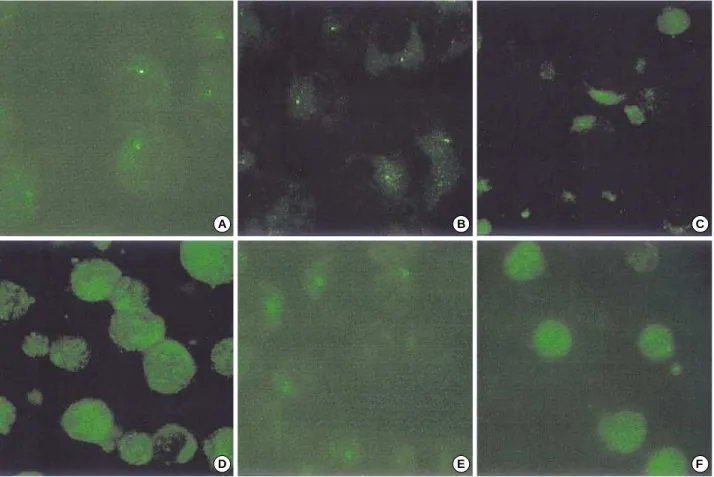
DG75, Akata, Sav I, Sav III, and Jijoye cell lines were used for the immunofluorescence staining to confirm the localiza- tion of endogenous IRF7 protein. Immunoreactivity for IRF7 is shown as small bright spots in the EBV-negative (Fig. 1A)
and EBV-positive type I latency cell lines (Fig. 1B, C). How- ever, the IRF7 distributes as scattered granules throughout the entire cell of type III latency Sav III cells (Fig. 1D). There were two patterns of IRF7 in Jijoye, one identical with the EBV negative or type I latency cell line (Fig. 1E), and the other consists of clumps and scattered granules in the cells (Fig. 1F).
Colocalization of IRF7 with EBV LMP1 protein
To verify the localization of LMP1 and IRF7 proteins, dou- ble immunofluorescence was performed in Jijoye and Sav III cells, which express endogenous LMP1 and IRF7. The pat- tern of LMP1 immunofluorescence was identical with pre- vious reports (2, 6) and IRF7 colocalized with LMP1 as a
Fig. 1.The immunofluorescence pattern of endogenous IRF7 in various B lymphoblastoid cell lines. Immunofluorescence assays (IFA) were per- formed with a rabbit polyclonal IRF7 antibody, with subsequent reaction with donkey anti-rabbit IgG-FITC in DG75 (A), Akata (B), Sav I (C), Sav III (D) and Jijoye (E, F) cell lines. IRF7 was captured with a Axioscope fluorescence microscope using a Scion software program.
A B C
D E F
Fig. 2.Colocalization of LMP1 and IRF7. The LMP1 and IRF7 proteins are double immunostained with mouse monoclonal LMP1 antibody and rabbit polyclonal IRF7 antibody, and subsequently reacted with donkey anti-mouse IgG-rhodamine and donkey anti-rabbit IgG-FITC, respectively. Panel (A) and (B) are Jijoye, (C) is Sav III, and (D) is DG75 cell line co-transfected with LMP1 and IRF7 plasmids. Fluorese- cence was captured with a confocal microscope. Red and green color represent of LMP1 and IRF7, respectively; yellow indicates colo- calization of both proteins.
A B C D
capping configuration in the cytoplasm of Jijoye cells (Fig.
2A, B). There was only weak co-localization in Sav III cells (Fig. 2C). DG75 cells were transiently co-transfected with LMP1 and IRF7 plasmids and these are colocalized in DG75 cells, which expresses both of the proteins (Fig. 2D).
LMP1 and IRF7 are co-immunoprecipitated in Jijoye cell and DG75 transfected with LMP1 and IRF7
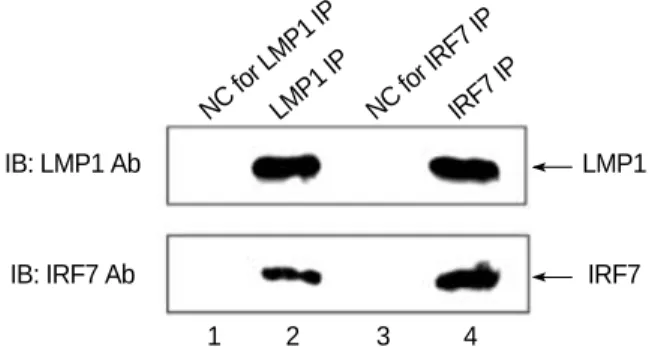
To confirm the physical interaction of the endogenous LMP1 and IRF7 proteins, co-immunoprecipitation was performed in the Jijoye cell. LMP1 and IRF7 were immunopurified with monoclonal CS1-4 antibody or anti-IRF7 antibody, and the immune complexes were subjected to SDS-PAGE and then analyzed by Western blotting (Fig. 3). Both LMP1 and IRF7 were detected by Western blot in the immunocomplexes, which were immunopurified with LMP1 antibody (Fig. 3, lane 1-2), or IRF7 antibody (Fig. 3, lanes 3-4). This result suggests that endogenous LMP1 and IRF7 interact with each other in the Jijoye cell. FLAG-LMP1 (WT), IRF7, or both of FLAG-LMP1 (WT) and IRF7 were over-expressed in DG75 cells by electroporation using Gene Pulser II, followed by co-immunoprecipitation. Cell lysates were immunopurified with M2 flag antibody or rabbit polyclonal IRF7 antibody.
LMP1 and IRF7 were detected in the immune complex, which was purified with M2 flag antibody (Fig. 4A), the cell lysate that was co-transfected with both LMP1 and IRF7 (Fig 4A, lane 4). In the immune complex purified with IRF7 antibody (Fig. 4B), LMP1 was detected in both cell lysates transfect- ed with LMP1 only (Fig. 4B, lane 2), or LMP1 plus IRF7 (Fig. 4B, lane 4).
DISCUSSION
IRF7 is a member of the interferon regulatory factor fam- ily. It is predominantly expressed in cells of lymphoid origin (13, 14). IRF7 was first identified as a repressor of the Bam HI Q promoter (Qp) of EBV, which is used for the transcrip- tion of the Epstein-Barr nuclear antigen 1 (EBNA1) mRNA in type I latency cells (13). It is known that IRF7 and IRF3 are important for the induction of type I IFN gene expres- sion following viral infection, and that IRF7 gene expression is induced by both type I IFN and by viral infection (12, 14, 25, 26). As with IRF3, it is considered that the un-phospho- rylated IRF7 (inactive form) locates in the cell cytoplasm and the phosphorylated IRF7 (active form) translocates to the nucleus (14, 15). However, another report suggests that un- phosphorylated IRF7 is present in both the cytoplasm and the nucleus (27). In all of these previous experiments, the over-expression systems of IRF7 fusion proteins were used for the localization of IRF7. As mentioned in a recent paper concerning the half-life of IRF7 (18), there is a possibility that over-expressed IRF7 fusion proteins might differ from endogenous IRF7.
To confirm the localization of endogenous IRF7, we applied immunofluorescent staining to several B-lymphoblastoid cell lines. There are two visual patterns of endogenous IRF7, one of tiny spots within a large granule located in the cyto- plasm near the nuclear indentation, and the other of scattered granules in the nucleus with clumps in the cytoplasm (Fig. 1).
The former pattern was found in EBV-negative and type I latency B-lymphoblastoid cell lines and is considered to rep- resent an inactive state of IRF7 (Fig. 1A-C). The latter pat- tern was found in type III cell lines (Fig. 1D, F) and consid-
Fig. 4.Interaction of LMP1 and IRF7 in transfected DG75. DG75 cells were transfected with pcDNA3 (lane 1), FLAG-pcLMP1 (lane 2), pcIRF7 (lane 3) or FLAG-pcLMP1 plus pcIRF7 (lane 4). Cell lysates were immunopurified with M2 FLAG antibody (A) or IRF7 antibody (B) and then subjected to western blot analysis with mouse LMP1 antibody (upper panels) or rabbit IRF7 antibody (lower panels).
IP: M2 flag Ab IB: LMP1 Ab
IP: M2 flag Ab IB: IRF7 Ab
1 2 3 4
cDNA3 LMP1 IRF7 LMP1+IRF7 LMP1
IRF7 A
IP: IRF7 Ab IB: LMP1 Ab
IP: IRF7 Ab IB: IRF7 Ab
1 2 3 4
cDNA3 LMP1 IRF7 LMP1+IRF7 LMP1
IRF7 B Fig. 3.In vivo association of LMP1 with IRF7 in Jijoye. Cell lysates
of Jijoye were subjected to immunoprecipitation with normal mouse serum (lane 1), LMP1 antibody (lane 2), normal rabbit serum (lane 3), or IRF7 antibody (lane 4). The immunocomplexes were ana- lyzed by SDS-PAGE on 10% gel and subjected to western blot analysis with mouse LMP1 antibody (upper panel) or rabbit IRF7 antibody (lower panel).
IB: LMP1 Ab
IB: IRF7 Ab
1 2 3 4
NC for LMP1 IPLMP1 IP NC for IRF7 IPIRF7 IP
LMP1
IRF7
ered to represent an active state of IRF7.
The expression of IRF7 protein was very low in EBV-nega- tive and type I latency B-lymphoblastoid cell lines (Fig. 1A- C), but it was high in the Sav III cell line (Fig. 1D). These results are in agreement with a previous Western blot results (13). In Jijoye a type III latency cell line, both of these pat- terns were found (Fig. 1E, F), and Raji (a type III latency lymphoblastoid cell line) also showed two patterns of IRF7 similar to those found in Jijoye cells (data not shown). There was evidence that LMP1 and IRF7 have a strong relationship in EBV-positive B cell lines (13, 17, 19). In type I latency, LMP1 is not expressed and IRF7 expression is very low, but the expression of both LMP1 and IRF7 are high in type III latency (13). It is interesting that even though LMP1 protein is highly expressed in Sav III and Jijoye cell lines in Western blot, there are two patterns of IRF7 expression in Jijoye cells when detected by immunofluorescence staining. Liebowitz et al. reported that about 2% of the Jijoye cells showed evi- dence of early or late viral replication (3). Therefore, some of Jijoye cells are not actually type III latency cells and they do not express LMP1. Not only Jijoye, we found that some of Sav III and Raji cells also did not express LMP1 in immuno- fluorescence staining (data not shown). Cell proliferation also influenced to the EBV replication and interferons also regu- late the expression of interferon regulatory factor 7 (25). Those viral or cellular factors may be involved in the induction and/
or activation of IRF7 protein. Further experiments will be necessary to confirm which additional factors are involved in the regulation of IRF7.
In double immunofluorescence staining, colocalization of LMP1 and IRF7 was detected in the cytoplasm of Jijoye cells (Fig. 2) and interaction was also confirmed by co-immuno- precipitation (Fig. 3). The functional diversity of such a tran- scriptional factor is dependent on its modification, such as by phosphorylation and/or interactions with other transcriptional factors that are co-expressed and/or activated in the cell (27).
LMP2A also colocalizes in the LMP1 patch, and LMP2A recruits several cellular kinases, which are involved in the B cell signaling pathway (5). LMP1 and IRF7 over-expression in EBV negative DG75 cells showed that they interacted physically (Fig. 4). The reason why the LMP1 detected in the second lane (Fig. 4B upper panel) is may be that over- expressed LMP1 interacts with endogenous IRF7.
These results suggest that interaction between LMP1 and IRF7 may be necessary for the signal transduction pathway of LMP1 and/or IRF7. Further experiments will be needed in order to provide additional details about the relationship between LMP1 and IRF7 in the signaling pathway of Epstein- Barr virus infected B-lymphocytes.
REFERENCES
1. Kaye KM, Izumi KM, Kieff E. Epstein-Barr virus latent membrane
protein 1 is essential for B-lymphocyte growth transformation. Proc Natl Acad Sci USA 1993; 90: 9150-4.
2. Hennessy S, Fennewald S, Hummel M, Cole T, Kieff E. A membrane protein encoded by Epstein-Barr virus in latent growth-transforming infection. Proc Natl Acad Sci USA 1984; 81: 7207-11.
3. Liebowitz D, Wang D, Kieff E. Orientation and patching of the latent infection membrane protein encoded by Epstein-Barr virus. J Virol 1986; 58: 233-7.
4. Longnecker R, Kieff E. A second Epstein-Barr virus membrane pro- tein (LMP2) is expressed in latent infection and colocalizes with LMP1. J Virol 1990; 64: 2319-26.
5. Longnecker R, Druker B, Roberts TM, Kieff E. An Epstein-Barr virus protein associated with cell growth transformation interacts with a tyrosine kinase. J Virol 1991; 65: 3681-92.
6. Li HP, Chang YS. Epstein-Barr virus latent membrane protein 1:
structure and functions. J Biomed Sci 2003; 10: 490-504.
7. Nguyen H, Hiscott J, Pitha PM. The growing family of interferon regulatory factors. Cytokine Growth Factor Rev 1997; 8: 293-312.
8. Kimura T, Nakayama K, Penninger J, Kitagawa M, Harada H, Mat- suyama T, Tanaka N, Kamijo R, Vilcek J, Mak TW, Taniguchi T.
Involvement of the IRF-1 transcription factor in antiviral responses to interferons. Science 1994; 264: 1921-4.
9. Au WC, Moore PA, Lowther W, Juang YT, Pitha PM. Identification of a member of the interferon regulatory factor family that binds to the interferon-stimulated response element and activates expression of interferon-induced genes. Proc Natl Acad Sci USA 1995; 92: 11657- 61.
10. Harada H, Kitagawa M, Tanaka N, Yamamoto H, Harada K, Ishihara M, Taniguchi T. Anti-oncogenic and oncogenic potentials of inter- feron regulatory factors-1 and -2. Science 1993; 259: 971-4.
11. Tanaka N, Ishihara M, Kitagawa M, Harada H, Kimura T, Matsuya- ma T, Lamphier MS, Aizawa S, Mak TW, Taniguchi T. Cellular com- mitment to oncogene-induced transformation or apoptosis is depen- dent on the transcription factor IRF-1. Cell 1994; 77: 829-39.
12. Sato M, Suemori H, Hata N, Asagiri M, Ogasawara K, Nakao K, Nakaya T, Katsuki M, Noguchi S, Tanaka N, Taniguchi T. Distinct and essential roles of transcription factors IRF-3 and IRF-7 in res- ponse to viruses for IFN-alpha/beta gene induction. Immunity 2000;
13: 539-48.
13. Zhang L, Pagano JS. IRF-7, a new interferon regulatory factor asso- ciated with Epstein-Barr virus latency. Mol Cell Biol 1997; 17: 5748- 57.
14. Au WC, Moore PA, LaFleur DW, Tombal B, Pitha PM. Character- ization of the interferon regulatory factor-7 and its potential role in the transcription activation of interferon A genes. J Biol Chem 1998;
273: 29210-7.
15. Lin R, Mamane Y, Hiscott J. Multiple regulatory domains control IRF-7 activity in response to virus infection. J Biol Chem 2000; 275:
34320-7.
16. Sharma S, tenOver BR, Grandvaux N, Zhou GP, Lin R, Hiscott J.
Triggering the interferon antiviral response through an IKK-related pathway. Science 2003; 300: 1148-51.
17. Zhang L, Pagano JS. Interferon regulatory factor 7 is induced by Ep- stein-Barr virus latent membrane protein 1. J Virol 2000; 74: 1061-8.
18. Zhang L, Wu L, Hong K, Pagano JS. Intracellular signaling molecules activated by Epstein-Barr virus for induction of interferon regulato- ry factor 7. J Virol 2001; 75: 12393-401.
19. Ning S, Hahn AM, Huye LE, Pagano JS. Interferon regulatory fac- tor 7 regulates expression of Epstein-Barr virus latent membrane protein 1: a regulatory circuit. J Virol 2003; 77: 9359-68.
20. Ning S, Huye LE, Pagano JS. Interferon regulatory factor 5 represses expression of the Epstein-Barr virus oncoprotein LMP1: braking of the IRF7/LMP1 regulatory circuit. J Virol 2005; 79: 11671-6.
21. Ben-Bassat H, Goldblum N, Mitrani S, Goldblum T, Yoffey JM, Cohen MM, Bentwich Z, Ramot B, Klein E, Klein G. Establishment in continuous culture of a new type of lymphocyte from a ‘‘Burkitt like’’ malignant lymphoma (line D.G.-75). Int J Cancer 1977; 19:
27-33.
22. Takada K, Horinouchi K, Ono Y, Aya T, Osato T, Takahashi M, Hayasaka S. An Epstein-Barr virus-producer line Akata: establish- ment of the cell line and analysis of viral DNA. Virus Genes 1991;
5: 147-56.
23. Ragona G, Ernberg I, Klein G. Induction and biological characteri-
zation of the Epstein-Barr virus (EBV) carried by the Jijoye lymphoma line. Virology 1980; 101: 553-7.
24. Nonkwelo C, Skinner J, Bell A, Rickinson A, Sample J. Transcrip- tion start sites downstream of the Epstein-Barr virus (EBV) Fp pro- moter in early-passage Burkitt lymphoma cells define a fourth pro- moter for expression of the EBV EBNA-1 protein. J Virol 1996; 70:
623-7.
25. Marie I, Durbin JE, Levy DE. 1998. Differential viral induction of distinct interferon-alpha genes by positive feedback through inter- feron regulatory factor-7. EMBO J 1998; 17: 6660-9.
26. Au WC, Yeow WS, Pitha PM. Analysis of functional domains of interferon regulatory factor 7 and its association with IRF-3. Virol- ogy 2001; 280: 273-82.
27. Marie I, Smith E, Prakash A, Levy DE. Phosphorylation-induced dimerization of interferon regulatory factor 7 unmasks DNA bind- ing and a bipartite transactivation domain. Mol Cell Biol 2000; 20:
8803-14.
28. Tjian R, Maniatis T. Transcriptional activation: a complex puzzle with few easy pieces. Cell 1994; 77: 5-8.