Relationship between Irritable Bowel Syndrome, Worry and Stress in Adolescent Girls
The aim of this study is to investigate prevalence of irritable bowel syndrome (IBS) among adolescents and difference in worry and stress between normal and IBS groups.
Questionnaire survey was conducted at a girl’s middle and high school. Students from seventh to eleventh grade participated in the examination on Rome II criteria, lifestyle and dietary habits. Worry and stress were measured with the Korean version Penn State Worry Questionnaire-Children and the Korean version Brief Encounter Psychosocial Instrument.
Worry score was significantly higher in the IBS group (22.07 ± 9.38, P < 0.001) than in the normal group (18.65 ± 8.99) and was higher in high school students than in middle school students (P = 0.02). Stress score also was higher in the IBS group than in the normal group (P < 0.001) and was higher in the high school girls than in the middle school ones (P = 0.04). Of all the lifestyle factors influencing IBS preference for fatty foods, preference for salty foods, drinking alcohol and sleeping for less than six hours a day were found to be significant. Worry and stress seem to be associated with IBS symptoms. The findings of this study draw a clue that less worry and stress will help decrease IBS symptoms.
Key Words: Irritable Bowel Syndrome; Worry; Stress Sang-Wook Song, Seo-Jin Park,
Se-Hong Kim, and Sung-Goo Kang Department of Family Medicine, St. Vincent’s Hospital, The Catholic University of Korea, Suwon, Korea
Received: 29 March 2012 Accepted: 14 August 2012 Address for Correspondence:
Sung-Goo Kang, MD
Department of Family Medicine, St. Vincent’s Hospital, The Catholic University of Korea, 93 Jungbu-daero, Paldal-gu, Suwon 442-723, Korea
Tel: +82.31-249-8308, Fax: +82.31-249-8253 E-mail: [email protected]
http://dx.doi.org/10.3346/jkms.2012.27.11.1398 • J Korean Med Sci 2012; 27: 1398-1404 Psychiatry & Psychology
INTRODUCTION
Irritable bowel syndrome (IBS) is a common functional gastro- intestinal disorder and its characteristic symptoms are chronic abdominal pain or discomfort for over three months, abdomi- nal distension and changes in bowel habit. Its prevalence was recorded to be around 10%-15% of adults in North America and to be 6.6% of adults in Korea (1, 2). IBS affects quality of life of individuals and many efforts to determine its causes have been made. The prevalence of children is similar with that of adults and the prevalence of females is known to be two times higher than that of males (3).
IBS often occurs just after gastroenteritis, after long-term gas- troenteritis, in females or with associated with psychiatric stress.
Stress can aggravate IBS symptoms in some cases (4). Psychiat- ric factors worsening IBS are anxiety, somatizing syndrome and depression (5, 6). Brown and Barlow reported that 55% of pa- tients have symptoms meeting criteria for at least one addition- al anxiety or depressive disorder (7). On the contrary, IBS was observed frequently in patients with psychiatric diseases. Some studies found that 46% of panic disorder, 29% of major depres- sion and 19% of schizophrenia were associated with IBS (8).
Stress is psychological pressure caused by an imbalance be- tween ones’ adaptive ability and the demand in persceptive en- vironment by individual (9). Stress is more complex and has
more social properties than worry. As normal developmental tasks, adolescents are exposed to severe stress caused by com- petition in relation to university entrance examination and aca- demic performance. Especially Korean adolescents are under a lot stress and pressure because they have to culturally face a fierce competition in relation to the entrance examination.
Most of psychiatric stress of adolescents is attributed by aca- demic performance and career searching, which can be pre- sented as anxiety, worry, depression and physical symptoms associated with them (10). These worries are known to be a critical symptom of generalized anxiety disorder or one of anxi- ety disorders (11).
On the other hand, worry is a generalized psychological phe- nomenon that can be seen among most people. Borkovec et al.
(12) defined that worry is a chain of thoughts and images, nega- tively affect-laden and relatively uncontrollable. The worry pro- cess represents an attempt to engage in mental problem-solv- ing on an issue whose outcome is uncertain but contains the possibility of one or more negative outcomes; Consequently, worry relates closely to the fear process. However, because wor- ry in adolescents has been recognized as a relatively timid psy- chological phenomenon which is commonly experienced, it has not been dealt as a main topic of a certain study. But, many studies reported that when worry became severe not to be con- trolled, they could influence daily life and ultimately lead to an
anxiety disorder (13, 14).
According to a study of Muris et al. (15) conducted with com- munity children without anxiety disorder, about 6.7% showed an excessive worry exceeding the normal range and some of them had symptoms to be diagnosed as generalized anxiety disorder. According to another previous research, it reported that about 30% of normal group with no experience of psycho- logical treatment showed a high level of worry (16). Like this, worry is a symptom to which we should pay attention but there has been nearly no study on correlation between IBS and wor- ry. A recent study of Son et al. (17) reports that high school girls with IBS recorded higher anxiety score than those without it.
Both in population and in clinical samples, women are almost twice as likely as men to meet diagnostic criteria for IBS (18, 19).
Therefore, this study investigates prevalence of IBS and correla- tion among worry, stress and IBS with students in a girls’ mid- dle school and a girls’ high school.
MATERIALS AND METHODS Subjects
Questionnaire survey was performed in a girls’ middle school and a girls’ high school located in Gyeonggi-do, Korea. In Korea, students graduating an elementary school enter into a middle school and those graduating a middle school enter into a high school. Middle school and high school correspond to seventh to ninth grade and tenth to twelfth grade in the USA, respective- ly. Among those students, high school seniors, twelfth grader girls, were excluded in this study due to the college entrance ex- amination. The homeroom teachers gave out the questionnaires to 827 girls. Then the teachers collected questionnaires the next day. Researchers obtained agreement of the principles and the vice-principles of the two schools after explaining them the pur- pose of this study by visiting the schools and sent official notes to the students and their parents to ask whether they agreed to participate in this study. The purpose of the study was described on the first page of the questionnaire to reflect the opinion of students by making them fill in it voluntarily and directly by themselves. The purpose of the study was noted, but the hy- pothesis was not revealed. By excluding copies of questionnaire without answers to the questions asking basic personal data, lifestyle, dietary habit and diagnosis criteria of IBS, the data of 820 students were finally analyzed.
Diagnostic assessment
A questionnaire was developed based on Rome II criteria which was most widely used for diagnosis of IBS (20). It included ques- tions about personal data, patterns of defecation according to Rome II criteria, history of disease, family history, lifestyles, fre- quency and time of exercise, worry and stress.
Definition of IBS
Rome II criteria are based on actual symptoms of patients and are very useful for diagnosis with relatively higher specificity compared to other ones (21). With Rome II criteria, IBS is diag- nosed when abdominal pain or discomfort continues for at least 12 weeks and two of following three symptoms are observed:
(A) symptoms are relieved after defecation; (B) occurrence of symptoms is related with changes in frequency of defecation;
and (C) occurrence of symptoms is related with changes in shape of stool.
Dietary habits and lifestyles
The questionnaire was developed by including 11 questions about dietary habits and lifestyles which were considered to af- fect IBS from many reports (22). The subjects answered the aver- age for the last one year. Questions about dietary habits asked regular diets, frequency of meals for a day, frequency of dairy product intake, frequency of fruit intake, salty food intake and fatty food intake, and those about lifestyles asked alcohol drink- ing, smoking, regular exercise and time for it and hours of sleep per day.
Socioeconomic status (SES)
The subjects were classified according to Hollingshead index based on occupation and educational status of parents (23).
Their occupation and educational status were divided into five groups, respectively and the lowest level group and the highest level groups scored zero and four points, respectively. Accord- ing to the sum of the scores, they were classified into four SES groups from the lowest level group (I) recording 0-4 points to two groups recording 5-8 and 9-12, respectively and to the high- est level group (IV) recording 13-16 points.
Body mass index (BMI)
Height and body weight were measured and BMI was calculat- ed with them. Based on growth curve of Korean adolescents reported in 2007 the subjects of less than 85%, 85% to less than 95% and 95% or more than 95% were classified into normal, overweight and obese groups, respectively (24).
Worry
The degree of worry was examined with Korean version Penn State Worry Questionnaire for Children (PSWQ-C). PSWQ-C developed to use for adolescents and children by Chorpita et al.
was reversely translated by Kang et al. (25, 26) by following the recommended guidelines of Guilleman et al. (27) and Beaton et al. (28) and its confidence in Korean elementary school chil- dren was proven with Cronbach’s α of 0.92 (26). Its score range from 0 to 42 and higher score means severe worry.
Stress
Stress was investigated with Korean version Brief Encounter Psychosocial Instrument (BEPSI). The questionnaire was in- vented by Yim et al. and its confidence was proved with Cron- bach’s alpha of 0.71 (29). It is a self-report tool for patients to re- port their degree of stress and consists of total five questions.
Patients answer them with 1 point (always) to five points (never) to describe their symptoms and the average of the total scores is used as their stress score. According to the score the subjects were divided into three groups of mild, moderate and severe stress groups.
Statistical analysis
All statistical analysis was performed with the statistical pack- age for social sciences (SPSS) version 12.0 for Window’s in this study. To investigate general characteristics of subjects, chi- square test was utilized and to determine correlation worry, stress and IBS Student t-test and ANOVA were used. A P value of less than 0.05 was considered to be statistically significant.
Ethics statement
This study was approved by institutional review board (IRB) of St. Vincent’s Hospital and performed in accord with currently accepted ethical and safety guidelines (VC09EISI0020). We re- ceived the approval from IRB that we did not need an informed consent.
RESULTS
General characteristics of IBS patients
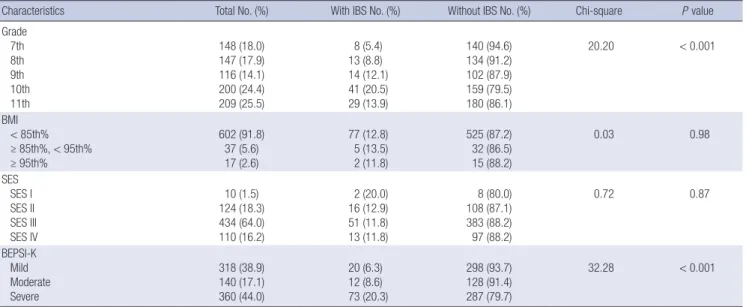
Of a total of 827 students, 820 (99.2%) students answered to these questionnaires and among them 105 (12.8%) met the di-
agnosis criteria of IBS. As the rates of IBS in middle school and high school girls were 35 (8.5%) of 411 and 70 (17.1%) of 409, respectively, there was a significant difference between the two groups (P < 0.001) (Table 1). For SES the prevalence was signifi- cantly higher in SES I group by recording 20%, but other groups did not show any significant difference.
Dietary habits and lifestyle
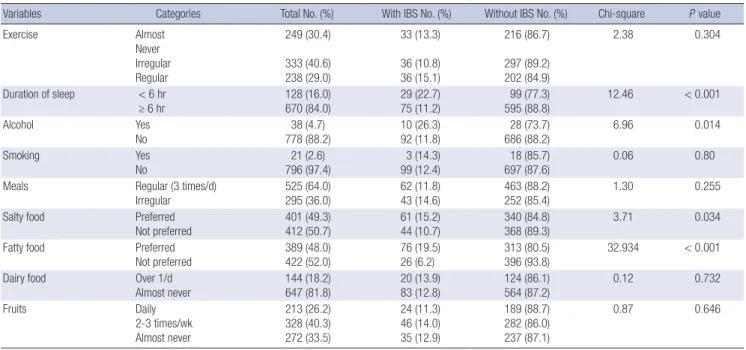
In relation to the nine questions about dietary habits and life- style, the groups liking fatty foods (P < 0.001), liking salty foods (P = 0.034), drinking alcohol (P = 0.014) and sleeping for less than six hours a day (P < 0.001) recorded significantly higher prevalence of IBS. On the contrary, regular exercise, smoking and fruit and milk intake and regular meals did not produce any significant difference compared to the normal group (Table 2). When worry and stress scores were compared according to sleep time, the worry score of the group sleeping for less than six hours a day (20.16 ± 9.14) and that of the group sleeping for over six hours a day (18.80 ± 9.05) were similar (P = 0.126). Multi- variate regression analysis revealed that sleeping for less than six hours a day and liking fatty foods were independently relat- ed with prevalence of IBS (Table 3).
Correlation between IBS and worry
PSWQ-C score was significantly higher in the IBS group than the normal group (P < 0.001) (Fig. 1). In comparison between middle school and high school students, PSWQ-C score of high school girls was significantly higher than that of middle school students (P = 0.001), and comparison of worry score by grade did not find any significant difference but the score tended to be higher in the upper grades (P = 0.064) (Fig. 2).
Table 1. Comparison of general characteristics between two groups
Characteristics Total No. (%) With IBS No. (%) Without IBS No. (%) Chi-square P value
Grade 7th 8th 9th 10th 11th
148 (18.0) 147 (17.9) 116 (14.1) 200 (24.4) 209 (25.5)
8 (5.4) 13 (8.8) 14 (12.1) 41 (20.5) 29 (13.9)
140 (94.6) 134 (91.2) 102 (87.9) 159 (79.5) 180 (86.1)
20.20 < 0.001
BMI < 85th%
≥ 85th%, < 95th%
≥ 95th%
602 (91.8) 37 (5.6) 17 (2.6)
77 (12.8) 5 (13.5) 2 (11.8)
525 (87.2) 32 (86.5) 15 (88.2)
0.03 0.98
SES SES I SES II SES III SES IV
10 (1.5) 124 (18.3) 434 (64.0) 110 (16.2)
2 (20.0) 16 (12.9) 51 (11.8) 13 (11.8)
8 (80.0) 108 (87.1) 383 (88.2) 97 (88.2)
0.72 0.87
BEPSI-K Mild Moderate Severe
318 (38.9) 140 (17.1) 360 (44.0)
20 (6.3) 12 (8.6) 73 (20.3)
298 (93.7) 128 (91.4) 287 (79.7)
32.28 < 0.001
IBS, Irritable Bowel Syndrome; BMI, Body mass index, weight in kilogram divided by height in meters squared; SES, Socioeconomic status by the Hollingshed index; BEPSI-K, Brief Encounter Psychosocial Instrument (BEPSI), Korean version.
Correlation between IBS and stress
According to the average of five questions of BEPSI-K the sub- jects were classified into mild-stress, moderate-stress and se- vere-stress groups with less than 1.7 points, 1.7-2.1 points and over 2.1 points, respectively (29). The IBS group showed higher stress score (P < 0.001) and the prevalence of IBS was signifi- cantly higher in the severe stress group than in the mild stress group by recording 20.3% and 6.3%, respectively (Table 1). Com- parison between middle school and high school girls found that the stress score of high school students was higher than that of middle school ones (P = 0.009), and comparison by grade re- vealed that upper grades tended to be associated with severe
stress score although the difference was not statistically signifi- cant (P = 0.056) (Fig. 2). Multi-variate regression analysis showed that severe stress was independently related with prevalence of IBS. In particular, its odd ratio was 2.54 for severe stress to mild stress group (95% CI 1.47-4.39) (Table 3).
DISCUSSION
Keefer et al. (30) said that although patients diagnosed with IBS were found not to be highly anxious, they reported high levels of intolerance of uncertainty, which is a construct found to be highly related to worry. In addition, they also showed that worry Table 2. Comparison of dietary and lifestyle variables between two groups
Variables Categories Total No. (%) With IBS No. (%) Without IBS No. (%) Chi-square P value
Exercise Almost
Never Irregular Regular
249 (30.4) 333 (40.6) 238 (29.0)
33 (13.3) 36 (10.8) 36 (15.1)
216 (86.7) 297 (89.2) 202 (84.9)
2.38 0.304
Duration of sleep < 6 hr
≥ 6 hr
128 (16.0) 670 (84.0)
29 (22.7) 75 (11.2)
99 (77.3) 595 (88.8)
12.46 < 0.001
Alcohol Yes
No 38 (4.7)
778 (88.2) 10 (26.3)
92 (11.8) 28 (73.7)
686 (88.2) 6.96 0.014
Smoking Yes
No 21 (2.6)
796 (97.4) 3 (14.3)
99 (12.4) 18 (85.7)
697 (87.6) 0.06 0.80
Meals Regular (3 times/d)
Irregular
525 (64.0) 295 (36.0)
62 (11.8) 43 (14.6)
463 (88.2) 252 (85.4)
1.30 0.255
Salty food Preferred
Not preferred 401 (49.3)
412 (50.7) 61 (15.2)
44 (10.7) 340 (84.8)
368 (89.3) 3.71 0.034
Fatty food Preferred
Not preferred 389 (48.0)
422 (52.0) 76 (19.5)
26 (6.2) 313 (80.5)
396 (93.8) 32.934 < 0.001
Dairy food Over 1/d
Almost never
144 (18.2) 647 (81.8)
20 (13.9) 83 (12.8)
124 (86.1) 564 (87.2)
0.12 0.732
Fruits Daily
2-3 times/wk Almost never
213 (26.2) 328 (40.3) 272 (33.5)
24 (11.3) 46 (14.0) 35 (12.9)
189 (88.7) 282 (86.0) 237 (87.1)
0.87 0.646
IBS, irritable bowel syndrome.
Table 3. Multivariate logistic regression analysis to evaluate risk factors of IBS (n = 782)
Variables Odds ratio 95% CI P value
Sleep ≥ 6 hr < 6 hr
1.00
2.22 1.32-3.75 0.003
Alcohol No Yes
1.00
1.77 0.78-4.00 0.171
Salty food Not preferred Preferred
1.00
1.079 0.68-1.70 0.746
Fatty food Not preferred
Preferred 1.00
3.19 1.94-5.24 < 0.001
BEPSI-K Mild Moderate Severe
1.00 0.88
2.54 0.39-1.98
1.47-4.39 0.746
0.001 P value by Multivariate logistic regression. IBS, Irritable Bowel Syndrome; BEBSI-K, Brief Encounter Psychosocial Instrument (BEPSI), Korean version.
Fig. 1. Comparison of Penn State Worry Questionnaire for Children (PSWQ-C) score between two groups. *P value by t-test.
PSWQ-C
Without IBS With IBS
50.00
40.00
30.00
20.00
10.00
0.00
18.65 ± 8.99 22.07 ± 9.38
*P < 0.001
and state anxiety were proved to be good predictors of GI symp- tom severity, accounting for almost 30% of the variance. They suggest that worry may be an important factor in the onset and/
or maintenance of IBS. IBS patients and chronic worriers tent to devote higher levels of attentional resources toward monitor- ing threatening information and tend to perceive themselves as more vulnerable to disease (31-34). Unfortunately, the mecha- nism by which worry works in developing or maintaining IBS has yet to be elucidated.
IBS is one of functional gastrointestinal disorder occurring without an organic cause. As its symptoms are nonspecific and subjective, it is diagnosed by excluding other organic diseases.
Studies to explain its mechanism have been researched and its pathologic mechanism is explained with brain-gut disorder al- though it is not clearly confirmed (4). Disorder of serotonin reg- ulation cause changes of gastrointestinal movement and imbal- ance of absorption and secretion, and following abnormality of intestinal motility is considered to lead to abdominal pain and discomfort. In addition, not only changes of immune response and intestinal flora but also other various causes have been known to influence the complex gastrointestinal movement. So bowel hypersensitivity, brain-gut disorder and psychiatric and
social factors have been recognized as possible mechanism (4, 6, 35).
Also in this study, students with IBS had a significantly higher stress score and anxiety score as well, which implies that men- tal stress or excessive worry could affect occurrence of IBS. In the case of the anxiety disorder, the hyperactivity of the central norepinephrine system or the abnormal activation of serotonin or GABA receptors acts upon it (7, 36, 37). Such neurotransmit- ters may cause motility disorder in the gastrointestinal system or abnormal susceptibility, which indicates a possibility that stress or excessive worry may increase the imbalance among neurotransmitters in the central nervous system and as a result IBS may occur. According to several reports, patients with IBS who were trained for cognitive behavior therapy were able to control the symptoms of stress and anxiety including school- work-related problems (38) and relaxation therapy such as med- itation, which is helpful to relieve such symptoms (39). Thus, such therapies are expected to be applied to students. In addi- tion, there is a need to formulate an effective plan to relieve the schoolwork stress for the upper grade students who tend to have a higher stress score and anxiety score.
In this study, the incidence rate of IBS reached 8.5% and 17.1%
Fig. 2. Penn State Worry Questionnaire for Children (PSWQ-C) score and Brief Encounter Psychosocial Instrument-Korean version (BEPSI-K) score according to grades. *P, by t-test.
Middle school High school 7th 8th 9th 10th 11th
21.0 18.0 15.0 12.0 9.0 6.0 3.0 0.0
21.0 18.0 15.0 12.0 9.0 6.0 3.0 0.0 17.96
PSWQ-C PSWQ-C
17.60 18.02 18.35
20.15 20.20
20.10 *P = 0.001
7th 8th 9th 10th 11th
Middle school High school
2.00
1.50
1.00
0.50
0.00 2.00
1.50
1.00
0.50
0.00
BEPSI-K BEPSI-K
1.99 2.10 2.20 2.26 2.26
2.09
2.26 *P = 0.009
in middle school students and high school students respective- ly. The incidence rate in middle school students was similar to the rate reported in other studies. But in the case of high school students, it was lower than other studies (19.1 to 25.7%) (17, 22).
It may be because the data of high school seniors were exclud- ed from this study. If the data was included, the results may be similar to those of other studies.
Out of demographic characteristics, lower SES was associat- ed with higher prevalence of IBS, but this study was not thought to reflect the difference in IBS prevalence by SES because the number of students included in SES I group was only ten stu- dents. Large-scale studies could investigate the prevalence ac- cording to SES more accurately.
This study examined prevalence of IBS by subdividing life- style factors among risk factors of IBS and found that the groups sleeping for less than six hours a day, liking salty foods and lik- ing fatty foods recorded significantly higher prevalence. Accord- ing to a study of Lee et al. in 2007, the subjects sleeping for more than six hours a day were found to be more vulnerable to IBS and they reported that the reason was because more sleep time led to less physical activity (22). However, in this study the group sleeping for less than six hours a day showed higher IBS preva- lence and recorded higher worry and stress scores. As described before, it was well known that worry and stress were followed by imbalance of neurotransmitters (7, 37). Such imbalance of various neurotransmitters related with worry and stress was considered to work to provoke both of sleep disturbance and occurrence of IBS. The questionnaire used in this study asked only sleep time, so it could not evaluate the quality of sleep. If future study examines the quality of sleep, it will help to assess correlation between sleep disturbance and IBS.
For alcohol-drinking and smoking which have been known to affect gastrointestinal symptoms among lifestyles, the group not drinking alcohol showed a significantly lower prevalence.
However, in multivariate regression analysis alcohol-drinking was found not to affect prevalence IBS as an independent vari- able. That was considered to be because the alcohol-drinking rate was only about 5% not to reflect its effect on the occurrence of IBS and because the subjects might not answer frankly the question about alcohol-drinking which was not allowed. Alco- hol-drinking rate and smoking rate of the total subjects of this study were 4.7% and 3%, respectively and the levels were differ- ent from those of the survey performed by the Ministry of Health and Welfare in 2007 or 33.6% and 7.9%, respectively. As this study excluded boys, the rates of subjects including male stu- dents were expected to become higher to be similar with those of previous reports.
As limitations of this study, it investigated only preference of dietary factors which could influence IBS. Because it did not quantify actual intake, it could not consider the absolute actual intake of the subjects. If a questionnaire survey on an accurate
diet is conducted, its results will help to provide appropriate countermeasures through improvement of dietary habits. Sec- ond, although it evaluated correlation of IBS with various vari- ables such as lifestyle factors, worry and stress, it could not deter- mine their causal relation because it was a cross-sectional study.
Lastly, this study excluded boys and third grade high school girls.
Prevalence of IBS of females was reported to be two times high- er than that of males and the degree of worry and stress were done to be severer in females than in males, but studies on boys experiencing same stress due to college entrance examination were also considered to be necessary.
Korean adolescents’ worries and stress caused by college en- trance examination and social expectation can be presented eventually as physical symptoms and especially as IBS or one of gastrointestinal symptoms largely influenced by alterations in the neurotransmitters which are involved in the brain-gut axis.
The findings of this study draw a clue that less worry and stress will help decrease IBS symptoms. Additional studies on activi- ties to reduce worry and stress like relaxation therapy and med- itation and on improvement of IBS symptoms will make their application to adolescents easier.
REFERENCES
1. Drossman DA, Camilleri M, Mayer EA, Whitehead WE. AGA technical review on irritable bowel syndrome. Gastroenterology 2002; 123: 2108-31.
2. Han SH, Lee OY. Prevalence of irritable bowel syndrome in Korea : Pop- ulation-based survey using the Rome II criteria. J Gastroenterol Hepatol 2006; 21: 1687-92.
3. Everhart JE, Renault PF. Irritable bowel syndrome in an office-based practice in the United States. Gastroenterology 1991; 100: 998-1005.
4. Mayer EA. Irritable Bowel Syndrome. N Engl J Med 2008; 358: 1692-9.
5. Lee OY. Psychosocial factors and visceral hypersensitivity in irritable bowel syndrome. Korean J Gastroenterol 2006; 47: 111-9.
6. Creed FH. The relationship between psychosocial parameters and out- come in irritable bowel syndrome. Am J Med 1999; 107: 74S-80S.
7. Brown TA, Barlow DH. Classification of anxiety and mood disorders. In:
D. H. Barlow (Ed.), Anxiety and its disorders: the nature and treatment of anxiety and panic. New York: Guilford Press, 2002, p292-327.
8. Garakani A, Win T, Virk S, Gupta S, Kaplan D, Masand PS. Comorbidity of irritable bowel syndrome in psychiatric patients: a review. Am J Ther 2003; 10: 61-7.
9. McGarth JE. A conceptual formulation for research on stress. Social psy- chologic factors in stress. New York: Holt, Reinhart & Winston, 1970, p10-21.
10. Jung JH, So YH. The relationship between entrance examination stress, anger and depression of physical education examinee. J Sport Leis Stud 2008; 34: 1407-19.
11. Kang MH, Jung EE. A study on stress coping strategies and thought sup- pressions of adolescents with excessive worry. Korean J Youth Stud 2003;
10: 439-60.
12. Borkovec TD, Robinson E, Pruzinsky T, DePree JA. Preliminary explo- ration of worry: some characteristics and processes. Behav Res Ther 1983;
21: 9-16.
13. Orton GL. A comparative study of children’s worries. J Psychol 1982; 110:
153-62.
14. Brown JM, O’Keeffe J, Sanders S, Baker B. Developmental changes in children’s cognition to stressful and painful situation. J Pediatr Psychol 1986; 11: 343-57.
15. Muris P, Meesters C, Merckelbach H, Hülsenbeck P. Worry in children is related to perceived parental rearing and attachment. Behav Res Ther 2000; 38: 487-97.
16. Bell-Dolan DJ, Last CG, Strauss CC. Symptoms of anxiety disorders in normal children. J Am Acad Child Adolesc Psychiatry 1990; 29: 759-65.
17. Son YJ, Jun EY, Park JH. Prevalence and risk factors of irritable bowel syndrome in Korean adolescent girls: a school-based study. Int J Nurs Stud 2009; 46: 76-84.
18. Thompson WG, Dotevall G, Drossman DA. Irritable bowel syndrome:
guidelines for the diagnosis. Gastroenterol Int 1989; 2: 92-5.
19. Drossman DA, Li Z, Anduzzi E, Temple RD, Talley NJ, Thompson WG.
U.S. householder survey of functional gastrointestinal disorders. Dig Dis Sci 1993; 38: 1569-80.
20. Thompson WG, Longstreth GF, Drossman DA, Heaton KW, Irvine EJ, Mueller-Lissner SA. Functional bowel disorders and functional abdom- inal pain. In: Drossman DA, Talley NJ, Thompson WG, Whitehead WE, Corazziari E, eds. Rome II: functional gastrointestinal disorders: diagno- sis, pathophysiology, and treatment. 2nd ed. McLean, VA: Degnon Asso- ciates, Inc., 2000, p351-432.
21. Ji SW, Park HJ, Choi JP, Lee TH, Lee DY, Lee SI. Validation of Rome II criteria for functional gastrointestinal disorders in Korean patients. Ko- rean J Gastroenterol 2003; 41: 183-9.
22. Lee KT, Yoo JH, Kim BK, Cheong HK. Prevalence and risk factors of irri- table bowel syndrome in Korean high school students. Korean J Epide- miol 2007; 29: 21-33.
23. Hollingshead AB. Four factor index of social status. 1975. (thesis) 24. Moon JS, Lee SY, Nam CM, Choi JM, Choe BK, Seo JW, Oh K, Jang MJ,
Hwang SS, Yoo MH, et al. 2007 Korean National Growth Charts: review of developmental process and an outlook. Korean J Pediatr 2008; 51:
1-25.
25. Kang SG, Shin JH, Hwang YN, Lee EJ, Song SW. Relations between wor- ry, attachment styles and perceived parental rearing in primary school children. J Korean Acad Fam Med 2008; 29: 854-66.
26. Kang SG, Shin JH, Song SW. Reliability and validity of the Korean ver- sion of the Penn State Worry Questionnaire in primary school children. J Korean Med Sci 2010; 25: 1210-6.
27. Guillemin F, Bombardier C, Beaton D. Cross-cultural adaptation of health-related quality of life measures: literature review and proposed guidelines. J Clin Epidemiol 1993; 46: 1417-32.
28. Beaton DE, Bombardier C, Guillemin F, Ferraz MB. Guidelines for the process of cross-cultural adaptation of self-report measures. Spine 2000;
25: 3186-91.
29. Yim JH, Bae JM, Choi SS, Kim SW, Hwang HS, Huh BY. The validity of modified Korean-translated BEPSI (Brief Encounter Psychosocial Instru- ment) as instrument of stress measurement in outpatient clinic. J Korean Acad Fam Med 1996; 17: 42-53.
30. Keefer L, Sanders K, Sykes MA, Blanchard EB, Lackner JM, Krasner S.
Towards a better understanding of anxiety in irritable bowel syndrome:
a preliminary look at worry and intolerance of uncertainty. J Cogn Psy- chother 2005; 19: 163-72.
31. Gros DF, Antony MM, McCabe RE, Swinson RP. Frequency and severity of the symptoms of irritable bowel syndrome across the anxiety disorders and depression. J Anxiety Disord 2009; 23: 290-6.
32. Butler G, Matthews A. Cognitive processes in anxiety. Adv Behav Res Ther 1983; 5: 551-65.
33. Russel M, Davey GC. The relationship between life events measures and anxiety and its cognitive correlates. Pers Individ Dif 1993; 14: 317-22.
34. Crane C, Martin M. Perceived vulnerability to illness in individuals with irritable bowel syndrome. J Psychosom Res 2002; 53: 1115-22.
35. Han SH, Lee OY, Lee YS, Kim KB, Yoon BC, Choi HS. Anxiety, depres- sion and sleep disturbance in female constipation predominant irritable bowel syndrome. Korean J Neurogastroenterol Motil 2005; 11: 66-71.
36. Kearney DJ, Brown-Chang J. Complementary and alternative medicine for IBS in adults: mind-body interventions. Nat Clin Pract Gastroenterol Hepatol 2008; 5: 624-36.
37. Krystal AD, Goforth HW, Roth T. Effects of antipsychotic medications on sleep in schizophrenia. Int Clin Psychopharmacol 2008; 23: 150-60.
38. Shen YH, Nahas R. Complementary and alternative medicine for treat- ment of irritable bowel syndrome. Can Fam Physician 2009; 55: 143-8.
39. Keefer L, Blanchard EB. A one year follow-up of relaxation response meditation as a treatment for irritable bowel syndrome. Behav Res Ther 2002; 40: 541-6.