INTRODUCTION
Suicide is the second cause of death next to car accidents among adolescents in Korea and is a leading cause of death in Western countries as well (1, 2). Most investigators sug- gest that the rise in suicidality with age in adolescence may be due to the drastic physical and psychological changes that occur during that phase combined with developmental stress, increased social pressures, the increasing drive for individu- ation and an increase in the number of major psychiatric dis- orders during adolescence.
Deliberate self harm is an act with a non-fatal outcome in which an individual deliberately behaves in ways that suggest they intend to commit self harm (3). Deliberate self harm is important due to the fact that clinically untreated deliberate self harm behaviors may precede suicide (4). In the same way, suicidal ideation, particularly in adolescence, and its relation- ship to psychiatric morbidity and completed suicide contin- ue to be a subject of attention (5-8). The seriousness of sui- cidal ideation as a symptom and indicator of psychiatric ill- ness and a marker of distress and poor functioning has been
confirmed in findings from several studies (9). For this reason, much research concerning deliberate self harm behavior and suicidal ideation in adolescents is required in order to assist in the recognition of those at risk as well as in the design of prevention programs.
Several risk factors are known to be associated with self-harm behavior and suicide ideation. These include dysfunctional behavior at school (10, 11), living in broken families (12), pa- rental psychopathology (13), difficulties in relationships with parents and stressful and traumatic life events (14). Aggres- sive behavior, depression, impulsivity, anxiety and substance abuse have been repeatedly shown to be associated with sui- cidal behavior among young people (15, 16).
In spite of the clinical concern and research interest, most Korean studies (17, 18) are performed using a cross-section- al method. There have been few prospective studies regard- ing possible early childhood psychopathology predictors for deliberate self-harm behavior and suicide ideation in Kore- an adolescents. Therefore, longitudinal study that identifies the early childhood risk factors related to suicide is necessary.
The aim of this study is to investigate early childhood pre-
215
Yun Mi Shin, Young Ki Chung, Ki Young Lim, Young Moon Lee*, Eun Young Oh�, and Sun Mi Cho
Departments of Psychiatry and Behavioral Sciences, and Medical Humanities & Social Medicines*, Ajou University School of Medicine, Suwon; Oh’s Psychiatric Clinic�, Suwon, Korea
Address for correspondence Sun Mi Cho, Ph.D.
Department of Psychiatry, School of Medicine, Ajou University, San 5 Wonchon-dong, Yeongtong-gu, Suwon 443-749, Korea
Tel : +82.31-219-5813, Fax : +82.31-219-4380 E-mail : [email protected]
*This work was supported in part by a grant from the Ajou University Research Foundation.
DOI: 10.3346/jkms.2009.24.2.215
Childhood Predictors of Deliberate Self-Harm Behavior and Suicide Ideation in Korean Adolescents: A Prospective Population-Based Follow-Up Study
The aim of this study was to investigate predictors of adolescence suicidality in a longitudinal study. Additionally, the prevalence of deliberate self-harm behavior and suicide ideation at age 7 and during middle school were examined. Initial assessment data was obtained from 1998 to 2000, and a follow-up assessment was performed in 2006 when the original subjects became middle school students. The address- es and names of 1,857 subjects were located from the original data; they were 910 boys and 947 girls. The subjects were evaluated with the Korean version of the Child Behavior Checklist (K-CBCL), which was administered by the parents of the chil- dren, and by various demographic and psychosocial factors. They were reassessed using self reports on the Korea Youth Self Report (K-YSR); in particular, replies to items related to self-harm behavior and suicide ideation were recorded. A logistic regression analysis showed that the factors of gender, economic status, the over- all amount of behavior problems, the tendency to internalizing and externalizing prob- lems, somatic problems, thought problems, delinquent behavior, and aggressive behavior were independent predictors of adolescent suicide ideation and self-harm behavior. The importance of total behavior problems suggested that adolescent dif- ficulty is a consequence of an accumulation of various risk factors. Accordingly, clin- icians must consider a range of internalizing and externalizing issues, especially over- all adaptation, for suicide intervention.
Key Words : Child; Adolescent; Suicide; Longitudinal Studies
Received : 8 July 2007 Accepted : 22 June 2008
dictors of adolescent deliberate self-harm behavior and suicide ideation longitudinally. The prevalence of suicide ideation and acts of deliberate self-harm in 7-yr-old boys and girls and in middle school students is also reported.
MATERIALS AND METHODS Subjects
This study was part of a larger epidemiological study on child psychiatric disorders conducted in Osan, a small city southwest of Seoul, Korea. During a periodic health exami- nation, a survey was performed by the Child Mental Health Care Center. The data were collected in two separate in- stances (1998-2000 and 2006). The first assessment was con- ducted with the approval from teachers and parents. All of the first grade children in an entire primary school were re- cruited for the study, resulting in a study group of 3,808 pupils.
A follow-up assessment was performed in 2006 when the original subjects became middle school students. This was composed of two stages. In the first stage, all 14-16-yr-old adolescents who were living in Osan city were requested to complete the questionnaire with parental consent. The total number of subjects was 5,670. After the adolescents complet- ed the questionnaire, their personal information was compared with the data obtained in 1998-2000. As a result, 1,857 ma- tched sets of data originating form the same person at differ- ent times were obtained and were enrolled in this study. The retention rate was 48.8% and the mean age of the children at the first time point was 6.85 yr (S.D. 0.41); at the second time point, the mean age was 13.75 yr (S.D. 1.0).
Methods
At the first time point, children were evaluated by parents using the Korean version of the Child Behavior Checklist (K- CBCL) to investigate behavioral problems. The K-CBCL forms, a frequently used instrument with 119 items providing par- ent-reported data on problem behavior in children, were sent home with each child, completed by the parents, and were then collected after 3 to 5 days. The K-CBCL score was com- puted based on Korean normative samples (19), with the total problem behavior score computed by summing the scores ob- tained for each item. The 90th percentile cut-off point, based on the distribution of the scores in the sample, was consid- ered to depict poor adaptive functioning in each of these life areas.
In addition to the CBCL, the parents also completed a gen- eral questionnaire covering family structure, parental educa- tion and economic status, and the age and gender of the child.
Education level was divided into two categories: parents who had completed a minimum of twelve years of schooling and those with less than twelve years. Economic status was divid-
ed into three categories based on family income.
During the follow-up, the psychopathology and adaptive functioning of the subjects were studied with the Korea Youth Self Report (K-YSR) (20). The YSR was developed for the assessment of psychopathology during the six month in ado- lescence directly preceding the exam. Self-reports of ideations of suicide during the preceding six months was determined in the YSR using the question: “I think about killing myself”
and acts of deliberate self-harm were determined by the ques- tion: “I deliberately try to hurt or kill myself” (alternatives 0=not true, 1=somewhat or sometimes true, 2=very true or often true; alternatives 1 and 2 were pooled together).
Similar questions were asked in parent questionnaires for 7-yr-old children on the CBCL. A child was defined as belong- ing to the deliberate self harm or suicide ideation group if their parents reported ideations or acts of deliberate self harm dur- ing the preceding six months.
Statistical analysis
In this study, a chi-square test was performed to examine the differences in background characteristics that included the family structure as well as the parental income and edu- cation levels between the boys and girls. The prevalence of deliberate self-harm behavior and suicide ideation in children and adolescents by gender was calculated, and the level of agreement on deliberate self harm behavior and suicide idea- tion between boys and girls was analyzed using a proportion- al agreement test.
Statistically, multiple methods were implemented to ana- lyze predictors of deliberate self-harm behavior and suicide ideation. First, with self-harm behavior and suicide ideation serving as dependent variables and the socio-demographic data and childhood psychopathology serving as independent vari- ables, a logistic regression analysis evaluated the association between the variables. The odds ratio (OR) and 95% confi- dence intervals (95% CI) were calculated using univariate and multivariate logistic regression analyses for all variables sig- nificant at the p<0.05 level.
Due to the hierarchical relationship of the eight CBCL syn- drome scales and the externalizing, internalizing, and total problem scales, regression analyses performed according to three different sets of variables were necessary: the first set in- cluded the total problem score, the second set encompassed the externalizing and internalizing scores, and the third set included the eight syndrome scores.
A p value of less than 0-05 was regarded as statistically sig- nificant.
RESULTS
Of the 1,857 students in total, 910 (49.0%) were boys. Wh- ile boys were outnumbered by girls 910 (49.0%) to 947 (51.0
%), a comparison of the socio-demographic variables of the family structure ( 2=0.01, p>0.05), the father’s education level ( 2=0.25, p>0.05), the mother’s education level ( 2=1.41, p>0.05), and the economic status of the family ( 2=2.13, p>
0.05) revealed no statistically significant differences by gen- der (Table 1).
The prevalence of ideations and acts of deliberate self-harm during childhood and adolescence are presented Table 2. In the parent reports at childhood, 6.76% of the girls and 5.51%
of boys reported deliberate self-harm behavior, while in the self-reports at adolescence, 10.51% of girls and 7.85% of boys reported this behavior. According to the parent reports,
4.65% of the girls and 4.40% of boys showed suicide ideation.
The self-reports of the adolescents showed that 32.87% of the girls and 17.50% of the boys reported suicide ideation (Table 2). Furthermore, gender was a significant factor for acts ( 2=3.89, p<0.05) and ideation ( 2=57.74, p<0.01) in adolescence, as girls were found to have significantly more acts and thoughts related to suicide compared to boys. How- ever, no significant difference related to gender was found in the parent-reported surveys concerning ideations or acts by children.
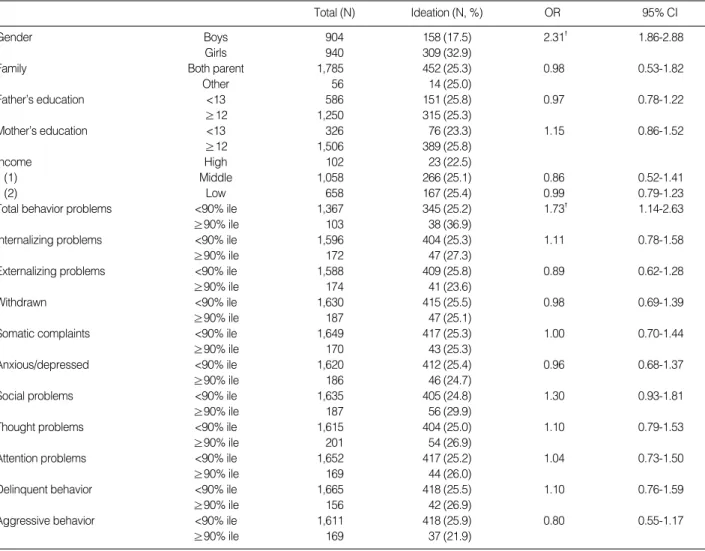
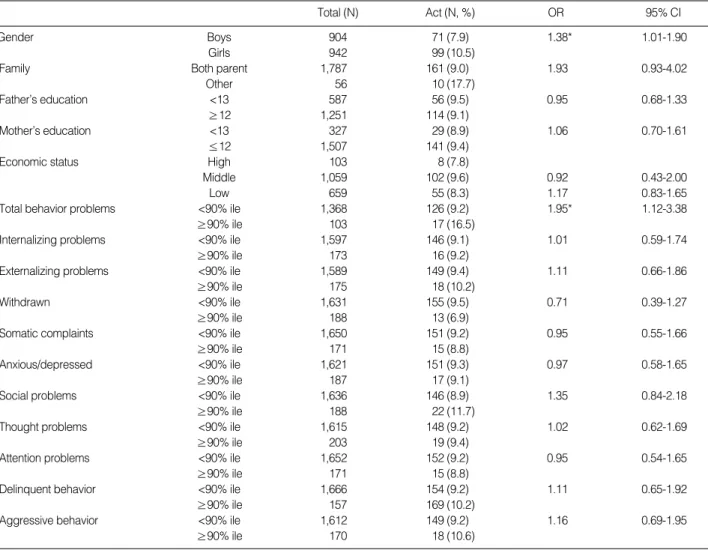
The factors associated with suicide ideation and deliberate self-harm behavior in school-aged children were investigat- ed. In the univariate regression analysis shown in Table 3, 4, gender (OR 2.31, 95% CI=1.86-2.88) and total problems (OR 1.73, 95% CI=1.14-2.63) in the CBCL were associat- ed with suicide ideation. Additionally, gender (OR 1.8, 95%
CI=1.00-1.90) and total problems (OR 1.95, 95% CI=1.12- 3.38) in the CBCL were associated with deliberate self-harm behavior.
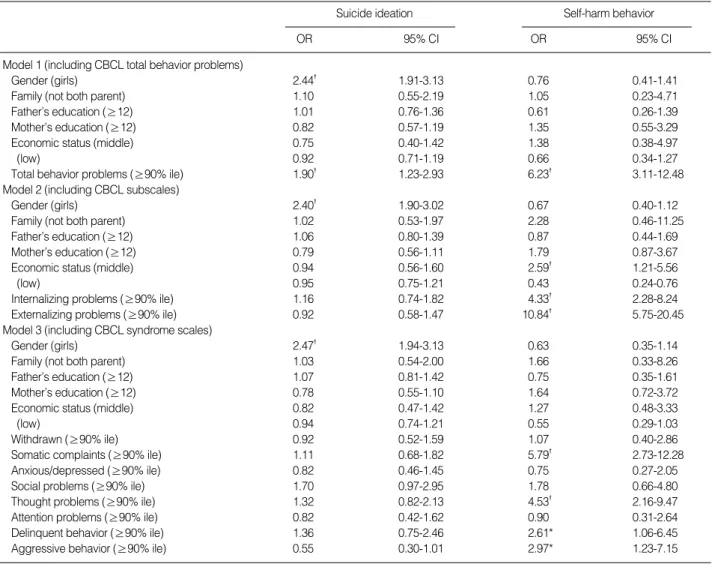
Demographic variables, family structure, and parent reports of psychopathology were entered into a multivariate analy- sis. Due to the hierarchical relationship between the CBCL total problems, subscales, and syndrome scales, analyses were performed in three models (Table 5).
As shown in Table 5, female gender (OR 2.44, 95% CI=
1.91-3.13) and CBCL total problems (OR 1.90, 95% CI=
1.2-2.93) at age 7 independently predicted acts of suicide id- eation. Moreover, economic status (OR 2.59, 95% CI=1.21- 5.56), CBCL total problems (OR 6.23, 95% CI=3.11-12.48), externalizing problems (OR 10.84, 95% CI=5.75-20.45), internalizing problems (OR 4.33, 95% CI=2.28-8.24), somat- ic problems (OR 5.59, 95% CI=2.73-12.28), thought prob- lems (OR 4.53, 95% CI=2.16-9.47), delinquent behaviors (OR 2.61, 95% CI=1.06-6.45), and aggressive behaviors (OR
*p<0.05; �p<0.01.
Analyses were performed using the chi-square test.
Boys (%) Girls (%) Total 2
Grade 1 377 (51.22) 359 (48.77) 736 4.5
2 274 (49.81) 276 (50.18) 550
3 250 (45.37) 301 (54.62) 551
Total 901 (49.04) 936 (50.95) 1,837 Family Both parents 881 (48.99) 917 (51.01) 1,798 0.01
Other 27 (48.21) 29 (51.78) 56 Total 908 (48.97) 946 (51.03) 1,854 Father’s <13 294 (49.74) 297 (50.25) 591 0.25
education ≥12 610 (48.48) 648 (51.51) 1,258 Total 904 (48.89) 945 (51.11) 1,849 Mother’s <13 163 (49.65) 165 (50.30) 328 0.12
education ≥12 738 (48.64) 779 (51.35) 1,517 Total 901 (48.83) 944 (51.16) 1,845 Economic High 54 (51.42) 51 (48.57) 105 2.13
status Middle 505 (47.46) 559 (52.53) 1,064 Low 337 (50.82) 326 (49.17) 663 Total 896 (48.90) 936 (51.09) 1,832 Table 1. Background characteristics of the children by gender
*p<0.05; �p<0.01.
Analyses were performed using the chi-square test.
Self-harm behavior
Total 2
Child
Boys Girls
Suicide ideation
Total 2
Boys Girls
No N 858 883 1,741 1.25 866 903 1,769 0.06
% 94.49 93.24 93.85 95.60 95.35 95.46
Yes N 50 64 114 40 44 84
% 5.51 6.76 6.15 4.40 4.65 4.53
Total N 908 947 1,855 906 947 1,853
Table 2. Prevalence of deliberate self-harm behavior and suicide ideation at age 7 and as adolescents by gender
Self-harm behavior
Total 2
Boys Girls
Suicide ideation
Total 2
Boys Girls
Adolescent
No N 833 843 1,676 3.89* 746 631 1,377 57.74�
% 92.15 89.49 90.79 82.50 67.13 74.67
Yes N 71 99 170 158 309 467
% 7.85 10.51 9.21 17.50 32.87 25.33
Total N 904 942 1,846 904 940 1,844
2.97, 95% CI=1.23-7.15) at age 7 predicted acts of deliber- ate self-harm.
DISCUSSION
Predictors of adolescence suicidality were investigated in this study. In a univariate analysis, gender and total problems of the CBCL were found to be associated with suicide ideation and deliberate self-harm. In addition, gender and CBCL total problems at age 7 independently predicted acts of suicide id- eation according to a multivariate analysis. Economic status, CBCL total problems, externalizing problems, internalizing problems, somatic problems, thought problems, delinquent behaviors, and aggressive behaviors at age 7 predicted acts of deliberate self-harm behavior.
In these results, it was noteworthy that suicide ideation was related to total problems while it was not related to internal- izing problems or externalizing problems. As depressive symp-
toms are often found to form a common antecedent to ado- lescent suicidality and complete suicide (14, 21), it was rea- sonable that internalizing problems predicted suicidality. But recent investigations have demonstrated that psychopathol- ogy were resulted from accumulated problems and that most risk factors are held to predict symptom severity and not di- rectionality (22). According to those studies, the risk factors for internalizing and externalizing problems may be indistin- guishable. The results in which children who showed conduct and internalizing problems had the worst outcomes (23) also suggest that the direction of psychopathology might be dis- continuous and that combined problems are more serious. The results obtained in our survey are interpreted to be in agree- ment with those previous studies.
Many risk factors are known to be associated with suicidal behaviors and acts according to previous studies; these include diverse socioeconomic problems, psychiatric disorders such as depression, anxiety disorders, conduct disorders, and alco- hol and drug abuse (9, 24, 25). Psychiatric disorders in the
*p<0.05; �p<0.01. Analyses were performed using univariate logistic regression analyses.
CI, confidence interval; OR, odds ratio.
Total (N) Ideation (N, %) OR 95% CI
Gender Boys 904 158 (17.5) 2.31� 1.86-2.88
Girls 940 309 (32.9)
Family Both parent 1,785 452 (25.3) 0.98 0.53-1.82
Other 56 14 (25.0)
Father’s education <13 586 151 (25.8) 0.97 0.78-1.22
≥12 1,250 315 (25.3)
Mother’s education <13 326 76 (23.3) 1.15 0.86-1.52
≥12 1,506 389 (25.8)
Income High 102 23 (22.5)
(1) Middle 1,058 266 (25.1) 0.86 0.52-1.41
(2) Low 658 167 (25.4) 0.99 0.79-1.23
Total behavior problems <90% ile 1,367 345 (25.2) 1.73� 1.14-2.63
≥90% ile 103 38 (36.9)
Internalizing problems <90% ile 1,596 404 (25.3) 1.11 0.78-1.58
≥90% ile 172 47 (27.3)
Externalizing problems <90% ile 1,588 409 (25.8) 0.89 0.62-1.28
≥90% ile 174 41 (23.6)
Withdrawn <90% ile 1,630 415 (25.5) 0.98 0.69-1.39
≥90% ile 187 47 (25.1)
Somatic complaints <90% ile 1,649 417 (25.3) 1.00 0.70-1.44
≥90% ile 170 43 (25.3)
Anxious/depressed <90% ile 1,620 412 (25.4) 0.96 0.68-1.37
≥90% ile 186 46 (24.7)
Social problems <90% ile 1,635 405 (24.8) 1.30 0.93-1.81
≥90% ile 187 56 (29.9)
Thought problems <90% ile 1,615 404 (25.0) 1.10 0.79-1.53
≥90% ile 201 54 (26.9)
Attention problems <90% ile 1,652 417 (25.2) 1.04 0.73-1.50
≥90% ile 169 44 (26.0)
Delinquent behavior <90% ile 1,665 418 (25.5) 1.10 0.76-1.59
≥90% ile 156 42 (26.9)
Aggressive behavior <90% ile 1,611 418 (25.9) 0.80 0.55-1.17
≥90% ile 169 37 (21.9)
Table 3. Univariate association between suicide ideation and significant variables at age 7
family, separation from parents and sexual abuse are regard- ed as important factors related to suicide (10, 26, 27). It was generally found that children in families of low economic sta- tus showed a high proportion of suicide ideation and self- harm behavior (14). Our result that economic status was relat- ed to suicide ideation is consistent with previous findings.
The factors associated with self-harm behavior were greater in number compared to those of suicide ideation; more aggres- sive, impulsive features such as delinquent behavior were in- cluded in this finding. Some research has demonstrated that the continuum from suicidal thoughts to attempts at suicide to completed suicide is not linear (15). Despite the overlap be- tween self-harm attempts and ideations and despite the sig- nificant prediction of future attempts from ideations, the fact that the diagnostic profiles of attempters and those who expe- rience suicide ideation are somewhat different was clarified (28). Considering the data from this study, it is presumed that diverse factors including aggressive behaviors, somatic com- plaints, and thought problems during childhood was pow-
erful factor related to adolescent suicidality. As suicide atte- mpts, self-harm behavior, or completed suicide appear to be determined by various elements, future work needs to focus on the different mechanisms affecting suicide-related acts and ideation.
The prevalence of deliberate self-harm behavior and sui- cide ideation at age 7 and in middle school age were exam- ined. Whereas most studies in Korea have relied on cross-sec- tional data (29, 30), a strength of the present study is that lon- gitudinal data was collected. According to parental reports at age 7, 6.76% of girls and 5.51% of boys engaged in delib- erate self-harm behavior, while 4.65% of girls and 4.40% of boys reportedly engaged in suicide ideation. In general, the results of the present study are in line with other epidemio- logic studies that found reported prevalence rates of suicide ideation and prevalence rates of self-harm behaviors ranging from 2% to 20% (31, 32).
The fact that the ratio of self-harm behavior exceeded sui- cide ideation was noteworthy. This is believed to relate to the
*p<0.05; �p<0.01. Analyses were performed using univariate logistic regression analyses.
CI, confidence interval; OR, odds ratio.
Total (N) Act (N, %) OR 95% CI
Gender Boys 904 71 (7.9) 1.38* 1.01-1.90
Girls 942 99 (10.5)
Family Both parent 1,787 161 (9.0) 1.93 0.93-4.02
Other 56 10 (17.7)
Father’s education <13 587 56 (9.5) 0.95 0.68-1.33
≥12 1,251 114 (9.1)
Mother’s education <13 327 29 (8.9) 1.06 0.70-1.61
≤12 1,507 141 (9.4)
Economic status High 103 8 (7.8)
Middle 1,059 102 (9.6) 0.92 0.43-2.00
Low 659 55 (8.3) 1.17 0.83-1.65
Total behavior problems <90% ile 1,368 126 (9.2) 1.95* 1.12-3.38
≥90% ile 103 17 (16.5)
Internalizing problems <90% ile 1,597 146 (9.1) 1.01 0.59-1.74
≥90% ile 173 16 (9.2)
Externalizing problems <90% ile 1,589 149 (9.4) 1.11 0.66-1.86
≥90% ile 175 18 (10.2)
Withdrawn <90% ile 1,631 155 (9.5) 0.71 0.39-1.27
≥90% ile 188 13 (6.9)
Somatic complaints <90% ile 1,650 151 (9.2) 0.95 0.55-1.66
≥90% ile 171 15 (8.8)
Anxious/depressed <90% ile 1,621 151 (9.3) 0.97 0.58-1.65
≥90% ile 187 17 (9.1)
Social problems <90% ile 1,636 146 (8.9) 1.35 0.84-2.18
≥90% ile 188 22 (11.7)
Thought problems <90% ile 1,615 148 (9.2) 1.02 0.62-1.69
≥90% ile 203 19 (9.4)
Attention problems <90% ile 1,652 152 (9.2) 0.95 0.54-1.65
≥90% ile 171 15 (8.8)
Delinquent behavior <90% ile 1,666 154 (9.2) 1.11 0.65-1.92
≥90% ile 157 169 (10.2)
Aggressive behavior <90% ile 1,612 149 (9.2) 1.16 0.69-1.95
≥90% ile 170 18 (10.6)
Table 4. Univariate association between deliberate self-harm behavior and significant variables at age 7
data from their parents. Although the prevalence of suicide ideations and self-harm behaviors in children in this study were not clearly lower than this statistic in other studies (31, 33), the possibility of underestimation should be considered. The prevalence of parent-reported suicidal behavior is markedly lower than the self-reported rate from previous research (16, 34). As shown in other studies, in which depressive children were found to show not only negative moods but also deviant behaviors, the patterns of childhood mood symptoms are gen- erally accepted to be unlike those of adults; parents may fail to report the mood and thoughts of their children accurate- ly (35). This result implies that parents are more sensitive to the behaviors of their children than to the thoughts or to affective states of their children.
The results here confirmed that gender was significant for suicidal acts and ideation in adolescence. It was found that girls have significantly more acts and thoughts compared to boys. However, no significant differences in terms of gender
were found in the parent-reported ideations or acts of children.
Most Korean studies in this area have shown that suicidal acts and ideations are more common among females (4, 17, 29, 33). In this study, the prevalence rate of self-reported delib- erate self harm and suicide ideation increased dramatically from age 12 to age 15 among girls; however, this was not the case for boys. This result reaffirms that gender is an important factor in the prevention of suicide.
The strength of this longitudinal study lies in the commu- nity-based sampling method. The results obtained in the sur- vey are in agreement with those of most previous studies in which adolescent suicide ideation and self-harm behaviors are affected by various factors such as gender, socio-economic envi- ronment, and internalizing and externalizing problems. The finding regarding the total behavior problems score has spe- cial importance, as this finding supports the accumulative as- sumption that subjective difficulties, including suicide idea- tion and acts by a child are the outcome of an accumulation
*p<0.05; �p<0.01. Analyses were performed using multivariate multinomial logistic regression analyses.
CI, confidence interval; OR, odds ratio; CBCL, child behavior checklist.
Suicide ideation Self-harm behavior
OR 95% CI OR 95% CI
Model 1 (including CBCL total behavior problems)
Gender (girls) 2.44� 1.91-3.13 0.76 0.41-1.41
Family (not both parent) 1.10 0.55-2.19 1.05 0.23-4.71
Father’s education (≥12) 1.01 0.76-1.36 0.61 0.26-1.39
Mother’s education (≥12) 0.82 0.57-1.19 1.35 0.55-3.29
Economic status (middle) 0.75 0.40-1.42 1.38 0.38-4.97
(low) 0.92 0.71-1.19 0.66 0.34-1.27
Total behavior problems (≥90% ile) 1.90� 1.23-2.93 6.23� 3.11-12.48
Model 2 (including CBCL subscales)
Gender (girls) 2.40� 1.90-3.02 0.67 0.40-1.12
Family (not both parent) 1.02 0.53-1.97 2.28 0.46-11.25
Father’s education (≥12) 1.06 0.80-1.39 0.87 0.44-1.69
Mother’s education (≥12) 0.79 0.56-1.11 1.79 0.87-3.67
Economic status (middle) 0.94 0.56-1.60 2.59� 1.21-5.56
(low) 0.95 0.75-1.21 0.43 0.24-0.76
Internalizing problems (≥90% ile) 1.16 0.74-1.82 4.33� 2.28-8.24
Externalizing problems (≥90% ile) 0.92 0.58-1.47 10.84� 5.75-20.45
Model 3 (including CBCL syndrome scales)
Gender (girls) 2.47� 1.94-3.13 0.63 0.35-1.14
Family (not both parent) 1.03 0.54-2.00 1.66 0.33-8.26
Father’s education (≥12) 1.07 0.81-1.42 0.75 0.35-1.61
Mother’s education (≥12) 0.78 0.55-1.10 1.64 0.72-3.72
Economic status (middle) 0.82 0.47-1.42 1.27 0.48-3.33
(low) 0.94 0.74-1.21 0.55 0.29-1.03
Withdrawn (≥90% ile) 0.92 0.52-1.59 1.07 0.40-2.86
Somatic complaints (≥90% ile) 1.11 0.68-1.82 5.79� 2.73-12.28
Anxious/depressed (≥90% ile) 0.82 0.46-1.45 0.75 0.27-2.05
Social problems (≥90% ile) 1.70 0.97-2.95 1.78 0.66-4.80
Thought problems (≥90% ile) 1.32 0.82-2.13 4.53� 2.16-9.47
Attention problems (≥90% ile) 0.82 0.42-1.62 0.90 0.31-2.64
Delinquent behavior (≥90% ile) 1.36 0.75-2.46 2.61* 1.06-6.45
Aggressive behavior (≥90% ile) 0.55 0.30-1.01 2.97* 1.23-7.15
Table 5. Multivariate association between suicide ideation, deliberate self-harm behavior and significant variables at age 7
of earlier family distress factors as well as the child’s external- izing and internalizing problems. These results suggest that clinicians must consider various internalizing problems and behavioral problems as important risk factors for the diagno- sis of trouble and for the intervention of suicide.
The present study is subject to certain limitations. First, as the duration of the follow-up assessments differed, some students were assessed 6 yr after the first assessment, and oth- ers were evaluated 7 or 8 yr later. However, a high proportion of other findings in this area have been reported using vari- ous age ranges, and this did not appear to be a central issue.
Second, only a small portion, 48.8%, of original subjects participated in the follow-up survey. This transpired because reassessment data was obtained only from subjects who did not alter their residence.
Third, although the sample in this study was sufficiently large and although well-established instruments were used to interpret the findings, the scale of the investigation pre- vented the conduction of person-to-person interviews with structured, diagnosing interview forms. This limited access to information regarding psychiatric diagnoses. Thus, a diag- nostic formulation should be performed in a further study for further understanding.
REFERENCES
1. WHO. WHO statistical information system. In: Website: http:
//www3. who.int/whosis/menu.cfm, 2004.
2. Office KNS. Deaths and death rates By cause (103 item)/By sex/By age. In: Website: http: //www.nso.go.kr/, 2005.
3. Hawton K, Rodham K, Evans E, Weatherall R. Deliberate self harm in adolescents: self report survey in schools in England. BMJ 2002;
325: 1207-11.
4. Hawton K, Houston K, Shepperd R. Suicide in young people. Study of 174 cases, aged under 25 years, based on coroners’ and medical records. Br J Psychiatry 1999; 175: 271-6.
5. Meehan PJ, Lamb JA, Saltzman LE, O’Carroll PW. Attempted sui- cide among young adults: progress toward a meaningful estimate of prevalence. Am J Psychiatry 1992; 149: 41-4.
6. Lieberman EJ. Suicidal ideation and young adults. Am J Psychiatry 1993; 150: 171.
7. Ahrens B, Linden M, Zaske H, Berzewski H. Suicidal behavior-symp- tom or disorder? Compr Psychiatry 2000; 41 (2 Suppl 1): 116-21.
8. Dhossche D, Ferdinand R, van der Ende J, Hofstra MB, Verhulst F.
Diagnostic outcome of adolescent self-reported suicidal ideation at 8-year follow-up. J Affect Disord 2002; 72: 273-9.
9. Reinherz HZ, Giaconia RM, Silverman AB, Friedman A, Pakiz B, Frost AK, Cohen E. Early psychosocial risks for adolescent suicidal ideation and attempts. J Am Acad Child Adolesc Psychiatry 1995;
34: 599-611.
10. Gould MS, King R, Greenwald S, Fisher P, Schwab-Stone M, Kramer R, Flisher AJ, Goodman S, Canino G, Shaffer D. Psychopathology associated with suicidal ideation and attempts among children and
adolescents. J Am Acad Child Adolesc Psychiatry 1998; 37: 915-23.
11. Gould MS, Fisher P, Parides M, Flory M, Shaffer D. Psychosocial risk factors of child and adolescent completed suicide. Arch Gen Psy- chiatry 1996; 53: 1155-62.
12. Brent DA, Perper JA, Moritz G, Allman C, Friend A, Roth C, Schweers J, Balach L, Baugher M. Psychiatric risk factors for adolescent sui- cide: a case-control study. J Am Acad Child Adolesc Psychiatry 1993;
32: 521-9.
13. Fergusson DM, Beautrais AL, Horwood LJ. Vulnerability and resilien- cy to suicidal behaviours in young people. Psychol Med 2003; 33:
61-73.
14. Beautrais AL, Joyce PR, Mulder RT. Risk factors for serious suicide attempts among youths aged 13 through 24 years. J Am Acad Child Adolesc Psychiatry 1996; 35: 1174-82.
15. Apter A, Gothelf D, Orbach I, Weizman R, Ratzoni G, Har-Even D, Tyano S. Correlation of suicidal and violent behavior in different diagnostic categories in hospitalized adolescent patients. J Am Acad Child Adolesc Psychiatry 1995; 34: 912-8.
16. Sourander A, Aromaa M, Pihlakoski L, Haavisto A, Rautava P, Hele- nius H, Sillanpaa M. Early predictors of deliberate self-harm among adolescents. A prospective follow-up study from age 3 to age 15. J Affect Disord 2006; 93: 87-96.
17. Cho SJ, Jeon HJ, Kim JK, Suh TW, Kim SU, Hahm BJ, Suh DH, Chung SJ, Cho MJ. Prevalence of suicide behaviors (suicidal ideation and suicide attempt) and risk factors of suicide attempts in junior and high school adolescents. J Korean Neuropsychiatr Assoc 2002;
41: 1142-55.
18. Kim HS. Predictors of suicide attempts in the Korean adolescent population. Korean J Child Health Nurs 2005; 11: 34-42.
19. Oh K, Hong K, Lee H, Ha E. K-CBCL. Seoul, Korea: Chung Ang Aptitude Publishing Co; 1997.
20. Oh K, Ha E, Lee H, Hong K. K-YSR. Seoul, Korea: Chung Ang Apti- tude Publishing Co; 2001.
21. Marttunen MJ, Aro HM, Henriksson MM, Lonnqvist JK. Mental disorders in adolescent suicide. DSM-III-R axes I and II diagnoses in suicides among 13-to 19-year-olds in Finland. Arch Gen Psychi- atry 1991; 48: 834-9.
22. Essex MJ, Kraemer HC, Armstrong JM, Boyce WT, Goldsmith HH, Klein MH, Woodward H, Kupfer DJ. Exploring risk factors for the emergence of children’s mental health problems. Arch Gen Psychi- atry 2006; 63: 1246-56.
23. Sourander A, Jensen P, Davies M, Niemela S, Elonheimo H, Ristkari T, Helenius H, Sillanmaki L, Piha J, Kumpulainen K, Tamminen T, Moilanen I, Almqvist F. Who is at greatest risk of adverse long-term outcomes? The Finnish From a Boy to a Man study. J Am Acad Child Adolesc Psychiatry 2007; 46: 1148-61.
24. Lewinsohn PM, Rohde P, Seeley JR. Psychosocial characteristics of adolescents with a history of suicide attempt. J Am Acad Child Ado- lesc Psychiatry 1993; 32: 60-8.
25. Reinherz HZ, Tanner JL, Berger SR, Beardslee WR, Fitzmaurice GM.
Adolescent suicidal ideation as predictive of psychopathology, sui- cidal behavior, and compromised functioning at age 30. Am J Psy- chiatry 2006; 163: 1226-32.
26. Andrews JA, Lewinsohn PM. Suicidal attempts among older ado-
lescents: prevalence and co-occurrence with psychiatric disorders.
J Am Acad Child Adolesc Psychiatry 1992; 31: 655-62.
27. Fennig S, Geva K, Zalsman G, Weizman A, Fennig S, Apter A. Effect of gender on suicide attempters versus nonattempters in an adoles- cent inpatient unit. Compr Psychiatry 2005; 46: 90-7.
28. Haavisto A, Sourander A, Multimaki P, Parkkola K, Santalahti P, Helenius H, Nikolakaros G, Moilanen I, Kumpulainen K, Piha J, Aro- nen E, Puura K, Linna SL, Almqvist F. Factors associated with id- eation and acts of deliberate self-harm among 18-year-old boys. A prospective 10-year follow-up study. Soc Psychiatry Psychiatr Epi- demiol 2005; 40: 912-21.
29. Park E, Park S, Hong S. Adolescent health risk behaviors in Jeju, South Korea. Korean J Child Health Nurs 2007; 13: 212-21.
30. Ra HJ, Park GS, Do HJ, Choi JK, Joe HG, Kweon HJ, Cho DY, Moon SW. Factors influencing the impulse of suicide in adolescence. J Korean Acad Fam Med 2006; 27: 988-97.
31. Fleming TM, Merry SN, Robinson EM, Denny SJ, Watson PD. Self-
reported suicide attempts and associated risk and protective factors among secondary school students in New Zealand. Aust N Z J Psy- chiatry 2007; 41: 213-21.
32. Walrath CM, Mandell DS, Liao Q, Holden EW, De Carolis G, San- tiago RL, Leaf PJ. Suicide attempts in the “comprehensive commu- nity mental health services for children and their families” program.
J Am Acad Child Adolesc Psychiatry 2001; 40: 1197-205.
33. Sourander A, Helstela L, Haavisto A, Bergroth L. Suicidal thoughts and attempts among adolescents: a longitudinal 8-year follow-up study.
J Affect Disord 2001; 63: 59-66.
34. Liu X, Sun Z, Yang Y. Parent-reported suicidal behavior and cor- relates among adolescents in China. J Affect Disord 2008; 105: 73- 80.
35. Puura K, Almqvist F, Tamminen T, Piha J, Kumpulainen K, Rasa- nen E, Moilanen I, Koivisto AM. Children with symptoms of depres- sion-what do the adults see? J Child Psychol Psychiatry 1998; 39:
577-85.