INTRODUCTION
The most severe acute hemolytic transfusion reactions (HTRs) occur when transfused packed red blood cells (RBCs) are incompatible with serum ABO blood group of the recip- ient (1). Such HTRs with severity also are associated with unexpected antibodies (1, 2). We report a case of two consec- utive episodes of acute HTRs due to multiple alloantibodies including anti-E, anti-c and anti-Jkbin a 34-yr-old man who received repeated transfusions after total hip replacement.
CASE REPORT
A 34-yr-old man who suffered from hematuria and fever was admitted to the Emergency Department of Pusan Nation- al University Hospital on 7 December 2002, after repeated transfusions of packed RBCs. Total hip replacement was per- formed at a local orthopedic clinic on 26 November 2002 for treatment of avascular necrosis of left femoral head. He received five units of packed RBCs during the surgery. An unexplained drop in hemoglobin level was observed nine days after the surgery. He was transfused with packed RBCs; however, dur- ing the transfusion of the first two units, fever and brown-col- ored urine were resulted, and the transfusion was discontin-
ued. Transfusion of RBCs was performed again the next day.
He experienced even more severe symptoms during the trans- fusion of the first unit, and therefore the transfusion was sto- pped and the patient was transferred to Pusan National Uni- versity Hospital. Vital signs were as follows: blood pressure 110/70 mmHg, pulse rate 80/min, temperature 36℃, and respiration rate 20/min. Physical examination revealed no re- markable abnormal findings except icteric sclera. Complete blood cell count showed leukocyte count of 6,400/ L, hemo- globin level of 8.8 g/dL, and platelet count of 22,000/ L. Blood chemistries yielded abnormal results: total bilirubin 2.46 mg/
dL (reference range 0.3-1.3 mg/dL), direct bilirubin 1.16 mg/
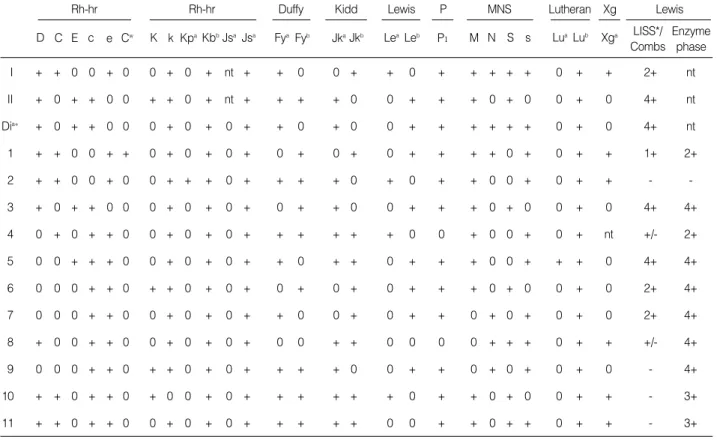
dL (reference range 0.05-0.40 mg/dL), aspartate aminotrans- ferase 44 IU/L (reference range 15-40 IU/L), alanine amino- transferase 34 IU/L (reference range 6-40 IU/L), alkaline phos- phatase 146 IU/L (reference range 95-280 IU/L), BUN 14 mg/dL (reference range 6-26 mg/dL), creatinine 1.2 mg/dL (reference range 0.4-1.5 mg/dL), and lactate dehydrogenase 1,251 IU/L (reference range 218-472 IU/L). The results of ABO and RhD blood grouping showed group O and RhD positive. The antibody screening test (DiaMed AG, Cressier, Morat, Switzerland) produced positive results. Anti-E, anti- c and anti-Jkbwere detected by antibody identification study (Table 1); however, the result was negative on repeated direct antiglobulin tests. Kidd and Rhesus antigenic phenotyping
Tae Sung Park, Ki Uk Kim*, Woo Jin Jeong*, Hyung Hoi Kim, Chulhun L. Chang, Joo Seop Chung*, Goon Jae Cho*, Eun Yup Lee, Han Chul Son
Departments of Laboratory Medicine and Internal Medicine*, Pusan National University College of Medicine, Busan, Korea
Address for correspondence Hyung Hoi Kim, M.D.
Department of Laboratory Medicine, College of Medicine, Pusan National University, 1-10 Ami-dong, Seo-gu, Busan 602-739, Korea
Tel : +82.51-240-7418, Fax : +82.51-247-6560 E-mail : [email protected]
894 J Korean Med Sci 2003; 18: 894-6
ISSN 1011-8934
Copyright � The Korean Academy of Medical Sciences
Acute Hemolytic Transfusion Reactions due to Multiple Alloantibodies Including Anti-E, Anti-c and Anti-Jk
bWe report a case of two consecutive episodes of acute hemolytic transfusion reac- tions (HTRs) due to multiple alloantibodies in a 34-yr-old man who suffered from avascular necrosis of left femoral head. He received five units of packed red blood cells (RBCs) during surgery. Then the transfusion of packed RBCs was required nine days after the surgery because of the unexplained drop in hemoglobin level.
The transfusion of the first two units resulted in fever and brown-colored urine, but he received the transfusion of another packed RBCs the next day. He experienced even more severe symptoms during the transfusion of the first unit. We performed antibody screening test, and it showed positive results. Multiple alloantibodies includ- ing anti-E, anti-c and anti-Jkbwere detected by antibody identification study. Acute HTRs due to multiple alloantibodies were diagnosed, and the supportive cares were done for 6 days. We suggest the antibody screening test should be included in the panel of pretransfusion tests for safer transfusion, and it is particularly mandatory for the patients with multiple transfusions, pregnant women, and preoperative pa- tients.
Key Words : Blood Transfusion; Blood Grouping and Cross Matching; Blood Group Incompatibility;
Isoantibodies
Received : 24 December 2002 Accepted : 11 February 2003
Acute HTRs Due to Anti-E, Anti-c and Anti-Jkb 895
(DiaMed AG) were conducted; it showed Jkapositive, Jkb negative on Kidd antigenic phenotyping, and Rhesus sub- group was CDe. The haptoglobin level was below the detec- tion limit (<10.0 mg/dL).
He was diagnosed as having acute HTRs due to multiple alloantibodies including anti-E, anti-c and anti-Jkb. No more transfusions were requested, and he was under the supportive
care for 6 days. He returned to the previous hospital with relief of symptom, and his condition gradually improved thereafter (Fig. 1).
DISCUSSION
Acute HTRs are most severe when these occur in ABO incompatibility (1). They also are associated with unexpected antibodies to the other blood group antigens (1, 2). The bind- ing of antibody to blood group antigens may activate comple- ment and intrinsic clotting cascade of coagulation system and causes intravasucular hemolysis, or may be phagocytozed by macrophages in reticuloendothelial system, which results in extravascular hemolysis (2). Also, the role of cytokines in acute HTRs is increasingly recognized (1, 2). The symptoms and signs produced by acute HTRs include fever, hematuria, jaun- dice, renal failure, and even the state of shock. The reports of acute HTRs related to unexpected antibodies including anti- bodies against Rhesus, Kidd, Diego, P antigens, and others have been introduced in the literature (3-8).
The patient reported having received the transfusion of packed RBCs during the surgery of right knee twelve years before. Thus, we think that the delayed HTR might have occurred mainly due to anti-E, known as the most common
Rh-hr D C E c e Cw
Rh-hr K k KpaKbbJsa Jsa
Duffy Fya Fyb
Kidd JkaJkb
Lewis Lea Leb
Lewis LISS*/
Combs Enzyme
phase Lutheran
LuaLub MNS
M N S s P
P1
Xg Xga I + + 0 0 + 0 0 + 0 + nt + + 0 0 +
II + 0 + + 0 0 + + 0 + nt + + + + 0 Dia+ + 0 + + 0 0 0 + 0 + 0 + + 0 + 0 1 + + 0 0 + + 0 + 0 + 0 + 0 + 0 + 2 + + 0 0 + 0 0 + + + 0 + + + + 0 3 + 0 + + 0 0 0 + 0 + 0 + 0 + + 0 4 0 + 0 + + 0 0 + 0 + 0 + + + + + 5 0 0 + + + 0 0 + 0 + 0 + + 0 + + 6 0 0 0 + + 0 + + 0 + 0 + 0 + 0 + 7 0 0 0 + + 0 0 + 0 + 0 + + 0 0 + 8 + 0 0 + + 0 0 + 0 + 0 + 0 0 + + 9 0 0 0 + + 0 + + 0 + 0 + + + + 0 10 + + 0 + + 0 + 0 0 + 0 + + + + + 11 + + 0 + + 0 0 + 0 + 0 + + + + +
+ 0 + + + + + 0 + + 2+ nt
0 + + + 0 + 0 0 + 0 4+ nt
0 + + + + + + 0 + 0 4+ nt
0 + + + + 0 + 0 + + 1+ 2+
+ 0 + + 0 0 + 0 + + - -
0 + + + 0 + 0 0 + 0 4+ 4+
+ 0 0 + 0 0 + 0 + nt +/- 2+
0 + + + 0 0 + + + 0 4+ 4+
0 + + + 0 + 0 0 + 0 2+ 4+
0 + + 0 + 0 + 0 + 0 2+ 4+
0 0 0 0 + + + 0 + + +/- 4+
0 + + 0 + 0 + 0 + 0 - 4+
+ 0 + + 0 + 0 0 + + - 3+
0 0 + + 0 + + 0 + + - 3+
Table 1.The results of antibody screening and identification test (DiaMed AG, Screening cell Lot No. Set I+II 45151.16.x and 05980.85.x:
Panel cell Lot No. SetID-Diapanel 45161.17.x)
*LISS, low ionic strength salt solution; nt, not tested.
Fig. 1.The changes of laboratory results after acute hemolytic trans- fusion reactions.
D0 D2 D3 D4 D5 D6
Admission Date 20
15
10
5
0
Hemoglobin (g/dL) Platelet (×104/ L) LDH (×102 IU/L) Total bilirubin (mg/dL) Creatinine (mg/dL)
896 T.S. Park, K.U. Kim, W.J. Jeong, et al.
causative antibody in delayed HTRs, with or without the other unexpected antibodies, after receiving the transfusion of the five units of packed RBCs during the operation; how- ever, no antibody screening test was performed for detection of unexpected antibodies. First acute HTR was noticed when the patient was transfused with the two units of packed RBCs nine days after the replacement surgery, and he complained of fever and brown-colored urine concomitantly. Unfortunately, no further evaluation was done for hemolytic reaction, and he was transfused again with one unit of packed RBCs the day after. Then the second acute hemolytic episode with even more severe symptoms and signs such as fever, hematuria, and jaundice occurred. In addition, severe thrombocytopenia was observed immediately upon admission, probably accompanied by the activation of coagulation system during the acute HTR.
However, no further evaluation was done for any other partic- ular coagulopathies.
Anti-E, anti-c and anti-Jkbwere detected by a series of anti- body identification tests (DiaMed AG), such as antiglobulin and enzyme phase. In general, direct antiglobulin test reveals positive in HTR, but the result in this case was negative prob- ably due to immediate and aggressive destruction of transfused red cells by multiple alloantibodies. In Korea, pretransfusion tests including ABO, RhD blood grouping and crossmatch- ing test for safe transfusion have been performed for many years.
The primary purpose of the crossmatching is to detect ABO incompatibility, and the secondary purpose of this test is to exclude incompatible donor cells with patient serum (i.e. detec- tion of unexpected antibodies). Antibodies reactive at 37℃ or in the antiglobulin test are more likely to be clinically sig- nificant than cold reactive antibodies (2). Unfortunately, an- tiglobulin phase of crossmatching in order to rule out the unex- pected antibodies have not been conducted by many hospi- tals other than university-affiliated medical centers in Korea.
Hence, the clinically significant unexpected antibodies such as antibodies against Rhesus, Kidd, Duffy, Diego antigens, and others cannot be detected by saline phase of crossmatch- ing alone.
The antibody screening test is used as a part of routine pre- transfusion studies for the purpose of detection of unexpected antibodies; however, in Korea it has not received as much attention as such a tool prior to transfusion. According to the annual reports by The Korean Association of Quality Assurance for Clinical Laboratory published in 2002, hospitals with ability to perform antibody screening tests have been gradually increasing in number for the past 3 or 4 yr as column agglu- tination method was introduced, presenting up to 42.1% of the laboratories participated (9). However, the number of hos-
pitals that actually perform this test as part of their routine pretransfusion study is quite limited. For preventing HTRs due to unexpected antibodies, antiglobulin phase of cross- matching or antibody screening test must be conducted in all patients who receive transfusion. Thus, we suggest the antibody screening test should be included in the panel of pretransfusion tests for safer transfusion, which is already a part of routine pretransfusion procedure in other countries. In addition, it is needed to make it mandatory for patients with multiple transfusion and pregnant women as well as preop- erative patients.
ACKNOWLEDGMENT
The author thanks Dr. S.C. Charles Moon for review of the manuscript and for many insightful comments, and MIRR SciTech Corp. for technical assistance.
REFERENCES
1. Brecher ME. Technical Manual. 14th ed. Bethesda, Maryland: Amer- ican Association of Blood Banks, 2002; 585-604.
2. Mollison PL, Engelfriet CP, Countreras M. Transfusion in Clinical Medicine. 10th ed. Oxford: Blackwell Science, 1997; 358-76.
3. Han KS, Park MH, Kim SI. Transfusion Medicine. 2nd ed. Seoul:
Korea Medical Publishing Co., 1999; 276-9.
4. Reid ME, Oyen R, Marsh WL. Summary of the clinical significance of blood group alloantibodies. Semin Hematol 2000; 37: 197-216.
5. Jo SH, Kim WB, Lee DH, Kang DY. A case of hemolytic transfusion reaction in hemophiliac patient. Korean J Clin Pathol 1985; 5: 393-7.
6. Park TS, Kim HH, Son HC, Kim BC. Hemolytic transfusion reaction with acute renal failure due to anti-Jkb: a case study. Korean J Blood Transfusion 2002; 13: 89-92.
7. Kawai M, Tsugawa Y, Yoshimura A, Tofuku Y, Kuroda M, Takeda R, Mori T. [A case of acute hemolytic transfusion reaction due to allo- antibodies against Diego b, Kidd a and Rh-Hr (E, c), resulting in dis- seminated intravascular coagulation and renal failure.] Nippon Naika Gakkai Zasshi 1985; 74: 780-5.
8. Arndt PA, Garratty G, Marfoe RA, Zeger GD. An acute hemolytic transfusion reaction caused by an anti-P1that reacted at 37℃. Trans- fusion 1998; 38: 373-7.
9. Kwon SW, Kim DW, Han KS, Kim HO, Seo JS, Cha YJ, Jeon DS, Park HJ, Oh YC, Kwon KC, Ryang DW, Hwang YS. Annual report on external quality assessment in blood bank tests in Korea (2001).
J Clin Pathol & Quality Control 2002; 24: 75-81.