Received June 14, 2019 Revised June 14, 2019 Accepted June 25, 2019 Corresponding author Jong-Cheon Joo
Dept. of Sasang Constitutional Medicine, Wonkwang University Jeonju Korean Medicine Hospital, 99, Garyeonsan-ro, Deokjin-gu, Jeonju-si, Jeonbuk, 54887, Korea
Tel: +82-63-270-1073, E-mail: [email protected] Corresponding author Young-Mi Kwon
Dept. of Radiology, Wonkwang Hospital, 99, Garyeonsan-ro, Deokjin-gu, Jeonju-si, Jeonbuk, 54887, Korea, Tel: +82-63-270-1010, E-mail: [email protected]
Ⓒ The Society of Sasang Constitutional Medicine.
All rights reserved. This is an open acess article distributed under the terms of the Creative Commons attribution Non-commercial License (http:// creativecommons.org/licenses/by-nc/3.0/)
비알코올성지방간의 유관 인자 임상 연구:
종양표지자, 심박변이도, 사상체질
곽시라1†․신뢰1†․박수정2․권영미3*․주종천1*
1원광대학교 한의과대학 사상체질과, 2우석대학교 한의과대학 사상체질과, 3원광대학교 한의과대학 영상의학과
Abstract
Clinical Study on Nonalcoholic Fatty Liver Disease Related Factors:
Tumor Marker, Heart Rate Variability, Sasang Constitution
Si-Ra Gwak1†․Lei Shen1†․Soo-Jung Park2․Young-Mi Kwon3*․Jong-Cheon Joo1*
1Dept. of Sasang Constitutional Medicine, College of Korean Medicine, Wonkwang University,
2Dept. of Sasang Constitutional Medicine, College of Korean Medicine, Woosuk University,
3Dept. of Radiology, College of Korean Medicine, Wonkwang University Objectives
The aim of this study is to investigate the related factors of nonalcoholic fatty liver disease (NAFLD).
Methods
The subjects were 187 persons diagnosed as fatty liver by abdominal ultrasonography. They were divided into three groups according to the severity of fatty liver: control, mild, moderate or severe. The three groups' general characteristics, laboratory results, liver function indexes, metabolic syndrome indexes, tumor markers, heart rate variability values and Sasang constitution distribution were compared and analyzed.
Results
Male ratio, height, weight, body mass index, red blood cell count, hemoglobin level and creatinine level were higher in NAFLD groups than in control group. The levels of sodium and amylase were higher in control than in NAFLD. In liver function, the levels of aspartate transaminase, alanine transaminase and gamma-glutamyl transpepsidase of NAFLD were higher. In metabolic syndrome index, systolic blood pressure, diastolic blood pressure, waist circumference, total cholesterol, triglyceride and low density lipoprotein cholesterol levels were higher in NAFLD, while high density lipoprotein cholesterol level was higher in control. The alpha-feto protein level was higher in NAFLD, and the heart rate variability was not different between NAFLD and control groups. In Sasang constitution, Taeeumin ratio of NAFLD was higher than of control.
Conclusions
The results suggest that nonalcoholic fatty liver is clinically related to liver dysfunction, metabolic syndrome, tumor markers, and Sasang constitution. Further studies are needed to control nonalcoholic fatty liver disease and prevent severe disease such as cirrhosis and cancer caused by fatty liver.
Key Words: nonalcoholic fatty liver disease, related factor, alpha-feto protein, heart rate variability, Sasang constitution, metabolic syndrome
Ⅰ. 緖論
비알코올성지방간(nonalcoholic fatty liver disease, NAFLD)은 간 손상이 동반될 수 있는 간지방증 상태이 다. 대부분은 증상이 없어 간 효소 수치의 상승이나 영상 검사를 통해 우연히 발견되지만 일부에서는 피로 감, 우상복부 통증 등이 있을 수 있다. NAFLD는 병리 학적으로 단순지방간(nonalcoholic fatty liver, NAFL) 또 는 지방간염(nonalcoholic steatohepatitis, NASH) 등으 로 구분되고, 정확한 염증 정도를 결정하기 위해서는 생검이 필요하다. 치료에 있어 주된 목적은 체중 감소, 당뇨병과 고질혈증의 조절이며, 간경변으로 진행될 경우에는 간이식까지 고려할 수 있다1,2.
NAFLD의 주요한 위험 인자로는 제2형 당뇨병, 고 지혈증, 비만, 대사증후군 등이 널리 알려져 있다. 그 외에 나이, 성별, 고혈압, 혈청 내 aspartate transaminase, alanine transaminase 수치 등도 유관 인자로서 NAFLD 의 발병 혹은 악화에 영향을 미친다고 알려져 있으며
1,3,4
, 이러한 관련변수들과 실제 초음파 혹은 생검을 통해 진단된 지방간과의 관계를 살펴본 국내외의 임 상 연구들5,6이 이루어진 바 있다.
NAFLD는 진행될 경우 간경변, 간암, 사망을 초래 할 수도 있는 주요 만성 간질환이다. 대부분 간세포암 은 간경변이 있는 상태에서 발생하지만 최근에는 간 경변증이 없는 NAFLD, NASH에서도 간세포암이 발 생할 수 있다는 증거가 증가하고 있다. 비만, 당뇨병, 대사증후군 역시 간세포암의 발병 위험요인으로 알려 져 있다7.
NAFLD와 자율신경계의 지표인 심박변이도(heart rate variability, HRV)의 관련성에 대해서는 당뇨병을 앓고 있는 NAFLD 환자군이 당뇨병이 없는 NAFLD군 및 대조군에 비해 심박변이도의 대표적 지표인 심박 간격 표준편차(standard deviation of normal to normal, SDNN)가 낮았다는 연구가 있다8.
사상체질의 NAFLD에 대한 영향은 연구에 따라 소 양인과 태음인의 두 체질, 혹은 태음인의 한 가지 체질 이 독립적인 위험인자라는 보고가 있었다9,10.
이에 따라 본 연구에서는 건강검진에서 복부초음 파를 통해 지방간으로 진단된 사람을 대상으로 지방 간의 중증도에 따라 각 집단별 일반적 특징, 신체 계측 치, 혈액 검사, 심박변이도와 사상체질 검사 등의 결과 를 대조군과 비교하여 현재까지 알려진 유관 인자들 의 관련성을 확인하고 또한 유의성을 나타내는 새로 운 변수의 가능성을 찾고자 하였다.
Ⅱ. 硏究 對象 및 方法
1. 연구 대상
○○한방병원 건강검진센터에서 2016년 1월 1일 부터 2017년 12월 31일까지 건강검진을 받은 사람을 대상으로 복부초음파를 시행한 사람 중 비알코올성지 방간으로 진단된 63명과 대조군 124명 총 187명의 검 사 결과 자료를 비교 분석하였다.
2. 연구 방법
비알코올성지방간 환자 63명 중 중증 지방간은 3 명, 중등도 지방간은 9명, 경증 지방간은 51명이었으 며, 통계 분석은 대조군 집단, 경증 집단, 중등도와 중증을 합친 집단의 세 집단으로 하였다. 검사결과 자료는 일반적 특징, 기타 혈액 검사 검사, 간기능 관 련 지표, 대사증후군 관련 지표, 종양표지자, 심박변이 도 변수, 사상체질 분포로 나누어 분석하고 정리하였 다. 본 연구는 ○○한방병원 기관생명윤리위원회의 심의를 거쳐 진행하였다.
3. 통계 분석
경증 지방간 집단, 중등도와 중증 지방간을 합친 집단, 대조군의 세 집단을 대상으로 일원배치분석방 법을 시행하였으며, 사후분석은 Scheffe법을 사용하였 다. 사상체질 분포는 카이제곱 검정을 시행하였다. 유 의수준은 0.5로 하였다.
Ⅲ. 硏究 結果
1. 비알코올성지방간군과 대조군의 일반적 특징 및 기타 혈액 검사 결과 비교
비알코올성지방간군은 대조군에 비해 남성 비율 (p=.001), 신장(p=.012), 체중(p=<.001), 체질량지수(p=
<.001), 적혈구(p=<.001), 헤모글로빈(p=<.001), 크레 아티닌(p=0.029)이 높았으며, 나트륨(p=.041), 아밀라
제(p=.030)가 낮았다(Table 1).
2. 비알코올성지방간군과 대조군의 간기능 관련 지표 비교
비알코올성지방간군은 대조군에 비해 aspartate transaminase(p=<.001), alanine transaminase(p=<.001), gamma-glutamyl transpepsidase(p=<.001)가 높았다 (Table 2).
Variables Control
(N=124)
Nonalcoholic Fatty Liver Diseae Grade
Total
(N=187) p-value
Mild (N=51)
Moderate or Severe (N=12)
Age (years) 48.6±12.9 47.4±9.3 48.3±6.4 48.2±11.6 .828
Sex (Male) 75 45 9 187 .001
Height (cm) 165.9±9.5a 170.3±7.4b 168.4±9.2ab 167.3±9.1 .012
Weight (kg) 63.8±11.7a 77.6±11.3b 77.2±14.1b 68.4±13.4 <.001
BMI (kg/m²) 23.0±2.8a 26.6±3.0b 27.0±3.2b 24.2±3.3 <.001
WBC (Thous/uL) 5.7±1.4 6.2±1.5 6.4±1.7 5.9±1.5 .079
RBC (MiL/uL) 4.4±0.5a 4.7±0.4b 4.7±0.5b 4.5±0.5 <.001
Hemoglobin (g/dL) 13.6±1.5a 14.7±1.6b 14.7±1.6b 14.0±1.6 <.001
Sodium (mmol/L) 142.7±2.2a 143.4±.2.6b 141.6±2.6a 142.8±2.4 .041
Potassium (mmol/L) 4.0±0.4 4.1±0.4 4.0±0.3 4.0±0.4 .465
Calcium (mg/dL) 8.6±0.5 8.7±0.5 8.5±0.5 8.6±0.5 .279
Chloride (mmol/L) 104.2±2.5 103.7±2.2 104.3±2.1 104.1±2.4 .432
Posphorus (mg/dL) 4.1±1.1 3.4±0.3 3.4±0.4 3.9±1.0 .191
Uric acid (mg/dL) 5.5±1.6 6.2±1.5 6.5±1.7 5.7±1.6 .058
Amylase (U/L) 63.8±23.8a 59.8±18.8ab 46.4±18.1b 61.6±22.6 .030
Lipase (U/L) 33.2±11.9 36.5±13.0 29.8±5.4 33.8±12.0 .139
Free T4 (ng/dL) 1.4±0.2 1.4±0.2 1.4±0.3 1.4±0.2 .508
TSH (uIU/mL) 2.1±1.5 2.0±1.0 1.3±0.6 2.0±1.3 .194
BUN (mg/dL) 12.0±4.1 12.6±3.7 13.4±5.2 12.3±4.0 .410
Creatinine (mg/dL) 1.0±0.2a 1.1±0.2b 1.0±0.2ab 1.0±0.2 .029
Values are represented by mean±standard deviation or numbers. The same character in shoulder of values means same group by Sheffe's post-hoc analyis. N, number; BMI, body mass index; WBC, white blood cell; RBC, red blood cell; TSH, thyroid stimulating hormone.
Table 1. General Characteristics and Other Laboratory Results of Nonalcoholic Fatty Liver Disease and Control Groups
Variables Control
(N=124)
Nonalcoholic Fatty Liver Diseae Grade
Total
(N=187) p-value
Mild (N=51)
Moderate or Severe (N=12)
AST (U/L) 23.8±5.9a 33.0±17.9b 38.0±19.3b 27.2±12.4 <.001
ALT (U/L) 23.7±10.6a 47.0±29.3b 54.8±31.9b 31.9±22.4 <.001
r-GTP (U/L) 31.4±27.0a 69.6±65.0b 69.2±54.5b 44.0±45.7 <.001
ALP (U/L) 208.8±55.7 217.9±49.4 222.3±55.4 212.1±54.0 .492
Total protein (g/dL) 7.2±0.5 7.3±0.4 7.1±0.4 7.2±0.4 .263
Albumin (g/dL) 4.7±0.3 4.8±0.2 4.7±0.2 4.7±0.3 .519
Total bilirubin (mg/dL) 1.0±0.4 0.9±0.4 1.1±0.4 1.0±0.4 .268
Direct bilirubin (mg/dL) 0.3±0.1 0.2±0.1 0.3±0.1 0.3±0.1 .127
Values are represented by mean±standard deviation. The same character in shoulder of values means same group by Sheffe's post-hoc analyis. N, number;
AST, aspartate transaminase; ALT, alanine transaminase; r-GTP, gamma-glutamyl transpeptidase; ALP, alkaline phosphatase; BUN, blood urea nitrogen.
Table 2. Liver Function Indexes of Nonalcoholic Fatty Liver Disease and Control Groups
3. 비알코올성지방간군과 대조군의 대사증후군 관련 지표 비교
비알코올성지방간군은 대조군에 비해 수축기혈압 (p=0.007), 이완기혈압(p=0.004), 허리둘레(p=<.001), 총 콜레스테롤(p=.001), 중성지방(p=<.001), 저밀도 콜레 스테롤(p=.014)이 높았으며, 고밀도 콜레스테롤(p=
<.001)이 낮았다(Table 3).
4. 비알코올성지방간군과 대조군의 종양표지자 비교
비알코올성지방간군은 대조군에 비해 alpha-feto protein(p=0.033)이 높았다(Table 4).
5. 비알코올성지방간군과 대조군의 심박변이도 변수 비교
비알코올성지방간군은 대조군에 비해 심박변이도 변수의 차이가 없었다(Table 5).
6. 비알코올성지방간군과 대조군의 사상체질 분포 비교
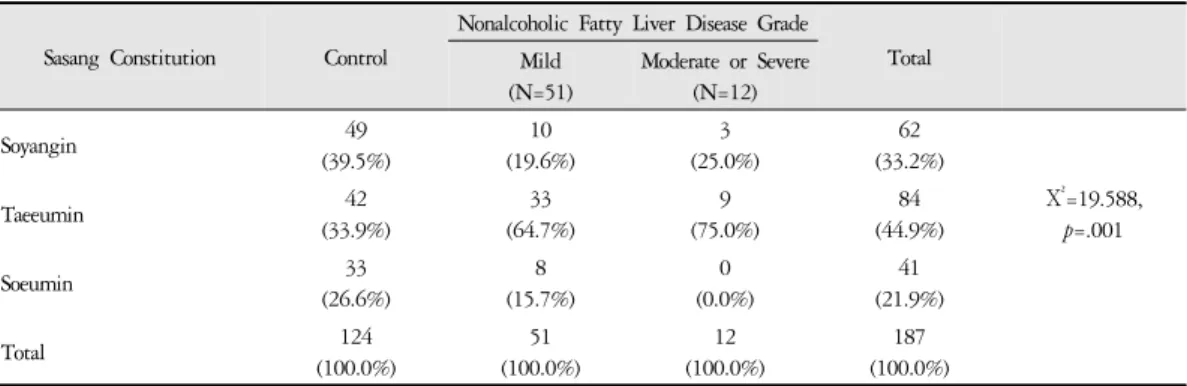
비알코올성지방간군의 태음인 비율은 중등도 및 중증 집단에서 75.0%, 경증 집단에서 64.7%로 대조군 의 태음인 비율인 33.9%에 비해 각각 2.2배, 1.9배로 높았다. 소음인 비율은 비알코올성지방간군에서 15.7%로 대조군의 소음인 비율인 26.6%에 비해 0.6배
Variables Control
(N=124)
Nonalcoholic Fatty Liver Diseae Grade
Total
(N=187) p-value
Mild (N=51)
Moderate or Severe (N=12)
SBP (mmHg) 113.6±12.1a 118.6±11.8ab 121.7±9.4b 115.5±12.1 .007
DBP (mmHg) 70.9±9.2a 75.1±10.7ab 78.3±11.1b 72.5±10.0 .004
Waist circumference (cm) 81.2±8.1a 91.0±8.2b 91.0±9.9b 84.5±9.4 <.001
FBS (mg/dL) 99.0±22.6 104.0±18.1 108.8±17.3 100.9±21.3 .162
Total Cholesterol (mg/dL) 196.3±36.6a 211.3±42.7ab 234.6±25.9b 202.8±39.0 .001
HDL cholesterol (mg/dL) 56.9±11.7a 48.9±10.3b 47.5±7.4b 54.2±11.7 <.001
Triglyceride (mg/dL) 101.7±69.2a 169.0±80.7b 187.2±131.6b 125.1±84.1 <.001 LDL cholesterol (mg/dL) 119.1±36.4a 128.5±40.0ab 149.7±25.9b 123.6±37.5 .014
HbA1c (%) 5.5±1.0 5.7±0.8 5.82±0.7 5.6±0.9 .259
Values are represented by mean±standard deviation. The same character in shoulder of values means same group by Sheffe's post-hoc analyis. N, number; SBP, systolic blood pressure; DBP, diastolic blood pressure; FBS, fasting blood sugar; HDL, high density lipoprotein;
LDL, low dendity lipoprotein.
Table 3. Metabolic Syndrome Indexes of Nonalcoholic Fatty Liver Disease and Control Groups
Variables Control
(N=124)
Nonalcoholic Fatty Liver Diseae Grade
Total
(N=187) p-value
Mild (N=51)
Moderate or Severe (N=12)
AFP (ng/mL) 3.0±1.5a 3.8±2.8b 3.0±1.2ab 3.2±2.0 .033
CEA (ng/mL) 2.1±1.8 2.1±1.2 2.2±0.7 2.1±1.6 .993
CA125 (U/mL) 15.8±13.6 17.0±15.3 11.4±4.6 15.7±13.3 .837
CA19-9(U/mL) 9.4±6.9 7.9±4.6 9.6±4.6 9.0±6.2 .350
PSA (ng/mL) 1.3±1.6 0.9±0.5 1.1±0.9 1.2±1.3 .213
Values are represented by mean±standard deviation. The same character in shoulder of values means same group by Sheffe's post-hoc analyis. N, number; AFP, alpha-feto protein; CEA, carcinoembryonic antigen; CA125, cancer antigen 125; CA19-9, cancer antigen 19-9;
PSA, prostate specific antigen.
Table 4. Tumor Markers of Nonalcoholic Fatty Liver Disease and Control Groups
로 낮았다(p=0.001)(Table 6).
Ⅳ. 考察
비알코올성지방간(nonalcoholic fatty liver disease, NAFLD)은 현재 전 세계적으로 증가하는 추세에 있어 공중보건에 부담이 되고 중요한 의학적 이슈로 대두 되고 있다. 전 세계적으로 NAFLD의 유병률은 약 10-30% 정도이고, 한국에서의 유병률은 약 15-25%로 중국이나 일본보다도 높은 것으로 판단된다. NAFLD 는 영양과잉과 운동부족으로 인한 간장 내의 지방합 성과 축적이 유도되는 것으로, 최근 더욱 문제가 되고 있는 대사증후군의 또다른 형태로도 볼 수 있으며 한
의학적으로는 간의 소설기능 억제로 담음축적과 습열 이 생성되는 것으로 해석할 수 있다11.
NAFLD에서 간 지방증을 일으키는 핵심 메커니즘 은 인슐린 저항성이다. 인슐린 저항성, 내장 비만, 지 방산 대사 이상 등의 대사적 요인에 의해 지방이 간세 포에 축적되며, 이후 염증과 섬유화의 과정에는 산화 스트레스가 중요한 역할을 한다고 생각되고 있다1.
NAFLD에 의한 간 손상과 섬유화는 일부 환자에서 는 진행되어 간경화와 간세포암과 같은 심각한 간질 환을 일으키기도 한다. 또한 NAFLD는 대사증후군과 죽상동맥경화증, 심근병증, 심부정맥 등의 심혈관질 환의 위험을 증가시키는데, 그 기전은 전신성 염증, 내피 기능 부전, 간의 인슐린 저항성, 산화 스트레스, 지질 대사의 변화이다12.
Variables Control
(N=124)
Nonalcoholic Fatty Liver Diseae Grade
Total
(N=187) p-value
Mild (N=51)
Moderate or Severe (N=12)
Mean Heart rate (times/min) 65.5±7.7 66.5±8.5 64.4±8.4 65.0±8.4 .317
SDNN (ms) 36.4±21.2 34.2±13.2 35.5±17.2 35.2±16.4 .872
RMSSD (ms) 30.4±21.6 23.7±11.1 30.5±23.5 28.6±20.8 .145
TP (ms) 1192.9±1157.9 968.7±682.8 996.1±1034.6 1001.5±957.5 .765
VLF (ms²) 468.3±401.4 494.2±351.7 492.5±651.5 491.4±569.2 .989
LF (ms²) 287.5±310.8 301.0±304.6 257.2±315.1 271.0±311.0 .693
HF (ms²) 412.1±912.1 173.4±168.1 237.2±291.5 231.2±341.8 .089
LF normal 56.6±23.6 60.5±18.3 52.8±19.05 55.1±19.3 .056
HF normal 43.4±23.6 39.5±18.3 47.3±19.0 45.0±19.3 .052
Values are represented by mean±standard deviation. N, number; SDNN, standard deviation of normal to normal; RMSSD, root mean square of successive differences; TP, total power; VLF, very low frequency; LF, low frequency; HF, high frequency.
Table 5. Heart Rate Variability Values of Nonalcoholic Fatty Liver Disease and Control Groups
Sasang Constitution Control
Nonalcoholic Fatty Liver Disease Grade
Total Mild
(N=51)
Moderate or Severe (N=12)
Soyangin 49
(39.5%)
10 (19.6%)
3 (25.0%)
62 (33.2%)
Χ²=19.588, p=.001
Taeeumin 42
(33.9%)
33 (64.7%)
9 (75.0%)
84 (44.9%)
Soeumin 33
(26.6%)
8 (15.7%)
0 (0.0%)
41 (21.9%)
Total 124
(100.0%)
51 (100.0%)
12 (100.0%)
187 (100.0%) Values are represented by number.
Table 6. Sasang Constitution Distribution of Nonalcoholic Fatty Liver Disease and Control Groups
본 연구 결과에서는 간기능 지표인 aspartate trans- aminase(AST), alanine transaminase(ALT), gamma-glu- tamyl transpeptidase(r-GTP)는 NAFLD군이 대조군보다 높게 나타났다. NAFLD는 경도의 아미노 전이 효소의 상승을 일으키는 가장 흔한 원인으로 알려져 있으며, 약 50%의 환자에서 r-GTP가 정상 상한치의 약 3배까 지 상승할 수 있다13.
비만 및 대사증후군과 관련된 지표 중 체질량지수, 허리둘레, 수축기혈압, 이완기혈압, 총 콜레스테롤 (total cholesterol, TC), 중성지방, 저밀도 콜레스테롤 (low density lipoprotein cholesterol, LDL-C)은 NAFLD군 에서 대조군보다 유의하게 높았으며 반면 고밀도 콜 레스테롤(high density lipoprotein cholesterol, HDL-C)은 더 낮았다. 중국 진촨에서 32,121명을 대상으로 이루 어진 코호트 연구에서는 TC/HDL-C 비율이 높을수록 NAFLD의 위험율이 더 높아진다고 하였으며, receiver operator characteristic(ROC) curve를 이용해 의미있는 예측값을 도출하기도 하였다14.
이전의 유사한 연구 중 멕시코의 건강검진자를 대 상으로 한 연구에서 NAFLD가 남성에서 많이 나타나 며, 중성지방, AST, r-GTP는 증가하고 고밀도 콜레스 테롤은 감소한다고 하여15, 본 연구 결과와 유사한 결 과를 보였다. 본 연구 결과 NAFLD군의 남성 비율은 대조군에 비해 유의하게 높았으며 NAFLD나 간세포 암이 남성에게 많은 이유는 행동 위험 요인과 생물학 적 요인 모두와 관련이 있는 것으로 보인다16.
기타 혈액검사 결과 중 신장기능 지표인 크레아티 닌(creatinine, Cr)은 NAFLD군이 대조군보다 높았으며, 아밀라제는 NAFLD군이 더 낮았다. NAFLD 환자의 신장 기능에 대해 조사한 연구에 의하면 NAFLD 환자 의 약 1/3이 GFR 감소나 단백뇨와 같은 신장 기능 손상을 보이며, 이 때 간 질환의 심각도와 당뇨병이 영향을 준다고 하였다17. 낮은 아밀라제 수치는 일반 적으로 비만, 대사증후군, 당뇨병과 관련이 있다고 알 려져 있으며, 최근에는 NAFLD와의 관련성을 밝히기 위한 임상연구가 여러 국가에서 이루어진 바 있다18,19. 2013년에 일본인 1,475명을 대상으로 한 연구에서 저
혈청 아밀라제가 NAFLD와 관련이 있다고 하였으며
18, 2014년에 중국인 1,017명을 대상으로 한 연구는 대사증후군이 있는 NAFLD 환자가 대사증후군이 없 는 NAFLD 환자 또는 건강한 대조군보다 혈청 아밀라 제 수치가 낮았다고 보고하여19, 일본과 중국의 연구 결과 모두 본 연구 결과와 유사하였다.
본 연구에서 NAFLD군의 갑상선 수치는 대조군과 차이가 없었다. 2018년에 갑상선기능저하증과 NAFLD 의 관련성을 살펴본 메타분석에서는 갑상선기능저하 증이 있으면 NAFLD가 존재할 가능성이 있으며 중증 도에도 영향을 미친다고 하여20, 본 연구의 결과와는 차이가 있었다.
본 연구 결과에서는 여러 종양표지자 가운데 al- pha-feto protein의 수치가 NAFLD군에서 대조군에 비 해 높게 나타났다. AFP, PIVKA-2는 가장 일반적으로 사용되는 간세포암의 표지자로서, NAFLD가 있는 간 세포암 환자의 35.4%에서 혈청 AFP 상승을 보였고 대부분이 정상 혈청 AFP 수치를 보였다는 연구결과가 존재하며21, 또 다른 연구에서는 ALD/NAFLD 환자에 서 간세포암의 표지자로서 혈청 AFP 수치가 58%의 민감도와 100%의 특이도를 보였다22.
대사증후군과 NAFLD 모두 제2형 당뇨병, 심혈관 질환, NASH 및 간세포암으로 전변할 수 있으며23, NAFLD로 인한 간세포암의 발병은 고인슐린 혈증 및 만성 염증 상태, 적응 면역 반응 및 간 전구 세포 집단, PNPLA3의 돌연변이를 포함한 유전 다형성과 같은 세포 기전과 밀접한 관련이 있다24. 동물 실험에서는 NAFLD가 간의 섬유화 및 전암 단계의 분자 신호를 일으킬 수 있다는 결과도 있다25. NAFLD 관련 간세포 암은 간과 관련된 이환율과 사망률의 중요한 원인이 될 것이므로26,27 NAFLD에서 기인하는 간세포암의 위 험 인자 확인을 통한 예방 및 치료가 필요하다.
간세포암을 제외한 암과의 관련성에 대해서는 비 만하지 않은 여성의 유방암에서 NAFLD가 odds ratio 3.04로 전통적인 암의 위험인자와는 별도로 영향을 미친다는 연구가 있으며 이는 비만이라는 공통된 인 자를 공유하기 때문인 것으로 추정하였다28.
본 연구에서는 심박변이도와 NAFLD의 관련성이 확인되지 않았으나, 심박변이도 변수가 유의하게 낮 은 수치를 보인다는 보고도 있다29. 적절한 설계에 의 한 자율신경계, 면역계 등 신체 균형이나 생활습관 등과 관련된 연구도 필요할 것으로 보인다.
사상체질이 개별 질환에 미치는 영향에 대해서는 경계성 고혈압, 비만, 복부비만, 대사증후군, 당뇨병, 과민성장증후군 등의 질환에서 사상체질이 위험인자 로 작용함을 밝힌 체계적 문헌고찰 연구가 있다30. 암 환자의 사상체질 분포 연구에서는 암 환자와 건강대 조군의 체질 분포 간에 유의한 차이가 있었다고 보고 하여 암과 사상체질의 상관성을 시사하였다31.
본 연구에서는 사상체질 중 태음인 체질이 특별히 NAFLD의 위험인자로 작용하는 것으로 나타났다. 이 러한 결과는 태음인의 과체중 또는 비만이 큰 영향을 미쳤을 것이라 생각할 수도 있으나, 이전의 연구들에 의하면 비만 또는 고혈압, 당뇨, 이상지질혈증 및 대사 증후군 등의 관련 위험요인을 보정한 후에도 태음인 의 odds ratio는 유의하게 높았음을 알 수 있다9,10. 이는 태음인 특유의 기운인 흡취지기의 영향일 것으로 생 각되며, 사상체질이 NAFLD의 독립적인 위험인자가 될 가능성이 있어 추후 이에 대한 추가적인 연구가 필요할 것으로 보인다.
Ⅴ. 結論
본 연구에서는 비알코올성지방간(nonalcoholic fatty liver disease, NAFLD)의 특징 및 유관 인자들을 알아보 고자, 건강검진에서 복부초음파를 시행하고 지방간으 로 진단된 사람 187명을 대상으로 일반적 특징, 신체 계측치, 혈액 검사, 심박변이도와 사상체질 검사 등의 결과를 대조군과 비교하여 다음의 결과를 얻었다.
1. NAFLD군은 대조군에 비해 남성 비율, 신장, 체 중, 체질량지수, 적혈구, 헤모글로빈, 크레아티 닌 수치가 높았으며, 나트륨, 아밀라제 수치가
낮았다.
2. NAFLD군은 대조군에 비해 aspartate transaminase, alanine transaminase, gamma-glutamyl transpepsidase 가 높았다.
3. NAFLD군은 대조군에 비해 수축기혈압, 이완기 혈압, 허리둘레, 총 콜레스테롤, 중성지방, 저밀 도 콜레스테롤이 높았으며, 고밀도 콜레스테롤 은 낮았다.
4. NAFLD군은 대조군에 비해 alpha-feto protein이 높았다.
5. NAFLD군과 대조군의 심박변이도 변수에는 유의한 차이가 없었다.
6. NAFLD군의 태음인 비율은 대조군보다 높았으 며, 소음인 비율은 낮았다.
이상의 결과를 통해 비알코올성지방간이 임상적으 로 간기능 이상, 간세포암, 비만과 대사증후군, 사상체 질 등과 관련성을 가지며 이와 관련한 각종 변수들이 유관 인자로 작용할 수 있다는 것을 알았다. 비알코올 성지방간을 적절히 관리하고 이로부터 간경변, 간암 등의 중증 간질환으로의 진행을 예방하기 위하여, 향 후 비알코올성지방간의 유관 인자에 대한 추가적인 연구가 필요할 것으로 생각된다.
Ⅵ. Acknowledgement
이 논문은 2018학년도 원광대학교의 교비지원에 의해 수행됨.
Ⅶ. References
1. Sweet PH, Khoo T, Nguyen S. Nonalcoholic Fatty Liver Disease. Primary care. 2017;44(4):599-607.
2. Tanaka N, Kimura T, Fujimori N, Nagaya T, Komatsu M, Tanaka E. Current status, problems, and per-
spectives of non-alcoholic fatty liver disease research.
World journal of gastroenterology. 2019;25(2):163-177.
3. Farrell GC, Larter CZ. Nonalcoholic fatty liver disease:
from steatosis to cirrhosis. Hepatology. 2006;43(2 Suppl 1):S99-S112.
4. Kotronen A, Peltonen M, Hakkarainen A, Sevastianova K, Bergholm R, Johansson LM, et al. Prediction of non-alcoholic fatty liver disease and liver fat using met- abolic and genetic factors. Gastroenterology. 2009;
137(3):865-872.
5. Kim JS, Ryu GS. A Study on the Diagnosis of Fatty Liver by Ultrasonography. J of East-West Medicines.
2000;25(3):56-74. (Korean)
6. Neuschwander-Tetri BA, Clark JM, Bass NM, Van Natta ML, Unalp-Arida A, Tonascia J, et al. Clinical, laboratory and histological associations in adults with nonalcoholic fatty liver disease. Hepatology. 2010;
52(3):913-924.
7. Massoud O, Charlton M. Nonalcoholic Fatty Liver Disease/Nonalcoholic Steatohepatitis and Hepatocellular Carcinoma. Clinics in liver disease. 2018;22(1):
201-211.
8. Kumar MS, Singh A, Jaryal AK, Ranjan P, Deepak KK, Sharma S, et al. Cardiovascular Autonomic Dysfunction in Patients of Nonalcoholic Fatty Liver Disease. International journal of hepatology. 2016;
2016:5160754.
9. Lee SK, Yoon DW, Lee SW, Kim JY, Kim JK, Shin C. Non-alcoholic fatty liver disease among sasang con- stitutional types: a population-based study in Korea.
BMC complementary and alternative medicine. 2015;
15:399.
10. Kang MJ. Prevalence and Risk Factors of the Non alcoholic Fatty Liver Disease according to the Sasang Constitutional types. Seoul: KyungHee University;
2012. (Korean)
11. Park YH, Yoo SR, Son CG. Overview for Prevalence
and Pathology of Non-Alcoholic Fatty Liver Disease.
Korean J Orient Int Med. 2011;32(1):26-32. (Korean) 12. Stahl EP, Dhindsa DS, Lee SK, Sandesara PB, Chalasani
NP, Sperling LS. Nonalcoholic Fatty Liver Disease and the Heart: JACC State-of-the-Art Review. Journal of the American College of Cardiology. 2019;73(8):
948-963.
13. Giannini EG, Testa R, Savarino V. Liver enzyme alter- ation: a guide for clinicians. Canadian Medical Association Journal. 2005;172(3):367-379.
14. Ren XY, Shi D, Ding J, Cheng ZY, Li HY, Li JS, et al. Total cholesterol to high-density lipoprotein cho- lesterol ratio is a significant predictor of nonalcoholic fatty liver: Jinchang cohort study. Lipids in health and disease. 2019;18(1):47.
15. Briseno-Bass P, Chavez-Perez R, Lopez-Zendejas M.
Prevalence of liver steatosis and its relation to liver function tests and lipid profile in patients at medical check-up. Revista de gastroenterologia de Mexico.
2018.
16. Wu EM, Wong LL, Hernandez BY, Ji JF, Jia W, Kwee SA, et al. Gender differences in hepatocellular cancer: disparities in nonalcoholic fatty liver dis- ease/steatohepatitis and liver transplantation. Hepatoma research. 2018;4:66.
17. Nampoothiri RV, Duseja A, Rathi M, Agrawal S, Sachdeva N, Mehta M, et al. Renal Dysfunction in Patients With Nonalcoholic Fatty Liver Disease is Related to the Presence of Diabetes Mellitus and Severity of Liver Disease. Journal of clinical and ex- perimental hepatology. 2019;9(1):22-28.
18. Nakajima K, Oshida H, Muneyuki T, Saito M, Hori Y, Fuchigami H, et al. Independent association be- tween low serum amylase and non-alcoholic fatty liver disease in asymptomatic adults: a cross-sectional ob- servational study. BMJ open. 2013;3(1).
19. Yao J, Zhao Y, Zhang J, Hong Y, Lu H, Wu J.
Serum amylase levels are decreased in Chinese non-al- coholic fatty liver disease patients. Lipids in health and disease. 2014;13:185.
20. Mantovani A, Nascimbeni F, Lonardo A, Zoppini G, Bonora E, Mantzoros CS, et al. Association Between Primary Hypothyroidism and Nonalcoholic Fatty Liver Disease: A Systematic Review and Meta-Analysis.
Thyroid : official journal of the American Thyroid Association. 2018;28(10):1270-1284.
21. Duan XY, Qiao L, Fan JG. Clinical features of non- alcoholic fatty liver disease-associated hepatocellular carcinoma. Hepatobiliary Pancreat Dis Int. 2012;
11(1):18-27.
22. Beale G, Chattopadhyay D, Gray J, Stewart S, Hudson M, Day C, et al. AFP, PIVKAII, GP3, SCCA-1 and follisatin as surveillance biomarkers for hepatocellular cancer in non-alcoholic and alcoholic fatty liver disease.
BMC Cancer. 2008;8:200.
23. Yki-Jarvinen H. Non-alcoholic fatty liver disease as a cause and a consequence of metabolic syndrome. The lancet Diabetes & endocrinology. 2014;2(11):901-910.
24. Wong CR, Nguyen MH, Lim JK. Hepatocellular carci- noma in patients with non-alcoholic fatty liver disease.
World journal of gastroenterology. 2016;22(37):8294- 8303.
25. Almanza D, Gharaee-Kermani M, Zhilin-Roth A, Rodriguez-Nieves JA, Colaneri C, Riley T, et al.
Nonalcoholic Fatty Liver Disease Demonstrates a Pre-fibrotic and Premalignant Molecular Signature.
Digestive diseases and sciences. 2018:Epub ahead of print.
26. Bertot LC, Adams LA. Trends in hepatocellular carci- noma due to non-alcoholic fatty liver disease. Expert review of gastroenterology & hepatology. 2019;13(2):
179-187.
27. Margini C, Dufour JF. The story of HCC in NAFLD:
from epidemiology, across pathogenesis, to prevention and treatment. Liver international : official journal of the International Association for the Study of the Liver.
2016;36(3):317-324.
28. Kwak MS, Yim JY, Yi A, Chung GE, Yang JI, Kim D, et al. Nonalcoholic fatty liver disease is associated with breast cancer in nonobese women. Digestive and Liver Disease. 2019.
29. Liu YC, Hung CS, Wu YW, Lee YC, Lin YH, Lin C, et al. Influence of non-alcoholic fatty liver disease on autonomic changes evaluated by the time domain, frequency domain, and symbolic dynamics of heart rate variability. PloS one. 2013;8(4):e61803.
30. Lee HY, Lee WJ, Kim HW, Jang ES, Ahn YC, Ku BC, et al. A Systematic Review on Sasang Constitutional Type-Associated Susceptibility to Disorders in Korea. J Altern Complement Med. 2016 Dec;22(12):950-956.
31. Lee J, Kang W, Cho J, Cho C, Yoo H, Son C. Cancer incidence varies significantly depending on Sasang constitution of Traditional Korean Medicine. J Tradit Chin Med. 2013 Jun;33(3):312-315.