가열처리가 칡 이소플라본의 열 안정성에 미치는 영향
최성원1․김경선․허남윤1․김동섭2․안순철3․박천석․김병용․백무열․김대옥*
경희대학교 생명자원과학연구원 식품공학과, 1오산대학 호텔조리계열, 2부산대학교 생명자원과학대학
3부산대학교 의과대학 미생물학교실
Received September 4, 2008 /Accepted October 22, 2008
Effect of Heat Processing on Thermal Stability of Kudzu (Pueraria thumbergiana Bentham) Root Isoflavones. Sung-Won Choi1, Kyung-Seon Kim, Nam-Yun Hur1, Soon-Cheol Ahn3, Cheon-Seok Park, Byung-Yong Kim, Moo-Yeol Baik and Dae-Ok Kim*. Dept. of Food Science and Biotechnology, Institute of Life Science and Resources, Kyung Hee University, 1Department of Food and Culinary Arts, Osan College,
2College of Natural Resources and Life Sciences, Pusan National University, 3Department of Microbiology and Immunology, and Medical Research Institute, College of Medicine, Pusan National University - Effect of heat processing on thermal stability of kudzu root isoflavone was investigated for future use such as vari- ous processed foods and functional foods. Kudzu root extracts were heated at 80, 100, 121, 140, 165, and 180oC for up to 90 minutes before and after concentration, respectively. Changes in the amount of isoflavones were monitored using HPLC and thermal stability was investigated using Arrhenius equation. The amount of both daidzin and genistin decreased slightly during heating at 80, 100 and 121oC but decreased significantly above 140oC. This indicated that daidzin and genistin are stable at temperatures near the boiling point of water. The degradation of both daidzin and genistin occurred in two steps and each step showed typical first order kinetic. The degradation rates were faster in the first step than the second step in both daidzin and genistin. Additionally, the degradation was accelerated when they heated after concentration compared to the sample heated before concentration.
These results suggested that degradation of kudzu root isoflavone was highly dependent on both their concentration and heating temperature. This study provides the basic information on thermal stability of kudzu root isoflavones, which can be used for future processing of functional foods.
Key words : HPLC, isoflavone, Pueraria thumbergiana Bentham, thermal stability
*Corresponding author
*Tel:+82-31-201-3796, Fax:+82-31-204-8116
*E-mail : [email protected]
서 론
칡(Pueraria thumbergiana Bentham)은 콩과에 속하는 다년생 덩굴성 관목으로 한국, 일본, 북미 등에서 산과 들에 자생하고 있다[3]. 갈근은 칡의 주피를 제거한 뿌리(arrow root)를 건조 한 것으로 주성분은 다량의 전분 이외에 isoflavonoid인 daid- zin, daidzein 및 puerarin 등이며 이 중 일부는 그 생합성 기작 까지도 밝혀지고 있다[7-9]. 칡은 해열작용, 혈압강하작용, 술 독제거, 담즙과 위액의 분비증가, 혈압저하작용, 호흡조절작 용 및 심장박동강화작용, 저산소증 보호효과 활성, 사염화탄 소로 인한 간 손상에 대한 보호효과, 납 독성에 대한 보호작용 등을 가지고 있는 것으로 알려져 있다[6,20,24,26].
이소플라본에 관한 연구 중 특히 대두에 포함되어 있는 이소플라본의 함량에 대한 연구가 많이 보고되어 있는데 [21], 최근에는 대두 뿐 아니라 자연계에 많이 존재하는 칡에 도 상당량의 이소플라본이 존재한다는 사실이 보고되고 있 다[13]. Kaufman 등[11]은 칡 뿌리에 건조중량 kg 당 950 mg 의 daidzein이 함유되어 있다고 보고하였으며, Kim 등[13]은
대두에는 daidzein 130~910 mg/kg, genistein 30~1,200 mg/kg, glycitein 210~350 mg/kg 함유되어 있으나, 칡 가 루에는 dadizein이 대두보다 훨씬 많은 6,300 mg/kg 함유되 어 있다고 보고하였다. 또한 일반적으로 대두에서 관찰되지 않는 이소플라본 중의 하나인 puerarin이 칡에는 상당한 양 (1~10 g/100 g)으로 존재함이 밝혀져 새로운 이소플라본의 공급원으로써 이용될 수 있음을 확인하여 주었다[13].
현재 이소플라본의 열 안정성에 관한 연구 또한 콩에서 추출한 이소플라본에 대해서 활발하게 이루어지고 있는데, Xu 등[25]은 여러 단계의 열처리를 하였을 때 daidzin, glyci- tin, genistin과 각 이소플라본 유도체들의 열 안정성을 살펴 보았고, Eisen 등[4]은 두유를 고온과 상온에서 저장하면서 이소플라본인 daidzein, genistein의 열 안정성에 대해 보고 하였다. 이외에도, 대두 가공품인 두부의 제조 중의 가공공정 에 따른 이소플라본 함량과 조성 측정[1], 콩의 종류와 가공 조건에 의한 두유와 두부의 이소플라본 함량 변화[18], 콩 종 류와 대두 가공식품에 함유된 이소플라본의 정량[12], 콩 및 콩 제품 중의 이소플라본 함량과 특성[14], 콩 및 콩 가공식 품의 이소플라본 함량[16], 콩 음료와 두부의 제조 중 가공공 정에 따른 이소플라본의 조성과 함량[10] 등 콩 및 콩 함유식 품들의 가열에 따른 이소플라본의 함량 및 조성에 대한 연구
는 활발히 진행이 되고 있지만 칡 이소플라본에 대한 연구는 미비한 실정이다. 따라서 본 연구에서는 가열방법에 따른 칡 이소플라본의 열 안정성에 대하여 연구하였다.
재료 및 방법
본 실험에서 사용한 시료는 서울 경동시장에서 구입한 생 칡즙을 공시재료로 사용하였으며 4oC에서 보관하면서 실험 에 사용하였다.
시약
Isoflavone 정량분석을 위한 표준물질인 genistin 및 daidzin 은 Sigma사(St. Louis, MO, USA)로부터 구입하여 사용하였다.
이외에 실험에 사용한 시약들은 Sigma사나 Baker사 (Phillipsburg, NJ, USA)로부터 구입한 특급시약을 사용하였다.
시료 준비 및 열처리 조건
가열방법에 따른 칡 이소플라본의 열 안정성을 조사하기 위해 칡즙을 농축 후 열처리와 열처리 후 농축 두 가지 방법 으로 나누어서 실험을 하였다. 가열온도는 80oC, 100oC, 121oC, 140oC, 165oC, 180oC로 하였다. 80oC와 100oC 처리는 열수를 이용하였고, 121oC는 autoclave (HK-AC 600, HanKuk Scientific Technology Co., Korea)에서 열처리를 하 였고, 140oC부터는 silicone oil (KF-96-1,000CS, ShinEtsu, Korea)을 구입해 hot plate (MS-300, MTOPS, Korea)를 이용 하여 oil bath와 같이 온도 조절이 가능하도록 설치하여 열처 리를 하였으며, 모든 열처리 시간은 0, 3, 7, 15, 30, 60, 90 min으로 고정하여 실시하였다. 시료의 농축은 회전식 감압 농축기(R-124V, BUCHI, USA)를 사용하여 실시하였다.
HPLC 분석
칡즙의 이소플라본을 methanol로 추출한 후 원심분리하 고 상등액을 syringe filter (NYLON 66, 0.45 µm, Whatman, Kent, UK)로 여과 후 HPLC (SCL-10Avp, Shimadzu Co., Kyoto, Japan)로 분석 하였다. HPLC 분석을 위한 column은 C18역상 column (Mightysil RP-18 GP, Kanto Chemical Co., Kanagawa, Japan)을 사용하였고, column 온도는 30oC로 유 지하면서 분석하였다. 용매조건으로는 0.1% acetic acid를 함 유한 acetonitrile과 0.1% acetic acid를 함유한 물을 각각 A, B 용매로 하여 A용매의 농도를 초기 0%에서 30분 동안 100%로 증가시키는 농도 구배 방식으로 하여 분석하였다.
용매의 유속은 1 ml/min으로 하였고 UV detector를 사용하 여 254 nm에서 이소플라본을 확인하였다.
칡 이소플라본의 열 안정성 분석
칡 이소플라본의 열 안정성을 분석하기 위하여 가열 중
칡 이소플라본의 변화를 측정한 후 칡 이소플라본의 변화가 1차 반응임을 확인하고 아래의 식으로부터 구한 직선의 기울 기로부터 반응속도 상수(k)를 구하였다.
ln C=ln C0+kt C=measurements at time t C0=measurements at time to
k=rate constant t=storage time (week)
또한 Arrhenius 식을 사용하여 1차 선형회귀분석법으로 ln k (반응속도상수)를 Y축으로 하고 1/T (절대온도)를 X축 으로 하여 도식화했을 때 얻어지는 직선의 slope로부터 아래 의 식을 이용하여 활성화 에너지를 구하여 칡 이소플라본의 열 안정성을 알아보았다.
Ea=slope×R Ea=activation energy (온도의 함수) R=gas constant (1.986 cal/mol ok)
통계 처리
모든 실험은 최소 3회 이상 반복 측정한 다음, 통계처리 프로그램인 ANOVA procedure (Excel data analysis, Microsoft Inc., Seattle, WA, USA)를 이용하여 평균값과 표 준편차를 구하였다.
결과 및 고찰
Daidzin 및 genistin의 열 안정성
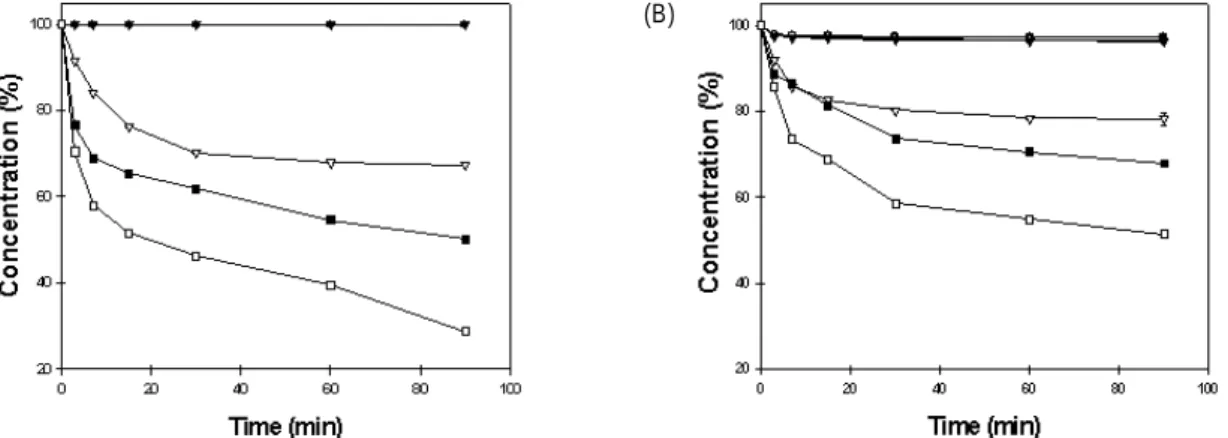
칡 이소플라본 중 daidzin과 genistin의 각 온도에서의 열 안정성을 측정한 결과는 Fig. 1 및 2와 같다. Daidzin 및 gen- istin 모두 농축 및 열처리 순서에 관계없이 80oC에서 121oC 까지 안정한 것으로 나타나 daidzin과 genistin이 물의 끓는 점 근처의 온도에서는 안정하다는 것을 알 수 있었다[25]. 그 러나 두 종류의 이소플라본 모두 처리방법에 상관없이 140oC 이상의 열처리 조건에서는 초기 30분 동안 급격히 열 안정성이 떨어지고 그 이후에는 변화가 적은 것으로 나타나, 처리온도가 높아질수록 열 안정성의 변화는 큰 것으로 나타 났다[25]. 그러나 daidzin은 농축 후 열처리가 열처리 후 농 축보다 열에 의한 이소플라본의 손실이 많았지만 genistin은 두 종류의 이소플라본 처리방법에 의한 함량의 변화에 있어 서 유의적인 차이를 보이지 않았다. 결과적으로 daidzin과 genistin은 처리온도가 높아질수록 열에 불안정하고, 고농도 에서 열에 의한 변화가 더 크며, daidzin이 genistin에 비해 온도에 더 민감한 것을 알 수 있었다[15,20].
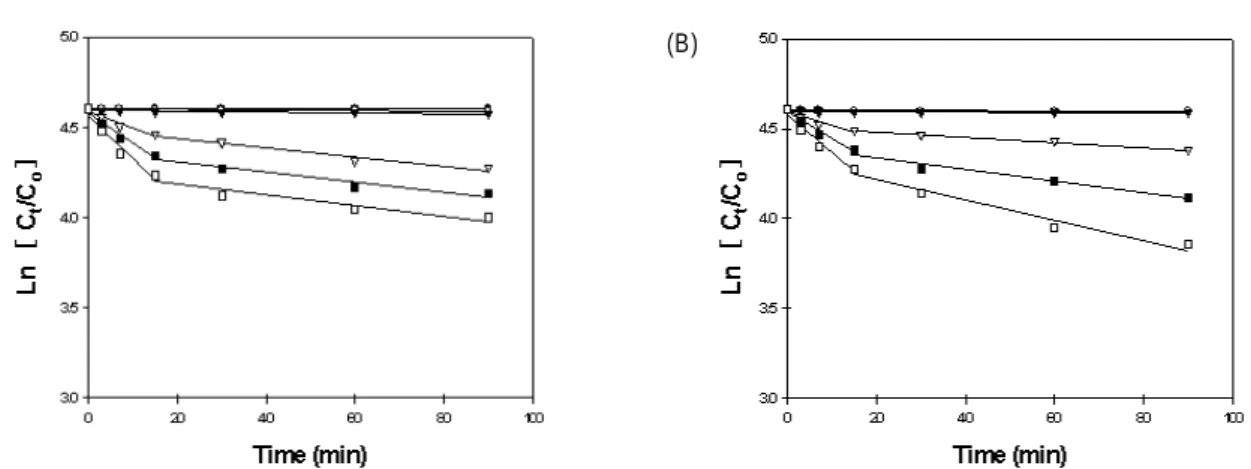
열처리 조건에 따른 daidzin 및 genistin의 온도 의존성 Dadizin과 genistin의 열처리 조건에 따른 칡 이소플라본 의 함량의 변화는 시간 및 농도에 따라 변화하는 1차 반응을 나타내어 변화량을 ln값을 취하여 반응속도상수를 알아보았
(A)
(B)
Fig. 1. Changes in daidzin concentration during heating at various temperatures. (A) Heated after concentration, and (B) Heated before concentration. ●: 80oC, ○: 100oC, ▼: 121oC, ▽: 140oC, ■: 165oC, □: 180oC
(A)
(B)
Fig. 2. Changes in genistin concentration during heating at various temperatures. (A) Heated after concentration, and (B) Heated before concentration. ●: 80oC, ○: 100oC, ▼: 121oC, ▽: 140oC, ■: 165oC, □: 180oC
(A)
(B)
Fig. 3. Degradation kinetics of daidzin at various temperatures. (A) Heated after concentration, and (B) Heated before concentration. ●: 80oC, ○: 100oC, ▼: 121oC, ▽: 140oC, ■: 165oC, □: 180oC
다. 두 종류의 이소플라본인 daidzin과 genistin은 처리방법 에 상관없이 두 단계로 변화가 일어남을 알 수 있었다.
Daidzin은 1단계가 2단계에 비해 더 빠른 반응속도를 나타 냈으며 농축 후 열처리가 열처리 후 농축에 비해 1단계에서 더 빠른 daidzin의 손실을 나타내었다(Fig. 3). Genistin도
daidizin과 동일하게 두 단계로 변화가 나타나고 1단계에서 더 빠른 반응 속도를 보여 주었지만 농도차이에 의한 반응속 도에 있어 유의차는 적은 것을 알 수 있었다(Fig. 4). 두 처리 방법에 의한 온도 의존성을 본 결과(Table 1), daidzin은 농 축 후 열처리의 1단계에서 온도 의존성이 높게 나타났지만
(A)
(B)
Fig. 4. Degradation kinetics of genistin at various temperatures. (A) Heated after concentration, and (B) Heated before concentration. ●: 80oC, ○: 100oC, ▼: 121oC, ▽: 140oC, ■: 165oC, □: 180oC
Table 1. Rate constants (k) and activation energies (Ea) of daidzin and genistin
Material Temp. (oC)
k1 (min
-1)k2 (min
-1)Ea 1 (KJ/mol) Ea 2 (KJ/mol)
Daidzin 1 (Heated after concentration)
80oC 100oC 121oC 140oC 165oC 180oC
4.40×10⁻⁵ 3.74×10⁻⁵ 3.57×10⁻⁵ 1.74×10⁻² 2.47×10⁻² 4.01×10⁻²
4.40×10⁻⁵ 3.74×10⁻⁵ 3.57×10⁻⁵ 1.48×10⁻³ 3.60×10⁻³ 7.52×10⁻³
31.01 62.00
Daidzin 2
(Heated before oncentration)
80oC 100oC 121oC 140oC 165oC 180oC
1.61×10⁻⁴ 2.52×10⁻⁴ 2.57×10⁻⁴ 1.19×10⁻² 1.20×10⁻² 2.36×10⁻²
1.61×10⁻⁴ 2.52×10⁻⁴ 2.57×10⁻⁴ 7.07×10⁻⁴ 2.18×10⁻³ 3.47×10⁻³
23.35 62.55
Genistin 1 (Heated after concentration)
80oC 100oC 121oC 140oC 165oC 180oC
1.21×10⁻⁵ 1.60×10⁻⁴ 2.16×10⁻⁴ 9.04×10⁻³ 1.69×10⁻² 2.38×10⁻²
1.21×10⁻⁵ 1.60×10⁻⁴ 2.16×10⁻⁴ 2.59×10⁻³ 2.77×10⁻³ 2.92×10⁻³
37.67 10.51
Genistin 2
(Heated before concentration)
80oC 100oC 121oC 140oC 165oC 180oC
8.22×10⁻⁵ 1.05×10⁻⁴ 1.48×10⁻⁴ 7.48×10⁻³ 1.49×10⁻² 2.10×10⁻²
8.22×10⁻⁵ 1.05×10⁻⁴ 1.48×10⁻⁴ 1.44×10⁻³ 3.28×10⁻³ 5.60×10⁻³
40.31 52.48
2단계에서는 농도차이에 의한 온도 의존성이 적은 것을 알 수 있었다. 반면에 genistin은 1단계에서는 농도의 차이에 따 른 온도 의존성은 적은 것을 알 수 있었지만 2단계에서는 저 농도에서 온도 의존성이 높은 것을 알 수 있었다. 또한 농도 에 따른 daidzin과 genistin의 변화를 본 결과 농축 후 열처 리의 경우는 genistin이 1단계에서 온도에 대한 의존성이 높 게 나타났으나 daidzin은 2단계에서 온도에 대한 의존성이 높은 것으로 나타났으며, 이것은 열처리 후 농축의 경우에서
도 동일하게 나타났다. 따라서 열처리에 의한 칡 이소플라본 의 반응속도가 빠르게 진행이 될수록 온도 의존성이 높다는 것을 알 수 있었다[15]. 각 열처리 조건에 의한 daidzin과 genistin의 함량 변화는 121oC까지는 온도에 따른 반응속도 의 변화가 없었고, 140oC부터 측정한 결과 농축 후 열처리 한 시료의 활성화 에너지 값이 열처리 후 농축한 시료의 활성화 에너지 값보다 더 높게 나타나 고농도에서 열처리한 경우 반 응이 상대적으로 천천히 일어난다는 것을 알 수 있었다.
(A)
(B)
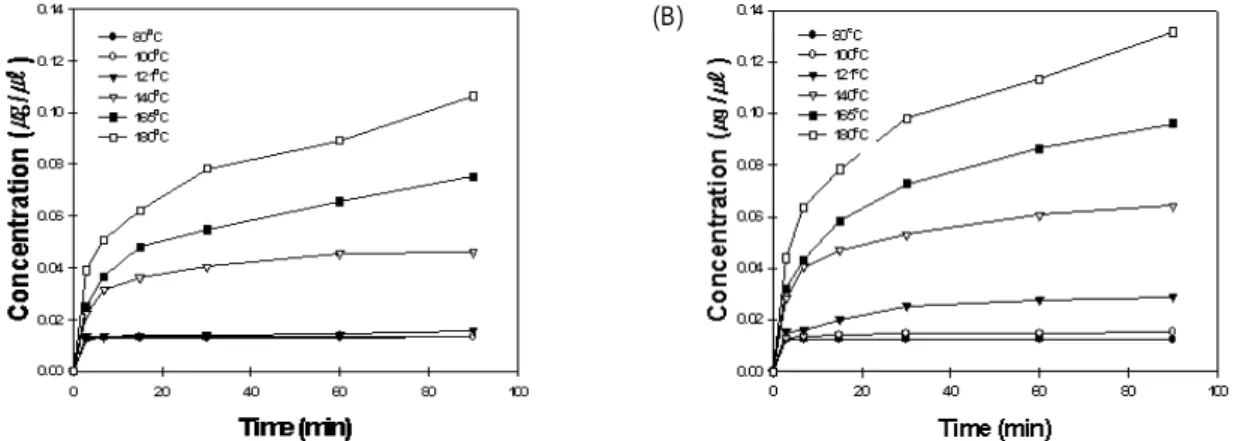
Fig. 5. Changes in daidzein concentration during heating at various temperatures. (A) Heated after concentration, and (B) Heated before concentration
(A)
(B)
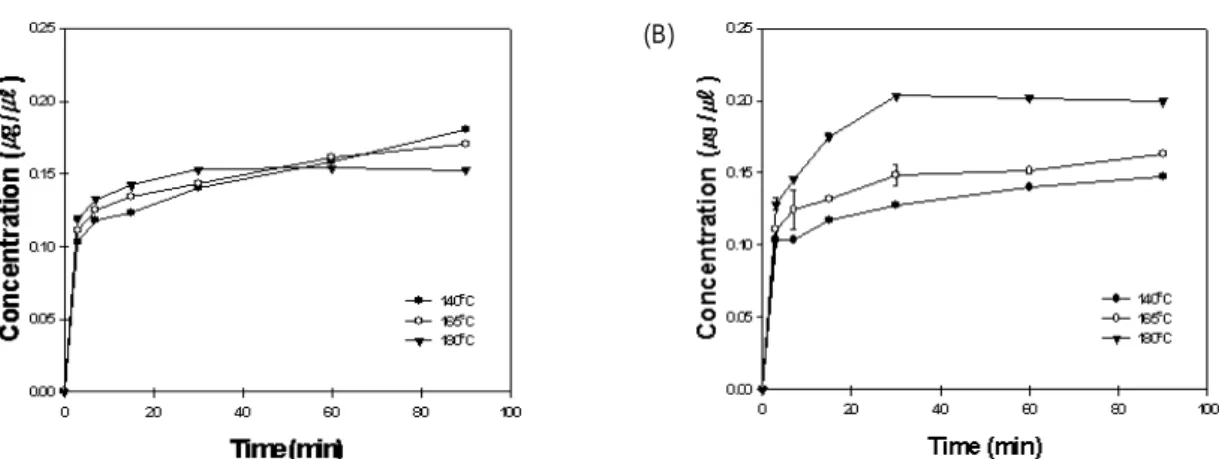
Fig. 6. Changes in genistein concentration during heating at various temperatures. (A) Heated after concentration, and (B) Heated before concentration
열처리 조건에 따른 daidzin과 genistin의 분해 산물 각각의 조건에 의해 칡 이소플라본을 열처리한 결과 daid- zein, malonyl-glycitin, glycitein, acetyl-genistin, genistein 등의 이소플라본 생성물이 생겨났는데, 이는 고온에서 콩 이 소플라본을 처리하였을 때 daidzein, glycitein, genistein 함 량이 증가한다는 보고와 일치하였다[2,5,17,19,22]. 농축 후 열처리 조건의 daidzein (Fig. 5)의 경우 80oC에서 121oC 까 지는 함량 변화에 있어 유의적 차이가 나타나지 않았지만, 140oC 이상의 열처리 조건에서 급격한 함량의 증가를 보여 주었다. 반면, 열처리 후 농축 조건의 daidzein은 농축 후 열 처리와 다르게 80oC, 100oC에서 유의차를 보이지 않았으나 121oC 열처리 조건에서 소량의 함량 증가를 보이기 시작해 140oC이상의 열처리 조건에서 급격하게 함량이 증가하는 것 을 알 수 있었다. 고온으로 처리 시 daidzein의 함량이 급격 하게 증가한다는 것을 알 수 있었으나 농축 처리 방법에 의 한 유의적인 차이는 적은 것을 알 수 있었다. Genistein (Fig.
6), glycitein (Fig. 7), malonyl-glycitin (Fig. 8), acetyl-genis- tin (Fig. 9)의 경우도 농축 조건에 상관없이 140oC 이상의 열 처리 조건에서 급격한 함량의 증가를 보여주었다. 이와 같은
현상은 배당체로 존재하는 이소플라본의 glucoside group이 열에 영향을 받아 가수분해가 일어나 daidzein, genistein, glycitein 등의 aglycone 형태의 이소플라본으로 변화하는 현 상이라고 보고 하였는데[22,23,25], 작용 기작을 조금 더 세세 히 살펴보면 열에 의해 malonyl-glycitin에 decarboxylation 이 유발되어 acetyl genistin이 생성하게 된다고 하였고, 결론 적으로 daidzin, genistin 등의 배당체가 열에 의해 분해되어 acetyl-genistin, malonyl-glycitin의 중간 유도체를 거쳐 최종 적으로 aglycone 형태의 daidzein, genistein, glycitein 등의 aglycone을 생성하게 된다[2,17,22,23].
요 약
열처리 조건 및 농도의 차이에 따른 칡 이소플라본인 daidzin과 genistin의 열 안정성에 대하여 조사하였다.
Daidzin과 genistin 두 종류의 이소플라본은 처리방법에 상 관없이 140oC이상의 열처리 조건에서 초기 30분 동안 급격 히 열 안정성이 떨어지고 그 이후 변화가 적게 나타나 처리 온도가 높을수록 열 안정성의 변화가 큰 것으로 나타났으며,
(A)
(B)
Fig. 7. Changes in glycitein concentration during heating at various temperatures. (A) Heated after concentration, and (B) Heated before concentration
(A)
(B)
Fig. 8. Changes in malonyl-glycitin concentration during heating at various temperatures. (A) Heated after concentration, and (B) Heated before concentration
(A)
(B)
Fig. 9. Changes in acetyl-genistin concentration during heating at various temperatures. (A) Heated after concentration, and (B) Heated before concentration
genistin은 daidzin에 비해 농도차이 에 따른 변화의 차이가 크지 않은 것을 알 수 있었다. 또한 열처리 조건에 따른 반응 속도는 모두 두 단계로 나타났는데, daidzin과 genistin 모두 2단계보다 1단계에서 빠른 반응속도를 보여 주었고, daidzin 은 고농도 일 수록 더 빠른 반응속도를 나타내는 것을 알 수
있었으나, genistin은 농도에 따른 유의차가 적은 것을 알 수 있었다. Daidzin은 1단계의 고농도에서 온도 의존성이 높게 나타났으며 2단계는 농도에 따른 온도 의존성에 유의차가 없 었다. Genistin의 경우 1단계에서는 농도에 의한 온도 의존성 이 작게 나타났지만 2단계의 저농도에서 온도 의존성이 높은
것을 알 수 있었다. 농도에 따른 변화를 보면 genistin은 고농 도와 저농도 모두 1단계에서 온도 의존성이 큰 것으로 나타 났으며 반면 daidzin은 고농도, 저농도 모두 2단계에서 온도 의존성이 높은 것을 알 수 있었다. 또한 daidzin과 genistin 모두 140oC 이상의 열처리에 의해 이소플라본 glucosidic group이 열에 의해 가수분해되어 daidzein, genistein, glyci- tein, malonyl-glycitin, acetyl-genistin 등의 중간 유도체 및 aglycone이 생성되며 140oC, 15 min의 처리 조건에서 대부분 가장 많은 양이 생성되는 것을 알 수 있었고, 농도 변화에 따 른 함량의 증가는 유의차가 적은 것을 알 수 있었으나 그 중 malonyl daidzin의 경우 열처리 조건에 의해 따른 생성량의 차이가 큰 것을 알 수 있었다. 열처리 후 농축조건이 농축 후 열처리보다 더 많은 daidzin, genistin 유도체들을 생성시킨 것으로 보아 칡 이소플라본의 각 열처리 조건에 따른 열 안 정성은 농축 후 열처리보다 열처리 후 농축이 훨씬 더 열에 안정하다는 것을 알 수 있었다. 따라서 칡 이소플라본의 열 안정성은 콩 이소플라본과 유사하게 140oC 이상 열처리에 의해 가수분해반응을 보였고, 이소플라본의 중간 유도체들 과 aglycone이 140oC 이상의 열처리 시 생성되었다. 따라서 칡 이소플라본의 열 안정성은 가열온도와 농도에 의해 큰 영 향을 받으며, 콩 이소플라본의 열 안정성과 매우 유사한 특 성을 나타내었다.
감사의 글
이 연구는 2005년도 경희대학교 지원(KHU-20050378)에 의한 결과이며 이에 감사드립니다.
References
1. Choi, Y. B. and H. S. Shon. 1998. Isoflavone content in Korean fermented and unfermented soybean foods. Korean
J. Food Sci Technol. 30, 745-750.
2. Coward, L., M. Smith, M. Kirk and S. Barnes. 1998.
Chemical modification of isoflavones in soyfoods during and processing. Am. J. Clin. Nutr. 68, 1486S-1491S.
3. Doosan World Encyclopedia. 1999. 25, pp. 116, Doosandonga.
Seoul. Korea.
4. Eisen, B. N., Y. E. Ungar and E. Shimoni. 2003. Stability of isoflavones in soy milk stored at elevated and ambient temperatures. J. Agric. Food Chem. 51, 2212-2215.
5. Grun, I. U., K. Adhikari, C. Li, Y. Li, B. Lin, J. Jhang and L. N. Fernando. 2001. Changes in the profile of genistein, daidzein, and their conjugates during thermal processing tofu. J. Agric. Food Chem. 49, 2839-2843.
6. Han, S. H., J. B. Kim, S. G. Min and C. H. Lee. 1995. The effect of Puerariae radix catechins administration on liver function in carbon tetrachloride-treated rats. J. Korean Soc.
Food Sci. Nutr. 25, 713-719.
7. Hayakawa, J., N. Noda, S. Yamada and K. Uno. 1984.
Studies on physical and chemical quality evaluation of crude drug preparation I. Analysis of Pueraria Radix and Species Puerariae. Yakugaru Zasshi. 50, 104-108.
8. Ingham, J. L., S. Tahara and S. Z. Dziedzic. 1986. A chem- ical investigation of Pueraria mirifica root. Z Naturforsch.
41, 403-409.
9. Inoue, T. and M. Fujita. 1974. Biosynthesis of isoflavone
C-glycoside in Pueraria root. Chem. Pharm. Bull. 22,
1422-1429.10. Jackson, C. J. C., J. P. Dini, C. Lavandier, H. P. Y.
Rupasinghe, H. Faulkner, V. Poysa, D. Buzzell and S.
Degrandis. 2002. Effect of processing on the content and composition of isoflavones during manufacturing of soy beverage and tofu. Process Biochem. 37, 1117-1123.
11. Kaufman, P. B., J. A. Duke, H. Brielmann, J. Boik and J.
E. Hoyt. 1997. A comparative survey of leguminous plants as sources of the isoflavones, genistein and daidzein:
Implications for human nutrition and health. J. Altern.
Complement. Med. 3, 7-12.
12. Kim, C. S., Y. S. Lee, J. S. Kim and Y. H. Hahn. 2000.
High performance liquid chromatographic analysis of iso- flavones in soybean foods. Korean J. Food SciI. Technol. 32, 22-30.
13. Kim, H. Y., J. H. Hong, D. S. Kim, K. J. Kang, S. B. Han, E. J. Lee, H. W. Chung, K. H. Song, K. A. Sho, S. J.
Kwack, S. S. Kim, K. L. Park, S. K. Lee, M. C. Kim, C. M.
Kim and I. S. Song. 2003. Isoflavone content and estrogen activity in arrowroot Puerariae Radix. Food Sci. Biotechnol.
12, 29-35.
14. Kim, S. R., H. D. Hong and S. S. Kim. 1999. Some proper- ties and contents of isoflavone in soybean and soybean foods. Korea Soybean Digest. 16, 35-46.
15. Lee, J. J. and J. W. Rhim. 2001. Determination of kinetic parameters for texture changes of sweet potatoes during heating. Korean J. Food Sci. Technol. 33, 66-71.
16. Lee, M. H., Y. H. Park, H. S. Oh and T. S. Kwak. 2002.
Isoflavone content in soybean and its processed products.
Korean J. Food Sci. Techinol. 34, 365-369.
17. Mahungu, S. M., S. Diaz-Mercado, J. Li, M. Mschwenk, K.
Singletary and J. Faller. 1999. Stability of isoflavones dur- ing extrusion processing of corn/soy mixture. J. Agric.
Food Chem. 47, 279-284.
18. Moon, B. K., K. S. Jeon and I. K. Hwang. 1996. Isoflavone contents in some varieties of soybean and on processing conditions. Korean J. Soc Food Sci. 12, 527-534.
19. Murphy, P. A., T. Song, G. Buseman, K. Barua, G. R.
Beecher, D. Trainer and J. Holden. 1999. Isoflavones in re- tail and institutional soy foods. J. Agric. Food Chem. 47, 2697-2704.
20. Oh, J., K. S. Lee, H. Y. Son and S. Y. Kim. 1990.
Antioxidative components of Pueraria root. Korean J. Food
Sci. Technol. 22, 793-800.
21. Wang, H. and P. A. Murphy. 1994. Isoflavone composition of American and Japanese soybeans in Iowa: Effects of va- riety, crop year, and location. J. Agric. Food Chem. 42,
1674-1677.
22. Wang, H. J. and P. A. Murphy. 1996. Mass balance study of isoflavones during soybean processing. J. Agric. Food
Chem. 44, 2377-2383.
23. Wang, C., Q. Ma, S. Pagadala, M. S. Sherrard and P. G.
Krishnan. 1998. Changes of isoflavone during processing of soy protein isolates. J. Am. Oil Chem. Soc. 75, 337-341.
24. Keung, W.-M. and B. L. Vallee. 1993. Daidzein a potent se-
lective inhibitor of human mitochondrial aldehyde dehydrogenase. Proc. Natl. Acad. Sci. USA. 90, 1247-1251.
25. Xu, Z. M., Q. J. Wu and J. S. Godber. 2002. Stability of daidzin, glycitin and generation of derivatives during heating. J. Agric. Food Chem. 50, 7402-7406.
26. Zeng, C. Y., L. Y. Zhang, Y. P. Zhou and L. L. Fan. 1982.
Pharmacological studies on Pueraria radix. Clin. Med. J. 95, 145-150.