Journal of Life Science 2008 Vol. 18. No. 12. 1771~1774 ⓒJLS / ISSN 1225-9918
Identifications of a Sprout-Rot Pathogen Pseudomonas Species SN239 and Selection Resistant Soybean Line
Jong Soo Lim, Kum Sook Do, Dong Sun Lee, Sang Gu Kang, Sang Gon Suh1 and Euiho Park*
Biotechnology Major, School of Biotechnology, Yeungnam University, Gyeongsan 712-749, Korea
1Department of Horticulture, College of Natural Sciences Yeungnam University, Gyeongsan 712-749, Korea Received November 21, 2008 /Accepted December 24, 2008
Control microbial contamination in pathogens to soy sprouts has always been highly concerned in soybean sprout industries because the soybean sprouts are consumed largely as a nutritious fresh veg- etable around the world. However, pathogens in soy sprouts are little known. Here, we isolated a strain of Pseudomonas sp. SN239 that caused severer symptoms in sprouts of many soybean cultivars.
In phylogenetic relationships using 16S ribosomal RNA sequences of the Pseudomonas species, the identified Pseudomonas sp. SN239 was grouped with P. putita, P. plecoglossicida, P. monteilii and P.
mevalonii. Thus, the bacterial strain SN239 might be a newly identified Pseudomonas species which closely related to P. putida. Furthermore, we found that a Korean indigenous soybean (Glycine max) cultivar YNPCSS3-19 has strong resistance against the Pseudomonas sp. SN239.
Key words : Pseudomonas, Glycine max, disease resistance soybean, 16S rRNA
*Corresponding author
*Tel:+82-53-810-3025, Fax:+82-53-816-8498
*E-mail : [email protected]
Introduction
People throughout the Asia are consuming soybeans as a variety of traditional soy food products for more than 1,000 years. Soy foods are typically consumed as non-fermented and fermented conditions. Non-fermented soy foods include fresh green soybeans, whole dry soybeans, soy nuts, soy sprouts, whole-fat soy flour, soymilk and tofu. Fermented soy foods include tempeh, miso, soy sauces, natto, soybean paste, and fermented tofu and soymilk products [4]. Among soy foods, soybean sprouts contain high concentration of iso- flavone and vitamins. Because of this reason, soybean sprouts are largely consumed and supplying the vitamins and isoflavones in eastern Asia [8]. In soybean sprout in- dustry, control microbial contamination by pathogens has always been tightly concerned. Gram-negative bacteria Pseudomonas strains and Bacillus are the major pathogens for soybean sprouts [7]. Up to date, many studies on the resist- ance of soybean plants against plant pathogenic bacteria have been investigated for understanding the mechanism of host-pathogene interactions [6,10,12]. However, little is known about the resistance of soybean sprouts against pathogens. Here, we isolated a bacteria strain, named SN239, that caused severer symptoms of the sprouts of many soy-
bean cultivars. We concluded that the identified bacteria SN239 is one of Pseudomonas species by using analysis of phylogenetic relationships based on 16S ribosomal RNA sequences. Furthermore, we found a soybean cultivar that showed strong resistance against bacteria pathogen.
Materials and Methods
Plant materials and plant infection
A Pseudomonas sp. SN239 was isolated from rotten soy- bean sprouts collected from local market in Gyeongsan city, Korea and cultured in NB broth (3.0 g/l beef extracts and 5.0 g/l pepton) (Becton Dickinson Co., Sparks, MD, USA) at 28oC. For inoculation to soybean sprouts, bacteria were cultured until 0.5 of OD number at 600 nm using spectrophotometer. Soybean (Glycine max) cultivars includ- ing YNPCSS3-19, YNPCSS1-11 and Eunha were inoculated with Pseudomonas sp. SN239. Seeds were surface-sterilized with 3% sodium hypochlorite for 30 min and germinated in petridish at 26oC in the dark for 2 days. Seedlings were imbibed for 2 hours in NB medium with 5x10⁸ cfu/mL of Pseudomonas sp. SN239 infection and then were washed with sterilized water. Seedlings with/without pathogen treat- ments continued to grow at 26oC in the dark and harvested every 12 hours up to 72 hours. Upon harvesting, samples were frozen in liquid nitrogen and stored at -80oC. In order to determine the survivability upon Pseudomonas infection, 48 hours later of treatment some of the seedlings were placed - Note -
1772 생명과학회지 2008, Vol. 18. No. 12
under light for further 48 hours to develop chloroplasts.
DNA sequencing and molecular genetics analysis
Nucleotide sequences of 16S ribosomal RNA of Pseudomonas sp. SN239 were amplified using polymerase chain reaction (PCR) with a set of primers, which are a for- ward primer (5’-TGACGCTGGCGGCGGCCTAAC-3’) and a reverse primer (5’-CCCGTCTGAATCCACCGTGGT-3’). PCR amplification was performed with a DNA thermal cycler by using a PCR reaction buffer containing each of the deoxy- nucleotide triphosphates at a concentration of 200 μM, each of the primers at a concentration of 1 μM, 10 ng of DNA and 2.5 U of Taq DNA polymerase in a total volume of 50 μl reaction. A total of 50 amplification cycles were performed following denaturation at 94oC for 1 min, primer annealing at 59oC for 45 s, and primer extension at 72oC for 2 min.
By using designed PCR primers, about 1.4 kb DNA frag- ments were amplified from the strain SN239. The amplified DNA fragments were purified by gel electrophoresis in 1.4%
agarose. The 1.4 kb of purified DNA fragment was cloned in to pGEM-T vector (Promega co. Madison, WI, USA). DNA sequencing for the ribosomal RNA in pGEM-T vector was performed with the BigDye Terminator Cycle Sequencing kits (PE Biosystems, Foster City, CA, USA) using an auto- mated DNA sequencing machine (ABI 3100, Applied Biosystems, Rockville, MD, USA). Primers used for DNA se- quencing were SP6 (5’-TATTTAGGTGACACTATAG-3’) and T7 (5’-TAATACGACTCACTATAGGG-3’). Neucleotide and deduced amino acid sequences were analyzed using the pro- grams in DNAsis (Hitachi, Japan). The nucleotide sequences were compared with sequences deposited in public data- bases of NCBI using the BLAST algorithm [1].
Data analysis
The nucleotide sequences of 16S rRNA were aligned by using the CLUSTALW computer program [11]. The 16S rRNA sequences were aligned based on their secondary structures. Evolutionary trees were constructed with the phylip program package [3], using the neighbour-joining method [9] with genetic distances computed by using the Jukes-Cantor model [5]. Phylogenetic trees were constructed from the 16S rRNA sequences.
Results and Discussion
To compare the homology of the Pseudomonas sp. SN239
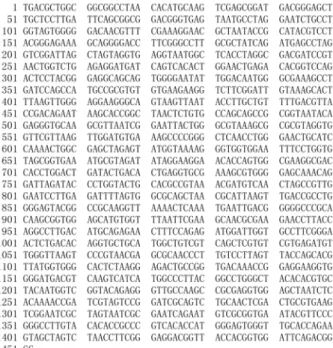
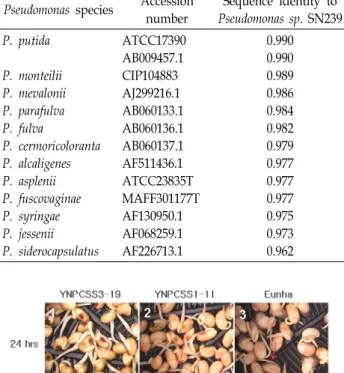
with that of other Pseudomonas species, 16S rRNA sequences were analyzed. We amplified 1,452 nucleotides of 16S rRNA sequences of Pseudomonas sp. SN239 (FJ529815) (Fig. 1) using rRNA specific primers. The 16S rRNA sequences of Pseudomonas sp. SN239 was showed 99 % homology with that of Pseudomonas putida (ATCC17390) [2] and Pseudomonas plecoglossicida (AB009457.1) (Table 2). However, the 16S rRNA sequences of P. sp. SN239 was showed less than 99
% homology with that of Pseudomonas fuscovaginae (MAFF301177T), P. asplenii (ATCC23835T), P. siderocapsulatus (AF226713.1), P. monteilii (CIP104883), P. mevalonii (AJ299216.1), P. parafulva (AB060133.1), P. fulva (AB060136.1), P. alcaligenes (AF511436.1), P. cermoricoloranta (AB060137.1), P. jessenii (AF068259.1) and P. syringae (AF130950.1) (Table 2). Analysis based on phylogenetic relationship showed that the Pseudomonas sp. SN239 strain might be grouped with Pseudomonas putida, Pseudomonas plecoglossicida, Pseudomonas monteilii, Pseudomonas mevalonii (Fig. 2), but not perfectly identical. Thus, the strain Pseudomonas sp. SN239, a soybean sprout pathogen, is a newly identified Pseudomonas species having sequence characteristics similar with P. putida.
Hundreds of soybean cultivars were germinated and ex- amined for resistance against Pseudomonas sp. SN239.
Sprouts of the most soybean cultivars were susceptible to this Pseudomonas strain. However, few soybean cultivars
Fig. 1. Nucleotide sequences of 16S ribosomal RNA of Pseudomonas sp. SN239. GenBank accession number is FJ529815.
Journal of Life Science 2008, Vol. 18. No. 12 1773
Fig. 2. Phylognetic tree derived from the analysis of the 16S rRNA sequences of the Pseudomonas species SN239 (GenBank ac- cession FJ529815). The bar represents a 1% sequence differences. Accession numbers of compared bacterial se- quences are: Pseudomonas putida (ATCC17390), P. pleco- glossicida (AB009457.1), P. fuscovaginae (MAFF301177T), P.
asplenii (ATCC23835T), P. siderocapsulatus (AF226713.1), P.
monteilii (CIP104883), P. mevalonii (AJ299216.1), P. parafulva (AB060133.1), P. fulva (AB060136.1), P. alcaligenes (AF511436.1), P. cermoricoloranta (AB060137.1), P. jessenii (AF068259.1) and P. syringae (AF130950.1).
Table 1. Average seedling length of three soybean genotypes after inoculation with sprout rot disease strain SN239
Strain SN239 Inoculation
Average seedling length (cm) after hours (hr) of treatments
24 hr 48 hr 72 hr YNPCSS3-19 Non-inoculated
Inoculated
3.6 3.5
5.6 5.6
7.3 6.2 YNPCSS1-11 Non-inoculated
Inoculated
3.9 2.5
6.0 2.8
7.4 3.2 Eunhakong Non-inoculated
Inoculated
3.9 2.3
6.3 2.3
7.5 2.6
showed relatively resistant to Pseudomonas sp. SN239.
Among them, YNPCS3-19, which is a Korean endogenous soybean cultivar, showed stronger resistant. Therefore, we performed detailed resistant analysis with YNPCS3-19 as a resistant cultivars, YNPCSS1-11 as a susceptible cultivar, and Eunha as a medium resistant cultivars against Pseudomonas sp. SN239 strain. When the seedlings were grown after 24 hours at 28oC after inoculation of Pseudomonas sp. SN239, both cultivars YNPCSS1-11 and Eunha showed brown rotten symptoms in their hypocotyls (Fig. 3). However, sprouts of YNPCS3-19 were not only showed symptoms up to 72 hours after the Pesudomonas inoculation (Fig. 3) but also kept grow- ing in hypocotyls (Table 1), indicating that soybean cultivar
Table 2. Sequence identities of 16S ribosomal RNA of Pseudomonas sp. SN239 with that of other Pseudomonas species Pseudomonas species Accession
number
Sequence identity to Pseudomonas sp. SN239 P. putida
P. monteilii P. mevalonii P. parafulva P. fulva
P. cermoricoloranta P. alcaligenes P. asplenii P. fuscovaginae P. syringae P. jessenii P. siderocapsulatus
ATCC17390 AB009457.1 CIP104883 AJ299216.1 AB060133.1 AB060136.1 AB060137.1 AF511436.1 ATCC23835T MAFF301177T AF130950.1 AF068259.1 AF226713.1
0.990 0.990 0.989 0.986 0.984 0.982 0.979 0.977 0.977 0.977 0.975 0.973 0.962
Fig. 3. Soybean sprouts inoculated with Pseudomonas sp. SN239.
Dark grown seedlings of soybean cultivars were in- oculated for 2 hours in NB media with Pseudomonas sp.
SN239 and then were washed with sterilized water. The seedlings were grown up to 72 hours at 28oC. Photograph were taken after 24 hours (upper panel) and 72 hours (lower panel) of inoculation. Soybean cultivars were YNPCS3-19 (panels1 and 4), YNPCSS1-11 (panel 2 and 5) and Eunha (panel 3 and 6). Arrows indicate rotten roots.
YNPCS3-19 has resistance against Pseudomonas sp. SN239.
Therefore, this Korean indigenous soybean cultivar YNPCS3-19 may be useful in breeding soybean cultivar re- sistant to soybean sprout disease.
Acknowledgment
This research was supported by a Korea Research Foundation Grant (KRF-2003-005-F00001).
References
1. Altschul, S. F., W. Gish, W. Miller, E. W. Myers and D.
1774 생명과학회지 2008, Vol. 18. No. 12
J. Lipman. 1990. Basic local alignment search tool. J. Mol.
Biol. 215, 403-410.
2. Chun, J., M. S. Rhee, J. I. Han and K. S. Bae. 2001.
Arthrobacter siderocapsulatus Dubinina and Zhdanov 1975AL is a later subjective synonym of Pseudomonas putida (Trevisan 1889) Migula 1895AL. Int. J. Syst. Evol. Microbiol.
51, 169-170.
3. Felsenstein, J. 1989. phylip-phylogeny inference package (version 3.2). Cladistics 5, 164-166.
4. Golbitz, P. 1995. Traditional soyfoods: processing and products. J. Nutr. 125, 570-572.
5. Jukes, T. H. and C. R. Cantor. 1969. Evolution of protein molecules. In Mammalian Protein Metabolism, pp. 21-132, Edited by H. N. Munro. New York, Academic Press.
6. Keen, N. T. 1990. Gene-for-gene complementarity in plant-pathogen interactions. Annu Rev Genet 24, 447-463.
7. Kim, H. J., D. S. Lee and H. D. Paik. 2004. Characterization of Bacillus cereus isolates from raw soybean sprouts. J. Food Prot. 67, 1031-1035.
8. Lee, S. J., J. K. Ahn, T. D. Khanh, S. C. Chun, S. L. Kim, H. M. Ro, H. K. Song and I. M. Chung. 2007. Comparison
of isoflavone concentrations in soybean (Glycine max (L.) Merrill) sprouts grown under two different light conditions.
J. Agric. Food Chem. 55, 9415-9421.
9. Saitou, N. and M. Nei. 1987. The neighbor-joining method:
a new method for reconstructing phylogenetic trees. Mol.
Biol. Evol. 4, 406-425.
10. Seehaus, K. and R. Tenhaken. 1998. Cloning of genes by mRNA differential display induced during the hyper- sensitive reaction of soybean after inoculation with Pseudomonas syringae pv. glycinea. Plant Mol. Biol. 38, 1225-1234.
11. Thompson, J. D., D. G. Higgins and T. J. Gibson. 1994.
Clustal w: improving the sensitivity of progressive multiple sequence alignment through sequence weighting, posi- tion-specific gap penalties and weight matrix choice. Nucleic Acids Res. 22, 4673-4680.
12. Whalen, M. C., R. W. Innes, A. F. Bent and B. J. Staskawicz.
1991. Identification of Pseudomonas syringae pathogens of Arabidopsis and a bacterial locus determining a virulence on both Arabidopsis and soybean. Plant Cell 3, 49-59.
초록:콩나물 부패균 Pseudomonas sp. SN239 동정과 콩나물 부패병 내병성 계통 선발
임종수․도금숙․이동선․강상구․서상곤1․박의호*
(영남대학교 생명공학부 생명공학전공, 1영남대학교 자연자원대학 원예학과)
콩나물은 우리나라에서 오래 전부터 재배하여 온 채소로서 그 기호성이 매우 높으며 영양학적으로 우수하나 일부 열악한 재배환경으로 콩나물의 부패문제가 자주 발생해 왔다. 따라서 본 연구는 시중의 부패된 콩나물로부터 다양한 병원균을 분리함과 동시에 재래콩 유전자원으로부터 시중의 콩나물 부패병에 강한 품종을 탐색하고 선발된 내병성 계통의 생육특성을 조사하였다. 분리된 콩나물 부패균들 중 병원성이 강한 콩나물 부패균인 Pseudomonas sp. SN239을 분리하고 16S rRNA 염기서열을 동정한 결과 P. putita, P. plecoglossicida, P. monteilii 및 P. mevalonii와 근연관계를 보였으나 완전히 일치하지는 않았으므로 Pseudomonas sp. SN239는 새로이 동정된 콩나물 부패균으로 여겨진다. 또한 재래콩 194계통에 콩나물 부패병균 Pseudomonas sp. SN239을 접종하여 저항성을 검정한 결과, 이병 성 계통은 심하게 부패되었으나 한국 고유계통 YNPCS3-19는 병원성이 없었으며 또한 지속적으로 생육하였다.
그러므로 부패균 저항성 계통 YNPCS3-19는 부패균 저항성 품종 육성에도 활용 가치가 크다고 판단된다.