1. 서 론
주위환경과 유사한 근적외선 반사율을 가져 야간 관 측기구에 의해 탐지되지 않는 근적외선 위장직물은 근 적외선 야간 관측기구의 발달로 인해 매우 중요한 가치 를 갖고 있다. 세계 각국의 스텔스 기능 전투복을 비교 해보면 캐나다 군복의 경우 스텔스 성능이 우수하며 주 변 환경과 반사율을 일치하여 감지 및 식별이 상당히 어 렵다고 알려져 있다. 현재 한국군복은 1,040nm까지 의 위장성능을 갖고 있으나 Light Green, Dark Green, Brown의 경우 860nm이상의 적외선 영역에 서는 반사율이 급격히 증가하여 최근의 향상된 야시장 비에서는 위장성능이 떨어지는 것으로 나타났다.
군복제작에 사용되는 직물은 P/C직물로 cotton에
는 상업용 배트 염료를 사용하여 적외선 위장기능을 부 여할 수 있지만 polyester섬유에는 분산염료로 위장기 능을 갖기 어렵다.
따라서 카본블랙(Carbon Black)과 같이 적외선 흡 수력이 우수한 안료를 프린팅하여 근적외선 반사율을 변화시킨다. 하지만 탄소의 검은 색상은 적절한 가시 및 근적외선 위장을 달성하는 데 문제가 있고, 특히 카 본마감처리는 쉽게 세척되고 벗겨지기 때문에 열등한 근적외선 위장 내구성을 갖는다. 또한 안료(Pigment) 와 바인더를 다량 사용함에 따라 섬유 표면에 존재하는 불용성 안료 입자에 의한 근적외선 반사율이 높고, 터 치성이 취약한 문제가 있다1-4).
국내에는 스텔스 염료 및 안료를 국내에서 제조 및 생 산하는 기술이 미비한 수준으로 상기와 같은 기존 위장
Swelling agent를 이용한 근적외선 흡수 유기색소의 polyester 흡착 A Study on PET Adsorption Property of NIR Dye Using Swelling Agents
권수현, 최재홍*
경북대학교 섬유시스템공학과
Su Hyeon Kwon and Jae Hong Choi*
Department of Textile System Engineering, Kyungpook National University, Daegu, Korea
*Corresponding author
Jae Hong Choi
([email protected])
Received_February 12, 2018 Revised_March 21, 2018 Accepted_March 23, 2018
Textile Coloration and Finishing TCF 30-1/2018-3/20-28
ⓒ2018 The Korean Society of Dyers and Finishers
Abstract
The near infrared ray camouflage fabric has a near infrared ray reluctance similar to the surrounding environment and has a camouflage effect on the surrounding environment. Synthetic fibers used in military uniforms are difficult to have gastrointesti- nal function as general commercial dyes, unlike cellulose fibers, which use some com- mercial vat dyes to impart infrared gastrointestinal function. In this study, we optimized the adsorption pH, temperature and time for NIR dye application for polyester fabrics, and established the optimum concentration for the evaluation of adsorption build-up char- acteristics. In addition, it is difficult to adsorb it since the polyester material has a dense crystal structure and the NIR dye is bulky. Therefore, a swelling agent used for dyeing meta-aramid fibers with high Tg and high crystallinity was introduced as a separate prepa- ration to increase the affinity to polyester, which is a hydrophobic fiber, to thereby obtain an excellent adsorption rate. As a result of comparing before and after using swelling agent, the adsorption rate difference was 10 times or more when compared with before.Keywords NIR dye, swelling agent, dyeability, polyester, camouflage
직물의 문제점을 해결하기 위해 (주)경인양행 및 (주)오 영산업에서 720~1,250nm 파장대의 근적외선을 선 택적으로 흡수하는 물질인 Nickel dithiolene dye, Phthalocyanine계 NIR dye와 같은 근적외선 흡수 색소를 개발 중에 있다.
본 연구에서는 근적외선 흡수 색소인 Phthalocya- nine계 NIR dye와 Nickel dithiolene dye를 poly- ester섬유에 적용하기 위하여 bulky한 특성을 지닌 근 적외선 염료는 polyester섬유의 치밀한 결정구조로 흡 착하기 어려움이 있는 점을 개선하기 위하여 Tg와 결 정화도가 높은 m-Aramid 섬유 염색에 사용되는 swelling agent를 도입했다. Swelling agent의 사 용은 염료의 염색이 이루어지는 amorphous영역을 넓 혀 bulky한 근적외선 염료의 흡착을 끌어 올렸다. 또 한 온도와 시간, 욕비 조건을 변경하며 조건별 흡착거 동을 파악하였고, 최적의 흡착조건을 제시하였다5-8).
따라서 본 연구를 통해 안료와 바인더 사용을 배제하 고 근적외선 염료와 분산염료만을 사용하여 polyester 흡착을 수행하여 적외선 분광반사율이 각 지형별 자연 배경의 근적외선 분광반사율과의 차이가 동일하거나 유사하도록 하여 위장효과를 효율적으로 달성할 뿐 아 니라 근적외선의 반사율이 대폭 감소하고, 견뢰도 및 터치성 등이 크게 향상되어 군사용 의류, 장비, 텐트 및 군장구류 등에 효과적으로 사용할 수 있다9-15).
2. 실 험
2.1 시료
본 실험에서 사용된 시료는 100% polyester이며 시
료의 물성을 Table 1에 정리하였다.
2.2 염료 및 조제
사용한 염료는 Table 2에 정리하였으며, (주)와이즈 캠에서 개발한 Phthalocyanine계 NIR dye와 Nickel dithiolene dye, 두가지 염료의 분산용액 상태로 제공 받아 사용했다. 각 염료는 분산제 종류 및 분산 비율에 따라 N1~N4와 N5~N8로 나뉘고, Table 3에 정리했 다. 사용한 swelling agent는 Table 4에 나타냈고, 또한 본 연구에 사용된 NIR dye에 관한 구조를 Figure 1과 Figure 2에 개략도로 나타내었다.
2.3 흡착 및 환원세정
흡착 방법은 각각의 dyeing profile을 Figures 3~7 에 정리하였다. 염색기는 IR 염색기(KOREA Chem- ical Ltd., Korea)를 사용하였다. 먼저 pretest의 조 건은 염료농도 1, 3, 5% o.w.f., 욕비 1:40, pH 4.0(acetic acid 4ml, water 1L의 완충액 사용)으로 잡고, 시작온도 60℃에서 승온(3℃/min)하여 130℃
에서 45분간 흡착을 진행했다. 그리고 최적 욕비를 찾 기 위해 1:10, 1:20, 1:40, 1:50으로 욕비를 설정하 고 다른 모든 조건은 동일하게 진행했다(Figure 3).
다음으로 온도를 최적화하기 위해 일반적으로 polyester섬유 염색에 사용된 130℃의 온도와 그 이 Table 1. Fabric specification used for this study
Fabric Manufacturer Specification Polyester 100% DONG-IL Co., Ltd.(Korea) 74/72
Table 2. NIR dyes used for this study
NIR dye No. Dispersing agent Ratio(dye:agent) Manufacturer
Phthalocyanine dye
N1 ULTRAZINE NZ 2:1
N2 DYWELL 500 2:1
N3 ULTRAZINE NZ 1:1
N4 DYWELL 500 1:1
Wisechem Corp., Korea
Nickel dithiolene dye
N5 ULTRAZINE NZ 2:1
N6 DYWELL 500 2:1
N7 ULTRAZINE NZ 1:1
N8 DYWELL 500 1:1
Wisechem Corp., Korea
상의 온도조건인 150℃로 조건을 바꾸어 실험하였다.
이때도 온도 이외의 조건은 모두 동일했다(Figure 4).
Polyester 섬유는 섬유의 선형사슬을 따라 주기적으
로 존재하고 평면적인 구조를 취하고 있기 때문에 결정 성이 높고 강한 결정을 이룬다. 섬유의 강력한 분자간 인력과 치밀한 고결정성으로 인해 고강도, 고탄성의 우 수한 장점이 있으나 염색 측면에서는 염료가 섬유 내부 로 확산되어 염착되기 어려운 단점을 가지고 있다. 일 반적으로 분산염료는 분자의 크기가 작아 polyester섬 유의 compact한 구조로 침투가 용이하여 염색이 가능 하지만, 근적외선 흡수 염료는 분자크기가 훨씬 크기 때문에 섬유의 amorphous영역으로 내부 확산을 기대 하기 어렵다. 따라서 interchain force를 낮춰 amor- phous영역을 확장시킬 수 있는 swelling agent를 사 용하였다.
Swelling agent를 첨가하는 실험의 경우 모든 흡착 조건은 동일했고, NIR dye를 투입하는 시점에 8%의 swelling agent(염욕 50ml 기준, swelling agent 4ml)를 넣어 흡착을 실시하였다(Figure 5).
Polyester섬유에 분산염료를 염색 할 때는 NIR dye 의 흡착실험과 같은 조건에서 진행하였고(Figure 6), 분산염료와 NIR dye를 동시 흡착시키는 실험의 경우 1% o.w.f.에서 NIR dye와 분산염료의 비율을 50:50 의 동일한 비율로 진행했다. NIR dye는 이미 분산용 액 상태로 받았기 때문에 NIR dye의 단독 흡착시에는 별도의 분산제를 넣지 않았고, 분산염료 염색시에는 분 산염료의 분산을 목적으로 정해진 양만큼의 분산제를 함께 첨가하여 염색을 진행했다(Figure 7).
흡착 전·후의 염욕을 0.1ml sampling하여 흡착률 을 측정했다. 모든 NIR dye의 흡착실험 후에는 70℃의 온도에서 30분간 씻어냈고, 분산염료의 염색 후에는 욕 Figure 1. Chemical structure of Phthalocyanine NIR dye.
Z1~16: alkyl, alkoxyalkyl, Halogen
Figure 2. Chemical structure of Nickel dithiolene dye.
Table 3. List of dispersing agent used for this study
Agent Commercial name(manufacturer)
Dispersing agent
UL-NA(Borregaard Corp., Norway) R85A(Ingevity Corp., USA) Dywell(SAMEUL Co., Ltd., Korea)
Table 4. List of swelling agent used for this study
Agent Main component(manufacturer)
Swelling agent 1 Swelling agent 2
N-Methylformanilide(Kyung-In Synthetic Corp., Korea) 1-Phenoxy-2-propanol(Kyung-In Synthetic Corp., Korea)
R1~2: Alkyl or Alkoxyalkyl or Aryl A: Halogen or Hydrogen
비 sodiumhydroxide(DUKSAN, Korea) 1g/L, sodium hydrosulfite(DUKSAN, Korea) 1g/L의 조건에서 70℃에서 30분간 환원세정을 실시하여 미고착 염료를 제거하였다. 고온의 열처리 과정을 따로 거치지는 않았 다.
2.4 흡착률 및 염착률(% Exhaustion)
근적외선 흡수 염료와 분산염료의 욕비별, 온도별, 조제 사용별 polyester 흡착거동을 살펴보기 위하여 흡착 전·후의 염욕 0.1ml를 sampling하여 di- methylformamide(DMF) 10ml에 녹여 최대 흡수 파 장에서의 UV-Vis absorbance 값을 측정해 흡착률
및 염착률을 산출하였다. 이 때, 흡착률 및 염착률은 다 음 식(1)을 사용하여 계산하였다.
Adsorption(%A)=[(A0-A1)/A0]×100 ……… (1)
where,
A0: Absorbance of the dyebath before dyeing A1: Absorbance of the dyebath after dyeing
2.5 견뢰도
전술의 방식으로 찾은 근적외선 흡수 염료의 흡착 최 적의 조건에서 흡착한 polyester 시료는 마찰견뢰도는 Figure 3. Optimum liquor ratio of dyeing profile.
Figure 4. Optimum temperature of dyeing profile.
Figure 5. Optimum swelling agent of dyeing profile.
Figure 6. Disperse dye of dyeing profile.
Figure 7. NIR dye and disperse dye of dyeing profile.
KS 0650, 땀견뢰도는 ISO 105 E04, 세탁견뢰도는 ISO 105 C06, 일광견뢰도는 ISO 105 E02법에 준하 여 gray scale 등급으로 평가하였다14,15).
3. 결과 및 고찰
3.1 욕비별 NIR dye의 polyester 흡착성
기존에 알려진 polyester 섬유의 염색조건(Figure 3)에서 NIR dye N1~N4를 polyester 섬유에 pretest 한 결과는 Table5, Figure8에 정리하였고, 0.5%~5.5%
의 흡착률을 얻었다. N1의 결과가 5.5%로 가장 높은 흡착률을 보였고, N1~N4는 같은 염료이기 때문에 NIR dye 10%, 분산제 5%를 사용한 N1의 염료를 가 지고 앞으로의 실험을 진행하였다.
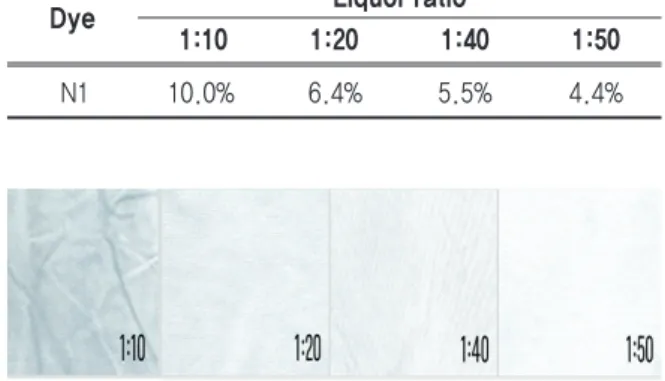
최적의 욕비를 찾기 위해 다른 조건은 이전과 그대로 두고 욕비만 1:10, 1:20, 1:40, 1:50으로 변경한 실 험을 진행했다(Figure 3). 그 결과 1:10의 욕비에서 가장 높은 흡착률인 10%의 값을 얻었다. 사용된 완충 액의 양이 가장 적기 때문에 염욕 내에서 NIR dye가 섬유로의 adsorption이 상대적으로 잘 되었다고 볼 수 있다. 실험 결과는 Table 6과 Figure 9에 정리하였다.
3.2 온도별 NIR dye의 polyester 흡착성
NIR dye 흡착에 온도가 미치는 영향을 살펴보기 위
해 N1을 가지고, 130℃와 150℃에서 흡착특성을 평 가하였다. 1% o.w.f.에서 흡착하여 그 결과를 Table 7과 Figure 10에 정리하였다. 130℃의 경우 10.0%
의 흡착률을 얻을 수 있었지만, 150℃의 경우 2.3%로 감소했다. 온도가 증가할수록 NIR dye의 열운동에너 지 증가로 migration이 잘되어 균염성을 확보할 수 있 지만 최종 흡착률은 오히려 떨어졌다.
일반적으로 polyester의 유리전이온도(Tg)에 근거 하여 살펴보면 70~130℃까지는 온도 상승시 결정영 역이 염료의 침투가 가능한 amorphous영역으로 바뀌 게 되어 염착률이 올라간다.
하지만 150℃의 조건으로 진행해도 130℃에서 이미 충분히 polyester섬유의 amorphous영역이 확장되 었기 때문에 그 이상의 효과는 기대할 수 없다. 게다가 Table 5. Adsorption rate(%) of phthalocyanine based
NIR dispersion of 1,3,5% o.w.f. of polyester fiber op- timum condition
Dye Adsorption(%)
1% o.w.f. 3% o.w.f. 5% o.w.f.
N1 5.5 4.2 4.8
N2 5.4 4.3 4.1
N3 1.4 1.4 3.2
N4 0.5 0.8 1.3
Figure 8. Adsorption color of 4 kinds of phthalocya- nine NIR dye in 1% o.w.f. of polyester fiber.
Table 6. Adsorption rate(%) by liquor ratio
Dye Liquor ratio
1:10 1:20 1:40 1:50
N1 10.0% 6.4% 5.5% 4.4%
Figure 9. Color according to liquor ratio of polyester fiber.
Table 7. Adsorption rate(%) according to adsorption temperature
Dye Temperature(℃)
130℃ 150℃
N1 10.0% 2.3%
Figure 10. Color according to adsorption temperature of polyester fiber.
온도를 지나치게 올리는 경우 NIR dye와 염욕과의 affinity가 증가하여 polyester섬유와의 affinity가 급격히 낮아져 최종 흡착률을 떨어뜨린다. 또한 르샤틀 리에(Le chatelier) 법칙에 의해 섬유와 염료의 결합은 발열반응이기 때문에 주변의 온도가 상승할 때 상승하 는 온도를 낮추기 위한 반응인 흡열반응이 일어나게 되 어 150℃에서 섬유와 NIR dye의 affinity가 낮아지므 로 따라서 130℃의 흡착온도가 최적조건이다.
3.3 Swelling agent 사용
욕비와 온도조건을 바꿔보았지만 가장 좋은 결과는 흡착률 10%이었고, 이는 잔욕에 남아 있는 dye의 양 이 90%라는 점에서 흡착이 성공적으로 일어났다고 할 수 없었다.
따라서 interchain force를 낮춰 amorphous영역 을 확장시킬 수 있는 swelling agent를 사용한 결과 동일 조건에서 swelling agent를 사용하지 않았을 때 는 10%의 흡착률을 보였지만 N-Methylformanilide 가 주성분인 swelling agent 1을 8%(염욕 50ml 기 준, swelling agent 4ml) 첨가한 결과 96%의 흡착률 을 나타냈다. 주성분 1-Phenoxy-2-propanol인 swelling agent 2로 동일한 실험을 진행한 결과 N1의 흡착률이 79%로 낮아지고, N6은 99%로 이전과 같이 흡착률이 유지되었다.
따라서 swelling agent 1을 사용하기로 결정하였 다. 결과적으로 swelling agent는 NIR dye가 침투할 수 있을 만큼 공간을 확보해주어 분자량이 큰 NIR dye 의 흡착을 도와 약 10배의 흡착률이 증가하는 효과가 있었다. 흡착률 결과는 Figure 11에 정리하였다.
3.4 최적 흡착조건
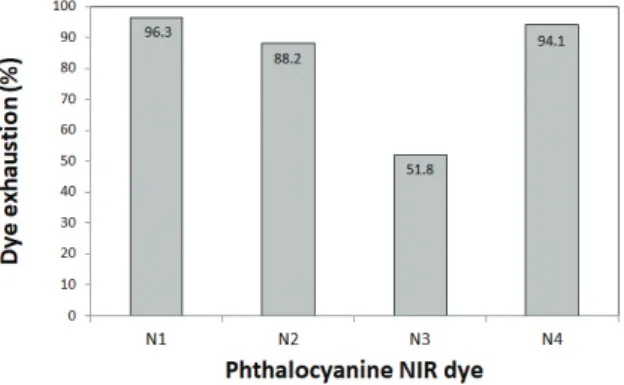
본 연구에서는 가장 높은 흡착률을 얻은 욕비 1:10, 온도 130℃, 시간 60분, pH 4.0, swelling agent 1 를 8%(염욕 50ml 기준, swelling agent 4ml) 첨가한 조건에서 Phthalocyanine계 NIR dye(N1~N4)의 흡 착 특성을 평가하여 Figure 12, Figure 13에 정리하 였다. N3는 51.8%이지만 Phthalocyanine계 NIR dye는 대체로 10배 이상 높아진, 90% 수준의 흡착률 을 얻었다.
Nickel dithiolene dye(N5~N8)는 swelling agent 를 사용하지 않아도 60%정도의 흡착률을 볼 수 있는 데, 이는 Nickel dithiolene dye의 분자크기가 Ph- thalocyanine계 NIR dye보다 작기 때문에 흡착에 더 유리하게 작용한 것으로 보인다. Swelling agent를 사용하면 90%이상 최고 99%의 흡착률을 얻을 수 있 다. Nickel dithiolene dye의 흡착특성 평가는 Fig- ure 14, Figure 15에 나타냈다.
3.5 분산염료와 NIR dye 동시적용
분산염료와 NIR dye를 동시에 적용하기에 앞서 군 복 제작시 실제로 사용되는 분산염료 3종(Dianix Yellow Brown S2R, Woocron Rubine 2GFL, Di-
Figure 13. Phthalocyanine NIR dye in the condition of using swelling agent of polyester fiber.
Figure 11. Comparison of adsorption rate(%) at 130℃
and 150℃ according to use of swelling agent.
Figure 12. Adsorption at optimal adsorption condi- tions(Phthalocyanine NIR dye).
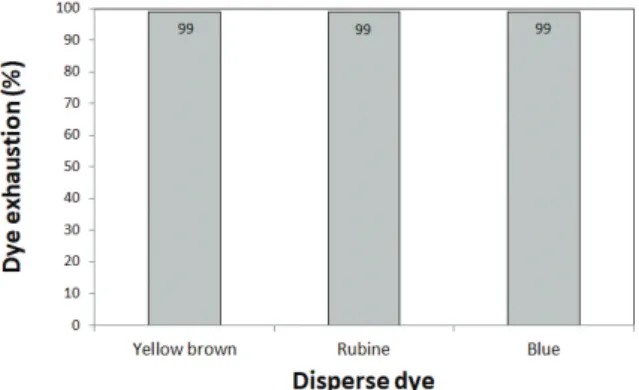
anix Blue AM-77 150%)을 단독으로 polyester 섬 유에 적용한 결과 3가지 색상의 분산염료 모두 99%의 높은 염착률을 보였고, 이를 Figure 16과 Figure 17 에 나타내었다.
다음으로 NIR dye 분산용액과 분산염료를 동시에 흡 착하여 각각 염료의 거동을 살펴본 결과는 Figure 18, Figure 19, Figure 20, Figure 21에 나타내었다.
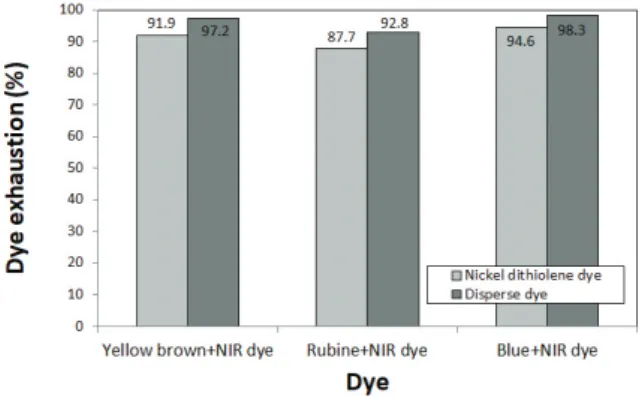
N1과 분산염료 3종을 동시에 흡착한 결과 N1은 이 전보다 약 40% 감소한 58.1~74.3%의 흡착률을 보였 고, N6와 분산염료 3종을 함께 흡착한 결과 N6는 약 8%가 감소한 91.9~94.6%의 흡착률을 보였다. 이는 Phthalocyanine계 NIR dye인 N1 경우 N6보다 더 bulky하기 때문에 NIR dye가 흡착하던 영역에 분산 염료도 함께 침투했을 시 염료의 흡착이 다소 떨어지는 결과를 나타내는 것으로 고찰되었다.
3.6 견뢰도
본 연구에서 찾은 최적의 욕비 1:10, 온도 130℃, 8%의 swelling agent 1 사용, pH 4.0, 1% o.w.f.의 조건에서 Nickel dithiolene dye(N6)를 흡착한 poly- ester 섬유의 마찰견뢰도, 땀견뢰도, 세탁견뢰도, 일 광견뢰도 결과를 측정하여 Table 8에 정리하였다.
Figure 15. Nickel dithiolene dye in the condition of using swelling agent of polyester fabric.
Figure 14. Adsorption at optimal adsorption condi- tions(Nickel dithiolene dye).
Figure 17. Color after disperse dye dyeing on poly- ester fiber.
Figure 16. The adsorption rate of three disperse dyes to polyester fiber.
Figure 19. Phthalocyanine NIR dye and disperse dye dyeing on polyester fabric in the condition of using swelling agent.
Figure 18. Adsorption rate during simultaneous ad- sorption of phthalocyanine NIR dye and disperse dye.
phous영역을 확장시킬 수 있는 swelling agent를 사 용하였다. 두가지 종류의 swelling agent를 사용해 본 결과 n-Methylformanilide가 메인성분인 swelling agent 1을 사용했을 때 90~99%라는 높은 흡착률을 얻을 수 있었다. Swelling agent의 사용은 polyester 섬유의 amorphous영역을 효과적으로 넓혀주어 bulky한 NIR dye도 잘 흡착할 수 있도록 도와주는 역 할을 한다는 것을 알아냈다. 또한, 군복 제작시 NIR dye만 단독으로 흡착시키는 것이 아닌 군복 색상을 염 색하기 위한 분산염료도 함께 적용된다는 점을 감안하 여 NIR dye 분산용액과 분산염료를 동시에 흡착해 본 결과 대체로 단독으로 흡착했을 때보다는 흡착 및 염착 률이 떨어졌다. 한정된 polyester의 amorphous영역 흡착가능한 자리에 두가지의 염료가 흡착되다 보니 이 전보다 각각의 흡착률이 떨어지는 것은 당연한 수치이 고, 분산염료만 염착되고, NIR dye는 흡착이 되지 못 하는 것이 아닌 두가지 염료 모두 골고루 흡착 및 염착 이 되었다는 점에서 의미있는 결과를 얻을 수 있었다.
Phthalocyanine계 NIR dye와 분산염료 3종을 흡 착시에는 NIR dye의 흡착률은 58.1~74.3%로 이전 보다 약 40% 감소하였고, Nickel dithiolene dye와 분산염료 3종을 흡착한 결과 NIR dye는 91.9~94.6%
로 약 8%가 감소했다. 동시에 흡착 및 염착을 시키는 경우 분산염료가 NIR dye가 흡착하던 영역에 먼저 침 투하여 NIR dye의 흡착에 방해를 주기 때문에 흡착을 다소 떨어지는 결과를 나타내는 것으로, 상대적으로 분 자의 크기가 작은 Nickel dithiolene dye는 큰 영향을 받지 않지만 더 bulky한 Phthalocyanine계 NIR dye 는 흡착률 감소폭이 있는 것으로 고찰되었다. 분산염료 측면에서 보면, Nickel dithiolene dye와 흡착시 분 산염료의 염착률은 92.8~98.3%로 약 7%로 감소하 고, Phthalocyanine계 NIR dye과 흡착시 분산염료 의 염착률은 33.2~63.7%로 약 40%로 감소하였다.
그 중 polyester 섬유에 가장 흡착률이 좋았던 Nickel dithiolene dye의 견뢰도를 평가해본 결과 일광견뢰
4. 결 론
본 연구에서는 카본 블랙과 같은 안료를 프린팅하는 방식에서 벗어나 근적외선 염료를 polyester섬유에 흡 착하여 적외선 위장기능을 부여할 수 있도록 연구를 진 행하였다.
흡착 build-up 특성 평가를 통해 polyester 섬유에 근적외선 흡수 염료를 흡착시킬 때에는 욕비 1:10, pH 4.0, 시작온도 60℃에서 승온(3℃/min)하여 130℃에 서 45분 흡착을 시켰을 때 가장 높은 흡착률을 얻을 수 있었다. 하지만 bulky한 구조를 지닌 NIR dye 분자는 polyester의 강한 결정성을 뚫고 침투하기가 어렵기 때문에 최고 흡착률은 10%이었다.
따라서 분자간의 interchain force를 낮춰 amor- Figure 21. Nickel dithiolene dye and disperse dye dyeing on polyester fabric in the condition of using swelling agent.
Figure 20. Adsorption rate during simultaneous ad- sorption of Nickel dithiolene dye and disperse dye.
Table 8. Fastness of polyester fabric dyed with NIR dye Light fastness
(Grey scale) Wash fastness
(Color changed) Rubbing fastness Perspiration fastness
4 4-5 4-5 4-5
도 4, 세탁견뢰도 4-5, 마찰견뢰도 4-5, 땀견뢰도 4- 5의 우수한 결과를 얻을 수 있었다.
감사의 글
본 연구는 2017년 산업통상자원부 연구비 지원(벤처 형 전문소재 기술개발사업)에 의하여 연구되었음(과제 번호 10077016).
References
1. L. Talas, R. J. Baddeley, and I. C. Cuthill, Cultural Evo- lution of Military Camouflage, Textile Coloration and
Finishing, 372, 1724(2016).
2. A. Elias and W. Dakin, On Camouflage in Nature and War, J. of Australian Studies, 32(2), 251(2008).
3. C. Y. Zhang, H. F. Cheng, Z. H. Chen, W. W. Zheng, and Y. Cao, Polarimetric Imaging of Camouflage Screen in Visible and Infrared Wave Band, Infrared and Laser
Engineering, 38(3), 424(2009).
4. M. S. Kim, H. K. Kim, S. W. Byun, S. H. Jeong, Y. K.
Hong, J. S. Joo, and J. Y. Lee, PET fabric/polypyrrole Composite with High Electrical Conductivity for EMI Shielding, Synthetic Metals, 126(2), 233(2002).
5. H. W. Wang, R. X. Dong, H. C. Chu, K. C. Chang, and W. C. Lee, Improvements on the Synthesis and Proper- ties of Fluorinated Polyimide-clay Nanocomposites by using Double-swelling Agents, Materials Chemistry and
Physics, 94(1), 42(2005).
6. J. Cegarra and P. Puente, Considerations on the Kinetics of the Dyeing Process of Polyester Fibers with Dispersed Dyes, Textile Research J., 37(5), 343(1967).
7. E. Karaca and F. Ozcelik, Fluence of the Cross-sectional Shape on the Structure and Properties of Polyester
Fibers, J. of Applied Polymer Science, 103(4), 2615 (2007).
8. L. Cho, J. A. Reffner, and D. L. Wetzel, Forensic Clas- sification of Polyester Fibers by Infrared Dichroic Ratio Pattern Recognition, J. of Forensic Science, 44(2), 283(1999).
9. J. N. Etters, Sorption of Disperse Dye by Polyester Fibers: Boundary Layer Transitional Kinetics, Textile
Research J., 64(7), 406(1994).
10. M. C. Lai, K. C. Chang, W. C. Huang, S. C. Hsu, and J.
M. Yeh, Effect of Swelling Agent on the Physical Prop- erties of PET-clay Nanocomposite Materials Prepared from Melt Intercalation Approach, J. of Physics and
Chemistry of Solids, 69(5), 1371(2008).
11. S. H. Im, U. Jeong, and Y. Xia, Polymer Hollow Parti- cles with Controllable Holes in Their Surfaces, Nature
Materials, 4(9), 671(2005).
12. K. L. Saenger, H. M. Tong, and R. D. Haynes, Improved Polyimide/polyimide Adhesion via Swelling Agent En- hanced Interdiffusion, J. of Polymer Science Part C:
Polymer Letters, 27(7), 235(1989).
13. S. T. Lee, Trands in Antimicrobial and Deodorizing Fin- ish for Textile Products, Textile Coloration and Finish-
ing, 9(2), 57(1997).
14. S. D. Hong, B. S. Kim, Y. G. Jeon, and J. S. Lee, A Study on the Improved Lightfastness Test Method for Military Textile Products, Textile Coloration and Finishing,
27(4), 288(2015).
15. S. D. Hong, B. S. Kim, Y. J. Jang, and J. S. Lee, A Study on Color Reliability of New Combat Uniform Fabrics through Quantitative Analysis of the Color and Color Fastness to Washing, J. of the Korean Society of Clothing