Historical Development of Nutrient and Calorimetry and Expired Gas Analysis Indirect Calorimetry
Byung-Kon Yoon, Jong-Won Kim
1and Do-Yeon Kim
1*
Department of Special Physical Education, Dong-Eui University, Busan 614-714, Korea
1
Department of Physical Education, Pusan National University, Busan 609-735, Korea
Received May 7, 2010 /Accepted June 15, 2010Indirect calorimetry is the measurement of the amount of heat generated in an oxidation reaction by determining the intake or consumption of oxygen or by measuring the amount of carbon dioxide or nitrogen released and translating these quantities into a heat equivalent. In the last 20 years there has been significant development in both laboratory and computerized metabolic systems used in indirect calorimetry. In addition, there has been increased use of breath-by-breath EGAIC. Several researchers have suggested that breath-by-breath analysis, because of their practicality, could fulfill this need for a valid and reliable expired gas analysis indirect calorimetry instrument. It was hoped this inves- tigation would determine the best validation for a precise measurement of breath-by-breath expired gas analysis indirect calorimetry. The problem with the available research is that few studies have ex- amined the validity and reliability of all these different systems for breath-by-breath expired gas anal- ysis indirect calorimetry. Therefore, there is a need to find out the most valid, reliable, and precise measurement of the breath-by-breath expired gas analysis indirect calorimetry.
Key words : Indirect calorimetry, heat equivalent, breath-by-breath, validity, reliability
*Corresponding author
*Tel:+82-51-663-4956, Fax:+82-51-663-4959
*E-mail : [email protected]
Introduction
When we exercise, our bodies use chemical energy de- rived from catabolism to cause muscle contraction. During this process we expend calories and generate mechanical power and work, as well as release heat.
Calorimetry is the science that quantifies the heat release from metabolism. There are two methods in calorimetry; di- rect calorimetry and indirect calorimetry. Direct calorimetry is the calorimetric method that directly measure heat dis- sipation from the body. Indirect calorimetry is the calori- metric method when heat dissipation is calculated from oth- er measurements. Indirect calorimetry is divided into Closed-circuit indirect calorimetry that involves the re- circulation of inhaled and exhaled air and Open-circuit in- direct calorimetry that involves the inhalation of atmos- pheric air and measurement exhaled air [31].
The measurement of ventilation and expired gas analysis used as a method of Indirect calorimetry (expired gas analy- sis indirect calorimetry; EGAIC) is an old science, dating back to the pioneering work of Bischoff and Voit in 1860,
Rubner in the 1890’s, and Atwater and Benedict in 1904 [1,18,30]. In 1842, the first law of bioenergetics helped scien- tists to quantify the total heat release from metabolism [30].
In 1860 Bischoff and Voit completed calculations on the caloric and respiratory gas exchange involved in the com- bustion of certain foods and pure nutrients [18]. The calo- rimeter used to combust food was called a bomb calorimeter.
Researchers have found bomb calorimetry to be of value when studying the effects of diet, not only in laboratory ani- mals, but also humans [30].
A German scientist named Rubner, established the clinical use of indirect calorimetry, and determined the caloric value of protein combustion in a bomb calorimeter, measured the energy release of dried urine and feces, and calculated the difference in energy release from the heat value of protein between bomb calorimetry and metabolism. Rubner’s caloric equivalent values have been widely used in different types of carbohydrate, protein and fat molecules that are metabo- lized in the body [18]. Rubner’s findings in 1904 were repro- duced in human subjects by Atwater and Benedict using a more sophisticated closed-circuit respiration calorimeter [18,30].
The development of equipment and techniques allowing
the measurement of oxygen consumption provided an in-
direct means to quantify the metabolic intensity of steady-state exercise and to calculate changes in energy ex- penditure with changes in exercise intensity [30]. Expired gas analysis indirect calorimetry measures three variables;
1) ventilation (V
E), 2) expired air O
2fraction (F
EO
2), and 3) expired air CO
2fraction (F
ECO
2). From these measurements, calculations are made for the rate of oxygen consumption (VO
2) and carbon dioxide production (VCO
2), and based on the data from bomb calorimetry and the correction to whole body metabolism provided by Rubner and Atwater, pro- vides an indirect means to quantify biological energy ex- penditure expressed as Kcals [1,30].
Dr. Robert Robergs from the University of New Mexico developed software and hardware for breath-by-breath EGAIC, and was awarded a U.S. patent for this invention and preliminary validation (Mixing chamber and expired gas sampling for expired gas analysis indirect calorimetry, United States Patent 6,942,623). Such preliminary validation revealed numerous concerns about current validation proce- dures used in prior scientific investigations and of the vali- dation of instruments and commercial systems used in EGAIC.
Several researchers have suggested that breath-by-breath analysis, because of their practicality, could fulfill this need for a valid and reliable expired gas analysis indirect calorim- etry instrument. It was hoped this investigation would de- termine the best validation for a precise measurement of breath-by-breath expired gas analysis indirect calorimetry.
As such, this review will discuss the definition of indirect calorimetry, methods and instruments for indirect calorim- etry, and validity and reliability of indirect calorimetry methods, respectively.
Materials and Methods Definition of indirect calorimetry
The measurement of metabolism or metabolic rate has ap- plication in a varied number of fields including exercise physiology, physiology, biology, biochemistry, nutrition, fit- ness, cardiology, pulmonology, and physical therapy. The most common method of carrying out such determinations is by indirect calorimetry. Indirect calorimetry, the determi- nation of airway carbon dioxide elimination (VCO
2) and oxygen uptake (VO
2), can be used to non-invasively detect non-steady state perturbations of gas kinetics and mirror tis- sue metabolism [11,32].
During at rest, indirect calorimetry determination on the effects of age, gender, body size, growth, disease, nutrition, and environment on metabolism are very useful. The resting metabolic rate per unit body mass is greater in males than in females, greater in children than in adults, greater in small individuals than in large individuals, and greater under ex- tremes of heat and cold than under normal environment [6].
Also, the use of indirect calorimetry is becoming more wide- spread of clinical applications of the measurement of resting energy expenditure in normal individuals and for guiding daily nutrition support as a whole, in critical care medicine, including the assessment of the physical fitness of healthy and diseased individuals such as major trauma and sepsis, for the healthy or sick obese patient through the measure- ment of ventilation, and the fractions of oxygen and carbon dioxide in expired air [5,11,21,26,32].
These tests are usually conducted to (a) the maximal oxy- gen consumptions (VO
2max), (b) an increase in the ventilator equivalent for oxygen (ventilation threshold, VT), (c) assess- ment of aerobic power, (d) the rate of change in VO
2for a given increase in exercise intensity (VO
2kinetics), (e) de- tection of cardiovascular and pulmonary diseases [2,7,20,13, 29,32].
Expired gas analysis indirect calorimetry calorimetry is one of the most common tools in exercise physiology. It is used for various purposes including the assessment of aero- bic power, determination of exercise intensity and the meas- urement of energy expenditure. All these systems need to calculate metabolic data are the fractional concentrations of oxygen (F
EO
2) and carbon dioxide (F
ECO
2) in expired air to- gether with pulmonary ventilation (expired (V
E) or inspired (V
I)). From these measurements, oxygen consumption (VO
2), carbon dioxide production (VCO
2), and the respiratory ex- change ratio (RER) can be calculated. These calculations are based on the Haldane transformation, which is derived from the fact that nitrogen is physiologically inert.
VO
2=Inspired O
2–Expired O
2=(V
I×F
IO
2)–(V
E×F
EO
2) VCO
2=Expired CO
2–Inspired O
2=(V
E×F
ECO
2)–(V
I×F
ICO
2) F
IO
2is fixed, assuming a room air concentration of 20.95%.
F
ICO
2is fixed, assuming a room air concentration of 0.03%.
While the science of EGAIC has remained largely un-
changed for the last ten decades, the equipment and fre-
quency of data collection and computations have changed
enormously within the last 15 years. Today, computations
of EGAIC are able to occur every breath, with breath-by-
breath data collection and computation now the standard
in most commercial systems. Consequently, breath-by- breath EGAIC is now widely used in both professional prac- tice and research in the clinical, basic and applied sciences.
Methods and equipments for indirect calorimetry
There are three methods of expired gas analysis indirect calorimetry (EGAIC); (1) manual Douglas bag, (2) fully auto- mated breath-by-breath, and (3) semi-automated and fully automated mixing chamber. In the last 20 years there has been a significant development of both laboratory and com- puterized metabolic systems used in indirect calorimetry [8,19,29]. Methods were developed and validated based on automated repeated measurements of ventilation, typically from an electronically integrated dry gas flow meter, and expired gas fractions using electronic gas analyzers or a mass spectrometer [35].
The most basic of these techniques to collect and analyze expired gas is the Douglas bag (DB) method. While the DB method is considered to be the gold standard, it also has several disadvantages and its own limitations. For example, the time interval for Douglas bag requires careful analysis by researchers to reduce errors while measuring the content of the bag. In addition, there are considerable inconsistencies in using the Douglas bag assumptions that violate actual physiological function of the respiratory and collecting zones of the lung. Furthermore, the bags are made of PVC material, which is slightly permeable to the external air [3,7,8,12]. This mixing continues to the next expiration, as the first volume of air from the body is actually room air not alveolar air.
There are currently no corrections for this mixing in any current method of indirect calorimetry. Some researchers have noted that it is very difficult to remove all the air from the Douglas Bag and air leaking out during the removal process [8]. According to some recent work of Bassett et al.
[3], the time need to be flushed out the Douglas bag valve and tubing inflated oxygen and decreased carbon dioxide gas content of room air. This dead air space acts to decrease the overall sensitivity and accuracy of the system. Probably, the time needed to flush out the Douglas bag valve and tub- ing inflated oxygen and decreased carbon dioxide gas con- tent of the sampled air.
Recently, increasing technology has seen the emergence of portable, lightweight and automated metabolic gas analy- sis systems; these systems are made breath-by-breath gas analysis of gas exchange practical and commonplace by us- ing commercially available equipments. These systems allow
the continuous measurement of expired gas concentrations and ventilation right outside the mouth and then immedi- ately display respiratory and metabolic data for each breath, and therefore markedly increase the efficiency of the gas analysis procedure. The use of these systems has allowed for very rapid gas analysis and ventilation measurement and is less time consuming than the DB technique [4,7,8,12,15, 19,24,25,28,34]. However, various commercial these systems limitations to breath-by-breath systems have been advanced.
Most commercial system limitations to breath-by-breath in- clude some technical errors that can make these systems measurements inaccurate. Noguchi et al. [23] reported that the delay time between the on-line digital multiplication and integration of flow and fraction signals have sources of error such as the accuracy and reproducibility of flow and gas fraction measurements.
Recent gas analyzers are typically pressure and flow sen- sitive, therefore there must be near same flow resistance dur- ing calibration. Another concern is the failure of many com- puterized systems to correct for water vapor pressure (PH
2O) in the expired air, as this pressure is different than in the calibration gas. Although mass- spectrometers can be altered to ignore the contribution of water vapor [10,15,19], most oxygen and carbon dioxide analyzers are sensitive to the presence of water vapor.
The reliability of breath-by-breath gas analysis systems will be influenced by the variability of each physiological measure. The total variability of a physiological measure- ment such as VO
2is the sum of the biological variability and the technical variability. The biological variability ac- counts for around 90% of the total variability, with only 10%
less of the remaining variability coming from technical prob- lems [19]. It is difficult to check the accuracy of a compu- terized system when subjects are at maximal aerobic power (VO
2max) since the biological variability in VO
2max is about 5% [17].
Some commercial suppliers of EGAIC systems have pro-
moted breath-by-breath EGAIC based on earlier systems that
used a mixing chamber to mix expired air across a breath
to derive a single representative value for each of F
EO
2and
F
ECO
2. Most exercise laboratories are using automated sys-
tems to measure respiratory gas exchange with a mixing
chamber which gives time averaged values for respiratory
variables [3,12,19,27,34]. The mixing chamber also offers the
advantage of presenting data in real time and is just as
time-saving as the breath-by-breath analysis. The expired
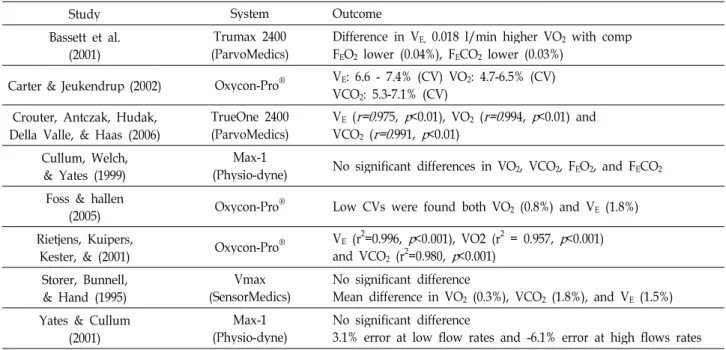
Table 1. Validity and reliability of indirect calorimetry methods
Study System Outcome
Bassett et al.
(2001) Trumax 2400
(ParvoMedics) Difference in VE, 0.018 l/min higher VO2 with comp FEO2 lower (0.04%), FECO2 lower (0.03%)
Carter & Jeukendrup (2002) Oxycon-Pro® VE: 6.6 - 7.4% (CV) VO2: 4.7-6.5% (CV) VCO2: 5.3-7.1% (CV)
Crouter, Antczak, Hudak, Della Valle, & Haas (2006)
TrueOne 2400
(ParvoMedics) VE (
r=0.
975,p
<0.01), VO2 (r=0
.994,p
<0.01) and VCO2 (r=0
.991,p
<0.01)Cullum, Welch,
& Yates (1999) Max-1
(Physio-dyne) No significant differences in VO2, VCO2, FEO2, and FECO2
Foss & hallen
(2005) Oxycon-Pro® Low CVs were found both VO2 (0.8%) and VE(1.8%) Rietjens, Kuipers,
Kester, & (2001) Oxycon-Pro® VE (r2=0.996,
p
<0.001), VO2 (r2 = 0.957,p
<0.001) and VCO2 (r2=0.980,p
<0.001)Storer, Bunnell,
& Hand (1995) Vmax
(SensorMedics) No significant difference
Mean difference in VO2 (0.3%), VCO2 (1.8%), and VE (1.5%) Yates & Cullum
(2001) Max-1
(Physio-dyne) No significant difference
3.1% error at low flow rates and -6.1% error at high flows rates
gas from several breaths is mixed in a mixing chamber and
a sample from this chamber gives an average expired gas concentration over those breaths. However, such systems have only been validated based on time averaged data using a criterion of the Douglas bag method [7,8,14]. Foss and Hallen [12] have assessed mixing chambers and have con- cluded that they should produce less error than the breath-by-breath analysis systems. The mixing bag may be constructed of any suitable material such as thin plastic that has sufficient compliance to expand with the pressure of exhalation. Furthermore, the Douglas bag method is not a suitable criterion method for breath-by-breath EGAIC. This problem has been recognized, and researchers have devel- oped mechanical calibration systems from which numerous EGAIC validation studies have been completed [13,16]).
Validity and reliability of indirect calorimetry methods
There are a considerable number of automated gas analy- sis systems currently available either laboratory-based, semi-portable, or fully portable, yet relatively independent validity or reliability studies on these systems have not been reported to date. However, some groups of researchers have investigated the validity and reliability of various breath-by- breath analysis systems using a computerized metabolic sys- tem fitted with a mixing chamber [3,7-9,12,22,28], and a number of different approaches have been taken to assess breath-by-breath analysis function. Some studies have re- ported correlation coefficients between fast metabolic meas-
urement system (the Oxycon-Pro
®) and Douglas bag method during low and high exercise intensities (Table 1).
Foss and Hallen [12] reported the VO
2was 0.8% (0.03 l·min
-1) lower with the Oxycon-Pro
®than with the Douglas bag method with a coefficient of variation (CV) of 1.2%
(p<0.05) and VE was 1.8% lower with CV of 1.0% (p<0.05).
Carter and Jeukendrup [7] used Oxycon-Pro
®and Douglas bag method to assess the mean absolute values of VO
2, VCO
2and RER. The results from testing 100 and 150 watts, showed very similar for the Oxycon-Pro
®and Douglas bags.
Therefore, the validity and reliability coefficients for the breath-by-breath analyses are high with validity coefficients as high as r=0.994 [8].
The high correlations between the values obtained from the Douglas bag method and the Oxycon-Pro
®computerized metabolic system with mixing chamber for V
E(p<0.001, r
2=0.996), VO
2(p<0.001, r
2=0.957) and VCO
2(p<0.001, r
2=0.980) [28].
Bassett et al. [3] used Truemax 2400 (ParvoMedics) and the Douglas bag method to assess the validity of inspiratory and expiratory methods of measuring gas exchange. F
EO
2was slightly lower (0.04%) with the computerized system,
compared with the Douglas bag method (p<0.01). VO
2was
an average of 0.018 l/min (p<0.05) higher for the inspired
system compared with the Douglas bag. F
ECO
2was slightly
lower (0.03%, p<0.05) for the expired system than the
Douglas bag. Thus the Truemax 2400 system, using in-
spiratory or expiratory configurations, permitted extremely
precise measurements to be made in a less time-consuming manner than the Douglas bag technique. Similarly, Crouter et al. [8] used TrueOne 2400 metabolic cart against the Douglas bag method to assess the accuracy and reliability of the measurement of gas exchange. Reliability between days for V
E(CV 7.3 to 8.8%) was similar among devices.
VO
2and VCO
2with the TrueOne 2400 (CV 4.7 to 5.7%) was more reliable compared to the Douglas bag (CV 5.3 to 6.0%).
The TrueOne 2400 was not significantly different from the Douglas bag at rest or any work rate for V
E, VO
2, or VCO
2(p≥0.05). The reliability of the TrueOne 2400 is similar to other systems currently available, which have been shown to have good reliability [7,22]. The mean bias and 95% pre- diction intervals for the TrueOne 2400 in the current study are similar to those reported previously by Bassett et al. [3].
Two studies have reported the accuracy of measurement of gas exchange between Max-1 (Physio-dyne) and the crite- rion Douglas bag system. Cullum et al. [9] used Max-1 with the Douglas bag to assess the accuracy and reliability of measurement of gas exchange. Findings of this study in- dicate that there were no statistically significant differences between the systems either in VO
2, VCO
2, F
EO
2, or F
ECO
2. When averaged across the 4 workloads, the VO
2values from the Max-1 were 87 ml/min less than the Douglas bags (mean relative error of 3.3%, p=0.0528). VO
2for the Max-1 demon- strated high repeatability, with an absolute error 64 ml/min (3.2%) which was slightly greater than the Douglas bag val- ues 55 ml/min (2.5%). Yates and Cullum [36] also found that though there were no statistically significant differences between the Max-1 and the Douglas bag, although the auto- mated system tended to produce VO
2values that, overall, underestimated the bag value by 2.9%. At low flow rates the error was around 3.1% and approximately -6.1% at high flows. Therefore, they concluded that the Max-1 was suitable system for measuring VO
2.
Simultaneous comparisons between the Vmax (SensorMedics) system and the Douglas bags with the mean differences in VO
2, VCO
2and V
Ewere 0.3, 1.8 and 1.5%, respectively, with no statistically significant differences. They also concluded the Vmax was accurate over work rates ranging from 40 to 160 watts [33].
Results
Indirect calorimetry methods have the potential to be used by exercise physiology, physiology, biochemistry, nu-
trition, cardiology for a number of different purposes.
Breath-by-breath analysis systems use a computerized meta- bolic system fitted with a mixing chamber is well suited for metabolic measurements of VO
2and inspiratory or ex- piratory configuration.
Such preliminary validation revealed numerous concerns about current validation procedures used in prior scientific investigations and of the validation of instruments and com- mercial systems used in expired gas analysis indirect calorimetry. Consequently, there is a need to apply sound scientific principles to the re-investigation of validation pro- cedures used in expired gas analysis indirect calorimetry, to develop appropriate methods of validation, and apply these validation techniques.
The problem with the available research is that few stud- ies have examined the effects of validation for breath-by- breath expired gas analysis indirect calorimetry. Due to the difficulties in developing valid systems for breath-by-breath EGAIC, there is a need to improve valid and cost effective hardware and software options suited to breath-by-breath applications of EGAIC. Therefore, the need for the best vali- dation for a precise measurement of the breath-by-breath ex- pired gas analysis indirect calorimetry at this time.
References
1. Ainslie, P. N., T. Reilly, and K. R. Westerterp. 2003.
Estimating human energy expenditure: a review of techni- ques with particular reference to doubly labeled water.
Sports Medicine
33, 683-698.2. Barnard, J. P. M. and J. W. Sleigh. 1995. Breath-by-breath analysis of oxygen uptake using the Datex Ultima.
British J. Anaesthesia
74, 155-158.3. Bassett, D. R. Jr, E. T. Howley, D. L. Thompson, G. A. King, S. Strath, J. E. McLanghlin, and B. P. Brian. 2001. Validity of inspiratory and expiratory methods of measuring gas ex- change with a computerized system.
J. Appl. Physiol.
91, 218-224.4. Beaver, W. L., N. Lamarra, and K. Wasserman. 1981.
Breath-by-breath measurement of true alveolar gas exchange.
J. Appl. Physiol.
51, 1662-1675.5. Brandi, L. S., R. Bertolini, and M. Calafa. 1997. Indirect calo- rimetry in critically ill patients: clinical applications and practical advice.
Nutrition
13, 349-358.6. Brooks, G. A., T. D. Fahey, T. P. White, and K. M. Baldwin.
2000.
Exercise physiology.
3rd Eds. Human Bioenergetics and its applications. Mountain View, CA: Mayfield Publishing Company.7. Carter, J., and A. E. Jeukendrup. 2002. Validity and reli- ability of three commercially available breath-by-breath res-
piratory systems.
Eur. J. Appl. Physiol.
86, 435-441.8. Crouter, S. E., A. Antczak, J. R. Hudak, D. M. DellaValle, and J. D. Haas. 2006. Accuracy and reliability of the ParvoMedics TrueOne 2400 and MedGraphics VO2000 met- abolic systems.
Eur. J. Appl. Physiol.
98, 139-151.9. Cullum, M. G., H. Welch, and J. W. Yates. 1999. Evaluation of an automated metabolic cart compared to Douglas bag measurement of VO2.
Med. Sci. Sports Exerc.
31,
S302.10. Davies, E. E., H. L. Hahn, S. G. Spiro, and R. H. Edwards.
1974. New technique for recording respiratory transients at the start of exercise.
Resp. Physiol.
20, 69-79.11. da Rocha, E. E., V. G. F. Alves, and R. B. V. da Fonseca.
2006. Indirect calorimetry: methodology, instruments and clinical application.
Curr. Opin. Clin. Nutr.
9, 247-256.12. Foss, O. and J. Hallen. 2005. Validity and stability of a com- puterized metabolic system with mixing chamber.
Int. J.
Sports Med.
26, 569-575.13. Gore, C. J., P. G. Catcheside, S. N. French, J. M. Bennett, and J. Laforgia. 1997. Automated VO2max calibrator for open-circuit indirect calorimetry systems.
Med. Sci. Sports Exerc.
29, 1095-1103.14. Gore, C. J., R. J. Clark, N. J. Shipp, G. E. Van Der Ploeg, and R. T. Withers. 2003. CPX/D underestimates VO2in ath- letes compared with an automated Douglas bag system.
Med. Sci. Sports Exerc.
35, 1341-1347.15. Hodges, L. D., D. A. Brodie, and P. D. Bromley. 2005.
Validity and reliability of selected commercially available metabolic analyzer systems.
Scand. J. Med. Sci. Sport
15, 271-279.16. Huszczuk, A., B. J. Whipp, and K. A. Wasserman. 1990.
Respiratory gas exchange simulator for routine calibration in metabolic studies.
Eur. Respir.
3, 465-468.17. Katch, V. L., S. S. Sady, and P. Freedson. 1982. Biological variability in maximum aerobic power.
Med. Sci. Sports Exerc.
14, 21-25.18. Lusk, G. 1909.
The elements of the science of nutrition
, 2nd ed. Philadelphia, PA: W. B. Saunders company.19. Macfarlane, D. J. 2001. Automated metabolic gas analysis systems.
Sports. Med.
32, 841-861.20. Matarese, L. E. 1997. Indirect calorimetry: Technical aspects.
J. Amer. Dietet. Assoc.
97(Suppl. 2), S154-S160.21. McClave, S. A. and H. L. Snider. 1992. Use of indirect calo- rimetry in clinical nutrition.
Nutr. Clin. Pract.
7, 207-221.22. Meyer, T., T. Georg, C. Becker, and W. Kindermann. 2001.
Reliability of gas exchange measurements from two differ- ent spiroergometry systems.
Int. J. Sports Med.
22, 593-597.23. Noguchi, H., Y. Ogushi, I. Yoshiya, N. Itakura, and H.
Yamabayashi. 1982. Breath-by-breath VCO2and VO2require compensation for transport delay and dynamic response.
J.
Appl. Physiol.
52, 79-84.24. Pinnington, H. C., P. Wong, J. Tay, D. Green, and B.
Dawson. 2001. The level of accuracy and agreement in meas- ures of FEO2, FECO2and VEbetween the Cosmed K4b2 port- able, respiratory gas analysis system and a metabolic cart.
J. Sci. Med. Sport
4, 324-325.25. Proctor, D. N. and K. C. Beck. 1996. Delay time adjustments to minimize errors in breath-by-breath measurement of VO2
during exercise.
J. Appl. Physiol.
81, 2495-2499.26. Reid, C. L. and G. L. Carlson. 1998. Indirect calorimetry- a review of recent clinical applications.
Curr. Opin. Clin.
Nutr.
1, 281-286.27. Reybrouck, T., F. Deroost, and V. Hauwaert. 1992.
Evaluation of breath-by-breath measurement of respiratory gas exchange in pediatric exercise testing.
Chest
102, 147-152.28. Rietjens, C. J. W. M., H. Kuipers, A. D. M. Kester, and H.
A. Keizer. 2001. Validation of a computerized metabolic measurement system (Oxycon-Pro®) during low and high intensity exercise.
Int. J. Sports Med.
22, 291-294.29. Robergs, R. A. and A. F. Burnett. 2003. Methods used to process data from indirect calorimetry and their application to VO2max.
J. Exerc. Physiol. Online
6, 44-57.30. Robergs, R. A. and S. J. Keteyian. 2003.
Fundamentals of ex- ercise physiology for fitness, performance, and health
. 2nd eds.New York: McGraw-Hill.
31. Robergs, R. A., and S. O. Roberts. 1997.
Exercise Physiology:
Exercise, performance, and clinical applications.
St. Louis, MO:Mosby-Year Book, Inc.
32. Rosenbaum, A., C. Kirby, and P. H. Breen. 2007. New meta- bolic lung simulator: development, description, and validation
. J. Clin. Monitor. Comp.
21, 71-82.33. Storer, T. W., T. J. Bunnell, A. Hand, and S. Grant. 1995.
Validation of a new metabolic measurement cart.
Int. J.
Sports Med.
16, 101.34. Wasserman, K., J. E. Hansen, D. Y. Sue, B. J. Whipp, and R. Casaburi. 1994.
Principles of exercise testing and interpretation
. 2nd Eds. Philadelphia, PA: Lea & Febiger.35. Wilmore, J. H. and D. L. Costill. 1974. Semi-automated sys- tems approach to the assessment of oxygen uptake during exercise.
J. Appl.
Physiol.
36, 618-620.36. Yates, J. W. and M. G. Cullum. 2001. The validation of a metabolic cart without human subjects.