1. Introduction
Instant fried noodles are one of the most popular fried products due to their convenience when eating,
acceptable taste, preferred texture, reasonable prices, and ease of mass-production [1-3]. However, frequent consumption of fried foods is associated with increasing diseases such as obesity, coronary heart
Convergence Study on In Vitro Lipid Digestibility of Instant Fried Noodle with HPMC
In Young Bae
1, Hye Lim Jang
2, Yean Jung Choi
1, Hyeon Gyu Lee
3*1Professor, Food and Nutrition, Far East University
2M.S., Food and Nutrition, Hanyang University
1Professor, Food and Nutrition, Far East University
3Professor, Food and Nutrition, Hanyang University
HPMC 점도의 유탕면 지방소화 지연에 대한 융합 연구
배인영1, 장혜림2, 최연정1, 이현규3*
1극동대학교 식품영양학과 조교수, 2한양대학교 식품영양학과 석사,
1극동대학교 식품영양학과 조교수, 3한양대학교 식품영양학과 교수
Abstract The effects of HPMC (hydroxypropyl methylcellulose) on instant fried noodles regarding oil uptake and in vitro lipid digestibility were evaluated according to different viscosity levels, as well as the same apparent viscosity. The oil uptake and lipid digestibility decreased with the increasing HPMC viscosity and replacement level, demonstrating that the reduced oil uptake and lipid digestibility may be caused by the high viscosity of HPMC.
Furthermore, the oil uptake and lipid digestibility of noodles with HPMC at both apparent viscosities decreased with the increasing viscosity of HPMC in spite of having the same apparent viscosity. As a result, the high viscosity of HPMC on instant fried noodles was more critical factor compared to apparent viscosity for lowering oil uptake and lipid digestibility.
Key Words : HPMC, viscosity, instant fried noodle, oil uptake, in vitro lipid digestibility
요 약 본 연구는 HPMC (Hydroxypropyl methyl cellulose)의 점도와 겉보기 점도가 유탕면의 흡유량과 지방 소화율에 미치는 영향을 확인하고자 하였다. HPMC 상업용 소재의 점도와 밀가루 대체 농도가 증가함에 따라 흡유량 감소와 지방 소화 지연 효과가 나타났다. 한편, 동일한 겉보기 점도를 보이는 수준으로 밀가루 대신 HPMC를 대체하여 제조한 유탕면에 서도 겉보기 점도가 같음에도 불구하고 HPMC 자체 점도 증가(높은 중합도를 갖는 시료)에 따른 흡유량 감소와 지방 소화 지연효과를 볼 수 있었다. 이상의 결과로부터, 유탕면의 흡유량 감소와 지방 소화 지연은 겉보기 점도가 동일하다 하더라도 HPMC 자체의 높은 점도가 더 주요한 영향을 주는 것을 확인할 수 있었다.
주제어 : HPMC, 점도, 유탕면, 흡유량, 지방 소화
*This research was supported by the Basic Science Research Program through the National Research Foundation of Korea (NRF) funded by the Ministry of Education (2012R1A1A3007853, 2017R1D1A3B03036428).
*Corresponding Author : Hyeon Gyu Lee ([email protected]) Received November 16, 2018
Accepted February 20, 2019
Revised December 14, 2018 Published February 28, 2019
disease, and high cholesterol levels [4]. Thus, many researches have been focused on controlling lipids digestibility within the gastrointestinal tract and reducing oil uptake during fat frying. For example, hydrocolloids such as chitosan, guar gum, pectin, and xanthan gum are good sources as lowering agents in blood cholesterol levels and lipid absorption [5-8].
Dietary fiber acts as a physical barrier of emulsified lipids on the surface area exposed to digestive enzymes and consequently function on reducing the breakdown of lipid droplets in the gastrointestinal tract [9].
Hydrophilic polymers effectively hinder the absorption of fat or oil during frying and finally the products with improved nutritional qualities such as reducing fat content and calories are presented [10]. Specially, methylcellulose (MC) and hydroxypropylmethyl cellulose (HPMC), cellulose derivatives, form thermally induced gels. They function on reducing oil absorption when they form film at temperatures above their incipient gelation temperature [11]. Although it was reported that the inhibition of lipid digestibility is not affected by cellulose [12], the influences of the cellulose derivatives on in vitro lipid digestibility have not yet been studied. Although many researchers have reported the ways of applying hydrocolloids in food products, little study has been done on using hydrocolloids for instant noodle products.
Thus, the impacts of HPMC on instant fried noodles concerning oil uptake and in vitro lipid digestibility were investigated from the point of view of HPMC viscosity. That is, various HPMC were replaced with wheat flour in the formulation of instant fried noodles at levels that met the same apparent viscosity, and then their effects on oil uptake and in vitro lipid digestibility were analyzed.
2. Materials and Methods
2.1 Materials
All-purpose wheat flour, salt, and soybean oil were
bought from CJ Co. (Seoul, Korea). Various HPMCs were a gift from the Samsung Fine Chemicals Co.
(Su-won, Korea). The pancreatin (P7545, porcine pancreas, activity 8XUSP/g), lipase (L3126), bovine serum albumin (BSA) (A7906), bile extract (B8631), and amyloglucosidase (A9913) were obtained from Sigma-Aldrich (St. Louis, MO, USA). The total starch assay kit (K-TSTA) and glucose oxidase-peroxidase assay kit (GOPOD, K-GLUC) were purchased from Megazyme International Ireland Ltd. (Bray, Ireland).
2.2 Preparation of instant fried noodles The instant fried noodles were made following the methods of Kim et al. [1] and the formulation was consisted of all-purpose wheat flour (100%), salt (1.5%), and distilled water (40%). Salt was dissolved in water and then mixed with wheat flour for noodle preparation with the following step: mixing at speed 1 using a Kitchen Aid mixer (Kitchen Aid, St. Joseph, MI, USA) for 3 min; hand-kneading for 2 min; passing through a sheeting roller (1.5 mm gap); folding into two layers; sheeting through the roller; cutting into noodle strands (12 cm long and 4 mm wide). Noodle strands were steamed at 100 °C for 5 min in a steaming pan, fried at 150 °C for 50 s in a deep fryer with soybean oil (Bomman, Seoul, Korea), and then cooled at room temperature for 60 min. All instant fried noodles were subjected to further analysis after milling procedure to pass through a 100 µm-pore diameter sieve.
In this study, two instant noodle groups were prepared: group 1 (the replacement level of 0.5-5.0% of three HPMC types (CN100, CN4000, CN100000) and group 2 (the replacement levels of three HPMC types (CN100, CN4000, CN100000) with similar apparent viscosity at 50 s-1). In order to obtain the group 2 formulation, a controlled strain rheometer (RheoStress RS1, ThermoHaake, Karlsruhe, Germany) equipped with parallel plate geometry (35 mm diameter and 1 mm gap) was used for measuring the apparent viscosity. Each HPMC solution was placed on a 25 ℃
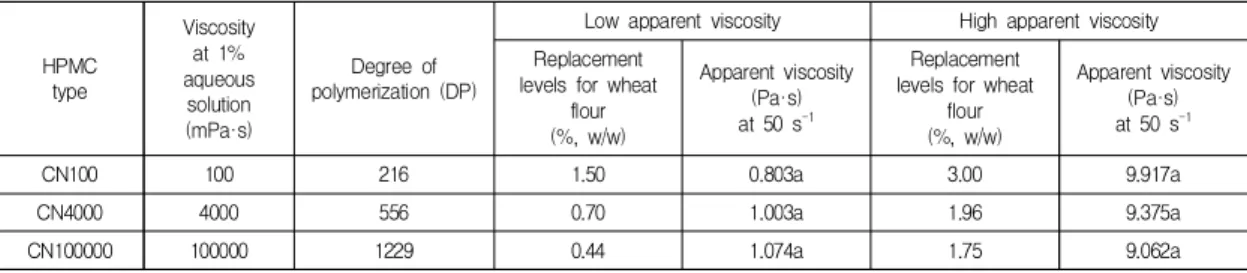
thermostat plate. The apparent viscosity was monitored at the shear rate range of 0.1-100 s-1 and then calculated using the power law model. The replacement levels for wheat flour were determined from three HPMC types with various viscosity (CN100, CN4000, CN100000) at two different concentrations to achieve low apparent viscosity (1 Pa·s) and high apparent viscosity (10 Pa·s) at a shear rate of 50 s-1. The shear rate used is physiologically representative of what occurs along the gastrointestinal tract [13]. Various HPMC types used in the preparation of instant fried noodles are presented in Table 1. The number in the HPMC sample name represents the viscosity (mPa·s) of a 1% aqueous solution.
2.3 Oil uptake
The oil uptake of instant fried noodles was analyzed using a Soxhlet apparatus according to the AOAC method after oil extraction from the noodle samples with diethyl ether [14].
2.4 In vitro lipid digestion
An in vitro lipid digestion was performed following the modified version of that described by Hur et al. [12]
and Versantvoort et al. [15]. The amount of noodle sample was adjusted to be equal to the oil content of the 5 g control sample. The duodenal solution (pH = 8.1±0.2) was made by pancreatin (9.0 g/L), BSA (1.0 g/L), and lipase (1.5 g/L). For preparing the bile juice solution (pH = 8.2±0.2), BSA (1.8 g/L) and bile extract (3.0 g/L) were dissolved with distilled water. The
instant fried noodle samples (5 g) and heating water (100 mL) were mixed, boiled for 3 min, and then cooled to 37 °C. For intestinal digestion, duodenal juice (12 mL) and bile juice (6 mL) were added to the sample, and then the mixture was incubated at 37 °C for 2 h while being stirred at 100 rpm. The digested mixture was heated for 5 min at 100 °C for enzyme inactivation and the released free fatty acid content was measured for predicting the lipid digestibility.
2.5 Free fatty acid content
The content of free fatty acid was measured by titrimetry [16]. The digested sample (5 mL) was mixed with an ether/ethanol solution (ether : ethanol = 1 : 1, 100 mL).
Phenolphthalein solution (0.1%, 50 μL) was added to this mixture and then titrated with 0.1 M alcoholic KOH.
Free fatty acid (KOH/g)
= 5.611 x A x F/sample weight (g) A: number of mL of 0.1M KOH solution F: titer of KOH
2.6 Confocal microscopy
For confocal imaging, a Leica TCS SP5 (Leica, Wetzlar, Germany) and 5 ug/mL nile red (a lipid fluorescent dye, exciting with a 488-nm argon laser line, staining for 20 min) were used. A fluorescence detector (543, a pinhole size of 95.54 μm) monitored the fluorescence emitted from the sample and the resulting
HPMC type
Viscosity at 1%
aqueous solution (mPa·s)
Degree of polymerization (DP)
Low apparent viscosity High apparent viscosity Replacement
levels for wheat flour (%, w/w)
Apparent viscosity (Pa·s) at 50 s-1
Replacement levels for wheat
flour (%, w/w)
Apparent viscosity (Pa·s) at 50 s-1
CN100 100 216 1.50 0.803a 3.00 9.917a
CN4000 4000 556 0.70 1.003a 1.96 9.375a
CN100000 100000 1229 0.44 1.074a 1.75 9.062a
Table 1. Characterization of HPMC types and their replacement levels for wheat flour in instant fried noodles
images were consisted of 1024x1024 pixels with a pixel size of 246.03 nm.
2.7 Statistical analysis
All data were expressed as mean ± standard deviation and SPSS software (version 17.0, SPSS Inc., Chicago, IL, USA) was used for statistical analysis.
One-way analysis of variance (ANOVA) containing Duncan’s multiple range test and Student's t-test were performed for considering significance at p<0.05.
Measurements were made in triplicate.
3. Results and Discussion
3.1 Effect of HPMC with various viscosities on oil uptake and in vitro lipid digestibility The effect of HPMC with various viscosities on oil uptake and in vitro lipid digestibility were investigated.
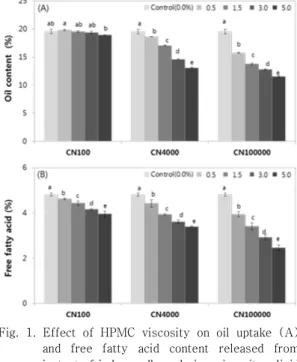
The control noodle was significantly showed high oil content than that of all of the samples prepared with HPMC, except for CN100 Fig. 1(A). The oil content had no significant difference when compared to the control and CN100 at various replacement levels (p>0.05), whereas it was observed that CN100000 was the most effective for the reduction of oil contents, followed by CN4000. The oil content of instant fried noodles decreased significantly with increasing HPMC replacement levels (p<0.05). At the 5% replacement level, the amount of oil reduction for CN100 and CN4000 was 17.69% and 29.45%, respectively, compared to that of the control sample. CN100000 provided an approximately 48.88% decrease in oil contents compared to the control. Varela and Fiszman [4] showed that HPMC at high levels effectively reduced the moisture loss and oil absorption in fried foods.
The fatty acid contents released from the lipids in instant noodles after in vitro digestion are shown in Fig. 1(B). HPMC replacement to wheat flour significantly led to a dose-dependent decrease in the level of free fatty acid (p<0.05). For each of the three
different viscosity types of HPMC, the free fatty acid contents were inversely related with the substitution levels of HPMC. The free fatty acid contents decreased steadily with increasing HPMC viscosity. This could possibly be demonstrated that HPMC acts as a physical barrier and finally inhibits enzymatic hydrolysis. Meyer and Doty [17] reported that lipid digestion can be retarded by increasing viscosity of the small intestine contents due to hydrocolloids. In addition, the transit time in the gastrointestinal tract delayed due to an increase in the solution viscosity after ingested foods with hydrocolloids [18]. Based on these results, it was confirmed that the reduced oil uptake and lipid digestibility may be caused by the high viscosity of HPMC. Therefore, the HPMC with different levels met the same apparent viscosity in the food model.
Subsequently, they were then used to replace wheat flour, and their effects on oil uptake and lipid digestibility were evaluated in terms of the viscosity and apparent viscosity.
Fig. 1. Effect of HPMC viscosity on oil uptake (A) and free fatty acid content released from instant fried noodles during in vitro lipid digestion (B). Different letters on the bars mean significant difference from each other (p<0.05)
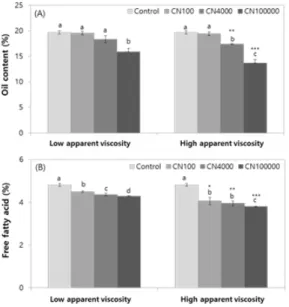
Fig. 2. Effect of HPMC on the oil uptake (A) and free fatty acid content released from instant fried noodles during in vitro lipid digestion (B) in terms of the viscosity and apparent viscosity. Different letters on the bars mean significant difference from each other (p<0.05). * p<0.05 compared with CN100 with low apparent viscosity, ** p<0.05 compared with CN4000 with low apparent viscosity,
*** p<0.05 compared with CN100000 with low apparent viscosity
3.2 Oil uptake and in vitro lipid digestibility of instant noodles with HPMC as a function of similar apparent viscosity Oil uptake and in vitro lipid digestibility of instant noodles with HPMC were examined in terms of similar apparent viscosity. Fig. 2(A) shows the influence of different apparent viscosities on the oil content of instant fried noodles. There was no difference in oil content among the control, CN100, and CN40000, except for CN100000 at low apparent viscosity (p>0.05).
However, the oil content at high apparent viscosity was dramatically lowered when CN4000 or CN100000 were incorporated into the instant fried noodles in comparison with the control, except for CN100 (p<0.05). Furthermore, CN100 was not significantly affected on the oil content of samples with both low and high apparent viscosity (p>0.05). The high
apparent viscosity of CN4000 and CN100000 was more effective in reducing oil uptake compared to low apparent viscosity (p<0.05). Generally, there is strong relation among the molecular weight, degree of polymerization (DP), and viscosity of HPMC [19].
Table 1 shows the DP for each of the HPMC CN types.
The DP increased with increasing viscosity of the HPMC: 216 for CN100, 556 for CN4000, and 1,229 for CN100000. In spite of the same apparent viscosity, CN100000 with high DP, or in other words, its high molecular weight was significantly affected on the reduction of the oil uptake in instant fried noodles.
Altunakar et al. [20] reported that high molecular weight and viscosity have been associated with greater oil uptake reduction in chicken nuggets. Therefore, oil uptake may be correlated with other factors, such as viscosity and molecular weight, than with just the apparent viscosity of HPMC.
The free fatty acid contents released from instant fried noodles containing three different HPMC types (CN100, CN4000 and CN100000) with similar low and high apparent viscosity under in vitro lipid digestion were evaluated Fig. 2(B). In the case of low apparent viscosity, the free fatty acid contents significantly decreased by the replacement of HPMC as follows:
CN100000 < CN4000 < CN100 < control (p<0.05). At high apparent viscosity, the free fatty acid contents in instant fried noodles after digestion were as follows:
control > CN100 = CN4000 > CN100000 (p<0.05). The application of CN100000 at both apparent viscosities was showed the most effective reduction of free fatty acid in fried noodles. On the other hand, the replacement of HPMC levels that met the high apparent viscosity exhibited higher reduction than that of the noodles with HPMC levels that met the low apparent viscosity in each HPMC sample (p<0.05). The commercial HPMC led to a significant inhibition against lipid digestion due to its higher viscosity, DP, and molecular weight [19]. Chiang et al. [21] reported that chitosan with high molecular weight is more effective than low molecular weight in retarding lipid
digestibility. Similarly, Pasquier et al. [22]
demonstrated that high molecular weight guar gum is more effective in reducing cholesterol and triglyceride than low molecular weight guar gum. The molecular weight became higher with an increase in the viscosity and DP [15]. As a result, the oil uptake and in vitro lipid digestibility were impacted by the viscosity of HPMC as well as the apparent viscosity in the food model.
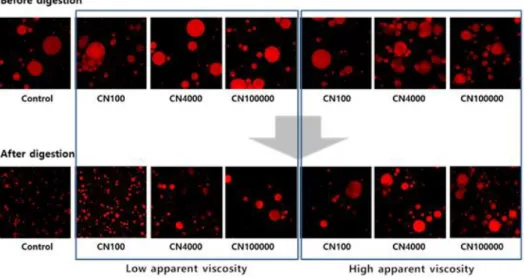
Fig. 3 shows representative confocal images of instant fried noodles containing HPMC depending on different apparent viscosity. The confocal images of instant fried noodles became covered with lipid droplets due to the formation of smaller droplets during digestion [23]. The size of the lipid droplets after digestion was smaller compared to the droplets before digestion. After digestion, the control was showed much smaller lipid droplets than those in samples with HPMC. Furthermore, the size of the lipid droplets in the samples with HPMC significantly decreased at both apparent viscosities as follows: CN100 > CN4000 >
CN100000. The size of the lipid droplets with low apparent viscosity was smaller than the droplet size with high apparent viscosity. This supports the fact that lipid digestibility is more critically reduced by the
incorporation of HPMC with high viscosity into the instant fried noodles.
4. Conclusion
The objective of this work is to investigate the influence of HPMC on oil uptake and in vitro lipid digestibility of instant fried noodles as a function of viscosity. That is, various HPMC were replaced with wheat flour in the formulation of instant fried noodles at levels that met the same apparent viscosity, and then their effects on oil uptake and in vitro lipid digestibility were analyzed. The effects of HPMC depending on various viscosities were evaluated in terms of reducing oil uptake and lowering lipid digestibility in instant fried noodles. The oil uptake and lipid digestibility dose-dependently decreased with increasing HPMC viscosity. In both low and high apparent viscosity, the oil uptake and lipid digestibility decreased with increasing the viscosity of HPMC. Thus, the high viscosity of HPMC may be useful for lowering lipid consumption.
Fig. 3. Representative confocal images of instant fried noodles with HPMC before and after in vitro lipid digestion
REFERENCES
[1] Kim, Y., Kim, Y., Bae, I. Y., Lee, H. G., Hou, G. G., & Lee, S. (2013). Utilization of preharvest-dropped apple powder as an oil barrier for instant fried noodles.
LWT-Food Science and Technology, 53(1): 88-93.
[2] Oh, C-H., & Chung, H-Y. (2018). Analysis of Sodium Content and Tastes of Ramyeon Cooked Using Different Recipes. Korean Journal of Food and Cookery Science, 34(5): 450-457.
[3] An, H. J., & Oh, S-Y. (2018). Five Views on RAMYEON - Focusing on the Analysis of Newspaper Articles from 1963 to 2012. The Journal of the Korea Contents Association. 18(9): 633-647.
[4] Varela, P., & Fiszman, S. M. (2011). Hydrocolloids in fried foods. A review. Food Hydrocolloids, 25(8): 1801-1812.
[5] Hur, S. J., Kim, D. H., Chun, S. C., & Lee, S. K. (2013).
Effects of dietary conjugated linoleic acid and biopolymer encapsulation on lipid metabolism in mice.
International Journal of Molecular Sciences, 14(4):
6848-6862.
[6] Park, J-H., Ryu, B-M., & Kim, C-S. (2016). Quality characteristics of naengmyeon noodle containing citric acid and guar gum. Korean Journal of Food and Cookery Science, 32(4): 426-432.
[7] Ryu, B. M., & Kim, C. S. (2015). Study on resistant starch contents and cooking characteristics of commercial extrusion-cooked noodles. Korean Journal of Food and Cookery Science, 31(3): 248-254.
[8] Bang, I-H., Joung, M-Y., & Kwon, S-C. (2016). Study of the limitation standards setting of sterilization processing to vagetable juice contain barley sprout.
Journal of the Korea Academia-Industrial cooperation Society. 17(7): 367-373.
[9] Lairon, D. (1997). Soluble fibers and dietary lipids.
Advances in Experimental Medicine and Biology, 427(1): 99-108.
[10] Balasubramaniam, V. M., Chinnan, M. S., Mallikarjunan, P., & Phillips, R. D. (1997). The effect of edible film on oil uptake and moisture retention of a deep-fat fried poutry product. Journal of Food Process Engineering, 20(1): 17-29.
[11] Grover, J. A. (1993). Industrial gums: Polysaccharides and their derivatives. Academic Press Inc.
[12] Hur, S. J., Lim, B. O., Park, G. B., & Joo, S. T. (2009).
Effects of various fiber additions on lipid digestion during in vitro digestion of beef patties. Journal of Food Science, 74(9): C653-C657.
[13] Dikeman, C. L., Murphy, M. R., & Fahey, G. C. (2006).
Dietary fibers affect viscosity of solutions and simulated human gastric and small intestinal digesta. The Journal of Nutrition, 136(4): 913-919.
[14] AOAC (2005). Official methods of analysis. Washington, DC: Association of official Analytical Chemists.
[15] Versantvoort, C. H., Oomen, A. G., Van de Kamp, E., Rompelberg, C. J., & Sips, A. J. (2005). Applicability of an in vitro digestion model in assessing the bioaccessibility of mycotoxins from food. Food and Chemical Toxicology, 43(1): 31-40.
[16] AOAC (1990). Official methods of analysis. Washington, DC: Association of official Analytical Chemists.
[17] Meyer, J. H., & Doty, J. E. (1988). GI transit and absorption of solid food: multiple effects of guar. The American Journal of Clinical Nutrition, 48(2): 267-273.
[18] Hur, S. J., Kim, Y. C., Choi, I., & Lee, S. K. (2013). The effects of biopolymer encapsulation on total lipids and cholesterol in egg yolk during in vitro human digestion.
International Journal of Molecular Sciences, 14(8):
16333-16347.
[19] Cash, M. J., & Caputo, S. J. (2009). Food stabilisers, thickeners and gelling agents: Cellulose Derivatives.
Blackwell Publishing Ltd.
[20] Altunakar, B., Sahin, S., & Sumnu, G. (2006). Effects of hydrocolloids on apparent viscosity of batters and quality of chicken nuggets. Chemical Engineering Communications, 193(6): 675-682.
[21] Chiang, M. T., Yao, H. T., & Chen, H. C. (2000). Effect of dietary chitosans with different viscosity on plasma lipids and lipid peroxidation in rats fed on a diet enriched with cholesterol. Bioscience, Biotechnology, and Biochemistry, 64(5): 965-971.
[22] Pasquier, B., Armand, M., Castelain, C., Guillon, F., Borel, P., Lafont, H., & Lairon, D. (1996). Emulsification and lipolysis of triacylglycerols are altered by viscous soluble dietary fibres in acidic gastric medium in vitro.
Biochemistry Journal, 314(1): 269-275.
[23] Hur, S. J., Lee, S. J., Lee, S. Y., Bahk, Y. Y., & Kim, C.
G. (2014). Effect of emulsifiers on microstructural changes and digestion of lipids in instant noodle during in vitro human digestion. LWT-Food Science and Technology, 60(1): 630-636.
배 인 영(In Young Bae) [종신회원]
․1997년 2월 : 한양대학교 식품영양 학과(이학석사)
․2006년 8월 : 한양대학교 식품영양 학과(이학박사)
․2013년 3월 ~ 현재 : 극동대학교 식품영양학과 교수
․관심분야 : 식품가공, 기능성식품
․E-Mail : [email protected]
장 혜 림(Hye Lim Jang) [학생회원]
․2015년 2월 : 한양대학교 식품영양 학과(이학석사)
․관심분야 : 식품가공, 기능성식품
․E-Mail : [email protected]
최 연 정(Yean Jung Choi) [종신회원]
․2004년 2월 : 한림대학교 식품영양 학과(이학석사)
․2007년 8월 : 한림대학교 식품영양 학과(이학박사)
․2018년 3월 ~ 현재 : 극동대학교 식품영양학과 교수
․관심분야 : 영양학, 보건학
․E-Mail : [email protected]
이 현 규(Hyeon Gyu Lee) [정회원]
․1994년 12월 : North Carolina State University(식품과학 박사)
․1996년 3월 ~ 현재 : 한양대학교 식품영양학과 교수
․관심분야 : 식품가공, 기능성식품
․E-Mail : [email protected]