(Journal of the Korean Chemical Society) Vol 15, Number 1, 1971
Printed in Republic of Korea
AN ESR STUDY OF AMINO ACID AND PROTEIN FREE RADICALS IN SOLUTION * **
* This work was supported by U. S. Public Health Service research grant
** Work reported is a portion of M. S. dissertation. Present address; Department of Agricultural Chemistry, Kang-Won National University, Chun-Chon, Korea.
PART L Reaction Mechanism of Free Radical Production in the Ti-H2 O 2 Flow System
by
Sun-Joo Hong * * and L. H. Piette
Department of Biochemistry and Biophysics^ University of Hawaii, Honolulu, Hawaii, 96822, U»S. A
(Received Feb. 1, 1971)
용액에서의 아미노산 및 단백질 자유기에 관한 ESR 연구 제 1 보 ; Ti-H 2 O2 Flow System 에서 자유기를 만드는 반응기구
흥 순
주
•L. H. Piette
미국
하와이
대학교 생화학및 생물리학과
(1971. 2 1접수)
ABSTRACT
The reaction of amino acids and the reactive hydroxyl radical generated by Ti3+—HjOj system was studied using fast flow techniques coupled with ESR.
Upon adding methionine to the 0・ 2M HQ? solution (0. 05M methionine after addition) and mixing with 0.01M TiC虹 the low field component of the two incompletely resolved peaks, in the spectrum of Ti3+—HgO2 system alone, vanished completely whereas the high field component re
mained almost constant and superimposed on the secondary spectrum of the methionine free radical.
Similar results were obtained for other amino acids and proteins. The results strongly demonstrate that the T아一H2O2 How system generates two different radical species, only one of which, giving rise to the low field component, is alone responsible for abstracting hydrogen atoms from substrate molecules.
The effects of HC1, H2SO4 and NaOH on the system were also studied with widely varying results.
INTRODUCTION
The development of fast flow techniques has study of short-lived free radio시& in the liquid opened a new experimental approach for ESR state.
38 Sun-Joo Hong and L. H. Piette
The first attempt to adapt a continuous flow method13 to obtain ESR of free radicals in aque
ous solutions was reported by Yamasaki, Mason and Piette11 irt 1959. They demonstrated that free redicals in enzyme catalysed oxidations of substrates can be identified25-55 by mixing two reactants immediately before they flow through an a디ueous cell situated in the cavity of the spectrometer. Successively, Piette6)*n and BorW developed an improved flow system of the type first used, which required high consumption of materials105 ~16) and the modifications resulted in reduced dead time and provided greater signab to-noise resolution from free radical products of very short life times.
Dixon and Normaniw-17>, on the other hand, have shown that radicals produced during the rapid reduction of H2O2 by Ti하 can be used to generate organic free radicals by abstracting a hydrogen atom from the moletules. The react
ion lik이y to produce primary radical is, Ti효++ H2O2->Ti4++OH-+ • OH (1) The identity of the radicals produced by this Ti-HgO2 flow system, and the effect of acid on this radiicals have been objects of much debate6)- loj.iD.12).but the formation of two different radical species has been confirmed®
However, which of these two radical species is responsible for abstraction of a hydrogen atom from organic molecules has not yet been con- cltiSively determined.
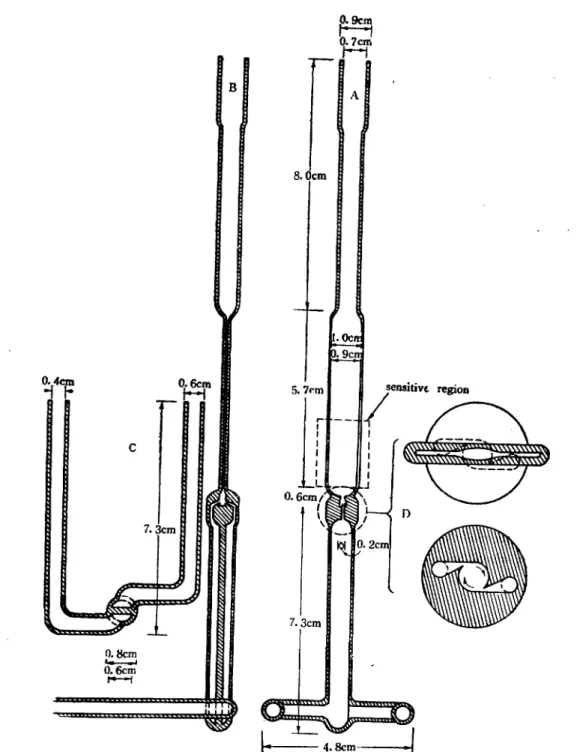
It was the aim of this investigation205 to ascertain, by the use of newly modified Piste's flow-mixing chamber and reaction cell (Fig. 1), the radical species responsible for the hydrogen atom abstraction from organic molecules. In addition, the effects of acid and alkali on the system were also studied with widely varying results.
EXPERIMENTAL
MATERIAL: TiCl3> 20% solution in HO, was obtained from K & K Laboratories, Hollywood, California. Hydrogen peroxide was Baker ana
lysed reagent. All amino acids were obtained as crystalline powders of the highest p기rity avail able from Sigma Chemical Company., St. Louis, Missouri, and used without further purifi
cation.
IN SITU GENERATION OF FREE RADI CALS: The flow system used by Piette35 was applied, in this experiment, to a Varian ESR spectrometer with a newly designed mixing cell. It was capable of both stopped and con
tinuous flow operation. Continuous flow was obtained by using nitrogen gas as the driving force which was connected to a mercury pressure gauge which directly read the applied pressure.
Stopped flow was Achieved with three microso
lenoid valves, one placed at the exit of the spectrometer cavity and the other two at the entrance arms of the mixing cell.
The two reactants are housed in reservoir liter bottles which are connected through valves to air powered syringes, and at the bottcwn of each of these is an electrically operated valve.
From these bottles, the separate liquids pass through manually operated valves which serve to fix the rationing of reactants into the mixing chamber where the reaction takes place. The newly formed products and intermediates then flow through the quartz mixing cell which is fixed in the detection cavity of the ESR spectro meter.
Fig. 1 shows the quartz, liqu너-How, mixing chamber and reaction cell which is modified Piette, s cell17>. The mixin횸 chamber with two tangent jets and flow cell is of one piece con
struction eliminating the necessity for flexible
Journal of the Korean Chemical Society
제 盅액冬啓盤我恩陽작幣鼎蛰賢新구
39
Fig. 1 DRAWING OF QUARTZ, FLOW-MIXING CELL: (A) front view: (B) side view; (C) bottom view; (D) cross-section of the entrance of the flat ceU (above) and the mixing-
chamber (below). s
I. Ocn-
40 Sun-Joo Hong and L. H. Piette
connections. The jets are off set so as to impart a swirling motion to the reactant streams as they mix. The reaction chamber itself is fashion
ed as close as possible to the bottom of the flat cell. The mixing cell is easily positioned in the V-4531 cavity using the V/jian VT548 aqueous sample cell holder.
The flow rate was varied between 1-11 ml.
sec. t as measured at the exit tube, by pressur
ing the reactant reservoirs with nitrogen and adjusting the manually operated valves. The dead volume from mixing to observation was less than 0.05 ml.
The sample handling operations consisted of preparing dilute solutions of H2O2 and TiCL, dissolving amino acids of interest in the so
lutions, and then flowing the solutions at room temperature through a mixing cell located in the microwave cavity. In the course of flow, OH radicals generated by the reaction of TiClg with H2O2 react with the solute, forming solute free radicals.
ESR SPECTROSCOPY: The ESR measure
ments were made using a Varian model V-4500 spectrometer. The spectrometer operates at a nominal frequency of 9. 5kMc. /sec., employs lOOkc. /sec. mod니ation and phase sensitive detection, and records the first derivative of the absorption signal on Varian F-80 XY recorder.
RESULTS AND DISCUSSION
The spectrum obtained by mixing equal volumes of 0. 01M TiCl3 and 0.2M H2O2 aqueous solution and flowing directly into the ESR cavity is shown in Fig. 2a. The spectrum consists of two incompletely resolved peaks instead of the one reported by Dixon and Norman10). A two peak ESR spectrum obtained by a similar tech
nique has been reported65 •,18) but the relative
intensity of the two peaks and shape of the signals were somewhat different.
It is now generally understood that the spectrum can be changed by varying the experi
mental factors such as pH of the system, flow rate, relative concentration of the reactive species in the system, and the temperature.
In the present work, it was found that addition of a small amount of H2SO4 (0. 05ml of concentrated H2SO4/Z of 0.2M-H2O2 solution) before mixing enhances the low field component of the spectrum (Fig. 2a) nea나y two-fold whereas the high field component was reduced rapidly. Further addition of the acid (0.5ml//) produced a singlet with a maximum intensity which was followed by a gradual decrease in signal intensity. On the other hand, the intensity of the original spectrum (Fig. 2a) is diminished by approximately one-third (Fig.
2b) after adding lOml/Z of concentrated HC1 to a 0.2M H2O2 solution. This effect was also observed by Turkevich et al18) and was explained by Dixon and Norman10) as a complex formation by chloride ion. On the contrary, wall et alin reported that the high field component, which was attributed to OH-Ti4+ complex, is inde
pendent of chloride concentration. The successive addition of HC1 to the H2O2 solution before mixing in the present experiments, however, caused a gradual diminishing of the total spectral intensity with the high field component dropping faster than the low field peak.
Upon adding methionine to the HQ2 solution (0.05M methionine after addition), the low field component (see trough P) in the original spectrum (Fig. 2a) vanished complexly whereas the high field component (see trough q) remained almost constant and superimposed on the secon
dary spectrum of the methionine free ra버c시
(Fig. 2c).
This superimposed spectrum was also observed
Journal of the Korean Chemical Society
용액에서의 아미노산 项 단백질 자유기에 관한 ESR 연구 제 1 보. ; Ti-H2O2 Flow System 에 서 자유기 를 만드는 반옹기 구
函ig. 2. SPECTRA OBTAINED BY FLOW-MIXING OF TITANIUM CHLORIDE AND HYDROGEN PEROXIDE:
(a) original spectrum obtained by mixing equal v이umes of 0.01M TiCl3 and 0.2M H2O2 aqueons solution: (b). spectrum obtained by mixing original elution pair where H2O2 solution contains lOml/Z of concentrated HC1; (c), spectrum obtained by mixing original solution pair where H2O2 elution contains 0. 05M methionine; (d). spectrum obtained by mixing solution pair 엉) where H2O2 solution contains 0.05M methionine, g-values of the low and high field component in the original composite spectrum are 2.0128 and 2.0114, respectively.
N
42 Sun-Joo Hong and L. H. Piette
for the other amino acids and proteins which were investigated in the present experiments, by adjusting the relative concentrations of each com
ponent of the system.
Although the present experiments faii to identify the oxidizing species, the results strong
ly demonstrate that the Ti-H2O2 flow system generates two different radical species, only one of which, giving rise to the low field component, is responsible for producing the amino acid free radical. The behavior of the other radical species was found to be much more complicated in agreement with the previous results115- It will therefore be tentatively assumed that the low field component is due to a reactive OH- radical complex and the high filed component is the spectrum of a non-reactive OH-associated titanic complex.
The most plausible explanation for the effect of acid employed would then seem to be des
truction of the nonreactive OH-Ti4+ complex.
Destruction of the complex by H2SO4 addition may result in the release of the reactive OH- radical complex and causes the improvement of the low field peak intensity assigned to that species. For the case of HC1 addition, on the other hand, there seems to be a strong reducing effect on the reactive species presumably due to the reaction215:
-OH+H++C1~―>-Cl+H2O (2) in addition to the complex destruction effect.
If the two reactions are assumed to proceed at approximately the same rate, the reactive OH- radical complex concentration may not be chang
ed ver much up to a certain extent, and the radical can be used to produce a constant amount of substrate free radical. Spectrum (d) in Fig. 2 strongly supports this assumption.
The signal intensity of the methionine free radical in (d) is not changed from that of spectrum (c) in spite of the signal intensity
decrease of the primary radical in (b) to 시most one-third of that in (a). Furthermore, no low field component of the primary spectrum was superimposed on the secondary spectrum of the methionine free radical, but trough (q) remained.
Chlorine atoms in solution, in contrast to the reactive OH-radical, cannot abstract H-atoms from saturated compounds. 2D
Low concentrations of NaOH were found to enhance the total signal intensity without any observable changes in shape. However, upon increasing the amount of NaOH, the trough (q) was gradually smeared out with reduced total signal intensity. Finally the signal became a singlet. NaOH could facilitate the formation of OH-Ti4+ complex but a higher production of OH-radical by adding NaOH can hardly be ex
pected due to the reaction (1).
A low〔Ti라〕/〔H2O2〕ratio improved the in
tensity of the low-field component while that of the high field component was enhanced under the condition of high [Ti3+] / (H2O2) ratio. A similar result was obtained by others'”). In order to investigate this effect more completely, an expriment was carried out in which the two extreme cases could be examined. When [Ti3+]
/〔H2O2〕is far higher (0. 01 M TiCk—0. 01M H2O2), than usu 시 (0. 01M TiCl3——2M H2O2), a narrow, sharp single line was observed only after stopping the flow, whereas in the usual case the spectrum in Fig. 2a is seen only during flow at the dead time of 0.01 second. The- appearance of this singlet occurs in a short time after stopping flow and was followed by a slow decay. On the other hand, a very low〔Ti"〕/
(H2O2] ratio in the system, 0. 002M TiCl3—0. 2 M H2O2, presented the singlet only during steady flow mixing. If the previously discussed [Ti3+] / [H2O2] ratio effect on the spectrum is- extended further to these extreme cases, the radical species generated under very high〔TV〕
Journal of the Korean Chemical Socie ty
용액에서의 아미노산 및 단백질 자유기에 관한 ESR 연구
제 1 i ; Ti-H2O2 Flow System 에서 자유기를 만드는 반응기구 4?
/ (H2O2] ratio could primarily correspond to the high field component and that under very low
〔Ti아) / (H2O2) to the low field component. To investigate this, the spectra under the two extreme conditions of [Ti3+] / (H2O2J were record
ed with the same instrum이ital setting. The singlet in each case was found to occur at the same magnetic field position with similar line widths and intensities. No change in the mag
netic field position of absorption seems to run counter to the previous assumptions that the two radical species are not identical. However, the addition of methionine to the high〔Ti러〕/
[H2O2J system presented neither the spectrum of methionine nor the primary radical during or after stopping flow. Whereas, methionine en
hances thes inglet intensity in the low [Ti3+] /(H2~
O2] system. This fact is consistent with the pre
vious 사hat adding small amounts of the sub
strate increased the intensity of the low field peak (see Fig. 2a). This was occasionally observed for all amino acids in the present work when the relative concentration of the reactive species are not sufficient to produce a secondary spectrum of the substrate free radical. This result presents further evidence that the radical species generat
ed by very low [Ti3+] / [H2O2] primarily con
sists of the low field component (Fig. 2a). The explanation of the results in the high [Ti3+] /
〔H2O2〕system seems to involve a more com
plicated mechanism. This complexity was also observed for the case of other amino acids which will be discussed later.
The amount of experimental information is too small to give a more detailed description of the identity of the radical species generated by the Ti-H2O2 flow system and the reaction mechanisms in this system. However, it is now clear that the Ti-H2O2 flow system generates two different kinds of radical species the low
field component of which is alone responsible for abstracting H-atoms from substrate molecules.-
REFERENCES
1) H. Hartridge and F. J. W. Roughton, Proc.
Roy. Sg, A, 104, 376 (1923).
2) I, Yamazaki, H. S. Mason, and L. H. Piette, Btochem. Biophys. Research Commun., 1, 336’
(1959).
3) I. Yamazaki, H. S. Mason, and L. H. Piette, J. Biol, Chem., 235, 2444 (I960).
4) H. S. Mason, E. Spencer, and I. Yamazaki, Btochem. Biophys. Research Commun., 4, 236 (1961).
5) I. Yamazaki, and L. H. Piette, Biochem.
Biophys. Acta., 50, 62 (1961).
6) L. H. Piette, G. Bulow and K. Loeffler,.
Preprint of the Am. Chem. Soc,, 9, No. 2-c, P. c-9 (1964)
7) L. H. Piette in "Rapid Mixing and Sampling Techniques in Biochemistry" B. Chance et al (eds), Academic Press, New York (1964).
8) D. C. Borg, Nature, 201, 1087 (1964).
9) D. C. Borg, in "Rapid Mixing and Sampling Techniques in Biochemistry" B. Chance et al (eds), Academic Press, New York (1964).
10) W. T. Dixon and R. O. C. Norman, J. Chem.
Soc.t 572, 3119 (1963).
11) F. Sicilio, R. E. Florin,【md L. A, Wall, J. Phys. Chem., 70, 47 (1966).
12) T. Shiga, ibid., 69, 3805 (1965).
13) P. Smith, J. T. Pearson, P. B. Wood, and T. C. Smith, J. Chem. Phys., 43,1535(1965).
14) T. Stone and W. A. Waters, Proc. Chem..
Soc., 253 C1962).
15) P. L. Kolker, J. Chem. Soc,, 5929 (1964).
16) M. F. R. Muleahy, J. R. Stenven, and J.
C. Ward, Aust. J. Chem., 18, 1177 (1965》 17) W. T. Dixon and R. O. C. Norman, Nature^
196, 891 (1962).
18) Y. S. Chiang, J. Craddock, D. Mickewich,.
44 Sun-Joo Hong and L. H. Piette
and J. Turkevich, J. Phys. Chem., 70, 3509 (1966).
19) D. C. Borg and J. J. Elmore, Jr. “Magnetic Resonance in Biological System" Wenner-Gren Center International Symposium Series, 9, 383 (1967).
20) Sun-Joo Hong, Abstracts, 1st ACS. Haw
aiian Section Annual Meeting-In-Miniature, Honolulu, Hawaii, Paper No. 4 (1968).
21) J. F. Ward, and L. S. Myers, Jr. Radi- aion Res., 26, 483 (1965).
Journal of the Korean Chemical Society