Inhibitory Effects of Phyllostachys bambusoides on Melanin Synthesis and Tyrosinase Activity in Cultured Human Melanoma Cells
Man Kyu Huh
1*, Min Ho Han
2,3, Cheol Park
1and Yung Hyun Choi
2,31
Department of Molecular Biology, College of Natural Sciences, Dongeui University, Busan 614-714, Korea
2
Department of Biochemistry, Dongeui University College of Oriental Medicine, Busan 614-052, Korea
3
Anti-Aging Research Center & Blue-Bio Industry RIC, Dongeui University, Busan 614-714, Korea
Received February 11, 2014 /Revised February 28, 2014 /Accepted February 28, 2014Tyrosinase is a rate-limiting enzyme that controls the production of melanin. The effect of bamboo (Phyllostachys bambusoides) on tyrosinase activity and melanin synthesis has not been studied. We ana- lyzed the effects of leaf and inner film fractions of bamboo extracts on the inhibition of tyrosinase activity and on melanin production. At a concentration of 5 mg/ml, the extracts of bamboo down- regulated the production of melanocytes. In addition, the extracts of bamboo reduced tyrosinase activ- ity and the melanin content in vitro. Our results suggest that bamboo extract may constrain melanin synthesis by inhibition of the activity and expression of tyrosinase.
Key words : Bamboo, extractions, melanocyte, tyrosinase activity, melanin
*Corresponding author
*Tel : +82-51-890-1521, Fax : +82-51-890-1529
*E-mail : [email protected]
This is an Open-Access article distributed under the terms of the Creative Commons Attribution Non-Commercial License (http://creativecommons.org/licenses/by-nc/3.0) which permits unrestricted non-commercial use, distribution, and reproduction in any medium, provided the original work is properly cited.
Journal of Life Science 2014 Vol. 24. No. 3. 284~289 DOI : http://dx.doi.org/10.5352/JLS.2014.24.3.284
Introduction
Visible pigmentation in mammals results from the syn- thesis and distribution of melanin in skin, hair bulbs and eyes [15]. At the cellular level, melanins are produced in pigment cells (melanocytes) in a specialized cytoplasmic or- ganelle (melanosome) [4].
The melanocyte is a neutral crest-derived cell that local- izes in the bottom layer (the stratum basale) of the skin's epidermis, the middle layer of the eye (the uvea) to several organs including the epidermis, eyes, inner ear, bones and heart. Melanocytes can absorb ultraviolet radiation and sur- vive considerable genotoxic stress. The skin is the primary barrier to the external environment, and relies on melano- cytes to provide, among other things, photo-protection and thermoregulation by producing melanin. The degree of pig- ment production shows as skin ‘phototype’ (skin color and ease of tanning) in the general population [10]. Melanin is the pigment primarily responsible for skin color and it can role in the most useful predictor of human skin cancer risk [3].
The tyrosinase is the rate-limiting enzyme for controlling the production of melanin [13]. It is mainly involved in two distinct reactions of melanin synthesis. One is the hydrox- ylation of a monophenol and the other is the conversion of an o-diphenol to the corresponding o-quinone which under- goes several reactions to eventually form melanin [9].
Tyrosinase is a copper-containing enzyme present in plant, animal tissues and fungal species that catalyzes the pro- duction of melanin and other pigments from tyrosine by oxi- dation, as in the blackening of a peeled or sliced potato ex- posed to air. It is found inside melanosomes [14].
Several polyphenols, including flavonoids or stilbenoid, substrate analogues, free radical scavengers, and copper che- lators, have been known to inhibit tyrosinase [2]. Henceforth, the medical and cosmetic industries are focusing research on tyrosinase inhibitors to treat skin disorders.
Tyrosinase is the key enzyme in pigment synthesis, ini- tiating a cascade of reactions which convert the amino acid tyrosine to the melanin biopolymer. Two other tyrosinase-re- lated proteins (TRP) are known, TRP-1 (probably DHICA oxidase) and TRP-2 (DOPA chrome tautomerase).
Bamboo (Bambuseae) is a tribe of flowering perennial ev-
ergreen plants in the grass family Poaceae, subfamily
Bambusoideae, tribe Bambuseae. Bamboos are of notable
economic and cultural significance in South Asia, Southeast
Asia and East Asia, being used for building materials, as
a food source, and as a versatile raw product. Bamboo is
also used in Chinese medicine for treating infections and
healing. All the bamboo materials have a mild sweet taste
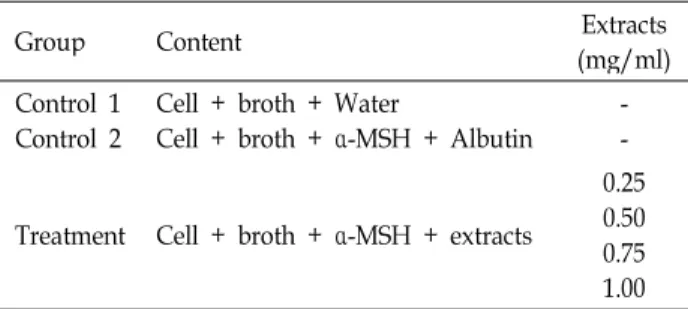
Table 1. Inhibitory effects of bamboo extracts and comparison of inhibitors
Group Content Extracts
(mg/ml) Control 1
Control 2 Cell + broth + Water
Cell + broth + α-MSH + Albutin - - Treatment Cell + broth + α-MSH + extracts
0.25 0.50 0.751.00
and all parts but the leaves are used to resolve phlegm.
While the phlegm disorder to be addressed may be related to lung heat causing coughing and sticky phlegm, bamboo is especially used for the disorder of hot phlegm that coats or obstructs the "orifices of the heart", affecting the brain functions. Thus, it is used for epilepsy, fainting and loss of consciousness in feverish diseases, and a variety of mental disorders that develop with aging.
The present investigation was undertaken to evaluate the inhibition of tyrosinase activity and expression ether extracts of bamboo (Phyllostachys bambusoides).
Materials and Methods Material
Phyllostachys bambusoides Sieb. et Zucc., a genus of grass family Gramineae (Poaceae) consists of diploid species (2n=
48). This species is native to China, but it is commonly worldwide grown, especially in Korea and Japan. Most spe- cies of the genus are economically important. For example, plant leaves, stems, and roots, which historically were used in Korea for building and in the manufacture of furniture.
Fifty mature trees (≥3 yr) were randomly collected from P. bambusoides.
Fraction of active constituents from the ethanol extract
P. bambusoides was collected from natural populations and its leaves dried in shade. HCl-ethanol extractions were ob- tained using 100 g leaves. In addition, bamboos split in half with a knife. Films of stems were collected from the inner wall of bamboos. 100 g of films were added to 50 ml distilled water and homogenized in homogenizer with 3,000 rpm for 2 min. Plant tissues were pulverized in liquid nitrogen (-7 0℃) using a mortar and pestle. Homogenous powder was transfer to HCl-ethanol and their solutions were treated in
an ultrasonic bath for 90 min. Samples were dried and ground hydro-distilled for 2.5 hr using a Clevenger-type apparatus. The components were extracted from the dis- tillate with ether, and then dried with anhydrous Na
2SO
4. The solvent was removed by distillation at atmosphere pres- sure, and the pure dried extraction was kept at 4℃ until analysis.
Cells and culture media
Melanin cells (B16F10) were used. The culture media were in Dulbecco's modified eagle medium (DMEM) with pen- icillin/streptomycin, 10% phosphate buffered saline (FBS) 50 ml, Bovine pituitary extracts 2.0 ml, FGF 1.0 ml, Insulin 1.0 ml, Hydrocortisone 0.5 ml, Phorbolmyristate acetate 0.5 ml, GA-1000 0.5 ml, and Fetal bovine serum 2.5 ml.
Cell viability
Melanin cells were divided into nine groups and each group treated with 0, 0.5, 1.0, 2.5, 3.0, 3.5, 4.0, 4.5, and 5.0 mg/ml extracts of P. bambusoides. Group-I is control which treated with DMSO (Dimethylsulfoxide) and 50 μg/ml albu- tin [17]. Cells were incubated in CO
2at 37℃ for 72 hr. After removing media, 0.5 mg/ml tetrazolium bromide salt (MTT) was added and were incubated in CO
2at 37℃ for 32 hr.
Afterremoving MTT, 1 ml DMSO was added and absorban- cemeasuredusing ELISA reader (Molecular Devices, Sunny- vale, CA, USA).
Tyrosinase activity
Inhibitory effects against tyrosine were carried out the fol- lowing procedure. Inhibitory effects against tyrosine were carried out the following procedure [6]. The reaction mixture containing various concentrations of the test samples and 4-hydroxyphenyl alpha-glucopyranoside, alpha-arbutin 50 μg/
ml. Sodium phosphate buffer (60 μl, 50 mM) at pH 6.8, 30
μ l tyrosinase (25 U/ml) and 10 μof the plant extract were
inserted into 96-well plates. After 5 min of incubation at
room temperature, 100 μl L-tyrosine (2 mM) were added and
incubated for additional 20 min. The optical density (OD)
of the samples at 475 nm (EL800, BIO-TEK Instruments,
USA) were measured compared to control without inhibitor,
demonstrating a linear color change with time during the
20 min of the experiment. Control incubations represent
100% enzyme activity and were conducted in a similar way
by replacing extracts by buffer. For blank incubation, to al-
low for absorbance (A) produced by the extract, the enzyme
Fig. 1. B16F10 (Primary Human Melanocytes) cells grown in medium with the addition of Human Melanocyte Growth Supplement (HMGS) after 48 hr.
Fig. 2. B16F10 cells grown in medium with the addition of HMGS after 72 hr.
solution was replaced by buffer. The inhibitory activity was determined by comparing the enzyme activity in the absence and presence of the evaluated inhibitor. 0.2 μM α-MSH was used as positive control. Albutin was also used as control [11].
Measurement of cellular melanin contents
Measurement of cellular melanin contents was carried out as previously described by Hosei et al. [4]. B16F10 melanin cells were cultured in 5% CO
2at 37℃ for 3 days with MSH.Cells were washed with PBS and separated by cen- trifugation at 1,500 rpm for 5. The pellets were solubilized in 1 N NaOH containing 10% dimethyl sulfoxide (DMSO) at 80℃ for 1 hr. After washing with washing solution, they were treated 100 μl enzyme conjugate and incubated at 22℃
for 45 min. The O.D. was measured at 475 nm using micro- plate reader (EL800, BIO-TEK Instruments, USA).
Results and Discussion
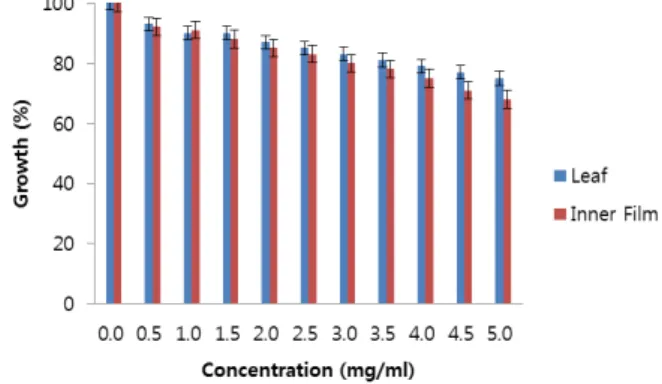
The effects of the various fractions of bamboo extract on HCl-ethanol were investigated, and the results were shown in Figs. 1 and 2. Fig. 1 was the results of B16F10 (Primary Human Melanocytes) cells grown in medium with the addi- tion of Human Melanocyte Growth Supplement (HMGS) af- ter 48 hr. As concentration of leaf and inner film extractions increased, the cell growth was inhibited. Thus, extractions of the leaves and inner film had an effect the survival rate for melanin cells. Compared to this control, treatments with various concentrations did not decrease significantly at 48 hr. However, when the proceeding time has longer, in- hibitory effect was found. For example, the reduction was shown significantly at 72 hr. Cell survival rate on 5 mg/ml
concentration of leaves and inner film were shown 75% and 50%, respectively.
Cell viability which was treatment with extracts on 72 hr observed by microscope (Fig. 3). The morphological charac- ter and melanocyte cell density did not show any change in the 1.0 mg/ml treated group. But the 2.0 mg/ml treatment groups were decreased overall cell density and observed morphologically change. Fig. 4 was shown the inhibitory ef- fects of inner film compounds on intra cellular tyrosinase activity in melanin cells at 72 hr after treatment. As concen- tration of leaf and inner film extractions increased, the cel- lular tyrosinase activity was inhibited. Inhibition of inner film for tyrosinase is higher than that of leaves.
In order to determine the effects of α-MSH on melano- genesis, melanin cell were treated with the bamboo extracts.
0.2 μM α-MSH induced mild stimulation of the tyrosinase activity in melanoma cells. In contrast, the addition of bam- boo extracts in to the cells led to a significant decrease in the activity and synthesis of tyrosinase, regardless of the presence or absence of α-melanocyte stimulating hormone (α-MSH) (Fig. 5). Moreover bamboo extracts (1.0 mg/ml) di- minished the expression and activity of tyrosinase, and mel- anin content in cultured normal human epidermal melano- cytes. We studied the inhibitory effects of 4-hydroxyphenyl alpha-glucopyranoside (alpha-arbutin) on melanogenesis in cultured human melanoma cells. The melanin content was found significantly to be decreased by bamboo extracts in a concentration-dependent manner (Fig. 5). Melanin syn- thesis in cells treated with alpha-arbutin at 50 μg/ml de- creased to 70% of that in non-treated cells. The cellular ty- rosinase activity of melanin cells also significantly decreased.
While melanin synthesis was reduced to 25% of that in the
control. Although the in vivo effects of bamboo extracts are
still unclear, these results suggest that bamboo extracts could
0.0 1.0 2.0
3.0 4.0 5.0
Fig. 3. Phase contrast images of primary human melanocytes (HEMa) in culture.
Fig. 4. Inhibitory effects of inner film compounds on intra cellular tyrosinase activity in melanin cells at 72 hr after treatment. The values of concentrations were shown in Table 1.
Fig. 5. Inhibitory effects of bamboo compounds on melanin content at 72 hr after treatment. The values of concentrations were shown in Table 1.
play important roles in controlling melanogenesis.
The decoction of inner film of bamboo is called as
“Jukyeo” in Korea and is a traditionally recognized folk medicine used to vomiting blood (Haematemesis) in China and Korea. Similarly, the material of bamboo is currently available on the Chinese, Korea, and Japanese markets as an herbal tea for the purpose of blood-clearing. In the course of investigating the therapeutic effects of inner film on bam- boo, we developed a renewed interest in the melanin syn- thesis-inhibitory ability of HCl-ethanol extracts from the P.
bambusoides.
When tested in melanoma B16/F10 cells treated with the α -melanocyte stimulating hormone (α-MSH), the aqueous ethanol extract of Sasa quelpaertensis culm inhibited the cel-
lular melanogenesis more effectively than its leaf extract [1].
These results of S. quelpaertensis were consistent withour re- sults (P. bambusoides). We concluded from that the bamboo compound including p-coumaric acid inhibited α-MSH- stimulated cellular melanogenesis more effectively than ar- butin or other structurally similar compounds including 3-(4-hydroxyphenyl) propionic acid, cinnamic acid and caf- feic acid. It also attenuated α-MSH-dependent increase of ty- rosinase protein.
Compared with unstimulated control, all extracts sig-
nificantly reduced melanogenesis in human melanoma cells
and normal adult epidermal melanocytes. These extracts also
reduced melanin transfer and reduced filopodia expression
on melanocytes, similar to hydroquinone and niacinamide,
indicating their effectiveness as multimode pigmentation ac-
tives [5, 7, 8].
Plants extracts are good resources to find functional com- pounds for human health. For example, mulberry, kiwi, and Sophora angustifolia and some natural plant extracts were as- sessed against isobutylmethylxanthine, hydroquinone, vita- min C and niacinaoma [16]. These extracts significantly re- duced also reduced melanogenesis in human melanoma cells and normal adult epidermal melanocytes. They also reduced melanin transfer in human skin cells [16]. In Korea, Kim et al. [8] reported that Inhibition of melanin synthesis of eight plant extracts, Acer psedo-siebolianum, Acer geiseum, Castanopsis cuspidata var. thunbergii, Acer ginnala, Cercidiphyllum japonica, Conus walteri, Distylum racemosum, Thuijopsis dolabrata cv. aur- ea showed the high at 1,000 mg in tyrosinase inhibitory activity.
Recent elucidation of regulatory mechanisms of eu- and pheomelanogenesis has led us towards an exciting new era of melanogenesis control. Mishima et al. [12] reported that progress on inhibitory control of melanogenesis from the macromolecular level to human skin color and many new melanogenic inhibitors have been discovered which, in spite of their non-suppressive effect on isolated naked tyrosinase, suppress melanin formation in the living pigment cell in vi- tro as well as in the natural world.
References
1. An, S. M., Lee, S. I., Choi, S. W., Moon, S. W. and Boo, Y. C. 2008. p-Coumaric acid, a constituent of
Sasa quel- paertensis
Nakai, inhibits cellular melanogenesis stimulated by α‐melanocyte stimulating hormone.British J Dermatol
159, 292-299.2. Chang, T. S. 2009. An updated review of tyrosinase inhibitors.
Intl J Mol Sci
10, 2440-2475.3. Hearing, V. J. and Tsukamoto, K. 1991. Enzymatic control of pigmentation in mammals.
FASEB J
5, 2902-2909.4. Hosei, J. E., Suda, T. and Kuroki, T. 1985. Regulation of mel- anin synthesis of B16 mouse melanoma cells by 1α,25-dehy- droxyvitamin D3 and retinoic acid.
Cancer Res
45, 1474-1478.5. Hurley, M. E., Guevara, I. L., Gonzales, R. M. and Pandya,
A. G. 2002. Efficacy of glycolic acid peels in the treatment of melasma.
Arch Dermatol
138, 1578-1582.6. Jeon, S. H., Kim, K. H., Koh, J. U. and Kong, K. H. 2005.
Inhibitory effects on L-dopa oxidation of tyrosinase by skin-whitening agents.
Bull Korean Chem Soc
26, 1135-1137.7. Jo, Y. O., Kong, Y. H., Lee, Y. C., Kim, S. S. and Choi, S.
Y. 2008. Inhibitory effect of white Ginseng fraction on skin pigmentation.
Korean J Med Crop Sci
16, 192-194.8. Kim, J. Y., Lee, J. Y., Lee, W. Y., Yi, Y. and Lim, Y. 2010.
Anti-oxidant property and inhibition of melanin synthesis of eight plant extracts.
Korean J Microbiol Biotechnol
38, 414-419.9. Kumar, C. M., Sathisha, U. V., Dharmesh, S., Rao, A. G.
and Singh, S. A. 2011. Interaction of sesamol (3,4-methylene- dioxyphenol) with tyrosinase and its effect on melanin synthesis
. Biochimie
93, 562-569.10. Lin, J. Y. and Fisher, D. E. 2007. Melanocyte biology and skin pigmentation.
Nature
445, 843-850.11. Maeda, K. and Fukuda, M. J. 1996. Arbutin: mechanism of its depigmenting action in human melanocyte culture.
Pharmacol Exp Ther
276, 765-769.12. Mishima, Y., Hatta, S., Ohyma, Y. and Inazu, M. 1988.
Induction of melanogenesis suppression: cellular pharma- cology and mode of differential action
. Pigment Cell Res
1, 367-374.13. Olivares, C. and Solano, F. 2009. New insights into the active site structure and catalytic mechanism of tyrosinase and its related proteins
. Pigment Cell Melanoma Res
22, 750-760.14. Park, J. H., Kim, Y. J., Mun, Y. J., Lee, Y. C. and Woo, W.
H. 2005. Inhibitory effect of methanolic extract of
Cnidiirhizoma
on the Melanogenesis.Korean J Oriental Physiol Pathol
19, 938-944.15. Seiji, M., Shimao, K., Birbeck, M. S. C. and Fitzpatrick, T.
B. 1963. Subcellular location of melanin biosynthesis.
Ann NY Acad Sci
100, 479-533.16. Singh, S. K., Baker, R., Wibawa, J. I., Bell, M. and Tobin, D. J. 2013. The effects of
Sophora angustifolia
and other natu- ral plant extracts on melanogenesis and melanin transfer in human skin cells.Exp Dermatol
22, 67-69.17. Sugimoto, K., Nishimura, T., Nomura, K., Sugimoto, K. and Kuriki, T. 2004. Inhibitory effects of alpha-arbutin on mela- nin synthesis in cultured human melanoma cells and a three-dimensional human skin model.