INTRODUCTION
In skiing, a turn is made according to arc-of-curvature shaped sidecut. In other words, a turn is made by the sidecut, and edging reduces the radius of sidecut (Evans, Jackman, Otlaway 1974; Maruyama et al., 1994). In addition, such sidecut's role is identified by an edge angle as well as by edge pressure (Ichino, 1999).
If a turn is made long, it is called 'long turn'. If made short, it becomes 'short turn' (Hyun, 2003). The ski plate itself represents if a turn is short or long as ski camber which makes sidecut and bending rebound. This study attempted to investigate if a human body's movement on the plate, which makes such turn maintains a long movement and creates a short turn.
A long turn is a preceding work performed for a turn. A
rotation which makes the shoulders face the uphill is conducted.
Then, body weight is put on the outer foot, and knees are placed inwardly. Then, the edge angle is set (Maruyama et al., 1994). At the same time, as repulsion against centrifugal force according to velocity, a human body is leaned toward uphill, taking a direction of turn (inclination). After the inclination of basic parallel, angulation is performed for quick conversion to the next turn instead of making the whole body lean. Since in- clination efficiency and axis make a big movement, angulation is performed along with inclination to avoid any shaking. Then, the pressure applied to one foot is regulated, preparing for the start and end of turn, radius of turn and next turn (Kang, Kim & Kim, 1999).
However, a short turn greatly differs. A short turn is not just reduction of a long turn. In fact, it uses quite different turning
Kinematic Comparative Analysis of Short Turns between Skilled and Unskilled Alpine Skiers
Hyun Dai Jo
Gonjiam Middle School, Gyeonggi-do, South Korea
Received : 31 October 2019 Revised : 26 November 2019 Accepted : 26 November 2019
Corresponding Author Hyun Dai Jo
Gonjiam Middle School, 82, Gonjiam-ro, Gonjiam-eup, Gwangju-si, Gyeonggi-do, 12804, South Korea Tel : +82-10-4195-3323 Fax : +82-31-763-1773 Email : [email protected]
Objective: The purpose of this study is to provide a better understanding of short turn mechanism by describing short turns after kinematic analysis and provide skiers and winter sports instructors with data through which they are able to analyze right postures for turns in skiing in a systematic, rational and scientific manner.
Method: For this, a mean difference of kinematic variables (ski-hip angle, ski-shoulder twist angle, pole checking angle, the center of gravity (CG) displacement, trunk forward lean angle) was verified against a total of 12 skiers (skilled and unskilled, 6 persons each), regarding motions from the up-start to down-end points for short turns.
Results: There was no difference in a ski-hip twist angle. The ski-shoulder twist angle was large at the up-start point while a pole-checking angle was high at the down-end point in skilled skiers. Concerning the horizontal displacement of CG, skilled skiers were positioned on the right side at the upstart point. No significant difference was observed in the trunk forward lean angle.
Conclusion: According to the ski-shoulder twist angle and CG horizontal displacement results, the upper body should be kept leant toward the pole. In addition, big turns should be made via edging and angulation. During pole checking, the hand holding the pole should be thrown and released toward a vector direction of the forearm.
Keywords: Short turn, Pole checking, Rotation, Pivoting, Angulation angles
techniques. In case pivoting is rotated just like a long turn, skiers wouldn't be able to change a direction faster. If inclination is only given just like basic parallel, the upper body would be shaky due to difficult upper body rotation. Such mechanism reminds of the pivot of a human body. A rotation would refer to the pivot of a human body while inclination would mean a rotation of a human body just like an anteroposterior axis around the skis. In terms of pressure control, to get an up move, it is unable to make a next turn unless weight is reduced fast for a quick shift of turn (Lee, 1999). Lastly, the last move for a quick turn is 'pole checking'. After all, the essential and last element for a natural, smooth and accurate short turn is 'pole checking'. Therefore, a short turn should be counter-rotated all the time, and angulation should be kept. In other words, it refers to a counter-rotation posture. In addition, the degree of pressure making the knees inserted and unweighting should also be done. Lastly, an accurate pole checking posture is critical.
This study investigated different mechanisms between short and long turns and examined what elements are needed for a short turn.
The development of devices could've made a short turn much easier. After all, the pivoting or angulation of conventional skiing's been simple and convenient because of the curvature of sidecut (Yoneyama, Kagawa, Okamoto & Sawada, 2000). In other words, pivoting and angulation are crucial in a short turn.
In addition, the comparison of lower limb joint angles at the up-down point in a traditional turn and up-down concept in the recent carving turn can slightly differ (Eun & Hyun, 2010).
Hence, this study attempted to analyze changes in a human body's vertical axis on pivoting (rotation) under a short turn through ski-shoulder and ski-hip rotations instead of such lower limb joint angles. It also targeted to investigate left displacement through which edging changes can be found after measuring trunk forward lean angles with a goal of figuring out if pres- sure has been applied to skis in accurate distribution. For such short turn elements, the followings were measured.
For pole checking, angles at three points (elbow, hands, tip of pole) were measured. To measure ski-hip and ski-shoulder angles, the rotation angle from the vertical axis of the line con- necting two shoulders and two hips and the line connecting two ankles was measured. To check edging additionally fur- thermore, differences in the horizontal displacement of CG were examined. To maintain forward lean, the angle between the trunk vector and skis was measured, and differences between forward and backward leans were examined.
The experiment was conducted against ski instructors because subjects should be able to make a short turn to some degree.
Basically, beginners can't even dare to imitate a short turn.
Therefore, subjects should be skilled enough to make a short turn to comparatively analyze good and bad short turns.
It's anticipated that there would be further studies on cor- relations among ski-shoulder and slope angles, forearm and upper arm rotation angle at shoulder gradient pole checking and variables affecting a short turn.
METHODS
1. ParticipantsIn this study, a total of 12 ski instructors from 'K' Resort in Gangwon-do were chosen. Specifically, 6 skilled skiers (KSA level 2 or higher) with more 3 or more years of ski instructor experiences and 6 unskilled skiers who have never taught skiing before were selected. In terms of their personal information, their mean age is (skilled 29.0±3.2 yrs, unskilled 21.3±0.5 yrs) while mean height and mean weight are (skilled 173.1±2.9 cm, unskilled 174.1±3.8 cm and 71.3±1.7 kg, 74.6±3.9 kg) respect- ively. In terms of the length of ski-instructor experiences, skilled and unskilled instructors were 6.8±2.2 yrs and 1.0±0.0 yrs each.
2. Procedures
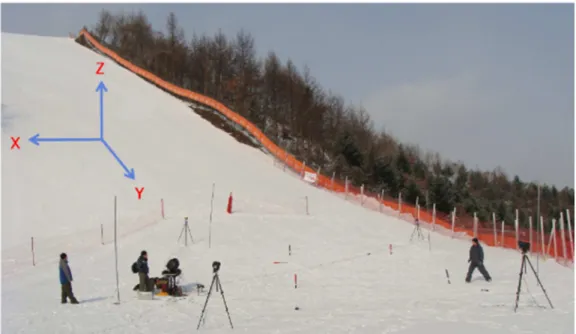
In this study, experiments were performed on the K Resort's J Slope. To set spatial coordinates, a single control object was set up within a range which completely includes subjects' turns.
In such turn moves, the left-right direction, forward direction and vertical direction were set to 'X', 'Y' and 'Z' axes respect- ively. In addition, four motion cameras were set up to film the whole range of motion including the control object. Then, after filing the experimental space with the camera, the control pole was removed (Figure 1).
For dynamic trial filming, the subjects made a turn 6 times with a 10-minute interval between attempts. To get accurate data, each turn was made 6 times, and the researchers classified and analyzed the data measured according to the purpose of the research.
A single turn comprised of a right turn in which both skilled and unskilled skiers' body weight was put on their left foot, and the radius of turn was 9.15 m. The gradient was 25~30%
in average. The distance from the start to the start of the first
turn was 21.55 m. Both left and right turns were attempted.
Then, the data from the start to the end of the left turn (second turn) were processed (Figure 2).
3. Data analysis and processing
For data analysis, human joints, CG and control poles were
coordinated. Then, the exact positions on the coordinates were examined, using the direct linear transformation method (DLT) (Abdel-Aziz & Karara, 1971). After smoothing, they were analyzed through a Kwon 3D XP motion analysis program (Kwon, 2003).
With the data obtained in this study, mean and standard deviation on kinematic variables within the measurement range were estimated against both skilled and unskilled skiers, using Figure 2. Subjects set up on ski slope
Figure 1. Experiment environment
SPSS. To investigate differences in such variables between skilled and unskilled skiers, t-test was performed.
4. Measuring events and phases
To analyze turns in skiing, events and phases were defined as follows:
1) Event (Figure 3)
(1) Event 1 (up1): Up-start point (2) Event 2 (up2): Edge-change point
(3) Event 3 (down1): Maximum angulation point (4) Event 4 (down2): Down-end point
2) Phase
(1) Phase 1 (E1-E2: P1): From the up-start to edge-change points
(2) Phase 2 (E2-E3: P2): From the edge-change to the max- imum angulation points
(3) Phase 3 (E3-E4: P3): From the maximum angulation to down-end points
RESULTS
1. Ski-hip, Ski-shoulder twist angles and pole angles
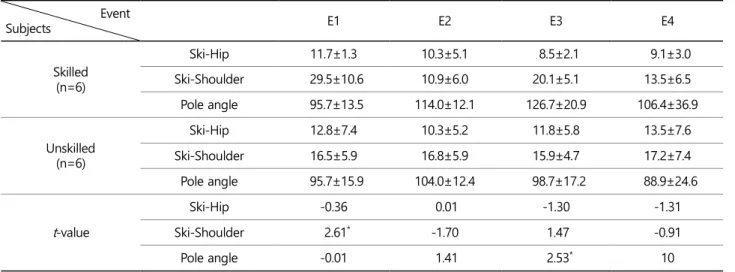
Ski-hip and ski-shoulder twist angles and pole-checking angle factors are stated in Table 1. In terms of ski-hip and ski- shoulder twist angles, the twist angles of the line connecting
the two-ankle line, two hip-joint line and two-shoulder line were observed. The pole-checking angle represents the angle con- necting the elbow, wrist and tip below the pole to observe in a short turn only.
Ski-hip and ski-shoulder twist angles represent the degree of upper limb-lower limb twisting. Their goal is to create a natural turn for a next turn. The ski-hip twist angle ranged from 8.5±
2.1° to 11.7±1.3° in skilled skiers and from 10.3±5.2° to 13.5±
7.6° in unskilled skiers, showing no difference.
In terms of a ski-shoulder twist angle, the preceding move of the shoulder-rotating turn converts linearity into rotation to enable a turn via curvature according to the ski camber and sidecut. In terms of the ski-shoulder twist angle, skilled and unskilled skiers were 29.5±10.6° and 16.5±5.9° respectively at the up-start point (E1). In the remaining phases, no difference was found.
In terms of the pole-checking angle, on the contrary, skilled and unskilled skiers were 126.7±20.9° and 98.7±17.2° each, showing a significant difference.
2. Displacement of CG and trunk forward lean angle
The CG displacement and trunk forward lean angle factors are stated in Table 2. In terms of the CG horizontal displacement, skilled and unskilled skiers were 4.17±0.30 m and 3.79±0.27 m respectively at the up-start point (E1). In the remaining phases, however, no difference was found. The numbers were higher in the down-end point (E4) than in the maximum angulation point (E3) and increased up to the level of E2 in skilled skiers because a quick and strong turn made a horizontal position move up to the edge-change point (E2) symmetrically. In terms Figure 3. Events
of anteroposterior displacement, skilled and unskilled skiers were 4.79±4.32 m and 7.01±3.09 m respectively at the up-start point (E1), showing no significant difference. According to the results of horizontal displacement at E1, inclination was in- creased when making a turn, or anteroposterior displacement was positioned more in the back along the sidecut without skidding and friction.
In terms of the trunk forward lean angle, skilled skiers ranged from 94.7±8.1° to 103.3±9.7° while unskilled ones were 96.3±
5.1° - 99.6±9.6°, showing no significant difference.
DISCUSSION
In a short turn, a symmetrical turn shift quickly happens so that quick weight transfer is important. However, ski rotation which generates such weight shift creates the rotation of head, shoulder, pelvis, knee and ankle rotations from a kinematic perspective. This rotation fixes the upper body toward the pole, causing the lower limb rotation to make a short turn. If the upper body is fixed, hip, knees and ankles are twisted in order. Then, hip/ankle twisting and ankle/shoulder twisting were measured.
Table 1. Ski-hip and Ski-shoulder twist angles and pole angles (deg)
Event
Subjects E1 E2 E3 E4
Skilled (n=6)
Ski-Hip 11.7±1.3 10.3±5.1 8.5±2.1 9.1±3.0
Ski-Shoulder 29.5±10.6 10.9±6.0 20.1±5.1 13.5±6.5
Pole angle 95.7±13.5 114.0±12.1 126.7±20.9 106.4±36.9
Unskilled (n=6)
Ski-Hip 12.8±7.4 10.3±5.2 11.8±5.8 13.5±7.6
Ski-Shoulder 16.5±5.9 16.8±5.9 15.9±4.7 17.2±7.4
Pole angle 95.7±15.9 104.0±12.4 98.7±17.2 88.9±24.6
t-value
Ski-Hip -0.36 0.01 -1.30 -1.31
Ski-Shoulder 2.61* -1.70 1.47 -0.91
Pole angle -0.01 1.41 2.53* 10
*p<.05
E1: The up-start, E2: The edge change, E3: The maximum angulation, E4: The down-end
Table 2. Displacement of CG (m) and trunk forward lean angles (deg)
Event
Subjects E1 E2 E3 E4
CG (X, Y)
Skilled (n=6)
X 4.17±0.30 3.93±0.27 3.63±0.49 3.57±0.61
Y 4.79±4.32 6.20±3.90 8.64±3.48 9.66±3.36
Unskilled (n=6)
X 3.76±0.27 3.58±0.44 3.33±0.71 3.25±0.80
Y 7.01±3.09 8.21±2.84 9.97±2.42 10.71±2.29
t-value X 2.23* 1.65 0.82 0.77
Y -1.02 -1.02 -0.76 -0.64
Trunk forward lean angles
Skilled (n=6) 97.2±6.8 94.7±8.1 101.4±10.1 103.3±9.7
Unskilled (n=6) 98.7±5.4 96.3±5.1 97.7±6.7 99.6±9.6
t-value -0.41 -0.40 0.74 0.66
*p<.05
E1: The up-start, E2: The edge change, E3: The maximum angulation, E4: The down-end
Lind & Sanders (2003) insisted that when the pelvis is twisted, the pelvis movement happens during warm-up and knee- inserting angulation-forming processes. During all turns in skiing, hip (the pelvis) can be twisted. However, no difference was found in the ski-hip twist angle.
In terms of the ski-shoulder twist angle, there were differences at the up-start point. The up-start point was connected to the down-end point under the previous turn. In terms of the ski- shoulder twist angle, skilled and unskilled skiers were 29.5±
10.6° and 16.5±5.9° respectively, showing a statistical difference.
According to a study by Joo et al. (2008), the angle between the two shoulder-connecting line and x-axis was greater in all phases in skilled skiers. Therefore, the shoulder twist movement occurred at the up-start point, showing a difference with skilled skiers. In other words, the movement of shoulders is important.
Hyun (2000) said that in terms of shoulder-hip-knee angu- lation angles during pflug bogen moves, skilled skiers were smaller than less-skilled skiers. In terms of CG height, the skilled skiers were higher than less-skilled ones. The pflug bogen pos- tures become the basics of short turn practices, and it can be said that short turn is in a symmetric state. The angulation from shoulders is related with the horizontal shift of the CG hori- zontal displacement in skilled skiers. In case knees are put deeply for a turn, an angulation angle increases, raising the edge angle. As a result, a direction of turn becomes larger. It can be concluded that they moved more horizontally in skilled skiers. Furthermore, in case the twist angle in the fixed shoulders for a short turn is large in skilled skiers, such condition means that skis rotated further. The CG horizontal displacement in this study also horizontally shifted more in skilled skiers because turns were further rotated by edging. The width difference of a single horizontal turn between skilled and unskilled skiers was about 10 cm, and such difference was greater in skilled skiers.
Koo, Lee, Kweon, Hyun & Eun (2014) said that the left and right movement of the CG of pflug bogen in the simulator is larger than other CG. Sodeyama, Miura, Ikegami, Kitamura &
Matsui (1979) said that the CG was low in skilled skiers and high in unskilled skiers, increasing the radius of turn. Large radius of turn can also mean that horizontal movements were not enough.
After all, the above rotation is dependent upon pivoting. In pivoting, beginners mostly turn their upper body even though some tend to turn their lower body by force. Pivoting by rotating the upper body can be done for a natural long turn. In addition, a short turn can be made naturally via counter rotation. Fixing
the upper body, seeing the pole line under short turn means that counter rotation is maintained.
In a short turn, a ski pole is the start and last of a turn. Since it is the start signal of down rhythm, it is also related with such down pressure. Miller, Meardon, Derrick & Gillette (2008) com- pared pressure on left and right feet depending on if a pole is available, using a ski simulator.
Sung (2001) insisted that it should be right-angled with the snow surface for pole checking. Specifically, it should be checked near the tip of the ski in a long turn and near the boots in case of a short turn. There was no comparison under a long turn, but the pole angle was kept at 90° in a short turn. It appears that the angle changes right after pole checking.
Regarding such angle differences, the elbow angle is fixed at pole checking at the very moment heading to the down- end point during pole checking under a short turn. However, the wrist should face upward, and the fingers holding the pole should be released from the pinky. Then, pole checking occurs just like tossing a pole. These patterns are found in skilled skiers. After pole checking, the maximum pole checking angle appeared on the down-end point, the phase right before ground checking. In unskilled skiers, 90° which is close to an elbow angle was continuously maintained at the maximum angulation and down-end points. Just like skilled skiers, it wasn't able to shift the hand holding the pole upwardly, and pinky couldn't be tossed and released. The pole-checking angle started to increase from 90° in skilled skiers for tossing and decrease for pole checking on the snow surface.
Trunk forward lean is related with steering. In a forward lean posture, the CG is found at front so that skis are being steered.
Then the rear part of skis is being scratched, making a small turn. On the contrary, in backward lean, the radius of turn in- creases because the CG is positioned in the back. Hence, to apply pressure to a neutral position, it is able to make accurate turns according to the radius of sidecut.
In trunk forward lean, a warm-up preparing for edging for a next turn is necessary. Therefore, it is important to perceive forward lean like walking on the pressure by applying load to the heel-connecting line (Kamibayasi, 2005). According to Ikegami, Miura, Kitamura, Matsui & Sodeyama (1979), the ankle joint and CG angles ranged from 25° to 30° when right-angled with the slope. In terms of torque which appears at forward/
backward lean, skilled skiers were greater than unskilled skiers.
Sung (2001) insisted that the pole line is encountered at edge change, and that a body angle is leaned backward due to fear.
Kröll, Wakeling, Seifert & Müller (2010) analyzed posture at the moment when skilled and less-skilled skiers cross over the non-evenly snow-covered slope, using EMG. In skilled skiers, forward lean up posture was more stable in skilled skiers than in less-skilled skiers. Hébert-Losier, Supej & Holmberg (2014) filmed skilled and less-skilled skiers crossing over the non-evenly snow-covered slope with the skis mounted with 16 mm camera and sensor and comparatively analyzed the results. Then, there was a significant difference in a body turn right before reaching the end of the protruded area. When riding up the protruded region, ski-boy angles decreased in skilled skiers, and a body was rotated to trunk forward lean angle postures. In less-skilled skiers, on the contrary, ski-boy angles increased, rotating toward the trunk backward lean angle posture. Even though there have been studies on such trunk forward lean angle, no difference has been found between this study and old studies. It appears that because both skilled and unskilled skiers were ski instructors who were aware of how to respond to all speed in both skilled and unskilled skiers, no backward lean with fear was found.
The trunk vector represents trunk forward lean. In other words, a human body should remain right-angled with the snow surface, not with gravity. Unless the subjects are well trained against high speed, fear and unnaturalness, it is hard to handle them. Therefore, it is difficult for beginners and inter- mediate-level skiers to take a slope designed for the advanced level. In terms of the trunk-ground angle, the upper body should not go too forward or too backward. It is ideal to remain right- angled with the ground. In case the upper body is leaned too forward, the skis turn near the front area only, making the rear part swept. In the event of backward lean, on the contrary, the center of steering is positioned in the back, and the radius of turn is increased, making it hard to control skis.
CONCLUSION
This study aimed to have a better understanding of short turn mechanism by describing short turns after kinematic analysis and provide skiers and winter sports instructors with data through which they are able to analyze right postures for turns in skiing in a systematic, rational and scientific manner.
For this, a mean difference of kinematic variables (ski-hip twist angle, ski-shoulder twist angle, pole checking angle, trunk for- ward lean angle, CG displacement) was verified against a total of 12 skiers (skilled and unskilled, 6 persons each), regarding motions from the up-start to down-end points for short turns.
First, there was no difference in a ski-hip twist angle. The ski- shoulder twist angle was large at the up-start point while a pole-checking angle was high at the down-end point in skilled skiers. In trunk forward lean angles, no significant difference was found in all phases. Under a short turn, the angle was small at the down-end point in skilled skiers.
A difference was found in the ski-shoulder twist because the lower limb rotation caused by pivoting could be greater in skilled skiers. Furthermore, for pole checking, the pinky holding the pole should be thrown and released when racing down.
Second, concerning the horizontal displacement of CG, skilled skiers were positioned on the right side at the upstart point.
No significant difference was observed across phases in the trunk forward lean angle. According to the horizontal displace- ment of CG, it appears that turns would be made further by edging and pivoting.
REFERENCES
Abdel-Aziz, Y. I. & Karara, H. M. (1971). Direct Linear Transfor- mation from Computer Coordinates into Objects Coordi- nates in Close-range Photogrammetry. Proceeding ASP UI Symposium on Close-Range Photogrammetry, Falls Church, VA: American Society of Photogrammetry.
Eun, S. D. & Hyun, M. S. (2010). The Differences in the Ski Carving Turn Motion According to Level of Expertise. Korean Journal of Sport Biomechanics, 20(3), 319-325.
Evans, H., Jackman, B. & Otlaway, M. (1974). We Learned to Ski. New York: St. Martin's Press.
Hébert-Losier, K., Supej, M. & Holmberg, H. C. (2014). Bio- mechanical factors influencing the performance of Elite Alpine Ski Racers. Sports Medicine, 44(4), 519-533.
Hyun, M. S. (2000). Dynamic Analysis of the Flugbogen. Journal of the Korea Sports Association, 39(4), 26-44.
Hyun, M. S. (2003). Analysis of Carving Short Turn Behavior.
Journal of the Korea Sports Association, 42(3), 89-95.
Ichino, S. (1999). Revolution in Ski: Carving Technique. Ski Journal, Ski Journal Co., Ltd., Tokyo, Japan.
Ikegami, Y., Miura, M., Kitamura, K., Matsui, H. & Sodeyama, H.
(1979). Analysis of the Body Position of Skiers during Turns, In Science in Skiing, Skating and Hockey, Terauds, J. and Gross, H. J., EDs., Academy Publishers, Del Mar, Calif., 33.
Joo, H. S., Park, J. H., Lee, G. S., Kim, W. K., Park, J. C. & Back, J. H. (2008). Kinematic Analysis on the Mogul Short Turn Motion in Interski. Korean Journal of Sport Biomechanics,
18(4), 67-76.
Kamibayasi, M. (2005). Japan Ski Instructors Guide Book. 11(2), 113-122.
Kang, C. G., Kim, J. H. & Kim, Y. J. (1999). Ski Lesson Manual.
Taegeun Publishing Company, 102-103.
Koo, D. H., Lee, M. H., Kweon, H. S., Hyun, B. R. & Eun, S. D.
(2014) Comparisons of Pflugbogen's Biomechanical Char- acteristics to Develop Interactive Ski Simulator. Korean Journal of Sport Biomechanics, 24(3), 189-199.
Kröll, J., Wakeling, J. M., Seifert, J. G. & Müller, E. (2010). Quad- riceps Muscle Function during Recreational Alpine Skiing.
Medicine and Science in Sports and Exercise, 42(8), 1545 -1556.
Kwon, Y. H. (2003). Kwon 3D XP motion analysis package. VISOL Co.
Lee, J. H. (1999). Conquer with Short turn and Expert Carving.
Kimyoungsa. 88-101.
Lind, D. A. & Sanders, S. (2003). The Physics of Skiing: Skiing
at the Triple Point. New York, NY: Springer-Verlag, 84.
Maruyama, S., Okuda, E., Watanabe, S., Hirakawa, H., Masuda, C., Murasato, T. & Suzuki, S. (1994). Japan Ski Kyotei (The Text of Ski Association of Japan). Ski Journal, Ski Journal Co., Ltd., Tokyo, Japan.
Miller, R. H., Meardon, S. A., Derrick, T. R. & Gillette, J. C. (2008).
Continuous Relative Phase Variability during an Exhaustive Run in Runners with a History of Iliotibial Band Syndrome.
Journal of Applied Biomechanics, 24(3), 262-270.
Sodeyama, H., Miura, M., Ikegami, Y., Kitamura, K. & Matsui, H.
(1979). Study of Displacement of a Skier's Center of Gravity during a Ski Turn. Biomechanics, Ⅴ-B, 271-276.
Sung, N. J. (2001). Ski!! Learn Right Quickly. Wow Publishing Company, 113, 126.
Yoneyama, T., Kagawa, H., Okamoto, A. & Sawada, M. (2000).
Joint motion and Reacting Force in the Carving Ski Turn Compared with the Conventional Ski Turn. Sports Engin- eering, 3, 161-176.