DOI http://dx.doi.org/10.7235/hort.2013.13047
Effects of Different Rootstocks on Fruit Quality of Grafted Pepper (Capsicum annuum L.)
Yoonah Jang
1,2, Ji-Hye Moon
1, Ji-Weon Lee
1, Sang Gyu Lee
1, Seung Yu Kim
1, and Changhoo Chun
2,3*1
National Institute of Horticultural & Herbal Science, Rural Development Administration, Suwon 440-706, Korea
2
Department of Plant Science, Seoul National University, Seoul 151-921, Korea
3
Research Institute for Agriculture and Life Sciences, Seoul National University, Seoul 151-921, Korea
Abstract. This study was conducted to examine the effect of grafted peppers (Capsicum annuum) on different rootstocks on fruit quality. Three pepper cultivars, ‘Nokkwang’, ‘Saengsaeng Matkkwari’, and ‘Shinhong’
were grafted onto five commercial rootstocks that are known to be resistant to Phytophtora blight. Non-grafted or auto-grafted peppers were used as controls. Grafted plants were grown during two consecutive harvest periods by semi-forcing culture (April to August) and retarding culture (September to March the subsequent year). Full size green fruits were harvested and weighed weekly from June to August (Semi-forcing culture) and from December to March of the subsequent year (Retarding culture). The fruit size, weight, flesh thickness, and firmness were measured every month. Total marketable yield was not significantly influenced by either auto-graft of ‘Nokkwang’, ‘Saengsaeng Matkkwari’, and ‘Shinhong’ of pepper or grafted with the five commercial rootsctocks. By contrast, grafting influenced the apparent fruit quality of peppers. Fruit characteristics differed depending on the rootstock cultivars. However, the fruit characteristics of rootstock did not affect the fruit characteristics of scion grafted onto that rootstock. Fruit characteristics in each treatment differed among harvest time (first, second, and third harvest). Fruit quality parameters were also different as affected by the harvest period. In conclusion, apparent quality and textural property of pepper fruits were influenced by not only grafting with different rootstocksbut also by the harvest period and harvest time. Accordingly, rootstock/scion combination, the scion variety and the harvest period must be carefully chosen to get the desired optimal fruit quality.
Additional key words: apparent fruit quality, harvest period, harvest time, scion, textural property
*Corresponding author: [email protected]
※ Received 2 April 2013; Revised 9 July 2013; Accepted 13 August 2013. This study was supported by National Institute of Horticultural
& Herbal Science, Rural Development Administration, Republic of Korea (Project No. PJ00857101).
ⓒ 2013 Korean Society for Horticultural Science
Introduction
Grafting is the union of two or more pieces of living plant tissues that grow as a single plant (Lee and Oda, 2003). It is usually used to reduce infections by soil-borne pathogens and to enhance tolerance against abiotic stresses such as low and high temperatures, salt, flooding, etc. (Colla et al., 2010;
Louws et al., 2010; Schwarz et al., 2010). Vegetable grafting is now common in Asia, parts of Europe, and the Middle East. In Korea, about 90% of Cucurbitaceous vegetables and 30% of Solanaceous vegetables are grafted onto various rootstocks (Lee et al., 2010).
Vegetable fruit quality for fresh consumption can be deter- mined in terms of appearance (size, shape, color, absence of defects and decay), firmness, texture, flavor (sugars, acids,
and aroma volatiles) and health-related compounds (desired compounds: minerals, vitamins, and carotenoids; undesired compounds: heavy metals, pesticides and nitrates) (Rouphael et al., 2010). It has been reported that the size, shape, color, texture, flavor, pH, sugar, carotenoid content of fruits can be affected by grafting and the type of rootstock (Davis et al., 2008a, 2008b). Regarding the changes in fruit quality by grafting, there are several conflicting reports whether grafting effects are advantageous or disadvantageous (Davis et al., 2008a; Lee et al., 2010). More yield and larger fruits were reported in pepper (Gisbert et al., 2010) and watermelon (Miguel et al., 2004) when plants were grafted. Firmness and rind thickness, which are the typical attributes used to describe the fruit texture, were also reported to increase in watermelon (Yetisir et al., 2003) when grafted. In tomato,
ISSN 1226-8763
Kor. J. Hort. Sci. Technol. 31(6):687-699, 2013
soluble solid content and titratable acidity were improved by grafting (Flores et al., 2010). However, abnormal fruit qualities including reduced fruit soluble solid content, fruit fermentation, poor texture, and off-taste were also reported for grafted oriental melons and watermelons (Lee and Oda, 2003).
Pepper (Capsicum annuum) is the most important and widely cultivated vegetable in Korea. It is continuously produced in the same field or greenhouse. In order to prevent soil-borne diseases in continuous cropping, peppers are grafted onto the rootstocks that have resistance to Phytophthora blight.
The rootstocks used for pepper grafting are the same species.
The present ratio of grafting in peppers is 5-10% (Lee et al., 2010) and the use of grafted peppers is expected to increase. Grafted peppers are mostly cultivated in greenhouse for five to six months, and fruits are harvested continuously in green and unripe form. Some greenhouse pepper growers noted that the fruit length of grafted peppers is shorter or longer than non-grafted peppers, depending on rootstock genotypes. Tsaballa et al. (2013) also reported that grafting the round shaped pepper (scion) on the long shaped pepper (rootstock) changed the fruit shape of the scion, resulting in elongated fruits different from the normal round shape fruit in the scion. However, there is no information on how grafting affects the fruit quality of peppers. This study was conducted to examine the influence of grafting with different rootstocks on fruit quality of peppers and whether the fruit characteristics of grafted pepper were affected by rootstock cultivars.
Materials and Methods
Plant Materials
Three pepper cultivars, ‘Nokkwang’ (Seminis Inc.),
‘Saengsaeng Matkkwari’, and ‘Shinhong’ (Nongwoo Bio Co., Ltd.) were used as scions. Five commercial rootstocks resistant to Phytophthora blight, ‘Kataguruma’ (Sakada Korea Seed Co., Ltd.), ‘Konesianhot’ (Seminis Inc.), ‘Koregon PR-380’
(Koregon Seed Co., Ltd.), ‘PR-power’ (Nongwoo Bio Co., Ltd.), and ‘Tantan’ (Nongwoo Bio Co., Ltd.) were used as rootstocks. Non-grafted or auto-grafted (scion and rootstock were from the cultivars) scion seedlings served as controls.
Growing Grafted Pepper Transplants
Experiments were conducted during two consecutive harvest periods (semi-forcing culture and retarding culture). Peppers were cultivated from April to August in semi-forcing and from September to March the subsequent year in retarding culture.
Seeds of scion were sown seven days (Semi-forcing culture)
and four days (Retarding culture) after sowing seeds of root- stocks in order to obtain seedlings of similar diameter with rootstocks. Seeds of scion and rootstock were sown into the 72-cell plug trays (W 280 × L 540 × H 45 mm, Bumnong Co., Ltd., Jeongeup, Korea) filled with commercial growing media (BM 2, Berger Group Ltd., Quebec, Canada). To promote germination, the plug trays were wrapped with vinyl chloride resin film and then placed in a germination chamber at 28°C. After four days, the germinated seedlings were moved to a greenhouse. Seedlings were watered daily. A nutrient solution (electric conductivity 1.5 dS・m
-1with ‘Hanbang’
for seedling, N-P-K-Ca-Mg = 8.0-2.4-2.4-4.8-1.6 me・L
-1, Coseal Co., Ltd., Gunsan, Korea) was applied. Application frequency of the nutrient solution was determined depending on the plants growth stage (RDA, 2008b).
When the seedlings developed five or six true leaves at 36 days (semi-forcing culture) and 31 days (retarding culture) after sowing of scion seeds, scions were grafted onto rootstocks.
The epicotyl of scion and rootstock were cut 1 cm below the first true leaf using a razor blade. After placing the scion on the rootstock, the grafted position was fixed with a grafting clip by slice grafting method. After grafting, plants were healed and acclimatized in the tunnel covered with double-layered plastic film and shade cloth in the greenhouse for one week (Lee et al., 2010). In order to prevent grafted plants from wilting by the excessive transpiration and to enhance healing, the tunnel was closed for the first three or four days of healing and acclimatization period. For the next three or four days, the opening and closing of the tunnel were done depending on the conditions of grafted plants and weather. This was done for the acclimatization of grafted plants to environmental conditions outside tunnel (RDA, 2008b). After the end of healing and acclimatization, grafted transplants were grown on the bench inside a glasshouse.
Cultivation of Grafted Peppers in a Greenhouse Peppers were cultivated in a greenhouse covered with polyethylene film. After soil test, pre-plant broadcast N-P-K- manure was applied to soil according to fertilizer recommenda- tion for pepper (NAAS, 2006). Three rows were made and each row was mulched with black plastic film prior to planting.
Two rows of drip irrigation tubing were placed under the plastic mulch in each row. The grafted and non-grafted transplants were transplanted at 38 days (April 6) and 31 days (September 27) after grafting, respectively. One row of pepper transplants were transplanted between drip irrigation tubing (35 cm between plants within row). The experiment was arranged in a randomized complete block design with three replicates.
Plants were pruned according to a 4-stem training system.
A
B
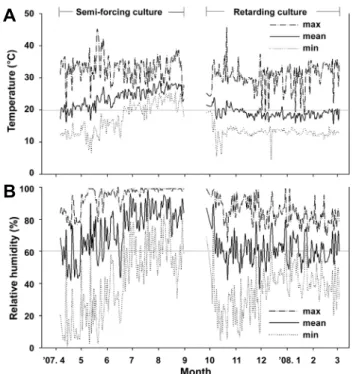
Fig. 1. Changes in daily maximum (max), mean, and minimum (min) temperature (A) and relative humidity (B) during the cultivation of peppers.
Irrigation and additional fertilizer application was carried out using the standard procedures for pepper cultivation (RDA, 2008a). Additional fertilizer (‘Hanbang’ for green pepper cultivation, N-P-K-Ca-Mg = 10.8-8-3-7-4-2 me・L
-1, Gunsan, Korea) was applied depending on the growth conditions through a drip irrigation system. Air temperature and relative humidity data in the greenhouse were collected at an interval of 30 minute with a data logger (TR-72U, T&D Co., Matsumoto, Japan). The greenhouses were heated by a warm air furnace system containing soil heating with electrothermal wire from April 6 to May 6 in semi-forcing culture, and from December 10 until the end of experiment in retarding culture, respectively.
The minimum temperature of the greenhouse was set to 15°C.
Full size green fruits were harvested weekly from June to August (Semi-forcing culture) and from December to March of the subsequent year (Retarding culture). All the fruits from each plant (fiveplants per each replicate) were harvested, counted and weighed. Fruits (ten fruits per each replicate) were selected and used for physical property test of fruit every month. Each fruit (five fruits per each replicate) was sliced into two (longitudinal) and the pericarp thickness at the center of the fruit was measured using a caliper gauge.
Textural property of the fruit was measured by using a texture analyzer (EZ Test-100N, Shimadzu Co., Kyoto, Japan) equipped with a 5 mm-diameter plunger. Compression force into the flesh at 7 mm depth was monitored at 2 mm・s
-1speed.
Statistical Analysis
The data were subjected to one-way, two-way, and three-way analyses of variance (ANOVA). Statistical computations were carried out using the Sigma Plot version 11 (Systat Software Inc., San Jose, CA, USA) and SAS version 9.1 (SAS Institute Inc., Cary, NC, USA) software.
Results
Temperature and Relative Humidity during Cultivation The average daily maximum, mean, and minimum tempera- tures were 33.0, 23.8, and 17.6°C during semi-forcing culture, and 30.4, 19.0, and 13.0°C during retarding culture, respectively (Fig. 1). In semi-forcing culture, the daily mean and minimum temperature went up steadily. The daily mean temperature from late May and the daily minimum temperature from late June rose above 20°C. In retarding culture, the temperatures hovered around average values. The average daily maximum, mean, and minimum relative humidity were 94.2, 73.6, and 41.0% during semi-forcing culture, and 83.7, 60.6, and 36.0%
during retarding culture, respectively. In semi-forcing culture, relative humidity went up steadily. The daily maximum relative
humidity reached 100% from late June until the end of experiment. In retarding culture, relative humidity fluctuated around average values.
Yield of Grafted Peppers
Total marketable yield was not significantly influenced by either auto-graft of ‘Nokkwang’, ‘Saengsaeng Matkkwari’, and ‘Shinhong’ of pepper or grafting with the five commercial rootsctocks (Fig. 2). Eventhough days to first harvests of the three cultivars in retarding culture were shorter than semi- forcing culture, the total yields of ‘Nokkwang’ and ‘Saengsaeng’
in retarding culture was less than semi-forcing culture. The average marketable yields of ‘Nokkwang’ were 1,706 g per plant in semi-forcing culture, and 1,036 g in retarding culture.
The average marketable yield of ‘Saengsaeng Matkkwari’
was 1,871 g per plant in semi-forcing culture, and 709 g in retarding culture. The average marketable yield of ‘Shinhong’
was 458 g per plant in semi-forcing culture, and 699 g in retarding culture.
Apparent Fruit Quality of Grafted Peppers
Even though the fruits of each scion cultivar had their own characteristic size and shape, these were influenced by grafting.
Fruit characteristics of grafted peppers differed depending on
the rootstock cultivars (Table 1). The scion cultivar (S) ×
rootstock (R) interaction was significant for fruit size and
weight. The scion cultivar (S) × harvest period (H) interaction
A B
C D
E F
Fig. 2. Cumulative yield of marketable fruits of grafted peppers ‘Nokkwang’ (A and B), ‘Saengsaeng’ (C and D), and ‘Shinhong’
(E and F) as influenced by different rootstocks in semi-forcing and retarding culture.
was significant, but rootstock (R) × harvest period (H) interac- tion was not significant for the apparent quality and textural property of grafted pepper.
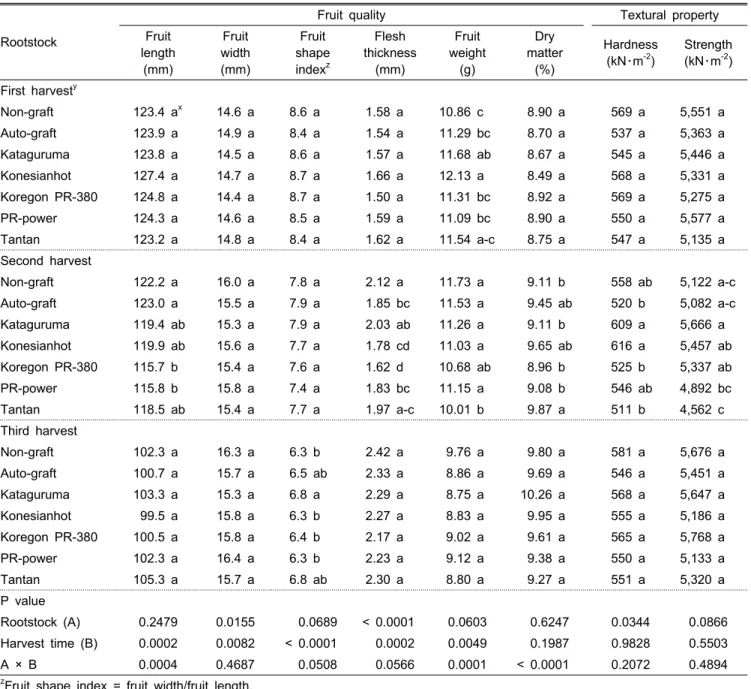
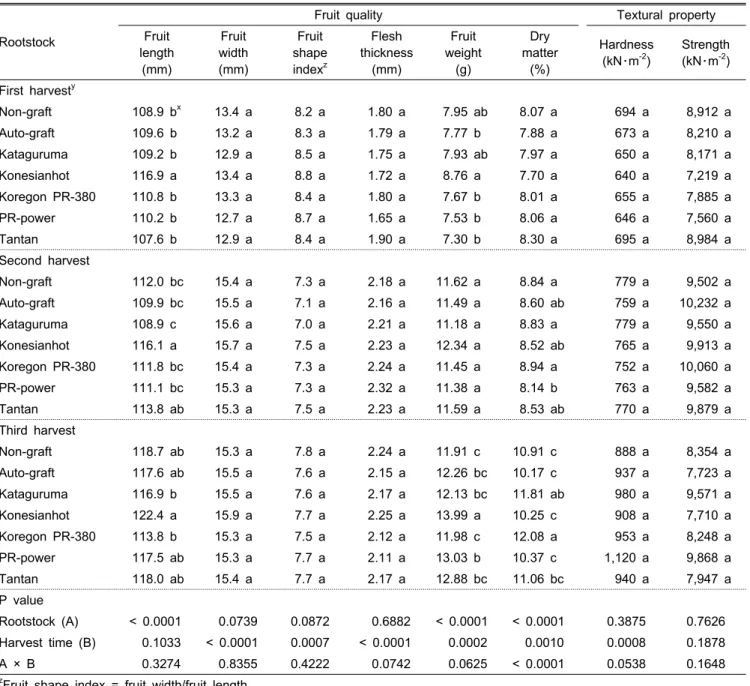
The average fruit length, fruit width, flesh thickness, fruit weight, and dry matter of ‘Nokkwang’ were 114.3, 15.0, and 1.99 mm, 10.58 g, and 9.23%, respectively (Table 1). In semi-forcing culture, fruit weight from the first and the second harvest differed depending on the rootstock cultivars, while fruit weight from the third harvest was not significantly influenced by grafting (Table 2). The fruit characteristics in each treatment also differed among harvest time (first, second, and third harvest). The fruit weight of pepper grafted onto ‘Konesianhot’ was the highest in the first harvest, but the fruit weight of non-grafted control plants was the highest in second harvest. The fruit length, flesh thickness, and fruit dry matter from the second harvest were significantly influenced
by grafting, while those from the first or the third harvest were not. The length, shape index and weight of fruits decreased but the width and flesh thickness increased at the later stage of cultivation. In retarding culture, fruit length, weight, and dry matter were also affected by grafting, and ranged from 108.9 to 122.4 mm, from 7.30 to 13.99 g, and from 7.70 to 12.08%, respectively, depending on rootstock genotypes and harvest time (Table 3). Fruit length and weight of pepper grafted onto ‘Konesianhot’ were found to be the highest. Fruit size, flesh thickness, fruit weight, and dry matter increased at the later stage of cultivation.
In ‘Saengsaeng Matkkwari’, the average fruit length, fruit
width, flesh thickness, fruit weight, and dry matter of were
88.3, 12.1, and 1.28 mm, 4.25 g, and 9.99%, respectively
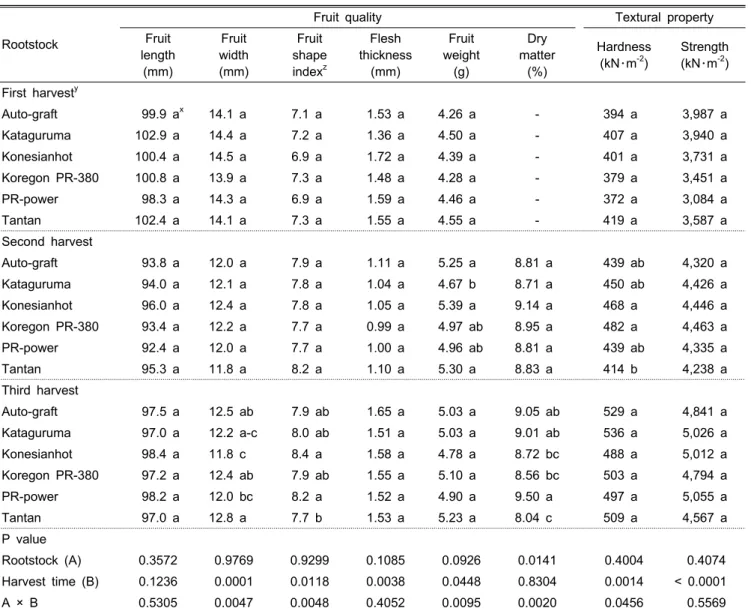
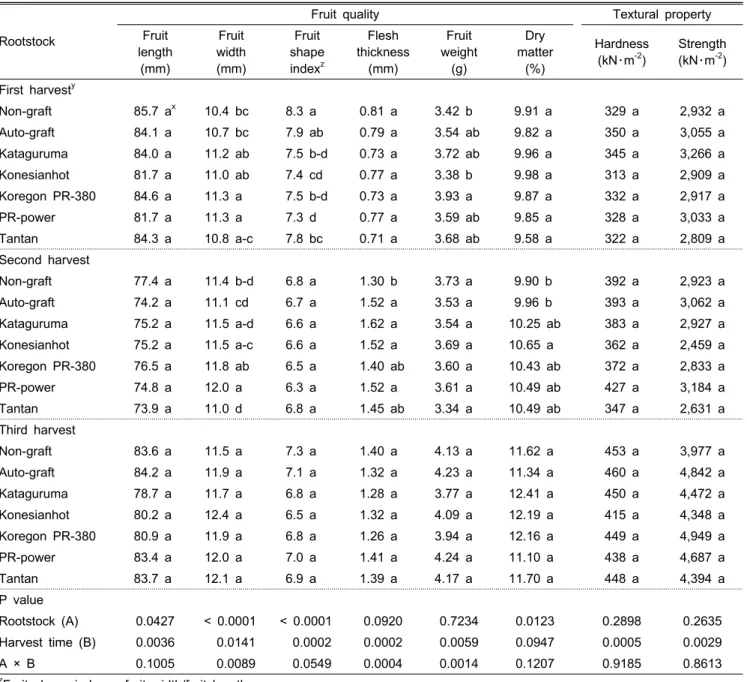
(Table 1). In semi-forcing culture, the weight and hardness
of fruit from the second harvest and fruit width and dry
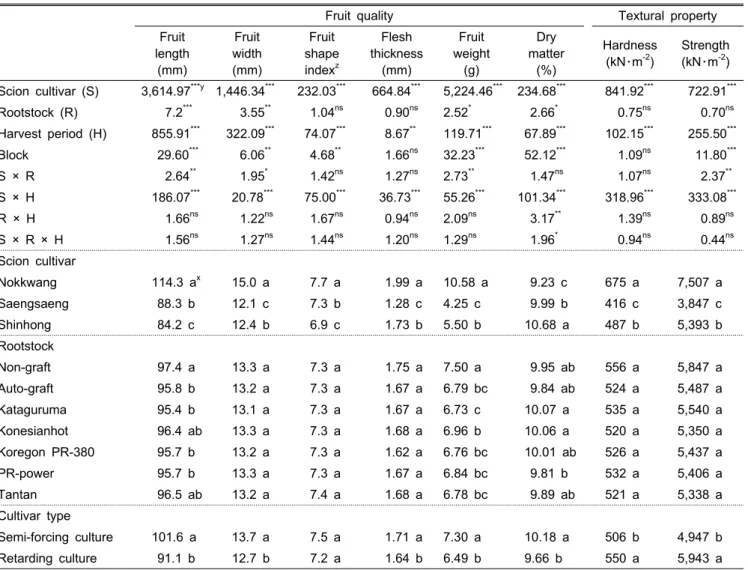
Table 1. ANOVA analysis of effects of scion cultivar,rootstock, and harvest period on the apparent quality and textural property of grafted pepper.
Fruit quality Textural property
Fruit length
(mm)
Fruit width (mm)
Fruit shape index
zFlesh thickness
(mm)
Fruit weight
(g)
Dry matter
(%)
Hardness (kN・m
-2)
Strength (kN・m
-2) Scion cultivar (S) 3,614.97
***y1,446.34
***232.03
***664.84
***5,224.46
***234.68
***841.92
***722.91
***Rootstock (R) 7.2
***3.55
**1.04
ns0.90
ns2.52
*2.66
*0.75
ns0.70
nsHarvest period (H) 855.91
***322.09
***74.07
***8.67
**119.71
***67.89
***102.15
***255.50
***Block 29.60
***6.06
**4.68
**1.66
ns32.23
***52.12
***1.09
ns11.80
***S × R 2.64
**1.95
*1.42
ns1.27
ns2.73
**1.47
ns1.07
ns2.37
**S × H 186.07
***20.78
***75.00
***36.73
***55.26
***101.34
***318.96
***333.08
***R × H 1.66
ns1.22
ns1.67
ns0.94
ns2.09
ns3.17
**1.39
ns0.89
nsS × R × H 1.56
ns1.27
ns1.44
ns1.20
ns1.29
ns1.96
*0.94
ns0.44
nsScion cultivar
Nokkwang 114.3 a
x15.0 a 7.7 a 1.99 a 10.58 a 9.23 c 675 a 7,507 a
Saengsaeng 88.3 b 12.1 c 7.3 b 1.28 c 4.25 c 9.99 b 416 c 3,847 c
Shinhong 84.2 c 12.4 b 6.9 c 1.73 b 5.50 b 10.68 a 487 b 5,393 b
Rootstock
Non-graft 97.4 a 13.3 a 7.3 a 1.75 a 7.50 a 9.95 ab 556 a 5,847 a
Auto-graft 95.8 b 13.2 a 7.3 a 1.67 a 6.79 bc 9.84 ab 524 a 5,487 a
Kataguruma 95.4 b 13.1 a 7.3 a 1.67 a 6.73 c 10.07 a 535 a 5,540 a
Konesianhot 96.4 ab 13.3 a 7.3 a 1.68 a 6.96 b 10.06 a 520 a 5,350 a
Koregon PR-380 95.7 b 13.2 a 7.3 a 1.62 a 6.76 bc 10.01 ab 526 a 5,437 a
PR-power 95.7 b 13.3 a 7.3 a 1.67 a 6.84 bc 9.81 b 532 a 5,406 a
Tantan 96.5 ab 13.2 a 7.4 a 1.68 a 6.78 bc 9.89 ab 521 a 5,338 a
Cultivar type
Semi-forcing culture 101.6 a 13.7 a 7.5 a 1.71 a 7.30 a 10.18 a 506 b 4,947 b
Retarding culture 91.1 b 12.7 b 7.2 a 1.64 b 6.49 b 9.66 b 550 a 5,943 a
z
Fruit shape index = fruit width/fruit length.
y
Data were analyzed by three-way variance (ANOVA).
*,**,***indicates F-test significance at the P ≤ 0.05, P ≤ 0.01, and P ≤ 0.001 level, respectively.
x
Means separation within each column by Duncan’s multiple range test (P ≤ 0.05).
matter from the third harvest differed depending on the rootstock cultivars, while fruit characteristics from the first harvest were not significantly influenced by grafting (Table 4). Fruit width, fruit shape index, flesh thickness, and weight were affected by harvest time. Fruit width decreased but fruit shape index and weight increased at the later stage of cultivation. Fruit size and weight in retarding culture were smaller than those in the semi-forcing culture. In retarding culture, the width, shape index, and weight of fruit from the first harvest and the fruit width, flesh thickness, and dry matter from the second harvest differed depending on the rootstock cultivars, while fruit characteristics from the third harvest were not significantly influenced by grafting (Table 5). Fruit width, flesh thickness, and fruit weight increased at the later stage of cultivation.
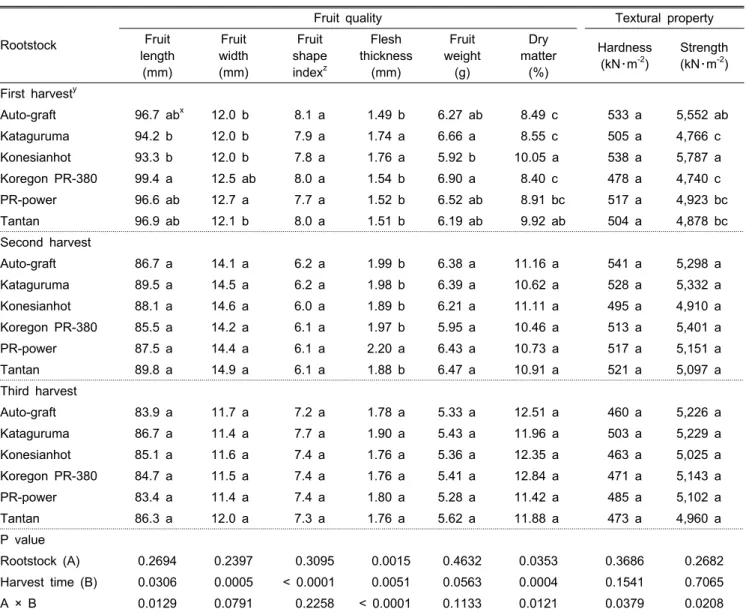
In ‘Shinhong’, the average fruit length, fruit width, flesh
thickness, fruit weight, and dry matter of were 84.2, 12.4, and 1.73 mm, 5.50 g, and 10.68%, respectively (Table 1).
Fruit size, weight and flesh thickness in retarding culture were smaller than those in semi-forcing culture. In semi-forcing culture, the fruit size, flesh thickness and dry matter from first harvest were affected by grafting, while fruit characteristics from the third harvest were not significantly influenced by grafting (Table 6). The length and weight of fruit grafted onto
‘Koregon PR-380’ were greatest in the first harvest. Fruit length and weight decreased at later stage of cultivation.
In retarding culture, the length and weight of fruit from the
second harvest and the fruit length from the third harvest
differed depending on the rootstock cultivars, while fruit
characteristics from the first harvest were not significantly
influenced by grafting (Table 7). The fruit length and weight
of pepper grafted onto ‘Koregon PR-380’ were highest in the
Table 2. Effects of different rootstocks on the apparent quality and textural property of ‘Nokkwang’ pepper fruits at different harvest time in the semi-forcing culture.
Rootstock
Fruit quality Textural property
Fruit length
(mm)
Fruit width (mm)
Fruit shape index
zFlesh thickness
(mm)
Fruit weight
(g)
Dry matter
(%)
Hardness (kN・m
-2)
Strength (kN・m
-2) First harvest
yNon-graft 123.4 a
x14.6 a 8.6 a 1.58 a 10.86 c 8.90 a 569 a 5,551 a
Auto-graft 123.9 a 14.9 a 8.4 a 1.54 a 11.29 bc 8.70 a 537 a 5,363 a
Kataguruma 123.8 a 14.5 a 8.6 a 1.57 a 11.68 ab 8.67 a 545 a 5,446 a
Konesianhot 127.4 a 14.7 a 8.7 a 1.66 a 12.13 a 8.49 a 568 a 5,331 a
Koregon PR-380 124.8 a 14.4 a 8.7 a 1.50 a 11.31 bc 8.92 a 569 a 5,275 a
PR-power 124.3 a 14.6 a 8.5 a 1.59 a 11.09 bc 8.90 a 550 a 5,577 a
Tantan 123.2 a 14.8 a 8.4 a 1.62 a 11.54 a-c 8.75 a 547 a 5,135 a
Second harvest
Non-graft 122.2 a 16.0 a 7.8 a 2.12 a 11.73 a 9.11 b 558 ab 5,122 a-c
Auto-graft 123.0 a 15.5 a 7.9 a 1.85 bc 11.53 a 9.45 ab 520 b 5,082 a-c
Kataguruma 119.4 ab 15.3 a 7.9 a 2.03 ab 11.26 a 9.11 b 609 a 5,666 a
Konesianhot 119.9 ab 15.6 a 7.7 a 1.78 cd 11.03 a 9.65 ab 616 a 5,457 ab
Koregon PR-380 115.7 b 15.4 a 7.6 a 1.62 d 10.68 ab 8.96 b 525 b 5,337 ab
PR-power 115.8 b 15.8 a 7.4 a 1.83 bc 11.15 a 9.08 b 546 ab 4,892 bc
Tantan 118.5 ab 15.4 a 7.7 a 1.97 a-c 10.01 b 9.87 a 511 b 4,562 c
Third harvest
Non-graft 102.3 a 16.3 a 6.3 b 2.42 a 9.76 a 9.80 a 581 a 5,676 a
Auto-graft 100.7 a 15.7 a 6.5 ab 2.33 a 8.86 a 9.69 a 546 a 5,451 a
Kataguruma 103.3 a 15.3 a 6.8 a 2.29 a 8.75 a 10.26 a 568 a 5,647 a
Konesianhot 99.5 a 15.8 a 6.3 b 2.27 a 8.83 a 9.95 a 555 a 5,186 a
Koregon PR-380 100.5 a 15.8 a 6.4 b 2.17 a 9.02 a 9.61 a 565 a 5,768 a
PR-power 102.3 a 16.4 a 6.3 b 2.23 a 9.12 a 9.38 a 550 a 5,133 a
Tantan 105.3 a 15.7 a 6.8 ab 2.30 a 8.80 a 9.27 a 551 a 5,320 a
P value
Rootstock (A) 0.2479 0.0155 0.0689 < 0.0001 0.0603 0.6247 0.0344 0.0866
Harvest time (B) 0.0002 0.0082 < 0.0001 0.0002 0.0049 0.1987 0.9828 0.5503
A × B 0.0004 0.4687 0.0508 0.0566 0.0001 < 0.0001 0.2072 0.4894
z
Fruit shape index = fruit width/fruit length.
y
In semi-forcing culture, first, second, and third harvest were done on June 21, July 19, and August 23, respectively.
x
Mean separation within columns for each harvest time by Duncan’s multiple range test (P ≤ 0.05).
second harvest, but the fruit length of pepper grafted onto
‘PR-power’ was the highest in the third harvest. Fruit size, flesh thickness, fruit weight, and dry matter increased at the later stage of cultivation.
Textural Property of Grafted Peppers
The average hardness and strength of ‘Nokkwang’, ‘Saengsaeng Matkkwari’, and ‘Shinhong’ were 675, 7,507, 416, 3,847, 487, and 5,353 kN・m
-2, respectively (Table 1). The hardness and strength of ‘Nokkwang’ in retarding culture were greater than those in semi-forcing culture (Tables 2 and 3). However,
the hardness and strength of ‘Saengsaeng Matkkwari’ in semi-forcing culture were greater than those in retarding culture (Tables 4 and 5). In semi-forcing culture of ‘Nokkwang’, the fruit hardness from second harvest was affected by grafting, and the greatest in peppers grafted onto ‘Konesianhot’. The hardness and strength of ‘Saengsaeng Matkkwari’ increased at the later stage of cultivation. In retarding culture, the hardness of ‘Nokkwang’ and the hardness and strength of
‘Shinhong’ also increased at the later stage of cultivation
(Tables 6 and 7).
Table 3. Effects of differentrootstocks on the apparent quality and textural property of ‘Nokkwang’ pepper fruits at different harvest time in retarding culture.
Rootstock
Fruit quality Textural property
Fruit length
(mm)
Fruit width (mm)
Fruit shape index
zFlesh thickness
(mm)
Fruit weight (g)
Dry matter
(%)
Hardness (kN・m
-2)
Strength (kN・m
-2) First harvest
yNon-graft 108.9 b
x13.4 a 8.2 a 1.80 a 7.95 ab 8.07 a 694 a 8,912 a
Auto-graft 109.6 b 13.2 a 8.3 a 1.79 a 7.77 b 7.88 a 673 a 8,210 a
Kataguruma 109.2 b 12.9 a 8.5 a 1.75 a 7.93 ab 7.97 a 650 a 8,171 a
Konesianhot 116.9 a 13.4 a 8.8 a 1.72 a 8.76 a 7.70 a 640 a 7,219 a
Koregon PR-380 110.8 b 13.3 a 8.4 a 1.80 a 7.67 b 8.01 a 655 a 7,885 a
PR-power 110.2 b 12.7 a 8.7 a 1.65 a 7.53 b 8.06 a 646 a 7,560 a
Tantan 107.6 b 12.9 a 8.4 a 1.90 a 7.30 b 8.30 a 695 a 8,984 a
Second harvest
Non-graft 112.0 bc 15.4 a 7.3 a 2.18 a 11.62 a 8.84 a 779 a 9,502 a
Auto-graft 109.9 bc 15.5 a 7.1 a 2.16 a 11.49 a 8.60 ab 759 a 10,232 a
Kataguruma 108.9 c 15.6 a 7.0 a 2.21 a 11.18 a 8.83 a 779 a 9,550 a
Konesianhot 116.1 a 15.7 a 7.5 a 2.23 a 12.34 a 8.52 ab 765 a 9,913 a
Koregon PR-380 111.8 bc 15.4 a 7.3 a 2.24 a 11.45 a 8.94 a 752 a 10,060 a
PR-power 111.1 bc 15.3 a 7.3 a 2.32 a 11.38 a 8.14 b 763 a 9,582 a
Tantan 113.8 ab 15.3 a 7.5 a 2.23 a 11.59 a 8.53 ab 770 a 9,879 a
Third harvest
Non-graft 118.7 ab 15.3 a 7.8 a 2.24 a 11.91 c 10.91 c 888 a 8,354 a
Auto-graft 117.6 ab 15.5 a 7.6 a 2.15 a 12.26 bc 10.17 c 937 a 7,723 a
Kataguruma 116.9 b 15.5 a 7.6 a 2.17 a 12.13 bc 11.81 ab 980 a 9,571 a
Konesianhot 122.4 a 15.9 a 7.7 a 2.25 a 13.99 a 10.25 c 908 a 7,710 a
Koregon PR-380 113.8 b 15.3 a 7.5 a 2.12 a 11.98 c 12.08 a 953 a 8,248 a
PR-power 117.5 ab 15.3 a 7.7 a 2.11 a 13.03 b 10.37 c 1,120 a 9,868 a
Tantan 118.0 ab 15.4 a 7.7 a 2.17 a 12.88 bc 11.06 bc 940 a 7,947 a
P value
Rootstock (A) < 0.0001 0.0739 0.0872 0.6882 < 0.0001 < 0.0001 0.3875 0.7626 Harvest time (B) 0.1033 < 0.0001 0.0007 < 0.0001 0.0002 0.0010 0.0008 0.1878
A × B 0.3274 0.8355 0.4222 0.0742 0.0625 < 0.0001 0.0538 0.1648
z
Fruit shape index = fruit width/fruit length.
y
Inretarding culture, first, second, and third harvest were done on December 5, January 9, and February 20, respectively.
x
Mean separation within columns for each harvest time by Duncan’s multiple range test (P ≤ 0.05).
Discussion
The fruit quality of vegetables including appearance, firmness, texture, flavor, and health-related compounds of the product is affected by cultivar genotype, environmental conditions (light, temperature, humidity, and atmospheric CO
2), and agricultural practices such as water management, fertilization strategies, growth and development regulators, pruning, growing systems, harvesting stage, and grafting (Rouphael et al., 2010). There are several conflicting reports on changes in fruit quality due to grafting and whether grafting effects are advantageous
or disadvantageous (Davis et al., 2008a, 2008b; Flores et al., 2010).
Positive effects of grafting are reported in tomato and watermelon, including the increase of fruit size, firmness, total soluble solids (TSS) content, and titratable acidity (Flores et al., 2010; Miguel et al., 2004). On the contrary, other reports showed abnormal fruit quality by grafting in eggplant, melon, and watermelon, including poor texture, reduction of contents of TSS and vitamin C and firmness (Arvanitoyannis et al., 2005; Lee and Oda, 2003; Traka-Mavrona et al., 2000).
There were also reports that demonstrated that grafting had
Table 4. Effects of different rootstocks on the apparent quality and textural property of ‘Saengsaeng’ pepper fruits at different harvest time in semi-forcing culture.
Rootstock
Fruit quality Textural property
Fruit length
(mm)
Fruit width (mm)
Fruit shape index
zFlesh thickness
(mm)
Fruit weight
(g)
Dry matter
(%)
Hardness (kN・m
-2)
Strength (kN・m
-2) First harvest
yAuto-graft 99.9 a
x14.1 a 7.1 a 1.53 a 4.26 a - 394 a 3,987 a
Kataguruma 102.9 a 14.4 a 7.2 a 1.36 a 4.50 a - 407 a 3,940 a
Konesianhot 100.4 a 14.5 a 6.9 a 1.72 a 4.39 a - 401 a 3,731 a
Koregon PR-380 100.8 a 13.9 a 7.3 a 1.48 a 4.28 a - 379 a 3,451 a
PR-power 98.3 a 14.3 a 6.9 a 1.59 a 4.46 a - 372 a 3,084 a
Tantan 102.4 a 14.1 a 7.3 a 1.55 a 4.55 a - 419 a 3,587 a
Second harvest
Auto-graft 93.8 a 12.0 a 7.9 a 1.11 a 5.25 a 8.81 a 439 ab 4,320 a
Kataguruma 94.0 a 12.1 a 7.8 a 1.04 a 4.67 b 8.71 a 450 ab 4,426 a
Konesianhot 96.0 a 12.4 a 7.8 a 1.05 a 5.39 a 9.14 a 468 a 4,446 a
Koregon PR-380 93.4 a 12.2 a 7.7 a 0.99 a 4.97 ab 8.95 a 482 a 4,463 a
PR-power 92.4 a 12.0 a 7.7 a 1.00 a 4.96 ab 8.81 a 439 ab 4,335 a
Tantan 95.3 a 11.8 a 8.2 a 1.10 a 5.30 a 8.83 a 414 b 4,238 a
Third harvest
Auto-graft 97.5 a 12.5 ab 7.9 ab 1.65 a 5.03 a 9.05 ab 529 a 4,841 a
Kataguruma 97.0 a 12.2 a-c 8.0 ab 1.51 a 5.03 a 9.01 ab 536 a 5,026 a
Konesianhot 98.4 a 11.8 c 8.4 a 1.58 a 4.78 a 8.72 bc 488 a 5,012 a
Koregon PR-380 97.2 a 12.4 ab 7.9 ab 1.55 a 5.10 a 8.56 bc 503 a 4,794 a
PR-power 98.2 a 12.0 bc 8.2 a 1.52 a 4.90 a 9.50 a 497 a 5,055 a
Tantan 97.0 a 12.8 a 7.7 b 1.53 a 5.23 a 8.04 c 509 a 4,567 a
P value
Rootstock (A) 0.3572 0.9769 0.9299 0.1085 0.0926 0.0141 0.4004 0.4074
Harvest time (B) 0.1236 0.0001 0.0118 0.0038 0.0448 0.8304 0.0014 < 0.0001
A × B 0.5305 0.0047 0.0048 0.4052 0.0095 0.0020 0.0456 0.5569
z
Fruit shape index = fruit width/fruit length.
y
In semi-forcing culture, first, second, and third harvest were done on June 12, July 10, and August 14, respectively.
x
Mean separation within columns for each harvest time by Duncan’s multiple range test (P ≤ 0.05).
no effect on fruit shape index, thickness of rind, texture, lycopene content or TSS in cucumber, tomato, and watermelon (Alan et al., 2007; Khah et al., 2006; Sakata et al., 2008).
In this study, the yield and fruit qualities of three pepper varieties grafted onto different rootstocks were investigated during two harvest periods (semi-forcing culture and retarding culture). Total marketable yield was not significantly influenced by either auto-grafting or grafting with the five commercial rootsctocks. In contrast, the fruit quality (fruit size, weight, flesh thickness) and textural property were influenced by grafting with different rootstocks (Tables 1, 2, 3, 4, 5, 6, and 7). However, fruit quality parameters were affected by grafting with different scion varieties, harvest periods, and harvest time. In the case of ‘Nokkwang’, fruit length, weight,
flesh thickness, and dry matter were affected by grafting, while those differed depending on harvest period and time.
In the case of ‘Saengsaeng Matkkwari’, the fruit width, weight, and dry matter in semi-forcing culture were affected by grafting, whereas fruit shape index and flesh thickness in addition to those were also influenced by grafting in retarding culture. In the case of ‘Shinhong’, fruit length, flesh thickness, weight, and dry matter in semi-forcing culture and fruit length and weight in retarding culture were affected by grafting.
Regarding the textural property, the hardness of ‘Nokkwang’
pepper fruit in the semi-forcing culture was affected by grafting.
Tsaballa et al. (2013) reported that grafting the round
shaped pepper (scion) on the long shaped pepper (rootstock)
Table 5. Effects of different rootstocks on the apparent quality and textural property of ‘Saengsaeng’ pepper fruits at different harvest time inretarding culture.
Rootstock
Fruit quality Textural property
Fruit length
(mm)
Fruit width (mm)
Fruit shape index
zFlesh thickness
(mm)
Fruit weight
(g)
Dry matter
(%)
Hardness (kN・m
-2)
Strength (kN・m
-2) First harvest
yNon-graft 85.7 a
x10.4 bc 8.3 a 0.81 a 3.42 b 9.91 a 329 a 2,932 a
Auto-graft 84.1 a 10.7 bc 7.9 ab 0.79 a 3.54 ab 9.82 a 350 a 3,055 a
Kataguruma 84.0 a 11.2 ab 7.5 b-d 0.73 a 3.72 ab 9.96 a 345 a 3,266 a
Konesianhot 81.7 a 11.0 ab 7.4 cd 0.77 a 3.38 b 9.98 a 313 a 2,909 a
Koregon PR-380 84.6 a 11.3 a 7.5 b-d 0.73 a 3.93 a 9.87 a 332 a 2,917 a
PR-power 81.7 a 11.3 a 7.3 d 0.77 a 3.59 ab 9.85 a 328 a 3,033 a
Tantan 84.3 a 10.8 a-c 7.8 bc 0.71 a 3.68 ab 9.58 a 322 a 2,809 a
Second harvest
Non-graft 77.4 a 11.4 b-d 6.8 a 1.30 b 3.73 a 9.90 b 392 a 2,923 a
Auto-graft 74.2 a 11.1 cd 6.7 a 1.52 a 3.53 a 9.96 b 393 a 3,062 a
Kataguruma 75.2 a 11.5 a-d 6.6 a 1.62 a 3.54 a 10.25 ab 383 a 2,927 a
Konesianhot 75.2 a 11.5 a-c 6.6 a 1.52 a 3.69 a 10.65 a 362 a 2,459 a
Koregon PR-380 76.5 a 11.8 ab 6.5 a 1.40 ab 3.60 a 10.43 ab 372 a 2,833 a
PR-power 74.8 a 12.0 a 6.3 a 1.52 a 3.61 a 10.49 ab 427 a 3,184 a
Tantan 73.9 a 11.0 d 6.8 a 1.45 ab 3.34 a 10.49 ab 347 a 2,631 a
Third harvest
Non-graft 83.6 a 11.5 a 7.3 a 1.40 a 4.13 a 11.62 a 453 a 3,977 a
Auto-graft 84.2 a 11.9 a 7.1 a 1.32 a 4.23 a 11.34 a 460 a 4,842 a
Kataguruma 78.7 a 11.7 a 6.8 a 1.28 a 3.77 a 12.41 a 450 a 4,472 a
Konesianhot 80.2 a 12.4 a 6.5 a 1.32 a 4.09 a 12.19 a 415 a 4,348 a
Koregon PR-380 80.9 a 11.9 a 6.8 a 1.26 a 3.94 a 12.16 a 449 a 4,949 a
PR-power 83.4 a 12.0 a 7.0 a 1.41 a 4.24 a 11.10 a 438 a 4,687 a
Tantan 83.7 a 12.1 a 6.9 a 1.39 a 4.17 a 11.70 a 448 a 4,394 a
P value
Rootstock (A) 0.0427 < 0.0001 < 0.0001 0.0920 0.7234 0.0123 0.2898 0.2635
Harvest time (B) 0.0036 0.0141 0.0002 0.0002 0.0059 0.0947 0.0005 0.0029
A × B 0.1005 0.0089 0.0549 0.0004 0.0014 0.1207 0.9185 0.8613
z
Fruit shape index = fruit width/fruit length.
y
In retarding culture, first, second, and third harvest were done on December 10, January 7, and February 18, respectively.
x
Mean separation within columns for each harvest time by Duncan’s multiple range test (P ≤ 0.05).
Fig. 3. Fruit shapes of different rootstock genotypes.
changed the fruit shape of the scion, giving rise to elongated
fruits different from the normal round shape fruit expected
in the scion. Among the rootstocks used in this experiment,
the fruit of ‘Konesianhot’ was slender with a pointed apex
and the fruit length was the longest (118.8 mm) (Table 8
and Fig. 3). The fruit of ‘Kataguruma’ was bell pepper
type with inverted-blunt and two-lobed apex. Its fruit was
shortest (80.0 mm), but widest (24.8 mm). The fruit length
of ‘Tantan’ (83.6 mm) was shorter than that of ‘Koregon
PR-380’ (95.6 mm). The highest fruit weight was recorded
in ‘Kataguruma’ and the lowest in ‘Konesianhot’. In the
Table 6. Effects of different rootstocks on the apparent quality and textural property of ‘Shinhong’ pepper fruits at different harvest time semi-forcing culture.
Rootstock
Fruit quality Textural property
Fruit length
(mm)
Fruit width (mm)
Fruit shape index
zFlesh thickness
(mm)
Fruit weight
(g)
Dry matter
(%)
Hardness (kN・m
-2)
Strength (kN・m
-2) First harvest
yAuto-graft 96.7 ab
x12.0 b 8.1 a 1.49 b 6.27 ab 8.49 c 533 a 5,552 ab
Kataguruma 94.2 b 12.0 b 7.9 a 1.74 a 6.66 a 8.55 c 505 a 4,766 c
Konesianhot 93.3 b 12.0 b 7.8 a 1.76 a 5.92 b 10.05 a 538 a 5,787 a
Koregon PR-380 99.4 a 12.5 ab 8.0 a 1.54 b 6.90 a 8.40 c 478 a 4,740 c
PR-power 96.6 ab 12.7 a 7.7 a 1.52 b 6.52 ab 8.91 bc 517 a 4,923 bc
Tantan 96.9 ab 12.1 b 8.0 a 1.51 b 6.19 ab 9.92 ab 504 a 4,878 bc
Second harvest
Auto-graft 86.7 a 14.1 a 6.2 a 1.99 b 6.38 a 11.16 a 541 a 5,298 a
Kataguruma 89.5 a 14.5 a 6.2 a 1.98 b 6.39 a 10.62 a 528 a 5,332 a
Konesianhot 88.1 a 14.6 a 6.0 a 1.89 b 6.21 a 11.11 a 495 a 4,910 a
Koregon PR-380 85.5 a 14.2 a 6.1 a 1.97 b 5.95 a 10.46 a 513 a 5,401 a
PR-power 87.5 a 14.4 a 6.1 a 2.20 a 6.43 a 10.73 a 517 a 5,151 a
Tantan 89.8 a 14.9 a 6.1 a 1.88 b 6.47 a 10.91 a 521 a 5,097 a
Third harvest
Auto-graft 83.9 a 11.7 a 7.2 a 1.78 a 5.33 a 12.51 a 460 a 5,226 a
Kataguruma 86.7 a 11.4 a 7.7 a 1.90 a 5.43 a 11.96 a 503 a 5,229 a
Konesianhot 85.1 a 11.6 a 7.4 a 1.76 a 5.36 a 12.35 a 463 a 5,025 a
Koregon PR-380 84.7 a 11.5 a 7.4 a 1.76 a 5.41 a 12.84 a 471 a 5,143 a
PR-power 83.4 a 11.4 a 7.4 a 1.80 a 5.28 a 11.42 a 485 a 5,102 a
Tantan 86.3 a 12.0 a 7.3 a 1.76 a 5.62 a 11.88 a 473 a 4,960 a
P value
Rootstock (A) 0.2694 0.2397 0.3095 0.0015 0.4632 0.0353 0.3686 0.2682
Harvest time (B) 0.0306 0.0005 < 0.0001 0.0051 0.0563 0.0004 0.1541 0.7065
A × B 0.0129 0.0791 0.2258 < 0.0001 0.1133 0.0121 0.0379 0.0208
z
Fruit shape index = fruit width/fruit length.
y
In semi-forcing culture, first, second, and third harvest were done on June 27, July 26, and August 8, respectively.
x
Mean separation within columns for each harvest time by Duncan’s multiple range test (P ≤ 0.05).
case of ‘Nokkwang’, however, the fruit length of grafted peppers had no difference among rootstocks or the fruits of non-graft and auto-graft were the longest in semi-forcing culture, though the fruit of grafted onto ‘Konesianhot’ was the longest (118.5 mm) in retarding culture. The fruit length of
‘Saengsaeng Matkkwari’ or ‘Shinhong’ grafted onto ‘Konesianhot’
was also shorter or similar than that of non-grafted pepper.
Accordingly, it is considered that grafting affects the fruit quality, but the fruit characteristics of rootstock do not affect the fruit characteristics of scion grafted onto that rootstock (Tables 2, 3, 4, 5, 6, 7, and Fig. 4).
There were reports that fruit length and weight of ‘Bugang’
and ‘Geumtap’ decreased for later harvest time (Cho et al., 2004). In this study, fruit quality of ‘Nokkwang’ in semi-force
culture was consistent with that report. However, in retarding culture, fruit length was not affected by harvest time and fruit weight increased for later harvest time (Tables 2 and 3). The fruit quality of ‘Saengsaeng Matkkwari’ and ‘Shinhong’
was also different according to harvest time and harvest
pattern (Tables 4, 5, 6, and 7). The differences in fruit quality
by grafting may be attributable partly to different production
environments (e.g. light intensity, air temperature, vapor pressure
deficit) and methods (e.g. soilless vs. soil culture, irrigation,
and fertilization), type of rootstock/scion combinations used,
rootstock/scion incompatibility, and harvest time (Davis et
al., 2008b; Lee et al., 2010; Rouphael et al., 2010; Zhao
et al., 2011). Exposure to high temperature often causes the
reduction of yield and quality of many crops including vegetables
Fig. 4. Fruits of peppers ‘Nokkwang’, ‘Saensaeng’, and ‘Shinhong’ grafted onto different rootstocks from third harvest of retarding culture.
Table 7. Effects of different rootstocks on the apparent quality and textural property of ‘Shinhong’ pepper fruits at different harvest time inretarding culture.
Rootstock
Fruit quality Textural property
Fruit length
(mm)
Fruit width (mm)
Fruit shape index
zFlesh thickness
(mm)
Fruit weight
(g)
Dry matter
(%)
Hardness (kN・m
-2)
Strength (kN・m
-2) First harvest
yNon-graft 72.5 a
x10.6 a 6.8 a 1.62 a 3.79 a 9.87 a 413 a 5,397 a
Auto-graft 73.8 a 11.1 a 6.7 a 1.57 a 3.90 a 10.02 a 416 a 5,305 a
Kataguruma 70.9 a 10.9 a 6.5 a 1.55 a 3.57 a 9.81 a 426 a 5,147 a
Konesianhot 72.2 a 10.8 a 6.7 a 1.54 a 3.69 a 9.81 a 413 a 5,319 a
Koregon PR-380 75.7 a 11.2 a 6.8 a 1.56 a 4.12 a 9.88 a 413 a 5,107 a
PR-power 75.1 a 11.2 a 6.7 a 1.55 a 4.10 a 10.06 a 436 a 5,225 a
Tantan 72.3 a 10.8 a 6.8 a 1.49 a 3.72 a 9.93 a 368 b 4,984 a
Second harvest
Non-graft 73.6 b 11.2 a 6.6 a 1.46 a 4.10 c 10.09 a 405 a 4,906 a
Auto-graft 76.5 a 11.5 a 6.7 a 1.54 a 4.39 a-c 9.91 a 421 a 4,942 a
Kataguruma 75.3 ab 11.6 a 6.5 a 1.41 a 4.26 bc 10.12 a 415 a 5,133 a
Konesianhot 73.9 b 11.5 a 6.5 a 1.55 a 4.35 a-c 10.01 a 412 a 5,290 a
Koregon PR-380 77.7 a 11.6 a 6.7 a 1.44 a 4.69 a 9.91 a 448 a 4,795 a
PR-power 77.6 a 11.3 a 6.9 a 1.43 a 4.54 ab 10.27 a 400 a 4,534 a
Tantan 77.5 a 11.6 a 6.7 a 1.57 a 4.57 ab 9.87 a 440 a 4,683 a
Third harvest
Non-graft 88.0 c 13.9 a 6.4 a 2.05 a 7.02 a 12.42 a 616 a 6,914 a
Auto-graft 88.8 a-c 13.9 a 6.4 a 1.99 a 6.84 a 11.79 a 558 a 6,419 a
Kataguruma 87.4 c 13.8 a 6.4 a 1.94 a 6.60 a 13.05 a 575 a 6,278 a
Konesianhot 87.9 c 13.8 a 6.4 a 1.88 a 6.91 a 12.42 a 574 a 6,413 a
Koregon PR-380 88.4 bc 13.8 a 6.4 a 2.09 a 6.58 a 12.42 a 633 a 6,898 a
PR-power 92.0 a 14.1 a 6.5 a 2.05 a 7.10 a 11.73 a 585 a 6,811 a
Tantan 91.5 ab 13.8 a 6.7 a 2.04 a 7.06 a 11.16 a 598 a 7,322 a
P value
Rootstock (A) < 0.0001 0.3549 0.1106 0.5794 0.0183 0.0040 0.2030 0.8916
Harvest time (B) < 0.0001 < 0.0001 0.1739 0.0020 < 0.0001 0.0031 0.0007 0.0008
A × B 0.4303 0.4964 0.8613 0.1511 0.0216 < 0.0001 0.0220 0.0454
z
Fruit shape index = fruit width/fruit length.
y
In retarding culture, first, second, and third harvest were done on December 11, January 8, and February 19, respectively.
x
Mean separation within columns for each harvest time by Duncan’s multiple range test (P ≤ 0.05).
Table 8. The apparent quality of different rootstock genotypes.
Rootstock Fruit length
(mm)
Fruit width (mm)
Fruit shape index
zFruit weight (g)
Kataguruma 80.0 c
y24.8 a 3.3 d 13.7 a
Konesianhot 118.8 a 8.3 d 14.5 a 5.0 e
Koregon PR-380 95.6 b 15.0 c 6.4 b 8.6 c
PR-power 88.0 bc 18.1 b 4.9 c 10.3 b
Tantan 83.6 c 14.5 c 5.8 bc 6.7 d
z
Fruit shape index = fruit width/fruit length.
y