51
Copyright © 2015 The Korean Society of Fisheries and Aquatic Science pISSN:0374-8111, eISSN:2287-8815
서 론
Enterococcus faecalis
는주로인간이나포유류등의장에서 서식하는통성혐기성Gram
양성세균의감염성세균으로치주 염(peri odontitis),
요로감염증(urinary tract infection),
상처감 염(wound infection),
농양(abscesses)
등을일으키고심할경 우 균혈증(bacteremia),
패혈증(sepsis)
까지 일으키는 병원성 세균이다(Kayaoglu and Ørstavik, 2004).
또한, E. faecalis
는carbohydrates, glycerol, lactate, malate, citrate, arginine, ag- matine
및keto-acids
등다양한에너지원을대사하고강알칼리
(pH 9.6)
및고염등의조건에서도생육이가능하고최적생육범위는
10℃
에서45℃
이나60℃
에서도30
분 정도생존이 가능하다고보고되고있다(Giraffa, 2002).
이러한이유때문 에염처리,
훈연처리,
살균처리등의과정을거친제품에서E.
faecalis
를포함하고있는Enterococcus spp.
의검출비율이높 은것으로보고되고있다.
예를들어소시지의일종인Salami
와Landjager
에서Enterococcus spp.
의세균이10
2에서10
5CFU/
g
로검출되고,
분리균들은온도, pH,
염및항생제에대한매우 높은저항성을나타낸다고보고되어있다(Giraffa, 2002).
또한, E. faecalis
는온혈동물뿐만아니라토양,
물,
식물및채소등 에서빈번히검출되며발효가진행되는우유,
육류등의비가 열식품과살균처리한가공식품에서도잔류할수있어음식물 을통한경구감염에의해식중독을일으키는식중독세균이기 도하다. E. faecalis
감염에의한식중독은4-5
시간의잠복기를 거친후복통,
설사,
구역질,
구토등의Staphylococcus aureus
감염에의한식중독과유사한증상을나타낸다(Giraffa, 2002).
최근보건위생에서심각한문제로대두되고있는것은항생 제내성
Enterococcus spp.
세균의증가로이들세균은amino-
항생제 내성 Enterococcus faecalis에 대한 감태(Ecklonia cava) 추출물의 항균 시너지 효과
김승용·김영목·김은정
1·이명숙
2*
부경대학교 식품공학과, 1LG전자, 2부경대학교 미생물학과
Synergistic Antibacterial Activity of Ecklonia cava Extract against Anti- biotic Resistant Enterococcus faecalis
Seung-Yong Kim, Young-Mog Kim, Eunjung Kim
1
and Myung-Suk Lee2
*Department of Food Science and Technology, Pukyong National University, Busan 608-737, Korea
1
LG Electronics, Changwon 642-714, Korea
2
Department of Microbiology, Pukyong National University, Busan 608-737, Korea
With continuing demand for the development of new, effective and safe therapies, an investigation was carried out to test the efficacy of an antibacterial agent derived from marine edible seaweed. The methanolic extract of Eck- lonia cava from marine edible seaweed evinced potential antibacterial activity against Enterococcus faecalis . Among five solvent-soluble fractions of E. cava methanolic extract, the ethyl acetate soluble extract (EtOAc) exhibited the strongest antibacterial activity, with a MIC value of 128 µg/mL against E. faecalis strains. Furthermore, a synergistic antibacterial effect between an antibiotic and the EtOAc fraction was assessed using fractional inhibitory concentra- tion (FIC) indices. A combination of ciprofloxacin and the EtOAc fraction resulted in a ∑FIC
minrange of 0.188 and
∑FIC
maxof 0.508 to 563, suggesting that the ciprofloxacin-EtOAc fraction of E. cava combination resulted in an antibacterial synergy effect against E. faecalis .
Key words: Antibacterial activity, Ecklonia cava , Enterococcus faecalis , Synergistic effect
This is an Open Access article distributed under the terms of the Creative Commons Attribution Non-Commercial Licens (http://creativecommons.org/licenses/by-nc/3.0/)which permits unrestricted non-commercial use, distribution, and reproduction in any medium, provided the original work is properly cited.
http://dx.doi.org/10.5657/KFAS.2015.0051 Kor J Fish Aquat Sci 48(1) 051-057, February 2015
Received 19 December 2014; Revised 12 January 2015; Accepted 13 January 2015
*Corresponding author: Tel: +82. 51. 629. 5615 Fax: +82. 51. 629. 5619
E-mail address: [email protected]
glycosides, penicillin, tetracycline, chloramphenicol, vanco-
mycin
등의항생제에높은수준의내성을나타내며또한두가지이상의항생제에대한내성을가지고있는다제내성균
(mul- tiple drug resistance bacteria)
도보고되고있다(Johnston and Jaykus, 2004; Hollenbeck and Rice, 2012).
특히,
문제가되 고있는것은methicillin-resistant S. aureus (MRSA)
의치료를 위해사용된vancomycin
에대한내성을획득한vancomycin resistant Enterococcus (VRE)
의출현으로이들내성균은병원 내감염등면역력이떨어진사람들에게치명적인결과를초래 할수있다.
실제로, 2001
년12
월,
호주서부의Royal Perth
병 원에서VRE
감염으로인한수주동안172
여건의VRE
감염 사고가발생하였다(Pearman et al., 2003).
이와같은항생제내성균의출현을억제하기위한방안으로 새로운항생제의개발이나몇가지항생제를병용하여사용하 는방법이있지만이는또다른내성균의출현을야기할수있기 때문에항생제내성균을해결하기위한새로운방안으로천연 물을이용한항생제내성균의제어에관한연구가진행되어지 고있다
(Eom et al., 2011; 2013a; 2013b; 2014).
지금까지연 구에서는천연물로부터생체에대한안정성이높고부작용이 적은생리활성물질또는의약품들이다수개발되어왔으나대 부분육상의식물체,
곰팡이와박테리아등의미생물및소수의 동물을대상으로이루어져왔으며,
그결과육상생물에서의천 연물탐색은한계에다다르게되었다(Eom et al., 2013a).
또한,
최근에는MRSA, Listeria monocytogenes
등의주요감염균 에대한천연물유래화합물과항생제조합에의한synergistic antibacterial effect
에대한보고가있으나E. faecalis
의경우이 에대한연구보고가많지않다(Eom et al, 2013a; Nshimiyu- mukiza et al., 2015).
이에본연구에서는갈조류,
녹조류,
홍조 류를포함한해조류추출물의주요식중독원인균인E. faecalis
에대한항균활성과항생제에대한내성을가지고있는
E. fae-
calis
균들에대한해조류추출물의첨가에의한기존항생제의항균력회복에대한연구를하였다
.
재료 및 방법
시료와 전처리
해조류는건조된상태의제품을시장에서구입하여물로충분 히세척하여탈염시킨후
60°C
에서건조시켰다.
본연구에사용 된해조류는감태(Ecklonia cava),
대황(Eisenia bicyclis),
고리 매(Scytosiphon lomentaria),
미역(Undaria pinnatifida),
곰피(Ecklonia stolonifera),
톳(Hitzikia fucales),
다시마(Laminaria japonica),
모자반(Sargassum fulvellum),
패(Ishige okamu- rae),
갈파래(Ulva lactuca),
구멍갈파래(Ulva perutsa),
잎파래(Enteromorpha linza),
청각(Codium fragile),
돌가사리(Chon- dracanthus tenellus)
및부채까막살(Carpopeltis prolifera)
등15
종이다.
건조된해조류는분쇄기(HMF-1000A; Hanil Elec-
tronics, Seoul, Korea)
를통해파우더상태로분쇄하였다.
각해 조류분말(500 g)
은70°C
에서3
시간동안3
회메탄올(MeOH;
10 L×3)
로 추출하였다.
메탄올 추출물은 진공회전농축기(Eyela Co., Tokyo, Japan)
로농축시키고,
농축된메탄올추 출물에10% MeOH (1.0 L)
를넣고차례로hexane (Hexane;
1.0 L×3), dichloromethane (DCM; 1.0 L×3). ethyl acetate (EtOAc; 1.0 L×3),
그리고n-butanol (BuOH; 1.0 L×3)
용 액으로분획하였다.
각각의분획물은진공상태인45°C
에서진 공회전농축기(Eyela Co., Tokyo, Japan)
를이용하여증발시켰 다.
본연구에서주재료로사용된감태는2013
년2
월제주앞바다에서채취된감태를구입하여
-80°C
에서냉동보관중인것을사용하였다
. 사용 균주 및 배지
본 연구에서는
KCTC
미생물자원센터(Korean Collection for Type Cultures, Daejeon, Korea)
에서분양받은표준균주E. faecalis KCTC 3206
와 경상대학병원(Gyeongsang Na- tional University Hospital, Jinju, Gyeongnam, Korea)
에서분 양받은7
종의분리균주(E. faecalis P107, P130, P227, P 684, P690, P1499
및P2088)
를 사용하였다.
종균 배양을위해서tryptic soy broth (TSB; Difco, Detroit, MI)
와nutrient broth (NB; Difco)
를사용하였으며disc diffusion assay
는Mueller Hinton agar (MHA; Difco)
를minimum inhibitory concentra- tion (MIC)
측정에는Mueller Hinton broth (MHB; Difco)
를 사용하였다.
항생제 감수성 테스트
E. faecalis
표준균주 및 분리균주의 항생제감수성실험은BBL™ Sensi-Disc™ Susceptibility Test Discs (Becton, Dick- inson and Company, Franklin Lakes, NJ)
를사용하여실시하 였다.
항균활성 측정
해조류추출물및항생제의항균활성은정성분석법으로
disc diffusion assay
에따라MHA
배지를가지고clear zone
의크기 로측정하였고,
정량분석은MHB
배지를가지고CLSI
의min- imum inhibitory concentration (MIC) assay
에따라측정하였 다(CLSI, 2008). E. faecalis
에대한항생제의MIC assay
에사 용된gentamicin
과ciprofloxacin
은Sigma-Aldrich
사(Sigma- Aldrich Co., St. Louis, MO)
에서구입하였다.
항균 시너지 효과(antibacterial synergy effect) 측 정
E. faecalis
에대한해조류추출물과항생제간의항균시너지효과는
fractional inhibitory concentration (FIC) assay (Hsieh
et al., 1993; Meletiadis et al., 2010)
를이용한checkerboard
방 법으로다음방정식에따라계산하였다.
∑FIC = FIC
A+ FIC
B= (C
A/MIC
A) + (C
B/MIC
B)
MIC
A와MIC
B는각각A
와B
의단독MIC
값이며, C
A와C
B는A
와B
를병용하였을때대상균주에대해가지게되는A
와B
의생육저해농도를의미한다.
두물질간의항균시너지효과는 최소∑FIC (∑FIC
min)
와최대∑FIC (∑FIC
max)
값을고려한FIC index
에의해평가한다(Choi et al. 2010).
두물질간의병용효 과를극대화시킬수있는값은∑FIC
min로나타내며,
이때의C
A 와C
B 농도는병용되었을때가장효과적으로생육을억제시키는농도를의미한다
. ∑FIC
max는시너지를나타내는가장높은∑FIC
값이며, ∑FIC
min와함께시너지효과의범위를나타낸다. FIC index <0.5
는synergistic, 0.5 - <1.0
은week synergy, >1.0 - <2.0
는indifferent
그리고>2.0
은antagonistic
으로평가한다. 통계분석
실험분석에서얻어진값은
SPSS 12.0 (SPSS Inc., Chicago, IL)
을이용하여통계분석하였고P<0.05
의유의수준에서평가 하였다.
결론 및 고찰
해조류 추출물의 E. facalis에 대한 항균활성
Disc diffusion assay
를이용하여E. faecalis
에대한15
종의해 조류MeOH
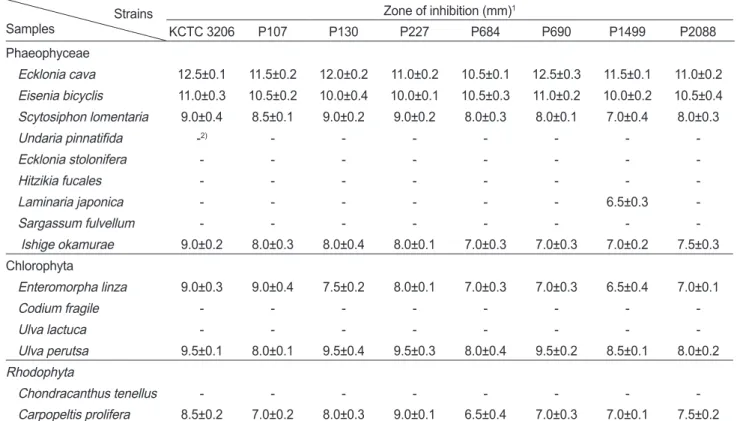
추출물의항균활성을검토하였다. Table 1
에나타 낸것처럼,
갈조류추출물이홍조류나녹조류추출물보다항균 활성이상대적으로좋았으며이는해조류추출물의식중독세 균및병원성세균에대한항균활성에대해연구한Eom et al.
(2011)
과Nshimiyumukiza et al. (2015)
의연구결과와도일치 하였다.
본연구에사용한15
종의해조류추출물중에서감태MeOH
추출물이E. faecalis KCTC 3206
와분리균주에대해 가장좋은항균활성을나타났다(Table 1). 5 mg
의감태추출물 이본연구에사용된8
종의E. faecalis
균주에대해10.5 mm- 12.5 mm
의clear zone
을형성하는것으로나타났으며,
이는감 태MeOH
추출물이다른해조류보다E. faecalis
에대한항균물 질을보다많이함유하고있다는것을의미한다.
E. faecalis
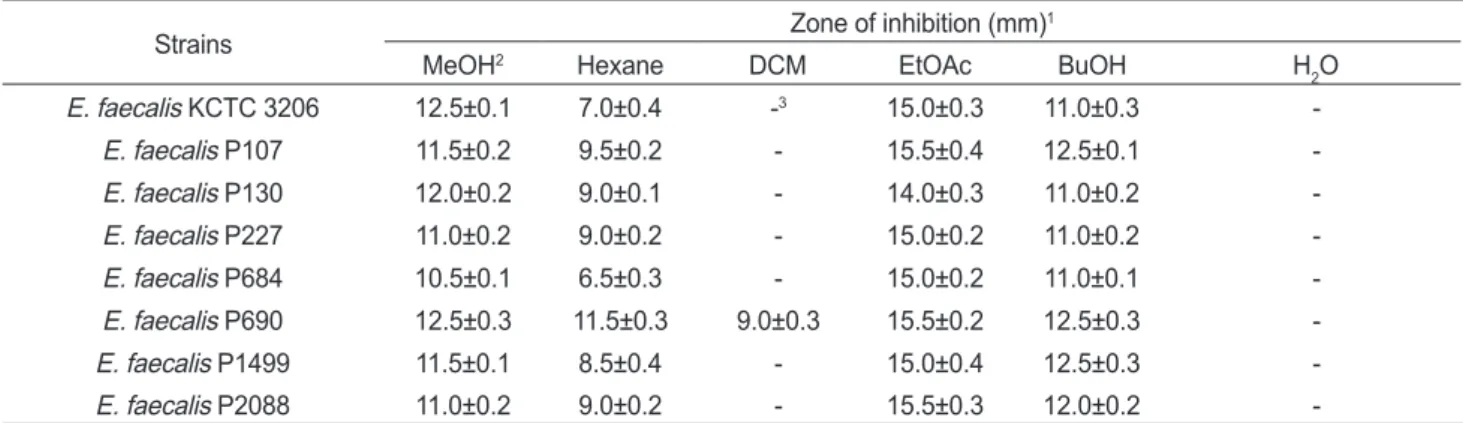
에대한감태추출물의항균활성에대한후속연구 를위해유기용매를이용하여분획을하였고,
여러분획추출 물중에서EtOAc
분획추출물이disc diffusion assay
에서E.
faecalis
에대해가장좋은항균활성을보였다(5 mg/disc: clear zone 14.0 mm-15.5 mm) (Table 2).
또한MIC assay
를이용한 감태추출물및분획물의항균활성에대한정량분석결과도Table 1. Disc diffusion assay of seaweed methanolic extracts against Enterococcus faecalis Strains
Samples Zone of inhibition (mm)1
KCTC 3206 P107 P130 P227 P684 P690 P1499 P2088
Phaeophyceae
Ecklonia cava 12.5±0.1 11.5±0.2 12.0±0.2 11.0±0.2 10.5±0.1 12.5±0.3 11.5±0.1 11.0±0.2 Eisenia bicyclis 11.0±0.3 10.5±0.2 10.0±0.4 10.0±0.1 10.5±0.3 11.0±0.2 10.0±0.2 10.5±0.4 Scytosiphon lomentaria 9.0±0.4 8.5±0.1 9.0±0.2 9.0±0.2 8.0±0.3 8.0±0.1 7.0±0.4 8.0±0.3
Undaria pinnatifida -2) - - - - - - -
Ecklonia stolonifera - - - - - - - -
Hitzikia fucales - - - - - - - -
Laminaria japonica - - - - - - 6.5±0.3 -
Sargassum fulvellum - - - - - - - -
Ishige okamurae 9.0±0.2 8.0±0.3 8.0±0.4 8.0±0.1 7.0±0.3 7.0±0.3 7.0±0.2 7.5±0.3 Chlorophyta
Enteromorpha linza 9.0±0.3 9.0±0.4 7.5±0.2 8.0±0.1 7.0±0.3 7.0±0.3 6.5±0.4 7.0±0.1
Codium fragile - - - - - - - -
Ulva lactuca - - - - - - - -
Ulva perutsa 9.5±0.1 8.0±0.1 9.5±0.4 9.5±0.3 8.0±0.4 9.5±0.2 8.5±0.1 8.0±0.2
Rhodophyta
Chondracanthus tenellus - - - - - - - -
Carpopeltis prolifera 8.5±0.2 7.0±0.2 8.0±0.3 9.0±0.1 6.5±0.4 7.0±0.3 7.0±0.1 7.5±0.2 The type bacterial strain used in this study was obtained from the Korean Collection for Type Cultures (KCTC) and clinical isolates were provided by the Gyeongsang National University Hospital. 1Seaweed methanolic extracts (5 mg/disc) were loaded onto a disc (6 mm in diameter). 2 –, no detected antibacterial activity.
disc diffusion assay
의결과와마찬가지로EtOAc
분획추출물 이모든E. faecalis
균주에대해128 µg/mL
로가장낮게나타 났다(Table 3).
이러한결과는감태의EtOAc soluble fraction
이병원성및식중독세균에대한항균활성이가장뛰어나다는 기존의연구결과들과일치하고있다(Choi et al., 2010; Eom et al., 2013b).
또한,
병원성세균및식중독세균에대한갈조류추출물의
EtOAc
분획추출물이가장강한항균활성을나타내고항균물질을가장많이함유하고있다는
Eom et al. (2011, 2013a)
와Lee et al. (2014)
의보고와도일치한다.
항생제에 대한 E. facalis 분리균주의 내성
Vancomycin
내성VRE
및vancomycin-resistant S. aureus (VRSA)
감염치료를위해사용되는항생제인linezolid
와tige-
cycline
이현재는효과적으로사용되고있다(Lee et al., 2013).
하지만
,
새로운항생제의개발에는많은난관이있으므로지속 적으로출현할것으로예상되는항생제내성균의출현을억제 하기위해alternative therapeutic method
로서항균활성을나 타내는천연물과항생제내성균에대한효력을잃어버린항 생제와의병용을통해잃어버린항생제의항균활성을회복하 는연구들이 진행되고있다
(Eom et al., 2013a, 2014; Lee et al., 2014; Nshimiyumukiza et al., 2015).
이에본연구에서도disc diffusion assay
와MIC assay
를통해E. faecalis
에대한강한항균효과를가지고감태의
EtOAC
분획추출물과항생제간의병용에의한
antibacterial synergy effect
에대한연구 를진행하였다.
이를위하여먼저E. faecalis
표준균주와7
종Table 2. Disc diffusion assay of the methanol extract and its solvent-soluble extracts from Ecklonia cava against Enterococcus faecalis
Strains Zone of inhibition (mm)1
MeOH2 Hexane DCM EtOAc BuOH H2O
E. faecalis KCTC 3206 12.5±0.1 7.0±0.4 -3 15.0±0.3 11.0±0.3 -
E. faecalis P107 11.5±0.2 9.5±0.2 - 15.5±0.4 12.5±0.1 -
E. faecalis P130 12.0±0.2 9.0±0.1 - 14.0±0.3 11.0±0.2 -
E. faecalis P227 11.0±0.2 9.0±0.2 - 15.0±0.2 11.0±0.2 -
E. faecalis P684 10.5±0.1 6.5±0.3 - 15.0±0.2 11.0±0.1 -
E. faecalis P690 12.5±0.3 11.5±0.3 9.0±0.3 15.5±0.2 12.5±0.3 -
E. faecalis P1499 11.5±0.1 8.5±0.4 - 15.0±0.4 12.5±0.3 -
E. faecalis P2088 11.0±0.2 9.0±0.2 - 15.5±0.3 12.0±0.2 -
The type bacterial strain used in this study was obtained from the Korean Collection for Type Cultures (KCTC) and clinical isolates were provided by the Gyeongsang National University Hospital. 1The methanolic extract and its solvent-soluble extracts from E. cava were loaded onto a disc (6 mm in diameter) at concentrations of 5 mg/disc. 2MeOH, methanolic extract; Hexane, n-hexane-soluble extract; DCM, dichloromethane-soluble extract; EtOAc, ethyl acetate-soluble extract; BuOH, n-butanol-soluble extract; H2O, water soluble extract. 3–, no detected antibacterial activity.
Table 3. Minimum inhibitory concentration of the methanol extract and its solvent-soluble extracts from Ecklonia cava against Enterococcus faecalis strains
Unit : μg/mL
Fraction
Strains MeOH1 Hexane DCM EtOAc BuOH H2O
E. faecalis KCTC 3206 512 1,024 >1,024 128 256 >1,024
E. faecalis P107 128 256 512 128 256 >1,024
E. faecalis P130 256 256 512 128 256 >1,024
E. faecalis P227 256 256 512 128 128 >1,024
E. faecalis P684 256 256 512 128 256 >1,024
E. faecalis P690 256 256 512 128 256 >1,024
E. faecalis P1499 256 256 512 128 256 >1,024
E. faecalis P2088 128 256 512 128 128 >1,024
The type bacterial strain used in this study was obtained from the Korean Collection for Type Cultures (KCTC) and clinical isolates were provided by the Gyeongsang National University Hospital. 1MeOH, methanolic extract; Hexane, n-hexane-soluble extract; DCM, dichloro- methane-soluble extract; EtOAc, ethyl acetate-soluble extract; BuOH, n-butanol-soluble extract; H2O, water-soluble extract.
의분리균주에대하여다양한항생제에대한항생제감수성을
disc diffusion assay
을통해분석하였다.
표준균주인E. faeca- lis KCTC 3206
와분리균주인E. faecalis P690
및P1499
을제 외한나머지분리균주에서ciprofloxacin
과gentamicin
에대한 생육저지환(clear zone)
이나타나지않았다(Table 4).
분리균주 인E. faecalis P1499
는ciprofloxacin
에서만clear zone
이나타 나지않았다.
이결과는5
종의분리균주의경우, ciprofloxacin
과gentamicin
에대한내성을가지고있는다제내성균(multiple drug resistance bacteria)
이라는것을의미한다(Johnston and Jaykus, 2004; Hollenbeck and Rice, 2012).
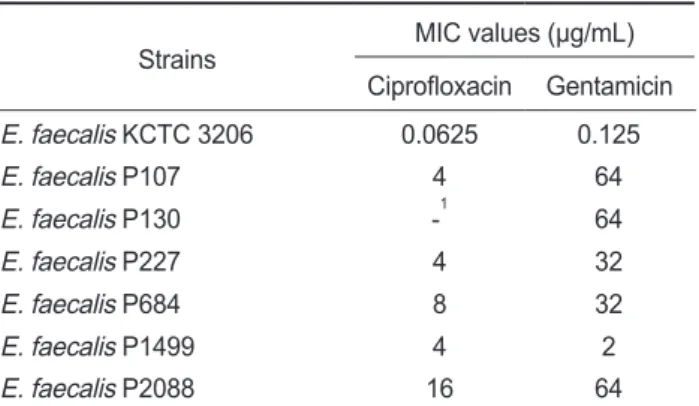
E. faecalis
균주들에대한두항생제의항균력을MIC assay
로정량분석하였다.
표준균주인KCTC 3206
균주는cipro- floxacin
과gentamicin
에대한MIC
값이각각0.0625 µg/mL
과0.125 µg/mL
로다른분리균주들의경우는두항생제에대하여4-64 µg/mL
로분석되었다(Table 5).
다섯분리균주들(P107, P227, P 684, P1499
및P2088)
의ciprofloxacin
에대한MIC
값 은항생제내성의기준값인MIC breakpoint value
인2 µg/mL
보다모두높은값을가지기때문에ciprofloxacin
에대한항생 제내성을획득했다고판단된다(Hällgren et al., 2011).
하지만, E. faecalis
균주들에대한gentamicin
의MIC
값은gentamicin
의MIC breakpoint value
인500-1,024 µg/mL
보다모두낮기 때문에본연구에서사용된분리균주들은gentamicine
감수성 균주인것으로분석되었다(Hällgren et al., 2011).
이에본연 구에서는ciprofloxacin
과감태EtOAC
분획추출물간의병용 에의한항생제항균활성의synergy
효과에대한연구를진행 하였다.
E. facalis에 대한 감태의 EtOAc 분획 추출물과 항생 제와의 시너지 효과
최근에항생제내성세균제어를위한효과적인방법중의하 나로천연물유래의항균활성물질과병용하여항생제의항균
활성을회복하는것에대한연구가활발히진행되고있다
(Eom
et al., 2013a, 2014; Lee et al., 2014; Nshimiyumukiza et al., 2015).
본연구에서는감태의EtOAc
분획추출물과의병용에 의한ciprofloxacin
의E. faecalis
에대한항균활성의synergy
효 과를FIC assay
로평가하였다. Table 6
에나타난것과같이감 태EtOAc
분획추출물(8 µg/mL)
을병용사용하였을때0.5 µg/
mL
의ciprofloxacin
첨가에E. faecalis
균주들의증식을억제할 수있었다.
결과적으로ciprofloxacin
을단독사용하였을때보 다8-32
배낮은농도로E. faecalis
균의생육을억제할수있는 것으로분석되었다(P107, P227
및P1499
균주의경우8
배; P684
균주의경우16
배; P2088
균주의경우32
배).
이러한결Table 5. Minimum inhibitory concentration (MIC) of antibiotics against Enterococcus faecalis strains
Strains MIC values (µg/mL)
Ciprofloxacin Gentamicin
E. faecalis KCTC 3206 0.0625 0.125
E. faecalis P107 4 64
E. faecalis P130 -1 64
E. faecalis P227 4 32
E. faecalis P684 8 32
E. faecalis P1499 4 2
E. faecalis P2088 16 64
The type bacterial strain used in this study was obtained from the Korean Collection for Type Cultures (KCTC) and clinical isolates were provided by the Gyeongsang National University Hospital.
1–, no determined.
Table 4. Antibiotic resistance against Enterococcus faecalis strains Antibiotics
Strains VA1 C TE LZD AMC CIP RA AM GM SYN
E.faecalis KCTC 3206 15±0.4 26±0.6 26±0.3 26±0.5 22±0.5 14±0.2 12±0.1 15±0.1 12±0.4 8±0.7 E. faecalis P107 18±0.2 26±0.7 10±0.5 34±0.3 24±0.3 AG2 10±0.4 24±0.6 AG 10±0.8 E. faecalis P130 18±0.3 AG 10±0.3 32±0.2 30±0.1 26±0.3 16±0.2 28±0.4 AG 14±0.3 E. faecalis P227 18±0.3 24±0.5 8±0.5 30±0.3 30±0.2 AG 18±0.1 26±0.4 AG 12±0.8 E. faecalis P684 18±0.7 22±0.4 10±0.3 26±0.3 29±0.2 AG 18±0.5 26±0.3 AG 10±0.6 E. faecalis P690 10±0.6 26±0.5 12±0.1 30±0.8 30±0.6 22±0.4 18±0.3 34±0.7 12±0.2 18±0.5 E. faecalis P1499 20±0.3 24±0.7 10±0.7 30±0.6 30±0.5 AG 18±0.3 22±0.2 16±0.1 10±0.5 E. faecalis P2088 16±0.1 20±0.2 8±0.4 30±0.6 30±0.2 AG 18±0.6 20±0.8 AG 10±0.3 The type bacterial strain used in this study was obtained from the Korean Collection for Type Cultures (KCTC) and clinical isolates were provided by the Gyeongsang National University Hospital.
1VA, 30 µg of vancomycin; C, 30 µg of chloramphenicol; TE, 30 µg of tetracycline; LZD, 30 µg of linezolid; AMC, 30 µg of amoxicillin/
clavulanic; CIP, 5 µg of ciprofloxacin; RA, 5 µg of rifampicin; AM, 10 µg of ampicillin; GM, 10 µg of gentamicin; SYN, 15 µg of quinu- pristin/dalfopristin. 2AG, all grow.
과를바탕으로
FIC value
를계산해본결과∑FIC
min, ∑FIC
max 및∑FIC
중간값이각각0.188, 0.508-0.563
및0.266-0.344
로 나타났다(Table 6). ∑FIC
min, ∑FIC
max및∑FIC
중간값이모두<1.0
의값을나타내었기때문에감태의EtOAc
분획추출물과ciprofloxacin
의병용사용은E. faecalis
균에대해week synergy
효과가나타나는 것으로나타났다(Lee et al., 2014).
이러한 결과는감태추출물과ampicillin
의병용사용이S. aureus
와Salmonella
속미생물에대한ampicillin
의항균활성을회복시 킨다는Choi et al. (2010)
의연구결과와도일치한다.
본연구결과는과거에많이검토되었던육상자원유래의생 리활성물질에관한연구의한계에서벗어나해양생물자원의생 리활성물질에대한검토로써의미가있으며항생제가아닌천 연물을통해주요식중독세균인
E. faecalis
의생육억제뿐만 아니라항생제내성을가지고있는multiple drug resistance E.
faecalis
에대한효과적인제어방법으로감태유래추출물을기존의항생제와병용사용함으로써항생제남용에따른항생제 내성균의출현억제뿐만아니라잠재적인치료제로도이용될 수있다는것을보여주었다
.
이러한결과는식품공정에서E.
faecalis
의감염의문제를해결하는데기여할수있을것이라생각되며추후정제과정등을거쳐생리활성물질에대해더심도 있는연구를진행하여다양한의약적측면에서의요구에부응 할수있을것이라고생각된다
.
사 사
이논문은부경대학교자율창의학술연구비
(2014
년)
에 의하 여연구되었음.
References
Choi JG, Kang OH, Brice OO, Lee YS, Chae HS, Oh YC, Sohn DH, Park H, Choi HG and Kim SG. 2010. Antibacterial ac- tivity of Ecklonia cava against methicillin-resistant Staphy-
lococcus aureus and Salmonella spp. Foodborne Pathog Dis
7, 435-441. http://dx.doi.org/10.1089/fpd.2009.0434.Clinical and Laboratory Standards Institute (CLSI). 2008. Ref- erence method for broth dilution antifungal susceptibility testing of yeasts: Approved Standard. 3rd ed. CLSI docu- ment M27-A3. CLIS, Wayne, PA, U.S.A.
Eom SH, Kang YM, Park JH, Yu DU, Jeong ET, Lee MS and Kim YM. 2011. Enhancement of polyphenol content and antioxidant activity of Eisenia bicyclis extract by microbial fermentation. Fish Aquat Sci 14, 192-197.
Eom SH, Kim DH, Lee SH, Yoon NY, Kim JH, Kim TH, Chung YH, Kim SB, Kim YM, Kim HW, Lee MS and Kim YM.
2013a. In vitro antibacterial activity and synergistic antibi- otic effects of phlorotannins isolated from Eisenia bicyclis against methicillin-resistant Staphylococcus aureus. Phyto- ther Res 27, 1260-1264. http://dx.doi.org/10.1002/ptr.4851.
Eom SH, Lee DS, Jung YJ, Park JH, Choi JI, Yim MJ, Jeon JM, Kim HW, Son KT, Je JY, Lee MS and Kim YM. 2014. The mechanism of antibacterial activity of phlorofucofuroeck- ol-A against methicillin-resistant Staphylococcus aureus.
Appl Microbiol Biotechnol 98, 9795-9804. http://dx.doi.
org/10.1007/s00253-014-6041-8.
Eom SH, Lim KS and Kim YM. 2013b. Potential of Candida utilis to ferment Ecklonia cava by-product for enhanced anti- methicillin-resistant Staphylococcus aureus (MRSA) activ- Table 6. Minimum inhibitory concentrations (MIC) and fractional inhibitory concentration (FIC) indices of the ethyl acetate (EtOAc) frac- tion of Ecklonia cava in combination with ciprofloxacin against Enterococcus faecalis
Strains Test compound MIC
(μg/mL) Median ∑FIC1 ∑FICmax2 ∑FICmin3 Minimum concentration for observing synergy
E. faecalis
P107 EtOAc 128
0.266 0.508 0.188 8
Ciprofloxacin 4 0.5
E. faecalis
P227 EtOAc 128
0.297 0.531 0.188 8
Ciprofloxacin 4 0.5
E. faecalis
P684 EtOAc 128
0.297 0.508 0.188 8
Ciprofloxacin 8 0.5
E. faecalis
P1499 EtOAc 128
0.344 0.563 0.188 8
Ciprofloxacin 4 0.5
E. faecalis
P2088 EtOAc 128
0.297 0.563 0.188 8
Ciprofloxacin 16 0.5
The type bacterial strain used in this study was obtained from the Korean Collection for Type Cultures KCTC) and clinical isolates were pro- vided by the Gyeongsang National University Hospital. The FIC index indicated synergistic; <0.5, addictive; 0.5 to <1.0, indifferent; >1.0 to
<2.0, antagonistic; >2.0. ∑FIC was calculated for each well with the equation: ∑FIC = FIC
A + FIC
B = (C
A/MIC
A) + (C
B/MIC
B), where MIC and MIC A
B are the MICs of drugs A and B alone, respectively, and C
A and C
B are the concentrations of the drugs in combination, respectively.
1∑FIC, the sum of FICs; 2 ∑FIC
min, the minimum ∑FIC; 3 ∑FIC
max, and the maximum ∑FIC.
ity. J Appl Phycol 25, 1949-1956. http://dx.doi.org/10.1007/
s10811-013-0034-3.
Giraffa G. 2002. Enterococci from foods. FEMS Microbiol Rev 26, 163-171.
Hällgren A, Abednazari H, Ekdahl C, Hanberger H, Nilsson M, Samuelsson A, Svensson E, Nilsson LE and Swedish ICU Study Group. 2001. Antimicrobial susceptibility patterns of enterococci in intensive care units in Sweden evaluated by different MIC breakpoint systems. J Antimicrob Chemother 48, 53-62.
Hollenbeck BL and Rice LB. 2012. Intrinsic and acquired resis- tance mechanisms in enterococcus. Virulence 15, 421-433.
http://dx/doi/org/10.4161/viru.21282.
Hsieh MH, Yu CM, Yu VL and Chow JW. 1993. Synergy as- sessed by checkerboard. A critical analysis. Diagn Microbiol Infect Dis 16, 343-349.
Johnston LM and Jaykus LA. 2004. Antimicrobial resistance of Enterococcus species isolated from produce. Appl En- viron Microbiol 70, 3133-3137. http://dx.doi.org/10.1128/
AEM.70.5.3133-3137.2004.
Kayaoglu G and Ørstavik D. 2004. Virulence factors of Entero-
coccus faecalis: relationship to endodontic disease. Crit Rev
Oral Biol Med 15, 308-320.Lee JH, Eom Sh, Lee EH, Jung YJ, Kim HJ, Jo MR, Son KT, Lee HJ, Kim JH, Lee MS and Kim YM. 2014. In vitro antibac- terial and synergistic effect of phlorotannins isolated from edible brown seaweed Eisenia bicyclis against acne-related bacteria. Algae 29, 47-55. http://dx.doi.org/10.1186/1471- 2334-13-163.
Lee SC, Wu MS, Shih HJ, Huang SH, Chiou MJ, See LC and Siu LK. 2013. Identification of vancomycin-resistant en- terococci clones and inter-hospital spread during an out- break in Taiwan. BMC Infect Dis 13,163. http://dx.doi.
org/10.1186/1471-2334-13-163.
Meletiadis J, Pournaras S, Roilides E and Walsh TJ. 2010. De- fining fractional inhibitory concentration index cutoffs for additive interactions based on self-drug additive combina- tions, Monte Carlo simulation analysis, and in vitro-in vivo correlation data for antifungal drug combinations against
Aspergillus fumigatus. Antimicrob Agents Chemother 54,
602-609. http://dx.doi.org/10.1128/AAC.00999-09.Nshimiyumukiza O, Kang SK, Kim HJ, Eun-Hye Lee EH, Han HN, Kim Y, Kim DH, Kim JH, Eom SH and Kim YM.
2015. Synergistic antibacterial activity of Ecklonia cava against Listeria monocytogenes. Fish Aquat Sci, In Press.
Pearman JW, Perry PL, Kosaras FP, Douglas CR, Lee RC, Pe- terson AM, Orrell CT, Khinsoe CH, Heath CH and Chris- tiansen KJ. 2003. Screening and electronic labeling of ward contacts of vancomycin-resistant Enterococcus faecium