1. Introduction
Following the conclusion of the Kyoto Protocol in
1997 and the establishment of the Paris Agreement in 2015, the world is accelerating toward a low-carbon society facing climate change. As
*Corresponding Author : Yim, Ki Heung([email protected]) Received April 1, 2019 Revised April 30, 2019 Accepted May 20, 2019 Published May 28, 2019
A Study on the Influence of Consumer Characteristics on Purchasing Behavior of Eco-Friendly Vehicles in Service
Management
Yim, Ki Heung * , Park, Chun Gyu
Dept. of Service Management, Kwangju Women's University, professor
서비스 경영에 있어서 친환경 자동차 구매 행동에 미치는 소비자 특성의 영향에 관한 연구
임기흥 * , 박천규
광주여자대학교 서비스경영학과, 교수
Abstract The market participation and development of major manufacturers of next-generation green vehicles is accelerating in recent years. The results of this study are as follows: Consumer type (personal value pursuit type, price value pursuit type) was significant difference between consumer. The results of this study were as follows: First, there was no significant difference in the characteristics of consumers (gender, age, monthly average income) and purchase intention according to age, gender and monthly average income, Image has a positive (+) impact on eco-friendly vehicles. This suggests that the development and market participation of next - generation green vehicles is accelerating and consumers 'interest is increasing, and the characteristics of environment - friendly vehicles and the government' s policy support are important factors.
Key Words : Next-generation eco-friendly vehicles, government support policy, consumer purchase behavior, consumer type, consumer characteristic
요 약 최근 몇 년 동안 차세대 친환경 자동차의 주요 제조업체의 개발 및 시장 참여가 가속화되고 있으며. 소비자 관심도 증가했다. 본 연구는 차세대 친환경 자동차의 소비자 특성, 소비 유형, 정부 정책 등에 중점을 두어 연구하였다.
본 연구의 결과로 소비자 유형 (가격 가치 추구 유형, 개인 가치 추구 유형, 소비자 사이의 유의 한 차이는 없음)과 소비자의 특성 (성별, 연령, 월평균 소득)와 구매 의도는 연령, 성별, 월평균 소득에 따라 유의 한 차이가 없었으나 소비 자의 유형에 따라 구매 의도가 유의미한 차이를 보였으며 디자인브랜드, 색상, 이미지는 친환경 자동차에 긍정적 (+)의 영향을 미치는 것으로 나타났다. 이는 최근 차세대 친환경 자동차의 개발 및 시장 참여가 가속화되고 소비자의 관심이 증대되고 있음을 시사하며, 친환경 차량의 특성 및 정부의 정책적 지원이 중요한 요소임을 알 수 있다.
주제어 : 차세대 친환경 자동차, 정부 지원 정책, 소비자 구매 행동, 소비자 유형, 소비자 특성
climate change, air pollution and instability of fossil fuel supply have emerged as global issues, the paradigm of the global automobile market has started to be transformed into a 'next generation green car' in which the emission of carbon dioxide is significantly reduced or does not emerge from internal combustion engines.
Major automobile companies in the world are actively developing automobile technology based on de-internal combustion engines such as electricity and hydrogen energy in the existing high-emission low-emission vehicles.
These next-generation eco-friendly vehicles are believed to lead the future automobile market, but they still face a lot of challenges in expanding their supply, such as higher prices and less infrastructure than existing internal combustion engine vehicles. Under these circumstances, consumers are not yet fully informed about when and how they would like to buy next-generation green vehicles. This study is a web survey on how purchasing behaviors change according to the price, performance, related infrastructure, and policy conditions of the next generation eco-friendly vehicles to consumers in Seoul, Based on the following. The results of this study are intended to provide implications for academic and related industries and policies on the future direction of domestic next - generation eco - friendly vehicles.
2. Theoretical Background and Research Model
2.1 Status of eco-friendly vehicles both at home and abroad
In this study, eco-friendly vehicles were defined as vehicles that were introduced to the market as vehicles that would be the ultimate direction of future vehicles as pollution-free vehicles, such as hydrogen-fueled vehicles in Table 1 [1].
Kinds Characteristic
Hybrid Vehicles (HEV) Mix motor and engine Plug-in Hybrid
Vehicles(PHEV)
Charged via plug and used by mixing engine and electric motor Electric Vehicles (EV) Powered only by an electric motor and
need periodic electrical charging Hydrogen Fuel Cell
Vehicles (FCEV)
Only driven by electric motor and need to charge hydrogen fuel Table 1. Types of echo-friendly Vehicles on currently
the market
Hybrid vehicles (HEV) account for the majority of eco-friendly vehicles in the world. Japan and the United States account for 75% and 23%, respectively, of total supply in the third quarter of 2016, Has been gradually declining since 2011.
Plug-in hybrid vehicles (PHEVs) accounted for 7.3% of FCEV in 2016 (1.4% in 2011), with 241 million in the US, 14.3 million in China, and 7.6 million in the Netherlands , And 5.7 million in Japan. In Korea, despite the government's aggressive eco-friendly vehicle policy, eco-friendly car sales have not been performing well yet. The government set the number of eco-friendly vehicles to 292,000 as of 2015. However, as of November, 2013, about 230,000 vehicles were supplied due to problems such as the distance traveled by electric vehicles (EV) and charging time. The government has set a target of 1.5 million eco-friendly vehicles by 2020, but it is not expected to be as easy as it is today [2].
2.2 Consumer type
Consumer types Karen Horney, a scholar of the American psychoanalyst of the American-born, distinguished three types of consumers according to their interpersonal styles: adaptive, offensive, and alienated [3]
Consumers can be categorized according to the
economic value. Dr. Robert Settle categorized
consumers in the"why they buy"of his best-seller
consumer into six types according to value
criteria ,as shown in Table2 [4]
Economic consumer
Pragmatist types that are useful and interested in what is possible eagle places great emphasis on
materiality and wealth accumulation
Intelligent consumer
Interested in truth and knowledge , and a type of rational and critical thinkingI like to compare and contrast and use both the words analysis and
integration when making judgments
Social consumer
Motivated by altruistic love and disliked by competition They are characterized by sympathy, kindness,
empathy for others
Aesthetic consumer
A type that focuses on harmonizing your own perceptions and experiences
We are interested in the balance and form of objects in the environment
Political consumer
Power-oriented type, trying to persuade others to accept their opinions or opinions material abundance
and wealth are emphasized in that they symbolize identity
Spiritual consumer
Interested in religious philosophical aspects I am more interested in the origin of life than material because I
value the spiritual aspects and supernatural Table 2. Consumer types analyzed by Robert Settle.
2.3 Eco-Friendly Product Properties
The characteristics of environment friendly vehicles products are as follows.
Aaker(1992) uses the brand image as the main image of the brand image, mainly the user and consumer,reputation,personality,intangibility,prod uct attribute, relative price ,consumer convenience, use and operation product type, competitor, lifestyle, personality[5]. And Gerald Häubl (1996) investigated the effect of country of brand name and origin on new vehicle evaluation. In his research, three items were used to evaluate the image of a car: passenger safety, reliability, completeness, and quality, and three items such as attractiveness, visibility, and smoothness of the car were used for appearance evaluation.
The characteristics were evaluated on 6 points scale of 3 items such as car navigation, excellent, pleasure, and benevolence [6].
Keller(1993) explained that brand image is reflected in various aspects of brand image depending on the reflection and strength of image in consumer memory ,type of association, likelihood of association, and uniqueness of image[7]. Kotler(2009) defines images as a collection of ideas, beliefs, and impressions that humans have about specific objects[8].
2.4 Intention of purchasing environment-friendly vehicles
In a previous study on the purchase intention of eco-friendly vehicles, Clark (1990) found that the country's culture, economy, nationality, and politics had a great influence on the purchase intention of foreign products [9]. Ozaki et al.
(2010) found that consumers' motives for buying eco-friendly vehicles have a significant effect on the motivation of purchasing eco-friendly vehicles [10].
2.5 Support Policy of Environment-friendly vehicles Government Support Policy of Environment-friendly Automobile Government
Beresteanu (2009) analyzed the impact of gasoline prices and government support policies on the purchase of hybrid vehicles in 22 large cities in the United States. Research shows that gasoline prices and government subsidies steadily increased from 1999 to 2006, affecting 14% -17%
of hybrid car purchases and 27% -32% of hybrid car purchases [11].
Diamond(2009) investigated the effect of government policies and gasoline prices on hybrid car purchases using monthly US Hybrid car registration data .According to the results of the research, the purchase of hybrid vehicles is very related to the price of gasoline, but the support policy of the government has are latively low correlation. Especially, the support policy to provide advance payment has a great effect[12].
Tsuyoshi (2010) used the Cournot oligopoly
model to give the government grants and benefits
for purchasing eco-friendly products. Studies
have shown that governments have improved the
quality of the environment. The government's
best policies affect the marginal social value of
environmental pollution, and if the marginal social
value of environmental pollution is greater than any
value, the subsidy policy based on the consumer's
environment will be one of the most desirable
policies [13].
2.6 Research Model and Research hypothesis 2.6.1 Research Model
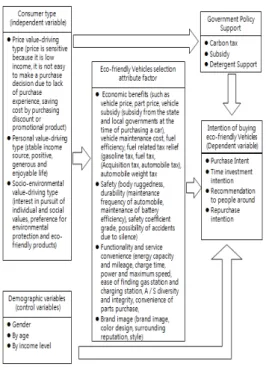
The purpose of this study is to investigate the characteristics of consumers, the characteristics of next - generation eco - friendly vehicles, and the effects of policy measures on next generation eco - friendly vehicles. The research model based on existing literature studies is shown in Fig. 1
Fig. 1. Research Model
Based on the review of the existing literature, the research model shows that there are three types of consumer types in terms of value consumption trends. Consumer types are diversified by type, social issues and the environment. They are interested in social environment values that pursue the benefits and shared values of society as a whole through consumption and participation. They are devoted to products that value their individual values, And to pursue personal value that does not spare investment. The attributes of eco - friendly vehicles selection factor are classified into economics, safety, functionality, service convenience, and
brand image. The dependent variable is the purchase intention of eco - friendly vehicles, intention of time investment, recommendation intention to neighboring friend, repurchase, respectively.
2.6.2 Research hypothesis
In this study, we set up the following hypotheses considering the characteristics of consumers, the characteristics of environment - friendly vehicles, and the policy support of the government through consumer researches.
Hypothesis1(H1): Consumer characteristics (by income, gender, ,age) will affect consumer buying behavior so eco-friendly vehicles Hypothesis1-1:Consumer type (socio-environmental value pursuit type ,individual value pursuit type, price value pursuit type )will affect eco-friendly vehicles consumer buying behavior
Hypothesis2(H2):The characteristics of the eco-friendly vehicles(image, functionality, stability, service convenience, economy) will have a positive effect on eco-friendly vehicles
Hypothesis3(H3):The government's policy support for eco-friendly vehicles will have a positive effectt on eco-friendly vehicles purchase behavior
2.6.3 Operational definition of measurement items (1) consumer type
Rober B. Settle(2014) argues that consumers are classified as economical, intellectual, social, aesthetic, political, and spiritual consumers according to value standards[14].
Based on this study, this study examines the effects of consumers' characteristics(by sex, age, income) and consumer types(price value seeking type, individual value seeking type, and social environment value seeking type)The results are summarized as follows.
(2) Characteristics of environment-friendly vehicles
JeongKi-Ho(1991) and Jang Won-Geun(1997)
measured the automobile evaluation factors
interms of service economic efficiency, comfort, external style, performance and stability[15-16].
Based on the previous research, the characteristics of eco-friendly vehicles(economic efficiency,s tability, functionality ,serviceconv enience ,image)
(3) Government policy support
Diamond(2009) etal. studied the effects of government policies and gasoline prices on the purchase of hybrid vehicles[12].
Based on the previous research ,the government's policy support by consumer type has a total of 5 questions about how it affects eco-friendly vehicles buying behavior.
(4) intention of purchase
The purchase intention of the eco-friendly vehicles used in previous research such as Clark(1990 )and Ozaki(2010) was measured using five items[9-10].
3. Empirical Analysis
3.1 General characteristics of the sample
This study conducted an online web survey.
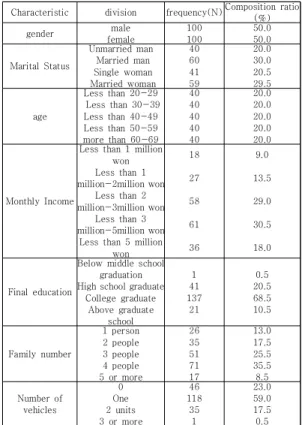
Although online web surveys are widely regarded as an alternative method to interview surveys and telephone surveys, they prefer to use self-enrollment methods without an interviewer. Researchers have been able to block inadequate respondents through questionnaire response time [17]. Respondents who responded unfairly to the online penal showed that it is alive. We investigated more samples than the actual number of samples and excluded the groups whose response time was too short in Table 3 shows the frequency characteristics of the respondents who were included in the analysis, and the frequency characteristics of the sample were as follows. For this study, 200 valid questionnaires were collected and analyzed.
Characteristic division frequency(N) Composition ratio (%)
gender male
female
100 100
50.0 50.0
Marital Status
Unmarried man Married man Single woman Married woman
40 60 41 59
20.0 30.0 20.5 29.5
age
Less than 20-29 Less than 30-39 Less than 40-49 Less than 50-59 more than 60-69
40 40 40 40 40
20.0 20.0 20.0 20.0 20.0
Monthly Income
Less than 1 million won Less than 1 million-2million won
Less than 2 million-3million won
Less than 3 million-5million won
Less than 5 million won
18 27 58 61 36
9.0 13.5 29.0 30.5 18.0
Final education
Below middle school graduation High school graduate
College graduate Above graduate
school
1 41 137 21
0.5 20.5 68.5 10.5
Family number
1 person 2 people 3 people 4 people 5 or more
26 35 51 71 17
13.0 17.5 25.5 35.5
8.5 Number of
vehicles
0 One 2 units 3 or more
46 118
35 1
23.0 59.0 17.5
0.5 Table 3. Demographic characteristics of the respondents
3.2 Reliability and Validity of Measurement Items
3.2.1 Reliability Analysis
Reliability was measured using Cronbach's Alpha Coefficient using several measurement items to measure the accuracy and reliability of measurement tools in this study, If the Cronbach alpha coefficient is more than 0.7, the reliability of the measurement item can be said to be [18-20]. The concept of construction can be judged as the internal consistency between the measurement items.
factor Number
of items
Cronbach's Alpha Consu
mer type
Type of driving price value 6 .764 Type of driving private value 4 .695 Type of Type of driving social
environmental value 4 .860
Product Profit 7 .923
Attributes
Safety 5 .887
Functionality and serviceability 8 .918
Image 3 .795
Purchase intent 5 .807
Table 4. Result of reliability analysis as to components
3.2.2 Feasibility Analysis
Factor analysis was performed on independent variables and parameters in this study, and Factor analysis was conducted based on factors with an eigenvalue of 1.0 or more .KMO (kaiser Mayer Olkin) and Bartlett test were performed to determine whether the collected data were suitable for factor analysis in addition,
If the value of KMO is 0.5 or more, the sample data is suitable for factor analysis.
Bartlett's sphere formation test to determine whether the correlation matrix between variables is a unit matrix. If the significance level is less than 0.05,the null hypothesis that the inter-variable matrix is a unit matrix is rejected,.
In general ,if the KMO statistic is greater than 0.5 and the result is significant in the test, it is considered suitable for factor analysis.
As shown in Table5 ,the KMO statistic was statistically significant at 0.809 and the Bartlett's sphere test was 857.911(p<0.000, .respectively.
The results of the Factor analys is of the parameters are as shown in Table 5, and analyzed by economic factor, stability, image, functionality and service convenience.
Consumer type factor
1 2 3
Type of driving social environmental
value
Prefer eco-friendly products .955 .015 -.107 Prefer corporate products .931 .015 -.126
Prefer carbon dioxide
reduction .603 .003 .113
Prefer recycling products .552 .119 .162 Interest in social issues .517 -.092 .322
Type of driving price value
Price sensitive -.015 .851 .121 Buy discounts and
promotional items -.013 .673 .172 Lack of buying experience .069 .634 .003
Type of driving private value
Satisfy your purchase
judgment -.019 .099 .691
Enjoying life .095 -.094 .651 Focus on your xperience -.009 .042 .615
Test of KMO and Bartlett Kaiser-Meyer-Olkin measure of suitability for
standard formation. .809
Bartlett's formation test
Approximate chi square 857.911
Degree of freedom 55
Probability of significance .000 Table 5. Result of confirmatory factor analysis of
measured items
3.3 Hypothesis Testing
3.3.1 Whether ownership of eco-friendly vehicles depends on consumer characteristics relationship between purchase intentions In order to verify the hypothesis 1, whether consumers 'ownership of eco-friendly vehicles depends on the consumers' characteristics and whether they influence the purchase intention, we conducted the χ² test. The results of the analysis are presented in Table 6, which shows that there is no significant difference between sexes, age groups, monthly average income, and consumer types. There is no significant difference in gender, age, and monthly income for the eco-friendly vehicles purchase intention.
However, the purchase intention of the eco-friendly vehiclesis significant according to the consumer type (price value pursuit type, personal value pursuit type, There was a difference.
Division
Whether you own eco-friendly
vehicles
Purchase intent
χ²/t/F Probability of significance
χ²/t/F Probability of
significance gender male
female 1.897/0.277 1,668/0.377
By age Less than 20-29 Less than 30-39 Less than 40-49 Less than 50-59 more than 60-69
4.922/0.295 1.329/0.260
By Monthly Income Less than 1 million won
Less than 1 million-2million won
Less than 2 million-3million won
Less than 3 million-5million won Less than 5 million won
2.688/0.611 0.620/0.649
By consumer typeType of driving price value Type of driving private
value Type of driving social
environmental value
0.385/0.825 5.953/0.003***
*p<.1, **p<.05,***p<.01,****p<.001
Table 6. The Impact of Demographic Characteristics on
the Ownership of Eco-Friendly Vehicles and
Purchase Intentions
3.3.2 Relationship between consumer type and purchase intention
And consumers' purchase intention (individual value seeking type, price value seeking type, social environment value seeking type).
Table 6 shows the results of multiple regression analysis to test hypothesis 2 that the characteristics of next-generation eco-friendly vehicles(economic efficiency, stability, functionality and service support, image)have a positive effect on consumer purchasing behavior.
In Table 7, the F-value of the predictive model of linear regression analysis was 3.612(p<.05) as the relationship between the characteristics of the next generation environmental friendly vehicles (economic efficiency, stability ,functionality and service convenience, image) Regression models are significant but regression coefficients are not significant
Variable
Non-standardiza tion factor
Stand ardiza tion
factor t
Probabil ity of significa nce B
Stand ard error
constant 2.350 .385 6.106 .000
Eco Vehic lecha racter isticsf actor
Profit .000 .115 .000 -.002 .998
Safety .125 .136 .117 .918 .360
Functio nality andser viceabil ity
-.007 .141 -.006 -.053 .958
Image .210 .083 .200 2.518 .013
R22(AdjustedR2
2) R22) ΔR2 .069(.050)
F(Significance
level) 3.612(.0007)***
a. dependent variable:purchase intention
*p<.1, **p<.05,***p<.01,****p<.001
Table 7. The Influence of Characteristics of Eco-Friendly Vehicles on Consumer Purchasing Behavior
Thus, according to Table 8, the regression model of dependent variable purchasing intention was significant when the image was the independent variable and the other three variables were removed.
Variable
Non-standardizatio n factor
Stand ardiza tion
factor t
Probabi lity of signific ance
B Standard
error
constant 2.684 .269 9.9776 .000
Image .253 .073 .241 2.518 .001
****R22(Adjusted
R22)ΔR2 .058(.053)
F(Significance
level) 12.206(.001)*****
a. dependent variable:purchase intention
*p<.1, **p<.05,***p<.01,****p<.001
Table 8. Reanalysis by step selection method
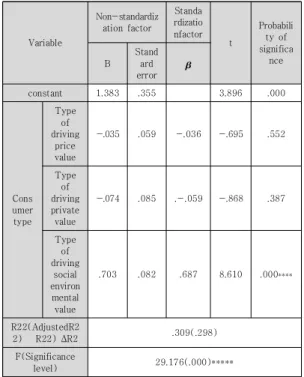
In Table 9, the F value of the predictive model of the linear regression analysis is 29.176 (p
<.0000), while the multiple regression model is significant, but the regression coefficient of the price value and individual value seeking is significant It is not. On the other hand, the regression coefficient of socio - environmental value pursuit was significant.
Variable
Non-standardiz ation factor
Standa rdizatio nfactor
t
Probabili ty of significa B nce
Stand ard error
constant 1.383 .355 3.896 .000
Cons umer type
Type of driving
price value
-.035 .059 -.036 -.695 .552
Type of driving private value
-.074 .085 .-.059 -.868 .387
Type of driving
social environ mental value
.703 .082 .687 8.610 .000
****R22(AdjustedR2
2) R22) ΔR2 .309(.298)
F(Significance
level) 29.176(.000)*****
a. dependent variable:purchase intention
*p<.1, **p<.05,***p<.01,****p<.001
Table 9. Impact on Purchase Intention by Consumer Type
Variable R R2 Adjuste dR2
Estimate d value standard
error
Statistic variation
R2 Variati
on F Variation
Probabili ty of significa
nce F Variation Type of
driving social environmental
value
.552 .304 .301 .59624 .304 86.663 .000
****
Carb on tax
5000 per ton
.638 .407 .401 .55196 .102 34.042 .000
****
Type of driving social environ mental value_5 000 per
ton
.639 .409 .400 .55246 .002 .643 .424
10,000 per ton
.621 .385 .369 .56201 .081 25.850 .000
****
Type of driving social environ mental value_1 0,000 per ton
.622 .387 .378 .56245 .002 .694 .406
Vehicle price
subsidy .577 .333 .326 .58524 .029 8.509 .004 **
Type of driving social environmental value_Vehicle price subsidy
.578 .334 .324 .58642 .001 .210 .647
Fuel tax
relief ..561 .315 .308 .59338 .010 2.909 .090*
Type of driving social environmental value_ Fuel
tax relief
.569 .324 .313 .59088 .009 2.670 .104
*p<.1, **p<.05,***p<.01,****p<.001
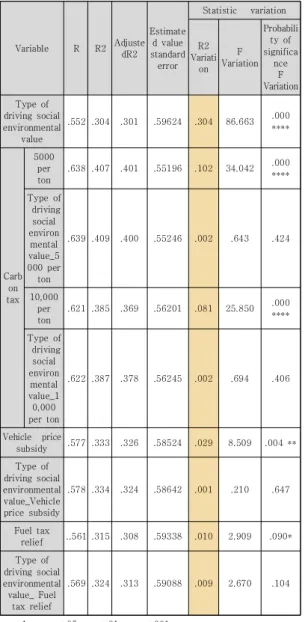
Table 10. Impact of government incentives on purchase intentions by consumer type
Table 10 shows the results of multiple regression analysis to test Hypothesis 3 that the government's policy support for eco-friendly vehicles will have a positive impact on eco-friendly vehicles purchasing behavior. In terms of social environment value-seeking type, the relationship between the government's support policy and purchase intention is related to the carbon-dioxide tax(KRW5,000 per ton,
KRW10,000 per ton) Direct adjustment of vehicle prices by national and local governments ,and reductions in fuel related taxes such as gasoline tax, diesel fuel, and carbon tax were found to have a positive adjustment effect(change in R2 value).
3.4 Hypothesis Verification Results
In this study, we analyzed the characteristics of consumers (sex, age, monthly average income), consumer type (price value pursuit type, individual value pursuit type, social environment value pursuit type) Stability, functionality and serviceability, image), and the government's administrative support (subsidies, tax breaks, etc.) and consumers' purchasing behavior toward eco-friendly vehicles.
First, consumers' characteristics(by sex, age, monthly income), consumer type(price value pursuit type ,personal value pursuit type, socio economic value pursuit type) and owner ship of environmentally friendly vehicles are analyzed by gender, age, There was no significant difference in the purchase intention by gender, age, and monthly income but there was a significant difference in purchase intention according to consumer type.
Second, it was found that the characteristics of eco - friendly vehicles affects positively (+) influence on consumer purchase behavior. As a result, the image of brand, color, design, etc.
Therefore, Hypothesis 2 was adopted that characteristics of eco-friendly vehicles will have a positive effect on the purchase behavior of eco-friendly vehicles.
Third, as the result of verifying that the
government 's policy support for eco - friendly
vehicles will have a positive impact on eco -
friendly vehicles purchasing behavior, it is found
that the socio - environmental value - seeking
type has a significant relationship with purchase
intention. (5,000 won / ton, 10,000 won / ton),
direct support from the government or local
governments, and gasoline tax, fuel tax, and
carbon tax. Therefore, the hypothesis that the government 's policy support for eco - friendly vehicles will have a positive effect on eco - friendly vehiclesr buying behavior was adopted.
In addition, it is necessary to actively promote the government 's support policies such as the direct assistance of the vehicles and the tax relief for the eco - friendly vehicles to domestic consumers who value social environment values.
In conclusion, Hypothesis 1 was adopted that the policy support of government by consumer type for eco-friendly vehicles will have a positive impact on eco-friendl vehicles purchasing behavior'.
The results of hypothesis testing are summarized in Table 11
divisioni hypothesis Verification
Result
hypothesis1
Consumer characteristics and consumer types will have an impact on eco - friendly consumer purchasing behavior.
partial accept
hypothesis1 -1
Consumer type (price value pursuit type, individual value pursuit type, socio-environmental value pursuit type) will affect eco-friendly car consumer
buying behavior
accept
hypothesis 2
The characteristics of eco-friendly vehicles will have a positive effect on the purchase behavior of eco-friendly
vehicles.
partial accept
hypothesis 3
The government incentives for consumer types will have a positive impact on eco-friendly car purchase
behavior
accept Table 11. Hypothesis test result
4. Summary of research results and direction of future research
4.1 Summary and Implications of Research Results
The purpose of this study is to investigate the effect of consumer type on the characteristics of eco - friendly vehicles selection attributes and consumer purchase behavior and the effect of government 's policy support on purchasing behavior. In other words, the types of consumers are divided into three types (value-seeking type,
individual value-seeking type, and socio-environmental value-seeking type) from the value-oriented viewpoint and the characteristics of consumers and the purchase intention of environment-friendly vehicles. And the effect of the type of consumer on the selection attributes of eco - friendly vehicles and the policy support of the government.
In order to accomplish the purpose of this study, first of all, the precedent study was carried out with the theoretical study. In the review process, the characteristics of the consumer, the type of consumer and the type of consumer, The results of this study are summarized as follows.
First, the results of this study are as follows. In particular, there has been no research on the difference in the purchase behavior of eco - friendly vehicles among consumers in Korea.
For the purpose of empirical analysis, we conducted a web survey on consumers in Seoul and collected 200 copies of each questionnaire respondent.
The analysis method used in this study was frequency analysis to identify the demographic characteristics. Reliability analysis and Factor analysis were conducted to confirm the validity of the questionnaire configuration items In order to test the hypothesis on the relationship between consumer characteristics and consumers' purchase behavior, characteristics of eco-friendly vehicles and purchasing behavior, government policy support by consumers, and eco-friendly vehicles purchase behavior at the stage of hypothesis testing(T test, F test) and multiple regression analysis. Multiple regression models were used, but hierarchical regression analysis was used to test hypotheses about the detailed effects of each item.
As a result of this study, it was found that the
characteristics of consumers (by age, sex, monthly
average income), types of consumers (pursuit type,
individual value pursuit type price value ). There
was no significant difference between consumers ,
and the purchasing intention was not significantly
different by age, monthly income, and gender ,
but there was a significant difference in purchase intention according to the type of consumer. The positive effects of consumer purchase behavior on design , color ,brand image etc. Have positive (+) affect on eco - friendly vehicles. The results of this study are as follows. First, the government's support policy, carbon dioxide tax (KRW 5,000 per ton, KRW 10,000 per ton), direct support from the national and local governments on the vehicle price, gasoline tax, gasoline tax in the old model.
The implication of this study is that the development and market participation of the next generation eco - friendly vehicles is accelerating and the interest of consumers is increasing. Among the characteristics of consumers, characteristics of environment - friendly vehicles, and the government 's policy support for next -generation eco - friendly vehicles. And how they effect on consumers' purchasing behavior through a web survey of Korean consumers in Seoul.
In this study, we will determine which domestic consumer will be the ultimate next-generation eco-friendly vehicles, whether the plug-in hybrid vehicles will be positioned as a next-generation eco-friendly vehicles equivalent to electric vehicles and hydrogen vehicles, Can also be analyzed in addition, how the strengthening of low-carbon policy (such as subsidy-supported carbon tax) affects consumers' purchasing patterns and how these policy factors and technological factors, and the infrastructure elements of eco-friendly vehicles and to provide implications for related industries and policies in the future diffusion of next-generation eco-friendly vehicles in Korea.
4.2 Limitations of Research and Future Directions.
The limitations of this study are as follows.
First, the population is not surveyed the consumers of eco-friendly vehicles in all regions of the country, but it is limited to the consumers who live in Seoul and the possibility of
generalization of the research results is lowered.
Second ,it is a fundamental problem in defining variables . we classified only three types of consumers as independent variables in this study. In this study, we classified to three types from the view point of value-based perspective.
However, there are limitations to the analysis be cause it is limited to four sub-factors and generalized.
Third, it is the limit of parameter selection.
The results of this study are summarized as follows It also has the limitation that it can fall.
In the future research, based on the results of this study, if an extension study is conducted to examine the relationship between consumer characteristics of eco-friendly vehicles choice factors and consumer purchasing behavior and the relationship between government policy support and purchase behavior. It is possible to more systematically identify the relationship between subjective norms, consumers' product attitudes and purchase intentions for vehicles.
If verifying the moderating effect of cultural and psychological variables of domestic consumers in the future, practical information will be provided in addition,
The development and market participation of
the next generation eco - friendly vehicles is
accelerated, and consumers' interest is increasing in
this study. Consumer characteristics, characteristics
of the next generation eco - friendly vehicles, and
policy measures for the next generation eco -
friendly vehicles. The results of this study are as
follows., We will determine which domestic
consumer will be the ultimate next-generation
eco-friendly vehicles, whether the plug-in hybrid
vehicles will become the next generation
eco-friendly vehicles equivalent to electric
vehicles and hydrogen vehicles in this study, The
study were also analyzed. and also examines
how the strengthening of low-carbon policy
(such as subsidy-supported carbon tax) effect on
consumers' purchasing patterns, and how such
technological factors ,policy factors, electricity
and hydrogen stations effect on the purchasing behavior. And suggest implications for related industries and policies in the future diffusion of next - generation green vehicles in Korea.
REFERENCES
[1] E. M. Yang. (2013). The Effect of Environment-Friendly Product Attributes on the Intention to Purchase Eco-Friendly vehicles with Variables to Control Well-being Lifestyle , Kyung Hee University Graduate School, Master's Thesis, pp.4-5.
[2] Ministry of Commerce, Industry and Energy.(2015.12) , Third Plan for Environmentally Friendly Automobile Development and Distribution.
[3] K. Horney. (2015). Consumer Psychology , Bourgle Books, pp.1-304.
[4] R. B. Settle. (2014). Consumer Psychology , Sejong Book, pp.1-10.
[5] D. A. Aaker. (1992), Managing brand equity:
Capitalizing on the valueof a brand name, Journal of marketing, 56(2) , 125-128.
[6] G. Häubl. (1996). A cross‐national investigation of the effects of country of origin and brand name on the evaluation of a new car, International Marketing Review.
[7] K. J. Keller., (1993), Conceptualizing, measuring and managing customer based brand equity, Journal of Marketing, 57(1), 1-22.
[8] P. Kotler. (2009). Marketing Management, Person higher Ed.,
[9] T. Clark. (1990). International marketing and national character:A review and proposal for and integrative theory, Journal of Marketing, 54(Oct) , 66-79.
[10] R. Ozaki & K. Sevastyanova. (2010), Going hybrid: An analysis of consumer purchase motivations, Energy Policy, 39(5), 2217-2227.
[11] B. Steaua. (2009), Potoleste-ti setea de victorie.
Astazi, in FC Steaua si Nike au prezentat noul echipament de joc pentru sezonul, p.47.
[12] D. Diamond. (2009), The impact of government incentives for hybrid—electric vehicles: Evidence from US states, Energy Policy, .37(3), 972-983.
[13] Tsuyoshi Toshimitsu.(2010), On the paradoxical case of a consumer-based environmental subsidy policy, Economic Modelling, 27(1), 159-164.
[14] R. B. Settle. (2014). Consumer Psychology , Sejong Book.
[15] K. H. Jeong. (1992), A Study on Product Selection of
Small Passenger Vehicle Purchasers in Korea: Excel, Lemans, Pride Focusing on the purchase of passenger vehicles, Sungkyunkwan University.
[16] W. G. Jang. (1997). An Empirical Study on Consumer Product Selection, Kyungnam University , pp.1-82.
[17] Y. S. Lee, J. K. Lee & K. T. Lee. (2008). A Study on the Response Error of Online Survey. -The relationship between survey response time and sincerity of response-, Seoul Metropolitan University Survey Research , pp.51-83,
[18] C. H. Cho. (2014). SPSS / AMOS Structural Equation Model Analysis, Chulam Publishing.
[19] S. Y. Nam & E. J. Yang. (2018). The effect of eco-friendly management activities of beauty companies on consumer decision making . The Journal of the Korean Fusion Society, 9(7), 285-291.
[20] Y. S. Hwang & S. Yoo. (2017), A Study on the Moderating Effect of Environmental Education on Eco - Friendly Consumers Using Value - Attitude - Behavior Model The Journal of the Korean Fusion Society, 8(7) , 273-282.
임 기 흥(Yim, Ki Heung) [종신회원]
․ 1983년 2월 : 중앙대학교 경영학과 (경영학 석사)
․ 1991년 2월 : 중앙대학교 경영학과 (경영학 박사)
․ 1984년 6월 ~ 1997년 2월 : 한국생 산성본부(책임전문위원)
․ 1997년 3월 ~ 현재 : 광주여자대학교 서비스 경영학과 교수
․ 2017년 6월 ∼ 8월 : 일본 메이조대 초빙연구원
․ 관심분야 : 서비스경영, 4차 산업 인력개발, 빅 데이터, 창업
․ E-Mail : [email protected]
박 천 규(Park, Chun Gyu) [정회원]