Vol. 24, No. 10 (2014)
538
자동차용 Al-6Si-2Cu 합금의 용체화처리에 따른 미세조직 및 기계적 특성 변화
홍승표·김정석†
조선대학교 재료공학과
Microstructure and Mechanical Properties on Solid Solution Heat Treatment of Al-6Si-2Cu Alloy for Lightweight Automotive
Seung-Pyo Hong and Chung-Seok Kim
†Department of Materials Science and Engineering, Chosun University, Gwangju 501-759, Korea
(2014년 8월 5일 접수: 2014년 9월 11일 최종수정: 2014년 9월 12일 채택)
Abstract
Microstructural and mechanical characteristics of Al-6Si-2Cu alloy for lightweight automotive parts were investigated. The test specimens were prepared by gravity casting process. Solution heat treatments were applied to as-cast alloys to improve mechanical properties. The microstructure of the gravity casting specimen presents a typical dendrite structure, having a secondary dendrite arm spacing (SDAS) of 37µm. In addition to the Al matrix, a large amount of coarsened eutectic Si, Al2Cu intermetallic phase, and Fe-rich phases were identified. After solution heat treatment, single-step solution heat treatments were found to considerably improve the spheroidization of the eutectic Si phase. Two-step solution treatments gave rise to a much improved spheroidization. The mechanical properties of the two-step solution heat treated alloy have been shown to lead to higher values of properties such as tensile strength and microhardness. Consequentially, the microstructural and mechanical characteristics of Al alloy have been successfully characterized and are available for use with other basic data for the development of lightweight automotive parts.Key words
Al-Si-Cu alloy, solution heat treatment, spheroidization, lightweight automotive.1.
서 론지구 온난화와 에너지 부족 현상이 사회적 주요 이슈 로 부각됨에 따라 자동차 산업에서 이산화탄소 배출량 또는 차량연비에 대한 구체적인 허용기준이 제시되고 있 다.
1)이러한 사회적 요구에 맞춰 세계 자동차 시장의 개 발 방향은 친환경과 에너지 절약에 그 관심이 집중되고 있다. 따라서, 자동차의 유해가스 배출량을 감소시키고 연 비를 향상시킬 수 있는 자동차 경량화에 대한 연구가 절 실하다. 오랫동안 Al 합금은 자동차 경량화 재료로 연 구되어 왔으며 이미 상당부분 대체재료로 적용 되고 있 다. 2010년 기준 유럽에서 생산되는 자동차의 Al 사용 비중은 약 29 %로 아시아의 15 %에 비해 두 배 정도
높은 것으로 보고되었다.
2)특히, 고강도 Al합금으로 Al-Si-Cu 합금은 우수한 주 조성과 기계적 성질로 실린더 헤드, 실린더 블록 등에 널 리 사용되고 있다.
3)일반적으로 Al-Si-Cu 합금의 기계적 성질은 첨가 원소, 합금의 미세구조와
4,5)용체화처리, 시 효를 통해 생성된 석출물들인 θ-Al
2Cu 상, α-Al
15(Fe, Mn)
3Si
2, β-Al
5FeS
i상 그리고 Si 상에 의존한다.
6-8)지금 까지 이러한 열처리, 시효 처리 동안의 미세구조의 변 화와 석출물의 거동에 따른 기계적 특성에 대한 많은 연 구가 진행되었다.
9-11)하지만 아직까지도 자동차용 부품 소재를 경량화하기 위해서 다양한 연구를 통한 적용부 품에 요구되는 강도와 연성 등의 물리적 특성 향상 연 구가 미진한 상태이다.
†Corresponding author
E-Mail : [email protected] (C.-S. Kim, Chosun Univ.)
©Materials Research Society of Korea, All rights reserved.
This is an Open-Access article distributed under the terms of the Creative Commons Attribution Non-Commercial License (http://creative- commons.org/licenses/by-nc/3.0) which permits unrestricted non-commercial use, distribution, and reproduction in any medium, provided the original work is properly cited.
따라서 본 논문에서는 자동차 경량화용 Al-Si-Cu 합금 을 중력주조하여 as-cast 상태와 함께 용체화처리 후의 미세조직과 기계적 특성을 평가하였다. 용체화처리는 500
oC 이하에서 1차로 θ-Al
2Cu 상을 재고용 시킨 후 θ- Al
2Cu 상의 용융온도 이상의 온도에서 2차 열처리를 통 한 미세조직적 그리고 기계적 특성의 변화를 연구하였 다. 이를 통해 향후 Al-Si-Cu 합금의 용체화처리의 응 용과 자동차용 경량화 대체 재료로의 적용 범위 확장에 대한 기초자료로 활용하고자 한다.
2.
실험 방법실험에 사용된 Al 합금은 열처리 전과후의 미세조직 과 기계적 특성을 평가하기 위하여 잉곳(670 mm × 100 mm × 40 mm)으로 중력주조 되었으며, 합금의 조성은 유 도결합 플라즈마 질량 분석기(inductively coupled plasma mass spectromerty, ICP-MS; Perkin Elmer, OPTIMA 4300 DV) 를 사용하여 분석하였고 결과는 Table 1에 나 타내었다.
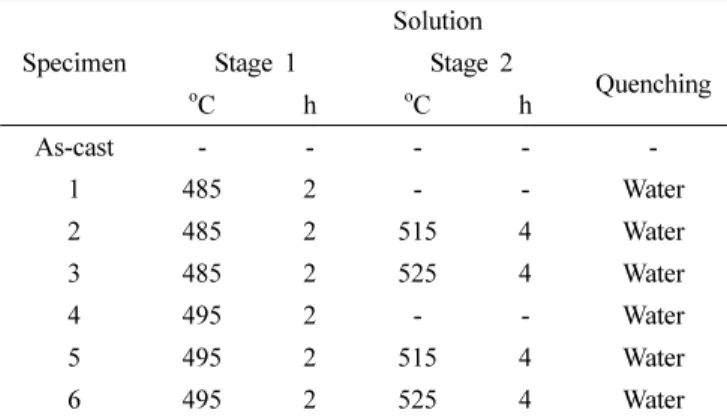
주조된 Al 합금에 적용된 1차 및 2차 용체화처리는 Table 2 에 상세히 나타내었다. 본 연구에서의 용체화 온 도는 Al
2Cu 상의 초기 용융을 피하기 위해 주의 깊게 설 정하였다.
12)1 차 용체화 온도는 Al
2Cu 상의 용융온도 이 하인 485 ± 1
oC 와 495 ± 1
oC 로 선정하고 2차 용체화 온 도는 Al
2Cu 상의 용융온도 이상인 515 ± 1
oC 와 525 ± 1
oC 로 열처리를 수행하였다.
미세조직 분석과 기계적 성질의 평가를 위한 시편은 잉 곳에서 기계절단(10 mm × 8 mm × 5 mm) 하였으며 시편 을 콜드 마운팅 한 후 Keller’s 용액(Nitric acid 1.25 ml + Hydrochloric acid 0.75 ml + Hydrofluoric acid 0.5 ml
+ Dist. water 47.5 ml) 을 사용하여 에칭 후 광학현미경 (Optical Microscope, OM; Zeiss, AXIO) 으로 관찰하였 으며, 석출상은 주사전자현미경(Scanning Electron Micros- cope, SEM; Hitachi, S-4800), 에너지 분산 분광법(Energy Dispersive Spectroscopy, EDS; E-MAX, ISIS310) 을 이 용하여 정성 및 정량 분석하였다.
결정구조 분석을 위해 X-선 회절분석(X-Ray Diffraction, XRD; Rigaku, X’pert PRO MPD) 을 수행하였다. CuK
α를 이용하여 20
o에서 90
o까지 2θ분석을 하였으며 스텝 사이즈 0.01
o, 스캔 스텝 시간 1 s로 하였다.
이론적인 열역학 계산을 통하여 Al-6Si-2Cu 합금의 평 형상태도를 평가하였다. 이론적 계산을 위한 상용프로그 램은 Thermo-calc를 사용하였다.
기계적 성질의 평가를 위한 경도 시험은 미소 경도시 험기(Shimadzu, HMV-2T) 를 사용하였으며 1 kg의 하중 으로 유지시간 5 s씩 각 시편 당 20회 측정하였다. 인장 시험용 시편은 KS인장규격 14B호를 기초로 하여 평행 부거리 32 mm인 판 형태로 제작하였으며, 인장시험기 (MTS, Landmark Servohydraulic Test System) 을 이용하 여 상온에서 1 mm/min의 변형속도 조건에서 수행하였다.
3.
결과 및 고찰 3.1미세조직
Fig. 1 은 as-cast 시편의 광학현미경 그리고 주사전자 현미경 사진을 나타내었다. Fig. 1(a)에서 미세조직은 전 형적 주조조직인 덴드라이트 조직을 보였으며 이미지 분 석기(IMT, i-Solution)로 측정한 덴드라이트 암 간격 (SDAS) 은 37 µm를 보였다. 또한 시편에서는 명암과 형 태학적으로 구분 가능한 여러 가지 상들이 Al 기지에서 관찰되었다. 이러한 상들의 정성 분석을 위해 SEM-EDS 분석을 수행하였다. Fig. 1(b)에서와 같이 명암과 형태를 차이로 표시된(Fig. 1(b)의 1-4) 4가지의 상들로 구분 가 능했다. 각각의 상들의 EDS 분석을 수행하였고 그 결 과는 Table 3에 나타내었다.
EDS 분석 결과 α-Al 기지와 chinese script형태의 α- Al
15(Fe,Mn)
3Si
2과 침상의 β-Al
5FeSi 의 Fe-rich 상, 판상 의 θ-Al
2Cu 그리고 공정 Si이 관찰 되었다. 이는 Ceschini 등이 Al-10Si-2Cu 합금의 인장과 피로 특성에서 Fe 함 유와 미세구조적 특징의 효과 대한 연구에서 보고한 α- Al
15(Fe,Mn)
3Si
2과 β-Al
5FeSi 의 결과와 일치한다.
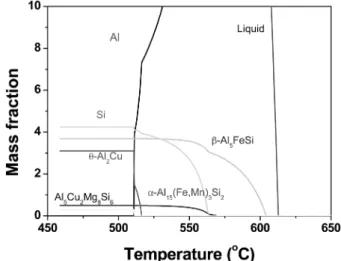
13)Fig. 2 는 Al-6Si-2Cu 합금에 대해 Thermo-Calc로 열 역학 계산을 통해 얻은 평형상을 나타내었다. 열역학 계 산 결과와 같이 본 연구에서 수행한 용체화 처리 온도 구간에서 Fe-rich한 α와 β상이 존재 하였다. 또한, 본 연 구에서 1차 용체화와 2차 용체화 온도의 기준이 된
Table 1. Chemical composition of Al-Si-Cu alloy (wt%).Alloy Si Cu Fe Mn Mg Al
Al-Si-Cu 6.01 2.09 1.03 0.19 0.12 Bal.
Table 2. schedule of solution heat treatment.
Specimen
Solution
Stage 1 Stage 2
Quenching
oC h oC h
As-cast - - - - -
1 485 2 - - Water
2 485 2 515 4 Water
3 485 2 525 4 Water
4 495 2 - - Water
5 495 2 515 4 Water
6 495 2 525 4 Water
Al
2Cu 의 용융온도도 약 510
oC 로 계산되어 본 연구에서 설정한 용체화 온도가 타당함을 보여준다.
각 상들의 결정 구조 분석을 위해 X-선 회절 시험을 수행하고 그 결과를 Fig. 3에 나타내었다. XRD 분석 결 과 Fig. 3(a)에 회절면을 표시한대로 Al, Si, Al2Cu의 회절 피이크만이 나타났다. 이는 Fig. 1(b)에서 관찰 된 것처럼 α와 β상 등의 석출상들의 부피분율이 작아 X- 선 회절에 의해 나타나지 않기 때문이다. 용체화 열처리 에 따른 상들의 변화를 관찰하고자 용체화 열처리 단계 에 따른 X-선 회절 분석을 하여 Fig. 3(b)에 대표적인 결 과를 나타내었다. 결과에서처럼 20.6
o부근의 Al
2Cu(110) 회절면이 485
oC 2 시간 1차 용체화 및 495
oC 2 시간와 525
oC 4 시간 2차 용체화 처리로 인해서 나타나지 않음 을 알 수 있다. 따라서 용체화 처리로 인해 Al
2Cu 상들 이 대부분 기지내로 재고용 된 것으로 판단된다.
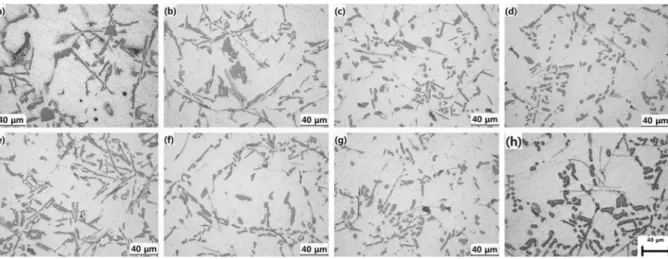
Fig. 4 은 as-cast와 1차와 2차의 각 용체화 처리에 따
른 미세 조직의 변화를 보여준다. 공정 Si 입자들의 평 균면적과 형상비(단축/장축)를 측정하여 Table 4에 나타 내었다.
용체화 처리 후에 Si 입자들의 평균 면적은 현저하게 감소하였으며 형상비는 증가하였다. 이는 Al-6Si-2Cu 합 금이 열처리 후에 기지내의 공정 Si 입자들이 용체화 처 리에 따라서 Al 기지내로 재고용되면서 그 크기가 미세
Fig. 1. OM and SEM micrographs of as-cast Al-6Si-2Cu alloy; (a) OM and (b) SEM.Table 3. EDS analyses of as-cast sample (wt%).
Point Si Cu Fe Mn Mg Al Phase
1 10.7 - 22.0 8.6 - 56.6 α
2 17.5 - 23.1 2.6 - 56.6 β
3 93.6 - - - - 6.3 Si
4 - 51.3 - - - 48.6 θ
Fig. 2. Equilibrium phase diagram of Al-6Si-2Cu alloy calculated by Thermo-calc.
Fig. 3. XRD patterns; (a) dominant phases in as-cast sample and (b) diffraction peak (110) of Al2Cu at each heat treatment.
해지고 공정 Si 입자의 재고용시 장축방향의 모서리 부 분의 재고용이 가속화 되어 구상화 되어진다는 것을 나 타낸다. 또한 열처리 온도와 시간이 증가할수록 Si 입자 들이 더욱 미세해지고 구상화 되었다.
3.2
기계적 특성
Fig. 5 는 열처리된 Al-6Si-2Cu 합금의 마이크로 비이 커스 경도 시험 결과를 나타내었다. 열처리 후의 합금 의 경도는 as-cast와 비교 할 때 약 107 Hv에서 27 %가 증가하였다. 이는 잉곳 내에 석출된 조대한 θ-Al
2Cu 입 자들이 석출 강화에 기여하지 못하고 용체화 처리 후에 Cu 원자들이 기지내에 고용됨에 따라 고용 강화 효과에 기여하여 경도 값이 증가된 것으로 판단된다.
Fig. 6 는 열처리된 Al-6Si-2Cu 합금의 인장 특성을 보 여준다. 열처리 후의 합금은 as-cast와 비교할 때, 최대 인장강도가 185 MPa에서 최대 249 MPa(485
oC/2 h 525
o
C/4 h) 으로 항복강도는 152 MPa에서 최대 198 MPa(495
o
C/2 h 515
oC/4 h) 로 연신율은 1.36 %에서 최대 1.93 % (495
oC/2 h 525
oC/4 h) 로 증가하였다. 이는 경도특성에서 와 같이 Cu 원자들이 용체화 단계에 따라서 기지내로 재 고용되므로 고용강화에 기여하는 것이며 연신율의 향상 은 초기 공정 Si의 재고용에 따른 면적감소 및 구상화 로 인해 나타난 것으로 판단된다. 특히, 항복강도는 495
o
C 에서 2시간 동안 1차 용체화 하고 515
oC 와 525
oC 에 서 4시간 동안 2차 용체화 할 경우 as-cast 대비 약 30
Table 4. Mean area and aspect ratio of silicon particles after solutionheat treatment.
Measurement As-cast 1 2 3 4 5 6
Mean area
(um2) 47.1 31.4 29.6 26.1 31.7 25.8 20.6 Aspect ratio* 0.16 0.27 0.39 0.40 0.32 0.37 0.44
*Where a value of 1 is a round particle
Fig. 4. Microstructure of Al-6Si-2Cu alloys after different solution heat treatment; (a) as-cast, (b) 485oC/2 h, (c) 485oC/2 h 515oC/4 h, (d) 485oC/2 h 525oC/4 h, (e) 495oC/2 h, (f) 495oC/2 h 515oC/4 h, (g) 495oC/2 h 525oC/4 h and (h) image analysis.
Fig. 5. Micro Vickers hardness of alloys at various solution heat treatment.
Fig. 6. Tensile properties of alloys at various solution heat treatment.
% 이상 향상되었고 연신율은 525
oC 에서 2차 용체화 할 경우 약 40 %이상 증가하였다.
4.
결 론자동차 경량화용 Al-6Si-2Cu 합금의 용체화 처리 후 의 미세조직 및 기계적 특성을 평가 한 결과, 다음과 같 은 결론을 얻을 수 있었다.
1) 용해 주조 시 Al-6Si-2Cu 합금의 미세 조직은 Al 기지에 chinese script 형상의 α-Al
15(Fe,Mn)
3Si
2상과 침 상의 β-Al
5FeSi 상의 Fe-rich 상, 판상의 θ-상(Al
2Cu) 그 리고 eutectic Si상 이 관찰 되었고 이는 열역학적으로 계산한 평형상 결과와 일치하였다.
2) XRD 에 의한 기지내 상분석 결과 용체화 열처리 후 에 θ-Al
2Cu 상은 기지내로 재용체화 되어 회절 피이크가 나타나지 않았다. 그리고 Si입자들은 미세화 및 구상화 되었다.
3) 합금의 기계적 특성은 용체화 처리 후에 증가 하 였으며 495
oC 에서 2시간의 용체화 처리 후에 525
oC 에 서 4시간의 용체화 처리를 한 합금이 실험 합금 중에 서 최대인장강도, 항복강도와 연신율이 각각 32 %, 27 % 그리고 42 % 향상된 기계적 특성을 나타내었다.
감사의 글
본 논문은 2013년도 정부(미래창조과학부)의 재원으로 한국연구재단의 지원을 받아 수행된 연구입니다(NRF- 2013R1A1A1010152).
References
1. B. M. A. Alawi and T. H. Bradley, Appl. Energ., 113, 1323 (2014).
2. K. T. Kim, J. Korea Foundry Soc., 31, 101 (2011) (in Korean).
3. K. Sasaki and T. Takahashi, Int. J. Fatigue., 28, 203 (2006).
4. L. Ceschini, A. Morri, A. Morri and G. Pivetti, Mater.
Design, 32, 1367 (2011).
5. M. Zeren, E. Karakulak and S. Gumus, Trans. Nonferrous Met. Soc. China, 21, 1698 (2011).
6. E. H. Samuel, A. M. Samuel and H. W. Doty, AFS Trans., 30, 839 (1996).
7. Z. Li, A. M. Samuel, F. H. Samuel, C. Ravindran and S. Valtierra, J. Mater. Sci., 116, 1203 (2003).
8. L. Ceschini, I. Boromei, A. Morri, S. Seifeddine and I.
L. Svensson, Mater. Design, 36, 522 (2012)
9. E. Sj lander and S. Seifeddine, Mater. Design., 31, 44 (2010).
10. T. Nishimura, H. Toda, M. Kobayashi, T. Kobayashi, K.
Uesugi and Y. Suzuki, Int. J. Cast Metal. Res., 21 114 (2008).
11. Y. J. Li, S. Brusethaug and A. Olsen, Scripta. Mater., 54, 99 (2006).
12. I. A. Luna, H. M. Molinar, M. J. C. Roman, J. C. E.
Bocardo and M. H. Trejo, Mater. Sci. Eng. A., 561, 1 (2013).
13. L. Ceschini, I. Boromei, A. Morri, S. Seifeddine and I.
L. Svensson, J. Mater. Process. Tech., 209, 5669 (2009).
″o