공유리더십이 팀직무열의에 미치는 영향: 팀긍정심리자본의 매개효과와 직무특성의 조절효과를 중심으로
Impact of Shared Leadership on Team Work Engagement: Focusing on the Mediating Role of Team Positive Psychological Capital and the Moderating Role of
Task Characteristics
유태섭*, 오상진**
경희대학교 국제대학원 국제경영학과*, 서울과학종합대학원 경영학과**
Tae-Seob Yoo([email protected])*, Sang-Jin Oh([email protected])**
요약
본 연구는 국내 기업의 근무자를 대상으로 팀 수준에서 공유리더십의 효과성을 연구하는데 있어 지금까 지 국내에 별로 소개 된 바 없는 팀 변수인 팀긍정심리자본과 팀직무열의와의 관계를 규명하는데 목적이 있다. 이를 위하여 공유리더십이 팀직무열의에 미치는 영향, 공유리더십과 팀직무열의간의 관계에서 팀긍정 심리자본(Team PsyCap)의 매개효과 그리고 공유리더십과 팀긍정심리자본과의 관계에서 직무특성의 조절 효과를 검증하였다. 국내 16개 기업 100개 팀의 구성원 421명을 대상으로 연구를 실시하였고, 수집된 자료 의 분석과 통계처리를 위하여 SPSS23.0을 사용하였다. 연구 결과, 높은 공유리더십 수준은 팀의 직무열의 에 유의한 영향을 미치는 것으로 밝혀졌고 이 과정에서 팀의 긍정심리자본이 매개 역할을 하는 것으로 검증 되었다. 이러한 결과는 공유리더십이 팀긍정심리자본을 촉진하고 팀직무열의에 긍정적인 영향을 미치는 주 요 변인임을 입증하는 것이다. 그러나 공유리더십과 팀 긍정심리자본에 대한 직무특성의 조절효과는 지지 되지 않았다. 마지막으로, 본 연구 결과가 주는 이론적 및 실무적 함의를 논하였으며, 마지막으로 연구의 한계 및 향후 연구방향을 제시하였다.
■ 중심어 :∣공유리더십∣팀직무열의∣팀긍정심리자본∣직무특성∣
Abstract
The purpose of this study is to examine, at the team level, the relationship between shared leadership and team work engagement and team psychological capital which have rarely been introduced into academic leadership research in Korea. This study tested the impact of shared leadership on team work engagement and the mediating role of team psychological capital between the two variables. And also, this study tested moderating role of task characteristics between shared leadership and team psychological capital. A total of 421 employees of 100 teams in 16 companies in South Korea participated in this study. The SPSS 23.0 statistical program was used in this study to analyze and statistically process the collected survey data. The result showed that high level of shared leadership positively influence team work engagement and team PsyCap works as mediator in the relationship between shared leadership and team work engagement. This results means that shared leadership is a crucial factor to facilitate team’s psychological capital toward team’s work engagement. However, Task characteristics had no moderating effect between shared leadership and team PsyCap. Finally, theoretical and practical implications of the study results have been discussed along with limitations and future direction of the study.
■ keyword :∣Shared Leadership∣Team Work Engagement∣Team Positive Psychological Capital∣Task Characteristics∣
접수일자 : 2016년 07월 04일 수정일자 : 2016년 07월 20일
심사완료일 : 2016년 07월 20일
교신저자 : 오상진, e-mail : [email protected]
I. INTRODUCTION
Companies are entering an era of hyper- competition[1], information technology, and globalization, which presents a dynamic, complex, and extremely competitive environment. Accordingly, to effectively navigate such an environment, companies are implementing team-based structures[2]. In other words, to conduct more self-managed and complex work in response to environmental changes, the introduction of team-based structures into companies has been increasing. Thus, identifying the key factors of team effectiveness and promoting such factors to improve the organization’s overall performance has become a critical issue in its management[3].
Given such tendencies toward team-based structures, scholars have started to focus on identifying and examining elements that can contribute to the entire team[4]. Leadership within and of teams has often been identified as one of the critical factors of team success[2]. In other words, the spread of team-based structures also influences the research on leadership.
To date, leadership research has been focused on the hierarchical leadership expressed by a leader, i.e., an official person. However, recently, teams have tended to reduce their dependence on a traditional leader’s authority[5], and lateral leadership in which the group or team members share influence has attracted attention[6]. One such lateral leadership method within and of teams is called shared leadership, which is explained as “an emergent team property that results from the distribution of leadership influence across multiple team members”[7].
During the last decade, work engagement has been researched as an important construct for both employee performance and well-being[8]. In
accordance with the increase in implementing team-based structures, research on work engagement is being conducted on work engagement in team units, i.e., team work engagement. Team work engagement is defined as a shared, positive and fulfilling, and motivational emergent state of work-related well-being[8]. Engaged teams work energetically and actively, and productively behave and quickly bounce back from unexpected negative events.
Under a team-based structure, although the positive tendencies of an organization’s individual members are important to its performance, the importance of positive tendencies at the team level has also been emphasized[9]. In accordance with such tendencies, research on the positive psychological capital of teams, rather than of units of individuals, is being conducted by scholars as well[10-16].
A review of the concepts previously mentioned, i.e., leadership, work engagement, and PsyCap, indicates that numerous studies have been conducted on the relationships among the variables at an individual level. However, research on the relationships among leadership, psychological capital, and work engagement at the team level are extremely scanty.
Accordingly, this paper examines the effect of shared leadership as an independent variable on team work engagement as a dependent variable. This paper also studies whether team PsyCap performs a mediating role between the independent and the dependent variable, and whether task characteristics have a moderating effect between the two variables.
II. THEORETICAL BACKGROUND
Shared leadership, as a possible alternative or a complementary factor of traditional vertical
leadership, has been highlighted and studies have surged in the past few years[2] and are in a constant state of flux and development[17].
In the beginning, the studies concentrated on identifying antecedent conditions of shared leadership, which include coaching[7], the collectivist orientation of team members[18] and in recent, team proactivity [19]. Recently, the consequences of shared leadership have been studied and empirical studies have suggested that shared leadership positively influences team effectiveness[20-23].
Shared leadership, as a group-level construct and a team property[7], is expected to foster positive outcomes, not only for individuals but also for teams in particular. However, although some studies reported an overall positive relationship between shared leadership and team performance, as previously noted, others such as Boies, Lvina and Martens[24], Mehra, Smith, Dixon and Robertson[25]
did not support this prediction[2]. Fausing, Jeppesen, Jønsson, Lewandowski, Bligh[26] also questioned the overall implications of shared leadership and failed to find any relationship between team performance and shared leadership. Pearce, Wassenaar and Manz[27]
supported the concept of shared leadership but also acknowledge the need for a hierarchical underlying background structure. That is, study results on the relations between shared leadership and team performance are not harmonized and need to be reconciled through additional research.
Work engagement is a positive achievement- oriented psychological state related to work and claimed that it consists of the three sub-dimensions of “vigor, dedication, and absorption[28]. Parallel to the studies on work engagement at the individual level, multiple researchers also attempted to find a construct at the team leve[29-33]. Team work engagement emerges from the interaction and the
shared experiences of the members of a work team[34][29][30]. Similar to individual-level work engagement[35][36], team work engagement is proposed as a multidimensional construct characterized by affective and cognitive dimensions. The three dimensions of team-level work engagement are team vigor, team dedication and team absorption[37].
Recently, some studies showed that work engagement has positive relationships with task and team performance, collective positive affect, and efficacy beliefs at the team level. Costa et al.[33] used data collected from 82 research teams and team leaders and found that the direct influence of task conflict and relationship conflict has a detrimental effect on the development of a positive emergent state of work engagement. Stiphout[38] reported that four clusters of characteristics, i.e., team composition, a team’s level of interdependence, a safe and respectful team atmosphere, and a team’s internal relations, may influence the emergence of team engagement.
Torrente et al.[29] tested, for the first time, the factorial structure of a team work engagement scale by aggregating data at the team level of analysis.
They reported that CFA confirms the expected three-factor structure of team work engagement (vigor, dedication, and absorption) when tested at the team level with nine items using aggregated data, and offers a validated scale with which to test work engagement in teams. Torrente et al.[29] also applied a “referent shift” to their individual work engagement questionnaire, the Utrecht Work Engagement Scale (UWES), to measure team work engagement. They shifted the survey items’ focus from the individual to the collective, asking individuals to rate team properties rather than report on their personal experiences. Torrente et al.[29] also mentioned that emotional contagion is the mechanism underlying team work engagement.
Torrente et al.[30] used 62 teams from 13 organizations and reported that team social resources, a supportive team climate, coordination, and teamwork are positively related to team work engagement, which is in turn related to team performance. In the same research, they reported that two constructs of team work engagement, i.e., team work vigor and team work absorption, were significantly related to in-role performance. Salanova et al.[39] used students working in groups and showed that activity engagement increases collective positive affect and collective efficacy. Harter, Schmidt and Hayes[40] engaged in a meta-analytic study and showed that engagement positively predicts business unit outcomes. Salanova et al.[34] used a sample of students working in groups and found that, when collective efficacy is high, collective work engagement increases task performance. Salanova et al.[41] used a sample of 114 service employees from hotel front desks and restaurants and found that work engagement relates to service climate, which in turn predicts employee performance.
To date, PsyCap has been studied predominantly at the individual level and has been conceptualized as an individual-level construct concerned with an employee’s state of positive psychological development[42]. However, some requests have been made to investigate the possibility of a collective version of the concept by testing PsyCap in teams and larger groups[15]. Walumbwa et al.[43] defined team PsyCap as a group’s shared psychological state characterized by efficacy, hope, optimism, and resilience. Recently, research began to examine the phenomenon as a shared psychological team state[44].
Multiple studies examined PsyCap at a collective level and showed a positive relationship between team-level PsyCap and team performance. West, Patera, and Carsten[45] first tested collective PsyCap
on student groups and reported that collective optimism affects group cohesion, cooperation, coordination, conflict, and satisfaction when groups are newly formed. Clapp-Smith et al.[11] utilized social cognitive theory[46] and social contagion theory [47] to argue that PsyCap can also exist at a collective level. They found that trust in management has a mediating role between team-level PsyCap and team performance. Walumbwa et al.[43] implemented a brief referent shift version (eight items) of the PCQ with 146 intact groups from a large financial institution. The study found a significant relationship between team PsyCap and team-level performance and citizenship behavior. Petersen and Zhang[12]
investigated collective PsyCap among 67 top management teams and found that the collective PsyCap of top management teams (TMT) was positively related to business unit performance.
Memili, Welsh and Kaciak[48] used family franchise firms to suggest that organizational PsyCap of family franchise firms can be fostered by unique family firm LMXs characterized by trust, respect, and obligation.
Vanno et al.[14] found that group-level PsyCap, on the basis of the direct consensus model and the referent-shift consensus model, had significantly positive effects on group effectiveness. Goncalves et al.[49] found that team PsyCap mediated the leader’s humility and team creativity. Heled et al.[44] found a positive relationship between the team’s psychological capital and the individual’s job satisfaction and the team’s organizational citizenship behavior (OCB). In recent, Dawkins et al.[42] pointed out the processes by which team members become akin in PsyCap perceptions; thus, generating collective PsyCap was not specified in the existing literature. To explore the process, they utilized “social contagion theory” as a theoretical framework to demonstrate the potential social processes that may contribute to the emergence
of PsyCap at higher levels. They also suggested that
“emotional contagion” might complement social contagion processes in contributing to the emergence of collective PsyCap.
Ⅲ. Research Hypothesis
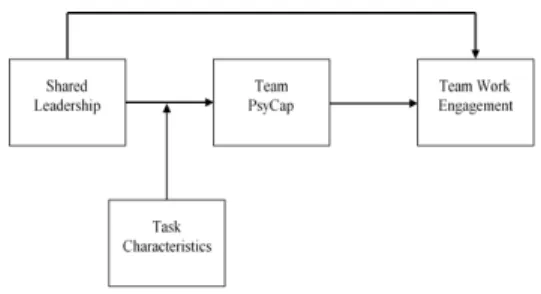
The purpose of this study is to clarify the causal relationship between shared leadership and team psychological capital and team work engagement, and to investigate the moderating effect of task characteristics between shared leadership and team psychological capital [Figure 1].
Figure 1. Conceptual Model of the Present Study
1. Shared Leadership and Team Work Engagement
According to JD-R theory, which is the most often used for studying engagement, job resources including autonomy, social support, performance feedback, which are similar to the sub dimensions of shard leadership, influence work engagement[50].
Pearce, Wassenaar, and Manz[27] emphasized that shared leadership results in a more engaged workforce and makes the workforce more effective as a direct result of having multiple leaders available.
Nevertheless, a few studies were conducted that investigated whether shared leadership has an effect
on work engagement, with the exceptions of Leeuwen [51], Zeier[52], and Lovelace et al.[53]. However, those studies focused on the individual level and the results are not reconciled. Whereas Zeier[52], and Lovelace et al.[53] showed a positive relation, Leeuwen [51]
concluded that shared leadership does not have a significant impact on engagement relative to vertical leadership. Therefore, the question arises as to how shared leadership stimulates or impedes work engagement in teams and team work engagement.
According to the JD-R model, employees are especially engaged in their work when their resources are combined with challenging demands[54][55].
Accordingly, it is likely that employees feel more engaged when they have a high-quality exchange relationship with their leader because their leader expects high job performance and facilitates their job performance in return through a so-called social support process. Leadership styles, in their inherent position of power, can be an important source of social support. Hiller et al.[18] argued that social support is a major factor of shared leadership.
Transformational and empowering leadership was shown to be positively related to work engagement[56]. According to Pearce et al.[57], effective shared leadership teams generally use a transformational and empowering leadership style.
Ranthum found that the shared leadership is positively and significantly related to team performance[58]. Thus, the possibility exists that shared leadership also has a positive relationship with work engagement at the team level. On the basis of this discussion, the following hypothesis were proposed in the present study.
Hypothesis 1. Shared leadership influences team
work engagement.
2. Shared Leadership and Team PsyCap
JD-R theory explains that job resources including autonomy, social support, performance feedback that is similar to the concepts of shard leadership predict PsyCapwork[50]. Research on the relations between shared leadership and PsyCap is still lacking.However, PsyCap was found to be related to a number of leadership styles. PsyCap is related to authentic leadership and ethical and empowering leadership[59]. PsyCap can become shared among team members through communications regarding the team’s functions and operations[42]. McKenny et al.[60] suggested that organizational PsyCap develops through members’ interactions over time and reflects the shared level of positivity among employees. Li, Shu, Lie, Guoyuan & Lei[61] found that employees who perceived higher levels of supervisor support had higher levels of PsyCap. Ranthum also found that shared leadership and team psychological capital have a positive relationship[58]. Therefore, this study proposes the following hypothesis that result from these discussions.
Hypothesis 2. Shared leadership positively influences team PsyCap.
3. Team PsyCap and Team Work Engagement
Using the Xanthopoulou et al.‘s concept, Bakker and Demerouti developed a JD-R theory that shows that job resources and personal resources, independently or combined, predict work engagement[62]. Personal resources include self efficacy, hope, resilience that are identical to the sub dimensions of psychological capital. PsyCap was found to be a useful predictor of various job attitudes, behaviors, and performance [58].Walumba et al.[43] argued that the work group’s collective psychological capital is not only a product of interactive/coordinative dynamics and leadership
but also a producer of desired behaviors and performance outcomes. Additionally, three studies examined PsyCap at a collective level[11-13] and demonstrated positive relationships between team-level PsyCap and team performance. Ranthum also discovered team psychological capital to be positively and significantly related to team performance[58]. As individual work engagement has a positive impact on job performance at individual level[51], team work engagement can be an antecedent of team performance. Thus, the following hypothesis were proposed in the present study.
Hypothesis 3. Team PsyCap positively influences team work engagement.
4. Mediating Role of Team PsyCap
JD-R theory explains that PsyCap mediates job resources and work engagement[50]. Walumba et al.empirically proved that group-level psychological capital fully mediates the relationship between authentic leadership and two desired group outcomes:
group OCB and performance[43]. Luthans et al.
empirically tested the concept that PsyCap fully mediates the relationship between a supportive organizational climate and employee performance, a consequence of work engagement[63]. A supportive organizational climate, which is defined as the overall amount of perceived support that employees receive from their immediate peers and their supervisor that they view as helping them successfully perform their work duties, is similar to the basic concept of shared leadership[18]. Ranthum found that team psychological capital partially mediated the relationship between shared leadership and team performance[58]. Newman, Ucbasaran, Zhu and Hirst[64] argued that their intensive meta-analysis on the antecedents and outcomes of PsyCap and PsyCap’s role as a mediator
at the individual, team, and organizational levels indicated the possibility of a mediating role of team PsyCap between shared leadership and team-level engagement. Therefore, this study proposes the following hypothesis, which results from the previous discussions.
Hypothesis 4. Team psychological capital partially mediates shared leadership and team work engagement.
5. Moderating Role of Task Characteristics
The primary focus of research on shared leadership to date has been on investigating the direct effects of shared leadership. However, several scholars suggested the possibility that the relationship between shared leadership and outcomes may be moderated by other variables[24]. One of the variables is task characteristics, which has a direct effect onemployee work-related attitudes and behaviors and, more importantly, the individual differences needed for development, which is called the
Growth Need Strength in Job Characteristics Theory (Hackman and Lawler 1971). Hoch et al.[65] found that task characteristics, including task independence, task complexity has a moderating effect on the shared leadership and team performance relationship. The moderating effects highlight the possible variation in the relationship between shared leadership and team processes for implementation teams. Dawkins et al.[42] proposed that teams with high task interdependency may have a better opportunity to develop team PsyCap because members regularly communicate about the team’s overall likelihood of achieving goals (team optimism) and their shared belief in their ability to achieve tasks (team efficacy).Using the previous discussion, the following hypothesis was proposed in the present study.
Hypothesis 5. Task characteristics moderate the relationship between team PsyCap and team work engagement, such that the relationship is stronger when task characteristics is high.
Ⅳ. Methodology
Participants for this study were employees in South Korea. A total of 700 surveys were sent by mail and direct delivery, and 421 surveys from 100 teams in 16 companies were collected, representing a response rate of 60.1%. Respondents had the following demographic characteristics: approximately 63.4%
were male, 69% had a bachelor’s degree, 13.5% had a master’s degree or higher, and 73.6% had job tenure less than 10 years. The average age of the participants was 36 years, and the average years of work experience was 4.6 years.
Participants rated their team’s shared leadership level, team PsyCap, team work engagement, and task characteristics levels by using a five-point Likert scale that ranged from “strongly disagree” (1) to
“strongly agree” (5). Shared leadership was measured with the 25-item scale that was developed and validated by Hiller et al.[18] and used by Bang[66].
We measured team’s shared leadership level by checking the items by each team member and team leaders because the shared leadership is a group-level construct and a team property[7] and the interactive influence among team members including team leader.
Sub-factors are composed of 1) planning and organizing, 2) problem solving, 3) support and consideration, and 4) development and mentoring.
Sample items include “organizing tasks so that work flows mores smoothly,”(우리 팀원들은 공동으로 팀의 업무가 원활히 흘러갈 수 있도록 업무를 조정한다).
“diagnosing problems quickly,”(팀원들은 공동으로 당 면 문제를 빠르게 분석한다. ) and “helping to develop each other’s skills.”(팀원들이 공동으로 다른 구성원들 이 스킬을 배양할 수 있도록 돕는다.)
Team work engagement is divided into three categories: team vigor, team dedication and team absorption. This measure adapted the nine-item scale to assess team work engagement that was developed and validated by Costa et al.[32]. Each of the three factors was assessed by three items. In the present research, a referent shifted questionnaire was used.
Sample items include “At our work, we feel bursting with energy,” “We are enthusiastic about our job,”
and “We feel happy when we are working intensely.”
Team psychological capital which has four constructs, Team hope, Team resilience, Team optimism, and Team efficacy was measured with the 24-item scales that was developed by Dawkins et al.[15]. Each of the four factors was assessed using six items. Sample items include “My team is confident analyzing a long-term problem to find a solution,” “Right now my team is pretty successful at work,” “My team usually manages difficulties one way or another at work,” and
“My team always looks on the bright side of things regarding our jobs.” Task characteristics which has seven constructs, task variety, task significance, task identity, interdependent feedback and reward, task interdependence, goal interdependence and heterogeneity were measured with 21-item scales that was developed by Campion et al.[67]. Each of the seven factors was assessed using three items. Sample items include “Most everyone on my team gets a chance to do more interesting tasks.”, “The work performed by my team is important to the customers in my area.”, “My team is responsible for all aspects of a product for its area.”
Ⅴ. Result
1. Exploratory Factor Analysis and Reliability nalysis
1.1 Shared Leadership
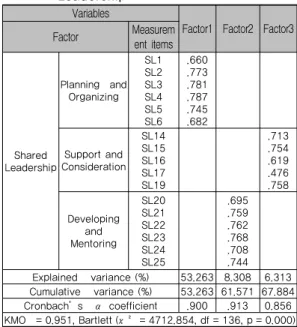
The results of the reliability analysis on a total of three latent variables are as follows. The Cronbach’s α coefficient was higher than 0.7, thereby indicating a highly reliable score[Table 1]. Furthermore, exploratory factor analysis was performed using principal component analysis for factor extraction and the Varimax method as the rotation method. As a result, two variables with significantly low factor loading values were removed, and a total of 17 variables were selected. A factor loading value higher than 0.4 is considered a valid variable, and a value higher than 0.5 is considered an important variable.
All 17 variables presented factor loading values of more than 0.4 and, thus, can be considered important variables. Additionally, the three variables can be
Table 1. Exploratory Factor Analysis on Shared Leadership
Variables
Factor1 Factor2 Factor3
Factor Measurem
ent items
Shared Leadership
Planning and Organizing
SL1 SL2 SL3 SL4 SL5 SL6
.660 .773 .781 .787 .745 .682
Support and Consideration
SL14 SL15 SL16 SL17 SL19
.713 .754 .619 .476 .758
Developing and Mentoring
SL20 SL21 SL22 SL23 SL24 SL25
.695
.759
.762
.768
.708
.744
Explained variance (%) 53.263 8.308 6.313
Cumulative variance (%) 53.263 61.571 67.884
Cronbach’s α coefficient .900 .913 0.856
KMO = 0.951, Bartlett (χ² = 4712.854, df = 136, p = 0.000)
viewed as having an explanatory power of 67%. The KMO value, which measures the adequacy of the sample, was 0.951, i.e., close to 1.
1.2 Team Work Engagement
The result of conducting a reliability analysis on a total of two latent variables indicated that the Cronbach’s α coefficient was higher than 0.7, thereby signifying very high reliability [Table 2]. Furthermore, exploratory factor analysis was performed using principal component analysis for factor extraction and the Varimax method as the rotation method. As a result, four items with significantly low factor loading values were removed and five items were selected. A factor loading value higher than 0.4 is considered valid, and a value higher than 0.5 is considered important. All five variables presented factor loading values higher than 0.5 and, thus, are considered important variables. Additionally, the two variables are viewed as having an explanatory power of 73%.
The KMO value, which measures the adequacy of the sample, was 0.748 or close to 1. Bartlett’s sphericity test statistics, which verify whether the correlation between the variables is 0, was 1410.603 (df=15, p=0.000), thereby significant at the 0.01 significance level. Therefore, the correlation matrix can be interpreted as appropriate for the factor analysis.
Table 2. Exploratory Factor Analysis on Team Work Engagement
Variables
Factor1 Factor2 Factor Measurement
items
Team Work Engagement
Team vigor
WE1 WE2
.835 .857 Team
absorption WE7 WE8 WE9
.581 .911 .915
Explained variance (%) 57.237 15.936 Cumulative variance (%) 57.237 73.173 Cronbach’s α coefficient 0.828 0.912 KMO = 0.748, Bartlett (χ² = 1410.603, df = 15, p=0.000)
1.3 Team PsyCap
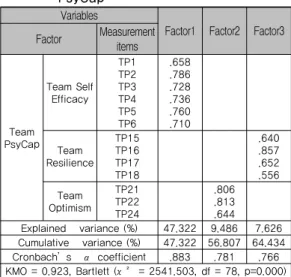
The result of conducting a reliability analysis on a total of three latent variables indicated that the Cronbach’s α coefficient was higher than 0.7, thereby signifying very high reliability [Table 3]. Furthermore, exploratory factor analysis was performed using principal component analysis for factor extraction and the Varimax method as the rotation method. As a result, five items with significantly low factor loading values were removed, and a total of 13 items were selected. A factor loading value of higher than 0.4 is considered a valid variable, and a value higher than 0.5 is considered an important variable. All 13 variables presented a factor loading value higher than 0.5 and, thus, can be considered important variables.
Additionally, the three variables are viewed as having an explanatory power of 64%. The KMO value, which measures the adequacy of the sample, was 0.923, i.e., close to 1, and Bartlett’s sphericity test statistics, which verify whether the correlation between the variables is 0, was 2541.503 (df = 78, p = 0.000), thereby significant at a 0.01 significance level. Thus, the correlation matrix can be interpreted as appropriate for the factor analysis.
Table 3. Exploratory Factor Analysis on Team PsyCap
Variables
Factor1 Factor2 Factor3 Factor Measurement
items
Team PsyCap
Team Self Efficacy
TP1 TP2 TP3 TP4 TP5 TP6
.658 .786 .728 .736 .760 .710
Team Resilience
TP15 TP16 TP17 TP18
.640 .857 .652 .556 Team
Optimism TP21 TP22 TP24
.806
.813
.644
Explained variance (%) 47.322 9.486 7.626
Cumulative variance (%) 47.322 56.807 64.434
Cronbach’s α coefficient .883 .781 .766
KMO = 0.923, Bartlett (χ² = 2541.503, df = 78, p=0.000)
1.4 Task Characteristics
The results of conducting reliability analysis on a total of four latent variables indicated that the Cronbach’s α coefficient was higher than 0.7, thereby signifying very high reliability[Table 4]. Furthermore, exploratory factor analysis was performed using principal component analysis for factor extraction and the Varimax method as the rotation method. As a result, two items with significantly low factor loading values were removed and ten items were selected. A factor loading value of higher than 0.4 is considered a valid variable, and a value higher than 0.5 is considered an important variable. All ten variables presented factor loading values higher than 0.7 and, thus, can be considered important variables.
Additionally, the four variables can be viewed as having an explanatory power of 74%. The KMO value, which measures the adequacy of the sample, was 0.747, i.e., close to 1. The Bartlett’s sphericity test statistics, which verifies whether the correlation between the variables is 0, was 1322.933 (df=45, p=0.000), thereby significant at the 0.01 significance
Table 4. Exploratory Factor Analysis on Task Characteristics
Variables
Factor1 Factor2 Factor3 Factor4 Factor
Measur ement
items
Task Char acteri stics
Task Variety
TC1 TC2
.871 .872 Task
Identity TC8 TC9
.876 .856 Interdepe
ndent Feedback
and Rewards
TC16 TC17 TC18
.787 .866 .763
Heterogen eity
TC19 TC20 TC21
.796 .837 .716
Explained variance (%) 35.657 14.265 12.499 11.676 Cumulative variance(%) 35.657 49.922 62.421 74.096
Cronbach’s α
coefficient .772 .749 .755 .772 KMO = 0.747, Bartlett (χ² = 1322.933, df = 45, p=0.000)
level. Thus, the correlation matrix can be interpreted as appropriate for the factor analysis.
2. Review of Analysis Level
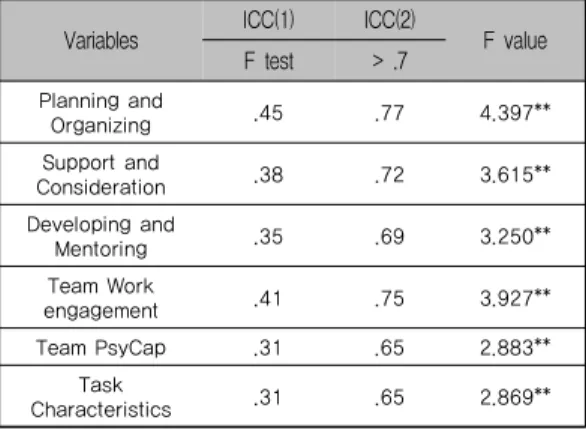
The results of the analysis level review indicate that the value of ICC (1), which conducts a degree-of-freedom-based F test, exists between –1 and +1. Statistically significant values were derived for all variables; therefore, the size of the between- group dispersion on the total variance of the corresponding variable was determined to be sufficiently large [Table 5]. The current ICC (1) value for each variable is indicates between the .31 and .45levels, which can be interpreted as 31%–42% of the total variance being explained by between-group dispersion. The ICC (2) values indicate that Developing and Mentoring, Team PsyCap, and Task Characteristics are low, at less than .7. However, this level needs to be reviewed comprehensively with the analysis results from other coefficients.
Considering the statistical inference results on such analysis levels, all variables measured at the individual level can be summed at the group level to perform an analysis and resolve the level issue.
Table 5. Results of Analysis Level Review
Variables ICC(1) ICC(2)
F value F test > .7
Planning and
Organizing .45 .77 4.397**
Support and
Consideration .38 .72 3.615**
Developing and
Mentoring .35 .69 3.250**
Team Work
engagement .41 .75 3.927**
Team PsyCap .31 .65 2.883**
Task
Characteristics .31 .65 2.869**
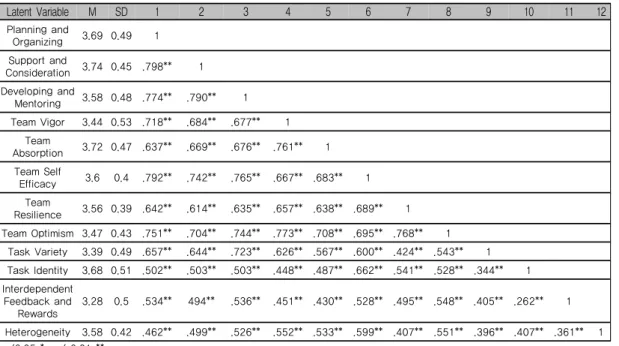
Latent Variable M SD 1 2 3 4 5 6 7 8 9 10 11 12 Planning and
Organizing 3.69 0.49 1
Support and
Consideration 3.74 0.45 .798** 1 Developing and
Mentoring 3.58 0.48 .774** .790** 1
Team Vigor 3.44 0.53 .718** .684** .677** 1 Team
Absorption 3.72 0.47 .637** .669** .676** .761** 1
Team Self
Efficacy 3.6 0.4 .792** .742** .765** .667** .683** 1 Team
Resilience 3.56 0.39 .642** .614** .635** .657** .638** .689** 1 Team Optimism 3.47 0.43 .751** .704** .744** .773** .708** .695** .768** 1
Task Variety 3.39 0.49 .657** .644** .723** .626** .567** .600** .424** .543** 1 Task Identity 3.68 0.51 .502** .503** .503** .448** .487** .662** .541** .528** .344** 1
Interdependent Feedback and
Rewards
3.28 0.5 .534** 494** .536** .451** .430** .528** .495** .548** .405** .262** 1
Heterogeneity 3.58 0.42 .462** .499** .526** .552** .533** .599** .407** .551** .396** .407** .361** 1 p <0.05 *, p < 0.01 **
Table 6. Correlation Analysis
3. Correlation Analysis Results of the Latent Variables
The correlations among the latent variables included in the research model are shown in [Table 6]. The correlations of latent variables were, for the most part, highly statistically significant. When all variables were compared, the correlations between the independent variable and mediating variable, the independent variable and dependent variable, and the mediating variable and dependent variable showed strong correlations.
4. hypothesis Testing Results
To test the hypothesis, a simple regression analysis and a three-step regression analysis were performed for the mediating effect. Moreover, a hierarchical regression analysis was performed for the moderating effect and a post-hoc test was conducted thorough the Sobel Test.
Hypothesis 1 states that shared leadership is positively related to team work engagement.
As shown in [Table 7], the regression analysis results indicate that the shared leadership and team work engagement regression model was suggested to be significant through F value verification (F = 151.621, p < .01). The explanatory power was high at
R² = 0.607. Additionally, the regression coefficient
regarding shared leadership and team work engagement is .779 (p < .01), which presents a significant positive (+) effect. Therefore, hypothesis 1 was supported.Table 7. Effect of Shared Leadership on Team Work Engagement
Team work engagement
B SE β t
Constant .544 .248
Shared
Leadership .827 .067 .779** 12.313
R² = 0.607, adj R² = 0.603, F = 151.621** (p < .05)
p < 0.05*, p < 0.01**
Hypothesis 2 states that shared leadership is positively related to team PsyCap.
As shown in [Table 8], the regression analysis results indicate that the regression model of shared leadership and team PsyCap was suggested as significant through F value verification (F = 261.682, p < .01). The explanatory power was very high at R²
= 0.728.
Table 8. Effect of Shared Leadership on Team PsyCap
Team PsyCap
B SE β t
Constant .941 .162
Shared Leadership .709 .044 .853** 16.177 R²= 0.728, adj R²= 0.725, F = 261.682** (p < .01) p < 0.05*, p < 0.01**
Additionally, the regression coefficient regarding shared leadership and team PsyCap is .853 (p < .01), thus presenting a significant positive (+) effect.
Therefore, hypothesis 2 was supported.
Hypothesis 3 states that team PsyCap is positively related to team work engagement.
As shown in [Table 9], the regression analysis results indicate that the team PsyCap and team work engagement regression model was suggested as significant through F value verification (F = 194.566, p < .01).
Table 9. Effect of Shared Leadership on Team PsyCap
Team work engagement
B SE β t
Constant –.109 .266 Team
PsyCap 1.041 .075 .815** 13.949
R² = 0.665, adj R² = 0.662, F = 194.566** (p < .01) p< 0.05*, p < 0.01**
The explanatory power was very high at R² = 0.665. Additionally, the regression coefficient regarding team PsyCap and team work engagement is .815 (p < .01), thus presenting a significant positive (+) effect. Therefore, hypothesis 3 was supported.
Hypothesis 4 states that team PsyCap mediates the relationship between shared leadership and team work engagement.
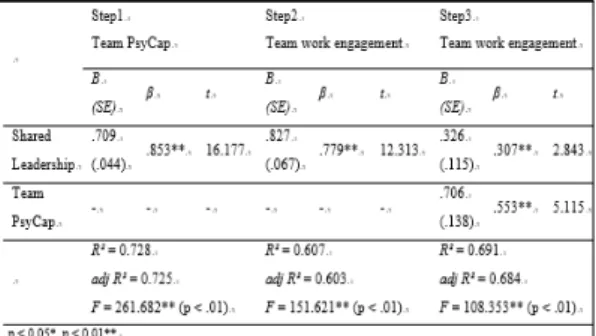
As shown in [Table 10], the result of testing Hypothesis 4 through the aforementioned three-step hierarchical regression analysis indicated that team PsyCap acts as a mediating role between shared leadership and team work engagement. First, examining regression models in step 1 indicates that the F value is 261.682 and the p (.000) value is smaller than the .01 significance level, thus presenting a significant result. The explanatory power was very high at R² = 0.728, and
β = .853; therefore, shared
leadership, i.e., an independent variable, can be viewed as having a significant positive (+) relationship with team PsyCap, i.e., a mediating variable. Next, an examination of regression models in step 2 indicates that the F value is 151.621 and the p (.000) p < 0.05*, p < 0.01**value is smaller than the significance level of .01, thus presenting a significant result.Table 10. Mediating Effect of Team PsyCap
The explanatory power was very high at R² = 0.607, and
β = .779; therefore, shared leadership, i.e.,
an independent variable, is viewed as having a positive (+) relationship with team work engagement, i.e., a dependent variable.Lastly, for the regression model in step 3, which examined simultaneously the affect relationships between the independent variable and the dependent variable of the mediating variable, the F value is 108.353 and the p (.000) value is smaller than the significance level of .01, thus presenting a significant result. The explanatory power was very high at R²
= 0.691. However, the
β
value, which is the standardized regression coefficient, decreased from .779 in step 2 to .307 in step 3. Therefore, team PsyCap, i.e., a mediating variable, can be viewed as functioning as the mediating role between shared leadership, i.e., an independent variable, and team work engagement, i.e., a dependent variable. Next, an additional Sobel Test was performed for a post-hoc test to verify whether the indirect effect of team PsyCap is significant. This test is a method for directly verifying whether the size of the indirect effect (i.e., mediating effect) that the independent variable has on the dependent variable through the mediating variable is significant. A Sobel Test was performed with the non-standardized standard error and the non-standardized regression coefficient of step 1 and step 3, and the results of the test determine that the mediating effect is significant if the Z value is larger than 1.96 or smaller than -1.96 (Baron & Kenny 1986). The result of testing B = .709 and SE = .044 from step 1, and B = .326 and SE = .115 from step 3, indicates that Z = 2.791, p < .01.Here, the Z value is larger than 1.96 and, thus, signifies that the indirect effect of team PsyCap that mediates the relationship of shared leadership and team work engagement is statistically significant.
Such results show that team PsyCap functions in a mediating role in the relationship between shared leadership and team work engagement. Accordingly, hypothesis 4 was supported.
Hypothesis 5 states that task characteristics moderate the relationship between shared leadership and team PsyCap. The relationship between shared leadership and team PsyCap is stronger for higher task characteristics.
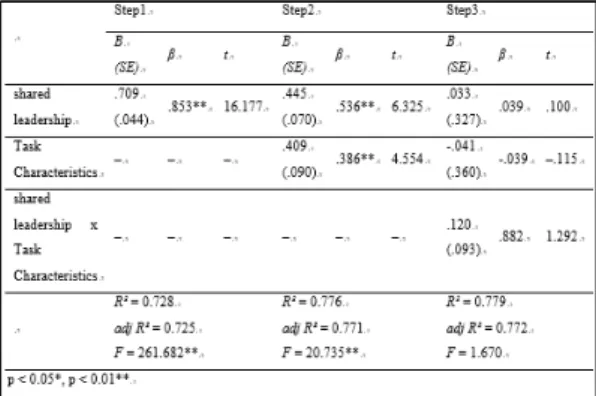
A hierarchical regression analysis was conducted to test hypothesis 5. To test Hypothesis 5, the interactive term of shared leadership and task characteristics was input into the effect of shared leadership on team PsyCap to analyze its moderating effects. As shown in [Table 11], this analysis indicated that the test for effectiveness with only shared leadership in step 1 resulted in an F value of 261.682, and the p (.000) value was smaller than the significance level of .01, thus presenting a significant result.
Table 11. Moderating Effect of Task Characteristics
The explanatory power was very high at R² = 0.728. In step 2, when shared leadership and task
characteristics are both input, the F value result is 20.735 and the p (.001) value was smaller than the 0.01 significance level. Therefore, a statistically significant result was presented.
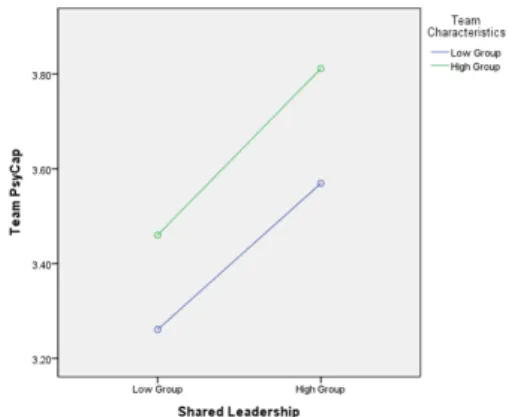
Figure 2. shared leadership and team psycap by team characteristics
Additionally, the explanatory power was very high at R² = 0.776. In step 3, the input of interactive terms for shared leadership and task characteristics indicated an F value of 1.670 with p (.199), which is larger than the 0.05 significance level and was not significant. Therefore, the results of hypothesis 5 appear to be not statistically significant as [Figure2].
Ⅵ. DISCUSSIONS
This study contributes to expanding our understanding of the effect of shared leadership by highlighting the concepts of team psychological capital and team work engagement— topics that have not been fully investigated in the literature on team effectiveness but that seems to be stimulated by the emergence of shared leadership among team members. The result of testing the effects of shared leadership and team work engagement indicated that shared leadership presents a positive (+) significant
and direct effect on team work engagement. This result signifies that an increase in the degree of shared leadership among team members leads to an increase in energy, dedication, and absorption to process work, as well as improved engagement within the team.
Team PsyCap functioned as a mediating role in the relationship between shared leadership and team work engagement. The results of preceding empirical studies on shared leadership presented a somewhat conflicting result. For this reason, this study suggests the effects of team PsyCap as an alternative to the process between shared leadership and team work engagement and empirical results support the hypothesis.
In this study, the moderating effect of the task characteristics on the relationship between shared leadership and team PsyCap was tested, but no significant effect was found. A few interpretations can be drawn to explain this result. First, various variables that can influence this study’s result should have been controlled properly to minimize the result contamination. Considering that the analysis level of this study is a team, a number of reasons for the absence of moderating variable effect can be inferred:
the team size and average tenure, known to influence the dynamic interaction within a team were not controlled; the fact that this study was conducted on teams from 16 different corporations was not taken into consideration so a control by industries was not factored in; and there was no control on the collectivism, a prevalent cultural characteristic of organizations in South Korea. Second, the samples, the subject of measurement of this study, were mainly office workers in corporations. It is difficult in reality to find significant differences in task characteristics of such samples. Third, another possible reason for insignificant moderating effect of
task characteristics might be multi-collinearity, because correlation between task characteristics and shared leadership showed strongly significant figure.
(r =0.82, p < .01) in this study. When we develop research model with task characteristics and shared leadership, definitely task characteristics is ‘task’
related variable, ‘Task characteristics is defined as various aspects which a task has’, and shared leadership is ‘leadership’ related variable, ‘a dynamic, interactive influence process among individuals and groups with the objective of leading one another to the achievement of group or organizational goals or both ‘(Pearce & Conger 2003). However, the result of survey revealed multi-collinearity between two variables. This can be a reason why the hypothesis 5 was not supported.
The implications of this study from a theoretical aspect are as follows. First, shared leadership was indicated as posing a significant positive (+) effect on team work engagement. Considering that a high degree of team work engagement is a predictor of strong performance, this result provides an explanation of the mechanism between shared leadership and team performance in reference to existing studies that connected shared leadership within the team to, ultimately, high performance[68].
Second, the improvement mechanism of team work engagement of shared leadership is identified.
Existing empirical studies on shared leadership lacked research into shared leadership that positively (+) affects team work engagement in a direct or an indirect manner. In this study, by testing the mediating effect of team PsyCap, the path through which shared leadership influences team work engagement was identified. In particular, team self-efficacy, among the sub-variables, was revealed as being the most important mediating variable in a mediating role. This study indicates that shared
leadership within teams activates team PsyCap and presents the result that this activation improves team work engagement. Moreover, shared leadership within teams is confirmed as an important input variable of team effectiveness.
The following is a discussion on the implication at the practical aspects in this study. First, at the leadership level, the implementation of shared leadership within the team does not mean that no vertical leaders exist. As mentioned in a previous study, shared leadership and traditional leadership are not alternative relationships; rather, they are interdependent relationships. A vertical leader has the final responsibility for managing the team’s boundary and performance-related matters. Above all, support and coaching are needed to activate shared leadership.
Most every team has a team head who is the official leader, and the role of the official leader is important in implementing shared leadership. Therefore, when explaining the phenomenon of shared leadership, rather than merely emphasizing that the role of the leader is shared among team members, to be effective, one must consider the various roles of the leader in accordance with team and task characteristics.
Second, in reality, where the hierarchical vertical relationship between supervisors and employees continues to be practiced, team members need to be aware of shared leadership throughout the organization. The mindset must exist that leadership can be shared within the team and all team members, including the team head, must have the awareness that lateral feedback needs to be implemented first.
Second, the organizational environment that is defined as hyper-competitive indicates that, for companies to continue to grow, they are in dire need of team members with energy, dedication, and absorption based on a high PsyCap that cannot be imitated by
other organizations. Shared leadership can be viewed as being effective compared with existing vertical leadership in organic formation and the emergence of such factors for the organization. Moreover, providing systems, institutions, and devices for empowerment and secure autonomy for team members during work at the organizational level is important for shared leadership to be implemented well among team members. Third, to achieve the activate practice of shared leadership, companies must go beyond mere HRD and establish a training system at the level of organizational development. In particular, shared leadership can change according to the duration of the team and changes in the members; therefore, a development program must provide practical education with the possibility of continuous monitoring and feedback. education through a long-term perspective plan that can be internalized within the team is needed.
The limitations of this study are as follows. First, the research sample of this study is 16 companies.
Although the research results might be favorable for generalization given the diversity secured within the dataset in terms of size, business sectors, and company age, doubt exists regarding whether or not errors exist in the data because they were collected from various samples. In particular, limitations exist in establishing credibility from the intervention of the organizational characteristics in the sub-variables.
Second, various exogenous variables and antecedents that can effect team PsyCap and team work engagement were not sufficiently considered. The following suggestions concern future research. First, a longitudinal study is desperately needed to test the sustainability effects of shared leadership, team PsyCap, and team work engagement. Team-related variables can be viewed as variables that react sensitively to the team’s age, i.e., from team creation
to growth, maturity, and decline. Therefore, identifying the patterns that occur through a long-term periodic constant, and measuring the effect of each variable accordingly, is necessary. Second, examining the level of harmonization between vertical leadership and shared leadership, and its effect on team PsyCap and team work engagement, is a good research topic for future studies. Lastly, actively searching out mediating variables other than team PsyCap as suggested in this study is needed to further identify the process of shared leadership that influences team work engagement. To which, research on the mediating effect of factors, such as team potency and team cohesion, is a possibility.
참 고 문 헌
[1] D. R. Goeltz, “Globalization and hyper- competition: Drivers, linkages, and industry differences,” Journal of International Business and Cultural Studies, Vol.8, 2014.
[2] V. LaPort Nicolaides, K. Chen, T. Tomassetti, A. Weis, E. Zaccaro, and J. Cortina, “The shared leadership of teams: A meta-analysis of proximal, distal, and moderating relationship,”
The Leadership Quarterly, Vol.25, pp.923-94, 2014.
[3] E. Salas, K. C. Stagl, and C. S. Burke, “25 years of team effectiveness in organizations: research themes and emerging needs,” International review of industrial and organizational psychology, Vol.19, No.42, pp.47-92, 2004.
[4] S. W. J. Kozlowski and B. S. Bell, “Work
groups and teams in organizations: Review
update [Electronic version],”
Cornell University, School of Industrial and Labor Relations, 2013.[5] J. Mielonen, “Making sense of shared leadership.
A case study of leadership processes and practices without formal leadership structure in the team context,” Acta Universitatis Lappeenrantaensis 451, Thesis for the degree of Doctor, 2011.
[6] J. O’Toole, J. Galbraith, and E. Lawler, “When two (or more) heads are better than one: the promise and pitfalls of shared leadership,” In Pearce, C. L. and Conger, J. (Eds), “Shared Leadership: Reframing the Hows and Whys of Leadership,” London: Sage, pp.250-267, 2003.
[7] J. B. Carson, P. E. Tesluk, and J. A. Marrone,
“Shared leadership in team: An investigation of
antecedent conditions and performance,”
Academy of Management Journal, Vol.50, No.5, pp.1217-1234, 2007.
[8] P. Costa, A. M. Passos, and A. B. Bakker,
“Team Work Engagement: A model of emergence,” Journal of Occupational and Organizational Psychology, Vol.87, pp.414-436, 2014a.
[9] L. I. Glassop, “The organizational benefits of teams,” Human Relations, Vol.55, pp.225-249, 2002.
[10] C. M. Youssef and F. Luthans,
“Positivepsychological capital in the workplace: Where we are and where we need to go,” In K. M.
Sheldon, T. B. Kashdan and M. F. Steger (Eds.),
“Designing positive psychology: Taking stock and moving forward,” New York, NY: Oxford University Press, pp.351-364, 2011
[11]
R. Clapp-Smith, G. R. Vogelgesang, and J. B.Avey, “Authentic leadership and positive psychological capital: The mediating role of trust at the group level of analysis,” Journal of Leadership and Organizational Studies, Vol.15, pp.227-240, 2009
[12] S. J. Peterson and Z. Zhang, “Examining the relationships between top management team psychological characteristics, transformational leadership, and business unit performance,” In M. A. Carpenter (Ed.). Handbook of top management research, New York: Edward Elgar Publishing, pp.127-149, 2011.
[13] V. Vanno, W. Kaemkate, and S. Wongwanich,
“Relationships between academic performance, perceived group psychological capital, and positive psychological capital of Thai undergraduate students,” Procedia – Social and Behavioral Sciences, Vol.116, pp.3226-3230, 2014.
[14] V. Vanno, W. Kaemkate, and S. Wongwanich,
“Effect of group-level positive psychological capital on group effectiveness of Thai students,”
Procedia – Social and Behavioral Sciences, Vol.171, pp.1309-1314, 2015.
[15] S. Dawkins, A. Martin, J. Scott, and K.
Sanderson, “Advancing conceptualization and measurement of psychological capital as a collective construct,” Human Relations, Vol.68, No.6, pp.1-25, 2014.
[16] S. L. Chen, “The relationship of leader psychological capital and follower psychological capital, job engagement and job performance: a multilevel mediating perspective,” The International Journal of Human Resource Management, Vol.26, No.18, pp.2349-2365, 2015.
[17] J. Somehagen and V. Johansson, Shared
Leadership and its Future Potential - Why do, How to and then What?, Linnaeus University,
Master Thesis, 2015.[18] N. J. Hiller, D. V. Day, and R. J. Vance,
“Collective enactment of leadership roles and team effectiveness: A field study,” The Leadership Quarterly, Vol.17, No.4, pp.387-397,
2006.
[19] C. Y. Chiu, Investigating the emergence of
shared leadership in teams: The roles of team proactivity, internal social context, and leader humility, Graduate School of the University at
Buffalo, State University of New York, Ph. D Dissertation, 2014.[20] J. K. Lee, A study on the Effect of Shared
Leadership on Team Effectiveness - The Mediating Effects of Team Efficacy, Team Intrinsic Motivation, and Team Accountability,
Kookmin University, Thesis for the degree of Doctor, 2016.[21] N. M. Wild, Antecedent conditions of shared
leadership: An examination of team personality composition, shared leadership and team effectiveness, The University of Tennessee at
Chattanooga, Chattanooga, Tennessee, Master Thesis, 2015.[22] J. E. Mathieu, M. R. Kukenberger, L.
D’Innocenzo, and G. Reilly, “Reciprocal Team Cohesion–Performance Relationships, as impacted by Shared Leadership and Members’
Competence,” Journal of Applied Psychology, Vol.100, No.3, pp.713-734, 2015.
[23] U. S. M. Ullah and D. S. Park, “Shared leadership and team effectiveness: Moderating effects of task interdependence,” African Journal of Business Management, Vol.7, No.40, pp.4206-4220, 2013.
[24] K. Boies, E. Lvina, and M. L. Martens, “Shared leadership and team performance in a business strategy simulation,” Journal of Personnel Psychology, Vol.9, pp.195-202, 2010.
[25] J. E Hoch, C. L Pearce, and L. Welzel, “Is the most effective leadership shared? The impact of shared leadership, age diversity, and coordination on team performance,” Journal of
Personnel Psychology, Vol.9, pp.105-116, 2010.
[26] M. S. Fausing, H. Jeppesen, T. S. Jønsson, J.
Lewandowski, and M. C. Bligh, “Moderators of shared leadership: Work function and team autonomy,” Team Performance Management, Vol.19, No.5, pp.244-262, 2013.
[27] C. Pearce, C. Wassenaar, and C. Manz, “Is shared leadership the key to responsible leadership?,” Academy Of Management Perspectives, Vol.28, No.3, pp.275-288, 2014.
[28] 변영실, 백기복, "이슈리더십과 혁신행동 관계에 있어 직무열의의 매개효과," 한국콘텐츠학회논문 지, Vol.15, No.9, pp.494-508, 2015.
[29] P. Torrente, M. Salanova, S. Llorens, and W. B.
Schaufeli, “From ‘I’ to ‘We’: The factorial validity of a team work engagement scale,” In J.
Neves and S. P. Goncalves(Ed.s). “Occupational health psychology: From burnout to well-being, pp.333-352, 2012a.
[30] P. Torrente, M. Salanova, S. Llorens, and W. B.
Schaufeli, “Teams make it work: How team work engagement mediates between social resources and performance in teams,”
Psicothema, Vol.24, pp.106-112, 2012b.
[31] H. Acosta, M. Salanova, and S. Llorens, “How Organizational Practices Predict Team Work Engagement: The Role of Organizational Trust,”
Ciencia & Trabajo, pp.7-15, 2012.
[32]P. Costa, A. M. Passos, and A. B. Bakker,
“Empirical validation of the team work engagement construct,” Journal of Personnel Psychology, Vol.13, pp.34-45, 2014b.
[33] P. Costa, A. M. Passos and A. B. Bakker,
“Direct and Contextual Influence of Team Conflict on Team Resources, Team Work Engagement, and Team Performance,”
Negotiation and Conflict Management Research, Vol.8, pp.211-227, 2015.
[34] M. Salanova, S. Llorens, E. Cifre, I. Martı´nez, and W. B. Schaufeli, “Perceived collective efficacy, subjective well-being and task performance among electronic work groups: An experimental study,” Small Groups Research, Vol.34, pp.43-73, 2003.
[35] W. B. Schaufeli and A. B. Bakker, “Job Demands, Job Resources, and Their Relationship with Burnout and Engagement: A Multi-Sample Study,” Journal of Organizational Behavior, Vol.25, pp.293-315, 2004.
[36] W. B. Schaufeli and A. B. Bakker, “The conceptualization and measurement of work engagement: A review. In A. B. Bakker and M.
P. Leiter (Eds.). Work engagement: A handbook
of essential theory and research,” New York,
NY: Psychology Press, pp.10-24, 2010.[37] P. Costa, A. M. Passos, and A. B. Bakker,
“Team work engagement: Considering team dynamics for engagement,” Lisbon, Portugal:
ISCTE-IUL, Business Research Unit (BRU-IUL), 2012.
[38] M. Stiphout, Greater Than the Sum of its
Parts: Exploring the Concept of Team Engagement and How It Emerges in the Public Sector, Utrecht University, Erasmus
University Rotterdam and Tilburg University, Master Thesis, 2014.[39] M. Salanova, S. Llorens, and W. B. Schaufeli,
“Yes, I can, I feel good, and I just do it! On gain cycles and spirals of efficacy beliefs, affect and engagement,” Applied Psychology: An International Review, Vol.60, pp.255-285, 2011.
[40] J. K. Harter, F. L. Schmidt, and T. L. Hayes,
“Business–Unit-Level Relationship Between Employee Satisfaction, Employee Engagement, and Business Outcomes: A Meta-Analysis,”
Journal of Applied Psychology, Vol.87, No.2,
pp.268-279, 2002.
[41] M. Salanova, S. Agut, and J. M. Peiró,
“Linking organizational resources and work engagement to employee performance and customer loyalty: The mediation of service climate,” Journal of Applied Psychology, Vol.90, pp.1217-1227, 2005.
[42] S. Dawkins, A. Martin, J. Scott, and K.
Sanderson, “Advancing conceptualization and measurement of psychological capital as a collective construct,” Human Relations, pp.1-25, 2015.
[43] F. Walumbwa, F. Luthans, J. B. Avey, and A.
Oke, “Authentically leading groups: The mediating role of collective psychological capital and trust,” Journal of Organizational Behavior, Vol.32, pp.4-24, 2011
[44] E. Heled A. Somech, and L. Waters,
“Psychological capital as a team phenomenon:
Mediating the relationship between learning climate and outcomes at the individual and team levels,” The Journal of Positive Psychology, Vol.11, No.3, pp.303-314, 2016.
[45] B. J. West, J. L. Patera, and M. K. Carsten,
“Team level positivity: Investigating positive psychological capacities and team level outcomes,” Journal of Organizational Behavior, Vol.30, pp.249-267, 2009.
[46] A. Bandura and D. Cervone, “Differential engagement of selfreactive influences in cognitive motivation,” Organizational Behavior and Human Decision Processes, Vol.38, pp.92-113, 1986.
[47] J. R. Meindl, “The romance of leadership as a follower centric theory: A social constructionist approach," Leadership Quarterly, Vol.6, pp.329-341, 1995.
[48] E. Memili, H. B. D. Welsh, and E. Kaciak,