1.
서 론최근 주5일 근무제와 함께 건강과 레저에 대한 관심 이 폭증하면서 가족 단위 레저 생활이 일반화되고 레 저 시장 규모 또한 급팽창하고 있다. 레저 시설 중 다 른 레저 스포츠에 비해 비교적 안전한 것으로 알려진 짚라인(Zipline)은 양 편의 나무 또는 지주대 사이로 튼 튼한 와이어를 설치하고 탑승자와 연결된 트롤리 (Trolley, 일종의 도르래)를 와이어에 걸어 빠른 속도로 반대편으로 이동하는 이동수단이다. 국내에는 1998년 충남 천안시 소재 한 기업 연수원에서 짚라인 2개 라 인이 최초로 설치된 후 2014년 현재 전국 54개소에 설 치되어 있으며 매년 증가하고 있다. 하지만 급격한 시 설 및 이용객 증가에도 불구하고 높은 고도와 빠른 속 도가 요구되는 짚라인 시설의 특성상, 사고 발생의 위 험성을 항상 내재하고 있으며 사고 발생 시 큰 인명피 해로 이어질 가능성이 있고 실제로 이로 인한 안전사
고가 빈번히 발생하고 있다. 짚라인 코스가 많은 미국 과 유럽, 오스트레일리아 등지에서는 이미 짚라인 레 저 안전 및 사고 예방을 위해 시설 설계 단계에서부터 시공, 탑승 장비에 이르기까지 세부 지침이 마련되어 운영되고 있다. 국내 집라인의 경우도 이를 준용하고 있다고 알려져 있으나 실제 사고 사례를 분석해 보면, 체계화되고 통일화된 규정 및 시설의 안전성 여부를 승인하고 점검해야 할 감독 기관조차 부재한 것이 지 금의 현실이며 이로 인해 짚라인 안전사고로 인한 인 명 피해는 꾸준히 증가하며 발생되어 오고 있다.
해외 짚라인에 대한 안전관리 규정을 살펴보면, 미 국의 경우 ACCT(Association for Challenge Course Tech -nology)에서 짚라인의 설계 및 시공, 운영 기준, 탑승 장비에 대한 세부 지침까지 마련하여 회원사로 하여금 이를 준용하도록 하고 있으며 안전검사, 교육 심포지 엄 개최 등 이용자 안전 확보를 위해 다양한 활동을 전개하고 있다. 유럽의 경우도 유럽 내 EN15567-1,
*한국교통대학교 산업경영안전공학부 교수 (School of Industrial Management and Safety Engineering, Korea National University of Transportation)
https://doi.org/10.14346/JKOSOS.2019.34.2.15 http://www.kosos.or.kr/jkosos
짚라인의 안전관리 실태와 개선방향에 관한 연구(Ⅰ)
김의수*†
A Study on Status Investigation and Improvement for Safety Management of Zipline(Ⅰ)
Eui Soo Kim*†
†
Corresponding Author Eui Soo Kim
Tel : +82-43-841-5332 E-mail : [email protected] Received : February 19, 2019 Revised : March 19, 2019 Accepted : April 22, 2019
Abstract : Recently, the number of facilities and users of zipline which is the most popular among extreme leisure facilities has been increasing year by year. Zipline is a means of transporting durable wire between two timber or stay and moving the trolley connected to the passenger at high speed in the opposite direction. However, due to the nature of the zip line facility, the risk of accidents is always present and safety accidents are frequently occurring. Therefore, this study investigates the current state of safety management and extract the problem in terms of safety management through analyzing the installation state of zipline facilities in the case of accidents and reviewing of similar facility regulations. In order to solve this problem, we will contribute to establishment of comprehensive and systematic countermeasures and establishment of safety improvement system by suggesting measures to improve safety management through analyzing foreign regulations and safety management regulations for zipline and other extreme leisure facilities.
Key Words : zipline, extreme leisure, safety management, ACCT, systematic countermeasures Copyright@2019 by The Korean Society
of Safety All right reserved.
15567-2 규정을 통하여 전반적인 익스트림 레저스포츠 에 대한 시공, 점검, 안전수칙을 명시하여 체계화된 운 용 기준이 적용되고 있다1-3). 반면 국내의 경우는 짚라 인과 유사한 삭도 및 유기시설 등에 관한 안전관리 규 정이 궤도운송법과 관광진흥법에 일부 명시하고 있으 나 짚라인이 동력을 사용하지 않고 유원지에 설치되어 있지 않는다는 점에서 현재는 제도권 밖에 벗어나 사 업자등록만으로 운영 할 수 있을 정도로 안전사각지대 에 놓여 있다4,5).
이에 본 연구에서는 짚라인 시설의 일반 현황 및 사 고사례 분석, 유사시설 관련 규정 검토 등을 통한 국내 안전관리 실태에 관해 조사한 후 문제점을 살펴보고 이를 해결하기 위해 해외 짚라인 관련 규정 및 안전관 리 규정을 분석하여 사고 재발 방지를 위한 안전관리 개선 방안을 제시함으로써 짚라인 및 기타 익스트림 레저시설에 대한 종합적이고 체계적인 대책 수립 및 안전성 향상 제도 정착에 기여하고자 한다.
2.
시설설치 및 사고발생 현황 2.1 시설설치 현황미국과 유럽, 오스트리아 등 해외에서는 다양한 짚 라인 코스가 운영되고 있으며 대부분 3개에서 10여 개 코스를 가이드가 함께 동반하여 순차적으로 진행하는 방식으로 운영되고 있다. 짚라인은 코스를 따라 장애 물을 극복하며 개개인의 창의력과 단체의 팀워크를 동 시에 향상시킬 수 있는 챌린지코스 등과 함께 청소년 단체나 기업 등의 프로그램의 일환으로 활용되고 있다. 특히 기존의 워크숍 프로그램으로 주로 이용되던 서바 이벌 게임, 래프팅 등을 대체할 만한 새로운 유형의 하 강레포츠로 각광받고 있다. 국내의 경우는 충남 천안 시 소재 삼성 에스원 연수원에 최초의 짚라인 시설이 설치(1998년)되어 현재까지도 운영되고 있으며 최근 들어 사업체 수는 년도에 따라 증감하는 추세로 이를 연도별로 정리하여 나타내면 Fig. 1과 같다.
Fig. 1. Installation status of zipline facility.
2.2 사고발생 현황
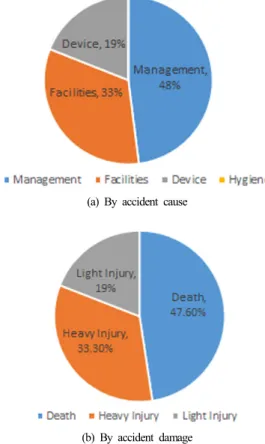
짚라인은 육상레저스포츠 중 하강시설로서 고위험 도에 해당하는 종목으로 추돌, 추락 시 작게는 경상에 서 크게는 사망에 이르기까지 중대재해가 발생 할 수 있다. Fig. 2에 나타낸 바와 같이 2007~2016년 기준 짚 라인 국내 사고사례 데이터를 취합하여 원인별, 유형 별로 분석한 결과, 사고 원인별로는 관리요인이 48%, 사고의 유형별로는 사망이 47.6%로 각각 가장 큰 비율 을 차지하였다. 관리요인의 내용으로는 시설물 설계도 서 및 관련서류 미보유, 화재예방 및 소화시설의 구축 미흡, 응급조치 운영방안 구축 미흡, 응급장비 및 의료 품 비치 사용기간 미 준수, 시설물 안전점검매뉴얼 및 안전점검 표지판 게시 미비, 운행개시 전 안전상태 확 인 및 기록관리 미흡, 승강시설 등 법적 장비의 정기검 사 미 준수 등을 들 수 있으며 사고 발생 시 사망 확률 이 매우 높다는 것을 알 수 있다. 사고 원인 중 관리 요인이 가장 많은 비율을 차지한다는 것은 짚라인 별 도의 시설설치 및 안전관리 기준이 마련되지 않아 시 설 내 각 구성요소마다의 안전규정을 개별적으로 적용 함으로써 종합적인 체계적인 안전관리가 이루어지지 못한데 있으며 국내 짚라인 안전관리의 문제점을 면밀 히 보여 주는 일례라 할 수 있다.
(a) By accident cause
(b) By accident damage
Fig. 2. Accident status of zipline facility.
2.3 시설구조 및 장치
짚라인의 주요 시설 구조는 Fig. 3에서처럼 탑승객 을 높은 지형에서 낮은 지형으로 이동시키는 와이어로 프, 와이어로프를 고정시키는 주 기둥 및 가이, 와이어 로프와 탑승객을 연결시키는 탑승장구 및 안전장구, 도착지점에서 작동되어 안전하게 하차할 수 있도록 하 는 브레이크 시스템, 탑승 및 도착 지점(플랫폼)으로 이루어져 있으며 주요 구조 및 역할은 다음과 같다6,7).
1) 주 기둥은 대부분 목재 또는 철구조물로 이루어져 있으며, 와이어로프를 고정, 지지 및 연결해주며, 출발, 도착점 데크 지지, 회수선 고정의 역할을 한다. 이러한 주 기둥은 탑승객들이 이동하는 구간을 지지해주는 역 할을 하므로 적절한 강도와 확실한 지지가 필요하다. 또한 탑승객과 주 기둥과의 충돌을 방지하여 설치하여 야 하고, 주 기둥의 마모, 부식 등을 점검 하여야 한다.
2) 와이어로프는 와이어로프의 중심을 이루는 심강 (core), 심강을 감싸는 스트랜드(strand), 와이어(wire)로 이루어져 있다. 와이어로프는 인장강도와 유연성이 크 고, 자전성이 있으며 길이가 긴 것을 쉽게 얻을 수 있 는 장점이 있으며 단점으로는 형붕괴를 일으키는 경향 이 있다. 따라서 와이어로프를 설치하기 위해선 와이 어로프의 구조, 강도, 도금유무, 꼬임방법 등을 확인하 여 설치할 필요가 있다. 그 밖에 와이어로프를 이루는 재질과 마모상태, 굽힘피로에 따른 점검이 필요하다.
3) 탑승장치 및 안전장치로는 와이어로프와 이용객 을 연결시켜 하강하게 하는 트롤리, 트롤리와 탑승객 을 연결해주는 랜야드, 장비와 장비를 연결하는 카라 비너, 보조 안전 고리(2중 안전장치, 퀵드로우 세트), 탑승객이 착용하는 하네스, 안전모 등이 있다. 추락사 고의 대부분을 차지하는 장치들이기 때문에 적절한 사 용과 점검이 요구된다. 따라서 트롤리의 볼트체결 부 식상태의 확인, 탑승객의 체중 체격에 따른 랜야드의 적정길이 조절과 하네스의 이용, 하네스의 안전상태, 카라비너의 연결상태, 강도의 확인 등이 필요하다.
4) 브레이크 시스템은 탑승객이 도착지점(데크)에 도착 시 안전하게 하차할 수 있도록 속도를 조절하는 시스템으로 크기 및 모양은 조금씩 다르지만 대체적으 로 1차는 출발, 도착 데크의 높이차를 고려한 중력 브 레이크, 2차는 블록 방식의 마중시스템 또는 트롤리 자 체 브레이크, 3차는 스프링 브레이크가 사용된다. 따라 서 도착 시 탑승객의 상태에 관계없이 충분히 작동되 어야 하며, 여유 공간 확보가 필요하다. 브레이크의 고 장 시 충돌 발생, 부상의 위험이 크기 때문에 브레이크 작동 점검이 필요하며 데크 출발, 도착 데크 주변의 위 험요소 제거가 필요하다.
Fig. 3. Structure and device of zipline facility.
3.
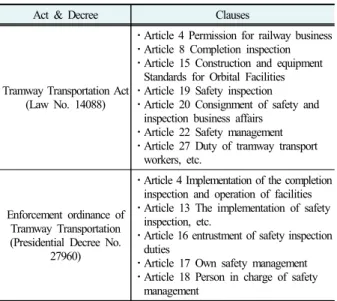
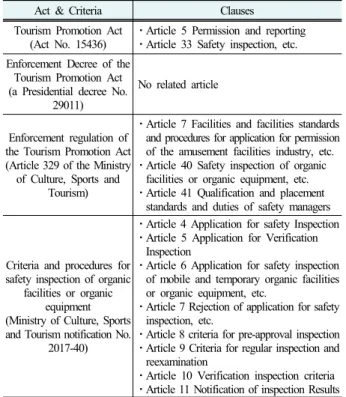
국내 및 국외 규정 검토 3.1 국내 관련 규정짚라인의 시설 구조 및 장치는 와이어로프로 이루어 진 주행로를 매달아 운행한다는 점에서 궤도 설비 중 삭도 설비와 매우 유사하나 삭도의 경우는 동력장치를 이용해 궤도차량을 매달아 운행하는 반면 짚라인의 경 우는 별도의 동력장치 없이 사람이나 화물을 운송한다 는 점에서 큰 차이를 가지고 있다. 이런 이유로 국내에 서는 궤도운송법에서 정한 설계, 시공, 안전검사 기준 에 적용을 받지 못하고 제도권에서 벗어나 있는 상태 이다. 또한 운송, 운동, 오락을 갖춘 시설물로 이를 이 용하여 관광객을 유치하는 시설이므로 관광진흥법에 서 정한 유기시설로 간주할 수 있으나 유기시설의 경 우는 유원시설업의 대상이 되는 대지 또는 실내에 설 치되는 시설이라는 점에서 이곳에 설치되어 있지 않은 짚라인 시설과는 차이를 나타낸다. 이런 이유로 국내
Table 1. Clauses relating to zipline in tramway transportation act
Act & Decree Clauses
Tramway Transportation Act (Law No. 14088)
⋅ Article 4 Permission for railway business
⋅ Article 8 Completion inspection
⋅ Article 15 Construction and equipment Standards for Orbital Facilities
⋅ Article 19 Safety inspection
⋅ Article 20 Consignment of safety and inspection business affairs
⋅ Article 22 Safety management
⋅ Article 27 Duty of tramway transport workers, etc.
Enforcement ordinance of Tramway Transportation (Presidential Decree No.
27960)
⋅ Article 4 Implementation of the completion inspection and operation of facilities
⋅ Article 13 The implementation of safety inspection, etc.
⋅ Article 16 entrustment of safety inspection duties
⋅ Article 17 Own safety management
⋅ Article 18 Person in charge of safety
management
Enforcement regulation of Tramway Transportation (The Ministry of Land Decree
No. 408 )
⋅ Article 3. Permission application for orbit Project
⋅ Article 9 Procedures for application for completion inspection, etc.
⋅ Article 16 Application of safety inspection
⋅ Article 16 Application for safety inspection
⋅ Article 18 Consignment of work for safety inspection, etc.
⋅ Article 20 Person in charge of safety management
Equipment standard for the construction of orbital
facilities (The Ministry of Land notification No. 2013-415)
⋅ Section 1 Reciprocating ropeway
⋅ Section 2 Automatic circulation type ropeway
⋅ Section 3 Fixed Circulation ropeway
⋅ Section 4 Towing ropeway
⋅ Section 5 Cargo ropeway
Safety inspection standards for orbital facilities
(Ministry of Land, Infrastructure and Transport
notification No.213-416)
Safety inspection standards for ropeway facilities
1. Holding 2. Grip device 3. Rope 4. Tension device 5. Carrying Equipment 6. Winding operating device 7. Brake Equipment 8. Wiring line 9. Control equipment 10. Security devices
11. Communications equipment 12. Insulation resistance 13. Ground Resistance 14. Test drive 15. Other facilities
Table 2. Clauses relating to zipline in tourism promotion act
Act & Criteria Clauses
Tourism Promotion Act
(Act No. 15436) ⋅ Article 5 Permission and reporting
⋅ Article 33 Safety inspection, etc.
Enforcement Decree of the Tourism Promotion Act (a Presidential decree No.
29011)
No related article
Enforcement regulation of the Tourism Promotion Act (Article 329 of the Ministry
of Culture, Sports and Tourism)
⋅ Article 7 Facilities and facilities standards and procedures for application for permission of the amusement facilities industry, etc.
⋅ Article 40 Safety inspection of organic facilities or organic equipment, etc.
⋅ Article 41 Qualification and placement standards and duties of safety managers
Criteria and procedures for safety inspection of organic
facilities or organic equipment (Ministry of Culture, Sports and Tourism notification No.
2017-40)
⋅ Article 4 Application for safety Inspection
⋅ Article 5 Application for Verification Inspection
⋅ Article 6 Application for safety inspection of mobile and temporary organic facilities or organic equipment, etc.
⋅ Article 7 Rejection of application for safety inspection, etc.
⋅ Article 8 criteria for pre-approval inspection
⋅ Article 9 Criteria for regular inspection and reexamination
⋅ Article 10 Verification inspection criteria
⋅ Article 11 Notification of inspection Results
에서는 관관진흥법에서 정한 유기시설의 시공, 안전검 사 기준에 적용을 받지 못하고 시설은 꾸준히 증가하
고 있으나 주무관청과 안전관리 체계가 부재한 안전사 각지대에 방치되어 있는 상태이다. 궤도운송법 및 관 광진흥법에서 짚라인 시설과 관련지을 만한 조항을 분 석 후 발췌하여 정리하면 Table 1, 2와 같다.
3.2 해외 관련 규정
해외 안전 선진국인 미국과 유럽 등지에서는 레저 안 전을 위해 시설의 설계, 시공, 탑승 장비에 대한 세부 지침이 마련되어 안전하게 운영되고 있다. 미국의 경우 하강레포츠시설을 포함한 챌린지 코스 산업전반의 관 계자들이 모여 1993년에 공식적으로 설립된 ACCT(미 국챌린지코스기술협회, Association for Challenge Course Technology)는 세계에서 가장 큰 미국규격협회(ANSI)가 승인한 표준 개발업체로 챌린지 코스와 어드벤처코스 산업을 전문으로 하고 있다. ACCT는 전 세계에 챌린지 코스, 짚 라인, 캐노피 투어, 에어리얼 어드벤처 코스에 관심이 있는 수백 개의 조직을 대표하는 2,600명 이상 의 회원들로 구성되며 ACCT의 매뉴얼 작성 근거 및 기 준은 대부분 미국규격협회(ANSI)의 기준을 적용하고 있다. CHALLENGE COURSES AND CANOPY/ZIP LINE TOURS STANDARDS(ANSI/ACCT 03-2016)을 살 펴보면, 제1장 설계, 성능 및 검사 표준(일반 요건, 검사 요건, 현장 고려사항, 엘리먼트 지지 구조물, 구명장치, 엘리먼트 지탱장치, 난간, 짚라인 장치, 장비), 제2장 운 영표준(일반 요건, 운영 관리, 직원 역량), 제3장 훈련표 준(일반 요건, 훈련), 제4장 교관 공인 표준(일반 요건, 공인), 별첨(보편적인 챌린지 코스 설계에 관한 논의, 지표면 고려사항, 짚라인 제동장치, 인증 및 장애인, 챌 린지 코스 인증 교관의 주요 역할)로 구성되어 있다.
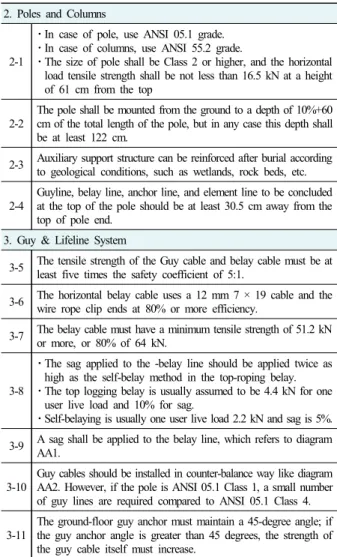
ACCT에서 짚라인을 포함한 첼리지 코스 산업 전반의 설계 및 시공, 안전 시공 및 운영 기준의 제정, 탑승 장 비에 대한 세부 지침을 마련하여 회원사로 하여금 이 를 준용하도록 하고 있으며 안전검사, 교육 심포지엄 개최 등 이용자 안전 확보를 위해 다양한 활동을 전개 하고 있다. 규정 내용 중 짚라인 시설 의 시공 전반에 관한 안전검사 관련 항목들을 분석, 발췌하여 정리하면 Table 3과 같다.
Table 3. Checklist relating to zipline in ACCT STANDARDS 1. Site Considerations
1-1 Emergency vehicle access routes and Emergency Exit Route be adequately secured.
1-2 Any access to the course shall be blocked during the absence of the manager or the closing time.
1-3 Sufficient distance and site for belay and supporting shall be secured.
2. Poles and Columns
2-1
⋅ In case of pole, use ANSI 05.1 grade.
⋅ In case of columns, use ANSI 55.2 grade.
⋅ The size of pole shall be Class 2 or higher, and the horizontal load tensile strength shall be not less than 16.5 kN at a height of 61 cm from the top
2-2
The pole shall be mounted from the ground to a depth of 10%+60 cm of the total length of the pole, but in any case this depth shall be at least 122 cm.
2-3 Auxiliary support structure can be reinforced after burial according to geological conditions, such as wetlands, rock beds, etc.
2-4
Guyline, belay line, anchor line, and element line to be concluded at the top of the pole should be at least 30.5 cm away from the top of pole end.
3. Guy & Lifeline System
3-5 The tensile strength of the Guy cable and belay cable must be at least five times the safety coefficient of 5:1.
3-6 The horizontal belay cable uses a 12 mm 7 × 19 cable and the wire rope clip ends at 80% or more efficiency.
3-7 The belay cable must have a minimum tensile strength of 51.2 kN or more, or 80% of 64 kN.
3-8
⋅ The sag applied to the -belay line should be applied twice as high as the self-belay method in the top-roping belay.
⋅ The top logging belay is usually assumed to be 4.4 kN for one user live load and 10% for sag.
⋅ Self-belaying is usually one user live load 2.2 kN and sag is 5%.
3-9 A sag shall be applied to the belay line, which refers to diagram AA1.
3-10
Guy cables should be installed in counter-balance way like diagram AA2. However, if the pole is ANSI 05.1 Class 1, a small number of guy lines are required compared to ANSI 05.1 Class 4.
3-11 The ground-floor guy anchor must maintain a 45-degree angle; if the guy anchor angle is greater than 45 degrees, the strength of the guy cable itself must increase.
유럽의 경우도 미국의 ACCT와 마찬가지로 유럽 내 EN규정(유럽안전기준)을 통하여 시공과 사용되는 시 설물에 대한 안전율을 정하여 사용하고 있다. 유럽기 준 EN 15567-1:2007.는 1부와 2부로 나누어져 있는데 1 부는 로프 코스(짚라인, 짚와이어 코스 포함)와 그 구 성품의 구상, 건설, 점검과 관리관련 안전수칙을 명시 하고 있다. 2부에서는 레저, 스포츠나 교육활동 또는 치료 목적범위에서 활용하는 로프 코스(짚라인, 짚와 이어 코스 포함)의 적합한 안전과 유지등급보장을 위 한 개발수칙을 명시한다. 규정 내용 중 짚라인 시설의 시공 전반에 관한 안전검사 관련 항목들을 분석, 발췌 하여 정리하면 Table 4와 같다.
Table 4. Checklist relating to zipline in EN 15567 1. Site Considerations
1-1 Passengers should be able to evacuate from any part of the course.
1-2 The surrounding environment should not interfere with the safety and location of the structure.
1-3 The natural element (lightning, moisture, erosion, flood, avalanche, etc.) should be considered in the design and development of installations. (See EN 15567-2)
1-4 Rope courses (including zip lines, straw wire courses) Access restrictions should take into account national regulations.
2. Poles and Columns
2-1 The stability and durability of the supporting system should be adjusted to the load calculated at 4.3.2.5.
4.3.2.5 Calculation
⋅ Installations using self-belaying systems, continuous and assisted belaying systems made out of steel wire rope shall be calculated using safety factor 3,0 in relation to the ultimate load. A belaying system for ropes courses shall be designed to withstand a load of 6 kN without permanent deformation to any part of the system.
⋅ The calculations shall take in account the weakness coefficient due to the type of wire rope termination used (EN 13411(all parts))
⋅ Imposed load, dynamic load, dead loads, snow, ice and wind loads applied shall be considered. The calculation for artificial structures shall relate to the relevant euro codes.
2-2
The support system may include:
a) Artificial elements like
- framework with foundation, guys, foundation, tension bars and compression bars, mounting parts on or in buildings b) Natural elements likes
- trees, rock
2-3
⋅ An arboricultural assessment shall be performed by arboriculturists to determine the physiological and mechanical condition of trees used as element supports.
⋅ The minimum frequency at which assessments should be made is as follows
a) first assessment shall be carried out before the ropes course is inaugurated. It is recommended to do this before the designated trees are trimmed and equipped, but no earlier than one year before the ropes course is open ;
b) after that date an assessment, by arboriculturists, shall be carried out annually to assess any changes in the forest and supporting trees.
2-4 When a tree is used as a supporting structure, the element load (dead load) shall not be taken into account if it is less than 30%
of the load created by the maximum fall stress.
2-5 The tree strength assessment takes the diameter of the tree and any changes in diameter into account
2-6 When rocks are used as supporting structures, the anchor pull out strength must be at least 4 times the applied load.
3. Guy & Lifeline System
3-1 Careful attention shall be given to the position of guys, possibly made inaccessible.
3-2 When they are accessible from the ground they shall be clearly visible or protected in order to avoid injury.
3-3
When guys are accessible on a self-belaying system, they shall have a device that prevents misuse or an uncontrolled descent.
(ex. a stop device which itself is inaccessible)
4.
개선 제안본 연구에서는 짚라인 시설의 일반 현황 및 사고사 례 분석, 유사시설 관련 규정 검토 등을 통한 국내 안 전관리 실태에 관해 조사한 후 문제점을 살펴보았다. 이를 해결하기 위해 해외 짚라인 관련 규정 및 안전관
Table 5. Checklist 1 relating to zipline construction suggested 1. Site Considerations
1-1 Emergency vehicle access routes and emergency exit route be adequately secured.
1-2 Any access to the course shall be blocked during the absence of the manager or the closing time.
1-3 Whether the surrounding environment does not hinder the safety and location of the structure
1-4 Passengers should be able to evacuate from any part of the course.
1-5 Whether lightning, moisture, erosion, flooding, avalanches, etc.
were considered in the planning and development of the installation.
Table 6. Checklist 2 relating to zipline construction suggested 2. Pillars
3-1 Whether or not the Auxiliary support structure can be reinforced after burial according to the geological condition such as wetlands and rock.
3-2 Whether or not the pillars support wire rope is applied and buried, at least 1.2m, or 10% + 60cm of the length of the holding, plus a large number.
3-3 Whether the Guy Line, belay line, and anchor line at the top of the pole are at least 30.5 cm away from the top point end.
3-4 For wood pillars of H4 grade, whether or not the pole treated pressure anti-corrosion was used
3-5 Wood pillars are installed vertically and whether they are corroded, corrupted or have severe cracks.
3-6 In the case of steel pillars, the joints using bolts, rivets, welding, etc. have been safely constructed and whether they are coated with anti-pollution.
3-7 In the case of steel pillars, whether or not the use of continuous facilities has caused symptoms such as cracking, rust, corrosion, and bending.
3-8 Whether the application load of the fixing device is more than four times the applied load when using the rock as a pillar.
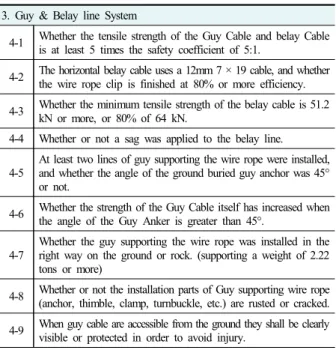
Table 7. Checklist 3 relating to zipline construction suggested 3. Guy & Belay line System
4-1 Whether the tensile strength of the Guy Cable and belay Cable is at least 5 times the safety coefficient of 5:1.
4-2 The horizontal belay cable uses a 12mm 7 × 19 cable, and whether the wire rope clip is finished at 80% or more efficiency.
4-3 Whether the minimum tensile strength of the belay cable is 51.2 kN or more, or 80% of 64 kN.
4-4 Whether or not a sag was applied to the belay line.
4-5 At least two lines of guy supporting the wire rope were installed, and whether the angle of the ground buried guy anchor was 45°
or not.
4-6 Whether the strength of the Guy Cable itself has increased when the angle of the Guy Anker is greater than 45°.
4-7
Whether the guy supporting the wire rope was installed in the right way on the ground or rock. (supporting a weight of 2.22 tons or more)
4-8 Whether or not the installation parts of Guy supporting wire rope (anchor, thimble, clamp, turnbuckle, etc.) are rusted or cracked.
4-9 When guy cable are accessible from the ground they shall be clearly visible or protected in order to avoid injury.
리 규정을 면밀히 분석하여 규정 내용 중 짚라인 시설 의 시공 전반에 관한 안전검사 관련 항목들을 검토, 제안하는 연구를 진행하였다. 발췌된 주요 내용들에 대해 국내 실정에 적합하게 적용 가능한 항목을 수정 검토하여 제안된 짚라인 시설의 시공 전반에 관한 안 전검사 항목을 정리하면 Table 5, 6, 7과 같다. 국내 짚 라인 시설의 경우는 별도의 동력장치 없이 사람이나 화물을 운송한다는 점과 유원시설업의 대상이 되는 대 지 또는 실내에 설치되어 있지 않는 시설이라는 점에 서 시설과 사고 발생은 꾸준히 증가하고 있으나 주무 관청과 안전관리 체계가 부재한 안전사각지대에 방치 되어 있는 상태이다. 본 연구에서는 해외 짚라인 관련 규정 및 안전관리 규정을 면밀히 분석하여 규정 내용 중 짚라인 시설의 시공 전반에 관한 안전검사 관련 항 목들을 검토, 제안하는 연구를 통해 사고 재발 방지를 위한 안전관리 개선 방안을 제시함8-10)으로써 짚라인 및 기타 익스트림 레저시설에 대한 종합적이고 체계적 인 대책 수립 및 안전성 향상 제도 정착에 기여하고자 한다.
감사의 글: 이 논문은 2017년도 정부(교육부)의 재원 으로 한국연구재단의 지원을 받아 수행된 기초연구사 업임(No. 2017R1D1A1B03028163)
References
1) The 8th Edition ACCT STANDARDS for Challenge Course & Canopy/Zip Line Tours, Association for Challenge Course Technology, pp. 1-80, 2016.
2) Sport and Recreational Facilities-Ropes Courses- Part 1:
Construction and Safety Requirements English Version of DIN EN 15567-1, EUROPEAN COMMITTEE FOR STANDARDIZATION, pp. 1-28, 2008.
3) Sport and Recreational Facilities-Ropes Courses- Part 2:
Operation Requirements English Version of DIN EN 15567-2, EUROPEAN COMMITTEE FOR STANDAR -DIZATION, pp. 1-13, 2008.
4) Tramway Transportation Act, Ministry of Land, Infrastructure, and Transport, 2017.
5) Tourism Promotion Act, Ministry of Culture, Sports and Tourism, 2018.
6) The Safety Manual of Youth Activity, Ministry of Gender Equality and Family, pp. 38-48, 2015.
7) The Training Course for Safety Specialist of Youth Adventure Facility, Korea Youth Work Agency, pp.
195-206, 2015.
8) E. S. Kim, Y. W. Choi, Y. J. Cho and H. K. Ji, “A Forensic Engineering Study on Safety Accident of Zipline”, Fall Conference of the Korean Society of Safety, p.186, 2016.
9) S. M. Choi, D. Y. Lee and C. B. Son, “Assessing the Safety Performance of Small-sized Contractors and Improvement
Measures”, J. Korean Soc. Saf., Vol. 23, No. 4, pp. 53-58, 2008.
10) E. S. Kim, “Mechanical Safety : A Study on Cause Analysis of the Crash for the Ski Lift,” J. Korean Soc. Saf., Vol. 24, No. 2, pp. 13-16, 2009.