1)
1. Introduction
Unmanned Aerial Vehicles (UAVs), or drones are opening
※ 이 논문은 2018년도 정부(교육부)의 재원으로 한국연구재단의 지원을 받아 수행된 기초연구사업임(NRF-2018R1D1A1B07040573).
† 준 회 원 : 아주대학교 컴퓨터공학과 석사
†† 정 회 원 : 아주대학교 사이버보안학과 교수 Manuscript Received : June 19, 2019 First Revision : September 19, 2019 Accepted : October 9, 2019
* Corresponding Author : Jai-Hoon Kim([email protected])
better opportunities to today world to have several applications in surveillance, disaster management [16], search and rescue [14], tour [17], environment monitoring, deliveries [15, 18], photography, agriculture, security [19], networks [20, 21], and more [1].
When drones provide its services to the destination, they may need to power up itself from the charging stations [2-5]. As a constraint device, drones have power consumption [6] for which they also have
Power Charge Scheduling and Charge-Ready Battery Allocation Algorithms for Real-Time Drones Services
Mehedi Tajrian † ⋅Jai-Hoon Kim ††
ABSTRACT
The Unmanned Aerial Vehicle (UAV) is one of the most precious inventions of Internet of things (IOT). UAV faces the necessity to charge battery or replace battery from the charging stations during or between services. We propose scheduling algorithms for drone power charging (SADPC). The basic idea of algorithm is considering both a deadline (for increasing deadline miss ratio) and a charging time (for decreasing waiting time) to decide priority on charging station among drones. Our simulation results show that our power charging algorithm for drones are efficient in terms of the deadline miss ratio as well as the waiting time in general in compare to other conventional algorithms (EDF or SJF). Also, we can choose proper algorithms for battery charge scheduling and charge ready battery allocation according to system parameters and user requirements based on our simulation.
Keywords : UAV, Drone, Real-Time, Power, Scheduling
실시간 드론 서비스를 위한 전원 충전 스케쥴링과 충전 배터리 할당 알고리즘
Mehedi Tajrian † ⋅김 재 훈 ††
요 약
무인항공기는 사물인터넷 분야에서 중요한 발명중의 하나이며 많은 응용에서 사용되고 있다. 특히 소형 무인항공기(드론)는 배터리로 동작을 하기 때문에 서비스 도중 또는 서비스간에 충전소에서 배터리 충전과 배터리 교체가 필요하다. 배터리 충전소가 제한된 상황에서 먼저 충전할 드론을 스케쥴링하고 충전된 배터리를 할당하는 문제는 중요하다. 본 논문에서는 효율적인 드론의 배터리 충전 스케쥴링 알고리즘을 제안하였다.
드론을 위한 배터리 충전 스케쥴링 알고리즘의 기본 아이디어는 실시간처리 환경에서 마감시간을 만족하기 위하여 마감시간을 고려함(EDF)과 동시에 대기시간을 줄이기 위해서 충전시간을 동시에 고려(SJF)하였다. 즉, 마감시간이 짧을수록 그리고 충전시간이 짧을수록 높은 우선순위를 부여하여 마감시간 준수율을 높이고 평균 대기시간을 줄임으로서 결과적으로 마감시간 준수율향상과 대기시간 단축이라는 두가지 측면을 동시에 만족할 수 있는 기법을 고려하였다. 이미 충전된 배터리의 할당에서는 충전시간이 길수록 높은 우선순위를 배정하므로서 평균 대기시간을 줄일 수 있다. 시뮬레이션 결과 제안 알고리즘을 이용하여 마감시간 준수율과 평균 대기시간 측면에서 기존 알고리즘(EDF와 SJF)과 비교하여 좋은 성능을 보임을 확인하였다. 시뮬레이션 결과를 바탕으로시스템 파라메터와 사용자 요구사항에 따라 배터리 충전 스케쥴링과 배터리 할당 알고리즘 을 합리적으로 선택할 수 있다.
키워드 : UAV, 드론, 실시간, 전원, 스케줄링
※ This is an Open Access article distributed under the terms of the Creative Commons Attribution Non-Commercial License (http://creativecommons.org/ licenses/by-nc/3.0/) which permits unrestricted non-commercial use, distribution, and reproduction in any medium, provided the original work is properly cited.
chance to have delivery latency. At the situation of having only one charging station, it is difficult to manage and decide which drone should get charged first among many drones [7, 13]. It is a critical situation to make order of priorities for drones to getting charged sequentially.
We are introducing an algorithm SADPC (scheduling algorithms for drone power charging) using which drones can have a priority set to decide which drone can get charged earlier among many other drones from a charging station and can have a sequential order of priority list to get charged earlier one by one depending on their priority to get charged. Early version of our basic idea was appeared in [13]. We extend the early version and add charge ready batter allocation scheme in this paper.
There are two steps in SADPC (parameters are defined as shown in Table 1):
• In the first step, it will calculate laxity time based on deadline time, transportation time and charging time of a drone:
Laxity = Deadline – (Charging time + Transportation time)
• In the second step, priority will be decided by the scheduler depending on shortest laxity time and charging time (small value has high priority):
Priority = (Laxity time + Charging time) / 2.
Parameters Definition
Deadline Time to finish service Charging Time Time to battery charging Transportation Time Time to drone moving for service
Laxity Deadline – (Charging time + Transportation time)
Table 1. Definition of Parameters
For an example, performances (deadline miss ratio and an average waiting time) with three drones (Table 2) are shown in Table 3. SJF (Shortest Job First) charging algorithm can minimize an average waiting time but miss deadline of drone C.
Preemptive LST (Least Laxity Time First) charging algorithm is the optimal algorithm to miss the deadline for all drones. We use non-preemptive LST, as non-preemptive algorithm seems more reasonable in battery charging to reduce physical context
switching time (replacing drone from a battery charger). Moreover, in many cases, an average waiting time is also important like soft real-time applications. Our proposed algorithm (SADPC) is expected to increase a deadline meet ratio while reducing an average waiting time by combining two algorithms (SJF and LST) as shown in Table 3.
drone Deadline (min.)
Charging (min.)
Transportation time (min.)
laxity (min.)
A 110 10 20 80
B 100 30 30 40
C 120 50 40 30
Table 2. Parameters of Three Drones
Algorithms (scheduling)
Average waiting time
(min.) Deadline meet ratio SJT (A→B→C) 50/3 2/3 (C misses) EDF (B→A→C) 70/3 2/3 (C misses) LST (C→B →A) 130/3 2/3 (B missed) SADPC (B→C→A) 110/3 1 (All meet)
Table 3. Performance Comparisons
We can expect that:
• SADPC is more efficient than the existing SJF, EDF and FCFS algorithm in many (or some) cases
• waiting time can be saved (or moderate)
• deadline miss ratio can be increase (or moderate).
2. Scheduling Algorithms
There are many priority algorithms like First come first serve (FCFS), Shortest job first (SJF), Longest job first (LJF) and Earliest deadline first (EDF) [8] and many more [9, 10, 11]. Let us assume two drones A and B where B has a big battery which needs more time to get charged compared to A. But B comes little earlier than A and B has short deadline than A.
• SJF: According to Shortest Job First (SJF) algorithm [8], drone A will get charged first. In this case, B have to wait until drone A finishes its charging.
It is the optimal in terms of an average waiting
time. But B can have short deadline to deliver its
work. So, B may miss the deadline.
• LJF: According to Longest Job First (LJF) algorithm, drone B will get charged first. In this case, A have to wait until drone B finish its charging.
LJF is not reasonable as it will increase an average waiting time for battery charging scheduling algorithm. But LJF is good for ready battery allocation as it will decrease an average waiting time for battery charging by allocating pre-charged battery for drone with a long charging time battery.
• FCFS: According to First Come First Serve (FCFS) and Earliest Deadline First (EDF) algorithms [8], drone B will get charged first. In this case, it is going to be very large waiting time for A which is injustice to it as it has small battery and need less time to get charged. So, A can have longest waiting problem.
• SADPC (proposed algorithm): Scheduling algorithms for drone power charging (SADPC) can solve the starvation and longest waiting problems by introducing the efficient priority algorithm by which charging station can priority queue for drones depending on their deadline for delivery, transportation time to reach the destination and charging time needed for power up their battery. The simulation result shows that SADPC can have less chance to miss the deadline time and has less turnaround time compared to other algorithms.
3. Proposed Drone Power Charge and Charge Ready Battery Allocation Algorithm
3.1 Scheduling Algorithms for Drone Power Charge Assuming there are some drones in a service area.
Some of them may have deadline for service delivery, some may have not. Some can have a far destination for service delivery, some may have near destination. Some may have large battery so they need more time to get charged comparing other. So, the drones which have small battery have to wait which is the killing of its time and there is only one charging station from where drones can charge by itself.
We indicate an algorithm SADPC, by which drones would have priority to decide among many which drone can get charge earlier from a charging station depending on their battery size, delivery destination and deadline. We set up our algorithm only for the delivery drones with delivery order and may need to get charge during moving the delivery path, not for the drones which do not have any order of delivery.
Drones can vary in their battery capacity [12].
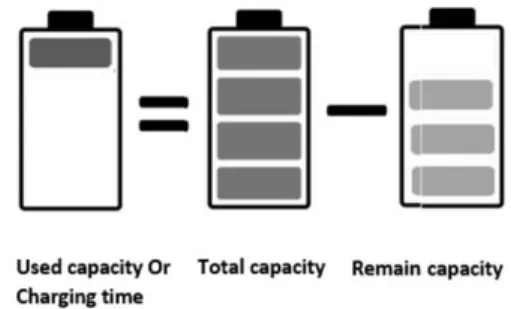
Battery charging velocity can differ from drone to drone depending on their battery type, battery capacity and some other factors. Charging time is proportional to the used battery capacity as the charging time is needed to fulfill the used amount of battery.
Used battery capacity = Total battery capacity - Remain battery capacity
Fig. 2. Describing the Charging Time Which is Equal to used Battery Capacity
Transportation time is measuring based on the destination distance from the charging station.
Fig. 3. Describing the Transportation Time
Every drone has its deadline for delivery of service defined by the client and service provider.
Fig. 1. A Scenario of Many Drones, Their Destination
and One Charging Station
Fig. 4. Describing the Deadline Time
There are following steps:
• Step one: take input parameters (charging time, deadline time and transportation time).
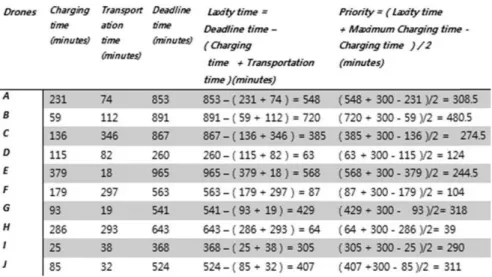
• Step two: checking and calculating the summation of charging time and transportation time, subtracting the summation result from deadline time for each drone. The calculation result is the laxity time for each drone. Shortest laxity time will get highest priority to power up.
• Step three: calculate the priority, where Priority = (laxity time + Maximum charging
time - charging time) / 2
Then the scheduler will finally have the highest priority drone which has the smallest value for this calculation. So, after calculating the priority scheduler will have a queue of highest prior drones for powering up. We are considering transportation time only from the charging station to delivery destination, not the total distance from the original service starting point. So, the transportation time in SADPC is the time to cover the distance from charging station to delivery destination. As we know a drone have to complete its delivery service before the deadline, it's transportation time and charging time should not more than deadline time.
Charging time, transportation time < deadline time
Fig. 5 showing the time limits for charging time, transportation time and deadline time.
Fig. 5. Imagination of the Time Limits for Charging Time, Transportation Time and Deadline Time
The pseudo code of SADPC is given bellow:
SADPC -ALGORITHM
1. Take input max_ndrone
(taking the limit of maximum number of drones) 2. Take random charging_time, deadline_time,
transportation_time for each drone (charging time + transportation time < deadline time)
3. Calculate laxity_time = deadline_time – (charging_time + transportation _time ) 4. Calculate priority = minimum of {(laxity_time +
maximum_charging_time - charging_time) / 2 } (creating the priority queue of drones
depending on the smallest value holding drone among all)
3.2 Scheduling Algorithms for Drone Power Charge with Charge Ready Batteries
We are introducing a solution for overcoming the situation when there are lots of drones waiting to get charged from the single charging station by replacing the charged battery. There can be some charge-ready battery besides battery charger in the charging station. In this case, some drones have high probability can replace their battery with the charge ready battery and others are scheduled for batter charging to achieve better performance (high deadline miss ratio and/or short waiting time).
Fig. 6. Illustration of the Situation of Drones` Arrival at the Charging Station and Allocation of Fully Charged Battery
Now, we describe two stage algorithm (an algorithm
is selected for each stage); charge ready battery
allocation algorithm and batter charge scheduling
algorithm.
• (first stage) charge ready battery allocation: one of SADPC, FCFS, EDF, and LJF algorithms
• (second stage) batter charge scheduling: one of SADPC, FCFS, SJF, and EDF
LJF (Longest Job First) can be used for charge ready battery allocation. We can save more average waiting time by using LJF as the longest charging time battery is firstly replaced with charge ready battery. A waiting time of drones replaced with charge ready battery becomes zero. Also, a drone schedule in the first for a battery charger does not wait.
For examples, due to lack of space, 4 cases are described out of 16 cases (product of 4 cases of charge ready battery allocation algorithms and 4 battery charging algorithms).
Case 1: SADPC for charge ready battery allocation and SJF for battery charger scheduling
• The laxity_time will be calculated for all the drone. After this, the priority list will be created depending on the laxity time and charging time.
laxity_time = deadline_time – ( charging_time + transportation_ time)
priority = ( laxity time + maximum charging time- charging time) / 2
• Then the drone which has the smallest value for priority would get the charge ready battery.
Then the charging time, waiting time, turnaround time will become 0 for the drones who are getting charged ready battery.
• The priority list will be created depending on the shortest charging_time for battery charge scheduling
• Then for comparison with other algorithm again the waiting_time will be calculated for all the drone depending on their (ahead on the priority queue) charging_time. Then turnaround_time will be calculated for all the drone and at the last the average turnaround_time will be calculated.
In next function the remaining_deadline_time will be calculated for all the drone.
turnaround_time = waiting_time + charging_time remaining_deadline_time = deadline_time –
(charging_time + transportation_ time + waiting_time)
• After this, the deadline_miss_ratio will be calculated depending on how many drone has missed their deadline.
deadline miss ratio = Number of drone missed deadline / Total number of drones
Case 2: FCFS for charge ready battery allocation and EDF for battery charger scheduling
• How many drones are initially on the charging station will be taken as input (max_ndrone) what is taking in the main function of the code. Then the charging_time, transportation_time and deadline_
time will be taken randomly.
• A drone arrived earlier get the charge ready battery. Then the charging time, waiting time, turnaround time will become 0 for the drones who are getting charged ready battery.
• After this, the priority list will be created depending on the shortest laxity_time for battery charge scheduling
• Then compute and compare the performances as described in Case 1.
Case 3: LJF for charge ready battery allocation and SJF for battery charger scheduling
• The drone with the longest charging time would get the charge ready battery. Then the charging time, waiting time, turnaround time will become 0 for the drone who are getting charge ready battery.
• After this, the priority list will be created depending on the shortest charging_time for battery charge scheduling.
• Compute and compare the performances.
Case 4: EDF for charge ready battery allocation and SADPC for battery charger scheduling
• The priority list will be created depending on
the shortest laxity_time. Drone with the smallest laxity_time would get the charged ready battery.
Then the charging time, waiting time, turnaround time will become 0 for the drones who are getting charged ready battery.
• In the next step, the laxity_time (laxity_time = deadline_time – ( charging_time + transportation_
time)) will be calculated for all drones. Then, priority = (laxity time + maximum charging time- charging time) / 2 will be calculated for all drones. After this, the priority list will be created depending on the smallest priority in the battery charge scheduling.
• Compute and compare the performances.
Due to lack of space, only two (2) cases are described out of 16 cases to demonstrate how the performances have been obtained.
Case 1 calculation:
Scheduled for get ready battery by SADPC:
When there are 3 charged batteries, Drone H, F and D will get the charged battery.
Scheduled for charging by SJF:
Priority = Shortest Charging time
Drones except D, F, and F are sorted according to the short charging time. Drone D, F, and H do not need to charge as they have already get the charged battery.
Table 5. Calculation of Waiting time, Turnaround time and Remaining Deadline time in SJF when there is
3 charged ready battery
Average turnaround time = 2575 / 10 = 257.5 Deadline miss ratio = 2/10 = 0.2
Case 2 calculation:
Scheduled for get ready battery by FCFS:
Table 6. Calculation of Waiting time, Turnaround time and Remaining Deadline time in FCFS.
Table 4. Calculation of Laxity time and Priority in SADPC
When there are 3 charged batteries, randomly chosen 3 three drones (assuming they arrived earlier than others) will get the batteries.
Scheduled for charging by EDF:
Priority = Earliest deadline
Drones except A, B, and C are sorted according to the earliest deadline. Drone A, B, and C do not need to charge as they have already get the charged battery.
Table 7. Calculation of Waiting time, Turnaround time and Remaining Deadline time in EDF when there is 3
charged ready battery
Average turnaround time = 3240 / 10 = 324 Deadline miss ratio = 3/10 = 0.3
4. Simulations
Consider an isolated system consisting of a charging station and many drones need to get charged. Drones come up to this charging station at random times, wait their turn for charging, are charged and then leave.
Fig. 7. Illustration of the Situation of Drones` Arrival at Charging Station and Departure After Charging
We calculated Deadline miss ratio depending on how many drones are missing their deadline.
Deadline miss ratio = Number of drone missed deadline / Total number of drones.
Turnaround time is the total time between the entry in queue of drones waiting for charge and completing the charging. That mean,
Turnaround time = Waiting time + Charging time.
The drone which has highest priority, will get charged battery first and will not have any waiting time. Then it`s turnaround time is only it`s charging time. So, when there is only one drone the turnaround time will be same for all the algorithm.
In this simulation, we assume that charging time and transportation time is not more than 300 units (evenly distribution between 0 and 300) and deadline time is less than 1000 (evenly distribution between 0 and 1000). Deadline miss ratio and turnaround time for all the algorithms after combining two stage schemes (charge ready battery allocation and power charge scheduling algorithms) are shown in (Fig. 8) and (Fig. 9) by using 10 drones and 0 to 5 charge ready batteries.
Even though preemptive EDF is the optimal algorithm in a real-time analysis, it is not so good as shown in (Fig. 8) if feasible scheduling (meeting all deadlines) is not exist. LJF for charge ready battery allocation and SJF for battery charger scheduling algorithms are expected to reduce turnaround time by minimizing waiting time. However, these algorithms also show good performance in terms of deadline miss ratio as it can reserve more laxity time by replacing long charging time battery in LJF and charging the short charging time battery first in SJF.
(E)SADPC shows not so good performance in terms of deadline miss ratio as we expected when the number of charge ready battery is small.
As we expected, LJF for charge ready battery allocation and SJF for battery charger scheduling algorithms show the short turnaround time by minimizing waiting time as shown in (Fig. 8).
However, EDF algorithm is not good in terms of a
turnaround time as it is focusing on deadline meet
ratio. Combined algorithm ((E)SADPC) shows good
deadline meet ratio comparing to others as the
number of charge ready battery increases. We think that it (system parameters with low deadline miss ratio) is more common case in real-time applications.
Based on these performance comparisons, we can choose proper algorithms according to system parameters and user requirements. For an example, we can choose LJF charge ready battery allocation algorithm and SJF battery charge scheduling when a short turnaround time is required.
5. Conclusion
Drones are opening new horizon as a major Internet-of-Things (IoT) player which is a network of objects. There should be a well-organized queue to decrease deadline miss ratio as well as turnaround
time when there is a limited number of charging station for drone power charge scheduling. Also, charge ready battery allocation is important issues when a limited number of charge ready battery exists. SADPC combining with other algorithms like SJF, LJF, and EDF provides a simple solution of these problems. Simulation results show that we can choose proper algorithms for charge scheduling and battery allocations according to system parameters and user requirements to obtain a better deadline meet ratio and a turnaround time.
References
[1] H. Shakhatreh, A. Sawalmeh, A. Al-Fuquaha, Z. Dou, E.
Almaita, I. Khalil, N. S. Othman, A. Khreishah, and M.
Guizani, “Unmanned Aerial Vehicles: A Survey on Civil Fig. 8. Deadline Miss Ratio (10 Drones, 0 to 5 Charge Ready Batteries, Charging Time,
Transportation Time < 300 Units, Deadline Time < 1000)
Fig. 9. Turnaround Time (10 Drones, 0 to 5 Charge Ready batteries, Charging Time,
Transportation Time < 300 Units, Deadline Time < 1000)
Applications and Key Research Challenges,” arXiv:1805.
00881v1 [cs.RO], 19 Apr. 2018.
[2] M. C. Silverman, D. Niles, B. Jung, and S. Sukhatme,
“Staying alive: a Docking Station for Autonomous Robot Charging.” in Proceedings IEEE International Conference on Robotics and Automation , pp.1050–1055, Washington D. C., USA, May 2002.
[3] G. B. Parker and R. S. Zbeda, “Controlled use of a robot colony power supply,” Proceedings of IEEE International Conference on Systems, Man and Cybernetics , pp.3491- 3496, 2005.
[4] P. Zebrowski and R. Vaughan, “Recharging robot teams:
a tanker approach,” Proceedings of the 2005 International Conference on Advanced Robotics , Seattle, Washington, USA, Jul. 2005.
[5] K. H. Kim, H. D. Choi, S. Yoon, K. W. Lee, H. S. Ryu, C. K. Woo, and Y. K. Kwak, “Development of Docking system for mobile robots using cheap Infrared Sensors,”
Proceedings of the 1st International Conference on Sensing Technology , pp.287–291, Palmerston North, New Zealand, Nov. 2005.
[6] T. S. Alemayehu and J. H. Kim, “Efficient Nearest Neighbor Heuristic TSP Algorithms for Reducing Data Acquisition Latency of UAV Relay WSN,” Wireless Personal Com- munications . Vol.95, Issue 3, pp.3271-3285, Aug. 2017.
[7] F. P. Kemper, K. A. O. Suzuki, and J. R. Morrison, “UAV Consumable Replenishment: Design Concepts for Automated Service Stations,” Journal of Intelligent &
Robotic Systems , Vol.61, Issue 1-4, pp.369-397, Jan. 2011.
[8] A. Silberschatz, P. B. Galvin, and G. Gagne, “Operating Systems Concepts with Java,” John Wiley and Sons, Inc., Eighth edition, Chapter 5, pp.183-239, 2010.
[9] Y. A. Kelkile, “Efficient Delivery and Charging Algorithms for Drone,” Master’s Thesis, Aug. 2016.
[10] Y. M. Song, K. C. Ko, B. H. Lee, and J. H. Kim, “Process Scheduling Policy Based on Rechargeable Power Resource in Wireless Sensor Networks,” APWeb Workshops , pp.
405-409, 2006.
[11] Ms. Rukhsar Khan, and Mr. Gaurav Kakhani, “Analysis of Priority Scheduling Algorithm on the Basis of FCFS & SJF for Similar Priority Jobs,” International Journal of Computer Science and Mobile Computing , Vol.4, Issue 9, pp.324-331, Sep. 2015.
[12] Y. Choi and P. M. Schonfeld, “Optimization of Multi- Package Drone Deliveries Considering Battery Capacity,”
TRB 96th Annual Meeting , 2017.
[13] M. Tajrian and J. H. Kim, “Efficient Scheduling Algorithm for Drone Power Charging,” Korea Information Processing Society 2019 Spring Conference , pp.60-61, May 2019.
[14] Y. H. Ho, Y. R. Chen, and L. J. Chen, “Krypto: Assisting Search and Rescue Operations using Wi-Fi Signal with UAV,” Proc. of the First Workshop on Micro Aerial Vehicle Networks, Systems, and Applications for Civilian Use , 2015.
[15] D. He, H. Ren, W. Hua, G. Pan, G. Pan, S. Li, and Z. Wu,
“FlyingBuddy: augment human mobility and perceptibility,”
Proc. of the 13th International Conference on Ubiquitous Computing , 2011.
[16] N. Uchida, N. Kawamura, T. Ishida, and Y. Shibata,
“Proposal of Autonomous Flight Wireless Nodes with Delay Tolerant Networks for Disaster use,” Proc. of Int. Conf. on Innovative Mobile and Internet Services in Ubiquitous Computing , pp.146-151, 2014.
[17] D. Mirk and H. Hlavacs, “Virtual Tourism with Drones:
Experiments and Lag Compensation,” Proc. of the First Workshop on Micro Aerial Vehicle Networks, Systems, and Applications for Civilian Use , pp.45-50, May 2015.
[18] Yonatan Ayalew Kelkile, Temesgen Seyoum, Jai-Hoon Kim,
“Efficient Heuristic Algorithms for Drone Package Delivery Route,” Korea Information Processing Society Spring Conference , 2016. 4.
[19] P. J. M. Elands, J. K. de Kraker, J. Laarakkers, J. G. E. Olk, and J. J. Schonagen, “Technical Aspects Concerning the Safe and Secure Use of Drones,” TNO report TNO 2015 R11721, Final Report, March 2016.
[20] P. Manzoni, C. Calafate, J.-C.s Cano, and E. Mota,
“Epidgeons: Combining Drones and DTNs Technologies to Provide Connectivity in Remote Areas,” Proc. of the First Workshop on Micro Aerial Vehicle Networks, Systems, and Applications for Civilian Use , 2015.
[21] N. Uchida, N. Kawamura, T. Ishida, and Y. Shibata,
“Resilient Network with Autonomous Flight Wireless Nodes based on Delay Tolerant Networks,” IT CoNvergence PRActice , Vol.2, No.3. pp.1-13, 2014.
M ehedi Tajrian
https://orcid.org/0000-0002-5531-5830
e-mail : [email protected] She received a Bachelor of Science degree in Information Technology from University of Information Technology &
Sciences, Bangladesh in 2016 and a
Master's degree in Computer Science Engineering from Ajou
University, South Korea in 2019. Her research interests are
in the area of IoT, 5G and Beyond Wireless Networks,
Blockchain, Cyber Security, Network Security, Drone
Security, Drone Scheduling algorithms, Cloud Technologies
(Fog computing, Edge computing).
Jai-H oon Kim
https://orcid.org/0000-0001-9738-6197