http://www.esasang.com
太陰調胃湯 추출액이 ICR mouse에서의 경구 투여 급성독성에 미치는 영향
마진열ㆍ황대선*ㆍ서창섭*ㆍ이시우**ㆍ김종열**ㆍ신현규*
한국한의학연구원 한의융합연구본부
*한국한의학연구원 표준화연구본부
**한국한의학연구원 체질의학연구본부
Abstract
Acute Toxicity Study on Taeeumjowi-tang in Mice
Jin-Yeul Ma, Dae-Sun Huang*, Chang-Seob Seo*, Si-woo Lee**, Jong-Yeol Kim**, Hyeun-Kyoo Shin*
TKM Converging Reaearch Division, Korea Institute of Oriental Medicine, Daejeon, 305-811, Korea
*Standard Research Division, Korea Institute of Oriental Medicine, Daejeon, 305-811, Korea
**Constitutional Medicine Research Division, Korea Institute of Oriental Medicine, Daejeon, 305-811, Korea 1. Objectives
The aim of this study is to investigate the acute toxicity and safety of Taeeumjowi-tang.
2. Methods
We investigated the acute toxicity for water-extracted Taeeumjowi-tang. 25 male and 25 female mice were observed for 14 days after one day oral administration of Taeeumjowi-tang at the respective doses of 0(control group), 2560, 3200, 4000 and 5000 ㎎/㎏.
3. Results
We observed survival rates, general toxicity, change of body weight and autopsy.
4. Conclusions
The data confirmed that Taeeumjowi-tang is free from the toxicity and safety problems in oral route respectively.
Compared with the control group, we could not find any toxic alteration in all treated groups(2560, 3200, 4000 and 5000 ㎎/㎏). In conclusion, LD50 of Taeeumjowi-tang was over 5000 ㎎/㎏ and it is very safe to mice.
Key Words : Taeumjowi-tang(Taiyintiaowei-tang), Acute toxicity, Safety, LD50
1)
∙본 연구는 한국한의학연구원에서 지원하는 ‘표준한방처방 EBM 구축사업’에 의해 수행되었다.
∙접수일 2009년 10월 05일; 심사일 2009년 11월 03일;
승인일 2009년 11월 29일
∙교신저자 : 신현규 대전시 유성구 엑스포로 483 한국한의학연구원 한약EBM연구센터
Tel : +82-42-868-9464 Fax : +82-42-864-2120 E-mail : [email protected]
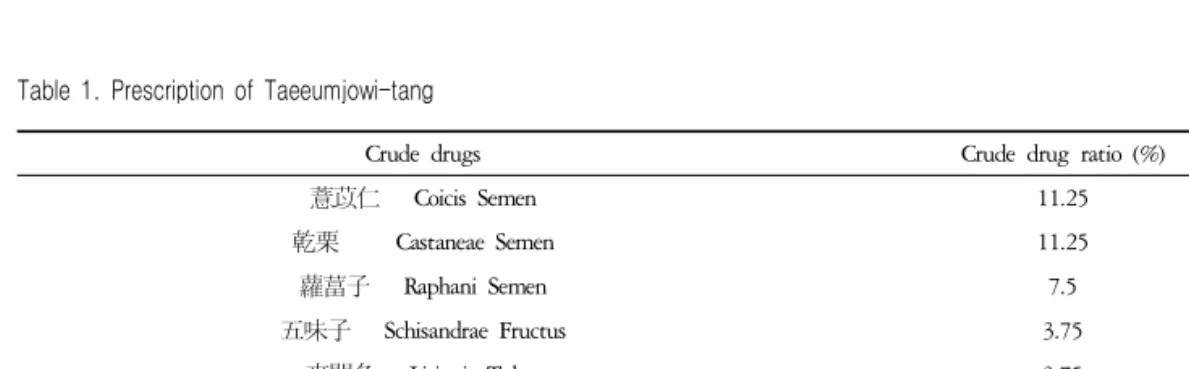
Crude drugs Crude drug ratio (%)
薏苡仁 Coicis Semen 11.25
乾栗 Castaneae Semen 11.25
蘿葍子 Raphani Semen 7.5
五味子 Schisandrae Fructus 3.75
麥門冬 Liriopis Tuber 3.75
石菖蒲 Acori Gramineri Rhizoma 3.75
桔梗 Platycodi Radix 3.75
麻黃 Ephedrae Herba 3.75
Table 1. Prescription of Taeeumjowi-tang
Ⅰ. 緖 論
太陰調胃湯은 李濟馬의 東醫壽世保元에 처음으로 소개된 처방으로 肝大肺小한 생리적 臟腑 形局을 지니는 太陰人의 胃脘受寒表寒病에 쓰이 는 대표적인 처방이다 1 . 太陰調胃湯의 약재 구성은 薏苡仁, 乾栗, 蘿葍子, 五味子, 麥門冬, 石菖蒲, 桔梗, 麻黃의 祛濕, 祛痰하는 약이 주류를 이루고 있으며 비만의 치료에 좋은 효과가 있는 것으로 알려 져 있다 2,3 . 또한 肺의 呼散之力을 강화시켜주고 상 대 장기인 肝의 吸聚力이 過 旺되는 것을 억제해 주는 효과가 있다 4 . 太陰調胃湯에 관한 연구로는 과 체중 아동의 체중 감소 효과 5 , 절식요법 시행 후 태음 인비만에 대한 연구 6 , 백서의 비만증 및 유도비만세포 에 미치는 효과 2 , 비만 백서의 leptin에 미치는 영향 7 , 항산화 효과에 의한 간세포 보호 효과 8 , 흰쥐의 간 기 능 효소와 간 내 지방축적에 미치는 영향 9,10 등이 있다.
최근의 한의학계에서는 소비자들의 한약에 대한 신뢰를 회복시키기 위한 연구로 四君子湯, 四物湯 (마침표 제거), 八物湯, 十全大補湯 등의 급성 독성
11-13 과 아급성독성 14,15 에 대한 연구가 활발하게 진행되
고 있으나 사상체질처방에 대한 독성 실험은 이루어 지지 않고 있는 실정이다. 따라서 본 실험에서는 전권 에 발표한 太陰人의 대표처방인 熱多寒少湯 16 에 이 어 太陰調胃湯을 가지고 급성 독성시험에 대한 안정 성을 평가하기 위한 연구를 수행하여 다음과 같은 유 의한 결과를 얻었기에 보고하는 바이다.
Ⅱ. 試驗 方法
1. 검액의 제조
太陰調胃湯의 급성독성시험을 하기 위하여 식품 의약품안전청고시 제1999-61호(1999년 12월 22일)의
‘의약품등의 독성시험기준’을 변형하여 실시하였다.
한약처방 太陰調胃湯의 한약재는 대한약전 및 대한 약전외한약(생약)규격집을 기준으로 蘿葍子(Raphani Semen), 石菖蒲(Acori Gramineri Rhizoma) 및 麻黃 (Ephedrae Herba)은 (주)HMAX(Chungbuk, Korea)에서 구입하였으며, 薏苡仁(Coicis Semen), 乾栗(Castaneae Semen), 五味子(Schisandrae Fructus), 麥門冬(Liriopis Tuber) 및桔梗(Platycodi Radix)은(주)옴니허브(Yeongcheon, Korea)에서 구입하였다.
太陰調胃湯의 구성은 東醫壽世保元 3 을 참 고하였으며 추출은 Table 1의 비율에 따라 경서기계산 업의 열수추출기(COSMOS 660)로 시료의 10배수에 해 당되는 물을 첨가하여 100℃에서 120분간 전탕하였 다. 전탕 후 여과하여 농축기(Eyela N-11)로 농축 후 동결건조기(일신랩 PVTFD100R)를 사용하여 분말 시 료를 얻었으며(수율 29.0%), 시료는 한국한의학연구 원 한약EBM연구센터(Specimen No. KE-29)에 보관하 였다.
2. 실험동물 및 사육환경
4주령의 ICR Mouse(오리엔트, 서울시 금천구 가산
동 459-24)를 사용하였다. 3주령의 마우스를 입수하여
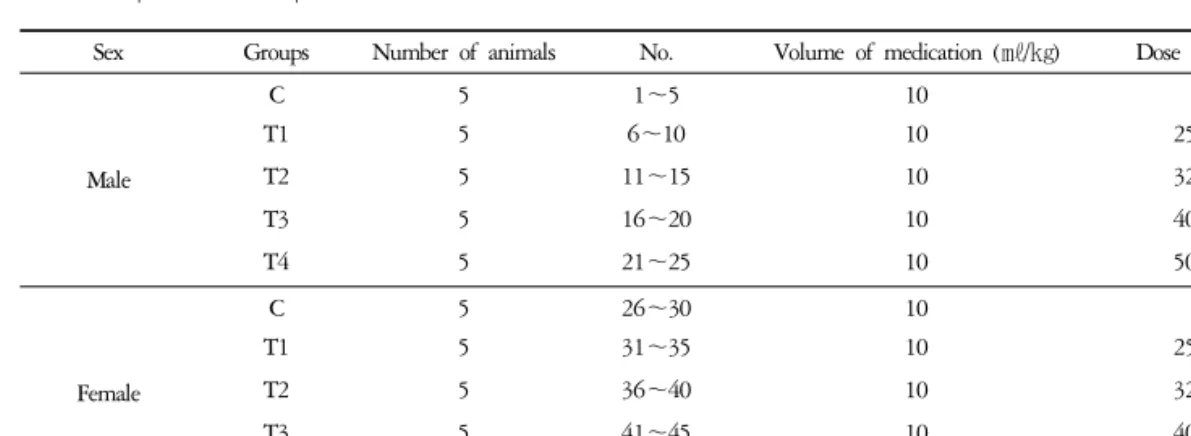
Sex Groups Number of animals No. Volume of medication (㎖/㎏) Dose (㎎/㎏)
Male
C 5 1~5 10 0
T1 5 6~10 10 2560
T2 5 11~15 10 3200
T3 5 16~20 10 4000
T4 5 21~25 10 5000
Female
C 5 26~30 10 0
T1 5 31~35 10 2560
T2 5 36~40 10 3200
T3 5 41~45 10 4000
T4 5 46~50 10 5000
Table 2. Experimental Groups
7일간 시험동물실에서 순화하고 마우스의 체중을 측 정한 후 2 g 간격으로 구분하여 암ㆍ수 각각 25마리씩 건강한 동물을 선정하여 각 군에 5마리씩 균등한 체중 으로 분배되도록 순위화한 체중과 난수를 이용한 무 작위법으로 분배하였다. 동물의 개체식별은 피모의 색소염색법과 개체식별카드 표시법으로 실시하였다.
순화 및 실험기간 동안의 사육환경은 온도 23±3℃, 상대습도 50±10%, 조명시간 12시간(오전 8시~오후 8시), 환기횟수 10~20회/hr. 및 조도 150~300 Lux로 조정하여 일정한 사육환경을 유지하였으며 실험동물 용 고형사료(삼양사료 주식회사)와 물은 자유섭취 조 건으로 한국한의학연구원 실험 동물실에서 시험하였 다. 또한 모든 실험 절차는 NIH 가이드라인과 실험동 물보호법에 따라 수행하였다.
3. 실험 군 및 한약재 투여
4주령 마우스에 대한 단회 투여에 의한 독성을 조 사하기 위하여 암ㆍ수 마우스를 각각 5개의 용량 군으 로 나누었다. 투여 경로는 한방 임상에서 사용하는 경구 투여법을 사용하였으며 경구 투여 가능 최대용 량인 5000 ㎎/㎏/day을 기준으로 공비 0.8로 하여 0, 2560, 3200, 4000 및 5000 ㎎/㎏의 용량으로 단회 경구 투여하고 14일간의 사망률, 일반증상, 체중변화 및 부 검소견을 관찰하였다. (Table 2)
4. 시험물질의 투여
太陰調胃湯 추출 분말 10g을 멸균증류수 20 ㎖
에 녹여 고농도(T4군)로 사용하였으며, 나머지군은 주 사용 멸균 증류수를 첨가하여 차례로 희석하여 투여 물질로 사용하였다. 투여방법은 피부 고정법으로 고 정하고 경구 투여용 금속제 sonde와 주사관을 이용하 여 투여 당일 투여당일의 측정된 체중을 기준으로 하 여 각각의 군별 투여량에 맞게 투여액량을 계산하여 오전에 개체별로 1회 강제 경구 투여하였다.
5. 임상증상 및 부검
실험동물의 임상 증상관찰은 투여당일은 최종 투여 후 1시간에서 6시간까지는 매 시간마다 탈모, 설사, 다뇨증, 변, 활동성, 떨림 및 부종 등과 같은 일반증상 을 관찰하였고, 투여 익일부터 14일까지는 매일 1회 일반증상의 변화, 독성증상 및 사망동물의 유무를 관 찰하였다.
6. 체중측정
시험에 사용된 모든 동물에 대하여 경구 투여개시 전과 투여 후 1, 3, 7일과 부검 직전인 14일에 체중을 측정 하였다.
7. 부검소견 관찰
투여 후 14 일째에 모든 생존동물의 외관 이상 유무
를 관찰하였으며, 내부 장기의 이상 유무는 Ether 마취
하에서 개복한 후에 복대동맥을 절단하여 방혈치사
시킨 후 간, 신장, 폐 등의 장기 이상 유무를 육안으로
관찰하였다.
Sex Dose (㎎/㎏)
Days after treatment
Final Mortality LD50 (㎎/㎏)
0 1 3 7 14
Male T1C T2T3 T4
Vehicle 2560 32004000 5000
0/5*0/5 0/50/5 0/5
0/50/5 0/50/5 0/5
0/50/5 0/50/5 0/5
0/50/5 0/50/5 0/5
0/50/5 0/50/5 0/5
0/50/5 0/50/5 0/5
0/50/5 0/50/5 0/5 Female
C T1 T2T3 T4
Vehicle 2560 32004000 5000
0/5 0/5 0/50/5 0/5
0/5 0/5 0/50/5 0/5
0/5 0/5 0/50/5 0/5
0/5 0/5 0/50/5 0/5
0/5 0/5 0/50/5 0/5
0/5 0/5 0/50/5 0/5
0/5 0/5 0/50/5 0/5
*Values are expressed as number of dead animals/number of animals examined.
Fig. 1. Mean body weight changes of male ICR mouse orally treated with Taeeumjowi-tang.
C; Control group, T1; Extraction of Taeeumjowi-tang 2560㎎/㎏(day) medication group, T2; Extraction of Taeeumjowi-tang 3200
㎎/㎏(day) medication group, T3; Extraction of Taeeumjowi-tang 4000㎎/㎏(day) medication group, T4; Extraction of Taeeumjowi-tang 5000㎎/㎏(day) medication group.
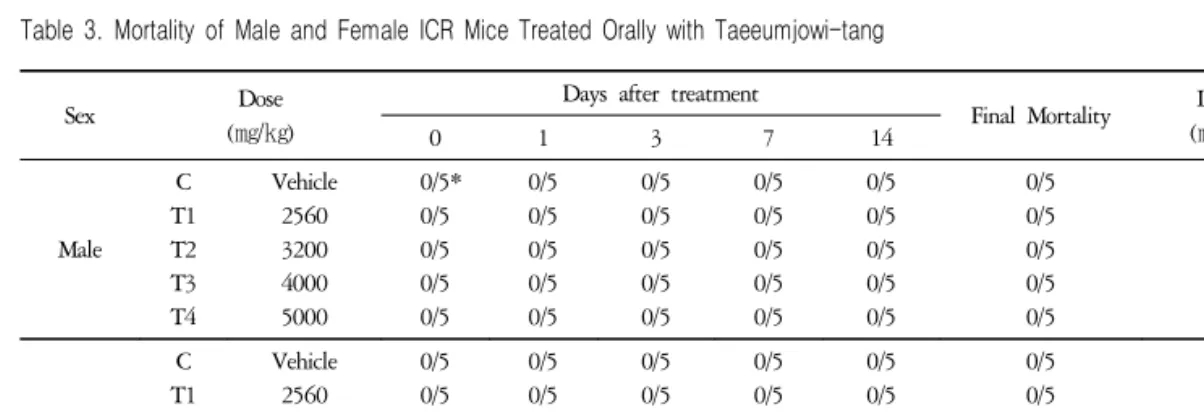
Table 3. Mortality of Male and Female ICR Mice Treated Orally with Taeeumjowi-tang
8. 통계학적 방법
모든 실험군에서 동물측정용 저울을 이용하여 체 중을 측정하여 평균과 표준 편차를 구하였다. 용매 대조군과 처치군 사이의 통계학적 유의차는 ANOVA 후에 사후 분석으로 Dunnett test에 의하여 검정하였 고, p<0.05를 실험군간의 유의성 있는 차이로 판정하 였다. 그리고 사망동물이 관찰되지 않아 LD50 값의 산출은 실시하지 않았다.
Ⅲ. 結 果
1. 사망률 및 LD50값
太陰調胃湯을 경구 투여한 후 암수 ICR 마우스를 14일 동안 관찰한 결과 사망동물과 LD50 값은 Table 3과 같다. 본 실험에서 경구 투여의 최대용량인 5000
㎎/㎏까지 투여하여도 ICR 마우스의 사망은 관찰되
지 않았다. 따라서 본 시험에서 LD50값은 암․수 모
두 5000 ㎎/㎏ 이상으로 사료된다.
Fig. 2. Mean body weight changes of female ICR mouse orally treated with Taeeumjowi-tang.
C; Control group, T1; Extraction of Taeeumjowi-tang 2560㎎/㎏(day) medication group, T2; Extraction of Taeeumjowi-tang 3200
㎎/㎏(day) medication group, T3; Extraction of Taeeumjowi-tang 4000㎎/㎏(day) medication group, T4; Extraction of Taeeumjowi-tang 5000㎎/㎏(day) medication group.
Sex Dose
(㎎/㎏)
Signs
Loss of Fur Diarrhea Polyuria Soft Stool Decreased Motor Activity Tremor Edema
Male T1C T2 T3T4
Vehicle 2560 3200 40005000
0/5*0/5 0/5 0/50/5
0/50/5 0/5 0/50/5
0/50/5 0/5 0/50/5
0/50/5 0/5 0/50/5
0/50/5 0/5 0/50/5
0/50/5 0/5 0/50/5
0/50/5 0/5 0/50/5
Female C T1T2 T3 T4
Vehicle 25603200 4000 5000
0/5 0/50/5 0/5 0/5
0/5 0/50/5 0/5 0/5
0/5 0/50/5 0/5 0/5
0/5 0/50/5 0/5 0/5
0/5 0/50/5 0/5 0/5
0/5 0/50/5 0/5 0/5
0/5 0/50/5 0/5 0/5
*Values are expressed as number of animals with the sign/number of animals examined.
Table 4. Clinical Signs in Male and Female ICR Mice Treated Orally with Taeumjowi-tang.
(㎎/㎏)Dose C
(Vehicle) T1
(2560) T2
(3200) T3
(4000) T4
(5000)
OrgansSex male female male female male female male female male female
Liver Heart Spleen KidneyLung Stomach
0/5*
0/50/5 0/50/5 0/5
0/5 0/50/5 0/50/5 0/5
0/5 0/50/5 0/50/5 0/5
0/5 0/50/5 0/50/5 0/5
0/5 0/50/5 0/50/5 0/5
0/5 0/50/5 0/50/5 0/5
0/5 0/50/5 0/50/5 0/5
0/5 0/50/5 0/50/5 0/5
0/5 0/50/5 0/50/5 0/5
0/5 0/50/5 0/50/5 0/5
*Values are expressed as number of animals with the abnormal/number of animals examined.
Table 5. Autopsy Finding in ICR Mouse Orally Treated with Taeeumjowi-tang.