http://dx.doi.org/10.14316/pmp.2016.27.3.131 pISSN 2508-4445, eISSN 2508-4453
This work was supported by the General Researcher Program (NRF-2015R1D1A1A09056828), the Nuclear Safety Research Program (Grant No. 1603016 and 1403019) through the Korea Foundation of Nuclear Safety (KOFONS), and was granted financial resources from the Nuclear Safety and Security Commission (NSSC), Republic of Korea.
Received 6 September 2016, Revised 22 September 2016, Accepted 23 September 2016
Correspondence: Dong Oh Shin ([email protected]) Tel: 82-2-958-9467, Fax: 82-2-958-9469
cc This is an Open-Access article distributed under the terms of the Creative Commons
Attribution Non-Commercial License (http://creativecommons.org/licenses/by-nc/4.0) which
permits unrestricted non-commercial use, distribution, and reproduction in any medium,
provided the original work is properly cited.
Comparative Analysis of Terminology and Classification Related to Risk Management of Radiotherapy
Yoonjin Oh*, Dong Wook Kim
†, Dong Oh Shin
‡, Jihye Koo
§, Soon Sung Lee
∥¶, Sang Hyoun Choi
¶, Sohyun Ahn**, Dong-wook Park
††
*Research Institute of Clinical Medicine,
†Department of Radiation Oncology, Kyung Hee University Hospital at Gangdong,
‡Department of Radiation Oncology, Kyung Hee University Hospital,
§Department of Bio-convergence Engineering, Korea University,
∥Department of Radiological and Medico Oncological Sciences, University of Science and Technology,
¶Division of Medical Radiation Equipment, Korea Institute
of Radiological and Medical Sciences, **Department of Radiation Oncology, School of Medicine, Yonsei University,
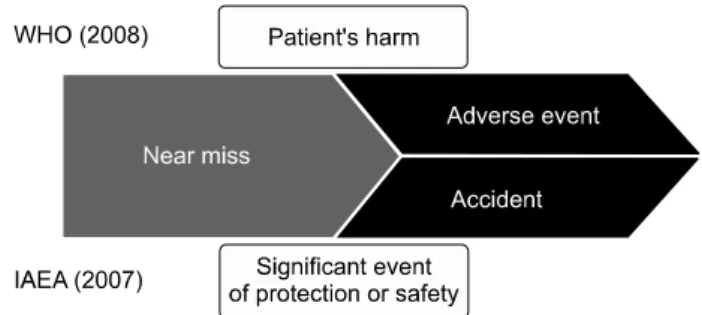
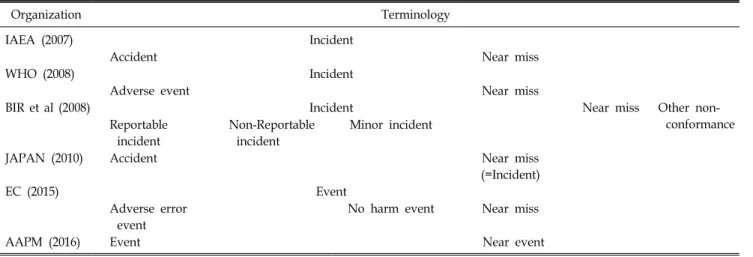
††Department of Radiation Oncology, Inje University Ilsan Paik Hospital, Seoul, Korea We analyzed the terminology and classification related to the risk management of radiation treatment overseas to establish the terminology and classification system for Korea. This study investigated the terminology and classification for radiotherapy risk management through overseas research materials from related organizations and associations, including the IAEA, WHO, British group, EC, and AAPM. Overseas risk management commonly uses the terms “near miss”, “incident”, and “adverse event”, classified according to the degree of severity.
However, several organizations have ambiguous terminologies. They use the term “near miss” for events such as a near event, close call, and good catch; the term “incident” for an event; and the term “adverse event”
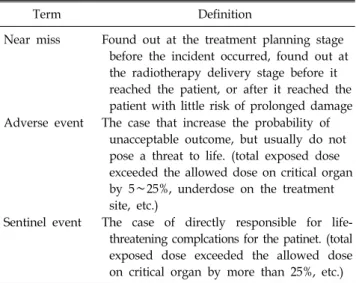
for the likes of an accident and an event. In addition, different organizations use different classifications: a “near miss” is generally classified as “incident” in most cases but not classified as such in BIR et al. Confusion might also be caused by the disunity of the terminology and classification, and by the ambiguity of definitions. Patient safety management of medical institutions in Korea uses the terms “near miss”, “adverse event”, and “sentinel event”, which it classifies into eight levels according to the severity of risk to the patient. Therefore, the terminology and classification for radiotherapy risk management based on the patient safety management of medical institutions in Korea will help in improving the safety and quality of radiotherapy.
Key Words: Radiotherapy, Risk management, Patient safety, Incident, Accident
Introduction
Radiotherapy, a high-dose irradiation therapy for treating cancer and relieving related symptoms, contributes funda-
mentally to the promotion of national health in the face of in-
creasing numbers of cancer patients. However, its risk manage-
ment for errors is extremely important because of the increas-
ing complexity of the advanced equipment and technology and
because of the nature of therapies that use high doses of
radiation. For these reasons, the American Association of
Physicists in Medicine (AAPM), the American Society for
Radiation Oncology (ASTRO), the American College of
Radiology (ACR), and the International Atomic Energy
Agency (IAEA) have all proposed guidelines for quality con-
trol to provide safe and effective radiotherapy. The Nuclear
Safety and Security Commission (NSSC) of Korea has also
recommended radiation safety management standards in the
medical field for the quality control of therapeutic radiation
instruments. Although the existing radiation safety management