• 검색 결과가 없습니다.

Effects of Enzyme Mixture and Beating Treatment on the Properties of Pulp Fibers

N/A
N/A
Protected

Academic year: 2021

Share "Effects of Enzyme Mixture and Beating Treatment on the Properties of Pulp Fibers"

Copied!
9
0
0

로드 중.... (전체 텍스트 보기)

전체 글

(1)

Effects of Enzyme Mixture and Beating Treatment on the Properties of Pulp Fibers

Seokho Lee

1

, Hyeonji Park

1

, Wanhee Im

1

, Heetae Park

1

, Hak Lae Lee

2

, Hye Jung Youn

2†

Received October 7, 2020; Received in revised from October 17, 2020; Accepted October 21, 2020

ABSTRACT

Pulp fibers were pretreated with the mixture of endoglucanase and endoxylanase to facil- itate the nanofibrillation. The effects of the combined pretreatment of the mixed enzymes and beating were investigated in terms of fiber length, fines content, freeness, water re- tention value (WRV), cupriethylenediamine (CED) viscosity, and the viscosity of cellulose nanofibrils (CNF) suspension. Compared to untreated and pure enzyme-treated pulps, the mixed enzyme-treated pulp showed higher fiber length and lower fines content. The CED viscosity of fibers was mainly affected by endoglucanase. The beating treatment on the enzyme pretreated pulp increased fines content and WRV greatly, which means that fiber structure was sufficiently weakened by enzyme treatment. In particular, when pulp was treated with enzyme mixture and beaten, the WRV and freeness were higher than single component-enzyme treatment. Depending on the enzyme composition and beating treatment, the low shear viscosity of the resultant CNF suspension exhibited different trend. It revealed that the use of endoenzyme mixture is beneficial to decompose pulp fi- bers and may control the aspect ratio of CNF.

Keywords: Beating, cellulose nanofibers, combined treatment, enzyme, pulp properties

Printed in Korea http://dx.doi.org/10.7584/JKTAPPI.2020.10.52.5.101

1 Department of Forest Sciences, College of Agriculture and Life Sciences, Seoul National University, 1 Gwanak-ro, Gwa- nak-gu, Seoul 08826, Korea, Student

2 Department of Agriculture, Forestry and Bioresources, College of Agriculture and Life Sciences, Seoul National University, 1 Gwanak-ro, Gwanak-gu, Seoul 08826, Korea, Professor

† Corresponding author: E-mail: [email protected]

1. Introduction

Cellulose nanofibril (CNF) which is prepared by repeated mechanical shearing has drawn a big interest from researchers. Owing to sustainability,

biodegradability and unique properties of CNF,

diverse applications of CNF has been extensively

studied. To expand the use of CNF, the price of CNF

should be inexpensive and the miscibility and dis-

persability should be improved. The production cost

(2)

of the mixing ratio of enzymes even though each enzyme has different role in the activity.

15)

More researches are required to understand the roles of each enzymes in the activity of enzymes mixtures.

The aim of this study is to evaluate how the mixed use of endoglucanase and endoxylanase as pre- treatment affects the pulp properties prior to pro- duction of CNF. In addition, the combined effects of mixed endoenzymes and beating on the pulp properties are investigated. For this purpose, the never-dried bleached kraft pulp was pretreated with mixture enzymes in different ratios. Fiber length, fines, freeness, water retention value (WRV), and cupriethylenediamine (CED) viscosity of each pretreated pulp were evaluated. Beating was used to reveal and promote the effect of enzyme pretreatment on the pulp. In addition, each pretreated pulp nanofibrillation behavior was examined in terms of suspension viscosity.

2. Materials and Methods

2.1 Materials

Never-dried bleached kraft pulp supplied by Moorim P&P Co., Ltd.(Korea) was used as raw material. According to sugar analysis by HPLC, the pulp fibers consist of 75% glucose, 19% xylose, and 0.5% mannose. The contents of lignin and ash were very small, so they are negligible. Endoglucanase (Fibercare R, Novozymes, Denmark) and endox- ylanase (Pulpzyme HC 2500, Novozymes, Den- mark) were used for pulp treatment in this study.

These enzymes were supplied by Buckman Labo- ratories Korea.

2.2 Pretreatment of pulp fibers with endoenzyme mixture

100 g (oven dried weight) of never-dried bleached kraft pulp was diluted to 10 wt% with deionized (DI) water. The pH of the diluted pulp suspension was of CNF can be lowered by reducing the nanofibril-

lation energy, which can be achieved by pretreat- ment of pulp fibers prior to nanofibrillation. There are various pulp pretreatment methods such as 2,2,6,6-tetramethylpiperidine-1-oxyl radical (TEMPO)-mediated oxidation,

1)

carboxymethyla- tion,

2,3)

and enzyme reaction.

4,5)

Among them, enzyme treatment is recognized as environmentally-friendly pretreatment because it does not require any solvent and produce less waste in the air. Enzymes have been widely used in the pulp and paper industry to hydrolyze materials such as cellulose and hemicellulose

6)

for a long time. The enzyme pretreatment with cellulase, hemicellulase and pectinase can help the kraft pulping,

7)

and laccase and protease reduce the energy required for the mechanical pulping.

8)

Kraft pulp pretreated with cellulase and hemicellulase can be used to reduce the energy consumption required for the refining in papermaking process.

9)

Enzymes can be used for removing stickies

10)

and deinking

11)

in the recovered paper process. In addi- tion, enzymes are also used for the pulp fiber modifications, which change the freeness of pulp fibers and the density and smoothness of the paper. Considering these works of enzymes, enzyme have potential enough to aid the nano- fibrillation of the pulp by weakening the structure of the pulp.

In some cases, it is hard to degrade the substrates with single enzyme, and enzyme mixture can be used to hydrolyze the substrates for improving the accessibility of enzymes to the substrates.

12)

Such synergistic effects with mixed enzymes have attracted attentions from many researchers.

13)

Advantage of the mixed enzymes treatment is

that they can hydrolyze more substrates with lim-

ited resources. However, most of researches, using

enzyme for preparation of CNF, use single enzyme

system,

4,5,14)

or use enzymes mixture under the

restricted condition with no further considerations

(3)

adjusted to 7 using buffer solution. Enzyme mix- tures was added by the addition level of 0.5 wt%

based on the oven dried weight of the pulp.

Enzyme mixtures were prepared by mixing endog- lucanase (referred as ‘G’) and endoxylanase (referred as ‘X’) with different weight ratios as mentioned in Table 1.

The pulp and enzyme mixtures were placed in a plastic bag and reacted at 50°C for 1 hour in the water bath. During the enzyme reaction, the pulp samples were kneaded at intervals of 15 minutes.

For termination of the reaction, the pulp samples were boiled for 15 minutes and then washed to deactivate the enzyme. Each enzyme-treated pulp was beaten with a laboratory Valley beater to reveal the effect of the combined pretreatment of enzyme and beating on the pulp. For beating, the enzyme-treated pulp slurries were diluted to 1%

stock with DI water. Each stock was beaten for 15 minutes.

2.3 Evaluation of pulp properties

The pulp properties including fiber length, fines content, freeness, WRV and CED viscosity were measured on the enzyme pretreated pulp samples and the enzyme-beating combined pretreated pulp samples. Fiber length and fines content were mea- sured using a Kajaani FiberLab (Kajaani, Finland).

The measurement on each condition was repeated three times and more than 3,000 fibers were mea- sured at each measurement. The fiber length result was suggested as a length-weighted average fiber length. Canadian Standard Freeness (CSF) of each treated pulp was measured in accordance with TAPPI method T 227 om-99.

The WRV of each treated pulp was measured in

accordance with Scan-C 62:00. Each sample was centrifuged at 3000 G for 15 minutes. The CED viscosity of the treated pulp fibers was measured in accordance with TAPPI method T 230 om-99. The pulp fibers were dissolved in the CED solution.

Then, the viscosity of the cellulose solution was measured using a capillary viscometer.

2.4 Preparation of CNF from enzyme treated pulp The consistency of each pretreated pulp suspen- sion was adjusted to 1.5 wt%. CNF was prepared using a grinder (Supermasscolloider, Masuko Sangyo, Japan) from each pretreated pulp suspen- sion. The gap distance between the stones was –80 μm and the stone rotation speed was 1500 rpm. Sampling was done after passing 30 times through the grinder, and the low shear viscosity of the CNF suspension was measured. The low shear viscosity of the fiber suspension (1%) was measured at 25±1°C using Brookfield viscometer (Brookfield Engineering Laboratories, USA). The morphology of CNF was observed using field-emission scan- ning electron microscope (SUPRA 55VP, Carl Zeiss, Germany).

3. Results and Discussion

3.1 Properties of mixed enzyme treated pulp fibers

Pulp fibers were pretreated with the mixture of endoglucanase and endoxylanase to facilitate the nanofibrillation. Also, the effects of the combined pretreatment of the mixed enzymes and beating were investigated in terms of fiber length, fines content, freeness, WRV, and CED viscosity.

Table 1. The composition of enzyme mixture

Condition G:X 100:0 G:X 80:20 G:X 60:40 G:X 40:60 G:X 20:80 G:X 0:100

Endoglucanase (G) 100 80 60 40 20 0

Endoxylanase (X) 0 20 40 60 80 100

(4)

the fiber length than other conditions. However, endoxylanase boosted the cutting effect rather than endoglucanase. This change in fiber length was likely to be originated from the fines content, as shown in Fig. 2. Generally, the fines content showed opposite trend against fiber length depending on the enzyme composition and beating.

With enzyme treatment, fines content was decreased, which resulted in the increase in the fiber length. Endoglucanase and endoxylanase would be more adsorbed on the particles with the large specific surface area, like fibrils or fines, and decomposed them. This result is similar to the work done by Pommier et al.

16)

More fines were removed when the enzyme mixture was added to the pulp slurry compared to the use of single com- ponent-enzyme. It seemed that accessibility of enzyme to fibers would be improved by use of the mixed enzyme. However, the combined treatment of enzyme reaction and beating generated much more fines in pulp slurry. Contrary to only enzyme treatment, additional beating treatment created fines much more. It was because that some of long fibers were degraded into small particles by enzyme attack. When pulp was treated by endoxylanase with higher dosage and beating, more fines were Fig. 1 shows the fiber length of each pretreated

pulp depending on the mixing ratio of endoen- zymes and beating pretreatment. The ‘Con’ sample corresponds to untreated pulp fiber sample. When only enzyme pretreatment was done on the pulp fibers, the average fiber length of fibers was rather longer for enzyme pretreated pulp fibers than for the untreated one. The fiber length was increased as the mixing ratio of the endoxylanase was increased up to 60%. The increase in fiber length seemed to be due to the degradation of the fibrils and primary fines in kraft pulp by enzyme. When the endoxylanase content was more than 60%, however, fiber length was decreased. The combined use of endoglucanase and endoxylanase with proper mixing ratio was more effective in increas- ing the average fiber length. When the enzyme- treated pulp was beaten, the fiber length result shows different trend compared to the case of only enzyme treatment. The fiber length increased by enzyme pretreatment was decreased by beating for all enzyme conditions. In particular, the fiber length was more decreased when the content of endoxylanase in the enzyme mixture was increased. Because endoglucanase attack cellulose chain, it was expected to give greater impact on

Fig. 1. Fiber length of pulp fibers depending on enzyme composition and beating.

Fig. 2. Fines content of pulp fibers depending

on enzyme composition and beating.

(5)

produced. Even though endoglucanase decrease the degree of polymerization of cellulose, it doesn’t lead to the generation of fines in beating. On the other hand, degradation of hemicellulose(xylose) in fibers is helpful to swelling the fiber wall, and accelerates the beating. It resulted in higher amount of fines.

Fig. 3 showed the WRV of pulp fibers depending on the mixing ratio of the enzymes and beating pretreatment. The WRV of the enzyme-pretreated pulp was slightly higher than that of untreated pulp, and beating treatment increased the WRV independently on the mixing ratio of pulp. Beating treatment was more effective in increasing the WRV compared to enzyme treatment. In addition, beating effect was more remarkable for mixed enzyme pretreated pulp. Abson and Gilbert

17)

reported that WRV decreased with removal of fines. In this study, however, WRV is not decreased but slightly increases even though fines are removed by enzyme activity. It means that the enzyme pretreatment has two opposite effects on WRV. The first effect is a decrease in WRV due to the removal of fines. And the second one is an increase in WRV by internal fibrillation which comes from the degradation of fiber component by

enzyme mixture. The WRV of the mixed enzyme- treated pulp is a little higher than that of control pulp or single component-enzyme treated pulp, which is due to creation of new surfaces like inter- nal fibrillation by more hydrolysis of pulp compo- nent by enzyme mixture. It indicates that the mixed enzyme treatment was more effective in degrading the internal structure of fibers. The change in WRV by beating can be explained by internal and external fibrillation and fines genera- tion as mentioned by Thode et al.

18)

Fig. 4 showed the change in the CSF of the untreated and pretreated pulp fibers with beating.

The mixed enzyme-treated pulp has higher CSF than non-treated pulp does, as mentioned in a previous work by Fuentes et al.

19)

The CSF of pulp fibers was decreased with beating regardless of enzyme treatment, which was caused by the gen- eration of fines and fibrillation, and fiber swelling.

Untreated pulp and single component-enzyme pretreated pulps tended to show a linear decrease in freeness with beating time, whereas the pre- treated pulp by the enzyme mixture showed a drastic reduction of the CSF until 7.5 min. and thereafter slow decline in the CSF. According to Clark, too much fines caused a ‘negative freeness’,

Fig. 3. WRV of pulp fibers depending on en- zyme composition and beating.

Fig. 4. Freeness of pulp fibers depending on

enzyme treatment and beating.

(6)

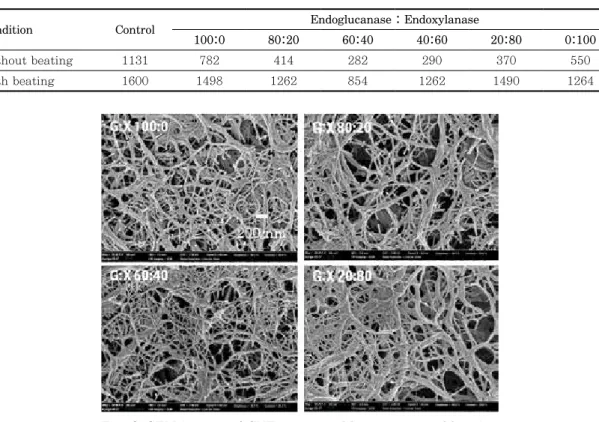
pulps and the enzyme-beating pretreated pulps by passing through a grinder 30 times. The low shear viscosity of each CNF suspension was measured (Table 2). The low shear viscosity of CNF suspen- sion is one of important properties of CNF because not only it can predict change in morphology such as shape, aspect ratio and surface areas in CNF,

21)

but also it can be used to confirm complete nano- fibrillation of fibers.

3)

Generally, chemical pre- treatment like carboxymethylation resulted in CNF suspension with very high viscosity compared to untreated CNF.

3)

However, in this study, enzyme-pretreated CNF exhibited relatively lower viscosity compared to untreated CNF. In particu- lar, enzyme mixture-pretreatment created CNF with lowest viscosity. When enzyme pretreatment was followed by beating treatment, the CNF had higher viscosity than those without beating pre- treatment. However, enzyme mixture conditions showed lower viscosity compared to untreated CNF or single enzyme case.

The enzyme mixture pretreatment showed a larger change in the CNF suspension viscosity than that of single component-enzyme pretreatment.

This seemed be due to the synergistic activity of endoenzymes mixture which reduced the DP of cellulose in the pulp and weakened the strength of pulp structure. It is known that enzyme pretreat- ment contributes to reduce nanofibrillation energy by decomposing the cell wall components.

4)

In this study, grinding pass number to complete nano- fibrillation was reduced by enzyme pretreatment.

However, the width of enzyme-pretreated CNF is similar to that of untreated CNF. Fig. 6 shows the SEM images on the enzyme-beating pretreated CNFs. Because of the observation magnification, it is hard to measure the length, but the widths of CNFs are similar irrespective of pretreatment con- dition. Therefore, low viscosity values are attributed to the decrease in the aspect ratio of CNF. Therefore, it is expected that enzyme mixture which means an increase in CSF as fines pass

through the perforation plate of the CSF freeness tester instead of forming a pulp mat.

20)

Therefore, a slight decrease in CSF freeness by 15 min beating might be due to the generation of fines with high amount.

The degree of polymerization (DP) of fibers was evaluated by CED viscosity of cellulose solution.

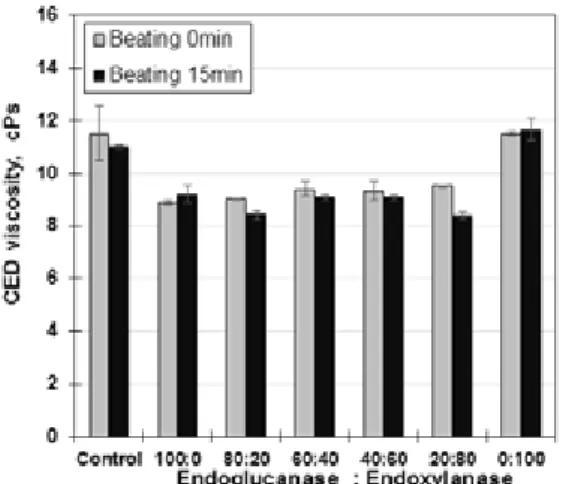
Fig. 5 shows the CED viscosity of cellulose depending on enzyme composition and beating pretreatment. Enzyme treatment decreased the CED viscosity, that is, DP of cellulose in the pulp, but beating did not change the DP of cellulose sig- nificantly. The DP of cellulose treated with endog- lucanase was reduced by 30% compared to the control untreated pulp in the experimental condi- tions. The beating did not affect the DP of the sin- gle endoglucanase- or endoxylanase-treated pulp, but the DP of the enzyme mixture-treated pulp was reduced to some extent but insignificantly. It means that the DP of cellulose was affected by mainly endoglucanase.

3.2 Effect of enzyme pretreatment on nanofibrillation

CNF was produced using the enzyme-pretreated

Fig. 5. CED viscosity of pulp fibers depending

on enzyme composition and beating.

(7)

pretreatment can be utilized to control the aspect ratio of CNF.

4. Conclusions

This study was conducted to investigate the effect of endoglucanase and endoxylanase in the mix usage on the pulp as pretreatment for production of CNF. In addition, the effect of enzyme mixture and beating pretreatment on the properties of pulp and nanofibrillation was evaluated. The enzyme pretreatment removed fines in the pulp and increase fiber length. The DP of cellulose was affected mainly by endoglucanase. With beating treatment, fiber length was decreased with an increase in fines content, and greatly increased WRV. When the mixed enzymes were treated on

pulp fibers, WRV and freeness were changed dras- tically. Enzyme mixture treatment was more effective in changing pulp properties and decom- pose the pulp fibers compared to control or sin- gle-component enzyme treatment. In addition, the mixed enzyme system resulted in CNF suspension with lower Brookfield viscosity. It means the CNF morphology can be affected by enzyme composi- tion. It is expected that enzyme mixture pretreat- ment can be used to produce CNF with controlled aspect ratio.

Acknowledgments

This work was supported by the Technological Innovation Program funded by the Ministry of Trade, Industry & Energy (Project No. 10062717).

Table 2. Low shear viscosity of CNF suspension depending on pretreatment condition (Unit: cPs)

Condition Control Endoglucanase : Endoxylanase

100:0 80:20 60:40 40:60 20:80 0:100

Without beating 1131 782 414 282 290 370 550

With beating 1600 1498 1262 854 1262 1490 1264

Fig. 6. SEM images of CNF pretreated by enzyme and beating

(30 passes).

(8)

Tappi J. 81(1):260-266 (1998).

8. Wong, K. K., and Mansfield, S. D., Enzymatic processing for pulp and paper manufacture-a review, Appita Journal 52(6):409-418 (1999).

9. Dickson, A. R., Wong, K. K. Y., and Mans- field, S. D., Response of xylanase-treated kraft pulp to Escher-Wyss and PFI refining, Tappi J. 83(7) (2000).

10. Fitzhenry, J. W., Hoekstra, P. M., and Glover, D., Enzymatic stickies control in MOW, OCC and ONP furnishes, Proceedings of 2000 TAPPI Pulping Process and Product Quality Conference, pp. 985-988.

11. Treimanis, A., Leite, M., Eisimonte, M., and Viesturs, U., Enzymatic deinking of laser- printed white office wastepaper, Chemical and Biochemical Engineering Quarterly, 13(2):53- 57 (1999).

12. Edgar, C. D., Mansfield, S. D., Gubitz, G. M., and Saddler, J. N., Synergistic effects of endoglucanase and xylanase in modifying Douglas fir kraft pulp, ACS Symposium Series, 687, pp.75-87 (1998).

13. Kumar, R., and Wyman, C. E., Effects of cel- lulase and xylanase enzymes on the decon- struction of solids from pretreatment of poplar by leading technologies, Biotechnology Prog- ress 25(2):302-314 (2009).

14. Kim, K.-J., Jung, J.-D., Jung, S.-E., Ahn, E.-B., and Eom, T.-J., Enzyme activity and beating properties for preparation of micro- fibrillated cellulose (MFC), J. of Korea TAPPI 47(1):59-65 (2015).

15. Long, L., Tian, D., Hu, J., Wang, F., and Saddler, J., A xylanase-aided enzymatic pre- treatment facilitates cellulose nanofibrillation, Bioresource Technology, 243:898-904 (2017).

16. Pommier, J. C., Goma, G., Fuentes, J. L., and Rousset, C., Using enzymes to improve the process and the product quality in the recycled paper industry. 2. Industrial applications, We appreciate Buckman Laboratories, Korea for

providing enzymes.

Literature Cited

1. Saito, T., Kimura, S., Nishiyama, Y., and Isogai, A., Cellulose nanofibers prepared by TEMPO-mediated oxidation of native cellu- lose, Biomacromolecules 8(8): 2485-2491 (2007).

2. Naderi, A., Lindstr öm, T., and Sundström, J., Repeated homogenization, a route for decreasing the energy consumption in the manufacturing process of carboxymethylated nanofibrillated cellulose, Cellulose 22(2):1147- 1157 (2015).

3. Im, W., Lee, S., Park, H., Lee, H. L., and Youn, H. J., Characteristics of Cellulose Nanofibrils by Carboxymethylation Pretreat- ment: Effect of the carboxyl contents, Journal of Korea TAPPI 48(6):195-202 (2016).

4. P ääkkö, M., Ankerfors, M., Kosonen, H., Nyk änen, A., Ahola, S., Österberg, M., and Lindstr öm, T., Enzymatic hydrolysis combined with mechanical shearing and high-pressure homogenization for nanoscale cellulose fibrils and strong gels, Biomacromolecules 8(6):1934- 1941 (2007).

5. Hassan, M. L., Bras, J., Hassan, E. A., Silard, C., and Mauret, E., Enzyme-assisted isolation of microfibrillated cellulose from date palm fruit stalks, Industrial Crops and Products 55:102-108 (2014).

6. Mansfield, S. D., Wong, K. K., Jong, E. D., and Saddler, J. N., Modification of Douglas-fir mechanical and kraft pulps by enzyme treat- ment, Tappi J. 79(8):125-132 (1996).

7. Jacobs-Young, C. J., Venditti, R. A., and

Joyce, T. W., Effect of enzymatic pretreatment

on the diffusion of sodium hydroxide in wood,

(9)

Tappi J. 73(12):197-202 (1990).

17. Abson, D. and Gilbert, R. D., Observations on water-retention values, Tappi, 63(9):146-147 (1980).

18. Thode, E. F., Bergomi, J. G., and Unson, R.

E., The application of a centrifugal water-re- tention test to pulp evaluation, Tappi 43(5):505 (1960).

19. Fuentes, J. L. and Robert, M., Process of

treatment of a paper pulp by an enzymatic solution, European Patent, 262040 (1988).

20. Clark, J. D. A., Pulp Technology and Treat- ment for Paper, 2nd ed., Miller Freeman Pub- lications, Inc., San Francisco, p. 697 (1985).

21. Iwamoto, S., Lee, S. H., and Endo, T., Rela-

tionship between aspect ratio and suspension

viscosity of wood cellulose nanofibers, Polymer

Journal 46(1):73-76 (2014).

수치

Table 1. The composition of enzyme mixture
Fig. 1.   Fiber length of pulp fibers depending on  enzyme composition and beating.
Fig.  4  showed  the  change  in  the  CSF  of  the  untreated and pretreated pulp fibers with beating
Fig.  5  shows  the  CED  viscosity  of  cellulose  depending  on  enzyme  composition  and  beating  pretreatment
+2

참조

관련 문서

• 이명의 치료에 대한 매커니즘과 디지털 음향 기술에 대한 상업적으로의 급속한 발전으로 인해 치료 옵션은 증가했 지만, 선택 가이드 라인은 거의 없음.. •

MP Yousef Al-Fadalah, Supervisor of Parliament Business Environment Committee declared that the Public Institution for Housing Care intends to dedicate nearly 150

The main objective of the Bi Regional Center for SMES Development is oriented towards generating the conditions of cooperation among the countries which

In a statement to Kuwait News Agency (KUNA) on the sidelines of a meeting of the Arab Parliament's Foreign Affairs Political and National Security

The meeting was attended by Assistant Foreign Minister for GCC Affairs, Ambassador, Nasser Al-Muzayyen, and Deputy Assistant Foreign Minister for the Office of the

“ Sheikh Nasser has a written message from HH the Amir, Sheikh Sabah Al-Ahmad Al-Jaber Al-Sabah to the Chinese President, Chi Gen Beng related to enhancing mutual

On his part, CEO of Express Roads Authority, Saud Al-Naqqi said that the heavy rains of the previous day led to clogging parts of the express

Kuwait will celebrate on Sunday the fourth anniversary of the UN honoring and proclamation of His Highness the Amir, Sheikh Sabah Al-Ahmad Al-Jaber Al-Sabah as