416
†
Corresponding author: (Phone) +82-55-350-1222
(E-mail) [email protected] <Received October 20, 2009>
Effect of Seed Priming Treatment on the germination of Sesame
Kang-Bo Shim*
†, Sang-Kyun Cho**, Jung-Dong Hwang*, Suk-Bok Pae*, Myoung- Hee Lee*, Tae-Jung Ha*, Chang-Hwang Park*, Keum-Yong Park*, and Jae-Cheon Byun***
*Department of Functional Crop, NICS, RDA, Miryang, 672-803, Korea
** Department of Rice and Winter cereal Crop, NICS, RDA, Iksan, 570-080, Korea
***College of Natural Resource & Life Science, Nat'l Pusan University, Pusan, 609-735, Korea
ABSTRACT This experiment was conducted to find out optimum priming treatment conditions to the sesame seed as a preliminary study for enhancing sesame germination properties. Effective priming agents and concentrations for sesame seed were K
3PO
4, 200 mM and PEG6000, -1.0 MPa respectively. Optimum priming temperature and duration were 15℃, 4 days in view of germination speed and germination percentage. PEG6000 with -1.0 MPa was selected as an efficient priming treatment condition at 1 5℃, 4 days. This study suggested that priming treatment to sesame seed would be an effective technique enhancing sesame seed germination and shortening time to the T
50at the field condition, but the efficiency of priming treatments to the sesame seed would be strongly dependent on individual or integrated conditions of priming agent, concent- ration, temperature and duration etc.
Keywords : sesame, priming, germination speed, germination percentage
Seed priming technique is to treat seeds with low osmotic solution to improve germination percentage, speed and uniformity. Basic priming principle is up-taking water to achieve critical water content that accelerate metabolic activity in the controlled environments (Taylor, 1997). The controlled environmental factors for the optimum seed priming are water potential of priming medium, temper- ature and duration. Effective priming treatment can be achieved by controlling the osmotic solution concentration enough to prevent germination. Sesame which is resistant to aridity and with high-temperature adaptability, can be germinated at the minimum temperature above 12℃. But
its sowing date in Korea usually comes to early May when the average temperature is less than 12℃ and soil moisture content is not enough to germinate sesame seed at the upland soil condition. Poor and uneven seedling germination increases labor cost and, eventually, decreases the effici- ency of sesame seed production. Therefore, the bottom line of sesame cultivation in Korea would be determined by uniformal seedling germination percentage which could save labor time for uneven seedling supplement or thinning.
Several experiments of priming or pellet treatment to the sesame seed were conducted to obtain healthy seedling germination(Kim et al., 1997a; Kim et al., 1997b; Kim et al., 1997c). Oh et al. (1997) developed sesame seed pellet methods. According to the study, charcoal was one of the excellent materials to make pellet sesame seed with the properties of hardness, breakdown, destruction rate and germin- ation percentage. The optimum sesame seed mixture rate was about 87g per 1ℓ of CaCl
2solution. And the moisture absorption rate was greater in the order of peat+charcoal, peat, charcoal and zeolite. The optimum sesame seed pellet materials were charcoal with the about 92% germination percentage. Nevertheless, integrated priming technique for the sesame germination improvement was not yet completed.
Thus, the object of this study was to determine the optimum agents, concentration, temperature and duration for the priming treatment to improve germination rate and speed of sesame seed.
MATERIALS AND METHODS
Sesame cultivar, Yangbaek’ seeds were used for this
experiment. Seeds were germinated in controlled temperature
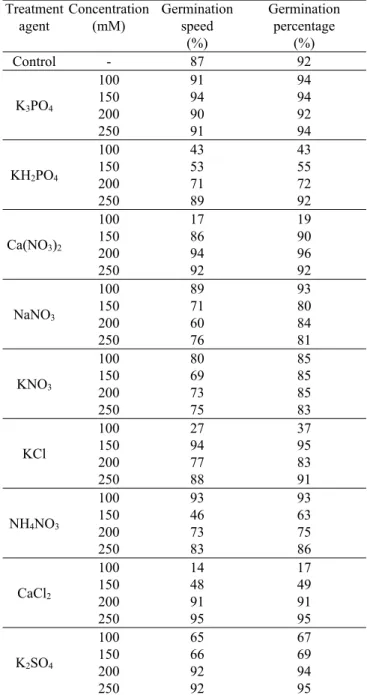
Table 1. Germination speed and percentage of primed sesame seeds as affected by different treatment agents and concentrations.
Treatment agent
Concentration (mM)
Germination speed
(%)
Germination percentage
(%)
Control - 87 92
K
3PO
4100 150 200 250
91 94 90 91
94 94 92 94
KH
2PO
4100 150 200 250
43 53 71 89
43 55 72 92
Ca(NO
3)
2100 150 200 250
17 86 94 92
19 90 96 92
NaNO
3100 150 200 250
89 71 60 76
93 80 84 81
KNO
3100 150 200 250
80 69 73 75
85 85 85 83
KCl
100 150 200 250
27 94 77 88
37 95 83 91
NH
4NO
3100 150 200 250
93 46 73 83
93 63 75 86
CaCl
2100 150 200 250
14 48 91 95
17 49 91 95
K
2SO
4100 150 200 250
65 66 92 92
67 69 94 95
†
Data was the means of 100 seeds of sesame with six replications. Seeds were dark-primed at 20℃ for 4 days and dark-germinated up to 10 days.
chambers at the Department of Functional Crops, National Institute of Crop Science, RDA during 2006. Each treatment combination consisted of 100 seeds in one plastic petri plate (100 mm diameter). Each plate had two pieces of filter paper wetted with 1.5 ml of water. The seeds were surface sterilized with 5% of NaOCl to protect seed borne infection followed by washing. The seeds were primed by solutions of polyethylene glycol (PEG 6000), K
3PO
4, KH
2PO
4, Ca(NO
3)
2, NaNO
3, KNO
3, KCl, NH
4NO
3, CaCl
2and K
2SO
4. The osmotic water potentials levels of PEG 6000 were -0.50, -0.75, -1.00, and -1.50MPa according to Michel and Kaufman (1973). Other agent solutions were 100, 150, 200 and 250mM. Priming duration and temperature were 4, 6, 8, 10 days and 15, 20, 25, 30℃ respectively. Seeds were primed for 4 days at 15℃ and 20℃ according to Jeong et al (1994). After priming, seeds were given surface washing with distilled water then dried to near original weight under shade. To find out the effect of low and high temperature on the sesame germination, temper- atures, 15, 20, 25, 30 and 35℃ were applied to the material with pre-primed under -1.00MPa PEG 6000, 20℃. Seeds were considered germinated when the radical was 2~3 mm in length. Germination percentage was calculated according to the technique of Standard Germination Test (ISTA, 1993). Count of germinated seed number was conducted at 12hr intervals for 6 days, and 24hr intervals from 7th day during 10 days. Germination speed (GS) was estimated according to the formula of McGuire (1962) as follows ; GS = 〔(No. of seedling)/(Days to first count) + …… + (No. of seedling)/(Days to final count)〕
It stated that the germination speed and percentage of primed sesame seeds were different according to the priming agent and it’s concentration(Table 1).
The time to get 50% germination percentage (T
50) was calculated according to the following formula described by Coolbar et al(1984).
T
50= t
i+ 〔(N/2-n
i)(t
j-t
i)〕/(n
j-n
i), where : N = The final number of germination
n
i, n
j= Cumulative number of seeds germinated by adjacent counts at times when n
i<N/2,n
jData were analyzed using ANOVA procedure of SAS statistical software (SAS System for Windows, rel. 8.02, SAS Institute, Cary, NC, USA).
RESULTS AND DISCUSSION
Effect of priming agent and concentration on the germination of sesame seed.
Analysis of variance indicated that treatment agents,
Table 2. Analysis of variance with mean squares and treatment significance of sesame seed germination speed and percentage as affected by different treatment agents, concentrations and their interaction.
Source Germination speed Germination percentage
†Treatment agent (T) 1376.3
**‡1436.6
**Concentration (C) 4216.6
**2439.2
**T × C 1365.1
**1040.1
**†
Germination percentage represents percentage seeds germinated in 10 days.
‡**
means significantly different at 0.01 probability levels.
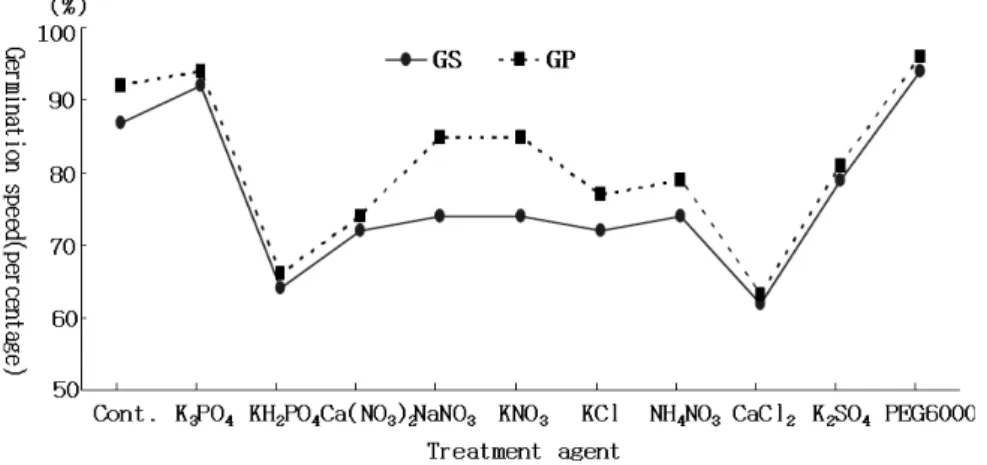
Fig. 1. Effect of different treatment agents on the germination speed (GS) and germination percentage (GP) of primed sesame seed.
Fig. 2. Germination properties in response to treatment agent concentration of priming sesame seed as well as the relation between the germination of sesame seed and the osmotic potentials of PEG 6000 solution.
concentrations and their interaction significantly affected sesame germination properties (Table 2).
In general, several priming agents were selected according to the different crops. For example, K
3PO
4and Ca(NO
3) showed more effective treatment priming agents on pepper and tomato respectively (Jeong et al., 1994). KCl showed highest germination speed and percentage in case of onion priming (Cho et al., 2006). In this study, treatment agents,
‘K
3PO
4’, ‘PEG6000’, showed higher germination speed and
germination percentage than that of control (Fig. 1). Haigh and Barlow (1987) said ion concentration accumulation in osmotic-priming seed would be in proportion to the time of treatment agent which would decrease metabolic mechanism of seed. In view of previous study, it assumed that NaNO
3and KNO
3show difference between germination speed and percentage.
Graphic data depicted in Fig. 2 show that germination
speed and germination percentage are proportionally increased
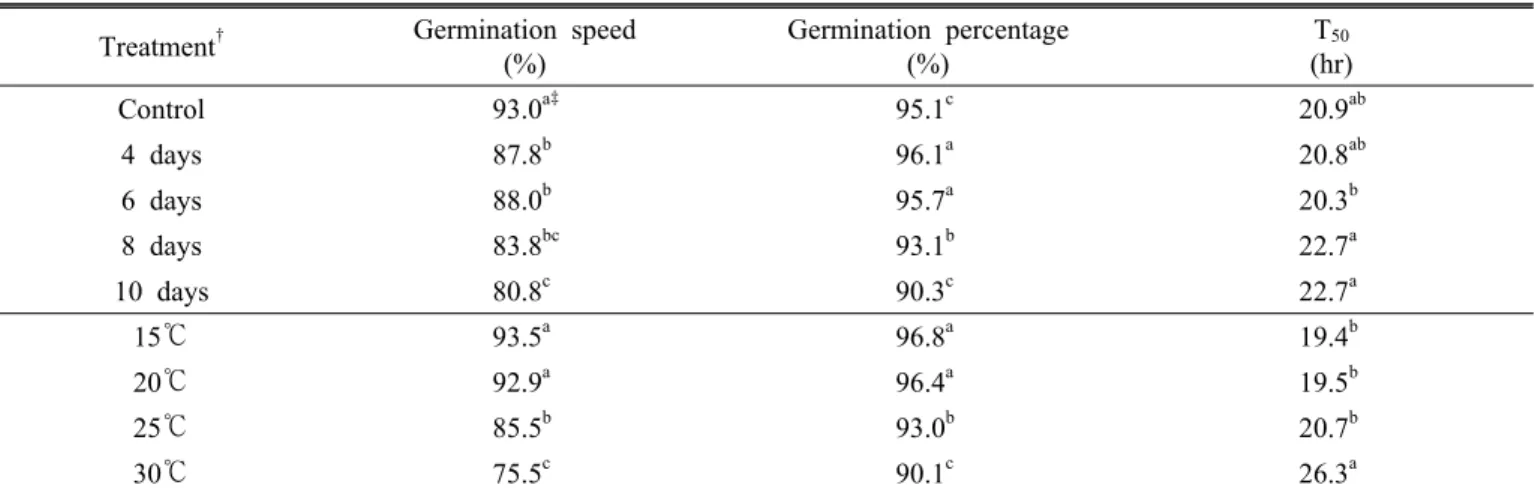
Table 3. Effect of priming duration and temperature on the germination properties and T
50of sesame seed.
Treatment
†Germination speed (%)
Germination percentage (%)
T
50(hr)
Control 93.0
a‡95.1
c20.9
ab4 days 87.8
b96.1
a20.8
ab6 days 88.0
b95.7
a20.3
b8 days 83.8
bc93.1
b22.7
a10 days 80.8
c90.3
c22.7
a15℃ 93.5
a96.8
a19.4
b20℃ 92.9
a96.4
a19.5
b25℃ 85.5
b93.0
b20.7
b30℃ 75.5
c90.1
c26.3
a†
Seeds for priming duration were dark-primed in PEG 6000 -1.0MPa at 20℃.
‡
Means followed by same letter within the same column are not significantly different at the 0.05 probability level using Duncan’s multiple range test.
as treatment agent concentration increased. In general, it can be stated that primed sesame seed normally germinated above 200mM concentration.
Priming is a technique to hydrate seeds under controlled conditions and it is very important to find a critical water level of priming medium to enhance seed germination. Fig.
2 also shows the correlation between germination percentage and osmotic potential of PEG 6000. The germination percentage was continuously increased depending on the reduction of osmotic potential of PEG up to -1.0 MPa and sharply decreased afterwards. Thus, the critical osmotic potential level of PEG 6000 solution enhancing germination was -1.0 MPa and the osmotic potential was applied in all treatment of sesame priming seed in this study.
Effect of priming duration and temperature on the germination of sesame seed.
Result indicated that priming duration had significantly effect on the seed germination speed and germination percentage (Table 3). Priming duration, 4 or 6 days was an effective treatment condition for the sesame seed, but not much more effective than as in the control. Increasing priming temperature was associated with a significant decrease in the germination speed and germination percentage.
The lowest priming temperature, 15℃, showed highest germination speed and germination percentage. The decrease of seed germination under the higher temperature condition
could be partly attributed to the exposure of seeds to heat which results in the abnormality of enzyme systems.
The responses of germination speed and germination percentage were different depending on priming temperature and duration (Fig. 3). Germination properties were reduced as the priming duration increased, regardless of any priming temperature. Especially, germination speed was rapidly decreased from 4 days of duration at the 20℃, 3 0℃ primed temperature. But, germination percentage was steadily increased up to 4 days of priming duration. The most effective priming temperature and duration were 1 5℃, 4 days respectively, considering germination percentage.
Effect of germination conditions on the germination of primed sesame seed.
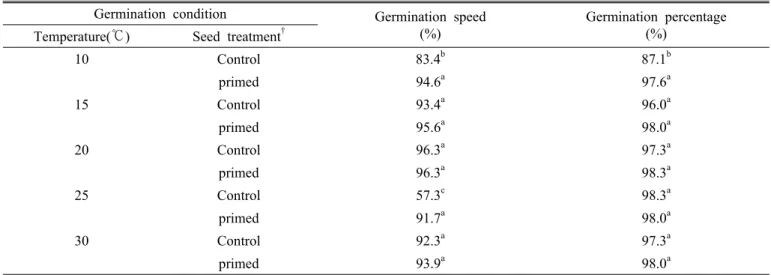
Table 4 shows that chamber temperature had not significantly effect on the seed germination speed and germination percentage except for the temperature at 10℃.
In comparison of the control and priming treatment, germination speed and germination percentage were increased up to 20℃.
Final germination was generally much higher in the
priming treatment than the controlled under all germination
temperature. Conclusively, the optimum priming conditions
for sesame seed were : 1) The effective priming agents
were K
3PO
4and PEG 6000. 2) The effective treatment
concentration of the solution was above 200mM. 3) The
Fig. 3. Relationship between priming duration and germination depending on the priming temperature for sesame seeds. Khan et al., (1995) said that the cold tolerance effect of priming could be derived from the activation or synthesis of large number of enzymes and higher mobilization of storage reserves before sowing.
Table 4. Effect of germination conditions on the germination properties of primed sesame seed.
Germination condition Germination speed
(%)
Germination percentage Temperature(℃) Seed treatment
†(%)
10 Control 83.4
b87.1
bprimed 94.6
a97.6
a15 Control 93.4
a96.0
aprimed 95.6
a98.0
a20 Control 96.3
a97.3
aprimed 96.3
a98.3
a25 Control 57.3
c98.3
aprimed 91.7
a98.0
a30 Control 92.3
a97.3
aprimed 93.9
a98.0
a†
Seeds were dark-primed in PEG 6000 -1.00MPa at 15℃ for 4 days.
‡