Analysis of Visual Material of Primary School Technology Textbooks in Nigeria
Choon-Sig LEE
*<Abstract>
The purpose of this study is to provide basic data that can be used for the development of technology textbooks of Nigeria-Korea Model School by analyzing external and internal aspects of Illustration in Nigerian primary school technology textbooks, and 10 textbooks used in Nigeria were analyzed.
Based on the results of the study, the conclusions are as follows. First, the form of the visual data should be diversified into a picture, a cartoon, a diagram, and a diagram from the photograph center, and provide various information closely related to the contents of the technology.
Second, it is necessary to increase the size of illustration so as to induce learners to be motivated, and to enhance the effect of editing.
Third, currently, partial enlargement data is rarely used, but visual material should be partially enlarged in order to express a detail part of product.
Fourth, diversity of editing should be done by using circular or background omission rather than using only rectangle uniformly in visual material.
Fifth, in terms of gender equality, it is necessary to deviate from male-centric visual materials and edit them with consideration for women.
Sixth, in order to provide learner-centered textbooks, the role of visual materials should be extended to 'inducement of motivation', 'activity guidance', and 'activity result' in addition to 'providing data'.
Finally, in terms of the function of visuals, the quality of textbooks should be upgraded by utilizing auxiliary and decorative functions in addition to essential functions.
Key words: Illustrative analysis of Nigerian technology textbooks, Primary Technology Textbook Analysis
* Correspondence: Professor, Gyeongin National University of Education, [email protected]
Ⅰ. Introduction
The Korea International Cooperation Agency (KOICA) has launched a project to establish primary and junior high schools in 2012 to support poor education in West Africa Nigeria as part of an international cooperation project. The school construction project, which started in 2014, is planned to build 24 classes of elementary school and 15 classes of junior high school and provide free of charge. NKMS (Nigeria-Korea Model School) officially opened on September 10, 2018 (KOICA, 2019). This researcher has provided teacher training and school operation manuals to help the school to operate efficiently by participating in the project.
Generally speaking, textbooks have a very high status in school classes. Textbooks used as a representative learning medium in school class have an authority that is incomparable to other learning mediums. As such, textbooks play an important role in school. In this way, the textbooks which are important in the classroom are composed of letters and visual materials. Among them, illustrations have educational significance by presenting contents in a visual form, thereby enhancing understanding of contents and interest and emotional impact. In particular, visual materials in technology textbooks play a very important role because they provide guidance on practical activities, provide various materials, and present the results of practical activities.
Nigeria's textbooks are written by the private sector, but the quality of textbooks is inadequate due to the low manpower and publishing capacity of publishers, and there is also a lack of research on textbooks. In addition, since technology textbooks are combined with science, technology, and physical education rather than developed independently, it is necessary to improve quality through textbook analysis. Therefore, it is necessary to analyze the visual materials of the textbooks in order to help the technology lessons of the NKMS established and supported by Korea. The results of textbook analysis can be used as a useful data for NKMS technology class. Nigerian technology teachers want to develop innovative textbooks that reflect Korea's experience in developing textbooks. Teachers also demand the need for objective data from Nigeria textbooks.
The purpose of this study is to analyze the visual material of Nigeria elementary school technology textbooks in terms of external and internal aspects and to present basic data that can be directly used for the development of NKMS technology textbooks in this year.
In order to achieve the purpose of this study, literature and research methods were
used. In the literature study, the textbook analysis framework was derived through the
researches related to the textbook analysis. The textbooks analyzed in this study were 10
elementary school textbooks used in Nigeria as of January 2019. The textbooks were collected and analyzed according to the analysis framework. The results of the first analysis were reviewed and supplemented by five elementary school teachers in Nigeria.
Elementary teachers corresponded to teachers with more than 5 years of education experience.
Ⅱ. Theoretical Background
1. Primary School Technology Education in Nigeria
The education system in Nigeria is implemented in 6-3-3-4. In other words, the education system of the United States has been introduced and operated for 6 years for primary school, 3 years for junior high school, 3 years for high school, and 4 years for university. Technology education is carried out in all grade levels of elementary school and is also being conducted in secondary schools. The content of technology education is organized into a thematic approach (NERDC, 2015). In other words, in the theme-centered approach, the main theme of the technology is set up, divided into sub-themes, and then presented again as a topic. Therefore, the technology subjects consisted of five main themes: Understanding of basic technology, safety, materials and processing, institutional practice, tools and machines and processing. In elementary school, there are two areas of understanding of basic technology, human and energy, and middle school consists of four areas: understanding of basic technology, safety, materials and processing, and institutional practice. The following table summarizes the results of the research (Table 1).
In the elementary school, technology education aims to understand how machines are being used in daily life and how energy is used in order to get acquainted with technology. In addition, molding is made using clay to make it naturally familiar with technology. In the upper grades, students are introduced to understand what technology is, transportation technology in life, and automobile components.
<Table 1> Contents of 'Basic Technology' course in Nigeria primary school.
Grade Understanding of basic
technology Human and energy
1st ㅇSimple machines ㅇEnergy
2nd ㅇClay ㅇForms of Energy(Sound)
3rd ㅇForms of technology ㅇEnergy Type: Light
※ Reconstructed referring to NERDC (2015).
2. Textbooks and Visual Materials
A. Educational significance of visual materials in textbooks
Visual material includes photographs, illustrations, pictures, diagrams, drawings and so on. Especially, the illustration is a picture that makes the explanation of the contents of the textbook easy to understand. When these visual materials are presented in textbooks and used as learning materials, they are used as data to explain and explain the contents of the curriculum, which is a basic element of learning rather than its own meaning. It also has educational value when visual data is appropriately presented according to the inquiry process and activities of knowledge.
These visual data have a lot of educational significance. In other words, pictures and illustrations provide pleasure through aesthetic beauty, contribute to the development of aesthetic senses, and have the advantage that they can not be conveyed as characters. In addition, pictures have the effect of overcoming the time and space limitations of the characters by using the expressive techniques that emphasize, exaggerate, or deliberate transformation to enhance the learning motivation by attracting interest to the learners and for the clear transmission. Therefore, visual data should be focused on supplementing teacher's explanation or enhancing learning effect through description, and it is effective for motivation of learning and memory, associative effect and internalization of new concept of learning. In particular, it implies the meaning of the content of the subject and helps to memorize the contents of the learning.
Grade Understanding of basic
technology Human and energy
4th ㅇTechnology and You
ㅇShape construction ㅇVehicle ㅇForms of Energy
5th
ㅇMaterials and maintenance ㅇBasic motor vehicle parts ㅇDrafting instrument
ㅇEnergy conversion ㅇHeat and temperature
ㅇBasic electricity ㅇMagnetism
6th
ㅇPrimary and secondary colors ㅇUse of drawing instruments ㅇIntroduction to woodwork hand
tools
ㅇMaintenance and safety of our roads
ㅇSimple machine: leverage
ㅇSimple machine: Pulley
ㅇSimple machine: Incline planes
B. Functions and roles of visual materials
The study of the functions of visual materials in textbooks has been discussed from various perspectives. In the textbooks, visual data should be selected and organized through functional methods. Instead of simply arranging the visual data, it is necessary to maximize the effect of the learning by determining what kind of visual data is needed according to the content to be transmitted (Duchastel, 1978).
In this context, the function of visual data is as follows (Levie & Lentz, 1982). First, with attentional function, visual data attracts attention to and focuses on the material and attracts attention to younger learners as well as older adults. Second, as an affective function, visual data can enhance learner's interest and affect emotions and attitudes. In other words, the learners are more influenced by the learners' emotions and attitudes than from the absence of visual data, to the presence of color, rather than to the absence of color. Third, with visual cognitive function, visual data helps learning by improving understanding and memory of contents, and it can easily present information that is difficult to explain with text.
Fourth, as a compensatory function, visual data can help learner with poor learning. In other words, it shows that the poorer learners are more dependent on the visual data than the better learners. Fifth, learners can more easily memorize and recall information that is difficult to understand, thereby providing a rich communication channel to promote understanding.
Finally, the visual data can be used as a supplementary role of the teacher to enhance the learning effect by describing the problem when it is difficult to understand without the visual data or when the oral explanation is insufficient. In other words, it has the purpose of using it as a means to help the learner understand the learning contents more easily and familiarly. The effect of information transfer on a picture is of immeasurable value and occupies an important position that can not be overlooked in utilization of textbooks and teaching and learning activities (Lee, 2011).
2. Criteria for Analysis of Visual Materials
The analytical criteria for visual materials can be divided into external and internal aspects. It is also important to select visual materials that are appropriate for the contents of the curriculum, but how to put them into textbooks is important for effective education.
Therefore, there is a way of expressing how visual material is composed, size and
proportion, arrangement, and commentary.
On the content side of the visual material, it is necessary to analyze whether the materials presented in the textbooks induce students to motivate learning and inquiry process to expand inquiry ability. Visual material in textbooks should effectively convey the content of the text to students, and sometimes show content that is independent of the complementary role of the text and specifically tailored to the student's ability. Therefore, it is necessary to examine whether the visual materials in the textbooks effectively present the content of the text, whether it is appropriate for learning, and whether there is any improvement or supplement.
In this context, this study is based on the analytical method of Lee (2011) in order to provide an analytical framework focusing on external and internal aspects of visual materials in elementary school textbooks of Nigeria. The criteria for analysis of visual data presented in Table 2 are only those items that are relevant to the technology textbooks by considering the criteria of the papers studied by the fields already presented in previous studies.
<Table 2> Criteria for analysis of visual materials
Visualmaterial
Analysis
item Criteria Visual
material
Analysi
s item Criteria
External aspect
Type
Photograph
Content aspect
Gender
Male-oriented Picture
Female-oriented illustration
Cartoon
Male &
female-oriented Table
Size (area ratio)
Full size
Role
Motivation
1/2 size Practice guide
1/4 size
Supply of material 1/8 size
1/16 size Presenting the
results of practice 1/32 size
Enlargem ent
Partial enlargement
Function
Essential function
Shape
Square
Auxiliary function Circle
Decoration function Omit
background
※ Partially modified the results of Lee (2011).
Ⅲ. Results of Textbooks Analysis
1. Overview of Nigerian Textbooks
The authors of the Nigerian technical textbooks consisted of a small number of people with one or two people, with an average of 1.57 people participating in 10 textbook publishers. In Korea, the number of textbook authors in Nigeria is very small compared to about 10 in textbook writing (Lee, 2011). Therefore, the quality of textbooks is inevitably declining as a few authors write.
In terms of the types of Nigerian textbooks, they are classified into STPI(Science, Technology, Physical & Health Education, and Information Technology), ST(Science and Technology) and T(Technology). The technology textbooks consisted of five publishing companies in the STPI format, four publishing companies in the ST format, and one publisher in the T format. According to the content development method, the traditional description method was six publishing companies, and the modular method was four.
There were also four publishers that provided workbooks. The number of pages of technology textbooks by publisher was varied, ranging from 6 pages to 55 pages. In general, the number of pages increased as the grade increased, and the overall average was about 35 pages.
As for other statuses, the textbooks were crown plates (176 x 248mm) with 6 publishers, and the other publishers were B5 size. The contents editing of the textbook consisted of nine publishing companies with one-column layout, and only one publisher had a two-column layout. The textbooks were printed in six publishing houses in Nigeria and three in India. Paper that determines the quality of textbooks is used in a variety of ways, including Notebook Paper, Book Paper, Middle Grade Printing Paper, and Secondary Grade Woodfree Printing Paper. In general, 50% of the textbooks use Notebook Paper to reduce their sharpness.
The codes (A to J) of the ten textbooks used in the analysis of this study are as follows.
A: University Press Plc. B: Cambridge University Press. C: Evans Brothers Limited. D:
Thursmay Publishers. E: Spectrum Books Limited. F: West African Book Publishers Ltd. G:
Extension Publications Limited. H: Metropolitan Publishers Ltd. I: Macmillan Publishers
Ltd. J: Razat Publishers Ltd.
2. Analysis of External Visual Materials
A. Types and numbers of visual materials
Visual materials include photographs, pictures, cartoons, illustrations, and charts. Table 3 shows the distribution of visual materials for each grade of technology textbooks. When the visual materials shown in 10 publishers' textbooks were averaged out, the photographic data ranged from 35% (24 numbers) to 62% (79) and the pictorial data ranged from 36%
(31 numbers) to 64% (44). However, there were few cartoons in visual materials, and illustrations and charts were only about 3%, which showed a tendency to deviate to one side. The textbooks with no photographs in the textbooks were two publishing companies (A and H) in the second grade, and illustrations and charts were gradually appearing in the upper grades. In the characteristics of technology textbooks, it is necessary to edit the textbooks in consideration of the fact that learners can easily understand the contents of learning through pictures or illustrations (Levie & Lentz, 1982; Lee, 2011).
<Table 3> Types and numbers of visual materials in textbooks unit: quantity (%)
publisher
type A B C D E F G H I J ave.
1st
pho. 28(58.3) 14(12.1) 42(53.9) 11(15.5) 85(85.9) 28(33.7) 6(37.5) 15(7.2) 12(33.3) 185(79.1) 42.6(43.0) pic. 20(41.7) 99(85.3) 36(46.1) 60(84.5) 13(13.1) 55(66.3) 10(62.5) 194(92.8) 24(66.7) 49(20.1) 56.0(56.6)
car. 0(0) 0(0) 0(0) 0(0) 0(0) 0(0) 0(0) 0(0) 0(0) 0(0) 0(0)
ill. 0(0) 1(0.9) 0(0) 0(0) 0(0) 0(0) 0(0) 0(0) 0(0) 0(0) 0.1(0.1)
tab. 0(0) 2(1.7) 0(0) 0(0) 1(1.0) 0(0) 0(0) 0(0) 0(0) 0(0) 0.3(0.3)
tot. 48(100) 116(100) 78(100) 71(100) 99(100) 83(100) 16(100) 209(100) 36(100) 234(100) 99.0(100)
2nd
pho. 0(0.0) 32(57.1) 30(32.6) 34(31.5) 75(76.5) 9(16.4) 6(60.0) 0(0.0) 15(33.3) 39(73.6) 24.0(35.3) pic. 47(100) 23(41.1) 61(66.3) 74(68.5) 23(23.5) 46(83.6) 3(30.0) 116(100) 30(66.7) 14(26.4) 43.7(64.3)
car. 0(0) 0(0) 0(0) 0(0) 0(0) 0(0) 0(0) 0(0) 0(0) 0(0) 0(0)
ill. 0(0) 0(0) 0(0) 0(0) 0(0) 0(0) 1(10.0) 0(0) 0(0) 0(0) 0.1(0.1)
tab. 0(0) 1(1.8) 1(1.1) 0(0.0) 0(0) 0(0) 0(0) 0(0) 0(0) 0(0) 0.2(0.3)
tot. 47(100) 56(100) 92(100) 108(100) 98(100) 55(100) 10(100) 116(100) 45(100) 53(100) 68.0(100)
3rd
pho. 26(48.1) 51(36.7) 14(48.3) 48(42.5) 144(93.5) 65(69.8) 4(40.0) 102(69.9) 18(29.0) 56(94.9) 52.8(61.5) pic. 28(51.9) 79(56.9) 14(48.3) 65(57.5) 6(3.9) 26(28.0) 6(60.0) 39(26.7) 43(69.4) 3(5.1) 30.9(36.0)
car. 0(0) 0(0) 0(0) 0(0) 0(0) 0(0) 0(0) 0(0) 0(0) 0(0) 0(0)
ill. 0(0) 2(1.4) 0(0) 0(0) 3(1.9) 1(1.1) 0(0) 4(2.7) 0(0) 0(0) 1.0(1.2)
tab. 0(0) 7(5.0) 1(3.4) 0(0.0) 1(0.6) 1(1.1) 0(0) 1(0.7) 1(1.6) 0(0.0) 1.2(1.4) tot. 54(100) 139(100) 29(100) 113(100) 154(100) 93(100) 10(100) 146(100) 62(100) 59(100) 85.9(100)
4th
pho. 52(81.4) 127(69.8) 118(70.7) 78(72.9) 146(83.4) 113(81.3) 44(83.0) 3(1.5) 50(44.2) 62(87.3) 79.3(62.2) pic. 10(15.6) 47(25.8) 46(27.5) 27(25.2) 18(10.3) 26(18.7) 8(15.1) 200(98.5) 61(54.0) 9(12.7) 45.2(35.5)
car. 0(0) 0(0) 0(0) 0(0) 0(0) 0(0) 0(0) 0(0) 0(0) 0(0) 0(0)
ill. 1(1.5) 4(2.2) 1(0.6) 0(0) 11(6.3) 0(0) 1(1.9) 0(0) 1(0.9) 0(0) 1.9(1.5 tab. 1(1.5) 4(2.2) 2(1.2) 2(1.9) 0(0) 0(0) 0(0) 0(0) 1(0.9) 0(0) 1.0(0.8) tot. 64(100) 182(100) 167(100) 107(100) 175(100) 139(100) 53(100) 203(100) 113(100) 71(100) 127.4(100)
※ pho: photograph, pic: picture, car: cartoon, ill: illustration, tab: table
B. Area ratio of visual materials
The visual data area ratio of technical textbooks is the ratio of the size of the visual material to one page of the textbook, and the analysis result is shown in <Table 4>. Of the visual material sizes, 1/32 size occupied the largest portion of textbooks from grade 1 to grade 5. In the sixth grade, 1/8 of the visual materials accounted for the largest proportion (27.4%). Overall, the size of one page of visual material was only 0.2%. These results show that there are many visual materials such as various tools and parts presented in technology textbooks, so that many illustrations can not be used in a limited number of pages.
<Table 4> Size of visual materials in Technology Textbooks. unit: quantity (%)
publisher
type A B C D E F G H I J ave.
5th
pho. 18(20.7) 99(70.8) 63(57.8) 73(73.0) 9(33.3) 91(55.2) 29(80.5) 4(1.4) 65(43.9) 79(95.2) 53.0(45.0) pic. 57(65.6) 30(21.4) 33(30.3) 23(23.0) 14(51.9) 70(42.4) 5(13.9) 275(97.2) 81(54.7) 1(1.2) 58.9(50.0)
car. 0(0) 1(0.7) 0(0) 0(0) 0(0) 0(0) 0(0) 0(0) 0(0) 0(0) 0.1(0.1)
ill. 7(8.0) 8(5.7) 6(5.5) 4(4.0) 0(0) 4(2.4) 1(2.8) 4(1.4) 1(0.7) 2(2.4) 3.7(3.1) tab. 5(5.7) 2(1.4) 7(6.4) 0(0) 4(14.8) 0(0) 1(2.8) 0(0) 1(0.7) 1(1.2) 2.1(1.8) tot. 87(100) 140(100) 109(100) 100(100) 27(100) 165(100) 36(100) 283(100) 148(100) 83(100) 117.8(100)
6th
pho. 56(50.0) 87(50.0) 74(52.5) 68(56.2) 9(8.4) 26(31.3) 15(38.5) 1(0.7) 26(17.4) 85(63.0) 44.7(37.3) pic. 52(46.4) 66(38.0) 59(41.8) 46(38.0) 83(77.6) 52(62.7) 23(59.0) 122(89.7) 116(77.9) 45(33.3) 66.4(55.5)
car. 0(0) 0(0) 0(0) 0(0) 0(0) 1(1.2) 0(0) 0(0) 0(0) 0(0) 0.1(0.1)
ill. 4(3.6) 19(10.9) 3(2.1) 0 5(4.7) 3(3.6) 0(0) 11(8.1) 1(0.7) 1(0.7) 4.7(3.9) tab. 0 2(1.1) 5(3.5) 7(5.8) 10(9.3) 1(1.2) 1(2.5) 2(1.5) 6(4.0) 4(3.0) 3.8(3.2) tot. 112(100) 174(100) 141(100) 121100) 107(100) 83(100) 39(100) 136(100) 149(100) 135(100) 119.7(100)
publisher
size A B C D E F G H I J ave.
1st
full 0(0) 1(0.9) 0(0) 0(0) 0(0) 0(0) 0(0) 0(0) 0(0) 0(0) 0.1(0.1)
1/2 2(4.2) 0(0) 1(1.3) 0(0) 0(0) 2(2.4) 0(0) 13(6.2) 0(0) 7(3.0) 2.5(2.6) 1/4 2(4.2) 0(0) 3(3.7) 0(0) 0(0) 8(9.6) 0(0) 7(3.4) 3(8.3) 16(6.8) 3.9(4.0) 1/8 15(31.3) 1(0.9) 8(10.3) 29(40.9) 73(73.7) 27(32.6) 7(43.8) 56(26.8) 15(41.7) 33(14.1) 26.4(26.7) 1/16 14(29.2) 10(8.8) 31(39.8) 17(23.9) 19(19.2) 6(7.2) 8(50.0) 46(22.0) 0(0) 46(19.7) 19.7(20.0) 1/32 15(31.3) 101(89.4) 35(44.9) 25(35.2) 7(7.1) 40(48.2) 1(6.2) 87(41.6) 18(50.0) 132(56.4) 46.1(46.7) tot. 48(100) 113(100) 78(100) 71(100) 99(100) 83(100) 16(100) 209(100) 36(100) 234(100) 98.7(100)
2nd
full 0(0.0) 0(0) 0(0) 0(0) 0(0) 0(0) 0(0) 0(0) 0(0) 0(0) 0(0)
1/2 0(0.0) 0(0) 0(0) 1(0.9) 2(2.0) 2(3.6) 0(0) 3(2.6) 0(0) 4(7.5) 1.2(1.6) 1/4 11(23.4) 1(0.8) 1(1.1) 1(0.9) 44(44.9) 8(14.5) 0(0) 8(6.9) 4(8.9) 0(0) 7.8(10.6) 1/8 21(44.7) 8(7.1) 29(31.5) 38(35.2) 9(9.2) 29(52.7) 2(20.0) 32(27.6) 20(44.5) 13(24.6) 20.1(27.3) 1/16 6(12.8) 3(2.7) 24(26.1) 25(23.1) 8(8.2) 9(16.5) 8(80.0) 29(25.0) 10(22.2) 27(50.9) 14.9(20.2) 1/32 9(19.1) 101(89.4) 38(41.3) 43(39.8) 35(35.7) 7(12.7) 0(0) 44(37.9) 11(24.4) 9(17.0) 29.7(40.3) tot. 47(100) 113(100) 92(100) 108(100) 98(100) 55(100) 10(100) 116(100) 45(100) 53(100) 73.7(100)
C. Number of illustrations for partial enlargement
The number of partially enlarged illustrations used in technology textbooks is shown in Table 5, with only 3.3 on average for all school grade textbooks. For the second grade textbooks, none of the publishing companies had a partial enlargement illustration.
<Table 5> Number of visual materials for partial expansion of textbooks. unit: quantity (%)
publisher
grade A B C D E F G H I J ave.
1st 0(0) 0(0) 1(14.3) 0(0) 0(0) 0(0) 0(0) 0(0) 0(0) 0(0) 0.1(3.0)
2nd 0(0) 0(0) 0(0) 0(0) 0(0) 0(0) 0(0) 0(0) 0(0) 0(0) 0(0)
3rd 0(0) 0(0) 0(0) 0(0) 1(20.0) 0(0) 0(0) 1(20.0) 0(0) 0(0) 0.2(6.1)
4th 1(33.3) 0(0) 1(14.3) 0(0) 2(40.0) 0(0) 0(0) 0(0) 0(0) 0(0) 0.4(12.1)
5th 2(66.7) 3(60.0) 3(42.9) 2(100) 1(20.0) 1(100) 0(0) 2(40.0) 1(33.3) 1(100) 1.6(48.5) 6th 0(0) 2(40.0) 2(28.5) 0(0) 1(20.0) 0(0) 1(100) 2(40.0) 2(66.7) 0(0) 1.0(30.3) tot. 3(100) 5(100) 7(100) 2(100) 5(100) 1(100) 1(100) 5(100) 3(100) 1(100) 3.3(100) publisher
size A B C D E F G H I J ave.
3rd
full 0(0.0) 0(0) 0(0) 0(0) 0(0) 1(1.1) 0(0) 0(0) 0(0) 0(0) 0.1(0.1)
1/2 0(0.0) 9(6.5) 0(0) 1(0.9) 1(0.6) 5(5.4) 0(0) 1(0.7) 0(0) 2(3.4) 1.9(2.2) 1/4 7(13.0) 11(7.9) 2(6.9) 5(14.3) 0(0) 8(8.6) 0(0) 18(12.3) 2(3.2) 4(6.8) 5.7(6.6) 1/8 6(11.1) 8(5.8) 8(27.6) 36(31.9) 82(53.3) 67(72.1) 5(50.0) 59(40.4) 8(0.1) 6(10.2) 28.5(33.2) 1/16 39(72.2) 12(8.6) 3(10.3) 36(31.9) 5(3.2) 11(11.8) 5(50.0) 60(41.1) 22(0.4) 41(69.4) 23.4(27.2) 1/32 2(3.7) 99(71.2) 16(44.2) 35(31.0) 66(42.9) 1(1.1) 0(0) 8(5.5) 30(48.3) 6(10.2) 26.3(30.6) tot. 54(100) 139(100) 29(100) 113(100) 154(100) 93(100) 10(100) 146(100) 62(100) 59(100) 85.9(100)
4th
full 0(0.0) 1(0.5) 0(0) 1(0.9) 0(0) 2(1.4) 0(0) 0(0) 0(0) 0(0) 0.4(0.3)
1/2 0(0.0) 3(1.6) 3(1.8) 3(2.8) 19(10.9) 1(0.7) 0(0) 0(0) 5(4.4) 7(9.9) 4.1(3.2) 1/4 1(1.6) 16(8.8) 10(6.0) 15(14.0) 29(16.6) 1(0.7) 7(13.2) 9(4.4) 13(11.5) 6(8.5) 10.7(8.4) 1/8 33(51.5) 17(9.3) 5(3.0) 14(13.1) 52(29.7) 70(50.4) 30(56.6) 53(26.2) 30(26.5) 21(29.6) 32.5(25.6) 1/16 25(39.1) 6(3.4) 4(2.4) 39(36.4) 55(31.4) 28(20.2) 13(24.5) 79(38.9) 45(39.8) 25(35.2) 31.9(25.0) 1/32 5(7.8) 139(76.4) 145(86.8) 35(32.8) 20(11.4) 37(26.6) 3(5.7) 62(30.5) 20(17.8) 12(16.8) 47.8(37.5) tot. 64(100) 182(100) 167(100) 107(100) 175(100) 139(100) 53(100) 203(100) 113(100) 71(100) 127.4(100)
5th
full 1(1.1) 2(1.4) 0(0) 0(0) 0(0) 2(1.2) 0(0) 0(0) 0(0) 0(0) 0.5(0.4)
1/2 8(9.2) 6(4.3) 1(0.9) 2(2.0) 0(0) 0(0) 0(0) 0(0) 10(6.8) 7(8.4) 3.4(2.9) 1/4 6(6.9) 8(5.7) 9(8.3) 6(6.0) 11(40.7) 9(5.5) 1(2.8) 20(7.1) 53(35.8) 5(6.0) 12.8(10.9) 1/8 41(47.2) 11(7.8) 16(14.7) 42(42.0) 3(11.1) 64(38.8) 0(0) 131(46.3) 55(37.2) 14(16.9) 37.7(32.0) 1/16 12(13.8) 10(7.2) 19(17.4) 36(36.0) 9(33.4) 36(21.8) 24(66.7) 90(31.8) 9(6.1) 39(47.0) 28.4(24.1) 1/32 19(21.8) 103(73.6) 64(58.7) 14(14.0) 4(14.8) 54(32.7) 11(30.5) 42(14.8) 21(14.1) 18(21.7) 35.0(29.7) tot. 87(100) 140(100) 109(100) 100(100) 27(100) 165(100) 36(100) 283(100) 148(100) 83(100) 117.8(100)
6th
full 0(0) 0(0) 0(0) 0(0) 0(0) 1(1.2) 0(0) 0(0) 0(0) 0(0) 0.1(0.1)
1/2 1(0.9) 2(1.1) 0(0) 1(0.8) 0(0) 1(1.2) 0(0) 2(1.5) 29(19.5) 10(7.4) 4.6(3.8) 1/4 9(8.0) 26(14.9) 9(6.4) 57(47.1) 4(3.7) 26(31.4) 2(5.1) 13(9.5) 58(38.9) 22(16.3) 22.6(18.9) 1/8 16(14.3) 19(10.9) 31(22.0) 30(24.8) 61(57.0) 27(32.5) 14(35.9) 61(44.9) 37(24.8) 32(23.7) 32.8(27.4) 1/16 58(51.8) 49(28.3) 23(16.3) 18(14.9) 19(17.8) 28(33.7) 19(48.7) 23(16.9) 12(8.1) 54(40.0) 30.3(25.3) 1/32 28(25.0) 78(44.8) 78(55.3) 15(12.4) 23(21.5) 0(0) 4(10.3) 37(27.2) 13(8.7) 17(12.6) 29.3(24.5) tot. 112(100) 174(100) 141(100) 121(100) 107(100) 83(100) 39(100) 136(100) 149(100) 135(100) 119.7(100)
On the other hand, 5th and 6th grade textbooks were used more frequently than lower grade textbooks. These results are seen as attempts to express technical facts as they move up to the upper grades. But in general, publishers in Nigeria lack the ability to draw detailed illustrations. In the case of Korean textbooks, there are paintings and illustrations that enable the development of photographic techniques and elaborate descriptions that can be used to express illustrations.
D. Shape of visual material
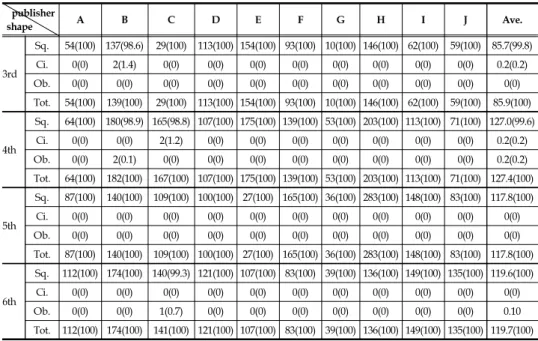
As shown in Table 6, the distribution of the shapes of visual materials used in textbooks was almost entirely square in all publishers of all grades (99.6% or more).
B and C publishers in the 3rd, 4th, and 6th grade textbooks used one or two circular shapes among visual materials, and most publishers only used square shapes. Therefore, in Nigeria's technical textbooks, there was no diversity because it was a simple form that presented only a square shape when presenting visual data. In order to reveal the characteristics of technology textbooks, it is much easier to understand by using shapes other than rectangles or background omissions. Nonetheless, using only squares is interpreted as a low level of editing design and a low publication environment. This situation is the same not only in technology textbooks but also in other textbooks. Because of the cost of producing textbooks, it is not possible to hire professional editing designers, and prints are often made in low-cost countries such as India. The silhouette, such as omission of the background, is used as a means to maximize the information by omitting the information of the background or the surrounding area, while preserving only the core part of the illustration corresponding to the technical content. In Korean textbooks, background abstraction artworks are used to clarify the contents, so it can concentrate attention of the learner and convey the contents well.
<Table 6> Shape of visual materials in technology textbooks unit: quantity (%)
publisher
shape A B C D E F G H I J Ave.
1st
Sq. 48(100) 113(100) 78(100) 71(100) 99(100) 83(100) 16(100) 209(100) 36(100) 234(100) 98.7(100)
Ci. 0(0) 0(0) 0(0) 0(0) 0(0) 0(0) 0(0) 0(0) 0(0) 0(0) 0(0)
Ob. 0(0) 0(0) 0(0) 0(0) 0(0) 0(0) 0(0) 0(0) 0(0) 0(0) 0(0)
Tot. 48(100) 113(100) 78(100) 71(100) 99(100) 83(100) 16(100) 209(100) 36(100) 234(100) 98.7(100)
2nd
Sq. 47(100) 113(100) 92(100) 108(100) 98(100) 55(100) 10(100) 116(100) 45(100) 53(100) 73.7(100)
Ci. 0(0) 0(0) 0(0) 0(0) 0(0) 0(0) 0(0) 0(0) 0(0) 0(0) 0(0)
Ob. 0(0) 0(0) 0(0) 0(0) 0(0) 0(0) 0(0) 0(0) 0(0) 0(0) 0(0)
Tot. 47(100) 113(100) 92(100) 108(100) 98(100) 55(100) 10(100) 116(100) 45(100) 53(100) 73.7(100)
※ Sq: Square, Ci: Circle, Ob: Omit background
2. Analysis of visual materials in terms of contents
A. Gender distribution of visual materials
Table 7 shows the gender distribution of visual materials in technology textbooks. In the visual materials of all grades, the average number of males was about 9 to 19, the number of females ranged from 1.7 to 4.9, and that of males and females ranged from 1 to 3.7.
Considering the context of the report (NCWD, 2019) that the concept of gender equality has not been established in Nigeria, the consideration of women in textbooks is still low.
In other words, men are more distributed than women in the visual materials of textbooks, so improvement is needed. In the case of Korean textbooks, since 2000, all textbooks have balanced gender proportions of the characters in the illustrations in terms of gender equality.
<Table 7> Visual material gender distribution of technology textbooks unit: quantity (%)
publisher
shape A B C D E F G H I J Ave.
3rd
Sq. 54(100) 137(98.6) 29(100) 113(100) 154(100) 93(100) 10(100) 146(100) 62(100) 59(100) 85.7(99.8)
Ci. 0(0) 2(1.4) 0(0) 0(0) 0(0) 0(0) 0(0) 0(0) 0(0) 0(0) 0.2(0.2)
Ob. 0(0) 0(0) 0(0) 0(0) 0(0) 0(0) 0(0) 0(0) 0(0) 0(0) 0(0)
Tot. 54(100) 139(100) 29(100) 113(100) 154(100) 93(100) 10(100) 146(100) 62(100) 59(100) 85.9(100)
4th
Sq. 64(100) 180(98.9) 165(98.8) 107(100) 175(100) 139(100) 53(100) 203(100) 113(100) 71(100) 127.0(99.6)
Ci. 0(0) 0(0) 2(1.2) 0(0) 0(0) 0(0) 0(0) 0(0) 0(0) 0(0) 0.2(0.2)
Ob. 0(0) 2(0.1) 0(0) 0(0) 0(0) 0(0) 0(0) 0(0) 0(0) 0(0) 0.2(0.2)
Tot. 64(100) 182(100) 167(100) 107(100) 175(100) 139(100) 53(100) 203(100) 113(100) 71(100) 127.4(100)
5th
Sq. 87(100) 140(100) 109(100) 100(100) 27(100) 165(100) 36(100) 283(100) 148(100) 83(100) 117.8(100)
Ci. 0(0) 0(0) 0(0) 0(0) 0(0) 0(0) 0(0) 0(0) 0(0) 0(0) 0(0)
Ob. 0(0) 0(0) 0(0) 0(0) 0(0) 0(0) 0(0) 0(0) 0(0) 0(0) 0(0)
Tot. 87(100) 140(100) 109(100) 100(100) 27(100) 165(100) 36(100) 283(100) 148(100) 83(100) 117.8(100)
6th
Sq. 112(100) 174(100) 140(99.3) 121(100) 107(100) 83(100) 39(100) 136(100) 149(100) 135(100) 119.6(100)
Ci. 0(0) 0(0) 0(0) 0(0) 0(0) 0(0) 0(0) 0(0) 0(0) 0(0) 0(0)
Ob. 0(0) 0(0) 1(0.7) 0(0) 0(0) 0(0) 0(0) 0(0) 0(0) 0(0) 0.10
Tot. 112(100) 174(100) 141(100) 121(100) 107(100) 83(100) 39(100) 136(100) 149(100) 135(100) 119.7(100)
publisher
gender A B C D E F G H I J Ave.
1st
Male 9(64.3) 9(40.9) 15(65.2) 5(45.4) 15(55.6) 19(45.2) 7(77.8) 41(68.3) 11(91.7) 7(50.0) 13.8(59.0) Female 5(35.7) 9(40.9) 8(34.8) 3(27.3) 7(25.9) 12(28.6) 1(11.1) 11(18.3) 0(0) 3(21.4) 5.9(25.2)
Both 0(0) 4(18.2) 0(0) 3(27.3) 5(18.5) 11(26.2) 1(11.1) 8(13.4) 1(8.3) 4(28.6) 3.7(18.8) Total 14(100) 22(100) 23(100) 11(100) 27(100) 42(100) 9(100) 60(100) 12(100) 14(100) 23.4(100)
B. Role of visual materials
As shown in <Table 8>, the role of visual ‘resources’ in technology textbooks was more than 80% on average. The role of other motivation, activity guidance, and presentation of activity results was very small. Considering the characteristics of the technology subject, there should be a lot of practical activities and the output of the related results should be presented.
Nonetheless, current textbooks show little of such a role. As a result, it seems that the textbooks do not play the role of textbooks because Nigeria does not have diverse perspectives about visual materials and merely supplies related contents when compiling Nigeria technology textbooks. In the case of Korean technology textbooks, there are many illustrations of practice guides and data providing roles to facilitate practical activities (Lee, 20011).
<Table 8> Role of visual materials in technology textbooks unit: quantity (%)
publisher
gender A B C D E F G H I J Ave.
2nd
Male 13(81.2) 8(88.9) 10(71.4) 13(76.5) 11(73.3) 9(56.3) 1(50.0) 15(60.0) 13(72.2) 6(66.7) 9.9(70.2) Female 1(6.3) 1(11.1) 4(28.6) 4(23.5) 4(26.7) 5(31.3) 1(50.0) 8(32.0) 2(11.1) 2(22.2) 3.2(22.7) Both 2(12.5) 0(0) 0(0) 0(0) 0(0) 2(12.6) 0(0) 2(8.0) 3(16.7) 1(11.1) 1.0(7.1) Total 16(100) 9(100) 14(100) 17(100) 15(100) 16(100) 2(100) 25(100) 18(100) 9(100) 14.1(100)
3rd
Male 6(60.0) 14(50.0) 4(66.7) 11(52.4) 13(56.5) 9(56.2) 3(60.0) 24(64.9) 20(62.5) 16(94.1) 12.0(61.5) Female 4(40.0) 5(17.9) 2(33.3) 9(42.9) 4(17.4) 3(18.8) 0(0) 11(29.7) 10(31.3) 1(5.9) 4.9(25.1)
Both 0(0) 9(32.1) 0(0) 1(4.7) 6(26.1) 4(25.0) 2(40.0) 2(5.4) 2(6.2) 0(0) 2.6(13.4) Total 10(100) 28(100) 6(100) 21(100) 23(100) 16(100) 5(100) 37(100) 32(100) 17(100) 19.5(100)
4th
Male 0(0) 10(66.7) 3(30.0) 2(66.7) 12(80.0) 9(64.3) 7(77.8) 26(86.7) 16(61.5) 8(53.3) 9.3(67.9) Female 0(0) 1(6.7) 5(50.0) 0(0) 1(6.7) 2(14.3) 1(11.1) 1(3.3) 4(15.4) 2(13.3) 1.7(12.4) Both 0(0) 4(26.6) 2(20.0) 1(33.3) 2(13.3) 3(21.4) 1(11.1) 3(10.0) 6(23.1) 5(33.4) 2.7(19.7) Total 0(0) 15(100) 10(100) 3(100) 15(100) 14(100) 9(100) 30(100) 26(100) 15(100) 13.7(100)
5th
Male 6(85.7) 11(50.0) 14(66.7) 9(56.3) 0(0) 22(51.2) 1(100) 33(78.6) 17(63.0) 3(60.0) 11.6(62.7) Female 1(14.3) 3(13.6) 3(14.3) 4(25.0) 1(100) 14(32.6) 0(0) 8(19.0) 7(25.9) 1(20.0) 4.2(22.7)
Both 0(0) 8(36.4) 4(19.0) 3(18.7) 0(0) 7(16.2) 0(0) 1(2.4) 3(11.1) 1(20.0) 2.7(14.6) Total 7(100) 22(100) 21(100) 16(100) 1(100) 43(100) 1(100) 42(100) 27(100) 5(100) 18.5(100)
6th
Male 14(77.8) 28(75.7) 12(80.0) 26(68.4) 7(87.5) 29(69.0) 8(88.9) 17(77.3 30(68.2) 23(59.0) 19.4(71.3) Female 2(11.1) 4(10.8) 3(20.0) 7(18.4) 0(0) 8(19.1) 0(0) 3(13.6) 11(25.0) 10(25.6) 4.8(17.6)
Both 2(11.1) 5(13.5) 0(0) 5(13.2) 1(12.5) 5(11.9) 1(11.1) 2(9.1) 3(6.8) 6(15.4) 3.0(11.1) Total 18(100) 37(100) 15(100) 38(100) 8(100) 42(100) 9(100) 22(100) 44(100) 39(100) 27.2(100)
publisher
role A B C D E F G H I J ave.
1st
mot. 0(0) 18(15.9) 1(1.3) 0(0) 0(0) 10(12.0) 0(0) 0(0) 0(0) 0(0) 2.9(3.5) act. 5(10.4) 27(23.9) 6(7.7) 0(0) 2(2.0) 0(0) 0(0) 0(0) 0(0) 1(0.4) 4.1(4.9) res. 27(56.3) 53(46.9) 56(71.8) 71(100) 96(97.0) 67(80.8) 16(100) 59(98.3) 36(100) 232(99.2) 71.3(85.1) act. 16(33.3) 15(13.3) 15(19.2) 0(0) 1(1.0) 6(7.2) 0(0) 1(1.7) 0(0) 1(0.4) 5.5(6.5) tot. 48(100) 113(100) 78(100) 71(100) 99(100) 83(100) 16(100) 60(100) 36(100) 234(100) 83.8(100)
※ mot: motivation, act: activity guide, res: resources, act: activity results
C. The function of the visual material related to the contents
As a result of analyzing the function of visual materials in technology textbooks in relation to content, it is as shown in <Table 9>. As shown in the table, over 95% of the essential functions were related to the technical contents, and visual materials of auxiliary function and ornamental function were less than 5%. These results seem to be used in consideration of the efficiency of learning because the essential functions such as summarizing and summarizing the content of learning are overwhelmingly improved. The essential function of the illustration is maximized, and the supplementary function or the decorative function is weakened to read the limited space effectively. If technology textbooks are not limited by the number of pages, it may be necessary to further demonstrate the aesthetic effects of textbooks, taking into account the use of auxiliary or decorative features of visual materials.
publisher
role A B C D E F G H I J ave.
2nd
mot. 1(2.1) 5(4.4) 3(3.3) 4(3.7) 0(0) 3(5.5) 0(0) 0(0) 0(0) 0(0) 1.6(2.2)
act. 1(2.1) 5(4.4) 2(2.2) 0(0) 9(9.2) 0(0) 0(0) 0(0) 0(0) 0(0) 1.7(2.3)
res. 37(78.7) 83(73.5) 79(85.9) 96(88.9) 89(90.8) 52(94.5) 10(100) 114(98.3) 43(95.6) 53(100) 65.6(89.0) act. 8(17.1) 20(17.7) 8(8.6) 8(7.4) 0(0) 0(0) 0(0) 2(1.7) 2(4.4) 0(0) 4.8(6.5) tot. 47(100) 113(100) 92(100) 108(100) 98(100) 55(100) 10(100) 116(100) 45(100) 53(100) 73.7(100)
3rd
mot. 0(0) 27(19.4) 3(10.3) 0(0) 0(0) 4(4.3) 0(0) 0(0) 0(0) 0(0) 3.4(4.0)
act. 0(0) 45(32.4) 0(0) 3(2.7) 24(15.6) 1(1.1) 0(0) 0(0) 1(1.6) 0(0) 7.4(8.6) res. 44(81.5) 33(23.7) 26(89.7) 101(89.4) 124(80.5) 88(94.6) 10(100) 146(100) 59(95.2) 59(100) 69.0(80.3) act. 10(18.5) 34(24.5) 0(0) 9(7.9) 6(3.9) 0(0) 0(0) 0(0) 2(3.2) 0(0) 6.1(7.1) tot. 54(100) 139(100) 29(100) 113(100) 154(100) 93(100) 10(100) 146(100) 62(100) 59(100) 85.9(100)
4th
mot. 0(0) 1(0.5) 5(3.0) 0(0) 0(0) 2(1.4) 0(0) 0(0) 0(0) 0(0) 0.8(0.6)
act. 0(0) 45(24.8) 2(1.2) 3(2.8) 6(3.4) 0(0) 1(1.9) 0(0) 1(0.9) 0(0) 5.8(4.6) res. 52(81.3) 126(69.2) 159(95.2) 104(97.2) 165(94.3) 137(98.6) 51(96.2) 203(100) 111(99.2) 71(100) 117.9(92.5) act. 12(18.7) 10(5.5) 1(0.6) 0(0) 4(2.7) 0(0) 1(1.9) 0(0) 1(0.9) 0(0) 2.9(2.3) tot. 64(100) 182(100) 167(100) 107(100) 175(100) 139(100) 53(100) 203(100) 113(100) 71(100) 127.4(100)
5th
mot. 0(0) 1(0.7) 0(0) 3(3.0) 7(25.9) 2(1.2) 0(0) 1(0.4) 0(0) 0(0) 1.4(1.2) act. 1(1.1) 51(36.4) 5(4.6) 5(5.0) 0(0) 0(0) 0(0) 1(0.4) 3(2.0) 0(0) 6.6(5.6) res. 86(98.9) 84(60.0) 100(91.7) 90(90.0) 20(74.1) 163(98.8) 35(97.2) 280(98.8) 145(98.0) 83(100) 108.6(92.2) act. 0(0) 4(2.9) 4(3.7) 2(2.0) 0(0) 0(0) 1(2.8) 1(0.4) 0(0) 0(0) 1.2(1.0) tot. 87(100) 140(100) 109(100) 100(100) 27(100) 165(100) 36(100) 283(100) 148(100) 83(100) 117.8(100)
6th
mot. 0(0) 5(2.9) 0(0) 0(0) 7(6.5) 2(2.4) 1(2.6) 1(0.7) 0(0) 0(0) 1.6(1.3) act. 2(1.8) 24(13.8) 7(4.9) 6(5.0) 0(0) 1(1.2) 0(0) 1(0.7) 1(0.7) 3(2.2) 4.5(3.8) res. 98(87.5) 103(59.2) 136(96.1) 103(85.1) 100(93.5) 76(91.6) 38(97.4) 134(98.6) 147(98.6) 127(94.1) 106.2(88.6) act. 12(10.7) 42(24.1) 0(0) 12(9.9) 0(0) 4(4.8) 0(0) 0(0) 1(0.7) 5(3.7) 7.6(6.3) tot. 112(100) 174(100) 143(100) 121(100) 107(100) 83(100) 39(100) 136(100) 149(100) 135(100) 119.9(100)
<Table 9> Function of visual material in technology textbook unit: Quantity (%)
publisher
function A B C D E F G H I J ave.
1st
com. 42(87.5) 95(84.1) 76(97.4) 71(100) 93(93.9) 81(97.6) 16(100) 60(100) 36(100) 234(100) 80.4(95.9) aux. 6(12.5) 18(15.9) 2(2.6) 0(0) 0(0) 1(1.2) 0(0) 0(0) 0(0) 0(0) 2.7(3.3)
dec. 0(0) 0(0) 0(0) 0(0) 6(6.1) 1(1.2) 0(0) 0(0) 0(0) 0(0) 0.7(0.8)
tot. 48(100) 113(100) 78(100) 71(100) 99(100) 83(100) 16(100) 60(100) 36(100) 234(100) 83.8(100)
2nd
com. 45(95.7) 106(93.8) 90(97.8) 108(100) 79(80.6) 48(87.3) 9(90.0) 116(100) 44(97.8) 53(100) 69.8(94.7) aux. 2(4.3) 7(6.2) 2(2.2) 0(0) 0(0) 5(9.1) 1(10.0) 0(0) 1(2.2) 0(0) 1.8(2.5)
dec. 0(0) 0(0) 0(0) 0(0) 19(19.4) 2(3.6) 0(0) 0(0) 0(0) 0(0) 2.1(2.8)
tot. 47(100) 113(100) 92(100) 108(100) 98(100) 55(100) 10(100) 116(100) 45(100) 53(100) 73.7(100)
3rd
com. 53(98.1) 128(92.1) 29(100) 108(95.6) 152(98.7) 88(94.6) 10(100) 145(99.3) 60(96.8) 59(100) 83.2(96.9) aux. 1(1.9) 11(7.9) 0(0) 5(4.4) 2(1.3) 4(4.3) 0(0) 1(0.7) 2(3.2) 0(0) 2.6(3.0)
dec. 0(0) 0(0) 0(0) 0(0) 0(0) 1(1.1) 0(0) 0(0) 0(0) 0(0) 0.1(0.1)
tot. 54(100) 139(100) 29(100) 113(100) 154(100) 93(100) 10(100) 146(100) 62(100) 59(100) 85.9(100)
4th
com. 63(98.4) 153(84.1) 165(98.8) 105(98.1) 163(93.1) 132(95.0) 52(98.1) 202(99.5) 110(97.3) 70(98.6) 121.5(95.4) aux. 1(1.6) 29(15.9) 2(1.2) 2(1.9) 12(6.9) 5(3.6) 1(1.9) 1(0.5) 2(1.8) 1(1.4) 5.6(4.4)
dec. 0(0) 0(0) 0(0) 0(0) 0(0) 2(1.4) 0(0) 0(0) 1(0.9) 0(0) 0.3(0.2)
tot. 64(100) 182(100) 167(100) 107(100) 175(100) 139(100) 53(100) 203(100) 113(100) 71(100) 127.4(100)
5th
com. 86(98.9) 126(90.0) 105(96.3) 100(100) 20(74.1) 161(97.6) 36(100) 279(98.6) 147(99.3) 82(98.8) 114.2(96.9) aux. 1(1.1) 14(10.0) 4(3.7) 0(0) 0(0) 2(1.2) 0(0) 1(0.4) 1(0.7) 1(1.2) 2.4(2.1)
dec. 0(0) 0(0) 0(0) 0(0) 7(25.9) 2(1.2) 0(0) 3(1.0) 0(0) 0(0) 1.2(1.0)
tot. 87(100) 140(100) 109(100) 100(100) 27(100) 165(100) 36(100) 283(100) 148(100) 83(100) 117.8(100)
6th
com. 111(99.1) 154(88.5) 140(99.3) 120(99.2) 100(93.5) 80(96.4) 38(97.4) 135(99.3) 132(88.6) 131(97.0) 114.1(95.3) aux. 1(0.9) 20(11.5) 1(0.7) 1(0.8) 0(0) 2(2.4) 1(2.6) 1(0.7) 5(3.4) 4(3.0) 3.6(3.0)
dec. 0(0) 0(0) 0(0) 0(0) 7(6.5) 1(1.2) 0(0) 0(0) 12(8.0) 0(0) 2.0(1.7)
tot. 112(100) 174(100) 141(100) 121(100) 107(100) 83(100) 39(100) 136(100) 149(100) 135(100) 119.7(100)
※ com: compulsory, aux: auxiliary, dec: decoration
3. Discussion of Research Results
Discussions based on the results of this study are as follows. First, in Nigeria 's technology textbooks, science, technology, and physical education are composed of one integrated textbook according to the curriculum, and the author has an average of 1.57.
Since a few authors focus on writing textbooks, authors present contents and examples presented in the curriculum as they are. Therefore, because the authors did not reinterpret the curriculum creatively and practically, all the textbooks were almost the same, so there was no difference. Nigerian textbook publishers need to consider that Korean textbooks are diverse and creative in their themes and methods of development, depending on the author and publisher.
Secondly, most of the visual materials consist mainly of photographs and paintings, and
little use of cartoons, illustrations, and graphics. In particular, educational cartoons were
only two cuts at all grades and publishing companies. Figures and illustrations which cost a lot of money to produce textbooks were also less than 3%, and there are very few charts that provide various data. It is therefore necessary to improve upon the Nigerian technology textbooks.
Third, the size of the visual materials presented in the textbook was the smallest of 1/32, and the full size was only 10 cuts across all grades and publishers. This phenomenon seems to be an inevitable way to provide a lot of information on a limited space.
Fourth, the partial enlargement of the visual data was only 3 on average in all grades and very few. The presented enlarged illustrations also had limited information exchange due to poor quality. Partial enlargement of the artwork is a delicate task and costly one, which is typical of Nigeria's lack of professionalism and finances.
Fifth, almost all of the visuals presented in the form of a quadrangle were round, and omission of background was less than 1%. The simple processing of visual materials is seen as a result of the lack of professional personnel in editing textbooks.
Sixth, about the content of the visual material, the sex of characters was about 65% for males, about 21% for females, and about 14% for males and females, and these results are relatively male - oriented illustrations. In other words, the cultural characteristics of women's discrimination in Nigeria are reflected in the textbook as a result. Although Nigeria continues to promote gender issues at the government level, it has not yet been reflected in textbooks.
Seventh, most of the various roles of visual materials are focused on 'provision of data' and it is not extended until the presentation of motivation, activity guidance, and activity results. It can be seen that the textbooks are still focused on providing simple information knowledge rather than learner-centered consideration.
Eighth, the functions of visual materials in textbooks are composed of essential functions and do not consider supplementary functions or decorative functions at all. These functions are necessary for upgrading the quality of textbooks. Therefore, it is necessary to develop programs that can enhance the capacity of textbook editors, and to fully support and train them. In addition, the Nigerian Ministry of Education should organize academic societies and organizations centering on textbooks, exchange information with each other, and provide training so that they can enhance their expertise in textbooks.
Finally, Nigeria's technology textbooks allocate more space to explain knowledge and
theories than to visuals. Textbooks in Korea are focused on the visual expression of
contents, and there is a lack of theoretical explanation. Therefore, when developing
textbooks in Korea, it is necessary to balance the proportion of knowledge and visual
materials in the editing of contents.
Ⅴ. Conclusion and Suggestions
In this study, the conclusions based on the analysis of the visual materials presented in primary school technology subjects in Nigeria are as follows. First, a single technology textbook is needed to show the characteristics of technology, rather than an integrated textbook consisting of science, technology, and physical education. Many authors should participate in the field of technology so that they can write contents creatively and creatively. It is good to organize authors variously as professors, researchers, and teachers.
Second, it is necessary to provide information closely related to the contents of technology by using pictures, cartoons, illustrations, and diagrams that are diverged from simple forms of visual materials based on photographs. And it is necessary to diversify the size of visual materials so as to induce learners to be motivated, and to enhance the effects of editing.
Third, current textbooks rarely use partial enlargement illustrations. However, in order to express detailed parts such as technical products or drawings, it is necessary to provide clear information by providing partial enlargement of visual data. And the visual materials of the textbook should not be uniformly used in rectangles, but should be given a variety of editing by using circles or background omissions.
Fourth, students should avoid stereotypes of gender by presenting masculine visual materials. In addition, women should be presented in a balanced way in the illustration to ensure that they have the right concept of gender equality.
Fifth, in order to provide learner-centered textbooks, the role of visual data should be diversified from 'providing data' to motivation, activity guidance, and presentation of results of activities.
Finally, the quality of textbooks must be upgraded by using supplementary and decorative features in addition to the essential functions of visual materials. In order to do so, it is essential to strengthen the editorial capacity.
Based on the results of this study, the follow - up study and the technical education of NKMS are briefly suggested as follows. It is also necessary to analyze the textbooks of elementary schools and middle school textbooks to compare the visual data of the grades.
In other words, it is possible to suggest an alternative for the production of high quality
textbooks by considering how the visual data of technology textbook between elementary
school and middle school are different according to contents change.
References
Akintelrure, B. B., et al. (2017). Classic Basic Science and Technology. Lagos: Thursmay Publishers.
Bakare, S. (2016). Basic Science & Technology. Lagos: Razat Publishers Ltd.
Bezuidenhout, W., et al. (2016). Basic Science and Technology. Ibadan: Macmillan Publishers Ltd.
Duchastel, P. C. (1978). Illustrating Instructional Texts. Educational Technology, 18(11).
36-39.
Fleming, M. (1967). Classification and analysis of instructional illustrations. AV
Communication Review, 15(3), 246-258.Harriman, T., Abubakar, M., & Shonubi, A. (2015). Basic Science and Technology: for
primary. Ibadan: Extension Publications Limited.Hassan, A. T., et al. (2017). Modular Basic Science and Technology: for Primary Schools.
Ibadan: Evans Brothers Limited.
Ijiyemi, C. (2018). Foundations of Basic Science and Technology. Lagos: Metropolitan Publishers Ltd.
Ivowi, E. O., et al. (20170. Basic Science and Technology for primary Schools. Lagos: West African Book Publishers Ltd.
KOICA. (2019). School Operation Manual: Primary & Junior Secondary. Abuja: NKMS.
Lee, C. S. (2011). Illustrations Analysis of Technology Contents in the Practical Arts Subject of the Revised Curriculum 2007. Journal of Korean Society of Practical
Arts Education, 24(2). 195~213.Levie, W. H., & Lentz, R. (1982). Effects of text illustrations: A review of research.
Educational Communication and Technology, 30(4), 195-233.
Myatt, B., & Carter, D. (1979). Picture preferences of children and young adults.
Educational, Communication and Technology Journal, 27, 43-45.
NCWD. (2016). Update study on maternal health indicators in Nigeria 2016: Addressing
issues of gender equality. Abuja: National Center for Women Development.NERDC (2015). The Revised 9-Basic Education Curriculum at a Glance. Lagos: NERDC Press.
Phillip, O., et al. (2016). Basic Technology. Lagos: Spectrum Books Limited.
Pocock, L., et al. (2016). Smart Basic Science & Technology. Lagos: Cambridge University Press.
Science Teachers' Association of Nigeria.(2016). STAN Basic Science and Technology:
UBE Edition. Ibadan: University Press Plc.
Spaulding, S. (1956). Communication potential of pictorial illustrations. AV
Communication Review, 3, 31-46.◎ 논문접수: 2019. 07. 30 / 1차수정본 접수: 2019. 09. 04 / 게재승인: 2019. 09. 16
나이지리아 초등학교 기술 교과서의 시각자료 분석
이춘식
** 교신저자: 교수, 경인교육대학교, [email protected]