• 검색 결과가 없습니다.

Recent Advances in Polybenzimidazole (PBI)-based Polymer Electrolyte Membranes for High Temperature Fuel Cell Applications

N/A
N/A
Protected

Academic year: 2021

Share "Recent Advances in Polybenzimidazole (PBI)-based Polymer Electrolyte Membranes for High Temperature Fuel Cell Applications"

Copied!
9
0
0

로드 중.... (전체 텍스트 보기)

전체 글

(1)

Review https://doi.org/10.14478/ace.2019.1080

1. Introduction 1)

Polymer electrolyte membrane fuel cells (PEMFCs) have drawn a great deal of attention as clean energy generation devices due to their many attractive features, such as environmental friendliness, high effi- ciency, high power density and moderate operation conditions which provide their potential application in stationary, transportation and port- able electronics[1-3]. Proton exchange membrane (PEM), facilitate the transport of protons from anode to cathode allow the completion of re- dox reaction in fuel cells, as well as function as barrier to avoid direct contact among fuel and oxidant[4]. Nafion, which consists of an ali- phatic perfluorinated backbone with ether-linked side chains that end in sulfonated cation exchange sites with long-term stability in oxidative and reductive conditions are typically used as the electrolyte in PEMFCs because of their high proton conductivity, excellent mechan- ical properties and good chemical stability. However, the Nafion mem- branes have severe drawbacks of low conductivity at temperatures greater than 100 ℃ due to dehydration and high methanol permeation, which causes loss of fuel and reduction in cathode performance in PEMFCs limit its large scale applications[5]. PEMFCs operating at high temperatures (100~200 ℃) and low humidity conditions bring several distinct advantages including a high tolerance of the anode to CO poisoning, increased catalyst efficiency, easy water/thermal man- agement and improved resistance to fuel impurities[6]. High temper- ature polymer electrolyte membranes, the essential components de-

† Corresponding Author: Gyeongsang National University,

Department of Materials Engineering and Convergence Technology, Engineering Research Institute, Jinju 52828, Republic of Korea

Tel: +82-55-772-1657 e-mail: [email protected]

pISSN: 1225-0112eISSN: 2288-4505 @ 2019 The Korean Society of Industrial and Engineering Chemistry. All rights reserved.

termining efficiency of the fuel cell have become active field of re- search nowadays. Among the membrane materials for elevated temper- atures, polybenzimidazoles (PBIs) owing to their high performance and low cost are considered to be promising candidates as high temperature polymer electrolytes[7].

Polybenzimidazole (PBI) is a rigid semi-crystalline polymer with good chemical resistance, high thermal stability and excellent mechan- ical strength[8]. Many types of polybenzimidazole based polymers, in- cluding poly(2,5 benzimidazole), phenylene based PBI, and pyridine based PBI polymers, owing to their high proton conductivity even at non-humidified conditions, as well as chemical, mechanical and ther- mal stabilities have been intensively studied and utilized in high tem- perature PEMFCs. Several different approaches such as doping, cross-linking, blending, copolymerization, hybridization with inorganic materials to improve applicability at high temperature have also been reported by several researchers[9]. In this review, the recent progress on PBI based high temperature PEMs is discussed.

2. Polybenzimidazole (PBI) Membranes

2.1. Acid-doped PBI membranes

Acid-base complex system formed by reacting polymer bearing basic sites with strong acids constitutes a new class of proton conducting polymer membranes. High acid contents result in high conductivity but sacrifice mechanical stability at high temperatures[5]. Wainright et al.

firstly introduced acid doped PBI membranes for high temperature PEMFCs[10]. Various inorganic acids such as H

2

SO

4

, H

3

PO

4

, HClO

4

, HNO

3

, HBr, HCl, etc have been investigated as dopant in PBI based membranes[11,12]. From proton conducting mechanism points of view, phosphoric acids are interesting as they are more amphoteric, having both proton donor (acidic) and proton acceptor (basic) groups to form

Recent Advances in Polybenzimidazole (PBI)-based Polymer Electrolyte Membranes for High Temperature Fuel Cell Applications

Vijayalekshmi Vijayakumar, Kihyun Kim, and Sang Yong Nam

Department of Materials Engineering and Convergence Technology, Engineering Research Institute, Gyeongsang National University, Jinju 52828, Republic of Korea

(Received October 10, 2019; Revised October 18, 2019; Accepted October 21, 2019)

Abstract

Polybenzimidazole (PBI), an engineering polymer with well-known excellent thermal, chemical and mechanical stabilities has been recognized as an alternative to high temperature polymer electrolyte membranes (HT-PEMs). This review focuses on recent advances made on the development of PBI-based HT-PEMs for fuel cell applications. PBI-based membranes discussed were prepared by various strategies such as structural modification, cross-linking, blending and organic-inorganic composites.

In addition, intriguing properties of the PBI-based membranes as well as their fuel cell performances were highligted.

Keywords: Cross-linking, Fuel cell, Polybenzimidazole, Polymer electrolyte membrane, Structure modification

(2)

dynamic hydrogen bond networks, in which protons can readily trans- fer by hydrogen bond breaking and forming processes. Savinell et al.

were the first to dope PBI with PA, resulting membranes which ex- hibited significant proton conductivity in the temperature range above 100 ℃[13]. Phosphoric acid-doped polybenzimidazole membranes of- fer great potential for high temperature proton exchange membrane ap- plications due to their high proton conductivity at elevated temperature and low humidity conditions. However, large amount of phosphoric acid doping tends to deteriorate mechanical and chemical stabilities of the membranes at high temperature and subsequently restricted its practical applications in HT-PEMFCs. Hence, the major challenge in fabricating high performance membranes is to maintain both high pro- ton conductivity and good mechanical strength. Several strategies have been developed within the last decade to increase the stability as well as integrity and to reduce PA loss of the doped PBI membranes.

2.2. Structurally modified PBI membranes

Exploring PBIs with novel chemical structures has been considered as an avenue to tailor the membrane properties and break the deficien- cies of the established membrane systems based on PA-doped m-PBI for improving the overall desired properties of HT-PEMs. One promis- ing method to potentially improve the acid doping level is to structur- ally design the PBI polymer with additional basic sites so that higher amounts of phosphoric acid can be loaded through acid-base inter- action process. Introduction of pyridine ring to PBI (Bipy-PBI) remark- ably improved the chemical interaction of phosphoric acid with the polymer backbone while retaining high thermal and mechanical stabilities. 146% increase in the membrane conductivity and 32% in- crease in the power density were recorded for the high molecular weight Bipy-PBI membrane at 120 ℃[7]. A series of polybenzimidazoles with increased imidazole groups were developed by incorporating some ben- zimidazole groups onto an aryl ether type polybenzimidazole backbone via a simple and efficient N-substituted reaction without catalyst.

Those aryl ether type polybenzimidazole exhibited good solubility un- der extremely high molecular weight and the acid doped grafted mem- branes exhibited high mechanical strength even at high phosphoric acid doping levels. With an acid doping level of 22.1, the grafted membrane showed a high conductivity of 212 mS cm

-1

at 200 ℃ without humid- ification and a H

2

/O

2

fuel cell based on this membrane presented a peak power density of 443 mW cm

-2

at 160 ℃[1].

Block copolymers have been reported as high temperature proton ex- change membranes due to the nanophase separated structures and phys- ico-chemical properties as a result of the combination of rigid and flex- ible segments in the copolymer, which results in continuous ion nano channels benefits proton transfer. PEMs based on block copolymers ex- hibit higher proton conductivity than Nafion within conditions of lower relative humidity. A series of PBI membranes with different block ratio of OPBI (poly(4,4’-diphenylether-5,5’-bibenzimidazole)) and p-PBI ((poly2,2’-(p-phenylene)-5,5’-bibenzimidazole)) structures prepared by Wang et al. (Figure 1) exhibited a maximum proton conductivity of 0.1 S cm

-1

under anhydrous conditions at 180 ℃. Simultaneously, the membrane’s mechanical and high temperature stability meet the prac-

Figure 1. Synthesis of the segmented block copolybenzimidazoles[14].

tical application requirements for long term durability. The membrane electrode assembly (MEA) prepared using this membrane reached a maximum power density of 360 mW cm

-2

at 160 ℃ under anhydrous conditions, which is much higher than that of MEAs containing sin- gle-structure OPBI or p-PBI and of traditional linear m-PBI or F6-PBI (Figure 2)[14]. The effects of pyrazole ring insertion into the polymer backbone as well as sulfonation on the membrane properties such as ionic conductivity, acid doping level and mechanical stability were investigated. Enhancement in mechanical strength with increasing butyl sulfonation level was reported, but mechanical stability deteriorated with acid doping. Proton conductivity of the prepared membranes was increased with increasing temperature and butyl sulfonation level[15].

A new class of copolymer formation by engrafting a thermosetting resin into a thermoplastic polymer reported by a leading company, BASF, resulting a threefold increase in the life time of the membrane.

Phosphoric acid (PA) doped polybenzoxazine (PBOA)-co-PBI (or ABPBI) membranes synthesized through ring opening polymerization showed cross-linked structure and unprecedented results in terms of both long term durability and proton conductivity. It is noteworthy that the long term operation of PBOA-co-PBI (or ABPBI) membranes with large amount of PA exceeds 40,000 h at high temperature[16].

Ionic liquids due to their unique properties such as negative vola-

tility, thermal stability, extensive electrochemical stability window and

ionic conductivity, have aroused great concerns in the field of

HT-PEMFC. However, leakage of ionic liquid when blended with pol-

ymer is a concern to be taken into account. Phosphoric acid doped

composite membranes with cage like cross-linked structure (cPBI-IL-X)

(3)

(a)

(b)

Figure 2. (a) Fuel cell performance of the OPBI, p-PBI and P

0.5

-b- O

0.5

-PBI membranes operating under anhydrous H

2

/air at 160 ℃, (b) Fuel cell performance of the P

0.5

-b-O

0.5

-PBI membrane operating under anhydrous H

2

/air at different temperatures[14].

Figure 3 Schematic representation of the cPBI-IL-X membranes[17].

based on PBI containing hydroxyl groups, 3-(triethoxysilyl) propyl iso- cyanate and 1-butyl 3-methyl imidazolium dihydrogen phosphate (Figure 3) exhibited elevated proton conductivity. The cage like cross-linked structure strengthened the mechanical properties and improved the IL

retention of the membranes[17].

Asymmetric ether containing PBI with dense and porous structure facilitated improved PA doping level, almost twice as that of homoge- neous dense poly[2,2’-(p-oxydiphenylene)-5,5’-benzimidazole] (OPBI) membrane. HT-PEMFC using this asymmetric OPBI membrane dem- onstrated an exceptional fuel cell functionality with a peak power den- sity of 393 mW cm

-2

at 160 ℃ under anhydrous conditions[18].

2.3. PBI-based cross-linked membranes

Cross-linking is an effective strategy to enhance the performance of PA-doped PBI membranes. Typical methods such as excess PBI blend- ing, thermal cross-linking and organic-inorganic composite are in- volved in the design of covalent or ionic cross-linking. Kim et al. re- ported highly durable and proton transportable phosphoric acid doped cross-linked benzoxazine - benzimidazole copolymer (P(pF-co-BI)) membranes. Benzoxazines are used as polymerizable cross-linking agents by forming the covalently bonded structure with the host mate- rial (PBI) during the thermal treatment. The cross-linked copolymer membranes were simply prepared by casting the solution mixture of poly[2,2’-(m-phenylene)-5,5’-bibenzimidazole] (PBI) with 6-fluoro-3-(py- ridine-2-yl)-3,4-dihydro-2H-benzoxazine (pF) in N,N-dimethylacetamide, followed by subsequent stepwise heating to 220 ℃. A maximum con- ductivity of 0.09 S cm

-1

at 150 ℃ under anhydrous conditions and the membrane electrode assembly using the same membrane with a high operating voltage of 0.71 V at 0.2 A cm

-2

and durability of 1,077 cy- cles with slow life time loss rate of -0.4 mV h

-1

on in situ accelerated mode were reported[9]. Cross-linked copolymer using PBI with 3-phe- nyl-3,4-dihydro-6-tert-butyl-2H-1,3-benzoxazine (pBUa) exhibited high proton conductivity of 0.12 S cm

-1

at 150 ℃ and its MEA displayed operating voltage of 0.71 V at 0.2 A cm

-2

and long-term durability up to 1,999 cycles with much slower performance decay, -0.03 mV h

-1

[19]. A series of thermally cross-linked benzoxazine-benzimidazole co- polymer, P(HFa-co-BI) prepared using poly[2,2’-(m-phenylene)-5,5’-bi- benzimidazole] (PBI), di-functional benzoxazine and 6,6’-(hexa- fluoroisopropylidene)bis(3-phenyl-3,4-dihydro-2H-benzoxazine) (HFa) heated at 250 ℃ was found to be thermally and mechanically stable.

Even though the proton conductivity of P(HFa-co-BI) membranes was smaller than that of the PBI membrane, their cell performance (0.68 V at 0.2 A cm

-2

at 150 ℃) was close to that of PBI membrane and their long-term durability (3,116 cycles on in situ accelerated lifetime mode of load cycling) was found to be far superior to the PBI mem- brane[20].

Small molecular cross-linking agents are always favoured by the re- searchers due to their well-defined structure and cross-linking mechanism.

In order to overcome the drawbacks such as poor durability and me-

chanical property associated with traditional covalently crosslinked

PBIs and branched PBIs after doping with PA due to large free volume

and weak intermolecular force, a difunctional benzoxazine, namely,

bis(3-phenyl-3,4-dihydro-2H-1,3-benzoxazinyl) isopropane (BA-a), was

used as the polymeric covalent cross-linker. Branched structure (Figure

4) within the host PBI polymer helped to enhance the stability and free

volume, and the polymeric crosslinking structure prevented the dis-

(4)

solution of the PBI matrix by PA and improved mechanical properties as well as excellent oxidative stability. Furthermore, the membrane electrode assembly fabricated with cross-linked membrane showed a peak power density of 690 mW cm

-2

at 160 ℃, and maintained for 200 h under constant current discharge (200 mA cm

-2

) without mem- brane degradation[21].

Benzimidazole grafted PBI prepared by nucleophilic substitution us- ing 2-chloromethyl benzimidazole due to the presence of mobile imida- zole ring on side chains provided additional alkaline site for acid-base interactions among the macromolecular chains. Cross-linking of these grafted polymer using 3-glycidoxy propyl trimethoxy silane and acid-base interactions maintained excellent thermal and chemical stabil- ity as well as sufficient mechanical strength to the membranes. In addi- tion, the Si-O-Si cross-linked network led to higher PA levels and its stability as well as proton conductivity[6].

Chen et al. put forward to introduce cross-linked composite mem- branes with dual proton transfer channels based on polybenzimidazole (PBI) and polymeric ionic liquids (PILs) containing imidazole rings.

Unlike ionic liquids (ILs), PILs tend to build continuous ionic channels as well as possess some of the unique features of the ionic liquids without IL leakage. The PIL ([PBI-BuI][BF

4

]) membranes cross-linked with γ-(2,3-epoxypropoxy) propyltrimethoxysilane (Figure 5) exhibited a maximum conductivity of 0.117 S cm

-1

at 170 ℃ and achieved bal- ance between mechanical strength and PA uptake conveys that the composite membranes could be promising candidates as PEM at ele- vated temperature[22].

The degradation pathway of phosphoric acid doped polybenzimidazole

membranes in HT-PEMFCs depends on the acid content, and the main degradation pathways seems to be creep by the large amount of ab- sorbed PA acting as a plasticizer of the membrane with cross-linked structure. Sulfonated para-polybenzimidazole membranes were stabi- lized by curing at 350 ℃. The conductivity of crosslinked sulfonated p-PBI and meta-PBI at 160 ℃ and 5% relative humidity reached 214 mS cm

-1

and 147 mS cm

-1

, respectively. Much lower voltage decay rate of about 16 µV h

-1

at 600 mA cm

-2

than commercial m-PBI (308 µV h

-1

) was observed. Furthermore, the average voltage of these mem- brane at 600 mA cm

-2

was 523 mV[23].

Ionically and covalently cross-linked PBI membranes by mixing with poly(tetrafluorostyrene-4-phosphonic acid) and halomethylated arylene polymers respectively as well as covalent-ionically cross-linked PBI blend membranes by mixing PBI with a sulfonated polymer and a hal- omethylated polymer resulted excellent chemical stabilities and con- ductivity in the range of 4~90 mS cm

-1

[13].

2.4. PBI-based blend membranes

Polymer blending is a common and potentially versatile approach to enhancing the physico-chemical properties of one or more components.

PBI membranes are highly impermeable to methanol with nearly zero

water drag coefficient. On the other hand, low strain and brittleness

has limited its wide usage. According to the Lewis acid - basic com-

plexes polymer concept, interaction among Lewis acid -SO

3

H groups

bonded on the sulfonated polymers and Lewis base imidazole -NH and

-N=C groups bonded on PBI impart the membranes suitable physico

- mechanical and electrochemical properties. Blending of PBI-BS (two

Figure 4. Synthesis of branched F6-PBI, BA-a and crosslinked branched F6-PBI[21].

(5)

butyl sulfonate grafted PBI) into PBI introduced bulky butyl sulfonate side chains in the membranes, which produced higher strain to the membranes and more excess free volume to retain H

3

PO

4

. High molec- ular weight PBI (PBIh) (Mw: 1.60 × 10

5

g/mol) based membranes ex- hibited much better fuel cell performance and mechanical strength than medium molecular weight PBI (PBIm) (Mw: 9.16 × 10

4

g/mol) mem- branes[24]. The blending of the pendent piperidinium functionalized polyetheretherketone/polybenzimidazole system was intended to create strong interfacial interactions which resulted in well-connected ion transporting channels and high hydroxide conductivity (61.5~72.8 mS cm

-1

at 80 ℃) as well as good tensile strength (42.8~58.9 MPa).

Piperidinium functionalized membranes retained 95% of its original OH

-

conductivity when treated in 1 M KOH at 60 ℃ for 576 h[25].

Acid - base blending is an effective method to prepare high perform- ance membranes. Blending PBI and SPEEK-Na followed by acid- ification resulted compact structure without any phase separation and improved mechanical, thermal and oxidative stability as well as a pro- ton conductivity of 0.198 S cm

-1

at 170 ℃ and 100% RH, and 0.099 S cm

-1

at same temperature and 50% RH[26]. Ionically cross-linked system based on sulfonated poly(arylene ether sulfone) (sPES) and poly(p-benzimidazole) (p-PBI) exhibited good physico-chemical prop- erties as well as a conductivity of 0.13 S cm

-1

at 80 ℃ with only 5 wt% of PES[27]. Acid/base blend membranes of poly-[(1-(4,4’-diphe- nylether)-5-oxybenzimidazole)-benzimidazole] (PBI-OO), a PBI de- rivative and a sulfonated polysulfone can be covalently crosslinked through thermally induced Friedel-Crafts reaction between the sulfonic groups and electron rich phenyl groups without prior hydrolysis step.

The resulting cross-linking moiety, aromatic sulfone bond (C-SO

2

-C) is

chemically stable. The cross-linked blend membranes exhibited a stable performance for at least 1,000 h and the MEA prepared showed a peak power density of 452 mW cm

-2

. Membrane with 20% polysulfone con- tent remained flat and wrinkle free even after 34 days of phosphoric acid exposure[28].

2.5. PBI-based composite membranes

Reduction in conductivity above 160 ℃ due to the dehydration of the phosphoric acid, which turned into H

4

P

2

O

7

has been reported as a major challenge in PA doped membranes. Conductivity of Nafion 117 could not be measured at 160 ℃ as it lost proton migration ability above 100 ℃. Free PA leaching out the membrane not only reduce the mechanical strength and proton conductivity, but also cause fuel loss and short cuts due to membrane thinning and pin - hole formation.

Organic - inorganic composites are one of the main focuses of recent

attempts to develop polymer electrolyte membranes[29,30]. Ozdemir et

al. investigated PBI based nanocomposite membranes (PBI/SiO

2

,

PBI/TiO

2

, PBI/ZrP) for HT-PEMFCs and reported a maximum proton

conductivity of 200 mS cm

-1

at 180 ℃ for PBI/ZrP membrane with

the highest doping level of H

3

PO

4

[31]. To broaden the operating tem-

perature range of phosphoric acid (PA) doped PBI membrane based

PEMFCs, a novel series of poly(2,5-benzimidazole)/sulfonated sepiolite

composite membranes (ABPBI/S-Sep) with low PA doping levels were

prepared via in-situ synthesis. Proton conductivity values above 0.01 S

cm at 40~90 ℃/20~98% RH conditions and 90~180 ℃/anhydrous

conditions as well as peak power density of 0.13 and 0.23 W cm

-2

at

80 and 180 ℃ with 0% RH, respectively from the ABPBI/2S-Sep

composite membrane reported are more beneficial compared to Nafion

Figure 5. Synthetic process of cPBI-BF

4

-X composite membranes[22].

(6)

at low temperatures and PBI based membranes at high temperatures, respectively[32]. PA doped fluorine containing PBI/silica hybrid mem- branes using tetraethoxysilane (TEOS), a silica precursor, via sol-gel method in PBI solution, followed by solution casting exhibited en- hanced mechanical properties and low methanol permeability[4].

Muthuraja et al. evaluated the conductivity and fuel cell performance of nano calcium titanate/PBI (nanoCTO/PBI) composites. The 15%

nanoCTO-PBI composite membrane showed higher conductivity of 32.7 mS cm

-1

. The membrane electrode assembly with the 10%

nanoCTO-PBI composite membrane showed the current density of 419 mA cm

-2

at 0.6 V and power density of 251.4 mW cm

-2

at 160 ℃.

This results indicated the possible application of the nanoCTO-PBI membrane for HT-PEMFCs[33].

Poly(4,4’-diophenylether-5,5’-bibenzimidazole) (OPBI), a diphenyl ether derivative of polybenzimidazole, is a promising alternative PEM material for high temperature (> 100 ℃) fuel cell because of their good solubility and processability, high thermal stability and desired mechanical strength. OPBI forms an acid-base complex when doped in strong acids like phosphoric acid and maintains high and stable con- ductivity at higher temperatures. The introduction of filler additives is an effective method to achieve membranes with improved water re- tention capacity, proton conductivity and controlled swelling[2]. Clays, owing to their high aspect ratio and strong interactions among siloxane oxygen atoms and polymer functional groups received much attention in nanocomposite PEM membranes. The effect of surfactants, dimethyl dihydrogenated ammonium chloride tallow (DDACT) contains two long alkyl chains and tributyl phosphonium molecule (TPB), a mole- cule containing short alkyl chains on OPBI/clay membrane properties were reported[34]. OPBI based membranes prepared via covalent cross-linking with chloromethylated polysulfone and doping with zirco- nium phytate (ZrPA) exhibit good thermal stability and proton con- ductivity up to 140 ℃[35]. Moradi et al. have recently prepared phos- phoric acid doped PBI-Fe

2

TiO

5

nanocomposite membranes for applica- tion in HT-PEMFCs and the effect of acid doping and filler mass frac- tion on proton conductivity was investigated experimentally and ac- counted in a model. The obtained proton conductivities by the model at various temperatures and PA doping levels were in good agreement with the experimental results indicating the reliability of the model[36].

Mustarelli and his co-workers proposed a new strategy to increase the acid retention capability of the membrane by increasing the poly- mer basicity. In their work, they had developed PBI based membranes by dispersing imidazole functionalized silica. Those membranes ex- hibited an outstanding improvement in the acid-retention properties and proton conductivity without degrading their film ability, allowing their use in PEMFCs at temperatures up to 150 ℃[37].

As we have discussed earlier, the long term durability is one of the major challenges in commercialization of high temperature PEMs.

Recently, second generation acid functionalized fillers have received much attention due to the mutual contribution to the proton transport.

In addition, acid functionality provides better dispersion and improves polymer-filler compatibility which directly affects dimensional stability and mechanical integrity of the membranes. In this regard, various car- bon based materials including graphene oxide, and silica functionalized with 3-propyl sulfonic acid were evaluated[11,38]. For example, highly durable 2,6-pyridine functionalized polybenzimidazole (Py-PBI) com- posite membranes prepared using highly dispersible phosphonic acid functionalized graphene oxide (PGO) exhibited a highest conductivity value of 76.4 × 10

-3

S cm

-1

compared to 19.6 × 10

-3

S cm

-1

for PA doped Py-PBI membrane at 140 ℃ and its fuel cell showed a maximum pow- er density of 359 mW cm

-2

at 120 ℃[39]. Composite membrane elec- trode assembly of poly-[(1-(4,4’-diphenylether)-5-oxybenzimidazole)-ben- zimidazole] (PBI-OO) and phenylsulfonated TiO

2

particles (s-TiO

2

) transformed their ionically crosslinked system into a covalently cross- linked system after thermal curing via Friedel-Crafts sulfonylation (Figure 6). Those membranes after acid doping showed the highest PA uptake of about 392 wt%, and proton conductivity of 98 mS cm

-1

at 160 ℃. A peak power density of 356 mW cm

-2

was reported for mem- brane electrode assembly using the corresponding membrane, which is 76% higher than that of the pristine membrane based system (202 mW cm

-2

)[40].

3. Summary and Conclusions

PBI owing to their excellent thermal, mechanical and chemical sta-

bility has been recognized as an alternative for polymer electrolyte

membranes for HT-PEMFCs and has made considerable progress in re-

Figure 6. Synthesis of thermally cured membranes[40].

(7)

cent years. The use of PA doped PBI membranes offer high con- ductivity at elevated temperature and low humid conditions. However, large doping level deteriorate its stability and hence applicability in HT-PEMFCs. Many researchers have focused their attention to im- prove the performance properties and applicability of PBI based mem- branes for fuel cells. This article provide a review of up-to-date re- search on various efforts that has been made during the last ten years on PBI polymer electrolyte membranes for high temperature fuel cells.

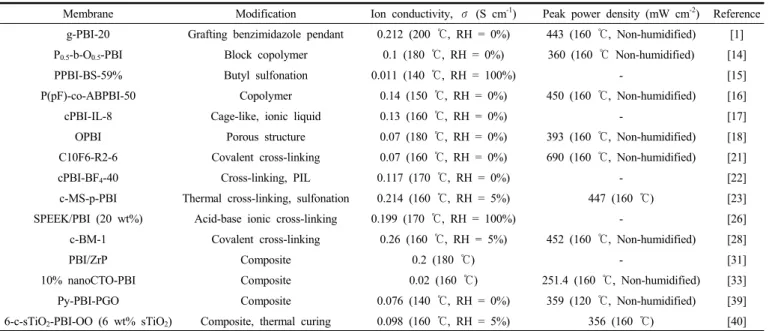
Table 1 shows a summarized report on membranes prepared by various approaches and their performances. Structurally modified membranes by inserting various functional groups, combining rigid and flexible segments, cage-like structures, etc demonstrated stability and con- duction properties. Covalently cross-linked composite membranes with PILs exhibited dual proton conduction channels as well as balance be- tween mechanical strength and PA uptake. Blending thermosetting res- in with thermoplastic and composite membranes significantly affected the durability and performance of PEMFCs. We believe that the past investigations have laid a solid foundation for the basic understanding of how the various strategies affected the performances of PBI-based HT-PEMs.

Acknowledgment

This work was supported by the National Research Foundation of Korea (NRF) grant funded by the ministry of science and ICI (NRF - 2015 M1A2A2058028).

References

1. X. Li, P. Wang, Z. Liu, J. Peng, C. Shi, W. Hu, Z. Jiang, and B.

Liu, Arylether-type polybenzimidazoles bearing benzimidazolyl pendants for high-temperature proton exchange membrane fuel cells, J. Power Sources, 393, 99-107 (2018).

2. C. Y. Wong, W. Y. Wong, K. Ramya, M. Khalid, K. S. Loh, W.

R. W. Daud, K. L. Lim, R. Walvekar, and A. A. H. Kadhum, Additives in proton exchange membranes for low and high temper- ature fuel cell applications: A review, Int. J. Hydrogen Energy, 44, 6116-6135 (2019).

3. T. Y. Son, T. H. Kim, H. J. Kim, and S. Y. Nam, Problems and solutions of anion exchange membranes for anion exchange mem- brane fuel cell (AEMFC), Appl. Chem. Eng., 29, 489-496 (2018).

4. S. W. Chuang, S. L. C. Hsu, and Y. H. Liu, Synthesis and proper- ties of fluorine-containing polybenzimidazole/silica nanocomposite membranes for proton exchange membrane fuel cells, J. Membr.

Sci., 305, 353-363 (2007).

5. Q. Li, R. He, J. O. Jensen, and N. J. Bjerrum, PBI-based polymer membranes for high temperature fuel cells - Preparation, character- ization and fuel cell demonstration, Fuel Cells, 4, 147-159 (2004) 6. X. Tian, S. Wang, J. Li, F. Liu, X. Wang, H. Chen, D. Wang, H.

Ni, and Z. Wang, Benzimidazole grafted polybenzimidazole cross-linked membranes with excellent PA stability for high-tem- perature proton exchange membrane applications, Appl. Surf. Sci., 465, 332-339 (2019).

7. M. R. Berber and N. Nakashima, Bipyridine-based poly- benzimidazole membranes with outstanding hydrogen fuel cell per- formance at high temperature and non-humidifying conditions, J.

Membr. Sci., 591, 117354 (2019).

8. G. J. Dahe, R. P. Singh, K. W. Dudeck, D. Yang, and K. A.

Berchtold, Influence of non-solvent chemistry on polybenzimidazole hollow fiber membrane preparation, J. Membr. Sci., 577, 91-103 (2019).

9. S. K. Kim, T. Ko, K. Kim, S. W. Choi, J. O. Park, K. H. Kim, C. Pak, H. Chang, and J. C. Lee, Poly[2,2’-(m-phenylene)-5,5’-bi- benzimidazole] and poly[6-fluoro-3-(pyridin-2-yl)-3,4-dihydro-2H-ben- zoxazine] based polymer electrolyte membranes for fuel cells at elevated temperature, Macromol. Res., 20, 1181-1190 (2012).

10. Q. X. Wu, Z. F. Pan, and L. An, Recent advances in alkali-doped polybenzimidazole membranes for fuel cell applications, Renew.

Sustain. Energy Rev., 89, 168-183 (2018).

Membrane Modification Ion conductivity, σ (S cm

-1

) Peak power density (mW cm

-2

) Reference g-PBI-20 Grafting benzimidazole pendant 0.212 (200 ℃, RH = 0%) 443 (160 ℃, Non-humidified) [1]

P

0.5

-b-O

0.5

-PBI Block copolymer 0.1 (180 ℃, RH = 0%) 360 (160 ℃ Non-humidified) [14]

PPBI-BS-59% Butyl sulfonation 0.011 (140 ℃, RH = 100%) - [15]

P(pF)-co-ABPBI-50 Copolymer 0.14 (150 ℃, RH = 0%) 450 (160 ℃, Non-humidified) [16]

cPBI-IL-8 Cage-like, ionic liquid 0.13 (160 ℃, RH = 0%) - [17]

OPBI Porous structure 0.07 (180 ℃, RH = 0%) 393 (160 ℃, Non-humidified) [18]

C10F6-R2-6 Covalent cross-linking 0.07 (160 ℃, RH = 0%) 690 (160 ℃, Non-humidified) [21]

cPBI-BF

4

-40 Cross-linking, PIL 0.117 (170 ℃, RH = 0%) - [22]

c-MS-p-PBI Thermal cross-linking, sulfonation 0.214 (160 ℃, RH = 5%) 447 (160 ℃) [23]

SPEEK/PBI (20 wt%) Acid-base ionic cross-linking 0.199 (170 ℃, RH = 100%) - [26]

c-BM-1 Covalent cross-linking 0.26 (160 ℃, RH = 5%) 452 (160 ℃, Non-humidified) [28]

PBI/ZrP Composite 0.2 (180 ℃) - [31]

10% nanoCTO-PBI Composite 0.02 (160 ℃) 251.4 (160 ℃, Non-humidified) [33]

Py-PBI-PGO Composite 0.076 (140 ℃, RH = 0%) 359 (120 ℃, Non-humidified) [39]

6-c-sTiO

2

-PBI-OO (6 wt% sTiO

2

) Composite, thermal curing 0.098 (160 ℃, RH = 5%) 356 (160 ℃) [40]

Table 1 Summary of PBI Membranes

(8)

11. Q. Li, J. O. Jensen, R. F. Savinell, and N. J. Bjerrum, High tem- perature proton exchange membranes based on polybenzimidazoles for fuel cells, Prog. Polym. Sci., 34, 449-477 (2009).

12. A. Vassiliev, A. K. Reumert, J. O. Jensen, and D. Aili, Durability and degradation of vapor-fed direct dimethyl ether high temper- ature polymer electrolyte membrane fuel cells, J. Power Sources, 432, 30-37 (2019).

13. J. Kerres and V. Atanasov, Cross-linked PBI based high temper- ature membranes: Stability, conductivity and fuel cell performance, Int. J. Hydrogen Energy, 40, 14723-14735 (2015).

14. L. Wang, Z. Liu, J. Ni, M. Xu, C. Pan, D. Wang, D. Liu, and L.

Wang, Preparation and investigation of block polybenzimidazole membranes with high battery performance and low phosphoric acid doping for use in high-temperature fuel cells, J. Membr. Sci., 572, 350-357 (2019).

15. H. Namazi and H. Ahmadi, Novel proton conducting membranes based on butylsulfonated poly[2,2’-(m-pyrazolidene)-5,5’-bibenzi- midazole] (BS-PPBI): Proton conductivity, acid doping and water uptake properties, J. Membr. Sci., 383, 280-288 (2011).

16. S. W. Choi, J. O. Park, C. Pak, K. H. Choi, J. C. Lee, and H.

Chang, Design and synthesis of cross-linked copolymer mem- branes based on poly(benzoxazine) and polybenzimidazole and their application to an electrolyte membrane for a high-temperature PEM fuel cell, Polymers, 5, 77-111 (2013).

17. X. Wang, S. Wang, C. Liu, J. Li, F. Liu, X. Tian, H. Chen, T.

Mao, J. Xu, and Z. Wang, Cage-like cross-linked membranes with excellent ionic liquid retention and elevated proton conductivity for HT-PEMFCs, Electrochim. Acta, 283, 691-698 (2018).

18. T. T. Ou, H. Chen, B. Hu, H. Zheng, W. Li, and Y. Wang, A fac- ile method of asymmetric ether-containing polybenzimidazole membrane for high temperature proton exchange membrane fuel cell, Int. J. Hydrogen Energy, 43, 12337-12345 (2018).

19. S. K. Kim, S. W. Choi, W. S. Jeon, J. O. Park, T. Ko, H. Chang, and J. C. Lee, Cross-linked benzoxazine-benzimidazole copolymer electrolyte membranes for fuel cells at elevated temperature, Ma- cromolecules, 45, 1438-1446 (2012).

20. S. K. Kim, K. H. Kim, J. O. Park, K. Kim, T. Ko, S. W. Choi, C. Pak, H. Chang, and J. C. Lee, Highly durable polymer electro- lyte membranes at elevated temperature: Cross-linked copolymer structure consisting of poly(benzoxazine) and poly(benzimidazole), J. Power Sources, 226, 346-353 (2013).

21. L. Wang, Z. Liu, Y. Liu, and L. Wang, Crosslinked polybenzimi- dazole containing branching structure with no sacrifice of effective N-H sites: Towards high-performance high-temperature proton ex- change membranes for fuel cells, J. Membr. Sci., 583, 110-117 (2019).

22. H. Chen, S. Wang, J. Li, F. Liu, X. Tian, X. Wang, T. Mao, J.

Xu, and Z. Wang, Novel cross-linked membranes based on poly- benzimidazole and polymeric ionic liquid with improved proton conductivity for HT-PEMFC applications, J. Taiwan Inst. Chem.

Eng., 95, 185-194 (2019).

23. N. Nambi Krishnan, A. Konovalova, D. Aili, Q. Li, H. S. Park, J. H. Jang, H. J. Kim, and D. Henkensmeier, Thermally cross- linked sulfonated polybenzimidazole membranes and their perform- ance in high temperature polymer electrolyte fuel cells, J. Membr.

Sci., 588, 117218 (2019).

24. H. L. Lin, C. R. Hu, S. W. Lai, and T. L. Yu, Polybenzimidazole and butylsulfonate grafted polybenzimidazole blends for proton ex-

change membrane fuel cells, J. Membr. Sci., 389, 399-406 (2012).

25. M. Niu, C. Zhang, G. He, F. Zhang, and X. Wu, Pendent piper- idinium-functionalized blend anion exchange membrane for fuel cell application, Int. J. Hydrogen Energy, 44, 15482-15493 (2019).

26. M. Song, X. Lu, Z. Li, G. Liu, X. Yin, and Y. Wang, Compatible ionic crosslinking composite membranes based on SPEEK and PBI for high temperature proton exchange membranes, Int. J. Hydrogen Energy, 41, 12069-12081 (2016).

27. M. Won, S. Kwon, and T. H. Kim, High performance blend mem- branes based on sulfonated poly(arylene ether sulfone) and poly- (p-benzimidazole) for PEMFC applications, J. Ind. Eng. Chem., 29, 104-111(2015).

28. N. N. Krishnan, D. Joseph, N. M. H. Duong, A. Konovalova, J.

H. Jang, H. J. Kim, S. W. Nam, and D. Henkensmeier, Phosphoric acid doped crosslinked polybenzimidazole (PBI-OO) blend mem- branes for high temperature polymer electrolyte fuel cells, J. Membr.

Sci., 544, 416-424 (2017).

29. M. S. Shin, D. E. Kim, and J. S. Park, Preparation and character- izations of poly(arylene ether sulfone)/ SiO

2

composite membranes for polymer electrolyte fuel cell, Membr. J., 27, 182-188 (2017).

30. C. Lee, H. Na, Y. Jeon, H. J. Hwang, H. J. Kim, I. Mochida, S.

H. Yoon, J. I. Park, and Y. G. Shul, Poly(ether imide) nanofibrous web composite membrane with SiO

2

/heteropolyacid ionomer for durable and high-temperature polymer electrolyte membrane (PEM) fuel cells, J. Ind. Eng. Chem., 74, 7-13 (2019).

31. Y. Ozdemir, N. Uregen, and Y. Devrim, Polybenzimidazole based nanocomposite membranes with enhanced proton conductivity for high temperature PEM fuel cells, Int. J. Hydrogen Energy, 42, 2648-2657 (2017).

32. X. Zhang, Q. Liu, L. Xia, D. Huang, X. Fu, R. Zhang, S. Hu, F.

Zhao, X. Li, and X. Bao, Poly(2,5-benzimidazole)/sulfonated se- piolite composite membranes with low phosphoric acid doping lev- els for PEMFC applications in a wide temperature range, J. Membr.

Sci., 574, 282-298 (2019).

33. P. Muthuraja, S. Prakash, V. M. Shanmugam, S. Radhakrsihnan, and P. Manisankar, Novel perovskite structured calcium tita- nate-PBI composite membranes for high-temperature PEM fuel cells: Synthesis and characterizations, Int. J. Hydrogen Energy, 43, 4763-4772 (2018).

34. S. Singha, R. Koyilapu, K. Dana, and T. Jana, Polybenzimida- zole-clay nanocomposite membrane for PEM fuel cell: Effect of organomodifier structure, Polymer, 167, 13-20 (2019).

35. Y. Lv, Z. Li, M. Song, P. Sun, X. Yin, and S. Wang, Preparation and properties of ZrPA doped CMPSU cross-linked PBI based high temperature and low humidity proton exchange membranes, React. Funct. Polym., 137, 57-70 (2019).

36. M. Moradi, A. Moheb, M. Javanbakht, and K. Hooshyari, Experi- mental study and modeling of proton conductivity of phosphoric acid doped PBI-Fe

2

TiO

5

nanocomposite membranes for using in high temperature proton exchange membrane fuel cell (HT-PEMFC), Int. J. Hydrogen Energy, 41, 2896-2910 (2016).

37. P. Mustarelli, E. Quartarone, S. Grandi, A. Carollo, and A.

Magistris, Polybenzimidazole-based membranes as a real alternative to nafion for fuel cells operating at low temperature, Adv. Mater., 20, 1339-1343 (2008).

38. A. A. Lysova, I. A. Stenina, A. O. Volkov, I. I. Ponomarev, and

A. B. Yaroslavtsev, Proton conductivity of hybrid membranes based

on polybenzimidazoles and surface-sulfonated silica, Solid State

(9)

Ionics, 329, 25-30 (2019).

39. E. Abouzari Lotf, M. Zakeri, M.M. Nasef, M. Miyake, P.

Mozarmnia, N.A. Bazilah, N.F. Emelin, and A. Ahmad, Highly du- rable polybenzimidazole composite membranes with phosphonated graphene oxide for high temperature polymer electrolyte membrane fuel cells, J. Power Sources, 412, 238-245 (2019).

40. N. N. Krishnan, S. Lee, R. V. Ghorpade, A. Konovalova, J. H.

Jang, H. J. Kim, J. Han, D. Henkensmeier, and H. Han, Polyben-

zimidazole (PBI-OO) based composite membranes using sulfophe-

nylated TiO

2

as both filler and crosslinker, and their use in the

HT-PEM fuel cell, J. Membr. Sci., 560, 11-20 (2018).

수치

Figure 1. Synthesis of the segmented block copolybenzimidazoles[14].
Figure 3 Schematic representation of the cPBI-IL-X membranes[17].
Table 1 shows a summarized report on membranes prepared by various  approaches and their performances

참조

관련 문서