Vol. 11, No. 1 December, 2009, 8-14
Semi-interpenetrated Polymer Network of Sulfonated
Poly(Styrene-Divinylbenzene-Acrylonitrile) based on PVC Film for
Polymer Electrolyte Membranes
Sung-Hyun Yun, Jung-Je Woo, Seok-Jun Seo, Jung-Woo Park, Se-Hun Oh, and Seung-Hyeon Moon† Department of Environmental Science and Engineering, Gwangju Institute of Science and Technology (GIST),
261 Cheomdan-gwagiro, Buk-gu, Gwangju 500-712, Korea (Received November 30, 2009, Accepted December 9, 2009)
Abstract: The sulfonated poly(styrene-divinylbenzene-acrylonitrile) (ST-DVB-AN) composite polymer electrolyte mem-brane based on the original PVC film was successfully synthesized to improve oxidative stability using semi-interpenetrated polymer network (semi-IPN). Weight gain ratio after copolymerization was enhanced by the DVB and AN contents, and the sulfonated membranes were characterized in terms of proton conductivity (k), ion exchange capacity (IEC), and water up-take (WU). The effect of DVB content and AN addition were thoroughly investigated by comparing the resulted properties
including oxidative stability. The obtained ST-DVB-AN composited semi-IPN membranes showed relatively high proton conductivity and IEC compared with Nafion117, and greatly improved oxidative stability of the synthesized membrane was obtained. This study demonstrated that a semi-interpenetrated sulfonated ST-DVB-AN composited membrane reinforced by PVC polymer network is a promising candidate as an inexpensive polymer electrolyte membrane for fuel cell applications.
Keywords: electrolyte membrane, monomer sorption, semi-interpenetrating polymer network, polystyrene, fuel cell
1. Introduction
1)
Fuel cells such as polymer electrolyte fuel cells (PEFCs) and direct liquid fuel cells (DLFCs) are one of the most potential power sources due to its con-venient operating temperature, high energy convertsion efficiency, and easy integration in hybrid systems [1,2]. Compared to conventional batteries, fuel cells spontan-eously generate electricity under the supplied fuel gases without electrical recharging, and power density based on the system weight is more efficient [3]. In addition, the products from PEFC such as water and heat are fairly environmentally friend compared to the fossil combustion engine. Thereby recent efforts are focused on the commercialization of PEFC in a variety
†Author for all correspondences
(e-mail:[email protected])
of applications such as portable devices, residences, stationary applications, and vehicles due to above pro-mising features [4].
Polymer electrolyte membrane (PEM) is one of the core components in membrane-electrode assembly (MEA) and perfluorinated sulfonic acid membranes such as Nafion®, Flemion®, Aciplex®, and Dow® series have been widely used due to its high proton conductivity and good thermal properties with oxidative stabilities [5]. In spite of the advantages, the Nafion membrane has some drawbacks such as excessive fuel crossover, high cost, and poor conductivity at a high temperature or under low humidified conditions [6]. To overcome these problems, many efforts are intended to develop alternative membranes as thoroughly reviewed in the previous papers [5,7]. Among the various candidates for PEM applications, non-fluorinated polymers such as polystyrene and its derivatives [8-10], sulfonated poly
(arylene ether sulfone)s [11], sulfonated poly(arylene ether ketone)s [12], sulfonated polyimides [13], sulfonated organic-inorganic hybrids [9] are conspicuously inves-tigated in order to render better oxidative stability by introducing cross-linking structure as reviewed pre-viously [14]. In pursuit of the cross-linking structures, one approach to improve the membranes properties is a reinforcing method, for example; blending a mechani-cally stable framework into a hydrocarbon based poly-mers [15,16]; grafting sulfonated hydrocarbon based polymers onto supporting materials by radiation or electron beam [17,18]; monomer sorption onto porous or nonporous substrate [9,10], etc., have been attempted. Among that, monomer sorption method is the most efficient way to introduce better oxidative stability since it is employing reinforcing material and cross- linking structure, together.
Among the various candidates for monomer sorption, divinylbenzene (DVB) and acrylonitrile (AN) are gen-erally used as an aromatic cross-linker and aliphatic additive to induce better thermal, mechanical, chemical behaviors, respectively. In this study, we present non- fluorinated composite polymer electrolyte membrane based on styrene (ST) backbone with semi-interpene-trating polymer network (semi-IPN) along the PVC chains. Since the PVC chains employed as a reinforc-ing polymer network, and the copolymerized monomers such as ST, DVB, and AN form a semi-INP structure, hereby it is expected that the copolymerized semi-IPN structure with the PVC chains improves oxidative stability for fuel cells applications.
2. Experiments
2.1. Materials
PVC film with a thickness of 100 µm was purchased from Hwashin Engineering Co. (Seoul, Korea) and it was immersed in n-hexane for 24 h to remove im-purities prior to use. Styrene (ST), divinylbenzene (DVB), and acrylonitrile (AN) from Adrich (Milwaukee, WI, USA) were used after purification with Aldrich in-hibitor removers to eliminate the polymerization
inhi-bitor tert-butylcatechol. Benzoyl peroxide (BPO) from Fluka Chem. (Buchs, Switzerland) was used as the thermal initiator. Chlorosulfonic acid from Aldirch, 1,2-dichloroethane from Junsei Chemical Co. (Tokyo, Japan), and other reagents were used as received.
2.2. Synthesis of Membranes
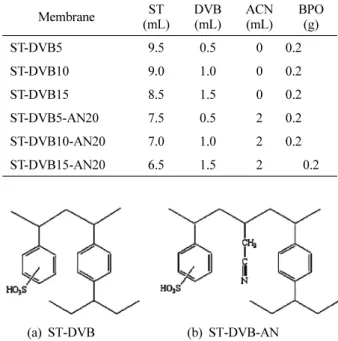
The monomer solution containing ST, DVB, AN, and BPO was prepared in a clean glass Petri dish at room temperature, and the cleaned PVC film was soaked and swelled in the monomer solution for 3 h to allocate sufficient monomer sorption into the original PVC polymer network. The swollen PVC film was placed on a glass plate and excess monomer solution was removed before thermal polymerization at 80°C for 8 h. The polymerized film was then kept in the air to dry up unreacted monomers, and immersed in 1,2-dichloroethane to remove uncrosslinked homopoly-mer. The pre-swollen film in 1,2-dichloroethane was sulfonated by immersing it in the mixture of chloro-sulfonic acid and 1,2-dichloroethane. The detailed con-cept and procedure for membrane preparation with semi- interpenetrated polymer network are well described in the previous reports [9,10,19]. To investigate the op-timum composition of DVB and ACN, different mono-mer solutions with various ST, DVB, and AN contents were prepared as shown in Table 1, and the expected structures of ST-DVB and ST-DVB-AN are shown in Fig. 1.
2.3. Characterization of Membrane 2.3.1. Structural Confirmations (FTIR)
Polymerization and sulfonation processes were con-firmed by Fourier transform infrared spectrometer (FTIR 460 plus, Jasco, Japan). For the FTIR measurement original PVC film, polymerized film, and sulfonated membrane were dried at 50°C under vacuum for 24 h before measuring. Each sample was measured by using attenuated total reflection (ATR) mode at 4 cm-1 of resolution and 20 times of scan rate in the air.
Table 1. The Components of ST-DVB-AN Membranes Membrane (mL)ST DVB (mL) ACN (mL) BPO(g)
ST-DVB5 9.5 0.5 0 0.2 ST-DVB10 9.0 1.0 0 0.2 ST-DVB15 8.5 1.5 0 0.2 ST-DVB5-AN20 7.5 0.5 2 0.2 ST-DVB10-AN20 7.0 1.0 2 0.2 ST-DVB15-AN20 6.5 1.5 2 0.2 (a) ST-DVB (b) ST-DVB-AN
Fig. 1. Structure of semi-interpenetrated polymer network (semi-IPN) with PVC.
2.3.2. Weight-gain Ratio
The weight-gain ratio (∆WP) after polymerization
reflected the polymerization yield. It was defined as
∆
× (1)
in which WO was the weight of original PVC film and
WP was the weight of the film after polymerization.
2.3.3. Water Uptake and Ion Exchange Capacity The water uptake (WU) was calculated by using the
weight of dried (Wdry) and wet (Wwet) membrane as
following equation.
× (2)
Ion-exchange capacity was measured according to the phenolphthalein end point detection by titrating NaOH aqueous solution. Before titration, the membrane in an acid form was soaked in 0.5 mol/L NaCl aqueous solution for 12 h and the equivalent of the protons released from the membrane in the solution was
detected by titrating 0.01 mol/L NaOH (CNaOH) aqueous
solution in the presence of phenolphthalein. With the amount of titrated NaOH volume (VNaOH), the IEC
(meq/g) was calculated by the following equation.
×
(3)
2.3.4. Proton Conductivity
The proton conductivity of the membrane was me-asured using a four-probe electrochemical impedance cell [9,10]. Impedance analysis was carried out by using potentiostat/gavanostat (Autolab PGSTAT 30, Eco Chemie, Netherland), and operated by a galvanostatic method under the conditions of 0.1 mA AC amplitude over a frequency from 1 MHz to 50 Hz at room tem-perature. The membrane resistance was determined at zero phase angle from the Nyquist behavior. Finally, the proton conductivity, k (S/cm) was calculated by the following equation:
× × (4)
where R is the experimentally determined membrane resistance, L is the distance between reference-sensing electrodes, and W and d are the width and thickness of the membrane, respectively.
2.3.5. Oxidative Stability
The oxidative stability was examined by measuring the weight change of the membrane while soaked in a H2O2
aqueous solution [19]. The membrane with a size of 1 cm × 4 cm was immersed in the 3 wt% H2O2 aqueous
solution at 60°C for 240 h, and remained dry weight of the membrane sample was recorded with the time.
3. Results and Discussions
3.1. Preparation of Membrane
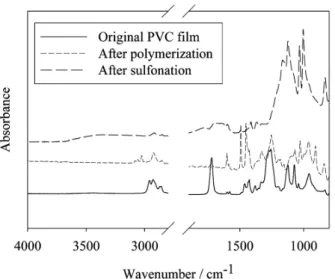
The polymerization and sulfonation processes during membrane synthesis were confirmed by FTIR spectra as shown in Fig. 2, where the absorbance spectrum of
Fig. 2. FTIR spectra of the original PVC film (black solid line, ――), polymerized film (blue short dashed line, ---), and sulfonated membrane (red long dashed line, −−). original PVC film was measured as a background. After polymerization, the new peaks at 1,600 and 1,491 cm-1 were appeared which are associated with the stretching vibration of the aromatic ring. Therefore it was con-firmed that ST and DVB monomers were copoly-merized by making semi-interpenetrating polymer net-work with the original PVC polymer chains. After the sulfonation reaction, the new absorbance peaks at 1,123, 1,004, 1,369, and 1,169 cm-1 were observed which are assigned to the sulfonic acid (SO3-) group
[9,10]. It was hereby confirmed that, the polymeriza-tion and sulfonapolymeriza-tion reacpolymeriza-tions have taken place su-ccessfully under the given conditions.
Since DVB is a common cross-linker that is used to enhance thermal and chemical stability, the ST back-bone was cross-linked by the DVB as described in Fig. 1(a) in this study. With the aromatic cross-linker, ST and AN are generally copolymerized to enhance mech-anical behavior and thermal stability as shown in Fig. 1(b) for the cross-linked structure of repeating units of ST, DVB, and AN. To investigate the effect of DVB content for the polymerization, monomer sorption ex-periments using 5, 10, and 15% of DVB were carried out and denoted as ST-DVB5, ST-DVB10, and ST- DVB15, respectively. Further, the effect of AN to the ST and DVB contents was investigated by adding 20%
Fig. 3. Weight-gain ratio of polymerized film for ST- DVB (■) and ST-DVB-AN (■).
of AN and denoted as ST-DVB5-AN20, ST-DVB10- AN20, and ST-DVB15-AN20, respectively. The effects of DVB and AN contents to the copolymerization with ST backbone were compared by using the weight gain ratio after polymerization as shown in Fig. 3. Increas-ing the DVB from 5 to 15 wt%, the weight gain ratio also gradually increased from 42 to 47 wt%. It implies that the degree of cross-linking structure by using DVB was substantially enhanced by the increased DVB con-tent, and the molecular weight of the membrane could be efficiently enhanced. At the same time, Fig. 3 shows the AN effect to the polymerization. With the increased DVB content, the addition of AN greatly enhanced the weight gain ratio from 97 to 144 wt%. Since the aliphatic AN induced the free volume between the aromatic ST/DVB coordination, the copoly-merization of ST-DVB-AN enhanced the weight gain ratio compared to the ST-DVB, so that a high mole-cular weight was anticipated for a better oxidative stability.
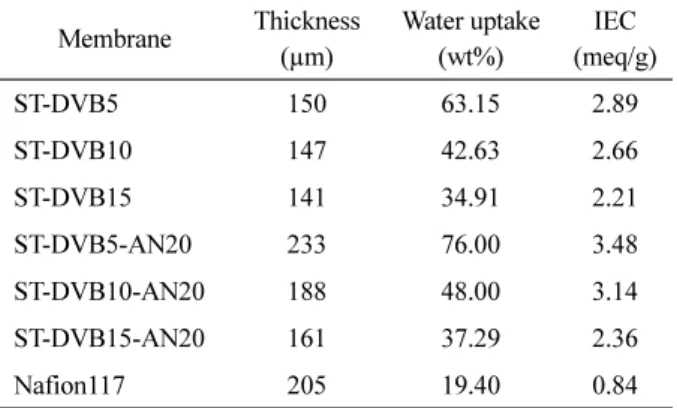
3.2. Properties of the Sulfonated Membranes Experimentally determined properties of the synthe-sized membranes such as thickness in wet state, water uptake, and IEC were summarized and compared with Nafion117 in Table 2. As the increased cross-linking by the DVB content, the thickness of membrane was reduced. Also the cross-linked structure of ST-DVB,
Table 2. Experimentally Determined Thickness in Wet State, Water Uptake, and IEC of the Sulfonated ST-DVB, ST-DVB-AN, and Nafion117
Membrane Thickness (µm) Water uptake (wt%) IEC (meq/g) ST-DVB5 150 63.15 2.89 ST-DVB10 147 42.63 2.66 ST-DVB15 141 34.91 2.21 ST-DVB5-AN20 233 76.00 3.48 ST-DVB10-AN20 188 48.00 3.14 ST-DVB15-AN20 161 37.29 2.36 Nafion117 205 19.40 0.84
semi-interpenetrated with the PVC support network, was an efficient way to suppress water swelling by a dense polymer network. Apparently, the water content was greatly reduced by the DVB content. The addition of AN to the ST-DVB network induced a higher water uptake and IEC than the cases without AN as com-pared in Table 2, since the aliphatic and polar AN moiety contributed to the sulfonation reaction by giv-ing the free volume and water uptake by polarity itself. As the increased water uptake, the membrane thickness increased in wet state by the addition of AN. With the increasing DVB content, the weight gain was enhanced due to the increased cross-linkage by the DVB, however, the relative ratio of ST was decreased by the increasing DVB content. Consequently, the sulfonated moiety decreased as indicated by the de-creasing IEC. For the ST-DVB-AN, however the IEC was greatly enhanced by addition of aliphatic AN. The IEC of ST-DVB5 and ST-DVB5-AN20 were 2.89 and 3.48 meq/g, respectively. It implies again, that the sulfonated moiety was increased by addition of AN due to the aliphatic moiety associated with proton con-ductivity.
Fig. 4 shows the proton conductivities of the synthe-sized ST-DVB and ST-DVB-AN membranes, compared with Nafiion117. For fuel cells applications, it is crucially required to exhibit enough proton conductivity like a commercial membrane such as perfluorinated acid ones. Here, it should be noted that proton
con-Fig. 4. Proton conductivity of the sulfonated ST-DVB (■), ST-DVB-AN (■), and Nafion117 (□).
ductivity was measured by using a 4-probe conven-tional impedance cell [20], in which the electrodes were placed along the surface direction of the mem-brane, so that the examined conductivity implies the ability of proton conduction along the surface direction. The higher content of DVB induced the lower proton conductivity under the same sulfonation conditions. For the membrane of 5% DVB (ST-DVB5), the conduc-tivity was 0.113 S cm-1, and 0.050 S cm-1 for the 15% DVB (ST-DVB15) which can be reasonably used for fuel cell applications. On the other hand, the addition of AN contributed to the great enhancement of proton conductivity as shown in Fig. 4. The ST-DVB5-AN20 showed the conductivity of 0.188 S cm-1 and it was much higher than Nafion117.
3.3. Oxidative Stability
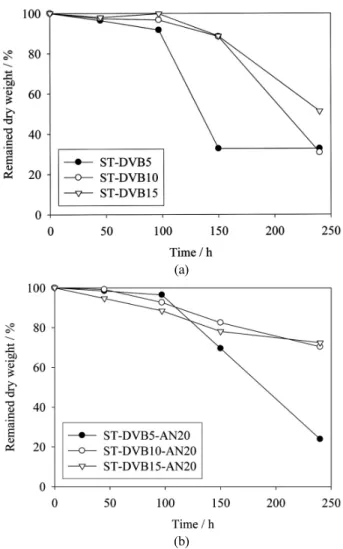
DVB was used to cross-link ST backbones in the semi-interpenetrated structure with the original PVC polymer network. In addition to the supporting con-tribution of the PVC chain, the cross-linked structure of ST by DVB was employed to render a better oxidative stability which must be improved for fuel cell applications particularly in the hydrocarbon based membranes. Fig. 5 presents the oxidative stability of the prepared ST-DVB and ST-DVB-AN membranes. Under the fixed accelerated oxidizing conditions in 3 wt% of H2O2 at 60°C, each membrane sample was
(a)
(b)
Fig. 5. Oxidative stability of (a) ST-DVB and (b) ST- DVB-AN; remained dry weight ratio were compared during accelerated oxidizing condition at 60°C.
chemically degraded by hydroxyl radical dominantly. To compare the degradation degree, remained dry weight of each membrane sample was quantitatively presented in Fig. 5. As a result, the oxidative stability of the ST- DVB membrane was greatly enhanced with the DVB content due to the reinforced PVC network and cross- linked structure by DVB as shown in Fig. 5(a). Also, the addition of AN induced highly interacted polymer networks partially due to aliphatic and polar charac-teristics within the ST-DVB coordination, so that the oxidative stability was further enhanced as shown in Fig. 5(b). These results indicate that the polymer elec-trolyte membrane of ST-DVB-AN having semi-inter-penetrated network with original PVC polymer chains
is a promising candidate for fuel cell applications.
4. Conclusions
This study reports the polymer electrolyte membrane prepared with semi-interpenetrating polymer network (semi-IPN) composed of poly(ST-DVB-AN)/PVC. In-itially a PVC nonporous film was employed as a rein-forcing film and ST, DVB, and AN monomers were copolymerized so that interpenetrated with those of PVC chains. The effect of the DVB content and AN were thoroughly investigated by comparing the pro-perties of the membranes including oxidative stability. The ST-DVB-AN composited semi-IPN membranes showed properties comparable to Nafion117 in terms of proton conductivity and IEC. Furthermore, greatly improved oxidative stability of the synthesized mem-brane was observed.
Acknowledgement
This work was out come of the fostering project (2008-N-FC02-J-01-0-000) of the Core-Technology/Re-search Center supported financially by the Korean Ministry of Knowledge Economy.
References
1. C. Bossi, A. D. Corno, M. Scagliotti, and C. Valli, “Characterisation of a 3 kW PEFC power system coupled with a metal hydride H2 storage”, J. Power Sources, 171, 122 (2007).
2. H.-S. Chu, F. Tsau, Y.-Y. Yan, K.-L. Hsueh, and F.-L. Chen, “The development of a small PEMFC combined heat and power system”, J. Power Sources, 176, 499 (2008).
3. N. Wan and G. Wang, “An integrated composite membrane electrode assembly (ICMEA) and its application in small H2/air fuel cells”, J. Power Sources, 159, 951 (2006).
J. C. Moore, G. Rusch, T. W. Sherman, N. T. Sisofo, and U. Beuscher, “A polymer electrolyte fuel cell life test: 3 years of continuous operation”, J. Power Sources, 158, 446 (2006).
5. R. Souzy and B. Ameduri, “Functional fluoropoly-mers for fuel cell membranes”, Prog. Polym. Sci., 30, 644 (2005).
6. B.-J. Chang, D. J. Kim, J. H. Kim, S.-B. Lee, and H. J. Joo, “Sulfonated poly(fluorene-co-sulfone)ether membranes containing perfluorocyclobutane groups for fuel cell applications”, J. Membr. Sci., 325, 989 (2008).
7. M. Rikukawa and K. Sanui, “Proton-conducting polymer electrolyte membranes based on hydrocar-bon polymers”, Prog. Polym. Sci., 25, 1463 (2000). 8. T. A. Sherazi, S. Ahmad, M. A. Kashmiri, D. S.
Kim, and M. D. Guiver, “Radiation-induced grafting of styrene onto ultra-high molecular weight poly-ethylene powder for polymer electrolyte fuel cell application II. Sulfonation and characterization”, J. Membr. Sci., 333, 59 (2009).
9. R.-Q. Fu, J.-J. Woo, S.-J. Seo, J.-S. Lee, and S.-H. Moon, “Covalent organic/inorganic hybrid proton- conductive membrane with semi-interpenetrating polymer network: Preparation and characterizations”, J. Power Sources, 179, 458 (2008).
10. R.-Q. Fu, J.-J. Woo, S.-J. Seo, J.-S. Lee, and S.-H. Moon, “Sulfonated polystyrene/polyvinyl chloride composite membranes for PEMFC applications”, J. Membr. Sci., 309, 156 (2008).
11. S. Feng, Y. Shang, X. Xie, Y. Wang, and J. Xu, “Synthesis and characterization of crosslinked sul-fonated poly(arylene ether sulfone) membranes for DMFC application”, J. Membr. Sci., 335, 13 (2009). 12. J. Jaafar, A. F. Ismail, and T. Matsuura, “Preparation
and barrier properties of SPEEK/Cloisite 15A®/ TAP nanocomposite membrane for DMFC application”, J. Membr. Sci., 345, 119 (2009).
13. Q. Li, J. O. Jensen, R. F. Savinell, and N. J. Bjerrum, “High temperature proton exchange mem-branes based on polybenzimidazoles for fuel cells”,
Prog. Polym. Sci., 34, 449 (2009).
14. R. Borup, J. Meyers, B. Pivovar, Y. S. Kim, R. Mukundan, N. Garland, D. Myers, M. Wilson, F. Garzon, D. Wood, P. Zelenay, K. More, K. Stroh, T. Zawodzinski, J. Boncella, J. E. McGrath, M. Inaba, K. Miyatake, M. Hori, K. Ota, Z. Ogumi, S. Miyata, A. Nishikata, Z. Siroma, Y. Uchimoto, K. Yasuda, K.-i. Kimijima, and N. Iwashita, “Sci-entific Aspects of Polymer Electrolyte Fuel Cell Durability and Degradation”, Chem. Rev., 107, 3904 (2007).
15. Y. Fu, A. Manthiram, and M. D. Guiver, “Blend membranes based on sulfonated poly(ether ether ketone) and polysulfone bearing benzimidazole side groups for proton exchange membrane fuel cells”, Electrochem. Commun., 8, 1386 (2006).
16. A. Mokrini, M. A. Huneault, Z. Shi, Z. Xie, and S. Holdcroft, “Non-fluorinated proton-exchange mem-branes based on melt extruded SEBS/HDPE blends”, J. Membr. Sci., 325, 749 (2008).
17. T. Yamaki, M. Asano, Y. Maekawa, Y. Morita, T. Suwa, J. Chen, N. Tsubokawa, K. Kobayashi, H. Kubota, and M. Yoshida, “Radiation grafting of styrene into crosslinked PTEE films and subse-quent sulfonation for fuel cell applications”, Ra-diat. Phys. Chem., 67, 403 (2003).
18. B. N. Kim, D. H. Lee, and D. H. Han, “Charac-teristics of Fuel Cell Membranes Prepared by EB Radiation Grafting onto FEP with Styrene Deri-vatives, Styrene and 2-Methylstyrene”, J. Electro-chem. Soc., 155, B680 (2008).
19. J.-J. Woo, S.-J. Seo, S.-H. Yun, and S.-H. Moon, “Improvement of oxidative stability for non-fluori-nated membranes prepared by substituted styrene monomers”, Membrane Journal, 17, 294 (2007) 20. L. Wu, C. Huang, J.-J. Woo, D. Wu, S.-H. Yun,
S.-J. Seo, T. Xu, and S.-H. Moon, “Hydrogen bonding: A channel for protons to transfer through acid-base pairs”, J. Phys. Chem. B, 113, 12265 (2009).