• 검색 결과가 없습니다.

MnOx/Sewage Sludge Char를 이용한 저온 NH3 SCR의 반응 메커니즘

N/A
N/A
Protected

Academic year: 2021

Share "MnOx/Sewage Sludge Char를 이용한 저온 NH3 SCR의 반응 메커니즘"

Copied!
4
0
0

로드 중.... (전체 텍스트 보기)

전체 글

(1)

Appl. Chem. Eng., Vol. 22, No. 3, June 2011, 308-311

308

MnOx/Sewage Sludge Char 를 이용한 저온 NH 3 SCR 의 반응 메커니즘

차진선⋅박영권

⋅박성훈*⋅전종기**

서울시립대학교 환경공학부, *순천대학교 환경공학과, **공주대학교 화학공학과 (2011년 3월 18일 접수, 2011년 3월 25일 채택)

-

Reaction Mechanism of Low Temperature NH 3 SCR over MnOx/Sewage Sludge Char

Jin-Sun Cha, Young-Kwon Park , Sung Hoon Park

*

, and Jong-Ki Jeon

**

School of Environmental Engineering, University of Seoul, Seoul 130-743, Korea

*

Department of Environmental Engineering, Sunchon National University, Suncheon 540-742, Korea

**

Department of Chemical Engineering, Kongju National University, Cheonan 331-717, Korea (Received March 18, 2011; Accepted March 25, 2011)

하수슬러지 촤에 MnOx를 담지한 촉매를 사용하여 NH 3 를 환원제로 하는 선택적 촉매 환원반응의 반응 메커니즘 분석

을 수행하였다. XRD 분석 결과 활성 Mn phase는 Mn 3 O 4 인 것으로 여겨졌다. 또한 150℃ 이하에서는 흡착반응이 주요 한 질소산화물 저감 메커니즘으로 작동하였으나, 100∼150℃에서는 환원반응도 질소산화물 저감에 관여하는 것으로 보여졌다. 실험결과에 기초하여 활성 촤와 여기에 MnOx를 담지한 촤에서의 반응속도상수를 비교하였다. MnOx 담지 촤는 높은 충돌계수와 낮은 활성화 에너지에 기인하여 높은 반응속도 상수와 높은 NOx 제거 효율을 나타내었다. 두 가지 촤 모두 본 실험 조건하에서 활성화 에너지는 상대적으로 낮았다(10∼12 kJ/mol).

The reaction mechanism of selective catalytic reduction of NOx over sewage sludge char impregnated with MnOx using NH 3 as the reducing agent was investigated. The active Mn phase was shown to be Mn 3 O 4 from the XRD analysis. Adsorption was the dominant NOx removal mechanism at low temperatures below 150 ℃ although reduction reaction also contributed partly to the NOx removal at 100 ∼150 ℃. The reaction rate constants of NOx removal over non-impregnated and MnOx-im- pregnated active chars were compared based on experimental results. The MnOx-impregnated char was shown to have a high- er reaction rate constant and a higher NOx removal efficiency due to a higher collision coefficient and a lower activation energy. The activation energy for both chars was shown to be relatively low (10 ∼12 kJ/mol) under the experimental con- ditions of this study.

Keywords: NOx, sewage sludge char, reaction mechanism, Mn

1. Introduction

1)

Nitrogen oxide (NOx) is a group of reactive gaseous species that irritates respiratory system of humans and animals. It causes not only acid rain but also photochemical smog and ozone via photochemical reactions. A variety of researches have been conducted to reduce NOx emissions. The most widely used NOx-reducing method over the world is the selective catalytic reduction (SCR). In particular, investigations on various catalysts for application to SCR processes have been carried out[1,2]. It is V 2 O 5 /TiO 2 (anatase) catalyst blended with WO 3 and MoO 3 that is used most widely in stationary NOx emission sources such as incineration plants and thermal power plants. While V 2 O 5

catalysts have high NOx reduction efficiencies and are resistant to SO 2 , their temperature window is relatively narrow (300 ∼400 ℃). Within

† 교신저자 (e-mail: [email protected])

this temperature range, exhaust gas usually contains particulate matter, which causes inactivation and poisoning of catalysts, and other pollutants including SO 2 and As. Therefore, efforts have been made to develop low-temperature SCR catalysts that are active below 300 ℃[3].

Sewage sludge produced during the waste water treatment had been

disposed mainly via landfill and ocean dumping in Korea until the

amendment of Enforcement Regulation for Waste Management Law in

2001 that banned the landfill of sewage sludge. Since the amendment,

most sewage sludge has been disposed by ocean dumping. As the 1996

Protocol to the London Convention took effect, however, regulation for

ocean dumping of waste including sewage sludge was tightened to a

large extent so that the ocean dumping of sewage sludge exceeding the

standards 1 and 2 is banned from February 2008 and from February

2011, respectively, which urgently calls methods for in-land treatment

of sewage sludge. Incineration, a representative in-land treatment

process in which sewage sludge is burned and then the residues are

(2)

309 MnOx/Sewage Sludge Char 를 이용한 저온 NH 3 SCR 의 반응 메커니즘

Appl. Chem. Eng., Vol. 22, No. 3, 2011 Figure. 1. XRD patterns of MnOx over sludge char.

landfilled, can reduce the volume landfilled by 80 ∼90%. However, incineration exhaust contains secondary pollutants including dioxins, sulfur oxides, nitrogen oxides, and hydrogen chloride. In addition, the heavy metal concentration in incineration residues is high causing potential soil pollution. An alternative way of sewage sludge treatment is thermal treatment including pyrolysis and gasification. Thermal treatment is advantageous over incineration in that it can treat sewage sludge stably and by-products can be used as energy resources. Solid product obtained from thermal treatments is called char. Because of its merits of waste recycling and low cost, investigations are under way to reuse the char as fertilizer, adsorbent, and solid fuel[4]. Reuse of sewage sludge char is drawing a large attention in terms of reuse of a by-product as well as reduction of the amount of sludge to treat[5].

Sewage sludge char has been used in various applications either as it is or after activation through physical and/or chemical methods. In particular, it was reported that sewage sludge char can replace activated carbon used in the de-NOx process. According to the results reported in Park et al.[6,7], the catalyst prepared by impregnating sewage sludge char with Mn exerted high activity for NOx removal at low temperature.

Park et al.[6,7] investigated the influences of various operating conditions such as temperature and activation method on removal of NOx. They obtained the highest NOx removal efficiency with the char catalyst that was produced through chemical activation using KOH and impregnated with Mn. Reaction kinetics of sewage sludge char, however, was hardly analyzed in their study. Therefore, in this study, the kinetics of NOx removing reactions by the sewage sludge char impregnated with Mn (Mn/Sewage sludge char) is investigated.

2. Experimental

2.1. Catalyst

In this study, the same catalysts as had been used in our previous study were used. Refer to[6,7] for detailed data for catalyst characteristics and abbreviations. X-ray diffraction was used to analyze the crystal structure of the MnOx impregnated on char under the conditions of Cu Kα radiation and 2θ = 10∼90°.

2.2. De-NOx Reaction

De-NOx experiments were performed following the method described in detail in the previous paper[6,7]. An SUS tubular fixed-bed reactor, with an inner diameter of 130 mm and a height of 1500 mm, was fabricated to measure the NO x removal efficiency of the produced chars. The composition of the inlet gas was maintained at 1000 ppm of NO, 1000 ppm of NH 3 , and 5 vol% of O 2 . The W/F (char sample weight/feed flow) ratio was 5.0 g ⋅min/L (SV ≒ 6000 h -1 ). The NO concentrations of inlet and outlet streams were measured by a NO x

analyzer (42C, ThermoIns.). After 1 h reaction time, the NO x removal efficiency was calculated by the following equation :

    ×      

 : inlet NO concentration (ppm)

 : outlet NO concentration (ppm)

3. Results and Discussion

3.1. MnOx Active Species

XRD measurement was carried out to analyze the crystal structure of MnOx impregnated on sludge char (Figure 1). As is shown in Figure 1, the MnOx impregnated on sludge char turned out to be Mn 3 O 4 . The previous study[6,7] showed that impregnation of char with MnOx enhanced the NOx removal efficiency. At temperatures above 150 ℃, at which reduction reaction of NH 3 and NO is the main mechanism, Mn 3 O 4 functioned as the active site. At lower temperatures (≤ 150 ℃), the improved NOx removal efficiency by impregnation of Mn 3 O 4 was explained by Marban et al.[8] as follows. Mn 3 O 4 is composed of octahedral Mn 2 O 3 phase and tetrahedral MnO phase. NO can be adsorbed on the oxygen vacancies of octahedral Mn 2 O 3 as is shown in Eq. (1). It may be even reduced into N 2 by the reaction shown in Eq. (2). The mechanism shown in Eqs. (1) and (2) explains how the NOx removal efficiency could be improved by impregnation of MnOx at low temperature as well.

{O=Mn- □-Mn=O} O + NO ↔ {O=Mn-[NO]-Mn=O} O (1) 2{O=Mn-[NO]-Mn=O} O → 2{O=Mn-O-Mn=O} O + N 2 (2) 3.2. Low-temperature Adsorption Mechanism

It has been reported in the literature that reduction of NOx emission below 150 ℃ is achieved by adsorption[6,7]. Based on NH 3 step response experiments under NO-NH 3 -O 2 condition, however, Zhu et al.

[9] suggested a different pathway. They reported that when an inlet gas

containing 610 ppm of NO, 700 ppm of NH 3 , and 3.5 vol% of O 2 was

provided into activated coke reactor at 30 ℃, NO concentration at

reactor exit was measured to be 240 ppm, which is translated to the

NOx removal efficiency of 60.7%. After ensuring that NO concentration

(3)

310 차진선⋅박영권⋅박성훈⋅전종기

공업화학, 제 22 권 제 3 호, 2011

Figure 2. NOx removal below 150 ℃ over SCK-2.0-600.

Figure 3. NOx removal below 150 ℃ over 3 wt% MnOx/SCK- 2.0-600.

Table 1. Removal Rate Constants (k) for NO Reduction with NH 3 over SCK-2.0-600 and 3 wt% MnOx/SCK-2.0-600

Sample k (cm 3 /g ⋅s)

150 ℃ 200 ℃ 250 ℃

SCK-2.0-600 36.38 51.80 66.78

3 wt% MnOx/SCK

(SCK-2.0-600) 65.43 93.74 112.23

is maintained constant at the above-mentioned reaction condition, NH 3 supply was ceased to investigate its effect on NOx removal. The NO concentration at the reactor exit was observed to increase to 470 ppm first and then decrease back to 320 ppm. The authors argued that the reduction of NO concentration without supply of NH 3 can be ascribed to oxidation of NO by O 2 followed by adsorption on the surface of activated carbon. In their experiments, the adsorption efficiency of NO via reaction between NO and O 2 was 47.6%, which is lower by about 13% than the NOx removal efficiency of 60.7% obtained with NH 3 supply. Based on this result, the authors suggested that the NOx removal over carbon catalyst at low temperature is achieved by both oxidation followed by adsorption and reduction reaction with NH 3 .

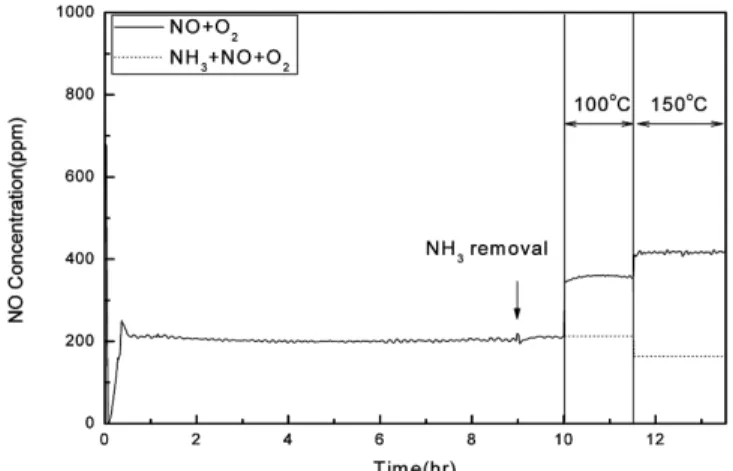
To investigate further the NOx removal mechanism at low temperature (below 150 ℃), similar experiments to those of Zhu et al.[9] were carried out in this study. Figures 2 and 3 show the results obtained using SCK-2.0-600 and 3 wt% MnOx/SCK-2.0-600, respectively. At 50 ℃, NO concentration was shown to be independent of NH 3 supply in both experiments, indicating that NOx removal at 50 ℃ is solely due to adsorption. At 100 ℃, however NO concentration increased significantly when NH 3 supply was ceased. This trend was even more pronounced at 150 ℃. These results suggest that both adsorption and reduction reaction contribute to removal of NOx at 100 ℃ and at 150 ℃

and that the relative contribution of adsorption decreases with increasing temperature. Nevertheless, the NOx removal due to adsorption is generally more important than that through the reduction reaction below 150 ℃.

3.3. Catalytic Reduction Reaction Rate of NOx

Muniz et al.[10] investigated the effects of the concentrations of NH 3 and NO on the efficiency of NO removal over activated carbon fiber. They reported that the NO removal reaction is 1st order and 0th order with respect to NO and NH 3 concentrations, respectively.

Garc´ıa-Bordejé et al.[11] also reported experimental results supporting the NO removal rate that is 1st order and 0th order with respect to NO and NH 3 concentrations, respectively. Based on their results, they suggested the following reaction rate equation.

   (3)

Garc´ıa-Bordejé et al. and Boyano et al.[11,12] confirmed that the external diffusion limitations are not considerable in SCR reactions and inferred the following relation between the reaction constant k and NO removal efficiency X under that condition.

    

 (4)

F 0 : molar NO feed rate (mol/s)

[NO] 0 : molar NO concentration at the inlet (mol/cm 3 ) W : catalyst weight (g)

Table 1 summarizes the reaction rate constants over activated sludge char and MnOx-impregnated char calculated using Eq. (4). Only the results obtained at high temperatures (150 ∼250 ℃) are shown here to account for the reduction reaction of NO with NH 3 because NO removal below 150 ℃ was dominated by adsorption. It is shown in this Table that the reaction constant is higher for the Mn-impregnated catalyst that has higher NOx removal efficiency.

The reaction rate constant scales with temperature and the relation is given by the following Arrhenius equation :

     

 (5)

where k is the reaction rate constant, A the collision coefficient or the

pre-exponential factor, E a the activation energy (J/mol), R the gas

constant (8.314 J/mol⋅K), and T the absolute temperature (K). Applying

(4)

311 MnOx/Sewage Sludge Char 를 이용한 저온 NH 3 SCR 의 반응 메커니즘

Appl. Chem. Eng., Vol. 22, No. 3, 2011 Table 2. Kinetic Parameters for NO Reduction with NH 3 over

SCK-2.0-600 and 3 wt% MnOx/SCK-2.0-600

Sample

Collision coefficient, A (cm 3 /g ⋅s)

Activation energy, E a (kJ/mol)

Coefficient of determination,

R 2

SCK-2.0-600 881.83 11.19 0.98

3 wt% MnOx/SCK

(SCK-2.0-600) 1144.82 10.00 0.97

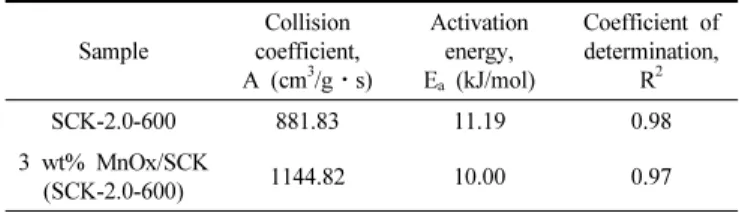
the reaction constant k to Eq. (5), the activation energy and the collision coefficient for each char can be estimated[13]. Since a linear relationship exists between natural logarithm of the reaction rate constant, ln(k), and the reciprocal of temperature, 1/T, one can obtain the collision coefficient and the activation energy from the y-intercept and the gradient, respectively, by plotting ln(k) as a function of 1/T.

Table 2 shows the values for the collision coefficient and the activation energy obtained in this way. Mn-impregnated SCK catalyst was shown to have a lower activation energy and a higher collision coefficient than the non-impregnated catalyst, resulting in a higher reaction rate constant.

Marbon et al.[14] and Kapteijn et al.[15] argued that the low activation energy of about 15 kJ/mol in low-temperature SCR can be attributed to the characteristics of Langmuir-Hinshelwood (LH) mechanism.

In LH mechanism, when NO and NH 3 are adsorbed, lattice oxygens at active sites receive hydrogen atoms from NH 3 to reduce the active sites. Then, the adsorbed -NH 2 and -NO 2 reacts with each other to produce N 2 and H 2 O and the reduced active sites are oxidized by gas-phase O 2 . The heat released by adsorption and oxidation reaction in LH mechanism is the reason of low activation energy[11]. Based on this explanation, it may be suggested that the reduction of NO with NH 3 over sludge char is dictated by Langmuir-Hinshelwood mechanism.

However, it should be noted that this is a hypothesis which has not been assessed thoroughly and additional investigations are required to verify it.

4. Conclusions

NOx removal over char catalysts at temperatures below 150 ℃ took place mostly by adsorption. At 100 ℃ and 150 ℃, however, reduction

reaction also contributed partly to NOx removal. The relative contribution of adsorption decreased with increasing temperature below 150 ℃.

The reaction rate constants of NOx removal over activated char and MnOx-impregnated char were obtained from experimental results. The MnOx-impregnated char was shown to have a higher NOx removal efficiency and a higher reaction rate constant than non-impregnated char. The collision coefficient and the activation energy were calculated by applying the reaction rate constants obtained at different temperatures to Arrhenius equation. The MnOx-impregnated char was shown to have a higher collision efficiency and a lower activation energy. The activation energy was shown to be 10 ∼12 kJ/mol under the experimental conditions used in this study.

References

1. J. C. Choi, C. H. Cho, K. E. Jeong, J. K. Jeon, J. H. Yim, and Y. K. Park, J. Kor. Ind. Eng. Chem., 19, 92 (2008).

2. F. Nakajima and I. Hamada, Catal. Today., 29, 109 (1996).

3. P. A. Lowe and J. N. Armor, ACS Symp. Series., 552, 205 (1994).

4. O. Ioannidou and A. Zabaniotou, Renew. Sustain. Energy Rev., 11, 1966 (2007).

5. G. López, M. Olazar, M. Artetxe, M. Amutio, G. Elordi, and J.

Bilbao, J. Anal. Appl. Pyrolysis, 85, 539 (2009).

6. J. S. Cha, J. C. Choi, J. H. Ko, Y. K. Park, S. H. Park, K. E.

Jeong, S. S. Kim, and J. K. Jeon, Chem. Eng. J., 156, 321 (2010).

7. Y. B. Jo, J. S. Cha, J. H. Ko, M. C. Shin, S. H. Park, J. K. Jeon, S. S. Kim, and Y. K. Park, Korean J. Chem. Eng., 28, 106 (2011).

8. G. Marban, T. V. Solis, and A. B. Fuertes, J. Catal., 226, 138 (2004).

9. Z. Zhu, Z. Liu, S. Liu, and H. Niu, Fuel, 79, 651 (2000).

10. J. Muñiz, G. Marbán, and A. B. Fuertes, Appl. Catal. B: Environ., 27, 27 (2000).

11. E. Garc´ıa-Bordejé, L. Calvillo, M. J. Lázaro, and R. Moliner, Appl. Catal. B: Environ., 50, 235 (2004).

12. A. Boyano, M. E. Galvez, M. J. Lazaro, and R. Moliner, Carbon, 44, 2399 (2006).

13. M. Koebel and M. Elsener, Chem. Eng. Sci., 53, 657 (1998).

14. G. Marban and A. B. Fuertes, Catal. Lett., 84, 13 (2002).

15. F. Kapteijn, L. Singoredjo, N. J. J. Dekker, and J. A. Moulijn, Ind.

Eng. Chem. Res., 32, 445 (1993).

수치

Table 1. Removal Rate Constants (k) for NO Reduction with NH 3 over SCK-2.0-600 and 3 wt% MnOx/SCK-2.0-600
Table 2 shows the values for the collision coefficient and the activation  energy obtained in this way

참조

관련 문서

At present, the caterpillar-type Fe electrode electrolysis system is known for its high phosphorous removal rate in sewage treatment, and in this study,

Directed Energy Deposition (DED) processes selectively dissolve and solidify the material using a high density energy source to produce a desired product. In

Subjects with a smoking period of 1 to 3 years had a high smoking cessation success rate (p=0.024), and the lower the average daily smoking amount, the higher the

First, the machine squat allowed higher load on the knee ligament due to the significant shorter distance between the patella and anterior tibia and induced

Electrons with sufficient energy can also excite the electrons of an atom from the lower energy level to a higher

The limitations of energy transfer set by analyte's higher LUMO energy level does not apply to MQDE silicon particles since a perturbation in wider energy

Through Simulation, we discovered that the heat and mass transfer efficiency of the porous metal foam membrane humidifier was higher, and the pressure drop was

 Increasing fusion reaction probability without losing energy is a better way to approach fusion: take a mixture of deuterium and tritium gas and heat it to the