Copyright ⓒ 2014, The Microbiological Society of Korea
전통 장류에서 분리한 Biogenic Amines 저감 유산균 Pediococcus pentosaceus의 분리 및 특성
오현화1․류명선1․허 준1․전새봄1․김용상2․정도연3․엄태붕1*
1전북대학교 자연과학대학 생물학과, 2식품의약품안전처, 3발효미생물산업진흥원
Characterization of Biogenic Amine-reducing Pediococcus pentosaceus Isolated from Traditionally Fermented Soybean Products
HyeonHwa Oh1, MyeongSeon Ryu1, Jun Heo1, SaeBom Jeon1, Young Sang Kim2, DoYoun Jeong3, and Tai-Boong Uhm1*
1Department of Biological Sciences, Chonbuk National University, Jeonju 561-756, Republic of Korea
2Ministry of Food and Drug Safety (MFDS), Osong 363-700, Republic of Korea
3Microbial Institute for Fermentation Industry (MIFI), Sunchang 595-804, Republic of Korea (Received August 29, 2014 / Accepted September 24, 2014)
Two bacterial strains, named as LE17 and LE22, were isolated from traditionally fermented soybean products in order to select lactic acid bacteria for the reduction of biogenic amines and harmful bacteria. Both strains were identified as Pediococcus pentosaceus by 16S rRNA sequence analysis and additional biochemical tests. The strain LE17 reduced the amines by 13.7% for histamine and by 25.9% for tyramine, when it grew in minimal synthetic media containing 0.1% (w/v) histamine and 0.1% tyramine at 30℃ for 48 h, while the strain LE22 reduced the amines by 23.7% for histamine and by 15.7% for tyramine. Both strains also had broad inhibition spectra against pathogens. Considering their properties, they could be used as starters for industrial soybean fermentation.
Keywords: Pediococcus, anti-bacterial agents, biogenic amines, lactic acid bacteria, soybean products
*For correspondence. E-mail: [email protected]; Tel.: +82-63- 270-3439; Fax: +82-63-270-3362
Biogenic amines은 인체에서 생합성 되는 미량의 필수 생리 물질로서 합성 분해의 대사과정을 통해 일정한 균형을 이루고 있다. 이들은 미생물에 의한 발효과정 중 흔히 생성되는데 amino acid decarboxylase 반응으로 histamine, tyramine류의 monoamine 과 putrescine, cadaverine류의 diamine을 생성한다(Karovičová and Kohajdová, 2005). 따라서 식품을 통해 인체 분해 한도를 넘는 양을 섭취할 때는 histamine의 경우 혈압 저하와 알레르기, tyramine 은 혈압 상승과 두통을 유발하며, putrescine과 cadaverine은 장내 미생물 대사를 통해 발암물질인 nitrosopiperidine, nitrosopyrrolidine 으로 전환될 수 있다(Warthesen et al., 1975). 한국인이 섭취하 는 주 식품을 보면 김치, 장류, 젓갈, 막걸리, 절임류 등으로 이들 은 모두 미생물 발효를 통해 만들어지기 때문에 biogenic amines 과량 섭취에 따른 인체 안전성이 문제가 되었다. 이에 따라 2007년 식품의약품안전처는 주요 발효 식품을 대상으로 biogenic amine 함량을 조사하였고, 그 결과 한국인의 biogenic amines 섭취량 대부분은 전통 장류, 김치, 젓갈로부터 기인되며 이들 식품에서
높은 함량은 인체에 해로운 수준임을 보고하였다(Cho et al., 2006).
유럽의 경우에도 주 발효 식품인 포도주, 치즈, 소시지 등에서 biogenic amine 함량이 높게 나타나 2011년 유럽 연합은 발효식 품의 biogenic amine 저감화를 위한 project를 진행했으며 (BIAMFOOD #211441, 2008), 2013년 FAO/WHO 합동 전문 가회의에서는 어류 내 histamine 허용 한도를 200 mg/kg 이내로 권고하였다(FAO/WHO, 2013).
발효 식품 내에 biogenic amines의 함량은 합성 효소인 amino acid decarboxylase 활성과 분해 효소인 biogenic amine oxidase 활성에 의해 결정된다. Amino acid decarboxylase은 Bacillus, Lactobacillus, Proteus, Pediococcus, Streptococcus를 포함하는 대 부분의 발효 관련 미생물들에서 발견되었고, tyrosine decarboxylase, histidine decarboxylase, ornithine decarboxylase, lysine decarboxylase 등의 발현양은 발효 과정 중의 아미노산 농도, 당 농도, 온도, pH, 산소 농도, 염 농도에 의해 영향을 받는 것으로 알려졌다 (Karovičová and Kohajdová, 2005). 유산균은 식품의 pH를 낮 추면서 동시에 항균 물질을 생산해 부패 미생물을 줄이는 역할 을 하며, 대사과정을 통해 풍미를 높이는 주요 발효균이다. 하지 만 소시지, 포도주, 치즈 등의 발효 식품에서 발견되는 유산균인
Lactobacillus, Pediococcus, Streptococcus들은 biogenic amines 생산에 주 역할을 하는 것으로 보고되었다(Coton et al., 2010).
Biogenic amine을 분해하는 유산균으로 L. plantarum (Capozzi et al., 2012; Callejón et al., 2014)과 Pediococcus acidilactici (Callejón et al., 2014)가 분리되었다. 국내에서는 전통 장류에서 분리한 B. licheniformis, B. subtilis, B. amyloliquefaciens들이 histamine, tyramine, putrescine, cadaverine을 분해하는 것으로 알려졌지만(Kim et al., 2012a, 2012b), 유산균에 의한 biogenic amines 분해 연구는 아직 보고된 바 없다.
다수의 미생물이 관여하는 장류 발효의 경우 미생물의 대사 제어는 어려운 일이기 때문에 우점 미생물의 역할은 중요하다.
최근 수행된 메주(Kim et al., 2011b)와 된장(Jeong et al., 2014)의 세균 군집 구조를 보면 우점 유산균으로 메주에서 Lactobacillus, Pediococcus, Leuconostoc, Weissella, Enterococcus가, 된장에 서 Tetragenococcus가 주로 발견되었다(Kim et al., 2011a, 2011b;
Jeong et al., 2014). 이의 해결 방안은 식품의약품안전처의 GRAS (Generally Recognized As Safe) 균주이면서도 biogenic amines 분해능력이 크며 유해균 억제 능력을 지닌 유산 균주를 분리하 는 일이다. Nagoya 의정서에 따라 균주 사용료를 지불해야 하는 현 상황에서, 우리는 국내 토착미생물로서 식품 안전성이 검증 된 유산균을 선발 함으로서 한국전통장류의 품질 고급화를 이루 는데 연구의 목표를 두었다.
재료 및 방법
균주 분리
전통 방식으로 제조한 150종의 된장, 간장, 고추장을 구입한 후, 각 0.1 g을 취해 0.9 ml MRS (de Man, Rogosa and Sharpe) broth (BD, USA)로 충분히 혼합하였다. 각 희석액 0.2 ml을 취 해 MRS agar (BD, USA) 표면에 도말하여 28℃에서 24시간 배 양하였고, 한 plate 내에서 동일 균주의 선발을 피하기 위해 집락 형태가 상이한 균들을 분리하였다.
Biogenic amines 분해 균주의 1차 선발
산업적 용도를 위하여 382종의 균들 중 biogenic amines을 생 성하지 않는 균주 선발을 위해 변형된 Bover-Cid and Holzqpfel 방법(1999)을 사용하였다. 즉, pH 5.3으로 조절한 배양 배지(0.4%
yeast extract, 0.05% Tween-80, 0.02% MgSO4, 0.005% MnSO4, 0.004% FeSO4, 0.01% CaCO3, 2% agar, 0.006% bromocresol purple)를 멸균하고 0.1%의 histidine과 tyrosine을 각각 무균적 으로 첨가하였다. 이 한천 배지에 균을 접종하여 30℃에서 24시 간 배양하였으며 이들 중 색의 변화가 없는 집락을 선발하였다.
선발 균들 중 histamine과 tyramine을 질소원으로 하는 최소 합 성 배지(2% glucose, 0.1% histamine, 0.1% tyramine, 0.04%
MgSO4, 0.9% K2HPO4)에 접종하여 30℃, 48시간 배양 후 집락 을 형성한 8종을 선발하였다.
Biogenic amines 분해력 확인
선발 균주의 biogenic amines의 분해 능력을 정량적으로 분석
하기 위해 HPLC를 수행하였다. 선발균들을 0.1% histamine과 tyramine이 함유된 최소 합성 배지에서 30℃에서 48시간 동안 배양 후 16,000 x g에서 10분간 원심 분리를 하였다. HPLC 분석 을 위한 유도체화 방법은 일본위생시험법(PSJ, 2005)의 일부를 변형하여 사용하였다. 즉, 상층액 100 µl에 100 µl 아세톤에 용 해된 1% dansyl chloride, 50 µl 포화 Na2CO3, 50 µl 내부 표준 물질 1,7-aminoheptane을 섞어 45℃ 암소에서 1시간 유도체화 시켰다. 이 용액에 50 µl 10% proline 용액을 넣어 과잉의 dansyl chloride를 제거한 뒤, 0.5 ml diethyl ether를 넣고 잘 섞어 3분 후 분리된 상층액 만을 모아 diethyl ether 용매를 증발시켰다. 이 를 200 µl acetonitrile에 녹여 HPLC 분석에 사용하였다. HPLC 는 역상 컬럼으로 C18 Capcell pack (Shiseido, Japan; 4.6 mm x 150 mm, 5 µm), 이동상은 0.1% formic acid가 용해된 H2O (A) 와 0.1% formic acid가 용해된 acetonitrile (B)을 사용하였고 농 도 경사는 0–10분, A:B=45:55; 10–15분, A:B=35:65, 15–25분, A:B=20:80; 25–30분 A:B=10:90, 유속은 분당 1 ml이었으며 10 µl 시료를 주입하였다. 시료 농도(Cs) 계산은 다음과 같았다 (Smělá et al., 2003).
Cs RFs × Ais Cis ×As
RFs (각 tyramine, histamine의 response factor)
= (Aiss/Ass) × (Css/Ciss)
Aiss, 정량표준곡선에서 내부표준물질의 피크면적; Ciss, 정 량표준곡선에서 내부표준물질의 농도; Ass, 정량 표준 곡선에서 tyramine 또는 histamine의 피크 면적; Css, 정량 표준 곡선에서 tyramine 또는 histamine 농도; Ais, 내부 표준물질 피크 면적;
As, 시료 피크 면적; Cis, 내부 표준물질 농도.
Multicopper oxidase 유전자 확인
Biogenic amines인 histamine, tyramine, putrescine을 aldehyde 와 ammonia로 분해하는 amine oxidase 유전자를 검출하기 위해 MRS에서 24시간 배양한 균 집락으로 colony PCR을 수행하였다.
표준 균주인 Pediococcus pentosaceus ATCC 25745의 copper amine oxidase 유전자(GenBank accession no. NC_008525 region: 555105-556634)를 기준으로 설계한 PCR primer는 각 각 5′-ATGGTTTGGCTGCCATGGTG-3′ (forward primer), 5′
-CGATCGCGACACTTTCGTCC-3′ (reverse primer)였고 PCR 은 95℃ 5분 열 변성, 30 cycles (95℃ 1분, 55℃ 1분, 72℃ 1분), 72℃ final extension 순으로 수행하였다. PCR 산물의 염기서열은 Bigdye Terminator v3.1 Cycle Sequencing kit (Applied Biosystems Inc, USA)를 사용하여 해독하였고, 표준균주의 copper amine oxidase 유전자 염기 서열과 비교는 CLUSTAL OMEGA (Sievers et al., 2011)를 사용하였다.
유해균 증식 억제능
유해균의 증식 억제 능력을 확인하기 위해 선발 유산균을 MRS 배지에 30℃에서 48시간 배양하고 16,000 x g에서 10분간
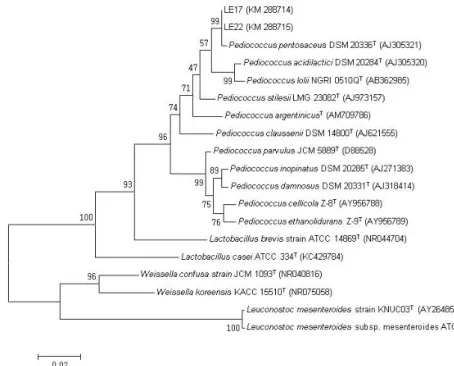
Fig. 1. Phylogenetic tree constructed from comparative analysis of 16S rRNA gene sequences showing the relationships of LE17 and LE22 with other type strains. Bootstrap values (percentage from 1,000 replicates) are indicated at the nodes. The scale bar indicates the nucleotide change per site.
원심 분리하여 상층액을 취했다. 유해균 배양을 위해 Bacillus cereus 배양액 200 µl는 chromogenic polymixin B-methoprim agar (CPMA) (oxoid, UK) plate에, Micrococcus와 Pseudomonas 각 배양액 200 µl는 Nutrient agar plate에, Staphylococcus, Escherichia coli, Enterococcus faecalis, Listeria monocytogenesis 각 배양 액 200 µl는 Luria-Bertani (LB) agar plate에 도말하였다. 6 mm 직경의 멸균 paper disc (Toyo Roshi, Japan)를 도말한 표면에 올 린 뒤 선발 유산균 배양 상층액 20 µl를 각각 분주하여 37℃에서 18시간 배양 후, paper disc 주위의 투명환의 크기를 측정하였다.
유해균 억제 물질이 단백질 구조를 가지는지 확인하기 위해 10 0℃에서 10분간 열처리한 뒤 냉각 후 짧게 원심 분리한 시료와 1,000 units의 proteinase K를 1 ml의 시료에 첨가 후 50℃에서 30분간 처리한 시료를 각각 사용하여 paper disc diffusion assay 를 수행하였다.
균주 동정
생화학적 특성에 따른 동정은 API 50 CHL kit (bioMérieux, France)를 사용하여 제품 manual에 따라 분석했고, 얻어진 결과 들은 on-line bacteria database인 apiwebsoftware (bioMérieux) 를 사용하여 분류균의 생화학적 특성을 비교 계산한 뒤 동정하 였다. 16S rRNA 유전자의 염기 서열에 의한 동정을 위해 universal primer로 27F (5′-AGAGTTTGATCCTGGCTCAG- 3′)와 1492R (5′-GGTTACCTTGTTACGACTT-3′)을 사용하여 16S rRNA 유전자를 증폭하고, 이 PCR산물을 정제한 후 염기 서열을 해독하였다. 이 염기 서열을 이용하여 BLASTN search (Zhang et al., 2000)와 Ribosomal Database Project (version 11)
의 SeqMatch program에서 서열 일치도가 높은 표준 균주의 16S rRNA 유전자 염기서열을 얻었고, 염기 서열간의 상호 비교를 위해 CLUSTAL W (Thompson et al., 1994)를 사용했다. 계통 도 분석은 균주들의 16S rRNA 유전자 염기서열들을 정렬하고 chromatogram의 비교와 수작업으로 gap이 최소화되게 보정한 후 Tamura-Nei model에 기초한 Maximum Likelihood 방법 (Tamura and Nei, 1993)을 사용하여 작성하였다. 산출한 각각의 계통수에서 각 분지에 대한 통계적 신뢰도를 산출하기 위해 bootstrap 분석을 1,000회 실행하였으며, 계통 분석과 bootstrap 분석은 MEGA program (Tamura et al., 2011)을 사용하였다.
결과 및 고찰
선발 균주의 동정
최종 선발한 LE17과 LE22 균주의 집락은 MRS 한천배지에 서 모두 백색의 윤택있는 원형으로 자랐고 집락 크기는 직경 약 1–2 mm였다. RDP (Ribosomal Database Project)의 SeqMatch 프로그램을 통해 두 균의 16S rRNA 유전자 염기 서열과 가장 가까운 표준 균주들을 선정한 뒤 MEGA program에서 계통도를 분석하였다. LE17과 LE22 균주는 P. pentosaceus DSM 20336 과 가장 가까운 근연 관계(Fig. 1)로 16S rRNA 유전자의 염기 서열 상동성은 각각 99.5% (1,408 bp/1,415 bp)와 99.6% (1,414 bp/1,420 bp)였다. LE17과 LE22 균주의 16S rRNA 유전자 내 1,420 bp의 염기 서열을 상호 비교한 결과 3곳에서 차이가 있었 고, 그 중 2곳에서 염기소실(LE22)과 1곳에서 염기 치환(A↔C) 이 발견되었다. API 50 CHL kit에 의한 50 종류의 생화학적 검
Substrate LE17 LE22
Control - -
Glycerol - -
Erythritol - -
D-Arabinose - -
L-Arabinose + +
Ribose + +
D-Xylose - -
L-Xylose - -
Adonitol - -
β-Methyl-D-xyloside - -
Galactose + +
Glucose + +
Fructose + +
Manose + +
Sorbose - -
Rhamnose - -
Dulcitol - -
Inositol - -
Mannitol - -
Sorbitol - -
α-Methyl-D-mannoside - -
α-Methyl-D-glucoside - -
N-Acetyl glucosamine + +
Amygdalin + +
Arbutin + +
Esculin + +
Salicin + +
Cellobiose + +
Maltose + +
Lactose - -
Melibiose + +
Sucrose + +
Trehalose + +
Inulin - -
Melezitose - -
Raffinose + +
Starch - -
Glycogen - -
Xylitol - -
Gentiobiose + +
D-Turanose - -
D-Lyxose - -
D-Tagatose + +
D-Fucose - -
L-Fucose - -
D-Arabitol - -
L-Arabitol - -
Gluconate - -
2-Keto-gluconate - -
5-Keto-gluconate - -
Table 1. The carbohydrate fermentation patterns of the isolated strains, LE17 and LE22, using API 50 CHL strips
Strains Degradation (%)
Histamine Tyramine
Control 0 0
LE 5 10.43 ± 0.05 15.71 ± 0.01
LE 10 -0.86 ± 0.14 15.05 ± 0.23
LE 11 19.03 ± 0.15 17.84 ± 0.12
LE 13 10.74 ± 0.06 16.51 ± 0.08
LE 15 13.76 ± 0.09 8.73 ± 0.20
LE 17 13.71 ± 0.05 25.89 ± 0.08
LE 20 -4.80 ± 0.20 8.81 ± 0.11
LE 22 23.66 ± 0.02 15.64 ± 0.13
‡ Data represent mean±SD of three separate experiments
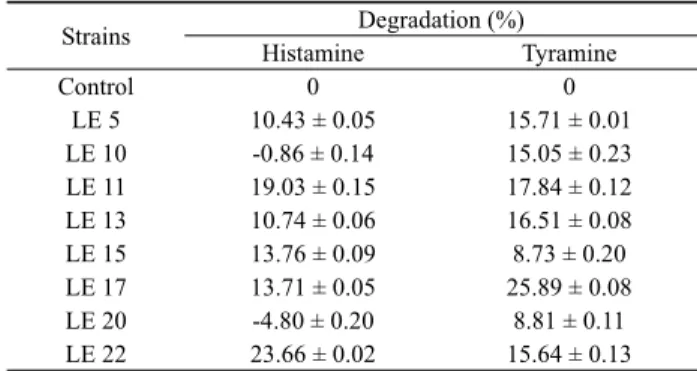
Table 2. Degradation of histamine and tyramine by the biogenic amine-degrading strains after 48 h of culture in minimal synthetic medium supplemented with histamine (0.1%) and tyramine (0.1%)
사 결과는 Table 1에 요약되었으며 각 99.9%와 99.9%의 확률로 P. pentosaceus로 동정되었다. Homofermentative 발효 특성을
가진 P. pentosaceus는 기질로서 pentose인 L-arabinose, D-ribose, D-xylose를 이용할 수 있는 특징을 가졌다(Dobrogosz and DeMoss, 1963). 따라서 생화학 분석과 계통학적 분류를 고려하여 두 균주 를 P. pentosaceus LE17 (GenBank accession no. KM288714) 와 P. pentosauceus LE22 (KM288715)로 각각 명명하였다.
Biogenic amines 저감화 균주의 선발
Amines 저감화를 위한 접종균으로 사용하려면 amine 분해 능력이 생성 능력보다 크면서 GRAS에 포함된 유산균을 선발하는 것이 요구된다. 이를 위해 집락의 증식 동안 염기성 amines 생성 에 의한 pH 변화를 indicator 발색을 통해 확인한 뒤, biogenic amines 함유 최소 배지에서 집락 형성 유무를 확인하는 방식으로 8종의 균주를 분리하였다. 이 선발방법은 정량적이지 않았지만 다수의 장류 시료에서 amines의 생산과 감소 능력을 신속하게 확인하는데 유용하였다. Monoamine인 histamine과 tyramine에 대한 저감 능력을 확인하기 위해 8종의 균주를 대상으로 HPLC 로 정량적인 감소율을 조사하였다. 유일한 질소원으로 0.1%
(w/v) histamine과 0.1% tyramine이 첨가된 최소 합성 배지에서 배양 후 분석한 결과, 각 균주에 따라 histamine과 tyramine의 감소 율에 차이를 보였다(Table 2). 이들 중 LE22 균주의 경우 histamine 은 평균 23.7%, tyramine은 15.7%가 감소한 반면, LE17의 경우 histamine은 13.7%, tyramine은 25.9%가 감소하였다. 선발 균들 에 의한 전체적인 감소율은 histamine에서 10–24%, tyramine에서 8–26% 범위였다. 비교를 위해 동일량의 histamine과 tyramine 을 첨가했지만 균주만 접종하지 않았던 동일 배양 배지에서는 이 들의 감소가 전혀 관찰되지 않아(Table 2), biogenic amines의 분 해가 이들 균주들에 의해서만 일어난다는 것을 확인하였다. 최근 포도주에서 분리한 Lactobacillus plantarum ENOLAB Lb132 균주는 0.004% (w/v) histamine 또는 tyramine이 첨가된 포도주 에서 각각 28.4%, 14.7%의 감소율을 보였고, L. plantarum ENOLAB Lb98 균주에서는 각각 25%, 27.8% 감소되었다 (Callejón et al., 2014). 사용한 배양액과 amine의 농도가 서로 달 라 균들 간 amine 분해 능력을 직접 비교할 수 없었지만, LE17 및 22 균주 또한 Lactobacillus와 같은 amine oxidase 활성이 있을 것으로 예상되었다. 포도주에서 분리했던 L. plantarum J16과
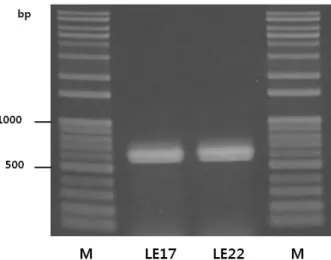
Fig. 2. PCR amplication of the putative multicopper oxidase gene of strains LE17 and LE22. M is a DNA ladder.
Fig. 3. Partial sequence comparison of putative multicopper oxidase gene in strains LE17 and LE22 with that of Pediococcus pentosaceus ATCC 25745 (GenBank accession no. NC 008525: 555105-556634).
Pediococcus acidilactici CECT 5930의 biogenic amines 분해 작 용은 해당 유전자의 발현 결과 laccase의 일종인 multicopper oxidase (MCO)인 것으로 판명되었고, 이들은 histamine, tyramine, putrescine을 분해할 수 있었다(Callejón et al., 2014). 선발 균주
들 중 histamine과 tyramine에 대해 감소율이 높았던 LE17과 LE22 균주를 대상으로 multicopper oxidase 유전자의 존재 유무 를 PCR로 조사하였다. 두 균주 모두 Pediococcus pentosaceus 로 동정되었으므로, 표준 균주인 P. pentosaceus ATCC 25745 의 putative multicopper oxidase 유전자를 기준으로 primers를 설계하고 PCR을 수행하였다. P. pentosaceus ATCC 25745의 putative muicopper oxidase 보존 영역을 CD-Search program (Marchler-Bauer and Bryant, 2004)으로 분석했을 때 3개의 cupredoxin domain을 포함하는 산화 효소임을 보였다. 전기영 동 결과 두 균주 모두 예상 PCR 산물 크기인 591 bp 위치에서 밴드(Fig. 2)가 나타났고, 이들 PCR 산물의 염기 서열은 P.
pentosaceus ATCC 25745 multicopper oxidase 유전자 내 548 bp 염기 서열 영역과 94.3% 상동성(각 517 bp/548 bp)을 나타내 이들 유전자의 발현으로 biogenic amine이 분해될 것으로 예상 되었다(Fig. 3). 그러나 두 균주가 생산하는 biogenic amine 분해 효소가 실제로 이 유전자로부터 발현되는지는 앞으로 기질에 대 한 활성 특성과 반응 속도의 확인을 통해 검증할 필요가 있다.
유해균주 억제 능력
선발 8종 유산균들 중 histamine과 tyramine의 분해 비율이 상대적으로 높았던 LE17 및 LE22 균주를 대상으로 병원성 유해
Pathogenic strains Inhibitor zone‡ (mm)
LE17 LE22
Bacillus cereus KACC 13066 11.52±0.87 10.73±1.03 Pseudomonas aeruginosa KACC 10259 8.37±0.48 8.19±0.13 Micrococcus luteus KACC 11306 10.44±0.23 9.83±0.20 Staphylococcus aureus KACC 10778 14.82±2.65 15.41±1.69 Escherichia coli KACC 13821 7.23±0.66 7.04±0.39 Enterococcus faecalis KACC 11304 10.92±0.55 10.40±0.35 Listeria monocytogenes KACC 10764 10.37±1.02 9.80±0.56
‡ Data represent mean±SD of three replications
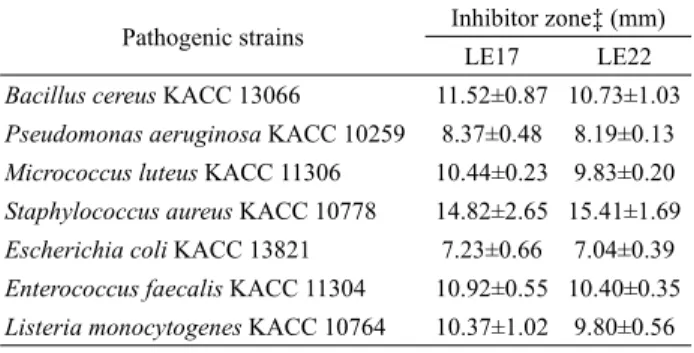
Table 3. Inhibitory spectra of two isolates, LE17 and LE22, exhibiting antibacterial activity
Fig. 4. Antibacterial effect of differently treated culture filtrate of the strain LE17 (upper) and LE22 (lower). (A) Culture supernatant without treatment; (B) filtrate of supernatant with 0.20 ㎛ filters; (C) culture supernatant diluted 2-fold with MRS medium; (D) culture supernatant diluted 4-fold with MRS medium; (E) culture supernatant heated at 100℃ for 10 min; (F) culture supernatant treated with proteinase K (20 U in 20 µl) at 5 0℃ for 30 min. Amount of soaked sample on the paper disc was 20 µl.
균에 대한 항균 효과를 조사했고 그 결과는 Table 3에 요약되어 있다. 두 유산균은 유해 균주 모두에 대해 항균 작용을 가졌고 특 히 Staphylococcus aureus KACC 10778에 대한 증식 저해 능력 이 컸다. 유산균의 항균 능력은 주로 유산에 의한 pH 감소와 bacteriocins 작용 때문이다. 낮은 pH 범위(pH 2–4)에서도 증식 할 수 있는 E. faecalis의 내산 특성(Nakajo et al., 2006)을 고려할
때, 두 균주는 bacteriocins을 생산하여 E. faecalis에 대한 항균 활성을 나타내는 것으로 판단되었다. 항균 물질이 bacteriocins 일 가능성을 확인하기 위해 배양 상층액을 처리한 후 저해를 많 이 받은 Staphylococcus aureus와 Listeria monocytogenes를 대 상으로 paper disc diffusion assay를 수행하였다(Fig. 4). 단계별 희석한 상층액에 의해 생성된 투명환을 비교한 결과 정량적이지 는 않았지만 그 크기가 감소되었고, Staphylococcus의 경우 희석 시료의 투명환 안에 작은 집락들이 관찰되었다. 원심분리만 한 상층액과 이를 0.20 µm filter (Toyo Roshi, Japan)에서 한번 더 여과한 상층액의 투명환 직경에 차이가 없는 점으로 보아, 상층 액 중의 미생물에 의한 투명환 생성 가능성은 배제되었다. 또한 배양 상층액을 100℃에서 열처리 한 시료와 proteinase K를 처 리한 시료 모두 항균 활성에 영향을 주지 않아 항균물질이 단백질 이 아닐 가능성을 시사했다. Pediococcus 속이 내는 bacteriocins의 경우 Class IIa에 속하는 저분자성 peptide로서 pediocin PD-1, AcH/PA-1, SM-1, SA-1 등의 구조가 존재하며, 특히 식품 병원성 미생물로서 Gram(+) 세균인 B. cereus, C. perfringens, Listeria species, S. aureus에 대해 항균 능력을 지닌다(Papagianni and Anastasiadou, 2009). 또한 열저항 peptide로서 121℃의 가열 시
에도 항균 활성을 거의 그대로 유지할 수 있기 때문에 식품의 보 존제로서 잠재적 가능성을 가지고 있다. Kingcha 등(2012)은 P.
pentosaceus의 한 균주가 L. monocytogenes를 효율적으로 감소 시켰으며 이 균주가 생산하는 항균 물질은 pediocin AcH/PA-1 과 같음을 보고하였다. Cytotoxin K, non-hemolytic enterotoxin, hemolysin, cereulide 등의 설사 및 구토독소를 생산하는 B.
cereus는 자연계에 흔할 뿐 아니라 포자형성으로 열에 잘 견디기 때문에, 식품의약품안전처는 식품 안전성 확보를 위해 2007년 부터 모든 장류 제품에서 B. cereus 균의 허용한도를 1 x 10⁴ CFU/g 이하로 고시하였다. 그러나, 위해 요소 중점 관리 제도 (HACCP)가 정착되지 않은 소규모 전통 장류 제조업체 입장에 서는 식품의약품안전처가 정한 B. cereus 균수 상한선을 맞추기 가 어려운 실정이다. Gram(+) 유해균들에 대해 항균 spectrum 이 넓은 이 유산균들을 발효 starter로 사용한다면, 장류의 위생 안전성을 향상하는데 도움을 줄 수 있을 것이다.
장류 발효 균주로서 평가
전통 장류의 숙성 동안 발효 과정은 다수의 미생물들이 관여 하지만 우점을 형성하는 균주들이 장류의 풍미와 식품 안전성 유지에 큰 영향을 준다. 장류 발효에 주요한 미생물 군집은 amylase와 protease의 공급원인 Bacillus 속이지만, 풍미와 부패 방지에 함께 역할을 하는 것은 효모와 유산균이다. 오랫동안 소 시지, 포도주, 피클, 치즈 등 유럽의 발효식품에 유산균으로 사용 되어온 Pediococcus 속은 균주 안전성이 확립되어 있을 뿐 아니 라 probiotic 으로서 잠재된 능력을 평가 받고 있다(Shukla and Goyal, 2014). Biogenic amines을 감소시키고 동시에 병원균에 대해 증식 억제 능을 가진 P. pentosaceus를 같은 특성을 지닌 Bacillus 속과 함께 숙성을 진행한다면 식품안전성을 높이는데 효과적일 것이다. 또한 장류 환경인 10–12% 염 농도와 pH 4.2–
8.2의 범위에서 잘 증식하는 P. pentosaceus의 일반적 배양 특성 (Tanasupawat et al., 1993)을 고려할 때, 장류 종균(starter)으로 써 이 균주들은 적합하게 사용될 수 있다. 현재 식품의약품안전 처가 제정한 식품 첨가물 규격(http://fse.foodnara.go.kr/origin/
search_data_list.jsp)에 따르면 Pediococcus 속들 중 P. pentosaceus, P. acidilactici, P. halophilus 만이 GRAS 균주로 인정받고 있다.
전통 장류의 biogenic amines 저감화는 위생적인 면에서 중요 한 과제이다. 장류 발효과정은 Bacillus, Aspergillus, 효모, 유산 균들 간의 상호 길항적 증식 관계를 유지하며 그에 따른 미생물 의 대사 과정이 서로 복합적으로 얽혀있다. 따라서 biogenic amines의 저감화는 유산균뿐 아니라 장류 발효의 주요 미생물인 Bacillus, Aspergillus, 효모들도 함께 고려해야 한다. 이를 위해 우리는 장류 주요 세균으로서 biogenic amines이 저감화된 B.
subtilis, B. licheniformis, B. amyloliquefaciens 균주들을 선발해 왔다(Kim et al., 2012a, 2012b). 앞으로 amine 생성이 저감화된 Aspergillus와 효모균주들을 선발한 뒤 이들 균주들을 이용하여 복합 발효를 하는 경우, biogenic amine이 감소된 전통 장류를 얻 을 수 있을 것으로 예상한다. 현재 이 유산균들을 산업용 Bacillus 균주들과 혼합 배양하여 발효 적절성을 검증할 예정이다.
적 요
장류 식품에서 biogenic amines 저감 기능과 유해균 저해 능 력을 동시에 지닌 유산균을 선발하기 위해, 전통방식으로 제조 한 장류 시료로부터 2종의 균주를 분리하였다. 생화학적 동정 및 16S rRNA 유전자 염기 서열을 분석 결과 이들 균은 유산균인 Pediococcus pentosaceus로 동정되었다. 질소원으로 0.1% (w/v) histamine과 0.1% tyramine이 첨가된 최소 합성 배지에서 30℃, 48시간 배양 후 잔류 amine을 분석한 결과, LE22 균주의 경우 histamine은 23.7%, tyramine은 15.7%가 감소한 반면, LE17의 경우 histamine은 13.7%, tyramine은 25.9%가 감소하였다. 장류 에서 발견되는 주요 유해균에 대한 항균 효과를 조사한 결과, 두 균주 모두 유해균들애 대해 항균 작용을 보였다. 두 균주의 발효 특성을 고려했을 때 이들은 유산균 종균으로써 산업적 장류 생 산에 적용할 수 있을 것으로 보인다.
감사의 말
본 연구는 2014년 농림수산식품부 고부가가치 식품개발사업 (과제번호 311036-3)에 의해 수행되었습니다.
References
BIAMFOOD. 2008. Controlling biogenic amines in traditional food fermentations in regional Europe (Project Reference no. 211441), EU’s 7th Framework Program for Research, EU.
Bover-Cid, S. and Holzapfel, W.H. 1999. Improved screening procedure for biogenic amine production by lactic acid bacteria. Int. J. Food Microbiol. 53, 33–41.
Callejón, S., Sendra, R., Ferrer, S., and Pardo, I. 2014. Identification of a novel enzymatic activity from lactic acid bacteria able to degrade biogenic amines in wine. Appl. Microbiol. Biotechnol. 98, 185–198.
Capozzi, V., Russo, P., Ladero, V., Fernández, M., Fiocco, D., Alvarez, M.A., Grieco, F., and Spano, G. 2012. Biogenic amines degradation by Lactobacillus plantarum: toward a potential application in wine.
Front. Microbiol. 3, 122.
Cho, T.Y., Han, G.H., Bahn, K.N., Son, Y.W., Jang, M.R., Lee, C.H., Kim, S.H., Kim, D.B., and Kim, S.B. 2006. Evaluation of biogenic amines in Korean commercial fermented foods. Korean J. Food Sci.
Technol. 38, 730–737.
Coton, M., Romano, A., Spano, G., Ziegler, K., Vetrana, C., Desmarais, C., Lonvaud-Funel, A., Lucas, P., and Coton, E. 2010. Occurrence of biogenic amine-forming lactic acid bacteria in wine and cider.
Food Microbiol. 27, 1078–1085.
Dobrogosz, W.J. and DeMoss, R.D. 1963. Pentose utilization by Pediococcus pentosaceus. J. Bacteriol. 85, 1356–1364.
FAO/WHO (Food and Agriculture Organization of the United Nations/
World Health Organization). 2013. Public health risks of histamine and other biogenic amines from fish and fishery products. Meeting Report. Rome, Italy.
Jeong, D.W., Kim, H.R., Jung, G., Han, S., Kim, C.T., and Lee, J.H. 2014.
Bacterial community migration in the ripening of doenjang, a traditional Korean fermented soybean food. J. Microbiol.
Biotechnol. 24, 648–660.
Karovičová, J. and Kohajdová, Z. 2005. Biogenic amines in food. Chem.
Pap. 59, 70–79.
Kim, Y.S., Cho, S.H., Jeong, D.Y., and Uhm, T.B. 2012a. Isolation of biogenic amines-degrading strains of Bacillus subtilis and Bacillus amyloliquefaciens from traditionally fermented soybean products.
Kor. J. Microbiol. 48, 220–224.
Kim, Y.S., Jeong, D.Y., Hwang, Y.T., and Uhm, T.B. 2011a. Bacterial community profiling during the manufacturing process of traditional soybean paste by pyrosequencing method. Kor. J.
Microbiol. 47, 275–280.
Kim, Y.S., Jeong, J.H., Cho, S.H., Jeong, D.Y., and Uhm, T.B. 2012b.
Antimicrobial and biogenic amine-degrading activity of Bacillus licheniformins SCK B11 isolated from traditionally fermented red pepper paste. Kor. J. Microbiol. 48, 163–170.
Kim, Y.S., Kim, M.C., Kwon, S.W., Kim, S.J., Park, I.C., Ka, J.O., and Weon, H.Y. 2011b. Analyses of bacterial communities in meju, a Korean traditional fermented soybean bricks, by cultivation-based and pyrosequencing methods. J. Microbiol. 49, 340–348.
Kingcha, Y., Tosukhowong, A., Zendo, T., Roytrakul, S., Luxananil, P., Chareonpornsook, K., Valyasevi, R., Sonomoto, K., and Visessanguan, W. 2012. Anti-listeria activity of Pediococcus pentosaceus BCC 3772 and application as starter culture for Nham, a traditional fermented pork sausage. Food Control. 25, 190–196.
Marchler-Bauer, A. and Bryant, S.H. 2004. CD-Search: protein domain annotations on the fly. Nucleic Acids Res. 32, W327–W331.
Nakajo, K., Komori, R., Ishikawa, S., Ueno, T., Suzuki, Y., Iwami, Y., and Takahashi, N. 2006. Resistance to acidic and alkaline environments in the endodontic pathogen Enterococcus faecalis.
Oral Microbiol. Immunol. 21, 283–288.
Papagianni, M. and Anastasiadou, S. 2009. Pediocins: The bacteriocins of Pediococci. Sources, production, properties and applications.
Microb. Cell Fact. 8, 3.
PSJ (The pharmaceutical society of Japan). 2005. Methods of analysis in health science, pp. 180–182. Kanehara & Co. Ltd., Tokyo, Japan.
Shukla, R. and Goyal, A. 2014. Probiotic potential of Pediococcus pentosaceus CRAG3: a new isolate from fermented cucumber.
Probiotics Antimicrob. Proteins 6, 11–21.
Sievers, F., Wilm, A., Dineen, D., Gibson, T.J., Karplus, K., Li, W., and Higgins, D.G. 2011. Fast, scalable generation of high‐quality protein multiple sequence alignments using Clustal Omega. Mol. Syst. Biol.
7, 539.
Smělá, D., Pechová, P., Komprdá, T., Klejdus, B., and Kubáň, V. 2003.
Liquid chromatographic determination of biogenic amines in a meat product during fermentation and long-term storage. Czech J. Food Sci. 21, 167–175.
Tamura, K. and Nei, M. 1993. Estimation of the number of nucleotide substitutions in the control region of mitochondrial DNA in humans and chimpanzees. Mol. Biol. Evol. 10, 512–526.
Tamura, K., Peterson, D., Peterson, N., Stecher, G., Nei, M., and Kumar, S. 2011. MEGA5: Molecular evolutionary genetics analysis using Maximum Likelihood, Evolutionary Distance, and Maximum Parsimony methods. Mol. Biol. Evol. 28, 2731–2739.
Tanasupawat, S., Okada, S., Kozaki, M., and Komagata, K. 1993.
Characterization of Pediococcus pentosaceus and Pediococcus acidilactici strains and replacement of the type strain of P.
acidilactici with the proposed neotype DSM 20284 request for an opinion. Int. J. Syst. Bacteriol. 43, 860–863.
Thompson, J.D., Higgins, D.G., and Gibson, T.J. 1994. CLUSTAL W:
Improving the sensitivity of progressive multiple sequence alignment through sequence weighting, position-specific gap penalties and weight matrix choice. Nucleic Acids Res. 22, 4673–
4680.
Warthesen, J., Scanlan, R., Bills, D., and Libbey, L. 1975. Formation of heterocyclic N-nitrosamines from the reaction of nitrite and selected primary diamines and amino acids. J. Agric. Food chem. 23, 898–
902.
Zhang, Z., Schwarz, S., Wagner, L., and Miller, W. 2000. A greedy algorithm for aligning DNA sequences. J. Comput. Biol. 7, 203–214.