전통고추장에서 유해균 억제 및 Biogenic Amines 분해 능력을 가지는 Bacillus licheniformis SCK B11의 분리
김용상1․정진오1․조성호2․정도연2․엄태붕1,3*
1전북대학교 자연과학대학 생명과학과
2순창발효미생물관리센터
3전북대학교 방사선기술연구소
Antimicrobial and Biogenic Amine-Degrading Activity of Bacillus licheniformis SCK B11 Isolated from
Traditionally Fermented Red Pepper Paste
Yong Sang Kim1, Jin Oh Jeong1, Sung Ho Cho2, Do Yeon Jeong2, and Tai-Boong Uhm1,3*
1Department of Biological Sciences, Chonbuk National University, Jeonju 561-756, Republic of Korea
2Sunchang Research Center for Fermentation Microbes (SRCM), Sunchang 595-804, Republic of Korea
3Institute for Radiation Technology, Chonbuk National University, Jeonju 561-756, Republic of Korea
(Received June 5, 2012 / Accepted June 27, 2012)
In order to inhibit the growth of pathogens and degrade biogenic amines during the fermentation of soybean products, an isolate with antimicrobial activity against pathogens and biogenic amine-degrading property was obtained from 83 traditionally fermented soybean products. The morphological and biochemical tests and the phylogenetic relationship among 16S rRNA gene sequences indicated that the isolate named as the strain SCK B11 was most closely related to Bacillus licheniformis. The cell-free supernatant of two day cultures was active against several pathogens including Enterococcus faecalis, Listeria monocytosis, Micrococcus luteus, Pseudomonas aeruginosa, Bacillus cereus, and Staphylococcus aureus. PCR analysis was conducted to determine relatedness to antimicrobial lantibiotics and biosurfactants produced by Bacillus spp., but showed negative for the genes encoding surfactin, lichenysin, and lichenicidine. Electron microscopic observation indicated that the antimicrobial agent seemed to attack the membrane of the pathogens, leaving the ghost or shrunken cells. The strain was found to degrade histamine by 72% and tyramine by 66% in the cooked soybean containing 5.3% of biogenic amine over 10 days of fermentation time. The use of selected strain would be a potential control measure in manufacturing traditionally fermented soybean products that are difficult to control pathogens and biogenic amine levels.
Keywords: Bacillus licheniformis, antimicrobial property, biogenic amines, fermentation, red bean paste
*For correspondence. E-mail: [email protected]; Tel.: +82-63-270- 3439; Fax: +82-63-270-3362
장류는 한국인의 식탁에 필수적인 부식이기 때문에 식품으로 서 안전성 확보는 무엇보다도 중요한 과제이다. 장류의 발효과 정에서 식품안전을 좌우하는 3가지 주요인자는 Bacillus cereus 와 같은 유해 미생물, Aspergillus flavus 등이 생산하는 aflatoxin, 발효 미생물들에 의해 생산되는 biogenic amine으로 요약될 수 있다(Ten et al., 1990; Shalaby, 1996).
전통 방식에 의해 제조하는 장류는 필연적으로 자연 환경에 노 출되는 상태로 발효가 이루어지기 때문에 토양이나 대기의 유해
미생물들에 의해 발효나 숙성과정 동안 독소들을 생성할 가능성 이 높다. 세균으로서 Bacillus subgroup 1에 속하는 B. mycoides, B.
thuringiensis, B. anthracis, B. cereus는 유해균으로 알려져 있고 특히 B. cereus는 haemolysin BL (HBL), non- hemolytic enterotoxin (NHE), cytotoxin K (cytK)와 같은 설사나 장염을 일으키는 단백 질 독소, 구토를 일으키는 펩티드 형태의 cereulide, anthrax와 유 사한 호흡 질환을 유발하는 certhrax를 생산할 수 있다. 이들 독소 들은 균주 또는 환경에 따라 그 종류나 생산량이 다르다는 것이 보고되고 있다(Granum and Lund, 1997; Birgit et al., 1999;
Guinebretiere et al., 2002; Lindback et al., 2004; Altayar and Suthurland, 2005; Apetroaie et al., 2005; Schoeni and Wong, 2005; Ouhib et al., 2006; Ngamwongsatit et al., 2008).
Primer pair Sequence Target sequence
(GenBank accession no) Size (bp) nheAF
nheAR
ATATGCGCAAAATGTAATTGCTCCA
TGCCTTCTTCAACATTTGTTTGAATTT Non-hemolytic enterotoxin, nheA (AY835995) 935 nheBF
nheBR
ACTTATGGCAGTATTTGCAGCAGGA
TGCAACGCTGTAATTGCAGTATCAA Non-hemolytic enterotoxin, nheB (AY835995) 972 nheCF
nheCR
GACCAGCAGGATTCCCAGATGTAAT
CCACGCCTTCATGTAATTTTTCTGT Non-hemolytic enterotoxin, nheC (AY835995) 930 hblAF
hblAR
ACCAGTAGCGACTTTTGCAAGTGAA
TTTTGAGCTGCATTCTCAATATGCC Hemolytic enterotoxin, hblA (AY822584) 909 hblCF
hblCR ATCAATACTCTCGCAACACCAATCG
ATGTGCTCGTTGCTCTGCTGTTAAT Hemolytic enterotoxin, hblC (AY822584) 957 hblDF
hblDR
GACTGAAGACAGCATTGGCTCAAAC
CGATGTCTTTCGAAATGAATTCTGC Hemolytic enterotoxin, hblD (AY822584) 1,059 cytKF
cytKR
CCGCTGTTTTTGCTAGTAGTGCTGT ACGTCTTTTACGTTGTTTCCAACCC
Cytotoxin K, cytK (DQ019311) 901
plcRF plcRR
CRGGYGCRGTATACCCAAGT
TGAAATACCCCATGYCATYG Phospholipase C regulatory protein, plcRpapR (DQ153391) 888 cesAF
cesAR
GTTGGCGTGTTATGTGATCG
GGTGAAACAGCTTCTCCTGC Cereulide synthetase A, cesA (AB248763) 662 ctxF
ctxR
TGCTAAAGGAGGGAAGGAACCGT
AGCCCCATGTACCCCTTCTGGA Certrax, ctx (AAEK01000004) 1,000
lchAF lchAR
ACGGCCGATCAGGAGCTTTC
TCTCAGCGCCTTCGATCTGC Lichenysin synthetase, lchAA (AJ005061) 557
lchBF lchBR
TTTGACCCGGAGCTCGTTGA
CTGAGGGCGGAAAGCAGGAT Lichenysin synthetase, lchAB (AJ005061) 706
lchCF lchCR
CATGTATACGGGCCGACGGA
CTGAAGGCCGGAGATGGCTT Lichenysin synthetase, lchAC (AJ005061) 1,173 lanM1F
lanM1R
TCGCTGACCACCGAGGAAAA
CGCTTTCTGCATGGTCCCAG Lantibiotic modification enzyme1, licM1 (NC006270) 571 lanM2F
lanM2R
CGACAGCGCACTACGCCTCT
TCCCGCATGCTGCAGAAAAT Lantibiotic modification enzyme2, licM2 (NC006270) 776 srfAF
srfAR
CGGTGTGTCATGGCGGATTT
TCGAAAGCGGACGGTTCAAA Surfactin synthetase A, srfAA (NC000964) 1,025 srfBF
srfBR
CGGTGTGTCATGGCGGATTT
TCGAAAGCGGACGGTTCAAA Surfactin synthetase AB, srfAB (NC000964) 696 srfCF
srfCR
TTCACTGTCGGAGGCGGAAA
ACCGGCAGATAGGCTGCTCC Surfactin synthetase AC, srfAC (NC000964) 933 Table 1. The PCR primers used in this study
최근 미생물 생태의 표준 도구로 이용되고 있는 pyrosequencing 방법을 사용하여 메주 및 된장 제조 중 미생물 군집 구조를 확인 한 연구(Kim et al., 2011)에 따르면 제조 과정에서 Bacillus cereus 외에도 일부 감염성 유해 세균들이 오염되는 것으로 나타 났다.
Biogenic amine은 미생물의 amino acid decarboxylase 작용 에 의해 아미노산으로부터 형성되며 세균에서는 Acromonas, Bacillus, Citrobacter, Clostridium, Escherichia, Klebsiela, Lactobacillus, Pediococcus, Proteus, Pseudomonas 속 등이 amino acid decarboxylase를 가지는 것으로 알려져 있다 (Kawabata et al., 1956; Havelka, 1967; Ferencik, 1970; Lerke et al., 1978; Omura et al., 1978; Taylor et al., 1979; Taylor and Speckhard, 1983). 이들 중 인체의 분해 한도를 넘어서는 histamine
과 tyramine을 식품에서 섭취하는 경우에는 심한 혈압의 변화, 알레르기, 두통과 같은 증상이 나타난다. 단백질 함량이 높은 콩 과 proteases 활성이 높은 Bacillus와 Aspergillus 속에 의한 발 효, 미혐기적 환경과 적당한 발효 온도를 고려할 때 장류는 biogenic amines을 생산하기 적당한 환경이라 할 수 있다. 2006 년 국내 유통 발효 식품 중에 biogenic amines 분포를 조사한 결 과에 따르면 한국인의 주 부식인 전통 된장에서 putrescine은 99.6–1453.7(평균 462.6) mg/kg, histamine은 260.1–952(평균 569.4) mg/kg, tyramine은 284.7–1430.7(평균 669.5) mg/kg으 로 한국인들이 주로 섭취하는 34종의 식품가운데 평균적으로 가 장 높았으며, 다음으로 멸치 젓갈, 시판 간장, 전통 간장, 현대식 된장 순이었다. 이 결과는 biogenic amime 함량이 가장 높은 식 품 7종 중 4종이 장류라는 점과 한국인의 음식 섭취 특성 상 젓
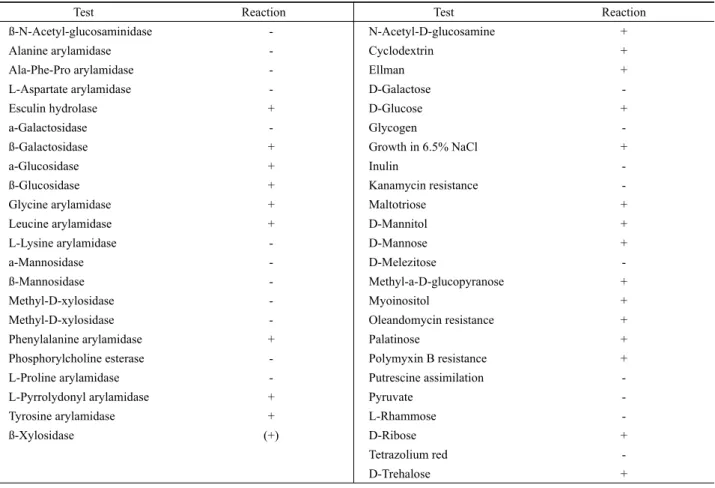
Test Reaction Test Reaction
ß-N-Acetyl-glucosaminidase - N-Acetyl-D-glucosamine +
Alanine arylamidase - Cyclodextrin +
Ala-Phe-Pro arylamidase - Ellman +
L-Aspartate arylamidase - D-Galactose -
Esculin hydrolase + D-Glucose +
a-Galactosidase - Glycogen -
ß-Galactosidase + Growth in 6.5% NaCl +
a-Glucosidase + Inulin -
ß-Glucosidase + Kanamycin resistance -
Glycine arylamidase + Maltotriose +
Leucine arylamidase + D-Mannitol +
L-Lysine arylamidase - D-Mannose +
a-Mannosidase - D-Melezitose -
ß-Mannosidase - Methyl-a-D-glucopyranose +
Methyl-D-xylosidase - Myoinositol +
Methyl-D-xylosidase - Oleandomycin resistance +
Phenylalanine arylamidase + Palatinose +
Phosphorylcholine esterase - Polymyxin B resistance +
L-Proline arylamidase - Putrescine assimilation -
L-Pyrrolydonyl arylamidase + Pyruvate -
Tyrosine arylamidase + L-Rhammose -
ß-Xylosidase (+) D-Ribose +
Tetrazolium red -
D-Trehalose +
Table 2. Biochemical characterization for the identification of the strain SCK B11
갈보다 장류가 많다는 것을 고려하면, 장류는 식품 섭취 시 biogenic amines의 주 공급원으로 건강에 위해를 줄 수 있는 수 준임을 보여주었다(Cho et al., 2006).
앞으로 전통 장류의 지향점은 전통적인 장류의 맛과 풍미는 유지하되 발효 미생물 제어를 통한 식품 위생상의 안전성을 동 시에 확보할 수 있어야 한다. 이를 위해 발효 동안 유해 균주들의 증식을 억제하며, biogenic amines을 생산하지 않고 동시에 분해 도 가능한 발효 균주의 선발은 필수적이다. 이의 해결을 위해 본 연구는 전통 장류에서 유해균의 증식을 억제하고 동시에 biogenic amines 분해 능력을 가지는 균주를 분리하는데 그 목표를 두었다.
재료 및 방법
균주 선발 및 배양
전통 방법에 따라 제조한 83종의 된장 고추장, 청국장들을 구입 후 5 g을 취해 0.3 mM 인산 완충액(pH 7.2)으로 희석하였다. Nutrient Agar (NA)와 B. cereus 선택 배지[chromogenic polymyxin B-methoprim agar (CPMA)] 표면에 희석된 균액을 각각 200 μl 씩 도포하고 30℃에서 24시간 배양 후, NA에서 자란 집락수에 비해 CPMA에서 자란 집락수의 비율이 낮았던 장류들을 선발하 였다. NA에서 배양한 이 선발 장류의 집락들을 toothpick으로 찍어 미리 만들어둔 NA와 CPMA 배지의 같은 위치에 각각 접
종하여 24시간 후 CPMA에 자라지 않은 균들 만을 수집하였다.
수집한 균들을 대상으로 PCR에 의해 B. cereus 독소 유전자 유 무를 검사한 뒤, 선발한 균들을 nutrient broth (NB)에 37℃, 78 시간 배양하고 1,000 rpm에서 3분간 원심분리 후 상층액만을 모 아 -20℃에 보관하였다.
표준 균주인 B. cereus KACC 11240 (ATCC 14579)과 본 실 험실에서 분리한 B. cereus JBE 0001 (GenBank accession no.
FJ 982655), JBE 0002 (FJ 982656), JBE 0004 (FJ 982654), JBE 0005 (FJ 982657), JBE 0006 (FJ 982658)을 NB에서 37℃, 21시간 배양 후 100 μl를 각 NA 표면에 골고루 spreading하고 배지 중앙에 4 mm paper disc (3M)를 올려놓았다. 냉동 보관했 던 원심분리 상층액을 녹여 paper disc 중앙에 20 μl를 분주하고 21시간 37℃로 배양 뒤 투명환 크기를 측정하여 6종의 B. cereus 모두에 대해 길항 능력을 가진 종들을 분리하였다.
B. cereus, B. licheniformis, B. subtilis, Escherichia coli, Micrococcus luteus, Pseudomonas aeruginosa, Staphylococcus aureus 배양 배지는 NB, B. cereus 검출 배지는 CPMA, Lactobacillus brevis, Enterococcus faecalis, Listeria monocytogenes 배양은 각각 Lactobacilli MRS broth (MRS), trypticase soy broth (TSB), Listeria Oxford broth (LOB), Aspergillus flavus, A.
fumigatus, A. ochraceus, A. parasiticus는 potato dextrose broth (PDB), Candida albicans는 yeast extract broth (YEB)를 사용하
Test strain Antimicrobial
Activitya Culture conditionb, c
Aspergillus ochraceus KACC 41859 + PDA, 30℃
Aspergillus fumigatus KACC 41186 + PDA, 30℃
Aspergillus flavus KACC 41403 + PDA, 30℃
Aspergillus parasiticus KACC 40074 + PDA, 30℃
Bacillus cereus KACC 10004(ATCC 27348) ++ NA, 37℃
Bacillus cereus KACC 10097(ATCC 11778) +++ NA, 37℃
Bacillus cereus KACC 11240(ATCC 14579) ++ NA, 37℃
Bacillus cereus KACC 13752 +++ NA, 37℃
Bacillus cereus KACC 13764 ++ NA, 37℃
Bacillus cereus KACC 13766 +++ NA, 37℃
Bacillus licheniformis KACC 121034 - NA, 37℃
Bacillus licheniformis KACC 121035 - NA, 37℃
Bacillus subtilis KCTC 10112 - NA, 37℃
Bacillus subtilis KCTC 1023 - NA, 37℃
Candida albicans KACC 30062 - YEA, 30℃
Enterococcus faecalis KACC 11304 +++ TSA, 37℃
Escherichia coli KACC 13821 + NA, 37℃
Lactobacillus brevis KACC 11433 - MRS, 28℃
Listeria monocytogenes KACC 10764 + LOA, 37℃
Micrococcus luteus KACC 13377 +++ NA, 37℃
Pseudomonas aeruginosa KACC 10259 +++ NA, 37℃
Staphylococcus aureus KACC 10778 ++ NA, 37℃
Staphylococcus aureus KCTC 1621 + NA, 37℃
Staphylococcus aureus KCTC 1916 ++ NA, 37℃
Staphylococcus aureus KCTC 1927 +++ NA, 37℃
Staphylococcus aureus KCTC 3881 + NA, 37℃
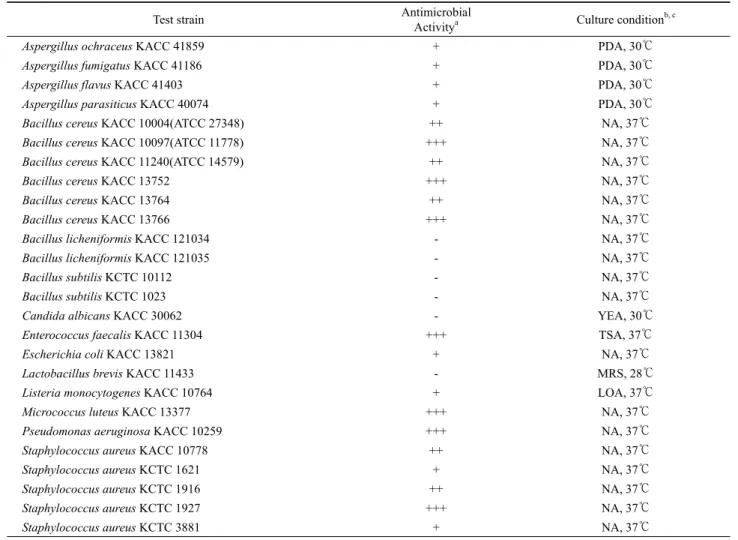
a +++, halo size >10 mm; ++, 7–9 mm; +, 5–6 mm; -, not detected.
b PDA, Potato dextrose agar; NA, Nutrient agar; YEA, Yeast extract agar; TSA, Trypticase soy agar; MRS, Lactobacilli MRS agar; LOA, Listeria Oxford agar
c The bacteria and fungi were grown on agar plates for 18–21 h and 4 days, respectively.
Table 3. Antimicrobial activities of the strain SCK B11 against bacteria and fungi
였다. 사용한 장류 유해 균주(Table 3)들은 생명자원센터(KCTC) 와 한국농업미생물자원센터(KACC)로부터 분양을 받았다. 배 양온도로 A. ochraceus는 25℃, L. brivis 28℃, Aspergillus 및 C. albicans는 30℃, 나머지 균들은 37℃에서 배양하였고 이들 균주 증식에 대한 SCK B11균의 길항력은 각 균의 최적 온도에 서 배양한 뒤 4 mm paper disc 주변의 투명환 직경으로 비교하 였다.
균주 동정
생화학적 동정을 위해 균을 새로운 NA 배지에 접종하고 37℃
에서 18시간 배양하였다. 형성된 집락은 NA 배양액에 희석 후 46종 건조 배지 및 생화학 반응물로 구성된 BCL ID card (bioMérieux Vitek Inc., USA)에 주입하였고, 15분 간격으로 결 과들이 VITEK 2 Compact software (bioMérieux Vitek)에 통합 적으로 저장 분석된 뒤 14시간 후 동정이 완료되었다.
16S rRNA 유전자의 염기서열에 의한 균 동정을 위해 universal primer로서 27F (5′-AGAGTTTGATCCTGGCTCAG-3′)와 1,492R
(5′-GGTTACCTTGTTACGACTT-3′)을 이용, 16S rRNA 유전 자를 PCR로 증폭 후, 동정에 중요한 가변 염기 영역을 포함하는 1,443 bp를 BigDye Terminator v3.1 Cycle Sequencing kit (Applied Biosystems Inc., USA)를 사용하여 해독하였다 (Chakravorty et al., 2007). 이 염기 서열은 NCBI database로부 터 BLASTN program (Zhang et al., 2000)과 Ribosomal Database Project (RDP)의 Seqmatch program (version 3)을 사 용하여 표준 균주들의 16S rRNA 유전자 염기서열들을 얻은 다 음 염기 서열들 간의 상호 비교를 위해 CLUSTALW 프로그램 (Thompson et al., 1994)을 사용하였다. 계통도 분석은 균주들의 16S rRNA 유전자 염기서열들을 정렬하고 시각적 관찰과 수작 업으로 gap이 최소화되도록 보정한 후 Kimura’s two-parameter method (Kimura, 1980)와 maximum parsimony method (Fitch, 1971)를 사용하여 작성하였다. 산출한 각각의 계통수에서 각 분 지에 대한 통계학적 신뢰도를 산출하기 위해 Bootstrap 분석을 1,000회 실행하였으며 계통 분석과 bootstrap 분석은 PAUP (version 4.0b)을 사용하였다(Swofford, 1998).
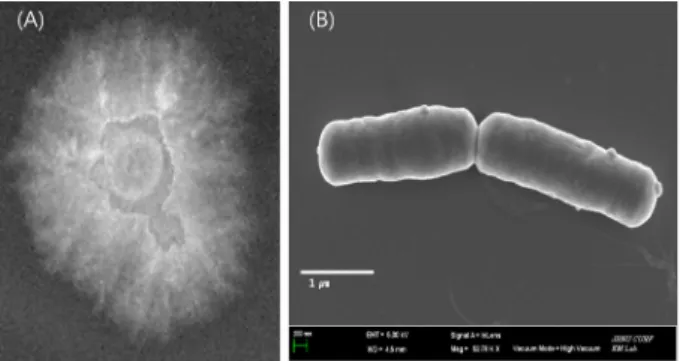
Fig. 1. (A) Colony morphology and (B) field emission scanning electron micrograph of the strain SCK B11. Bar, 1 μm.
PCR
SCK B11이 B. cereus의 설사 독소 유전자(nheABC, hblACD, cytK), 구토 독소 cereulide 합성 효소 유전자(cesA 및 cesB), 설 사독소 발현 전사조절 유전자 plcR-papR, 호흡독소인 certhrax 를 갖는가 확인하기 위하여 PCR을 실시하였다. 이들 독소 검출 용 primer 서열들은 Table 1과 같으며, PCR 조건은 94℃에서 2 분간 초기 변성 후, 94℃ 1분간 변성, 56℃ 1분간 결합, 72℃ 1분 간 증폭 과정을 30회 반복하고 72℃에서 5분간 마지막 증폭을 실시하였다. 항균물질 유전자 유무를 확인하기 위해 B.
licheniformis의 lichenysin 합성 효소 유전자인 lchAA, lchAB, lchAC와 lantibiotic 수식 효소 유전자인 licM1, licM2, B.
subtilis의 surfactin 합성효소 유전자 srfAA, srfAB, srfAC를 선택 하여 PCR을 수행하였다. Primer 서열들은 Table 1과 같고, PCR 조건은 94℃에서 2분간 초기 변성 후, 94℃ 1분간 변성, 56℃ 1 분간 결합, 72℃ 1분간 증폭과정을 30회 반복하고 72℃에서 5분 간 마지막 증폭을 실시하였다.
전자현미경 관찰
37℃에서 21시간 배양한 B. cereus KACC 11240 (ATCC 14579) 배양액 1 ml에 동일 조건에서 배양한 SCK B11 배양액 을 직경 0.2 µm filter (Satorius, Germany)로 여과한 여과액 2 ml 을 넣고 37℃에서 8시간 더 배양시켰다. 배양액을 1,000 rpm에 서 3분간 원심 분리 후 상등액을 제거하고 0.9% NaCl로 2번 pellet을 세척한 뒤 2.5% glutaraldehyde 1차 고정, 1% osmium tetroxide 2차 고정, ethanol 탈수과정을 거쳤다. 100% ethanol에 탈수된 균을 cover glass 위에 떨어뜨린 뒤 80℃에서 12시간 건 조시키고, ion sputter로 20분간 osmium을 코팅시켜 전계방사형 주사전자현미경(SUPRA 40VP, Carl Zeiss, Germany)에서 관찰 하였다.
Biogenic amine의 검출
선발 균주 SCK B11의 biogenic amines 분해 능력을 관찰하 기 위해 HPLC를 수행하였다. 증기 멸균한 삶은 콩가루 0.3 g에 각각 16 mg의 histamine과 tyramine을 녹인 0.8 ml NB 배지를 첨가하고 SCK B11 배양액 0.2 ml를 접종하였다. 대조군은 histamine과 tyramine이 없는 NB를 대신 첨가하였다. 47℃에서 시간 별로 배양 한 후 10,000×g에서 10분간 원심 분리하여 얻은 0.1 ml 상층액과 80 μl 아세톤 용해 1% dansyl chloride, 50 μl 포 화 Na2 CO3, 50 μl 내부 표준 용액을 섞어 45℃에서 1시간 유도 체화 시켰다. 유도체화한 시료용액에 50 μl 10% proline을 넣어 여분의 dansyl chloride를 제거한 뒤 0.5 ml ether를 넣고 3분 후 분리된 상층액만을 모아 증발 후 0.1 ml acetonitrile에 녹였다.
HPLC 분석으로 역상컬럼은 C18 (Capcell pak, 4.6 mm×150 mm, 5 μm), 이동상은 H2O에 녹인 0.1% formic acid (A)와 acetonitrile에 녹인 0.1% formic acid (B), 농도 경사는 0–10분, A:B=45:55; 11–15분, A:B=35:65; 16–25분, A:B=20:80; 26–30 분, A:B=10:90, 30분 유속은 1 ml/min이었으며 10 μl 시료를 주 입하였다.
결과 및 고찰
SCK B11의 동정 및 특성
전통 장류 발효에 적용할 우수 균주를 얻기 위하여 장류 시료 들에서 6종의 B. cereus 증식 억제능이 강했던 균들을 대상으로 1차 분리하였고, 2차로 이들 중 protease, amylase의 활성이 높 았던 SCK B11 (GenBank accession no. JX237847)를 선발하였 다. SCK B11는 NA에서 배양 시 백색의 집락 주위로 반투명의 광택 환을 형성하였다(Fig. 1A). 균은 1,500× 배율의 광학 현미 경하에서 관찰하였을 때 움직임이 매우 활발했고 그람 염색에서 양성을 나타냈다. 50,000× 배율로 확대한 주사전자현미경으로 관찰 결과 균의 형태는 전형적인 간균으로 0.8–0.9 μm × 2.0–3.0 μm의 크기를 보였다(Fig. 1B). BCL card를 이용하여 46종류의 생화학적 검사 결과를 Vitec 2 Compact Software에서 분석한 결 과 96%의 확률로 B. licheniformis로 분류되었다(Table 2), RDP 에 등록된 모든 Bacillus 표준 균주들만을 사용하여 계통도를 분 석한 결과 SCK B11은 B. licheniformis ATCC 14589과 가장 가 까운 근연 관계로 16S rDNA 유전자 서열 상동성은 99.93%
(1,399 bp/1,400 bp)를 보였다. 따라서 생화학 분석과 계통학적 분류를 고려하여 SCK B11을 B. licheniformis로 동정하였다.
SCK B11 균주가 독소 유전자를 함유하는지 확인하기 위해 B.
cereus 독소들인 NheABC, HblACD, CytK, cereulide, certhrax 와 단백질 독소 발현조절인자인 plcR-papR의 유전자들을 대상 으로 PCR을 수행한 결과 이들 유전자의 어느 것도 발견되지 않 았다.
SCK B11의 항균 작용
SCK B11의 병원성 세균 및 곰팡이에 대한 항균 효과는 Table 3에 요약되어 있다.
증식 억제에 차이는 있었으나 SCK B11은 실험에 사용한 B.
cereus 6종 모두의 증식을 억제하였다. 하지만 장류 유익 발효 균주들인 B. subtilis와 B. licheniformis 각 2종에 대해서는 전혀 증식 저해를 나타내지 않았다. 한편 고추장의 우수발효 균주로 선발한 B. licheniformis SCK 121057이 6종의 B. subtilis에 대해 모두 증식 억제능을 가졌다(Kim et al., 2010)는 최근 보고와는 대조를 보였다. 따라서 SCK B11 균주는 좋은 발효 특성을 가진
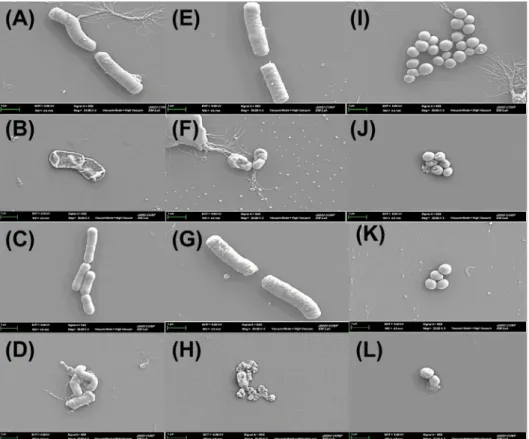
Fig. 2. Electron microscopic analysis of pathogens incubated with culture filtrate, which was filtered with 0.22 μm microfilter, of the strain SCK B11. The cultured cells (200 μl) were incubated with the culture filtrate (100 μl) of the strain SCK B11 for 20 h. The figures of intact and treated cells show B. cereus KACC 11240(ATCC 14579) (A and B), L. monocytogenesis KACC 10764 (C and D), E. coli KACC 13821 (E and F), P.
aeruginosa KACC 1025 (G and H), E. faecalis KACC 11304 (I and J), and S. aureus KCTC 1621 (K and L), respectively.
다른 B. subtilis 균들과 함께 고추장을 발효하는 것이 가능할 것 으로 판단되었다. SCK B11은 효모인 Candida albicans를 제외 하고 곰팡이들에 대해 항진균 특성을 나타냈고, aflatoxin B, G, M을 생산하는 A. flavus 및 A. parasiticus, ochratoxin A 생산균 인 A. ochraceus에 대해서도 효과적(투명환 직경 5–6 mm)인 증 식 저해를 보였다. 전통 장류 발효 시 mycotoxins의 생성여부는 식품 안전상 중요하며 이들 독소들은 간암이나 신장 독성을 유 발할 수 있기 때문에 항진균 효과를 가진 이 균의 사용은 숙성과 정에서 위생 발효를 위해 가치가 있을 것으로 예상된다. 또한 SCK B11은 병원성 또는 기회 감염성 세균들인 E. coli, L.
monocytogenes, M. luteus, P. aeruginosa에 대한 저해 능력(투 명환 직경 5–12 mm)이 있었고 특히 식중독과 염증 반응에 관여 하는 병원성 균인 S. aureus에 대해서는 사용한 5균주 모두에 대 해 증식 억제 효과를 보였다. SCK B11이 분비하는 항균 물질이 일부 B. licheniformis가 생산하는 펩타이드성 항균제인 lichenicidin이나 계면활성제인 lichenysin 또는 B. subtilis가 생 산하는 surfactin인지 확인하기 위하여 이들 합성 유전자에 대한 PCR을 수행하였다. 그러나 SCK B11은 lichenysin 합성효소 유 전자(lchAA, lchAB, lchAC), lichenicidin 합성을 위한 lantibiotic 수식효소유전자(licM1, licM2)와 surfactin 합성효소유전자 (srfAA, srfAC, srfAD)를 함유하고 있지 않아, 앞으로 이 항균 물 질의 특성은 규명해야 할 필요가 있다. 전통 장류 발효에 다양한
항 유해균 스펙트럼을 가진 SCK B11의 사용은, HACCP 시스 템의 도입이 어려운 장류 업체에서 유해균들의 오염 문제를 해 결할 수 있는 효과적 대안이 될 수 있을 것이다. 이러한 항균 특 성으로부터 SCK B11는 장류 발효 이외에 동물 사료, 의료, 공중 위생 분야에서 사용 가능성을 고려해 볼 수 있으며, 특히 methicillin 저항 균주(MRSA)를 포함하는 S. aureus균들에 대해 서는 항균 물질로서 사용 가능성을 조사할 필요가 있다.
항균 작용은 SCK B11의 배양 후 무균 상층액 100 μl를 취해 200 μl의 유해균 배양액에 넣고 20시간 37℃ 추가 배양 후 전계 방사형 주사전자현미경에서 확인하였다(Fig. 2). Fig. 4의 A, C, E, G, I, K는 SCK B11의 무균 상층액을 첨가하지 않은 대조균 들로서, 생육 정지기에 도달한 균의 형태를 보이고 있다. 그러나 무균 상층액을 첨가한 것 빼고는 동일 조건에서 같은 시간 배양 한 유해균들의 경우, 세포막이 부풀어오른 형태(D), 막이 터져 내용물이 흘러나오거나(D, J, L), 세포막 껍질만 있는 형태(B, F, H)들만이 대부분 관찰되었다. 전자현미경상에서 관찰했던 대조 군과 처리군의 모든 영상들을 비교했을 때 이러한 형태 차이는 분명하게 나타났다. 전체적으로 SCK B11로 처리한 유해균 표 면은 비처리군에 비해 세포막 표면이 거칠며 부분적으로 녹아있 는 형태를 나타냈고 균의 크기도 변화되어 있었다. 따라서 SCK B11의 항균 성분은 막 구조나 막 대사에 영향을 주어 막 투과조 절 능력의 상실이나 세포막 합성 저해를 일으키는 것 같다.
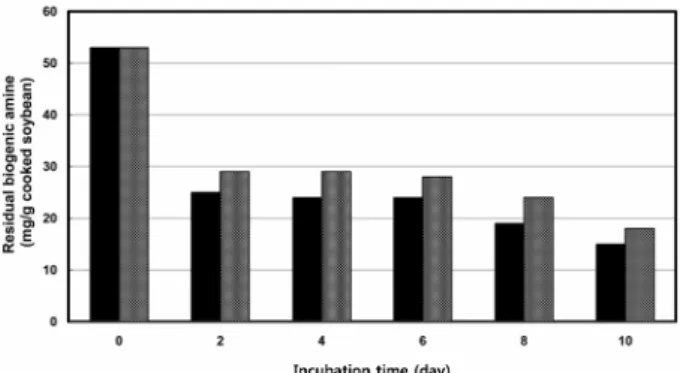
Fig . 4. Changes in the concentrations of initially added histamine (53 mg/g cooked soybean) and tyramine (53 mg/g cooked soybean) at various time intervals during fermentation of cooked soybeans inoculated with the strain SCK B11.
Fig. 3. Color development on the synthetic medium with Cresol Red as pH indicator by biogenic amine-producing bacterial strains.
Arrow indicates the colony of the strain SCK B11.
SCK B11의 biogenic amines의 분해
전통 장류 발효 시 높은 tyrosine과 histamine의 농도를 최소 화하기 위해 biogenic amine 선택 배지와 HPLC를 이용, SCK B11의 biogenic amine 생산 여부를 조사했다. Amino acid decarboxylase를 분비하는 미생물은 선택배지에 첨가된 L-histidine 또는 L-tyrosine을 염기인 histamine이나 tyramine으 로 전환되며, 이 때 변화된 pH 때문에 cresol red는 적자색으로 바뀐다. 최근 전통 소시지에서 분리한 일부 Staphylococcus와 Bacillus 속들이 biogenic amines을 생산하는 것이 발견되었다 (Bermudez et al., 2012). 하지만 histidine과 tyramine을 함유하 는 선택배지에서 배양 동안 보라색으로 바뀐 다른 균주들과는 달리 SCK B11의 집락 주변에 색 변화는 없었다(Fig. 3).
발효 숙성 동안 여러 미생물들로 오염되는 전통 장류의 특성 을 고려해 볼 때 전통 장류에 적용할 수 있는 가장 효율적인 균주 선발 전략은 항균 특성과 biogenic amines을 생산하지 않으면서 biogenic amines을 분해하는 균을 찾는 방법이다. 미생물이 분비 하는 monoamine oxidase와 diamine oxidase에 의해 다수의 미 생물들이 biogenic amines이 분해하는 것으로 보고되어 있다 (Naila et al., 2010). Biogenic amines 분해 여부를 확인하기 위 하여, 탄소원 및 질소원으로 2% histamine 및 tyramine 만을 사 용한 최소합성배지에서 이 균을 배양했을 때 잘 증식하였다. 또 한 HPLC 분석 결과, 삶은 콩 g 당 각 53 mg의 histamine과 tyramine을 첨가한 배지에서 2일 후 SCK B11은 이들 amine을 각각 53%와 45%, 10일 후에는 72%와 66%를 분해하였다(Fig.
4). 전통적인 청국장 제조는 삶은 콩에 볏짚을 넣고 47℃, 2일 동 안 발효과정을 거친다는 점을 고려할 때 특히 발효 2일 안에 약 50%의 biogenic amines을 제거하는 SCK B11를 접종하는 경우
볏짚 내 다른 미생물들에 의해 생성된 biogenic amines을 효율적 으로 제거할 것으로 보인다.
전통 발효 장류의 맛과 풍미를 유지하면서 동시에 위생상의 문제점을 해결하는 일은 발효 과정에 참여하는 수많은 미생물들 의 대사 제어와 상호 간 길항 특성을 이해해야 하기 때문에 쉬운 일이 아니다. 특히 위생적인 관점에서 우선적으로 해결해야 할 과제는 발효 유해균의 증식 억제, biogenic amines의 생성 억제, aflatoxin 생산 억제일 것이다. 그러나 HACCP (Hazard Analysis
& Critical Control Point) 인증을 받기 어려운 영세 전통 장류 공 장들은 시설의 현대화와 제조 공법의 혁신적인 전환 없이는 현 실적으로 이러한 요구에 부응할 수 없다. 이 문제점을 해결하기 위한 수단으로서 우리는 우수한 발효능력과 함께 유해균에 대해 강한 길항 능력을 지니며, biogenic amines을 생산하지 않지만 이들에 대해 높은 분해 능력을 보이는 균을 전통 장류에서 분리 하고자 하였다. SCK B11 균주는 이런 위생학적인 문제점을 해 결할 수 있는 발효 균으로서 전통 장류의 제조 초기 단계에서 과 량 접종하는 경우 현재 전통 장류의 위생적인 문제점들을 해결 할 수 있을 것이다. 현재 이 균주를 전통 장류의 풍미를 생산하는 다른 우수 발효균들과 함께 복합 접종으로 전통 장류를 재현하 는 실증 실험을 계획하고 있다.
적 요
장류의 유해균과 biogenic amines 함량을 줄이기 위해 항균 작용과 biogenic amines 분해능력이 있는 한 균주를 83종의 전 통장류로부터 분리하였다. 형태 및 생화학적 특성, 16S rRNA 유 전자 서열 해독 결과 이 균주는 Bacillus licheniformis에 속했으며, B. licheniformis SCK B11로 명명되었다. SCK B11을 이틀간 배양한 후의 원심분리 상층액은 유해 균주들인 Enterococcus faecalis, Listeria monocytogenes, Micrococcus luteus, Pseudomonas aeruginosa, Bacillus cereus, Staphylococcus aureus, Aspergillus flavus에 대해 균 증식 저지력을 보였다. 이 균주의 항균 특성을 확인하기 위해 B. licheniformis의 항균물질로 알려진 surfactin, lichenysin, lichenicidine 합성 유전자들에 대한 PCR을 수행한
결과 모두 음성으로 나와 이 항균 물질은 기존에 보고된 물질들 과는 다름을 보였다.
또한 전자 현미경 사진 결과 이 항균 물질은 유해균들의 세포 막 손상을 야기하는 것이 관찰되었다. 이 균주는 각각 5.3%의 histamine과 tyramine이 함유된 삶은 콩에서 10일의 발효 기간 동안 histamine 함량의 72%, tyramine 함량의 66%를 분해하는 것으로 나타났다. SCK B11의 항균 및 biogenic amine 분해 특 성을 고려할 때, 공정상 필연적으로 유해균 증식 및 biogenic amine 생성 문제를 지닌 전통 장류 발효 과정에서 이 균주는 이 문제점들을 해결할 수 있을 것으로 보인다.
감사의 말
본 연구는 2011년 농림수산식품부 고부가가치 식품개발사업 (과제번호311036-3), 2012년 지역 농식품 선도클러스터 육성사 업 및 2012년 전북대학교 자연계열 대학원생 지원 프로그램(김 용상)에 의해 수행되었습니다. 이 연구에 사용한 일부 균주들을 무상으로 기증해준 한국농업미생물자원센터(KACC)에 감사드 립니다.
참고문헌
Altayar, M. and Sutherland, A.D. 2005. Bacillus cereus is common in the environment but emetic toxin producing isolates are rare. J. Appl.
Microbiol. 100, 7–14.
Apetroaie, C., Andersson, M.A., Sproer, C., Tsitko, I., Shaheen, R., Jaaskelainen, E.L., Wijnands, L.M., Heikkila, R., and Salkinoinoja- Salonen, M.S. 2005. Cereulide-producing strains of Bacillus show diversity. Arch. Microbiol. 184, 141–151.
Bermudez, R., Lorenzo, J.M., Fonseca, S., Franco, I., and Carballo, J.
2012. Strains of Staphylococcus and Bacillus isolated from traditional sausages as producers of biogenic amines. Front.
Microbiol. 3, 1–6.
Birgit, M.P., Dietrich, R., Nibler, B., Martlbauer, E., and Scherer, S. 1999.
The hemolytic enterotoxin HBL is broadly distributed among species of the Bacillus cereus group. Appl. Environ. Microbiol. 65, 5436–
5442.
Chakravorty, S., Helb, D., Burday, M., Connell, N., and Alland, D. 2007.
A detailed analysis of 16S ribosomal RNA gene segments for the diagnosis of pathogenic bacteria. J. Microbiol. Methods 69, 330–339.
Cho, T.Y., Hahn, G.H., Bahn, K.N., Son, Y.W., Jang, M.R., Lee, S.H., Kim, D.B., and Kim, S.B. 2006. Evaluation of biogenic amines in Korean commercial fermented foods. Korean J. Food Sci. Technol.
38, 730–737.
Ferencik, M. 1970. Formation of histamine during bacterial decarboxylation of histidine in the flesh of some marine fishes. J. Hyg.
Epidemiol. Microbiol. Immunol. 14, 52–60.
Fitch, W.M. 1971. Toward defining the course of evolution: minimum change for a specific tree topology. Syst. Zool. 20, 406–416.
Granum, P.E. and Lund, T. 1997. Bacillus cereus and its food poisoning toxins. FEMS Microbiol. Lett. 157, 223–228.
Guinebretiere, M.H., Broussolle, V., and Nguyen-The, T. 2002.
Enterotoxigenic profiles of food-poisoning and food-borne Bacillus cereus strains. J. Clin. Microbiol. 40, 3053–3056.
Havelka, B. 1967. Role of the Hafnia bacteria in the rise of histamine in tuna fish meat. Cesk. Hyg. 12, 343–352.
Kawabata, T., Ishizaka, K., Mura, T., and Sasaki, T. 1956. Studies on the food poisoning associated with putrefaction of marine products. Ⅶ.
Bull. Jpn. Soc. Sci. Fish. 22, 41–47.
Kim, Y.S., Kim, M.C., Kwon, S.W., Kim, S.J., Park, I.C., Ka, J.O., and Weon, H.Y. 2011. Analysis of bacterial communities in Meju, a Korean traditional fermented soybean bricks, by cultivation-based and pyrosequencing methods. J. Microbiol. 49, 340–348.
Kim, Y.S., Yun, S.H., Jeong, D.Y., Hahn, K.S., and Uhm, T.B. 2010.
Isolation of Bacillus licheniformis producing antimicrobial agents against Bacillus cereus and its properties. Korean J. Microbiol. 46, 270–277.
Kimura, M. 1980. A simple method for estimating evolutionary rate of base substitutions through comparative studies of nucleotide sequences. J. Mol. Evol. 16, 111–120.
Lerke, P.A., Werner, S.B., Taylor, S.L., and Guthertz, L.S. 1978.
Scombroid poisoning. Report of an outbreak. West J. Med. 129, 381–
386.
Lindback, T., Fagerlund, A., Rodland, M.S., and Granum, P.E. 2004.
Characterization of the Bacillus cereus Nhe enterotoxin. Microbiology 150, 3959–3967.
Naila, A., Flint, S., Fletcher, G., Bremer, P., and Meerdink, G. 2010.
Control of biogenic amines in food-existing and emerging approaches.
J. Food Sci. 75, 139–150.
Ngamwongsatit, P., Buasri, W., Pianariyanon, P., Pulsrikarn, C., Ohba, M., Assavanig, A., and Panbangred, W. 2008. Broad distribution of enterotoxin genes among Bacillus thuringiensis and Bacillus cereus as shown by novel primers. Int. J. Food Microbiol. 121, 352–356.
Omura, V., Price, R.J., and Olcott, H.S. 1978. Histamine forming bacteria isolated from spoiled skipjack tuna and jack mackerel. J. Food Sci.
43, 1779–1787.
Ouhib, Q., Clavel, T., and Schmitt, P. 2006. The production of Bacillus cereus enterotoxins is influenced by carbohydrate and growth rate.
Curr. Microbiol. 53, 222–226.
Schoeni, J.L. and Wong, A.C. 2005. Bacillus cereus food poisoning and its toxins. J. Food Prot. 68, 636–648.
Shalaby, A.R. 1996. Significance of biogenic amines to food safety and human health. Food Res. Int. 29, 675–690.
Swofford, D.L. 1998. PAUP. Phylogenetic Analysis using Parsimony.
4.0 ed. Sinauer Associates, Sunderland, MA, USA.
Taylor, S.L and Speckhard, M.W. 1983. Isolation of histamine- producing bacteria from frozen tuna. Mar. Fish. Rev. 45, 35–39.
Taylor, S.L., Guthertz, L.S., Leatherwood, M., and Lieber, E.R. 1979.
Histamine production by Klebsiella pneumoniae and an incident of scombroid fish poisoning. Appl. Environ. Microbiol. 37, 274–278.
Ten Brink, B., Damink, C., Joosten, H.M., and Huis in’t Veld, J.H. 1990.
Occurrence and formation of biologically active amines in foods. Int.
J. Food Microbiol. 11, 73–84.
Thompson, J.D., Higgins, D.G., and Gibson, T.J. 1994. CLUSTALW:
improving the sensitivity of progressive multiple sequence alignment through sequence weighing position-specific gap penalties and weight matrix choice. Nucleic Acids Res. 22, 4673–4680.
Zhang, Z., Schwarz, S., Wagner, L., and Miller, W. 2000. A greedy algorithm for aligning DNA sequences. J. Comput. Biol. 7, 203–214.