196
©The Korean Society of Food Science and Technology
전통 발효 청국장으로부터 biogenic amine 저생성 미생물의 선발
최재영·홍성욱·정건섭*
연세대학교 생명과학기술학부
Selection of Biogenic Amine-reducing Microorganisms from
a Traditional Korean-style Fermented Food, Cheonggukjang
Jae Young Choi, Sung Wook Hong, and Kun Sub Chung* Division of Biological Science and Technology, Yonsei University
Abstract Microorganisms, having the lower decarboxylase activity, among the isolated strains from cheonggukjang and rice-straw in this study were selected by using biogenic amine (BA) media. The selected strains were identified as Bacillus subtilis HH12, B. subtilis HR254, and Paenibacillus barcinonensis KR97, by using 16S rRNA analysis. PCR analysis showed that the histidine decarboxylase (hdc) gene was absent in the HH12, HR254, and KR97 strains. However, PCR analysis showed that the tyrosine decarboxylase (tdc) gene was present in the HH12, HR254, and KR97 strains. Quantitative analysis of the selected strains by using high-performance liquid chromatography showed that histamine was absent in the HH12, HR254, and KR97 strains. However, these 3 strains showed tyramine concentrations of 6.09, 3.68, and 6.30 mg/L, respectively. These strains produced lower concentrations of amines (approximately 7.9, 0, and 9.3% amines in the HH12, HR254, and KR97 strains, respectively) than the B. subtilis MC138 strain, which showed the higher protease activity.
Keywords: cheonggukjang, biogenic amine, Bacillus
서
론
대두 발효식품인 청국장(cheonggukjang)은 콩을 삶은 후, 볏짚 을 가하여 Bacillus 균에 의해 40oC에서 2-3일간 발효시켜 만드는
우리나라의 고유한 전통 발효식품이다. 청국장에 존재하는 주요 미생물로는 Bacillus subtilis(1), B. licheniformis(2), B. pumilus(3), B. amyloliquefaciens(4) 등이 알려져 있다. 또한 청국장의 기능성 에 대해서 항돌연변이(5), 혈전용해(6), 항고혈압(7), 콜레스테롤저 하(8), 항산화(9), 면역증강활성(10) 등에 관한 연구결과가 활발하 게 발표되고 있다. 최근에는 식품의 안전성 측면에서 단백질을 함유한 발효식품 중에 biogenic amines(BAs)의 분포 및 함량조사 연구가 수행되고 있다(11). 우리나라의 전통 발효식품 중에서 청국장이나 된장은 단백질이 풍부한 콩을 원료로 만들고 식품에 존재하는 미생물들 은 protease 활성이 우수하기 때문에 유리아미노산이 원인이 되 는 BAs의 생성에도 관여하게 되어 장류와 발효식품에 있어 BAs 문제가 대두되고 있다. BAs은 일반적으로 동물, 식물 및 미생물 에서 아미노산의 효소적 탈탄산 반응에 의해 형성되는 저분자량 의 함질소 유독 화합물(amine)을 의미하며, 탈탄산효소(decarbox-ylase) 생산 미생물에 의해 고단백질성 식품이 부패하거나 발효 와 숙성과정에서 주로 많이 생성되며, 인체 및 동물체내에서 중 추신경의 신경전달물질 또는 간접적인 혈관계 조절에 관여한다 (12). 또한 BAs는 N-nitrosamine과 같은 발암물질로 전환될 수 있 는 잠재적인 위험성이 있으며(13), 다량섭취 또는 amine 대사과 정이 저해 또는 결핍된 경우에는 동물이나 사람의 몸에서 독성 을 나타내기도 한다(14). BAs류는 지방족화합물(putrescine, cadav-erine, spermine, spermidine), 방향족화합물(tyramine, phenylethy-lamine), 헤테로고리화합물(histamine, tryptamine)을 가진 형태로 되어 있다(15). 대두 발효식품인 청국장과 나또(natto)에서는 bio-genic amines 중에서 특히 histamine과 tyramine 함량이 높은 것으 로 연구 보고되었다(16). 발효식품의 BAs 생성 저감화 연구로는 감마선 조사(17), pH, 온도 및 NaCl 농도에 따른 영향(18) 등이 이루어지고 있으나 BAs 생성 저감을 위한 탈탄산효소 활성이 낮은 미생물에 대한 연구 는 미흡한 실정이다. 따라서 본 연구에서는 청국장의 BAs 저감 화를 목표로 청국장으로부터 분리한 미생물로부터 BAs 생성이 낮은 미생물을 탐색하고자 한다.
재료 및 방법
실험재료 및 시약 본 실험에서 사용된 청국장과 볏짚 시료들은 한국 전통식 방 법으로 제조하고 있는 풀목산농원(경기도 여주군 북내면), 미륵 산농원(강원도 원주시 귀래면), 흥업토속된장(강원도 원주시 흥업 면), 원조 김점례할머니(전라북도 순창군 순창읍), 서일농원(경기 도 안성시 일죽면)에서 각각 구입하여 실험에 사용하였다. *Corresponding author: Kun Sub Chung, Division of BiologicalSci-ence and Technology, Yonsei University, Wonju, Gangwon 220-710, Korea
Tel: 82-33-760-2252 Fax: 82-33-760-2183
E-mail: [email protected]
Received September 17, 2011; revised December 26, 2011; accepted January 11, 2012
Amine의 표준품은 histamine dihydrochloride(98%), tyramine hydrochloride(99%)와 내부표준물질인 1,7-diaminoheptane, 유도체 시약인 dansyl chloride는 Sigma Aldrich Co.(St. Louis, MO, USA) 제품을 사용하였고, 이동상으로 사용한 acetonitrile과 ether 시약은 HPLC 등급을 사용하였다.
미생물 분리 및 배양
청국장과 볏짚 시료를 각각 취하여 멸균 생리식염수에 1:9 비 율로 혼합한 후, homogenizer(Stomacher 400, Seward, West Sus-sex, UK)를 사용하여 10분 동안 균질화하여 현탁액을 제조하였 다. 이 현탁액을 멸균 생리식염수로 순차적으로 희석한 후 tryptic soy agar (TSA; Difco, Detroit, MI, USA) plate에 100 µL씩 도말 하여 37oC에서 18시간동안 배양한 후에 미생물 집락의 형태에
따라 서로 다른 미생물을 분리하였다.
탈탄산 효소의 활성측정
분리된 미생물의 탈탄산 효소(decarboxylase) 활성측정은 Bover-Cid와 Holzapfel(19)의 방법을 변형하여 측정하였다. 분리미생물 은 decarboxylase medium 배지(0.5% tryptone, 0.5% yeast extract, 0.5% meat extract, 0.25% sodium chloride, 0.05% glu-cose, 0.1% tween 80, 0.02% MgSO4, 0.005% MnSO4, 0.004% FeSO4, 0.2% ammonium citrate, 0.001% thiamine, 0.2% K2PO4, 0.01% CaCO3, 0.005% pyridoxal-5-phosphate, 0.4% amino acid, (L-lysine, L-histidine, L-ornithine, L-tyrosine, L-arginine), 0.006% bromocresol purple, pH 5.3)에 접종하여 37oC에서 배양하며 24시 간에서 72시간까지 12시간 간격으로 배지색깔의 변화를 관찰하 였다. 이때 배지색이 노란색으로 변하면 음성, 배지색이 보라색 으로 변하면 양성으로 표시하였다. 미생물의 동정 분리 선발한 미생물은 Gram 염색과 현미경 관찰을 통해 형태 학적 특성을 조사하였고 16S ribosomal RNA gene sequencing 분 석을 통하여 동정하였다. 선발미생물의 균체를 취하고 멸균된 생 리식염수에 균체를 2회 세척한 후, DNeasy tissue kit(Qiagen, Valecia, CA, USA)를 사용하여 DNA를 추출하였다.
추출된 DNA의 16S ribosomal RNA gene 증폭을 위하여 uni-versal primer; 27F(5'-AGAGTTTGATCATGGCTCAG-3')와 1492R (5'-GGATACCTTGTTACGACTT-3') primer를 사용하였다. PCR 반 응시 0.4 mM dNTP, 0.5 units Taq polymerase, 4 mM Mg2+이 함
유된 Takara Perfect Premix(Takara, Japan) 10 µL에 DNA tem-plate (20 µg/mL) 1 µL, 1.0 µM forward primer와 1.0 µM reverse primer를 각각 1 µL씩 넣고 나머지는 증류수를 첨가하여 총 부피 가 20 µL가 되도록 제조하였다. PCR 증폭은 Mastercycler gradient (Eppendorf, Hamburg, Germany)으로 수행하였다. PCR 반응은 95oC에서 5분(initial denaturation), 94oC에서 45초(denaturation),
52oC에서 45초(annealing), 72oC에서 1분(extension)을 30 cycles 실 시하였고, 72oC에서 5분간 최종 extension을 실시하였다.
증폭된 약 1,400 bp의 fragment를 T vector(Invitrogen, Carlsbad, CA, USA)에 결합시킨 후 형질전환하였다. T vector sequencing primer를 이용하여 염기서열 결정을 수행하였으며 그 결과는 BLAST search(http://www.ncbi.nlm.nih.gov) program을 이용하여 GenBank(NCBI, Bethesda, MD, USA)의 ribosomal RNA gene sequencing과 비교하여 동정하였다.
Decarboxylase gene 검출
Biogenic amines(histamine과 tyramine) 생성에 관여하는 hdc gene(histidine decarboxylase)과 tdc gene(tyrosine decarboxylase)을 검출하기 위해 specific primer를 사용하여 PCR 증폭을 수행하였 다. 선발미생물의 균체를 취하고 멸균된 생리식염수에 균체를 2 회 세척한 후, DNeasy tissue kit(Qiagen, Valecia, CA, USA)를 사용하여 DNA를 추출하였다. PCR 증폭에 사용한 primer는 Table 1과 같으며, PCR 반응은 95oC에서 5분(initial denaturation), 95oC 에서 45초(denaturation), hdc gene과 tdc gene 검출을 위한 annealing 온도는 각각 52와 48oC에서 45초, 72oC에서 2분(exten-sion)을 35 cycles 실시하였고, 72oC에서 5분간 최종 extension을 실시하였다. Positive control로는 탈탄산 효소 활성이 빠른 시간 내에 양성반응을 나타내는 균주로 선발하여 비교하였고, negative control 로는 배양에 사용한 배지를 사용하였다. PCR product는 2% agarose gel 상에서 전기영동을 수행하여 DNA band를 확인 하였다.
Amine 분석
선발미생물을 0.005% pyridoxal-5-phosphate, 0.4% L-histidine, 0.4% L-tyrosine이 함유된 tryptic soy broth(TSB)에 접종한 후, 37oC에서 2일 동안 진탕배양한 배양상등액을 5 mL을 취해서 dansyl chloride로 유도체화하여 분석하였다. Dansyl chloride를 이용한 유 도체화는 표준용액 및 시험용액 각각 1 mL을 마개 달린 유리시 험관에 취한 다음 내부표준용액 (I.S.) 100 µL 가한 후 포화 탄산 나트륨 용액 0.5 mL, 1% dansyl chloride 0.8 mL을 가하여 혼합한 후 마개를 하여 45oC에서 1시간 유도체화 하였다. 유도체화 후 10% proline 용액 0.5 mL, 에테르 5 mL를 가하여 10분간 진탕하 고 상층액을 취하여 질소 농축한 뒤 아세토니트릴 1 mL를 첨가 하고 0.45 µm membrane filter(Advantec, Tokyo, Japan)로 여과하 여 사용하였다. 유도체화시킨 sample을 이용한 HPLC 분석은 Shiseido NANOSPACE SI-2 시스템을 사용하였고 칼럼으로는 Cepcell pak C18 UG-120(2.0 mm×250 mm)를 사용하였다. 유속은 0.2 mL/min으로 조절하였으며 칼럼온도는 40oC를 유지시켰다. 이 때 이동상으로 사용한 용매의 조건은 55% 아세토니트릴을 최초 10분간 유지 후 15분까지 65%, 20분까지 80%로 5분간 유지 후, 27분까지 90%로 하여 5분간 유지, 35분까지 55%로 하여 5분간
Table 1. Primers for PCR amplification of histidine decarboxylase (hdc) and tyrosine decarboxylase (tdc) gene
Gene Primer1) Sequence (5' to 3') Tm (oC) Reference
hdc HDC3-F
HDC4-R
GAT GGT ATT GTT TCK TAT GA
CAA ACA CCA GCA TCT TC 48 Coton and Coton (27)
tdc TD2-F
TD5-R
CAA ATG GAA GAA GAA GTA GG
ACA TAG TCA ACC ATR TTG AA 48 Coton et al. (23) 1)F (forward) and R (reverse) indicate the orientation of the primers in relation to the rRNA sequence.
유지하였다. 검출파장은 UV detector를 이용하여 254 nm에서 측 정하였다. Amine 분석결과의 통계처리는 ANOVA test를 이용하 였고 Duncan’s multiple range test로 유의성을 검정하였다(20).
결과 및 고찰
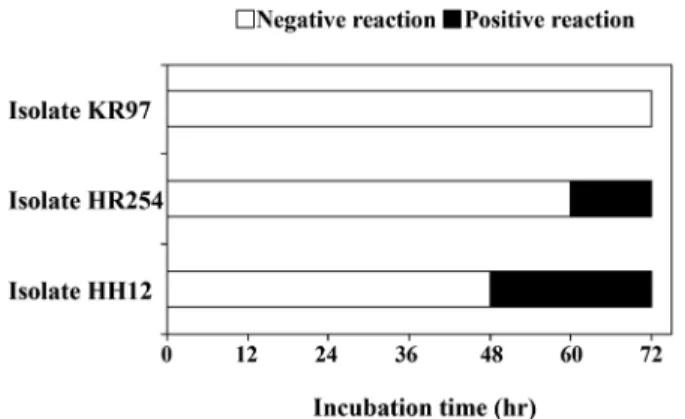
분리 미생물의 decarboxylase 활성 비교 배양중 분리 미생물의 decarboxylase 활성 비교는 decarboxylase medium 정색반응을 이용하여 비교하였다. 탈탄산효소 활성이 있 으면 전구체로서 첨가된 아미노산의 CHCOOH 말단기가 탈탄산 반응에 의해 CO2가 빠져 나가면서 증가하는 pH의 변화에 따라 노란색에서 보라색으로 배지색이 변하는 양상으로 decarboxylase 활성을 비교하였다. 청국장과 볏짚 시료로부터 분리한 미생물은 총 1,399주이었으며, 분리미생물을 decarboxylase medium에 각각 접종하여 정색반응을 12시간 간격으로 조사한 결과, 총 1,399주 중에서 배양 48-72시간에서 양성반응을 나타낸 균주 138주를 1 차 선발하였다(data not shown). 동일한 조건으로 2차 실험을 진행한 결과, 분리균주 HH12는 48시간까지, 분리균주 HR254는 60 시간까지, 분리균주 KR97는 72시간까지도 음성반응을 유지하여 HH12, HR254, KR97을 biogenic amines 저생성 미생물로 선발하 였다(Fig. 1). 선발한 HH12, HR254, KR97 균주는 현미경을 통해 미생물의 형태를 관찰한 결과, 그람양성 간균으로 포자를 형성함 을 확인하였다. 45oC에서 생육하며 catalase 양성반응인 것으로 보
아 Bergey’s manual의 Bacillus sp.와 유사하였다. 더 정확한 동정 을 위해 16S rRNA gene sequencing 결과, HH12와 HR254는 B. subtilis와 97%의 유사성을 나타내었고 KR97은 Paenibacillus bar-cinonensis와 97%의 유사성을 나타내어 이들 미생물은 각각 B. subtilis HH12, B. subtilis HR254, P. barcinonensis KR97로 명명 하였고, 선발 미생물들의 염기서열을 이용하여 분자생물학적 연 관성을 나타내는 계통도를 얻었다(Fig. 2).
BAs 저감화를 위해 decarboxylase medium에 동일한 배양조건 Fig. 1. Selection of biogenic amines reducing microorganisms in
the decarboxylase medium. Negative reaction; yellow color, Positive reaction: purple color
Fig. 2. Phylogenetic tree of isolated strains through 16S rRNA gene sequence homology. Sequences that were determined in this study are shown in bold, and GenBank accession nos. are shown in parentheses for all reference sequences. The scale bar represents the Jukes-Cantor evolutionary distance.
Fig. 3. PCR products of decarboxylase genes amplified with specific primers from selected microorganisms. M, 100 bp ladder marker; 1, B. subtilis MC138 (positive control); 2, medium (negative control); 3, B. subtilis HH12; 4, B. subtilis HR254; 5, P. barcinonensis KR97. Arrows indicate the histidine decarboxylase (hdc) gene (A) and tyrosine decarboxylase (tdc) gene (B).
에서 배지색의 변화를 조사하였을 때, 60시간 이후에 양성반응을 나타낸 미생물은 24시간 전후에 양성반응을 나타낸 미생물보다 탈탄산효소 활성이 현저히 낮을 것으로 사료되었고 적은양의 BAs 를 생성할 것으로 판단되었다. Brink 등(21)이 BAs의 함량은 식 품중 아미노산의 양과 탈탄산효소 활성을 갖는 미생물에 의해 좌 우되며, 미생물의 최적 발육조건과 높은 탈탄산효소 활성은 많은 BAs 생성 원인으로 작용한다고 보고하였다. 또한 Han 등(16)은 시판 청국장의 BAs 함량 측정실험에서 생성원인 균주로 B. subtilis, B. amyloliquefaciens, B. licheniformis를 보고 하였다. 본 연구에서 분리한 B. subtilis, B. amyloliquefaciens, B. licheniformis
균주의 탈탄산효소 활성을 조사한 결과, 같은 종의 미생물이라도 균주에 따라 탈탄산효소 활성의 차이가 있음을 확인하였다. 따라 서 BAs의 생성을 저감화할 수 있는 균주를 발굴하여 청국장 종 균으로 개발하는 것이 식품안전성 측면에 유리할 것으로 판단되었다.
Decarboxylase gene 조사
Decarboxylase 활성이 낮은 선발 균주들의 decarboxylase gene 함유 여부를 조사하였다. Mah 등(22)은 일부 청국장에서 비교적 높은 함량의 histamine과 tyramine이 검출되었다고 보고하였고, Cho 등(11)은 분석된 청국장 제품의 50%에 해당하는 시료에서 Fig. 4. HPLC analysis of biogenic amines produced by selected microorganisms. A, B. subtilis MC138 (positive control); B, medium (negative control); C, B. subtilis HH12; D, B. subtilis HR254; E, P. barcinonensis KR97. No detection of histamine is shown in parentheses.
tyramine 함량이 1,000-2,000 ppm으로 검출되었다고 보고하였다. 따라서 본 연구에서는 선발균주의 DNA를 추출하고 청국장에서 주로 검출되는 histamine을 생성하는 histidine decarboxylase(hdc) gene과 tyramine을 생성하는 tyrosine decarboxylase(tdc) gene을 PCR 방법을 통해 확인하였다. hdc gene 검출을 위한 전기영동 결과(Fig. 3A), B. subtilis HH12와 B. subtilis HR254 균주에서는 hdc gene으로 추정되는 435bp band가 확인되지 않았고 P. barci-nonensis KR97균주에서도 확인되지 않았다. 그러나 900 bp 부근 에서 band가 확인되었는데 이는 비특이적 증폭에 의한 band로 사 료되었다. 반면, 12시간에서 decarboxylase 양성반응을 나타낸 미 생물 중에서 BAs의 생성에 관여하는 decarboxylase 고생산 미생 물로 사료되는 B. subtilis MC138 균주에서는 band가 확인되어 B. subtilis MC138 균주만 histamine을 생성하는 것으로 사료되었다. tdc gene(Fig. 3B)의 경우는 B. subtilis HH12, B. subtilis HR254, P. barcinonensis KR97 균주에서 tdc gene으로 추정되는 1,100 bp band가 확인되어 이들 균주들은 tyramine을 생성할 것으로 사료 되었다. Coton 등(23)은 hdc gene 검출을 위해 HDC3/HDC4 primer set을 사용했을 때, PCR 증폭산물은 435 bp이며, tdc gene 검출을 위해 TD5/TD2 primer set을 사용했을 때, PCR 증폭산물 은 1,100 bp라고 보고하였다. 식품 중에 histamine을 다량 섭취할 경우, 오심, 호흡곤란, 발한, 두통, 설사, 경련, 홍반, 두드러기 등 이 발생할 수 있으며(24), tyramine은 가장 강한 혈압증진이 유발 되어 심각한 건강상의 위해를 초래할 수 있다고 보고하였다(25). Fricker 등(26)은 PCR 기법은 특이성과 민감성이 뛰어나 단시간 에 검출이 가능하다는 장점이 있지만 전기영동에 의한 추가적인 분석이 요구되며, 실험실 오염물질과 비특이적 증폭에 의한 false-positive의 위험을 유발할 수 있다고 보고한바 있다. 이처럼 PCR 을 이용한 biogenic amine의 검출은 한계가 있으며, 보다 더 정 확한 결과를 얻기 위해서는 적정 primer의 선정과 PCR 조건 등 을 고려할 필요가 있다. 선발 미생물의 amine 생성확인 청국장 발효미생물 중에서 탈탄산효소 활성이 낮은 선발미생 물들을 L-histidine, L-tyrosine이 0.4%(w/v) 첨가된 tryptic soy broth에 각각 배양하여 배양상등액 중의 amine의 함량을 HPLC로 분석한 결과는 Fig. 4에 나타내었으며, 이를 요약하여 Table 2에 나타내었다. Negative control로서 사용한 배양배지의 배양상등액 에서는 histamine이 검출되지 않고 tyramine은 4.86 mg/L 검출되 었다. B. subtilis MC138의 배양상등액에서는 histamine과 tyramine 은 각각 3.94와 16.47 mg/L로 검출되었다. 그러나, biogenic amine
저감화 선발미생물인 B. subtilis HH12, B. subtilis HR254, P. barcinonensis KR97 균주의 경우, histamine은 검출되지 않았고 tyramine은 각각 6.09, 3.68, 6.30 mg/L로 검출되었다. 이들 균주의 total amines 함량에서 배양배지 유래 amines 함량을 제외하고 BAs 생성량만을 MC138 균주와 비교해보면 HH12, HR254, KR97 균 주들은 각각 7.9, 0%, 9.3% 함량 수준으로 BAs를 적게 생성하는 것으로 나타내었다. Biogenic amine 생성유무를 PCR 증폭방법과 HPLC 분석방법을 사용한 결과, hdc gene이 확인되지 않은 B. subtilis HH12, B. subtilis HR254, P. barcinonensis KR97는 HPLC 분석에서도 histamine이 검출되지 않았고, tdc gene이 모두 확인된 선발미생물들은 tyramine이 검출되었다. Decarboxylase 활성이 낮 고 hdc gene도 함유하지 않고 HPLC 분석에서 amines 생성이 낮 은 B. subtilis HR254 균주는 청국장 발효종균으로 개발할 수 있 을 것이라 사료되었다.
요
약
본 연구에서는 청국장 및 볏짚에서 분리한 미생물중 decarbox-ylase 배지에서 탈탄산효소 활성이 낮은 균주로 B. subtilis HH12, B. subtilis HR254, P. barcinonensis KR97을 선발하였다. 이들 선 발 미생물들의 histidine decarboxylase(hdc) gene 과 tyrosine decarboxylase(tdc) gene을 조사한 결과, hdc gene은 HH12, HR254, KR97 균주에서는 검출되지 않았으나, tdc gene은 HH12, HR254, KR110 균주에서 검출되었다. 또한 HPLC를 통해 선발 균주들의 배양상등액 중 amines 생성량을 분석한 결과, HH12, HR254, KR110 균주는 histamine이 검출되지 않았고 tyramine은 HH12, HR254, KR110 균주는 각각 6.09, 3.68, 6.30 mg/L로 검출 되었다. 선발한 biogenic amines 저감화 균주들의 BAs 생성량을 decarboxylase 고생산 미생물로 사료되는 B. subtilis MC138 균주 와 비교해보면 현저히 낮은 수준으로 나타났다.감사의 글
본 연구는 농림수산식품부 농림기술개발사업(2009-2012)의 연 구비 지원에 의해 이루어진 것으로 이에 감사를 드립니다.문
헌
1. Kim YS, Jung HJ, Park YS, Yu TS. Characteristics of flavor and functionality of Bacillus subtilis K-20 cheonggukjang. Korean J. Food Sci. Technol. 35: 475-478 (2003)
Table 2. Contents of biogenic amines produced by selected microorganisms using HPLC analysis
Sample Biogenic amines (mg/L)
3)
Histamine Tyramine Total
B. subtilis MC1381) 5)3.94±0.41a,4) 16.47±1.48a0 20.42±1.28a0
Medium2) 5)N.D5) 4.86±0.12c 4.86±0.26c
B. subtilis HH12 N.D 06.09±0.08bc 06.09±0.87bc
B. subtilis HR254 N.D 3.68±0.26c 3.68±0.46c
P. barcinonensis KR97 N.D 06.30±0.42bc 06.30±1.14bc
Determination of biogenic amines were performed after cultivation at 37oC for 2 days in the tryptic soy broth contained 0.005% pyridoxal-5-phosphate, 0.4% L-histidine and L-tyrosine
1)Positive control 2)Negative control 3)Mean±SD
4)In a column, means followed by the same letter are not significantly different at the 5% level. 5)Not detected
2. Lee MY, Park SY, Jung KO, Park KY, Kim SD. Quality and functional characteristics of cheonggukjang prepared with various Bacillus sp. isolated from traditional cheonggukjang. J. Food Sci. 70: 191-196 (2005)
3. Kwon HY, Kim YS, Kwon GS, Sohn HY. Isolation of immuno-stimulating strain Bacillus pumilus JB-1 from cheonggukjang and fermentational characteristics of JB-1. Korean J. Microbiol. Bio-technol. 32: 291-296 (2004)
4. Kim SS, Lee JH, Ahn YS, Kim JH, Kang DK. A fibrinolytic enzyme from Bacillus amyloliquefaciens D4-7 isolated from cheonggukjang: Its characterization and influence of additive on thermostability. Korean J. Microbiol. Biotechnol. 31: 271-276 (2003)
5. Yoon KD, Hong SS, Kim SI, Chung KS. Inhibitory effect of soy-bean and fermented soysoy-bean products on the chemically induced mutagenesis. Korean J. Appl. Microbiol. Biotechnol. 24: 525-528 (1996)
6. Kil JP, Kim KN, Park IS. Production and characterization of fibrinolytic enzyme: Optimal condition for production of the enzyme from Bacillus sp. KP-6408 isolated from cheonggukjang. J. Korean Soc. Food Sci. Nutr. 27: 51-56 (1998)
7. Yang JR, Lee SH, Song YS. Improving effect of powders of cooked soybean and Chongkukjang on blood pressure and lipid metabolism in spontaneously hypertensive rats. J. Korean Soc. Food Sci. Nutr. 32: 899-905(2003)
8. Kim BJ, Kim D, Ham SS, Choi YS, Lee SY. Effects of spice added natto supplementation on the lipid metabolism in rats. J. Koreans Soc. Food Nutr. 24: 121-126 (1995)
9. Yoon KD, Kwon DJ, Hong SS, Kim SI, Chung KS. Inhibitory effect of soybean and fermented soybean products on the chemi-cally induced mutagenesis. Korean J. Appl. Microbiol. Biotech-nol. 24: 525-528 (1996)
10. Hong SW, Kim JY, Lee BK, Chung KS. The bacterial biological response modifier enriched cheonggukjang fermentation. Korean J. Food Sci. Technol. 38: 548-553 (2006)
11. Cho TY, Han GH, Bahn KN, Son YW, Jang MR, Lee CH, Kim SH, Kim DB, Kim SB. Evaluation of biogenic amines in Korean commercial fermented foods. Korean J. Food Sci. Technol. 38: 730-737 (2006)
12. Suzzi G, Gardini F. Biogenic amines in dry fermented sausages: A review. Int. J. Food Microbiol. 88: 41-54 (2003)
13. Shalaby AR. Significance of biogenic amines to food safety and human health. Food Res. Int. 29: 675-690 (1996)
14. Gilbert RJ, Hobbs G, Murray CK, Cruickshank JG, Young SE. Scombrotoxic fish poisoning: Features of the first 50 incidents to
be reported in Britain (1976-9). Brit. Med. J. 281: 71-72 (1980) 15. Halász A, Baráth A, Simon-Sarkadi L, Holzapfel WH. Biogenic
amines and their production by microorganisms in food. Trends Food Sci. Technol. 5: 42-49 (1994)
16. Han GH, Cho TY, Yoo MS, Kim CS, Kim JM, Kim HA, Kim MO, Kim SC, Lee SA, Ko YS, Kim SH, Kim DB. Biogenic amines formation and content in fermented soybean paste (cheon-ggukjang). Korean J. Food Sci. Technol. 39: 541-545 (2007) 17. Kim JH, Ahn HJ, Jo C, Park HJ, Chung YJ, Byun MW.
Radioly-sis of biogenic amines in model system by irradiation. Food Con-trol 15: 405-408 (2004)
18. Gardini F, Martuscelli M, Caruso MC, Galgano F, Crudele MA, Favati F, Guerzoni ME, Suzzi G. Effects of pH, temperature, and NaCl concentration on the growth kinetics, proteolytic activity, and biogenic amine production of Enterocuccus faecalis. Int. J. Food Microbiol. 64: 105-117 (2001)
19. Bover-Cid S, Hozapfel WH. Improved screening procedure for biogenic amine production by lactic acid bacteria. Int. J. Food Microbiol. 53: 33-41 (1999)
20. SAS Institute, Inc. SAS User's Guide. Statistical Analysis System Institute, Cary, NC, USA (1990)
21. ten Brink B, Damink C, Joosten HMLJ, Huis in't Veld JHJ. Occurrence and formation of biologically active amines in foods. Int. J. Food Microbiol. 11: 73-84 (1990)
22. Mah JH, Kim YJ, No HK, Hwang HJ. Determination of biogenic amines in kimchi, Korean traditional fermented vegetable prod-ucts. Food Sci. Biotechnol. 13: 826-829 (2004)
23. Coton M, Coton E, Lucas P, Lonvaud A. Identification of the gene encoding a putative tyrosine decarboxylase of Carnobacte-rium divergens 508. Development of molecular tools for the detection of tyramine-producing bacteria. Food Microbiol. 21: 125-130 (2004)
24. Chu CH, Bjeldanes LF. Effects of diamines, polyamines and tuna fish extracts on the binding of histamine to mucin in vitro. J. Food. Sci. 47: 79-80 (1982)
25. Bjeldanes LF, Schutz DE, Morris MM. On the aetiology of scom-broid poisoning: Cadaverine potentiation of histamine toxicity in guinea-pig. Food Cosmet. Toxicol. 16: 157-159 (1978)
26. Fricker M, Messelhäußer U, Busch U, Scherer S, Schulz ME. Diagnostic real-time PCR assays for the detection of emetic Bacillus cereus strains in foods and recent food-borne outbreaks. Appl. Environ. Microb. 73: 1892-1898 (2007)
27. Coton E, Coton M. Multiplex PCR for colony direct detection of Gram-positive histamine- and tyramine-producing bacteria. J. Microbiol. Meth. 63: 296-304 (2005)