136
서 론
유방암은 현재 한국의 여성암 유병률 2위로 발생률도 매
년 증가하고 있다. 최근 조기진단이 확대되고 치료가 발전함 에 따라 발생률이 증가함에도 유방암 환자의 생존율은 증가 하여 지난 2010년에서 2014년 사이 5년 상대생존율은 92%
Received: July 24, 2017 / Revised: October 9 2017 / Accepted: October 19, 2017
This research has been supported by the AMOREPACIFIC Foundation and a faculty research grant of Yonsei University College of Medicine for 2013 (6-2013-0180).
Corresponding author: Eun Lee, Department of Psychiatry, Yonsei University College of Medicine, 50 Yonsei-ro, Seodaemun-gu, Seoul 03722 Korea
Tel:02) 2228-1620·Fax:02) 313-0891·E-mail:[email protected]
인지 저하를 호소하는 유방암 환자들의 인지 기능 관련 요인
연세대학교 의학전문대학원,1 연세대학교 의과대학 정신과학교실/의학행동과학연구소2
이선아1·박경미2·김태호2·이 은2
Factors Associated with Cognitive Function
in Breast Cancer Patients Complaining Cognitive Decline
Sun Ah Lee, B.A.,1 Kyung Mee Park, M.D.,2 Tae Ho Kim, M.D.,2 Eun Lee, M.D., Ph.D.2
1Yonsei University, School of Medicine, Seoul, Korea
2Department of Psychiatry and Institute of Behavioral Science in Medicine, Yonsei University College of Medicine, Seoul, Korea
ABSTRACT
Objectives:Cognitive complaints are reported frequently after breast cancer treatments. The causes of cog- nitive decline are multifactorial, a result of the effect of cancer itself, chemotherapy, and psychological fac- tors such as depression and anxiety. However, cognitive decline does not always correlate with neuropsychologi- cal test performance. The purpose of this study was to examine the relationship of subjective cognitive decline with objective measurement and to explore associated factors of cognitive function in breast cancer survivors.
Methods:We included 29 breast cancer survivors who complain cognitive decline at least 6 months after treat- ment and 20 age-matched healthy controls. Neuropsychological tests were performed in all participants. Multivari- able regression analysis evaluated associations between neuropsychological test scores and psychological distress including depression and anxiety, also considering age, education, and comorbidity.
Results:There were no statistically significant differences in neuropsychological test performances. However, the breast cancer survivors showed a significantly higher depression(p=0.002) and anxiety(p<0.001) than the healthy controls did. Among the cancer survivors, poorer executive function was strongly associated with higher depression(β=-0.336, p=0.001) and anxiety(β=-0.273, p=0.009), after controlling for age, education, and comor- bidity. In addition, poorer attention was also significantly related with depression(β=-0.375, p=0.023) and anxiety (β=-0.404, p=0.013).
Conclusions:The results of this study showed the discrepancies between subjective complaints and objective measures of cognitive function in breast cancer survivors. It suggests that subjective cognitive decline could be in- dicators of psychological distress such as depression and anxiety.
KEY WORDS:Breast cancer ㆍCognitive decline ㆍDepression, anxiety.
252-6 / 3rd / 1.5 (Journal Design Team, SM Lee)
원 저
정신신체의학 25(2) : 136-144(2017)
137 로 집계되었다.1) 이는 유방암도 만성질환의 측면에서 치료
이후의 삶에 대한 장기적인 계획을 세우고 지속적으로 관리 해야 할 필요성이 있음을 의미한다.
치료를 마친 유방암 환자들은 피로, 수면 장애 등 비특이적 인 증상을 흔히 호소하는데,2) 이러한 증상들 중 삶의 질3)과 밀접한 관련이 있는 인지 저하가 1990년대 후반부터 주목 받 기 시작하였다. 인지기능이란 주의력, 기억력, 판단력, 언어 능력, 시공간기능, 실행기능 등을 포함한 광범위한 지적 능 력을 말한다.4) 특히 항암치료가 인지 기능에 영향을 준다는 것이 보고됨에 따라 케모 브레인(chemo-brain)이라는 개념 이 생겨났고,5-7) 항암 치료를 받은 환자들은 기억력, 주의력, 처리속도 등 다양한 영역의 인지 저하를 호소하였으나 특히 기억력 및 주의력 저하를 호소했다.8)
이후 진행된 전향적 연구들은 항암 치료 이전에도 인지 저하가 나타난다는 연구 결과를 보고하였다.9,10) 항암 치료를 마친 유방암 환자를 대상으로 한 연구들에서 환자들이 호소 하는 인지 저하가 항상 객관적으로 증명된 것은 아니었고 인지기능의 저하를 보고한 연구들은 대부분 주관적 보고에 의한 결과들이었다.11-14) 또다른 연구자들은 우울, 불안과 같은 정서 요인이 인지 저하와 관련된다고 보고한 바 있다.15-17) 이 는 더 이상 항암 치료만으로는 인지 저하의 존재나 원인을 설 명하기 어려우며, 다양한 요인들이 인지 저하에 영향을 미칠 수 있음을 시사한다.
유방암 환자에서 발생하는 인지 저하와 관련한 연구가 국 외에서 꾸준히 실시되어 온 것에 반해 국내에서의 연구는 미비한 실정이다. 이에 본 연구에서는 수술, 방사선 및 항암 치료를 마친 유방암 환자에서 인지 기능 검사를 통해 객관 적 인지 저하 여부를 평가하고, 인지 저하의 관련 요인을 알 아보고자 하였다.
방 법
1. 대 상
대상자는 세브란스병원 종양내과, 유방외과 및 정신건강 의학과에 부착한 포스터와 온라인 유방암 환우 모임 카페 에 게재한 “치료가 종결된 유방암 환자분 중 스스로 느끼기 에 인지기능이 떨어진 분들을 모집합니다.”라는 문구의 광 고문을 통해 인지 저하를 호소하는 만 30세 이상 85세 이하 의 여성 환자들을 대상으로 삼았다. 현재의 치료가 인지 기능 저하에 미칠 영향을 배제하기 위해 수술, 방사선 치료 및 항 암 치료를 종결한지 최소 6개월이 경과한 경우만을 연구 대 상으로 삼았다. 현재 조절되지 않는 당뇨나 심혈관 질환 등의 내과적 질환이 있는 경우, 주요 정신질환의 현증이나 과거력 이 있는 경우, 종양이 새로 발생했거나 재발을 한 경우, 신경
과적 현증이나 과거력이 있는 경우는 연구 대상에서 제외 하였다. 환자군과의 비교를 위해 정상 대조군 역시 환자군과 동일한 연령대의 여성 환자들 중 정신과적 현증이나 과거력 및 1차 가족력이 없는 경우, 신경과적 현증 및 과거력이 없 는 경우, 그리고 현재 조절되지 않는 내과적 질환이 없는 사 람들을 인터넷 지역정보지 광고를 통해 모집하였다. 모든 대 상자들의 정신과적 진단은 DSM-IV의 제1축 장애의 구조화 된 임상적 면담(Structured Clinical Interview for DSM-IV, SCID)18)를 이용하여 시행하였다. 이에 최종 연구 대상으로 유방암 환자군 29명, 정상 대조군 20명이 선발되었으며, 모 든 참가자들은 연구의 목적 및 과정에 대해 충분히 이해하 고 서면 동의 과정을 거쳤다. 본 연구는 헬싱키 선언의 원칙 을 준수하였으며, 세브란스병원의 임상연구윤리위원회(In- stitutional Review Board)의 승인을 받았다.
2. 측정 도구
1) 인구사회학적 변인 및 유방암 관련 특성
일반적 특성으로는 환자들의 정서상태 및 인지기능에 영 향을 미치는 인자로 알려진 나이,19) 교육 기간,20) 소득수준과 같은 사회인구학적 변인과 우울,21) 불안,22) 수면의 질,23) 공존 질환24)을 포함하였고, 질병 관련 특성으로는 병기, 항암화학 요법 치료 여부, 방사선 치료 여부, 그리고 호르몬 치료 여부 를 포함하였다.
우울 증상을 평가하기 위해 17문항으로 이루어진 해밀턴 우울 검사(Hamilton Rating Scale for Depression, HRSD)25) 를 시행하였다. HRSD는 원발성 우울질환을 가진 환자에서 우울 증상의 심각도를 평가하기 위해 고안된 척도로, 면담 중 관찰되는 대상자의 진술, 내용, 표정, 몸짓을 근거로 연구 자가 평가하는 것이다. 불안 증상을 평가하기 위해 14문항으 로 이루어진 해밀턴 불안 척도(Hamilton Anxiety Scale, HAS)26)를 시행하였다. HAS는 크게 정신적 불안 증상과 신 체적 불안 증상의 심각도를 측정하게 되며 HRSD와 마찬가 지로 면담에 의해 연구자가 평가하는 것이다. 수면을 평가 하기 위해서 가장 보편적으로 사용하는 피츠버그 수면평가 (Pittsburgh Sleep Quality Index, PSQI)27,28)를 이용하였다.
PSQI는 지난 한 달 동안의 수면의 질을 평가하며, 주관적인 수면의 질, 입면 시간, 수면 시간, 습관적 수면 효율, 수면 장 애, 수면제의 복용, 주간 기능 장애를 평가할 수 있는 세부 항목들로 구성되어 있다. 조절되지 않는 내과적 질환을 가 진 경우는 대상자 선별 시 제외하였으나, 그 외의 내과적 질 환이 결과에 영향을 미치는지를 평가하기 위해 찰슨 공존 이환 지표(Charlson Comorbidity Index, CCI)29)를 사용하 였다. CCI는 19개의 질환에 대하여 1년 이내 사망률의 상대 위험도를 근거로 가중치를 부여한 뒤, 이 가중치들의 합으로
138
환자의 동반 질환에 대한 중증도를 반영한다.
2) 인지 기능 평가
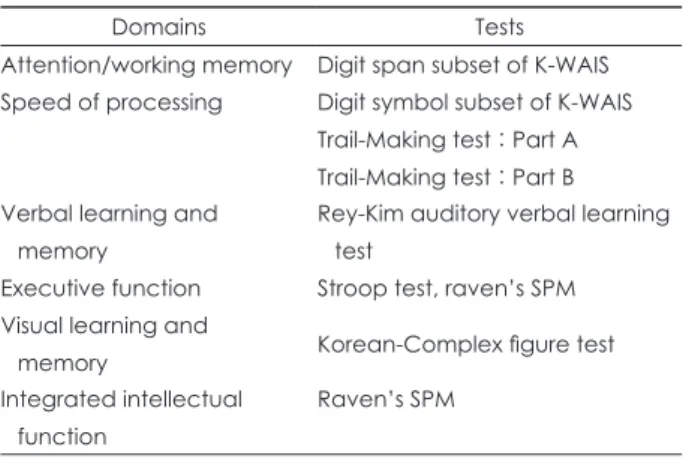
대상자들의 인지 기능은 주의력(attention), 작업 기억 (working memory), 처리속도(speed of processing), 언어 학 습 및 기억(verbal learning and memory), 전두엽 기능 및 실 행기능(executive function), 시각 학습 및 기억(visual learn- ing and memory)을 측정하였다. 주의력 및 작업기억을 측정하 기 위해 한국 웩슬러 성인용 지능검사(Korean-Wechsler Adult Intelligence Scale, K-WAIS)30)의 소검사인 숫자외우기(digit span), 처리속도를 측정하기 위해 K-WAIS의 소검사인 바꿔 쓰기(digit symbol)와 기호잇기검사(Trail making test)를 시 행하였다. 언어 학습 및 기억을 측정하기 위해 Rey가 개발한 청각 언어 학습 검사를 국내 실정에 맞춰 표준화 한 Rey- Kim Auditory Verbal Learning Test(RAVLT)31)를 시행하였 다. 전두엽 기능 및 실행기능(executive function)을 측정하기 위해 스트룹 검사(Stroop test)32)를 시행하고, 시각 학습 및 기 억을 측정하기 위해 그림을 보고 그린 후에 시각적 기억력을 측정하는 복합도형 검사(Korean-Complex Figure Test, K- CFT)31)를 시행하였고, 마지막으로 통합적인 인지기능 및 실 행기능을 측정하기 위해 Raven’s Standard Progressive Ma- trices(SPM)33)을 시행하였다(Table 1). SPM은 지각적 능력 과 시공간적 추론 능력을 기반으로 비언어적 추론 능력을 측정하는 것으로, 교육을 통해 습득된 지식 및 문화적 배경 이 영향을 주지 않도록 고안된 검사이다.34,35) 단순 지능검사
로서 뿐만 아니라 신경심리학적 평가도구로서도 유용성이 입증된 바 있으며, 인지적 유연성, 추상적 사고 등을 측정하 기 위한 도구로도 사용되고 있어 실행기능(executive func- tion) 을 평가한다고 볼 수 있다.36)
3. 분석 방법
유방암 환자군과 정상 대조군의 사회인구학적 변인 및 인 지기능에 따른 두 군의 차이를 비교 분석하였고, 정규성 가 정을 만족하는 경우에는 독립표본 t 검정(independent t- test)을, 정규성 가정을 만족하지 않는 경우에는 맨-휘트니 U 검정(Mann-Whitney U test)을 사용하였다. 유방암 환자 군에서 우울, 불안, 수면의 질 중 정상 대조군에 비해 유의한
Table 1. Neurophysiological tests and domains used to assess cognitive function in study participants
Domains Tests
Attention/working memory Digit span subset of K-WAIS Speed of processing Digit symbol subset of K-WAIS
Trail-Making test : Part A Trail-Making test : Part B Verbal learning and
memory
Rey-Kim auditory verbal learning test
Executive function Stroop test, raven’s SPM Visual learning and
memory Korean-Complex figure test
Integrated intellectual function
Raven’s SPM
K-WAIS : Korean-Wechsler Adult Intelligence Scale, Raven’s SPM : Raven’s Standard Progressive Matrices
Table 2. General characteristics and behavioral disturbances of study participants
Breast cancer patients(n=29) Non-cancer controls(n=20)
T(Z) p-value
n(%) n(%)
Age(mean±SD) 53.31±8.39 52.10±7.67 0.514 0.610
Education level Total years, mean±SD Elementary school Middle school High school College Above college
14.10±3.84 2(6.9) 2(6.9) 6(20.7) 15(51.7) 4(13.8)
13.50±2.59 0(0) 3(15.0) 5(25.0) 12(60.0)
0(0)
0.904 0.366
Income(KRW*104) Mean±SD Low(<2,200)
Middle-low(2,200-4,000) Middle-high(4,000-7,500) High(>7,500)
6237.93±4825.71 4(13.8) 8(27.6) 9(31.0) 8(27.6)
3790.00±2743.01 8(40.0) 6(30.0) 2(10.0) 4(20.0)
1.918 0.055
PSQI(mean±SD) 5.79±3.88 3.95±2.42 1.634 0.102
HRSD(mean±SD) 4.41±4.31 1.80±2.07 3.147 0.002
HAS(mean±SD) 3.93±3.04 1.50±1.73 4.083 <0.001
CCI(mean±SD) 1.76±0.95 1.70±0.98 0.272 0.785
PSQI : Pittsburgh Sleep Quality Assessment, HRSD : Hamilton Rating Scale for Depression, HAS : Hamilton Anxiety Scale, CCI : Charl- son Comorbidity Index
139 차이를 보이는 항목들과 각 인지기능 검사 항목들 간 상관
성은 피어슨(Pearson) 상관분석을 실시하여 평가하였다. 여 기서 우울 및 불안과 유의한 상관성을 보인 SPM 및 숫자외 우기를 각각 종속변수로, 우울 및 불안을 각각 독립변수로 하여 단순 회귀분석을 시행하였고, 이후 인지기능에 영향을 주는 것으로 알려져 있는 연령, 교육수준, 공존질환의 상호 영향을 통제하기 위해 다중 회귀분석을 실시하였다. 본 연 구에 사용된 모든 자료는 Statistical Package for the Social Sciences(SPSS) 23.0(SPSS Inc., Chicago, IL, USA)을 이용 하여 분석하였고, 통계적 유의성은 p<0.05로 하였다.
결 과
1. 대상자의 일반적 특성 및 질병 관련 특성
전체 대상자 49명의 평균 연령은 약 53세(범위 41~76세) 로, 교육 수준은 평균 13.86년이었으며, 대졸이 55.1%로 가장 많았다. 연 평균 가구소득은 사분위수에 따라 상, 중상, 중하, 하로 나누었고, ‘중하’라고 응답한 대상자가 28.6%로 가장 많 았다. 유방암 환자군과 정상 대조군을 비교 시 연 평균 가구소 득을 제외한 연령, 교육수준은 통계학적으로 유의한 차이를 보이지 않았다(Table 2). 유방암 환자군 29명 중 병기는 1기 가 48.3%로 가장 많았고, 화학항암요법을 받은 대상자는 72.4%(n=21)였다. 또한 방사선 치료를 받은 대상자는 75.9%
(n=22)였고, 호르몬치료를 받은 대상자는 69%(n=20) 였다 (Table 3).
한편 두 군간 우울과 불안의 정도, 수면의 질 및 공존 질환 을 측정한 결과, 두 군간 우울 및 불안 정도는 통계학적으로 유의한 차이를 보였고(p=0.002 ; p<0.001), 수면의 질과 공 존질환은 두 군에서 유의한 차이가 없었다(Table 2). 이 때 정상 대조군에 비해 유방암 환자군에서 우울, 불안 정도가 높 았고, 각각 평균 4.41점(범위 0~18점), 3.93점(범위 1~15점)
이었다.
2. 대상자의 인지 기능
유방암 환자군에서의 객관적 인지 기능을 측정하기 위해 평가한 결과 모든 항목에서 통계학적으로 유의한 차이를 보 이지 않았다(Table 4). 항암 치료를 받은 환자군(n=21)과 아닌 환자군(n=8)을 비교 시 복합도형 검사의 즉시회상(Z=-2.166, p=0.032) 및 지연회상(Z=-2.063, p=0.041)을 제외한 나머지 인지 영역에서는 유의한 차이를 나타내지 않았다.
3. 유방암 환자군에서 정서 요인이 인지 기능에 미치는 영향 유방암 환자군과 정상 대조군 간 우울, 불안, 수면의 질을 비교했을 때 유방암 환자군이 우울과 불안 점수가 더 높았 다. 이에 환자들이 호소하는 인지기능 저하가 정서 요인과 관련될 수 있다고 가정하고, 우울과 불안과 같은 정서 요인 들이 환자들의 인지 기능과 관련이 있는지를 알아보고자 하 였다. 상관분석 결과 우울 및 불안과 유의한 상관성을 보인
Table 3. Clinical characteristics of breast cancer patients Breast cancer patients(N=29)
n(%) Stage
0 1 2 3
1(3.4) 14(48.3) 12(41.4) 2(6.9) Chemotherapy
Yes No
21(72.4) 8(27.6) Hormonal therapy
Yes No
20(69.0) 9(31.0) Radiation therapy
Yes No
22(75.9) 7(24.1)
Table 4. Cognitive function measures of study participants
Breast cancer patients(N=29) Non-cancer controls(N=20) p-value
Digit span(mean±SD) 11.76±2.23 10.95±2.52 0.243
Digit symbol(mean±SD) 11.79±3.79 12.30±2.66 0.608
Trail making test A(mean±SD) 36.76±23.28 29.95±8.69 0.632
Trail making test B(mean±SD) 114.52±114.94 82.65±40.21 0.387
Raven’s SPM(mean±SD) 38.69±10.44 39.35±9.56 0.823
RAVLT(verbal memory) Recall(mean±SD) Recognition(mean±SD)
13.52±3.06 13.90±2.41
13.60±1.98 14.40±1.39
0.844 0.446
Stroop color 77.48±43.52 61.35±20.17 0.193
K-CFT
Immediate recall Delayed recall
12.66±2.96 12.59±3.15
12.25±3.19 12.25±3.54
0.566 0.870 RAVLT : Rey Auditory Verbal Learning Test, Raven’s SPM : Raven’s Standard Progressive Matrices, K-CFT : Korean Complex Figure Test
140
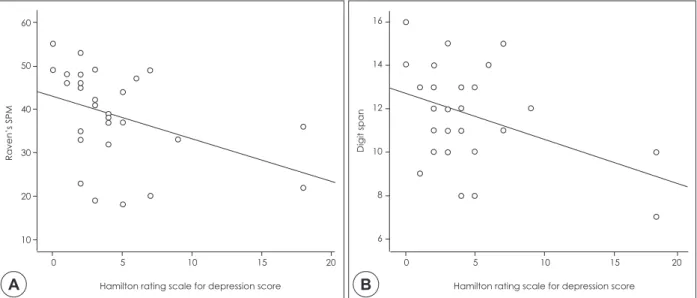
SPM, 숫자외우기, K-CFT의 지연회상을 각각 종속변수로 삼고 우울을 독립변수로 하여 단순회귀분석을 시행하였다.
그 결과, 우울할수록 SPM(R2=0.159, β=-0.399, p=0.032)과 숫자외우기(R2=0.168, β=-0.409, p=0.027)의 수행 점수가 낮 아졌고(Fig. 1), K-CFT 지연회상(R2=0.187, β=-0.433, p=
0.019) 역시 수행 점수가 낮아졌다. 불안을 독립변수로 하여 SPM 과 숫자 외우기의 수행 능력과의 연관성을 보는 회귀분 석을 시행하였을 때에도 비슷한 결과를 보였다. 즉, 불안 점 수가 높을수록 숫자 외우기(R2=0.199, β=-0.446, p=0.015)와 K-CFT 지연회상(R2=0.188, β=-0.433, p=0.019)의 낮은 수행 능력을 보였다. 다만, 불안은 SPM과는 유의한 관련성을 보 이지 않았다(Fig. 2).
이에 연령을 포함하여 인지기능과 연관이 있다고 알려져 있는 교육수준20)과 공존 질환24)을 공변인으로 통제한 후 다
중회귀분석을 시행하였다(Table 5). 공변인을 통제한 이후 SPM과 우울과의 관련성을 본 결과(모델 1) 우울할수록 SPM 수행능력이 낮음을 보였다(β=-0.336, p=0.001). 또한 연령, 교 육수준, 공존 질환, 우울이 SPM을 설명하는 설명력은 단순 회귀분석에서 우울이 SPM을 설명하는 설명력보다 높았다.
한편 공변인을 통제 후 불안과 SPM과의 관계를 본 결과(모델 2) 단순회귀분석에서 SPM과 유의한 연관성을 보이지 않았던 불안이 SPM과 유의한 관련성을 보였다(β=-0.273, p=0.009).
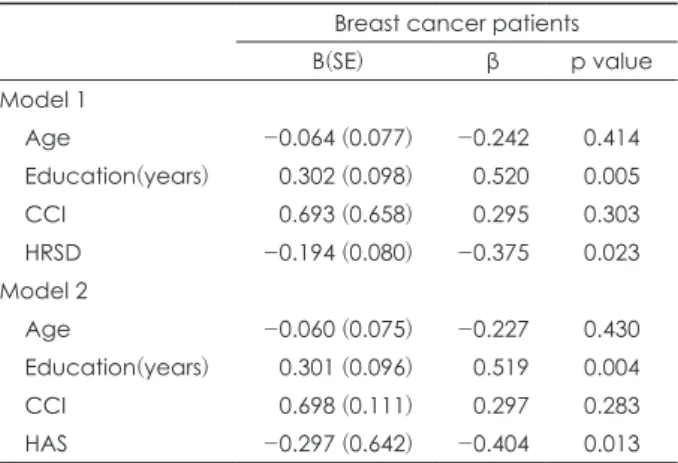
숫자외우기에 대해서도 마찬가지의 결과를 보여, 공변인을 통제한 이후 우울하거나 불안할수록 숫자외우기에 대해 낮 은 수행 능력을 보였다(Table 6). 연령, 교육수준, 공존 질환, 우울이 숫자외우기를 설명하는 설명력은 37.1%였고(β=
-0.375, p=0.023), 연령, 교육수준, 공존질환, 불안의 설명력 은 39.7%였다(β=-0.404, p=0.013). 반면 K-CFT 지연회상의
0 5 10 15 20 Hamilton rating scale for depression score 16
14
12
10
8
6
Digit span
0 5 10 15 20 Hamilton rating scale for depression score
60
50
40
30
20
10
Raven’s SPM
A B
0 2 4 6 8 10 12 14 Hamilton anxiety scale score
60
50
40
30
20
10
Raven’s SPM
0 2 4 6 8 10 12 14 Hamilton anxiety scale score
16
14
12
10
8
6
Digit span
A B
Fig. 1. Relationship between depression and cognitive function in breast cancer patients. A : Relationship between HRSD, Hamilton rating scale for depression score and Raven’s SPM, B : Relationship between Hamilton rating scale for depression score and digit span.
Fig. 2. Relationship between anxiety and cognitive function in breast cancer patients. A : Relationship between Hamilton Anxiety Scale score and SPM, B : Relationship between Hamilton Anxiety Scale score and digit span.
141
경우 공변인을 통제한 이후에는 우울 및 불안과 유의한 관 련성을 보이지 않았다.
고 찰
본 연구자들은 수술, 방사선 치료 및 항암 치료를 마친지 6개월 이상 경과한 유방암 환자 중, 인지 저하를 호소하는 사람들을 대상으로 주의력, 작업 기억, 처리속도, 언어 학습 및 기억, 전두엽 기능 및 실행기능, 시각 학습 및 기억 등 다 양한 영역의 인지 기능을 평가하였다. 그 결과 모든 영역에 서 정상 대조군과 유방암 환자군 간 유의한 차이를 보이지 않는 것으로 나타나 환자들이 호소하는 인지 저하는 객관적 으로 증명되지 않았다. 이것은 환자들이 주관적으로 느끼는 것과 실제로 검사를 통해 나타나는 인지 기능이 일치하지 않는다고 보고한 이전 연구들과도 일치하는 소견이다.17,37,38) 인지 기능이 다양한 영역을 포함하는 복합적인 기능이고 정 서 요인에 의해 영향을 받을 수 있다는 측면은 인지 기능에
대한 주관적 호소와 객관적 평가 사이의 불일치를 설명할 수 있다.39)
우울, 불안과 같은 정서 요인이 주관적 인지 저하와 관련 되고 객관적 인지 기능의 저하와는 관련성이 떨어진다고 보고됨에 따라15-17) 본 연구에서는 우울, 불안이 유방암 환 자들의 객관적 인지 저하와 관련되는지 알아보고자 하였다.
치료를 마친 유방암 환자들의 우울과 불안은 각각 평균 4.41(범위 0~18점), 3.93(범위 1~15점) 으로 정상 대조군 보 다 유의하게 높았고, 이에 유방암 환자군에서 연령과 교육 수준, 공존질환을 공변인으로 통제하고 다중회귀분석을 시 행한 결과, 우울하거나 불안할수록 숫자외우기의 수행 능력 은 저하된 것으로 나타났다. 숫자외우기가 주의, 단기기억 및 주의산만성의 정도를 측정하고, 불안, 우울 등의 감정에 영향을 받을 수 있는 소검사40)라는 점에서 유방암 환자들이 우울하거나 불안할수록 지속적으로 주의 집중력을 유지하는 데 있어 어려움을 호소하고 있음을 시사한다. 숫자외우기에 서 정상 대조군과 비교 시 객관적인 차이를 보이지 않았던 본 연구와는 달리 치료를 마친 유방암 환자를 대상으로 지 속적으로 주의력을 필요로 하는 과제를 수행하게 하였을 때 우울감이 심할수록 과제 수행 능력이 객관적으로 낮았다는 연구도 보고된 바 있다.41)
본 연구에서는 우울할수록 유방암 환자군의 SPM의 수행 능력이 유의하게 낮아짐을 보였다. 이는 SPM이 단순 지능 검사로서 뿐만 아니라 실행기능을 평가한다는 점에서36) 우 울할수록 유방암 환자들의 인지적 유연성이나 추상적 사고 능력이 저하됨을 시사한다. 더불어 실행기능은 목표를 성취 할 수 있도록 행동을 계획하고 수립하고 조직화 하도록 하 며, 주의, 언어, 시공간, 기억과 같은 하위 인지단계를 통제하 는 것으로 알려져 있다.42) 따라서 유방암 환자군에서 실행기 능의 저하는 다른 인지 영역 저하에 비해 낮은 삶의 질로 이 어질 수 있으므로 이에 대한 치료적 개입이 이루어져야 함 을 시사한다.
본 연구에서 항암치료를 받은 유방암 환자군과 받지 않은 환자군 간 복합도형 검사의 즉시회상 및 지연회상을 제외한 나머지 인지 영역에서는 유의한 차이를 나타내지 않았다.
이는 항암치료가 인지 기능 저하와 관련된다고 보고한 이전 연구들과 동일한 경향성을 나타내지만, 항암치료를 받은 환 자군이 21명, 받지 않은 환자군이 8명으로 표본 수의 불균 형이 심해 항암 치료를 받은 환자군에서 시각 학습 및 기억 력의 저하가 있다고 결론을 내리기에는 한계가 있다.
본 연구는 다음과 같은 제한점이 있다. 먼저 적은 연구 대 상자수로 인해 위 결과를 일반화하기에는 어려움이 있다.
또한 유방암 환자군에서 치료 전의 인지기능을 측정하지 않 아 실제로 치료 전에 비해 인지기능이 저하되었는지의 여부
Table 6. Multiple regression analyses of factors associated with digit span in breast cancer patients
Breast cancer patients
B(SE) β p value
Model 1
Age -0.064 (0.077) -0.242 0.414
Education(years) 0.302 (0.098) 0.520 0.005
CCI 0.693 (0.658) 0.295 0.303
HRSD -0.194 (0.080) -0.375 0.023
Model 2
Age -0.060 (0.075) -0.227 0.430
Education(years) 0.301 (0.096) 0.519 0.004
CCI 0.698 (0.111) 0.297 0.283
HAS -0.297 (0.642) -0.404 0.013
HRSD : Hamilton Rating Scale for Depression, HAS : Hamilton Anxiety Scale, CCI : Charlson Comorbidity Index
Table 5. Multiple regression analyses of factors associated with Raven’s SPM in breast cancer patients
Breast cancer patients
B(SE) β p value
Model 1
Age -0.477(0.204) -0.384 0.028
Education(years) 1.628(0.259) 0.599 <0.001
CCI 0.352(1.737) 0.032 0.841
HRSD -0.814(0.212) -0.336 0.001
Model 2
Age -0.423(0.223) -0.340 0.070
Education(years) 1.664(0.284) 0.612 <0.001
CCI 0.036(1.901) 0.003 0.985
HAS -0.940(0.329) -0.273 0.009
HRSD : Hamilton Rating Scale for Depression, HAS : Hamilton Anxiety Scale, CCI : Charlson Comorbidity Index
142
는 알 수 없다. 그리고 이전 여러 연구들에서 인지기능 저하 와 관련성을 보였던 폐경 여부,43) 유방암 진단 후 기간44) 등 의 일반적 특성을 포함하여 분석하지 못한 것과 치료 종결 후의 기간을 조사하고 통일하지 못한 점 또한 한계다. 마지 막으로, 대조군에서는 인지기능과 정서요인 사이의 상관관 계가 나타나지 않았다. 대조군의 경우, 우울과 불안 점수의 변량이 낮아 상관관계가 유의하지 않았을 수 있다. 그러나, 이 결과로 유방암 환자군에서만 고유하게 정서요인과 인지 기능이 관련있다고 판단할 수는 없으면 향후 추가 연구가 필 요한 부분이다.
이러한 제한점에도 불구하고 본 연구는 유방암 환자군 내 에서 보이는 임상적 역치 하에서의 우울 및 불안과 객관적 인지기능 사이의 관련성을 한 차례 더 분석하였다는 점에서 의의가 있다. 또한 기존 연구들이 인지 저하를 호소하지 않 는 환자들까지 인지기능 검사의 대상으로 삼았던 것과는 달 리45) 인지 저하를 호소하는 환자군만을 대상으로 정서 요인 과 객관적 인지 저하의 관련성을 알아볼 수 있었던 연구 디 자인이라는 점에서도 의미가 있다. 향후 더 많은 수의 동질 집단을 대상으로 한 대규모 연구를 진행한다면, 유방암 환 자들의 인지 저하와 정서 요인과의 관계를 보다 명확히 밝 힐 수 있을 것으로 생각된다.
결 론
본 연구에서는 인지 기능 검사를 통해 수술, 방사선 및 항 암 치료를 마친 유방암 환자들이 호소하는 인지 저하의 실 재 여부를 확인하고, 인지 저하 관련 요인을 조사하였다. 검 사 결과 유방암 환자군과 정상 대조군 간 객관적 인지 기능 의 유의한 차이는 없었으나, 유방암 환자군에서 우울 및 불 안 정도가 유의하게 높았다. 이에 환자군만을 대상으로 우울 및 불안과 인지 기능 간의 관련성을 분석한 결과, 우울할수 록 주의력 및 실행기능이 저하되고 불안할수록 주의력이 저 하됨을 보였다. 이는 유방암 환자군의 인지 저하가 우울 및 불안과 같은 정서 요인과 관련되어 있음을 나타내며 향후 유방암 환자들의 삶의 질 증진을 위해 우울 및 불안과 관련 한 치료적 개입이 필요함을 시사한다.
REFERENCES
(1) Cancer.go.kr. Cancer survival rate. Available at: http://www.
cancer.go.kr/mbs/cancer/subview.jsp?id=cancer_0403020000 00. Accessed December 20, 2016.
(2) Bower JE. Behavioral symptoms in patients with breast can- cer and survivors. J Clin Oncol 2008;26:768-777.
(3) Wefel JS, Vardy J, Ahles T, Schagen SB. International Cog- nition and Cancer Task Force recommendations to harmonise
studies of cognitive function in patients with cancer. Lancet Oncol 2011;12:703-708.
(4) McAllister TW. Cognitive functioning in the affective disor- ders. Compr Psychiatry 1981;22:572-586.
(5) Wefel JS, Schagen SB. Chemotherapy-related cognitive dys- function. Curr Neurol Neurosci Rep 2012;12:267-275.
(6) Falleti MG, Sanfilippo A, Maruff P, Weih L, Phillips KA.
The nature and severity of cognitive impairment associated with adjuvant chemotherapy in women with breast cancer: a meta-analysis of the current literature. Brain Cogn 2005;59:60- 70.
(7) Collins B, MacKenzie J, Tasca GA, Scherling C, Smith A.
Cognitive effects of chemotherapy in breast cancer patients:
a dose-response study. Psychooncology 2013;22:1517-1527.
(8) Wefel JS, Lenzi R, Theriault RL, Davis RN, Meyers CA.
The cognitive sequelae of standard-dose adjuvant chemother- apy in women with breast carcinoma: results of a prospective, randomized, longitudinal trial. Cancer 2004;100:2292-2299.
(9) Hermelink K, Untch M, Lux MP, Kreienberg R, Beck T, Bauerfeind I, Munzel K. Cognitive function during neoadju- vant chemotherapy for breast cancer: results of a prospective, multicenter, longitudinal study. Cancer 2007;109:1905-1913.
(10) Hermelink K. Chemotherapy and Cognitive Function in Breast Cancer Patients: The So-Called Chemo Brain. J Natl Cancer Inst Monogr 2015;2015:67-69.
(11) Pullens MJ, De Vries J, Van Warmerdam LJ, Van De Wal MA, Roukema JA. Chemotherapy and cognitive complaints in women with breast cancer. Psychooncology 2013;22:1783- 1789.
(12) Van Dyk K, Ganz PA, Ercoli L, Petersen L, Crespi CM. Mea- suring cognitive complaints in breast cancer survivors: psy- chometric properties of the patient's assessment of own func- tioning inventory. Support Care Cancer 2016;24:4939-4949.
(13) Debess J, Riis JO, Engebjerg MC, Ewertz M. Cognitive function after adjuvant treatment for early breast cancer: a population-based longitudinal study. Breast Cancer Res Treat 2010;121:91-100.
(14) Jenkins V, Shilling V, Deutsch G, Bloomfield D, Morris R, Allan S, Bishop H, Hodson N, Mitra S, Sadler G, Shah E, Stein R, Whitehead S, Winstanley J. A 3-year prospective study of the effects of adjuvant treatments on cognition in women with early stage breast cancer. Br J Cancer 2006;94:
828-834.
(15) van Dam FS, Schagen SB, Muller MJ, Boogerd W, vd Wall E, Droogleever Fortuyn ME, Rodenhuis S. Impairment of cognitive function in women receiving adjuvant treatment for high-risk breast cancer: high-dose versus standard-dose che- motherapy. J Natl Cancer Inst 1998;90:210-218.
(16) Schagen SB, van Dam FS, Muller MJ, Boogerd W, Linde- boom J, Bruning PF. Cognitive deficits after postoperative adjuvant chemotherapy for breast carcinoma. Cancer 1999;
85:640-650.
(17) Hermelink K, Kuchenhoff H, Untch M, Bauerfeind I, Lux MP, Buhner M, Manitz J, Fensterer V, Munzel K. Two dif- ferent sides of 'chemobrain': determinants and nondetermi-
143
nants of self-perceived cognitive dysfunction in a prospective, randomized, multicenter study. Psychooncology 2010;19:1321- 1328.
(18) 한오수, 홍진표. DSM-IV의 제1축 장애의 구조화된 임상적 면 담. SCID-I 연구용 판: 하나의학사;2000.
(19) Callahan CM, Hendrie HC, Tierney WM. Documentation and evaluation of cognitive impairment in elderly primary care patients. Ann Intern Med 1995;122:422-429.
(20) Mortamais M, Portet F, Brickman AM, Provenzano FA, Muraskin J, Akbaraly TN, Berr C, Touchon J, Bonafe A, le Bars E, Menjot de Champfleur N, Maller JJ, Meslin C, Sa- batier R, Ritchie K, Artero S. Education modulates the im- pact of white matter lesions on the risk of mild cognitive im- pairment and dementia. Am J Geriatr Psychiatry 2014;22:1336- 1345.
(21) Rock PL, Roiser JP, Riedel WJ, Blackwell AD. Cognitive impairment in depression: a systematic review and meta-anal- ysis. Psychol Med 2014;44:2029-2040.
(22) Breckenridge LM, Bruns GL, Todd BL, Feuerstein M.
Cognitive limitations associated with tamoxifen and aromatase inhibitors in employed breast cancer survivors. Psychooncolo- gy 2012;21:43-53.
(23) Fortier-Brochu E, Beaulieu-Bonneau S, Ivers H, Morin CM.
Insomnia and daytime cognitive performance: a meta-analysis.
Sleep Med Rev 2012;16:83-94.
(24) Mandelblatt JS, Stern RA, Luta G, McGuckin M, Clapp JD, Hurria A, Jacobsen PB, Faul LA, Isaacs C, Denduluri N, Gavett B, Traina TA, Johnson P, Silliman RA, Turner RS, Howard D, Van Meter JW, Saykin A, Ahles T. Cognitive impairment in older patients with breast cancer before system- ic therapy: is there an interaction between cancer and comor- bidity? J Clin Oncol 2014;32:1909-1918.
(25) Hamilton M. A rating scale for depression. J Neurol Neuro- surg Psychiatry 1960;23:56-62.
(26) Thompson E. Hamilton Rating Scale for Anxiety(HAM-A).
Occup Med(Lond) 2015;65:601.
(27) Buysse DJ, Reynolds CF, 3rd, Monk TH, Berman SR, Kup- fer DJ. The Pittsburgh Sleep Quality Index: a new instrument for psychiatric practice and research. Psychiatry Res 1989;28:
193-213.
(28) Sohn SI, Kim DH, Lee MY, Cho YW. The reliability and validity of the Korean version of the Pittsburgh Sleep Quality Index. Sleep Breath 2012;16:803-812.
(29) Charlson ME, Pompei P, Ales KL, MacKenzie CR. A new method of classifying prognostic comorbidity in longitudinal studies: development and validation. J Chronic Dis 1987;40:
373-383.
(30) Yeom TH PY, Oh JK, Kim TH. Korean version Wechsler Adult Intelligence Scale. Seoul: Korean Guidance;1992.
(31) 김홍근. 전두엽-관리기능 신경심리검사: 해설서. 대구: 도서출
판 신경심리;2001.
(32) Stroop JR. Studies of interference in serial verbal reactions [Ph D]. Nashville, Tenn.: George Peabody College for Teach- ers;1935.
(33) Raven J, Raven, J.C., & Court, J.H. Manual for Raven’s Pro- gressive Matrices and Vocabulary Scales. San Antonio, TX:
Harcourt Assessment;2003.
(34) Abdel-Khalek AM, Raven J. Normative data from the stan- darization of Raven’s standard progressive Matrices in Kuwait in an international context. Social Behavior and Personality 2006;34:169-180.
(35) Miklewska A, Kaczmarek M, Strelau J. The relationship between temperament and intelligence: Cross-sectional study in successive age groups. Personality and Individual Differ- ences 2006;40:643-654.
(36) Kim HK. What are real differences between intelligence and neuropsychological tests? Korean Journal of Clinical Psychol- ogy 2003;22:141-158.
(37) Schilder CM, Seynaeve C, Linn SC, Boogerd W, Beex LV, Gundy CM, Nortier JW, van de Velde CJ, van Dam FS, Schagen SB. Self-reported cognitive functioning in postmeno- pausal breast cancer patients before and during endocrine treatment: findings from the neuropsychological TEAM side- study. Psychooncology 2012;21:479-487.
(38) Hutchinson AD, Hosking JR, Kichenadasse G, Mattiske JK, Wilson C. Objective and subjective cognitive impairment following chemotherapy for cancer: a systematic review. Can- cer Treat Rev 2012;38:926-934.
(39) Bender CM. Chemotherapy may have small to moderate neg- ative effects on cognitive functioning. Cancer Treat Rev 2006;
32:316-319.
(40) Oh SW. Review of the Korean Wechlet adult intelligence scale- revised Wonkwang Psychiatry 1995;11:27-47.
(41) Kim LS, Hwang HS, Jon DI, Ham BJ, Seok JH. Dysfunc- tion of the neural network associated with sustained attention in cancer patients with clinically significant depressive symp- toms. Neurosci Lett 2008;447:1-6.
(42) Dirnberger G, Jahanshahi M. Executive dysfunction in Par- kinson’s disease: a review. J Neuropsychol 2013;7:193-224.
(43) Janelsins MC, Kohli S, Mohile SG, Usuki K, Ahles TA, Morrow GR. An update on cancer- and chemotherapy-related cognitive dysfunction: current status. Semin Oncol 2011;38:
431-438.
(44) Hedayati E, Alinaghizadeh H, Schedin A, Nyman H, Al- bertsson M. Effects of adjuvant treatment on cognitive func- tion in women with early breast cancer. Eur J Oncol Nurs 2012;
16:315-322.
(45) Wefel JS, Saleeba AK, Buzdar AU, Meyers CA. Acute and late onset cognitive dysfunction associated with chemothera- py in women with breast cancer. Cancer 2010;116:3348-3356.
144
국 문 초 록 연구목적
치료를 마친 유방암 환자들에서 인지 저하가 나타난다는 것이 알려져 있다. 인지 저하는 항암치료, 암이라는 질병 자체의 영향, 우울과 불안을 포함하는 정서요인 등의 다양한 원인들에 의해 나타날 수 있다고 알려져 있다.
그러나 인지 저하가 항상 신경심리검사 결과와 일치하는 것은 아니었다. 이에 본 연구는 주관적 인지 저하가 객 관적 인지기능 검사와 관련성이 있는지, 인지 저하의 관련요인은 무엇인지 알아보고자 하였다.
방 법
치료 종료 후 6개월이 지난 유방암 환자들 중 인지 저하를 호소하는 29명의 환자군과 동일한 연령대의 20명 의 정상 대조군이 연구에 참여하였다. 모든 연구 참여자들을 대상으로 신경심리검사를 시행하였고, 이후 다중회 귀분석을 통해 신경심리검사 점수와 우울, 불안을 포함하는 정서 요인과의 관련성을 평가하였고, 연령, 교육수 준, 공존 질환과의 연관성도 함께 알아보았다.
결 과
유방암 환자군과 정상 대조군 간 신경심리검사 결과의 차이는 없었다. 정상 대조군에 비해 유방암 환자군에 서 우울(p=0.002) 및 불안(p<0.001) 의 정도가 유의하게 높았다. 유방암 환자군 내에서 연령, 교육수준, 공존 질 환을 통제하였을 때 실행기능의 저하는 높은 우울(β=-0.336, p=0.001), 불안(β=-0.273, p=0.009)의 정도와 유의 한 관련이 있었다. 마찬가지로 주의력 저하도 높은 우울(β=-0.375, p=0.023) 및 불안(β=-0.404, p=0.013)의 정도 와 유의한 상관관계를 보였다.
결 론
연구 결과 환자들의 주관적 인지 저하와 객관적 인지기능 검사 결과가 일치하지 않는다는 것을 알 수 있었다.
이는 주관적 인지 저하가 우울이나 불안과 같은 정서적 스트레스의 지표로 나타날 수 있음을 시사한다.
중심 단어:유방암・인지저하・우울・불안.