• 검색 결과가 없습니다.

Evaluation of Pumping Characteristics of High Strength Concrete using Continuous Pumping System

N/A
N/A
Protected

Academic year: 2021

Share "Evaluation of Pumping Characteristics of High Strength Concrete using Continuous Pumping System"

Copied!
9
0
0

로드 중.... (전체 텍스트 보기)

전체 글

(1)

Journal of the Korea Institute of Building Construction, Vol. 11, No. 4

http://dx.doi.org/10.5345/JKIBC.2011.11.4.387 www.jkibc.org

Evaluation of Pumping Characteristics of High Strength Concrete using Continuous Pumping System

Kwon, Dae-Hun

1

Lee, Han-Seung

1

Jeon, Jun-Young

2

Jeong, Woong-Taek

3

Jo, Ho-Kyoo

3

Kim, Hyung-Rae

3*

Department of Architectural Engineering, Hanyang University, SangNok-Gu, AnSan, 426-791, Korea

1

R&D Center, EUGENE Group, DuckYang-Gu, GoYang, 412-480, Korea

2

R&D Center, HYUNDAI E&C, GiHeung-Gu, YongIn, 446-716, Korea

3

1)

Abstract

In the construction of tall-building, concrete pumping influences the success of the project. In order to establish pumping technology for high speed construction of tall building, study for quantitative evaluation of flow characteristics and pumpability should be conducted. So in this study, the characteristics including the inner pipe pressure, rheological properties of concrete and mortar through the continuous pumping test were evaluated. Then we analyzed the relations between rheological properties and pumpability. In the result of test, there are high correlations between the rheological characteristics which represented by yield stress and plastic viscosity and pressure loss with pipe length. Also, we estimated pressure loss according to conditions of concrete mix and pumping through the evaluation of inner pipe friction.

Keywords : concrete pumping, rheology, bingham model

1. Introduction

Concrete pumping technology has become an essential element for high-speed construction, and use of high-performance pump has also increased[1]. The evaluation and prediction of pumpability has become more and more important, and many studies related to characteristics of materials and the mechanisms of pumps have been conducted to improve pumpability[1,2]. Pumpability is often affected by the characteristics of fresh concrete[3,4]. However, the slump test, which has been used to evaluate the consistency of existing concrete, is no longer sufficient to evaluate the

Received : April 18, 2011 Revision received : June 9, 2011 Accepted : June 19, 2011

* Corresponding author : Kim, Hyung-Rae

[Tel: 82-31-280-7389, E-mail: [email protected]]

ⓒ2010 The Korea Institute of Building Construction, All rights reserved.

pumpability of the high-fluid and high-strength concrete which has recently been developed.

Therefore, the necessity for a method based on Rheology characteristics is increasing for quantitative and reasonable evaluation of concrete’

fluidity[5]. Since complicated factors affect concrete

when the fresh concrete is passing through a

pumping pipe, it is essential to use the Rheology

approach to evaluate and predict pumpability in

regard to fluidity, viscosity, resistant of slip and

segregation[2,3]. It is difficult to perform an

experiment to evaluate the concrete pumpability, so

there is almost no case of conducted experimental

study which have evaluated Rheology characteristics

and their effect on pumpability[4,5]. In this

research, change in characteristics of Rheology

according to pumping is measured by assuming

concrete as Bingham fluid, and comparing the

correlation between pumping characteristic and

Rheology properties. The purpose of this research is

(2)

Evaluation of Pumping Characteristics of High Strength Concrete using Continuous Pumping System

to establish a fundamental resource for predicting pumpability. Particularly, a 50m short-length pumping system which can continuously pump concrete was established for this study, to compare it with the results of vertical pumping on an actual construction site or the long span horizontal pumping test.

2. Pumpability and Concrete Rheology

The most direct indicator to determine concrete pumping performance is the maximum pumping load to need to pour the amount of concrete required.

Fundamentally, it is very important to select optimum pump equipment, and it is essential to consider losses and operational efficiency that might occur from installation of equipment and pipe.

As a way to calculate the pumping load of concrete pumps, Bernoulli's equation on pipe fluidity is suggested by many companies with high-pressure pumps. However, unlike situations where targeting Newton fluid, it is not appropriate to adapt this equation because concrete is in liquid-solid form.

The equation from Architectural Institute of Japan (Equation1) is the most common pumping load calculation. In other words, it is a function of the length of pipe for pumping concrete, pumping height, and concrete density where pressure loss occurs due to friction between the tube wall and concrete while the concrete is flowing in the pipe.

Thus, pumping load (P) of the pump can be calculated in advance by considering the pressure gradient, which changes depending on the flow characteristics of the concrete[2].

                 ×  ×  (1) where, P : pumping load applied to pump(N/㎟) K : pressure loss coefficient(N/㎟/m) L : length of straight pipe(m)

B : vent pipe length(m)

T : length of the tapered pipe(m) F : length of wrinkle pipe(m) W : unit mass of fresh concrete(t/㎥) H : pumping height(m)

On the other hand, pumping pressure loss of concrete is closely related to pumping speed or discharge per hour, which can be significantly changed by the mixing condition of the concrete.

Therefore, it is very important to understand the characteristics of fresh concrete to evaluate pumpability. In the past, slump flow of concrete, initial speed of L type flow, time to reach 50cm of slump flow were evaluation method generally used to understand pumpability of concrete. During the past 10 years, experiments to assess pumpability using a correlation between the result of concrete consistency measurements and pressure loss have actively been progressed. As new kinds of concrete, such as high-strength and high-fluidity concrete, are widely used, viscosity and friction resistance of concrete, which determine flow characteristics in pipe, have significantly altered. Therefore, in terms of pipe flow, attempt that want to evaluate pumpability of concrete are increasing. When pumping high-strength and high-fluidity concrete, especially, slip that occurs in concrete and inside the tube walls makes friction resistance. Such friction resistance becomes a critical element for predicting pressure loss[2,3]. Generally, pipe flow of concrete can be explained by movement of Bingham fluid, and as rheology indicator, yield stress and plastic viscosity as rheology constants are obtained by Equation (2).

    (2) where,  : shear stress(Pa)

: yield stress(Pa)

(3)

 : shear rate(1/s)

Rheology characteristics of concrete can be evaluated by an experiment that uses test devices, such as a 2-point test device and a rotational viscometer. As shown in Figure 1, plastic viscosity can be expressed as a slope between shear stress and shear rate. Yield stress means shear stress that starts to deform[6,7].

Figure 1. Flow curve for Bingham fluids

In the viewpoint of rheology, concrete, mortar, and cement paste represent different forms of suspension characteristics. Fresh concrete can be divided as matrix and particulate matter; the properties fluidity is often influenced by matrix viscosity and aggregate volume[9,10]. Therefore, to understand the rheology characteristics of concrete, it is necessary to compare and review the rheology characteristics of matrix and concrete, including the influence of the cement, the various kinds of admixture and binder However, there are no standard methods to identify the rheology characteristics of fresh concrete and mortar.

Moreover, the variances of the measurement results about yield stress and plastic viscosity are different depending on different researchers and measuring devices. Thus, it is advisable to analyze the correlation between pump ability and the rheology

comparison of measured samples and experimental conditions using the same test device[11].

3. Experiment

3.1 Experimental Factors and Level

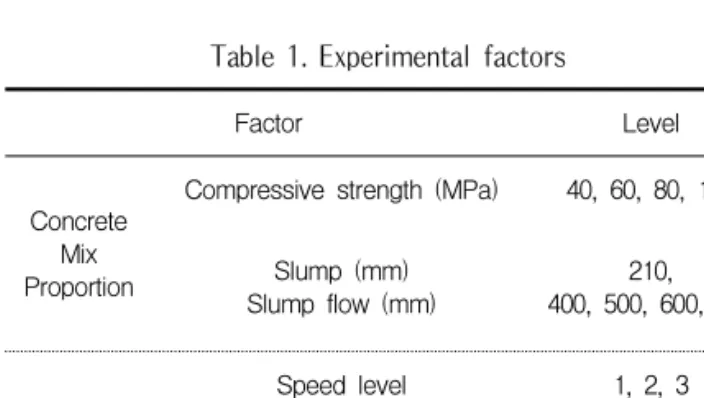
To find the influence of concrete fluidity on pumping pressure, compressive strength and flow test values of concrete were set as experimental factors for the mixing condition, and pumping speed and pumping elapsed time were set as factors for the pumping condition. Specifically, as it is expected that the changes in the amount of chemical admixture and binder used have the biggest influence on the concrete viscosity, 4 levels of concrete compressive strength (40MPa, 60MPa, 80MPa and 100MPa) were determined with each strength level having several target slump values. In the case of 40MPa, 210mm slump and 600mm of target slump level, in case of 60MPa, 500, 600, and 700mm of target slump level and in case of 80, 100MPa, 700mm of target slump level have been determined. Three pumping frequency levels of 5, 10 and 15 times per minute, were selected as the pumping condition. In addition, in sequentially circulating pumping, pumping frequency was set as about 10 times per minute and conducted for 25 minutes.

Factor Level

Concrete Mix Proportion

Compressive strength (MPa) 40, 60, 80, 100

Slump (mm) Slump flow (mm)

210, 400, 500, 600, 700

Pumping Condition

Speed level 1, 2, 3

Continuous pumping time

(min) 10, 25

Table 1. Experimental factors

(4)

Evaluation of Pumping Characteristics of High Strength Concrete using Continuous Pumping System

3.2 Materials and Mix Proportion

Tables 2∼4 show the physical properties of the materials used. In addition, as indicated in Table 5, AE Water reducing admixtures were used. Different kinds and amounts of admixture were used in accordance with expected concrete strength and target flow value. As Table 5 shows, the totals of 7 concrete mix designs were classified based on target strength. The evaluation of the difference in slump and flow is only adapted for a 60 MPa concrete mix design.

  OPC BFS FA

Fineness(㎠/g) 3326 4530 3229

Density(g/㎤) 3.14 2.88 2.22

Ignition loss (%)   1.23 3.80

Compressiv e strength

3day 31.8

- -

7day 41.8

28day 56.7

Table 2. Physical properties of cement and admixture

  Fine

aggregate

Coarse Aggregate

Density(g/㎤) 2.60 2.64

Absorption ratio (%) 0.99 0.57

Amount passing through

0.08mm sieve (%) 0.92 0.41

Fineness modulus 2.59 6.64

Table 3. Physical properties of aggregate

Density

(g/㎤) pH Viscosity (Pa‧s)

Solid Content (%)

Application mix

AD1 1.05 6.01 57.4 23.2 40MPa

(Slump 210)

AD2 1.05 6.08 58.1 22.4 40MPa

(Flow 600)

AD3 1.04 6.27 48.5 19.5 60MPa

AD4 1.06 6.11 67.0 24.2 80MPa

AD5 1.07 6.10 96.0 30.0 100MPa

Table 4. Physical properties of chemical admixture

Strength

(flow) W/C S/a Mix proportion(kg/m

3

) AD W OPC BFS FA SF S G (%) 40(210) 35.6 46.5 160 315 90 45 793 920 0.85 40(600) 35.1 45.5 165 329 94 47 - 762 920 1.05 60(500) 26.6 44.5 165 434 124 62 - 687 864 1.05 60(600) 26.6 44.5 165 434 124 62 - 687 864 1.20 60(700) 26.6 44.5 165 434 124 62 - 687 864 1.35 80(700) 22.0 43.5 165 503 188 - 60 618 809 2.20 100(700) 19.1 43.0 165 553 225 - 86 564 754 2.50

Table 5. Mix proportion of concrete

3.3 Experiment Methods

3.3.1 Physical Properties of Fresh Concrete This is an experiment to determine the changes in characteristics of fresh concrete before and after pumping. An evaluation before pumping was conducted was made right after mixing in the batch plant. The evaluation for after pumping was conducted after mixing for 25minute in the mixing truck and continuous pumping for first 10minutes continuously. Furthermore, in order to compare changes in properties of concrete caused by pumping, a test on the physical property was also conducted on the fresh concrete that was in the container for an hour without pumping.

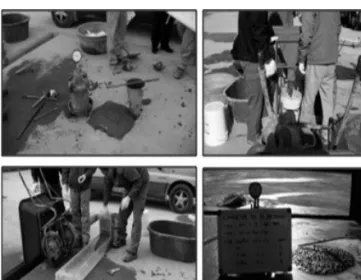
Figure 2. Consistency test of fresh concrete

3.3.2 Evaluation of Rheology Characteristic

As Figure 3 indicates, the Brookfield company’s

DV-III Rheometer is used in the concrete Rheology

characteristic test. The mortar used in the test was

taken from the concrete before and after pumping

by extracting coarse aggregate by sieving. Shear

stress and shear rate was calculated by torque of

spindle which was measured by gradually increasing

the spindle rotational speed in a sequence of 50,

100, 200, 250rpm and then decreasing [12,13].

(5)

Figure 3. Rheology test for mortar separated from concrete

3.3.3 Pumping and Pressure Measurement

In the pumping test, a pipe for high-pressure pumping with 125mm diameter was used and a short-length pumping system was consisted of 38m straight pipe in length and a 4m 90-degree bent pipe. As shown in Figure 4, the short-length pumping system is operated by making repeat pumping cycles of concrete inserted into the hopper of the concrete pump and then concrete is circulated in the repeat pumping system. Pumping pressure was measured by main pressure of pump cylinder and pressure sensor located at 3m (P1), 6.6m (P2), 39m (P3) respectively. The pressure sensor is a steel diaphragm type as shown in Figure 5, and pressure value is measured when concrete inside a pipe pressurizing pressure tap on the sense. The electronic signal measured from the sensor was converted by data acquisition system and saved simultaneously in the database.

Figure 4. Set-up for pumping test

4. Experiment Results and Analysis

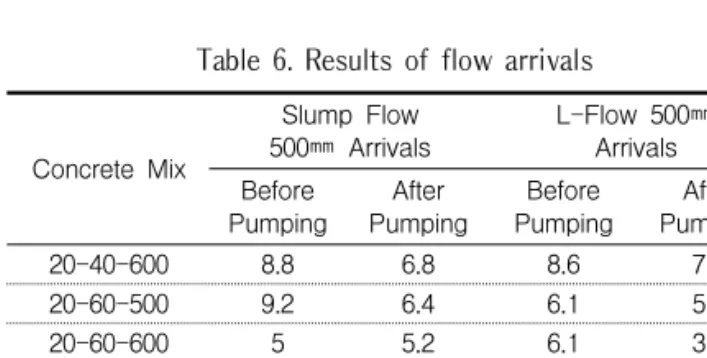
4.1 Change of Properties before/after Pumping Table 6 indicates the amount of time required to reach 500mm of slump flow and L type flow before and after pumping classified by mix. It is generally known that there is a tendency for decreasing consistency characteristics of slump flow and L type flow as viscosity of concrete after pumping decreases compared to before pumping. In this experiment, as shown in Figure 6, there was a similar tendency with the existing studies in the test result of slump flow and L type flow[3]. In most concrete mix conditions, test values after pumping showed a tendency to decrease. It had the same result in the test after on hour without pumping. On the other hand, visual degree of segregation was much severe because of the reduction of viscosity after pumping.

Therefore, to obtain construction quality of high-strength and high fluidity concrete after pumping, review and prediction in advance before pumping is required.

Concrete Mix

Slump Flow 500㎜ Arrivals

L-Flow 500㎜

Arrivals Before

Pumping

After Pumping

Before Pumping

After Pumping

20-40-600 8.8 6.8 8.6 7.3

20-60-500 9.2 6.4 6.1 5.8

20-60-600 5 5.2 6.1 3.3

20-60-700 5.2 4 4.6 2

20-80-700 6.3 4.5 4.8 2.7

20-100-700 13.8 4.9 13 5.6

Table 6. Results of flow arrivals

(6)

Evaluation of Pumping Characteristics of High Strength Concrete using Continuous Pumping System

Figure 6. Flow arrivals according to pumping and elapsed time

4.2 Rheology Characteristics of Mortar

Figure 7 shows the test results of plastic viscosity and yield stress of mortar according to concrete mixing conditions. Generally, the higher strength concrete, shows a higher rate of plastic viscosity and yield stress and in the case of 60MPa which has the same compressive strength, the higher slump flow shows a lower value of plastic viscosity and yield stress. On the other hand, in 40 MPa mix conditions, plastic viscosity and yield stress of slump flow 600mm increased much more than at slump flow 210mm as the result of using a different kind of admixture to satiate the target slump flow. As a result of measuring rheology characteristics of mortar before/after pumping and one hour after without pumping, Figure 8, 9 shows the general tendency of decrease in plastic viscosity and yield stress after pumping. According to the existing research, this is caused by a structural change between the pastes by internal pressure and friction when pumping of concrete occurs and this change causes viscosity degradation[6].

Figure 7. Rheology characteristics according to mix condition

Figure 8. Yield stress according to pumping and elapsed time

Figure 9. Plastic viscosity according to pumping and elapsed time

4.3 Concrete Compressive Strength Experiment Figure 10 indicates the experiment results for concrete compressive strength before/after pumping.

On 28 days, the measurement of concrete compressive strength before/after pumping exceeded designed compressive strength, and the rate of compressive strength after pumping was 5∼10%

higher which meant there was no problem with compressive strength. There was variation on the rate of compressive strength before/after pumping, but generally, the result after pumping was 3∼5%

higher, which means that internal concrete unit

quantity of water was decreased by pumping, and

consolidation effected by pumping pressure which

caused the elaboration of internal organization[14].

(7)

Mix proportion

of concrete Pumping method

Average of maximum pressure (bar) Stroke time

(sec) Number of discharge/hour

Δ P/L (Pa/cm)

Main pressure P1 P2 P3

20-40-600

Level1 17.84 3.78 3.74 2.08 13.42 268.26 52

Level2 66.11 16.21 14.96 3.71 5.69 632.69 379

Level3 109.50 26.30 24.42 5.51 3.42 1052.63 630

Rotation1 54.27 13.84 12.85 2.70 6.14 586.32 338

Rotation2 49.30 12.47 11.35 2.39 6.33 568.72 305

20-60-700

Level1 54.50 16.80 15.63 4.43 7.53 478.09 375

Level2 74.83 22.20 20.84 5.51 5.94 606.06 506

Level3 47.49 14.42 13.68 3.77 8.97 401.34 323

Rotation1 39.52 12.24 11.77 2.99 9.76 368.85 280

Rotation2 28.60 8.15 7.96 2.38 7.03 512.09 175

20-80-700

Level1 56.34 18.02 16.84 3.23 10.88 330.88 448

Level2 73.01 23.73 22.25 4.66 9.10 395.60 578

Level3 76.59 24.54 23.72 3.17 7.60 473.68 648

Rotation1 47.27 15.99 15.33 3.50 13.66 263.54 379

Rotation2 33.78 11.42 11.06 2.67 12.79 281.47 265

20-100-700

Level1 54.58 27.21 25.05 4.28 13.09 275.02 695

Level2 62.89 32.18 29.95 5.77 12.09 297.77 800

Level3 96.77 48.69 45.30 7.88 8.48 424.53 1237

Rotation1 65.18 33.62 31.47 4.97 11.29 318.87 868

Rotation2 37.24 18.21 17.21 3.46 11.00 327.27 447

Table 7. Results of continuous pumping system test Figure 10. Concrete compressive strength due to the pumping

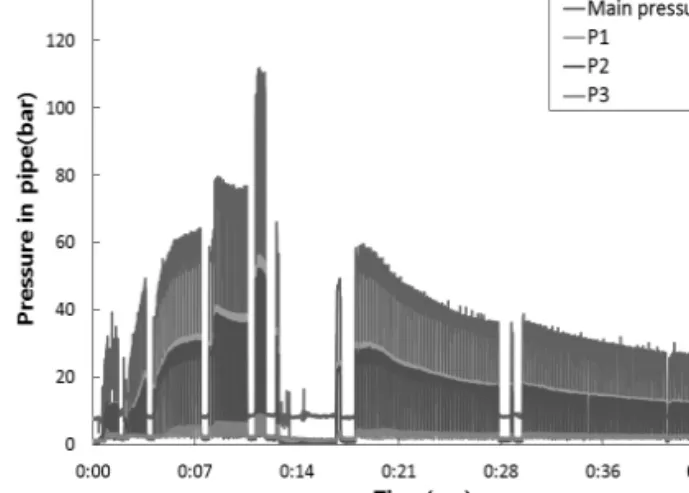
4.4 Characteristics of Pumping Pressure in Pipe Table 7 shows main pressure, average stroke time of pump cylinder and pumping frequency per hour with mix condition of concrete and pumping condition. Moreover, Figure 11 shows the result of positional pressure measurement in the case of different pumping speeds and repeated continuous pumping. In this figure, per elapsed time, pressure change tendency of 3 level pumping speeds from left, and continuous pumping can be known. The positional pressure means the average value of the highest pressure measured by every stroke, and

pumping by measuring the time for 15∼20 pumping which means the time from the start of one pulsation to the next pulsation.

Figure 11. Results of inner pipe pressure by each pumping method

4.4.1 Change Pressure by Mixing Condition

Figure 12 indicates the result of the positional

pumping pressure measurement with compressive

strength in case of continuous pumping. Generally,

the higher level of strength showed higher pumping

(8)

Evaluation of Pumping Characteristics of High Strength Concrete using Continuous Pumping System

pressure because viscosity of concrete goes higher and high pressure is required in case of pumping according to the lower ratio of water-cement and increase of volume of powder.

Figure 12. Pressure of inner pipeline at each pressure sensor

4.4.2 Change Pressure by Pumping Condition Figure 13 is the graph showing pressure loss change according to the pumping speed which shows the volume of pumping per hour in the horizontal pipe. According to the speed increase, in every mixing condition, pressure loss (or pressure gradient) per unit length increased, and when the level of strength increased, the pressure loss per unit length also increased.

Figure 13. Relation between pressure loss and actual discharge rate

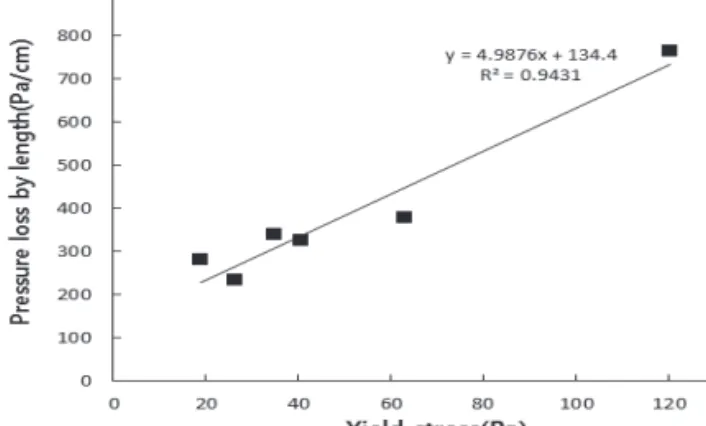
4.4.3 Corelation between Rheology and Pressure Figures 14 and 15 represent the relationship between yield stress and plastic viscosity and

pressure loss per unit length of mortar. Generally, when the measurement results increases, pressure loss also increases; this shows a high correlation which means there is a direct relationship between frictional resistance which occurs in the movement of concrete with high yield stress and plastic viscosity subjected to pressure in the pipe.

Figure 14. Pressure loss per pipe length by mortar yield stress

Figure 15. Pressure loss per pipe length by mortar viscosity

5. Conclusion

Through the continuous study on the characteristics of inner pipe pressure and rheology properties of high-strength and high-fluidity concrete utilizing continuous pumping, it is concluded that:

1) The consistency characteristics of fresh concrete

such as slump flow and L frame flow tests tended

to decrease before and after pumping. Because of

(9)

500mm seems to be reduced after pumping.

Therefore, the possibility of concrete segregation will be increased when pouring concrete into the form.

2) Yield stress and plastic viscosity, which is a rheology indicator of mortar, increased with higher concrete strength and it seemed to be reduced generally after pumping.

3) The research represents that when a higher strength of concrete was used, main pressure increased. Moreover, with increased pumping speed, the inner pipe pressure loss increased and when high strength concrete was used, the loss of inner pipe pressure increased because of the increase of viscosity in high-strength concrete.

4) There was a very high correlation between loss of inner pipe pressure and the rheology characteristic.

Therefore, it can be said that there is a direct relationship between yield stress and plastic viscosity.

Acknowledgement

This research is supported by a grant from High-Tech Urban Development Program funded by the Ministry of Land, Transport and Maritime Affairs. And thank for experimental support by R&D Center of Eugene Corporation.

References

1. Ji SW, Seo CH. Development of concrete pumping technology in high-rise buildings. Journal of the Architectural Institute of Korea. 2006 Apr;50(4):66-71.

2. AIJ. [Comprehensive evaluation of concrete pumpability-The 6th Association for research on pumping technology]. Tokyo (JP): Architectural Institute of Japan Pub; 2009. 99 p.

Japanese.

3. JSCE. [Concrete pump construction guide]. Tokyo (JP): Japan Society of Civil Engineers Pub; 2002. 229 p. Japanese.

Cement and Concrete Research. 2009 Nov;39(11):997-1006.

5. AIJ. [Method and construction guidelines for concrete pump].

Tokyo (JP): Architectural Institute of Japan Pub; 1994. 182 p. Japanese.

6. Tattersall GH, Banfill PFG. The rheology of fresh concrete.

Boston (MA): Pitman Advanced Pub. Program; 1983. 351 p.

7. Tattersall. G.H. The workability of concrete. Slough (UK):

Cement and Concrete Association; 1976. 138 p.

8. Chiara F, Ferraris. Measurement of the rheological properties of high performance concrete. Research of the National Institute of Standard and Technology. 1999 Sep-Oct;104(5) :461-78.

9. Tsong Yen, Kuang-Hong Chen. Flow behaviour of high strength high-performance concrete. Journal of the Cement and Concrete Composites. 1999 Dec;21(5-6):413-24.

10. Chidiac S.E, Mahmoodzadeh F. Plastic viscosity of fresh concrete - A critical review of predictions methods. Journal of the Cement and Concrete Composites. 2009 Sep;31(8):535-44.

11. Chiara F, Ferraris, Nicos S. Martys. Relating fresh concrete viscosity measrement from different rheometer. Research of the National Institute of Standards and Technology. 2003 May-Jun;108(3):229-34.

12. Kim KM, Yoo JK. Properties of water content variances in ultra high flowing concrete before and after the pumping operation. Journal of the Korea Concrete Institute. 2006 Feb;18(2):401-4.

13. Seo I, Lee HS, Park HG, Kim WJ. An experimental study on correlation between rheological parameter of picked mortar and fluidity of concrete from 30 to 150 MPa. Journal of the Architectural Institute of Korea. 2009 Oct;25(9):93-100.

14. Ko JH, Moon HJ, Seok WK Park SJ. A study on the 1:1 full

scale core wall mock-up test of high strength concrete

performed by testing pumpability. Journal of the

Architectural Institute of Korea. 2008 Aug;24(8):203-10.

수치

Table  1.  Experimental  factors
Table  3.  Physical  properties  of  aggregate
Table  6.  Results  of  flow  arrivals
Figure  7  shows  the  test  results  of  plastic  viscosity  and yield stress of mortar according to concrete mixing  conditions
+3

참조

관련 문서

Third, direct tensile strength tests showed that tensile performance appeared to be higher in cases where fiber volume fraction was high and in cases of 1% fiber volume

An evaluation of marginal fit of three-unit fixed dental prostheses fabricated by direct metal laser sintering system.. Marginal accuracy and fracture strength

In this way, it is possible to shorten the time of accident restoration and maintenance by minimizing the expression error of the high-strength facial

Within the limitations of this study, it is concluded that pretreatment of desensitizing agent (Seal&Protect) reduced the bond strength of two-step self-etch adhesive

• Lower w/c improve the rate of strength development at early age, can be used for precast concrete plant.

– Triaxial stress  hard to yield  more stress is needed to yield  higher  strength 

 Euler buckling strength of long column cannot be improved by higher- strength material since it is due to the instability of the column as a whole.  For a column

"Brazilian test: stress field and tensile strength of anisotropic rocks using an analytical solution." International Journal of Rock Mechanics and Mining