우리나라 주요 경제수종의 이용재적모델 개발
이대성 1⋅이정호1,3⋅서영완2⋅최정기 1*
1강원대학교 산림경영학과, 2강원대학교 산림과학연구소, 3강릉영동대학교 산림복지학과
Developing Merchantable Stem Volume Models for Major Commercial Species in South Korea
Daesung Lee 1, Jungho Lee1,3, Yeongwan Seo2 and Jungkee Choi 1*
1Department of Forest Management, Kangwon National University, Chuncheon 24345, Korea
2Institute of Forest Science, Kangwon National University, Chuncheon 24345, Korea
3Department of Forest Welfare, Gangneung Yeongdong University, Gangneung 25521, Korea
요 약: 본 연구는 국내 소나무, 잣나무, 낙엽송을 대상으로 입목의 총재적 중 상부직경 혹은 상부수고까지의 재적을 예측하 는 이용재적모델을 개발하고자 수행되었다. 모델개발을 위하여 사용된 자료는 강원 및 경북지역의 소나무림, 잣나무림, 낙엽 송림에서 수집한 총 131본의 수간석해목이었으며, 이용재적비율, 단순비율형태, 지수비율형태의 6개 이용재적식을 검토하여 최종모델을 개발하였다. 본 연구의 분석결과, 상부직경까지의 이용재적예측은 지수비율형태인 이 상 부수고까지의 이용재적예측은 단순비율형태인 이 최종모델로 선정되었다. 본 연구에서 선정된 2개 의 최적모델식을 정리하여 내재간곡선식을 도출하였으며, 이를 활용해 상부직경에 따른 상부수고와 상부수고에 따른 상부 직경 예측이 가능하였다. 본 연구결과에서 개발된 모델은 높은 정확도뿐만 아니라 임업현장에서 편리하게 사용할 수 있어 활용도가 높을 것으로 판단된다.
Abstract: This study was conducted to develop the merchantable stem volume models to predict the volume up to upper diameter or upper height out of the total stem volume, targeting on Pinus densiflora, Pinus koraiensis, and Larix kaempferi in South Korea. The 131 stemmed sample trees for stem analysis were used as the data for developing the models. The six kinds of merchantable volume equations including merchantable volume ratio form, ratio form, and exponential ratio form were examined to develop the best models. The two models were finally selected as the best models to predict the merchantable volume: for upper diameter and for upper height. By rearranging the best model equations, implicit taper functions were derived, and the estimation was performed for the upper height by upper diameter and upper diameter by upper height. Because of not only the high accuracy but also the convenience, the models developed in this study were considered to be easily applicable in the field of forestry.
Key words: upper diameter, upper height, ratio form, exponential ratio form, implicit taper function
서 론1)
임업의 목재생산에 있어 재적계산은 가격과 직결되므 로 그 중요성이 매우 크며(Son et al., 2016), 특히 임목부 위에 따른 목재의 용도가 다르며 이에 따른 가격차이가
* Corresponding author
E-mail: [email protected] ORCID
Daesung Lee http://orcid.org/0000-0003-1586-9385 Jungkee Choi http://orcid.org/0000-0001-8205-267X
발생하기 때문에 펄프재보다 용재로만 사용되는 세분화 된 재적량의 산출이 현장에서 더욱 유용하게 사용될 수 있다(Kwon et al., 2007; Lee et al., 2017a). 이와 같이 용도 에 맞추어 예측하고자 하는 상부직경 혹은 상부수고까지 의 재적을 이용재적이라 일컫는다(Burkhart, 1977; Burkhart and Tomé, 2012).
국내에서 이용재적은 특히 주요 경제수종인 소나무, 잣나 무, 낙엽송에 적용이 필요한 실정인데(Korea Forest Research Institute, 2012a, 2012b, 2012c), 현재 세 수종이 용재로 사용되는 재적량은 소나무 21.6%, 잣나무 5.6%, 낙엽송
JOURNAL OFKOREANFORESTSOCIETY ISSN0445-4650(Print), ISSN2289-0904(Online) http://e-journal.kfs21.or.kr
480
Species Statistics DBH (cm) Height (m) Volume outside bark (m3)
Volume inside bark (m3)
Pinus densiflora Mean 30.5 17.0 0.6707 0.6147
(n = 39) SD 8.5 4.1 0.3940 0.3715
Minimum 5.2 3.6 0.0067 0.0057
Maximum 47.3 23.8 1.6448 1.5234
Pinus koraiensis Mean 29.7 17.2 0.6888 0.6460
(n = 47) SD 7.9 4.4 0.4705 0.4441
Minimum 13.9 7.4 0.0527 0.0478
Maximum 45.9 24.6 1.9642 1.8368
Larix kaempferi Mean 27.8 22.8 0.7480 0.6688
(n = 45) SD 8.0 4.5 0.5160 0.4654
Minimum 17.0 12.2 0.1614 0.1401
Maximum 47.9 30.6 2.2803 2.0366
Table 1. Summary statistics of stemmed data to develop merchantable stem volume equations.
65.3%로 국산목재의 대부분을 차지하고 있다(Kim, 2017).
게다가 각 수종이 차지하고 있는 산림면적은 소나무 1,562,843 ha (66.8%), 잣나무 170,905 ha (7.3%), 낙엽송 272,800 ha (11.7%)로 국내 침엽수림의 대부분을 차지하 고 있다(Korea Forest Service, 2016). 이처럼 대단위 산림 면적에 분포하며 용재용 국산목재 공급의 90% 이상을 차지하는 소나무, 잣나무, 낙엽송에 이용재적식이 우선적 으로 제공될 필요가 있다.
국외에서 이용재적식은 총 수간재적 중 근원부부터 해 당 상부직경까지의 재적을 구하는 이용재적비율에서부 터 연구가 진행되어 왔다(Honer, 1964; Burkhart, 1977).
이후 상부수고까지의 재적비율을 계산하는 식을 개발하 였으며(Cao and Burkhart, 1980), 총재적과 이용재적비율 의 곱을 통하여 이용재적을 추정하는 식으로 발전하였다 (Knoebel et al., 1984; Amateis and Burkhart, 1987; Tassisa et al., 1997). 위 식은 통계적으로 더욱 유의하며 적합도 가 높은 지수비율형태의 식과도 비교하는 연구에 이르렀 다(Bullock and Burkhart, 2003).
국내에서는 Kozak 수간곡선식을 이용하여 말구직경 6, 9, 12 cm에 따른 이용재적을 산출할 수 있는 임목자원평 가프로그램을 제공하고 있지만(Korea Forest Research Institute, 2015), 고정된 상부직경에 대하여만 산출할 수 있어 이용자들에게 유연한 사용이 다소 제한되어 있다.
또한, 이용재적과 관련하여 목재수율 및 이용률에 대한 연구가 일부 수행되었지만(Kwon et al., 2007; Kwon et al., 2013; Son et al., 2016), 현장에서 흉고직경과 수고 정 보를 이용하여 간편하게 입목의 이용재적을 예측할 수 있는 연구는 아직 미흡한 실정이다(Lee, 2015).
따라서 본 연구는 국내 주요 침엽수종이자 경제수종인 소나무, 잣나무, 낙엽송을 대상으로 흉고직경과 수고를
이용하여 상부직경 혹은 상부수고에 따른 이용재적식을 개발하고자 하였다.
재료 및 방법
1. 연구재료
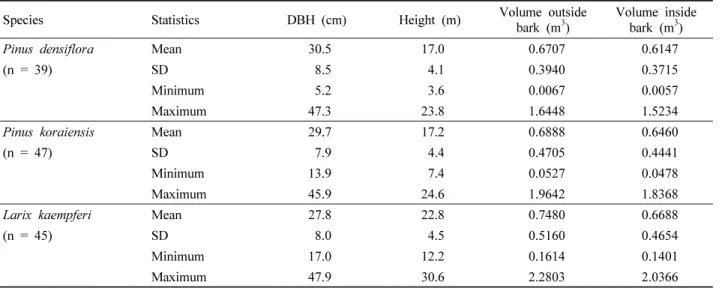
본 연구의 이용재적식 개발을 위해 강원 및 경북지역 의 소나무림, 잣나무림, 낙엽송림 내에서 벌도하여 수집 된 수간석해목 자료를 이용하였다(Lee et al., 2017b). 해 당 임목는 분지 및 절단이 없는 형질이 곧은 표준목을 대 상으로 하였으며, 수간석해 수집방법에 따라 원판 시료 를 수집하였다(Lee and Choi, 2016). 분석에 이용된 자료 는 소나무 39본, 잣나무 47본, 낙엽송 45본 이었으며, 소 경급부터 대경급까지 다양한 표본이 수집되었다(Table 1). 또한, 수종별 평균 흉고직경은 모두 대경급에 가까워 벌채 대상이 될 입목의 이용재적식 개발에 더욱 적합하 다고 판단되었다.
2. 분석방법
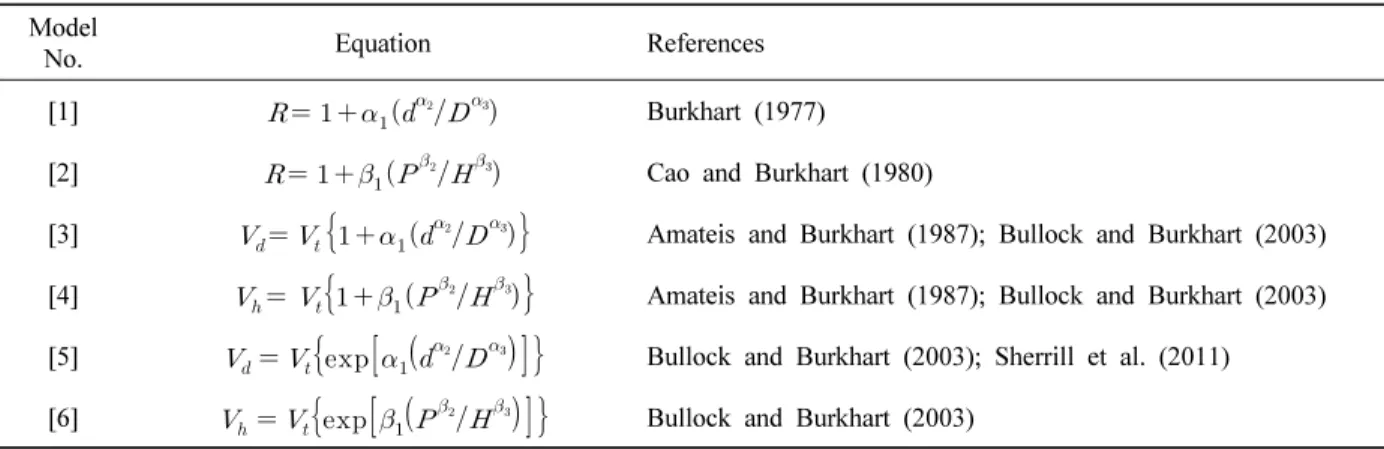
이용재적식의 산출을 위해 선행연구를 검토하여 6개의 이용재적모델을 최종적으로 선정하였다(Table 2). 선정모 델은 상부직경에 따른 이용재적을 예측하기 위해 사용된 Model 1,3,5와 상부수고에 따른 이용재적을 예측하기 위해 사용된 Model 2,4,6으로 구성되었다. 이 중 Model 1, Model 2는 이용재적과 총재적의 비율을 반응변수로 이용하였으 며(Burkhart, 1977; Cao and Burkhart, 1980), Model 3, Model 4는 총재적과 Model 1, Model 2에서 예측한 이용재 적비율의 곱을 해당 상부직경 혹은 상부수고까지의 이용 재적이라는 형태로 구성된다(Amateis and Burkhart, 1987;
Bullock and Burkhart, 2003). 마지막 Model 5, Model 6은
Model
No. Equation References
[1] Burkhart (1977)
[2] Cao and Burkhart (1980)
[3] Amateis and Burkhart (1987); Bullock and Burkhart (2003) [4] Amateis and Burkhart (1987); Bullock and Burkhart (2003) [5] Bullock and Burkhart (2003); Sherrill et al. (2011) [6] Bullock and Burkhart (2003)
Note: d is a diameter outside bark (cm); D is a diameter at breast height (cm); h is an upper height (m); H is a total height (m); P=(H-h), distance from the top of the tree, H, to the limit of utilization, h (m); Vd is a merchantable stem volume up to an upper diameter (m3); Vh is a merchantable stem volume up to upper height (m3); R is the ratio of a merchantable stem volume to a total stem volume, Vt is a total stem volume (m3); exp is the base of the natural logarithm; α1, α2, α3 are coefficients for merchantable stem volume up to an upper diameter; β1, β2, β3 are coefficients for merchantable stem volume up to uppper height.
Table 2. Candidate merchantable stem volume equations used in this study.
총재적에 곱해지는 비율을 지수비율형태로 표현하여 이용 재적을 예측하였다(Bullock and Burkhart, 2003; Sherrill et al., 2011).
한편 본 연구에서는 총재적에 대한 모델식은 추가적으 로 개발하지 않았으며 기존에 개발되어 높은 신뢰성와 적합도를 갖는 흉고직경, 수고의 이변수 재적식을 이용 하였다(Lee et al., 2017b). 총재적을 예측하는 모델의 경 우, 소나무는 식 1, 잣나무는 식 2, 낙엽송은 식 3과 같으 며, 모두 수피포함재적을 예측하는 식이다.
(1)
(2)
(3)
본 연구에서 이용재적모델의 파라미터 추정은 통계 패 키지 SAS 9.4의 PROC NLIN 프로시저를 이용하였다 (SAS Institute Inc., 2013). 모델검증을 위하여 결정계수 (R2, coefficient of determination), 평균제곱근오차(RMSE, root mean square error), 평균편차(MD, mean deviation), 평균절대편차(MAD, mean absolute deviation)를 사용하 였으며, 예측모델의 적합도와 신뢰성을 확인하고자 잔차 도를 검토하였다.
= measured volume for the th tree, = predicted volume for the th tree, = measured mean tree volume, = the total number of trees.
내재간곡선식(Implicit Taper Function)은 분석결과 선 정된 최적의 이용재적모델을 이용하여 유도하였다. 즉, 상부직경에 따른 이용재적 예측모델과 상부수고에 따른 이용재적 예측모델을 활용하면 형태의 식을 세울 수 있다. 이 식을 이용하여 상부직경 과 상 부수고 의 내재간곡선식을 유도하였다(Amateis and Burkhart, 1987; Bullock and Burkhart, 2003). 유도된 식 을 사용하면 흉고직경과 총수고와 더불어 특정 상부직 경이 주어졌을 때 상부수고를, 특정 상부수고가 주어졌 을 때 상부직경을 간편하게 구할 수 있다(Burkhart and Tomé, 2012).
Species Type Equation Parameters Fit statistics
α1 α2 α3 R2 RMSE MD MAD
Pinus densiflora dob 1 -0.1987 2.3916 2.0314 0.9333 0.0870 0.0112 0.0667
3 -0.1602 2.5786 2.1599 0.9623 0.0732 0.0039 0.0479
5 -0.5241 5.6665 5.3173 0.9893 0.0390 -0.0046 0.0234
dib 1 -0.3188 1.9341 1.6915 0.9230 0.0862 -0.0071 0.0710
3 -0.2691 2.1705 1.8813 0.9525 0.0770 0.0265 0.0531
5 -0.9058 4.6074 4.4110 0.9806 0.0491 0.0148 0.0265
Pinus koraiensis dob 1 -0.2922 2.4855 2.2407 0.9263 0.0920 0.0124 0.0673
3 -0.3234 2.6336 2.4189 0.9694 0.0786 0.0072 0.0491
5 -0.6640 5.8927 5.6347 0.9941 0.0344 -0.0053 0.0219
dib 1 -0.3619 2.2008 2.0068 0.9299 0.0840 -0.0023 0.0653
3 -0.3901 2.3530 2.1808 0.9646 0.0798 0.0259 0.0537
5 -0.8116 5.0065 4.8100 0.9897 0.0431 0.0113 0.0254
Larix kaempferi dob 1 -0.5173 2.4824 2.3871 0.9305 0.0870 0.0128 0.0675
3 -0.5126 2.4214 2.3236 0.9704 0.0830 0.0114 0.0569
5 -0.5238 5.2965 4.9443 0.9950 0.0342 -0.0037 0.0211
dib 1 -0.6098 1.9907 1.9284 0.9333 0.0760 -0.0057 0.0631
3 -0.5712 1.9726 1.8920 0.9549 0.0923 0.0466 0.0692
5 -0.7177 3.9427 3.6992 0.9795 0.0623 0.0295 0.0406
Note: dob is diameter outside bark; dib is diameter inside bark.
Table 3. Parameter estimates and fit statistics for nonlinear equations to predict merchantable stem volume outside or inside bark up to an upper diameter.
결과 및 고찰
1. 이용재적모델의 추정 및 검정
본 연구에서는 수종별 이용재적식에 대한 파라미터들 이 추정되었는데, 용도별 사용이 가능하도록 수피포함 및 제외를 구분하여 상부직경에 따른 이용재적모델을 개발하였다(Table 3). 추정된 파라미터들은 선행연구들 과 비교하여 과대 혹은 과소 추정된 값은 발생하지 않고 적합한 예측결과를 보여주었다. 검정통계량 분석결과, 수종별 수피여부에 따른 이용재적식 중 Model 5가 가장 작은 평균제곱근오차와 절대평균편차를 나타냈다. 또한, 잔차도 분석결과에서도 Model 1과 Model 3은 예측값에 따라 고른 잔차가 분포하지 않고 이상적이지 않은 형태 를 보인 반면에 Model 5는 전반적으로 작고 고른 잔차 분포를 나타냈으며, 이상적인 패턴을 보였다. 이에 따라 상부직경에 따른 최적의 이용재적식은 수종 및 수피여 부에 관계없이 Model 5로 선정되었으며, 본 연구의 최적 모델은 Bullock and Burkhart(2003)이 수행한 연구결과와 일치하였다.
상부수고에 따른 수종별 이용재적식에 대한 모델적합 에서도 선행연구와 비교하여 과대 혹은 과소 추정된 파
라미터들은 나타나지 않았다(Table 4). 모델들의 검정통 계량을 살펴본 결과 먼저 상부직경에 따른 이용재적모델 들보다 전반적인 검정통계량들이 더 작게 나타나 높은 적합도를 갖는 것으로 판단되었다. 또한, 상부수고에 따 른 최적 이용재적식은 예측모델 중 검정통계량의 값이 가장 작았으며 잔차도에서 예측값에 따른 잔차가 가장 작고 고른 분포를 보였던 Model 4로 선정되었다(Bullock and Burkhart, 2003).
2. 이용재적의 상부직경 및 상부수고 추정
상부직경 및 상부수고에 따른 이용재적을 추정하는 최적모델 Model 4와 Model 5를 이용하여 내재간곡선 식(Implicit Taper Function)을 유도하였다(Amateis and Burkhart, 1987). 내재간곡선식은 Model 4와 Model 5 두 식을 이용하여 산출되는 이용재적은 같다는 꼴이 활용되었다. 모델식을 상부직경 에 대하여 풀이하면 식 4 와 같은 함수식이 도출된다(Bullock and Burkhart, 2003).
× (4)
Species Type Equation Parameters Fit statistics
β1 β2 β3 R2 RMSE MD MAD
Pinus densiflora dob 2 -0.8968 2.4446 2.4109 0.9959 0.0217 0.0014 0.0154
4 -0.8330 2.3874 2.3288 0.9982 0.0160 0.0028 0.0109
6 -1.4991 3.7497 3.6044 0.9929 0.0319 -0.0057 0.0211
dib 2 -0.9846 1.8281 1.8338 0.9786 0.0455 -0.0139 0.0342
4 -1.0068 1.8844 1.8942 0.9931 0.0294 -0.0093 0.0216
6 -2.6027 2.9830 3.0365 0.9811 0.0486 -0.0199 0.0395
Pinus koraiensis dob 2 -0.8845 2.4549 2.4142 0.9946 0.0249 0.0015 0.0169
4 -0.8235 2.3958 2.3344 0.9966 0.0261 0.0013 0.0142
6 -1.4019 3.7585 3.5957 0.9916 0.0412 -0.0084 0.0242
dib 2 -0.9133 2.0505 2.0279 0.9881 0.0347 -0.0109 0.0278
4 -0.8510 2.0352 1.9906 0.9938 0.0334 -0.0086 0.0221
6 -1.5841 3.1772 3.0728 0.9838 0.0540 -0.0198 0.0393
Larix kaempferi dob 2 -0.8744 2.3768 2.3368 0.9972 0.0175 0.0015 0.0131
4 -1.0314 2.3934 2.4061 0.9992 0.0136 -0.0003 0.0095
6 -2.7114 3.7122 3.7680 0.9944 0.0360 -0.0097 0.0238
dib 2 -0.9516 1.7281 1.7273 0.9787 0.0430 -0.0132 0.0339
4 -1.1146 1.7774 1.8252 0.9906 0.0421 -0.0136 0.0274
6 -3.1426 2.7122 2.8468 0.9765 0.0666 -0.0255 0.0485
Note: dob is diameter outside bark; dib is diameter inside bark.
Table 4. Parameter estimates and fit statistics for nonlinear equations to predict merchantable stem volume outside or inside bark up to upper height.
또한 Model 4와 Model 5를 이용하여 상부수고 에 대하여 풀이하면 식 5와 같은 함수식이 도출된다(Bullock and Burkhart, 2003).
× (5)
도출된 식 4를 이용하면 흉고직경과 총수고를 알 때 상 부수고에 따른 상부직경을, 식 5를 이용하면 상부직경에 따른 상부수고를 예측할 수 있다. 비록 재적식의 최소제 곱법을 이용한 추정이므로 상부직경과 상부수고에 대한 최적 예측값은 아니지만 유도된 내재간곡선식을 통해 합 리적이며 정확하게 상부직경과 상부수고를 추정할 수 있 다(Amateis and Burkhart, 1987; Burkhart and Tomé, 2012).
3. 이용재적모델의 활용
본 연구에서 개발된 이용재적모델의 사용을 설명하고 자 흉고직경 40 cm, 총수고 30 m인 낙엽송을 예로 들어 해당 입목의 1) 상부직경 14 cm까지의 수피제외 이용재 적, 2) 상부수고 22 m 까지의 수피제외 이용재적, 3) 상부
직경 14 cm의 상부수고, 4) 상부수고 22 m의 상부직경을 예측하였다. 먼저 이용재적모델을 사용하고자 식 3을 이 용하여 낙엽송의 수피포함 수간총재적()을 산출한다.
×
×
다음으로 산출된 총재적()과 수피제외 이용재적을 산출하는 Model 4의 낙엽송 파라미터를 적용하면 해당 입목의 상부수고 22 m 까지의 수피제외 이용재적()을 계산할 수 있다.
상부직경 14 cm까지의 수피제외 이용재적()은 Model 5를 적용하여 다음와 같이 계산한다.
해당 입목의 상부직경이 14 cm가 되는 상부수고() 는 식 5에 해당 수종의 파라미터를 적용하여 산출한다.
×
×
마지막으로 상부수고 22 m 높이의 상부직경()은 식 (4)를 활용하여 아래와 같이 추정할 수 있다.
×
×
본 연구는 구하고자 하는 상부직경 및 상부수고에 따 라 이용재적을 유연하게 추정할 수 있으며, 내재간곡선 식을 이용하여 상부직경과 상부수고를 예측하는데 간편 하게 활용할 수 있다.
결 론
본 연구는 우리나라 주요 경제수종이자 대표 침엽수종 인 소나무, 잣나무, 낙엽송을 대상으로 상부직경과 상부 수고에 따른 이용재적을 예측하고 내재간곡선식을 이용 하여 상부직경과 상부수고를 상호적으로 추정하는 모델 을 개발하였다. 이용재적모델 개발은 강원 및 경북 지역 에서 수집한 수간석해목 자료를 활용하였으며, 이용재적 비율형태, 단순비율형태, 지수비율형태의 이용재적식을 다양하게 검토하여 최적모델을 선정하였다.
최종적으로 이용재적모델은 수피포함 및 제외에 따라
수종별로 개발하였으며 상부직경에 따른 이용재적 예측 은 지수비율형태인 Model 5에서 상부수고에 따른 이용 재적 예측은 단순비율형태인 Model 4에서 가장 적합도 가 높아 최적모델로 선정되었다. 더불어 선정된 최종모 델을 통해 개발된 내재간곡선식을 이용하면 상부직경과 상부수고를 추정할 수 있어 현장에서 편리하게 활용할 수 있을 것이라 사료된다.
References
Amateis, R.L. and Burkhart, H.E. 1987. Cubic-foot volume equations for loblolly pine trees in cutover, site-prepared plantations. Southern Journal of Applied Forestry 11(4):
190-192.
Bullock, B.P. and Burkhart, H.E. 2003. Equations for predicting green weight of loblolly pine trees in the South. Southern Journal of Applied Forestry 27(3): 153-159.
Burkhart, H.E. 1977. Cubic-foot volume of loblolly pine to any merchantable top limit. Southern Journal of Applied Forestry 1(2): 7-9.
Burkhart, H.E. and Tomé M. 2012. Modeling Forest Trees and Stands. Springer, New York, NY, pp. 457.
Cao, Q.V. and Burkhart, H.E. 1980. Cubic-foot volume of loblolly pine to any height limit. Southern Journal of Applied Forestry 4(4): 166-168.
Honer, T.G. 1964. The use of height and squared diameter ratios for the estimation of merchantable cubic foot volume.
The Forestry Chronicle 40(3): 324-331.
Kim KD. 2017. Domestic timber distribution condition and implication. Research report. National Institute of Forest Science, Seoul, pp. 16.
Knoebel, B.R., Burkhart, H.E. and Beck, D.E. 1984. Stem volume and taper functions for yellow-poplar in the southern Appalachians. Southern Journal of Applied Forestry 8(4): 185-188.
Korea Forest Research Institute. 2012a. Commercial Tree Species 1 Pinus densiflora. Korea Forest Research Institute, Seoul, pp. 250.
Korea Forest Research Institute. 2012b. Commercial Tree Species 3 Pinus koraiensis. Korea Forest Research Institute, Seoul, pp. 168.
Korea Forest Research Institute. 2012c. Commercial Tree Species 4 Larix kaempferi. Korea Forest Research Institute, Seoul, pp. 180.
Korea Forest Research Institute. 2015. Forest Tree Resources Assessment Program Manual ver 3.0. Korea Forest Research Institute, Seoul, pp. 41.
Korea Forest Service. 2016. The Statistical Yearbook of
Forestry 2016. Korea Forest Service, Daejeon, pp. 414.
Kwon, S.D., Kim, H.H. and Chung, J.S. 2007. Estimation of merchantable volume and yield using a stem shape simulation. Journal of Korean Forestry Society 96(3):
362-368.
Kwon, K., Han, H., Seol, A., Chung, H. and Chung, J. 2013.
Development of a wood recovery estimation model for the tree conversion processes of Larix kaempferi. Journal of Korean Forest Society 102(4): 484-490.
Lee, D.S. 2015. Studies on growth models for Larix kaempferi, Pinus koraiensis, and Pinus densiflora in Korea. Master thesis, Kangwon National University, Chuncheon, Korea.
Lee, D. and Choi, J. 2016. Estimating wood weight change on air drying times for three coniferous species of South Korea. Journal of Forest and Environmental Science 32(3):
262-269.
Lee, I., Lee, D., Seo, Y. and Choi, J. 2017a. Log production of major commercial species for sawtimber in Hongcheon region of South Korea. Journal of Forest and Environmental Science 33(3): 233-238.
Lee, D., Seo, Y., and Choi, J. 2017b. Estimation and validation of stem volume equations for Pinus densiflora, Pinus koraiensis, and Larix kaempferi in South Korea. Forest Science and Technology 13(2): 77-82.
SAS Institute Inc. 2013. SAS/STAT 9.4 User’s Guide. SAS Institute Inc., Cary, NC, USA.
Sherrill, J.R., Bullock, B.P., Mullin, T.J., McKeand, S.E. and Purnell, R.C. 2011. Total and merchantable stem volume equations for midrotation loblolly pine (Pinus taeda L.).
Southern Journal of Applied Forestry 35(3): 105-108.
Son, Y.M., Kang, J.T. Won, H.K. and Jeon, J.H. 2016.
Estimation of merchantable volume ratio by major species.
Journal of Korean Forestry Society 105(3): 330-335.
Tasissa, G., Burkhart, H.E. and Amateis, R.L. 1997. Volume and taper equations for thinned and unthinned loblolly pine trees in cutover, site-prepared plantations. Southern Journal of Applied Forestry 21(3): 146-152.
(Received: October 19, 2017; Accepted: November 15, 2017)