• 검색 결과가 없습니다.

Recycled Clothes and Its Characters Impact on Consumers' Consumption

N/A
N/A
Protected

Academic year: 2021

Share "Recycled Clothes and Its Characters Impact on Consumers' Consumption"

Copied!
9
0
0

로드 중.... (전체 텍스트 보기)

전체 글

(1)

*Corresponding Author : Pan-Young Hwan([email protected]) Received April 6, 2021

Accepted July 20, 2021 Revised June 26, 2021

Published July 28, 2021

Recycled Clothes and Its Characters Impact on Consumers’

Consumption

He-Luyao

1

, Pan-Young Hwan

2*

1

Ph.D Candidate, Dept. of Smart Experience Design, Graduate School of Techno Design, Kookmin University

2

Professor, Dept. of Experience Design, Graduate School of Techno Design, Kookmin University

재활용 의류와 그 특성이 소비자의 소비에 미치는 영향

하로요

1

, 반영환

2*

1

국민대학교 테크노디자인 전문대학원 스마트경험디자인학과 박사과정

2

국민대학교 테크노디자인 전문대학원 경험디자인학과 교수

Abstract The increasingly severe environmental problems such as resource depletion and ecological damage, and consumers' concern for sustainable fashion, make the fashion industry chain develop towards green energy saving. The purpose of this study is to explore the attitude and consumption psychology of specific groups towards sustainable fashion consumption, as well as their specific views and attitudes towards recycled textiles or fabrics for re-manufacturing clothing. This paper attempts to understand how the characteristics of recycled clothing affect consumer. Based on the review of relevant literature, a series of determinants affecting consumer behavior is determined, and the characteristics of recycled products, such as expression value and social value, are determined. An online questionnaire was designed based on this conceptual framework, and 226 valid, complete answers were received. The results show that the emphasis on social value and environmental protection consciousness can effectively affect consumers' decision-making. These findings were helpful to the research of whole green environmental protection and ecological clothing recycling industry system, promote the sustainable development of the clothing industry.

Key Words : sustainable fashion, recycled clothes, consumer behavior, sustainable design, green purchase intention

요 약 자원 고갈, 생태 파괴 등 날로 심각해지는 환경문제와 지속가능한 패션에 대한 소비자들의 관심은 패션 산업 사슬 을 녹색 에너지 절약 방향으로 발전하게 하였다. 본 연구는 특정 집단의 지속가능한 패션 소비에 대한 태도와 심리를 탐 구하고 재생 방직품 또는 재제조 의류 원단에 대한 그들의 구체적 인식과 태도를 탐구하는데 취지를 두었다. 본문은 구제  의류의 특성이 소비자에 미치는 영향에 대해 알아보았다. 관련 문헌자료를 찾아본 기초에서 소비자에 영향을 주는 일련 의 결정적 요소와 재생품의 표현 가치, 사회적 가치 등 특징을 확정했다. 이 이론적 배경에 근거해 온라인 설문조사를 설 계했으며 총 226개의 유효 응답을 받았다. 조사 결과에 따르면 사회적 가치와 환경보호에 대한 중시가 소비자의 결정에  영향을 미치는 것으로 나타났다. 이상 연구 결과는 전체 녹색 환경보호와 생태 의류 회수 산업 체계의 연구에 도움이 되 며 의류 산업의 지속가능한 발전을 추진한다.

주제어 : 지속 가능한 패션, 재활용 의류, 소비자 행동, 지속 가능한 디자인, 그린 구매 의도

(2)

1. Introduction

Increased energy consumption and environmental pollution are two of the most critical challenges in the 21st century. One way to overcome these challenges is to increase recycled materials and adopt environmentally friendly manufacturing methods. Over-consumption of clothing has led to a dramatic increase in the number of textile wastes. The state of the economy and consumer behavior is the leading cause of the textile waste issue[1]. Textile consumption has significantly increased, which in turn encompasses about 5%

of landfills. Pollution caused by the clothing industry has become the second-largest pollution source, following the oil industry, posing a significant threat to the global environment.

Clothing production has led to higher processing problems, resulting in huge waste, which also exacerbated the scarcity of natural resources.

The clothing industry has become the second-largest pollution industry in the world.

One of the important reasons behind this is that no one wants to use the waste fashion materials.

Once used, 75% of the clothing materials will not be reused or recycled[2]. In addition to environmental issues, it may also pose potential risks to social, moral, and health factors.

Sustainable fashion is increasingly concerned,

and the fashion industry is accepting changes, although it is inevitable[3]. Therefore, building a green fashion industry and adhere to sustainable development are advocated and respected. At the same time, many brands have been looking for more effective ways to recycle waste textiles or clothing. Many fast fashion brands also provide many related recycling projects and put forward some recycling schemes[4]. The formation of a green circular economy needs balanced development and coordination in many aspects.

In the clothing industry, recycling and reusing waste materials as much as possible, such as recyclable clothing, fabrics, and textiles, for

secondary design or treatment, may be a relatively simple and effective way to achieve sustainable development[5]. 

Utilizing a circular economy model is of utmost importance in ensuring sustainability and reducing environmental impacts in the textile and apparel sector. Recycling textile waste is a requirement for the implementation of a circular model[6]. Many solutions and measures have been put forward, such as ‘zero waste’ clothing design, organic fabric design, waste textile recycling, and textile recycling. The third stage of the waste disposal method is to design for reuse and realization of ‘zero waste’. ‘Zero waste’

means waste reduction, reusing products, and recycling resources[7]. The recycling system is a sign of sustainable environmental protection, such as the improvement of urban recycling system, designers' exploration of secondary design methods, the development of recycling artificial intelligence technology, the research of new materials.

Researchers tend to focused on sustainable

materials, and sustainable development or designer

should also consider how fashion products have

been manufacturing or consuming[8]. Logically

speaking, there are three units involved in the

recycling of clothing products: the supplier

(brand side), the demander (consumer), and the

regulator (government and industrial

organization). As one of the most important

links, consumers' cognition and attitude towards

the sustainable development of green fashion,

such as the recycling and reuse of clothing, are

few. In addition to the indispensable role of the

supplier, consumer-related factors, such as lack

of consumer awareness, inappropriate retail

environment, and social norms, are crucial for

green consumption. Consumers' adoption of

environmental fashion products depends on

consumers' educational understanding of

reducing waste and environmental impact. So it

is essential to understand how consumers' moral

(3)

values are shaped by different factors and provide informative guidelines for developing recycled clothing products[9]. This study focuses on consumers' perspectives and aims to outline a clear and up-to-date picture of how consumers make decisions under different degrees of consciousness, such as the factors that affect consumers' decision-making. This paper reviews the relevant literature to establish a unified conceptual framework to analyze the components and aspects of attitudes towards recycled clothing. On the other hand, we this study carefully designed a structured questionnaire to understand consumers' choices and behaviors.

For example, whether environmental protection and resource recycling awareness will change with variables or related to the price, gender, and education level of recycled clothing products.

2. Literature Review

2.1 Recycling and reuse of waste clothing and textile

Clothing waste mainly comes from three aspects. Textile waste refers to the industrial waste generated in the supply chain of clothing and textile product design, supply, production, distribution, and sales. It also includes the use of waste generated by consumers, and the process of buying, damaging, wearing, and discarding fashion and textiles. Specifically, the generation of textile waste divides into the following three stages. The first is the production of textile waste in factories; Second, the damaged, defective, or unsold clothing products in sales. Third, post-consumer textile waste can be defined as clothing and textiles that consumers no longer want to use after purchase[10]. These clothing and garments may be worn out, damaged, outdated, or no longer favored by consumers for various reasons. Given the exponential growth of

garment waste, researchers, manufacturers, and consumers pay more and more attention to the management and disposal of textile waste. For example, the recycling system and sustainable development of the clothing industry are proposing. First of all, a green recycling system symbolizes sustainable environmental protection, such as improving the urban recycling system, designers' exploration of the secondary design method, recycling artificial intelligence technology, or researching new materials. "Circular fashion"[11]

is a relatively new concept that combines circular economy and sustainable fashion. A circular economy is not a linear economy based on the production model of "take manufacture disposal." Still, a closed-loop economy minimizes environmental pollution by recycling waste and reducing resource consumption [12]. Both

"circular fashion" and sustainable fashion design belong to the category of "slow fashion." They are products after a long period of "treatment."

In other words, they refer to a kind of regeneration system, which considers resource efficiency, non-toxicity, biodegradability, life span, and recyclability from the design of clothing products to the treatment of clothing products. Their mission is not to cause social and economic losses or environmental damage.

2.2 Commodity characteristics and value of recycled clothes

In the scope of this paper, recycled clothing always appears as the definition of a commodity.

Therefore, it must conform to the definition and related attributes of a commodity in economic activities. Customer demand determines product value. Customer needs determine product value.

In analyzing product value, we should pay

attention to different requirements of customers

for products in different periods of economic

development. The factors that constitute product

value and the relative importance of various

elements will also be different. For example, in a

(4)

time of economic depression, due to the long-term shortage of products, people regard obtaining products as more important than the characteristics of products; Therefore, in today's increasingly rich market commodities and the general improvement of people's living standards, customers tend to pay more attention to the characteristic quality of products, such as complete functions, high quality, novel style and so on. As citizens become more and more affluent, many consumers' purchase choices are no longer limited to the functionality and cost performance of products, no longer focus on materialism or practicality of products, but also look for products based on altruism of products, especially in the aesthetic value and ecological value of products [13,14]. The production and use of clothing are related to severe environmental problems. Unlike other products, clothing products have an ecological impact and involve many other aspects of sustainable development. The consumption of recycled clothing is of great significance for environmental protection and sustainable development.

2.3 consumers' environmental awareness and green consumption view

As mentioned earlier, unlike other clothing products, as a commodity, the essential value of recycled clothes is reflected in the ecological value and social value. Consumers' environmental awareness and green consumption view play a decisive role. Their essential attitude towards social and ecological problems and their understanding of clothing-related problems may affect their consumption and use. Consumers' environmental awareness and green consumption views are often related to social and cultural background, personal social responsibility, government and enterprise guidance. There are many types of research on the influencing factors of green consumption behavior from three aspects of attitude, perception, and sense

of responsibility. There is also a lot of research literature from the attitude, perception, and sense of responsibility, and other psychological factors to explore the impact of green consumption behavior [15]. From the perspective of psychology, human needs arrange by potential forces. In other words, the emergence of a person's needs usually depends on the prior satisfaction of another potential need [16]. When it meets the needs of the essential functions of clothing, consumers will turn to a higher level of demand. Wealthy individuals no longer focus on basic needs or survival, so they have more opportunities and freedom to look for the added value of products, such as sustainable or recyclable products [17]. Partial research shows that consumers' green consumption concept is related to age, gender, income level, education level, and other factors, such as teenagers, women and high-income groups' green consumption behavior tendency is more apparent [18,19].

3. Methodology

This paper has reviewed the references and has combined a self-administered online questionnaire. In the survey, offline interviews conduct for the participants who were willing to describe more. The self-administered online questionnaire fills involuntarily online, and the authority is open. The final participants in the questionnaire are from China and South Korea. The whole questionnaire divides into three parts. The first part of the questionnaire revolves around the basic information of the participants, involving the gender, age, and education level of the participants, which is also the first statistical object to be considered when studying consumer decision-making.

The second part focuses on the participants'

basic and original understanding and views on

recycled clothing. As a premise, the

(5)

questionnaire explained to the participants the setting of hypothetical product objects. They are products A: Clothing made from recycled waste fabrics and textiles through cleaning and other processes; Product B: Garments made of non-recyclable fabrics. The first c question is as following: "now you are ready to buy a certain garment. When you know that its material sources are different (appearance, texture, and price are entirely the same), you will choose A or B?”. In the specific question setting, several factors and assumptions are adjusted, such as product price, the meaning of environmental awareness, to explore the choice of participants and the impact on the final research data.

Specific questions include some assumptions, such as asking participants whether they will change their choices after adjusting the percentage of product price. In the part of the literature review, as mentioned that, consumers' environmental awareness and social responsibility may be related to their relevant background, which will also affect consumers' attitudes towards recycled clothing. Then, the questionnaire further emphasizes that "A "may be more conducive to environmental protection, in line with sustainable economic development, while

"B" may aggravate industrial pollution, excess clothing production will cause more serious environmental problems, to get answers from participants.

The third part of the questionnaire sets up questions about comprehensive factors, like consumers' attitudes towards environmental and ecological protection or price modifications. In order to verify the relationship between the participants' background and their environmental awareness and social responsibility, and whether the correct concept of green consumption can affect consumers' attitude towards recycled clothing, and how the characteristics and characteristics of recycled clothing affect consumers' behavior, we conducted single item

analysis and cross analysis on the data obtained from the questionnaire.

4. Results

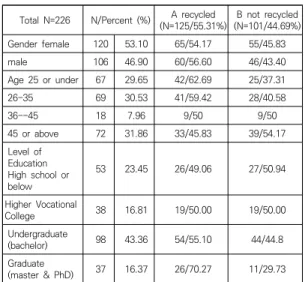
A sum of 226 valid questionnaires has been collected in the analysis. All the participants completed all the questions in the questionnaire without omission. Though the first part of the questionnaire, which is about the essential background of participants, we know that among the participants as shown in Table 1: 120 were female, accounting for 53.10%; 106 were male, accounting for 46.90%. The number of men and women participating in the survey was similar and balanced. 67 people under 25 years old, accounting for 29.65%; 69 people aged 26-35, accounting for 30.53%; 18 people aged 36-45, accounting for 7.96%; Over 45 years old 72, accounting for 31.86%. 53 (23.45%) graduated from high school / technical secondary school or below; 38 (16.81%) had a higher-vocational- college degree; 98 (43.36%) had undergraduate (Bachelor) education; 37 people with master's degree or above, accounting for 16.37.

After explaining product A (clothing made of recycled waste fabrics and textiles) and product B (clothing not made of recycled waste fabrics and textiles)to participants, participants made the first round of choices, as shown in Table 1. A total of 125 people (55.31%) chose A and 101 (44.69%) chose B. It can be seen that most participants are more inclined to environment-friendly clothing products without any other factors. The environmental protection and social welfare of product materials will also significantly affect consumers' decision-making.

Consumers begin to pay attention to or support

green producers and manufacturers. They are

not affected by the price or other factors and are

even willing to spend more money on green

goods. The results of a survey with Cohn & Wolfe

(6)

have been [20], more than 60 percent of consumers want to buy from companies responsible for the environment, and more than 30 percent plan to spend more on green products, the survey said.

From the table 1, it can be found that more than 50% of participants over the age of 45 choose option B. From the proportion of the

"age" group, it can be seen that the proportion of B selection (37.31%, 40.58%, 50% and 54.17%) increases with age, and it can be concluded that young people are more likely to buy clothes made from recycled materials than older people. 

Total N=226 N/Percent (%) A recycled

(N=125/55.31%) B not recycled (N=101/44.69%) Gender female 120 53.10 65/54.17 55/45.83

male 106 46.90 60/56.60 46/43.40

Age 25 or under 67 29.65 42/62.69 25/37.31

26-35 69 30.53 41/59.42 28/40.58

36--45 18 7.96 9/50 9/50

45 or above 72 31.86 33/45.83 39/54.17 Level of

Education High school or below

53 23.45 26/49.06 27/50.94

Higher Vocational

College 38 16.81 19/50.00 19/50.00

Undergraduate

(bachelor) 98 43.36 54/55.10 44/44.8

Graduate

(master & PhD) 37 16.37 26/70.27 11/29.73 Table 1. Demographic profile of participants.

The proportion of women who choose a is 54.17%, and that of men is 56.60%. There is little difference between men and women in the choice of recycled clothing. 

From the perspective of education level, 26 graduate students chose A, accounting for 70.27%, while the other three groups were "undergraduate (Bachelor)" 55.1% 、 "Higher Vocational College"

50%、and "high school or below" 49.06%. The data can support the point that consumers with higher education are more likely to purchase clothes made from recycled materials. 

The next survey mainly focuses on the balance

and exploration of comprehensive factors. One of the crucial factors is environmental protection and ecological problems, which also involves the attitude and ideas of the participants when environmental problems are involved in clothing products. Combined with offline interviews, we summarize the ideas and awareness into four levels. A: A suitable living environment is essential, willing to protect the environment and resolutely eliminate harmful clothing products, unconditional support for environmental protection, and public welfare projects. B:  Will consider environmental protection and ecological issues, tend to purchase environment-friendly clothing products, and will feel proud and happy because of the actions. C: There is a certain distance between environmental pollution and real life. In clothing consumption, this aspect is rarely being considered. D: Only consider the aesthetic and cost performance of clothing, do not care whether it will damage the environment, always choose "new" clothing. The degree of environmental friendliness decreases from A to D. The total number shows: A.45(19.91%);

B.140(61.95%);C. 23(10.18%); D.18(7.96%). Based on the total number, the relevant data are obtained through cross-analysis, shows in the following Figures.

Fig. 1.  The display of different gender at four levels

As can be seen from Fig. 1, the results are

close to the average in different genders. It can

conclude that there is no significant difference in

attitude and consciousness between the two

genders.

(7)

Fig. 2.  The display of different ages at four levels As can be seen from Fig. 2, among the groups over 45 years old, up to 40.28% of the participants hold idea A, the proportion of participants holding C (5.56%) / D (5.56%) ideas accounted for 11.12%, which is significantly lower in the same level of data. It indicates that this group has a strong desire for "a good ecological environment" and has a very high degree of concern and responsibility for environmental issues.

Fig. 3.  The display of different education experience at four levels

It can be seen from Fig. 3 that the group with high school or higher vocational education has more participants with A view, which are respectively 39.62% and 36.84%. It can conclude that this group has a very optimistic attitude towards an excellent ecological environment and a firm belief in environmental protection and efforts. Among the same group data, it is particularly prominent that only 2.7% of the participants with C view and 5.41% of participants with D view are the lowest in the whole rent data. Therefore, it is difficult for this group to accept the clothing products that will pollute the environment and prefer environmentally friendly clothing products.

226 N=

First

choice Second choice when reducing price (%) 1%-20% 21%-40% ≈ 50%

A n=125, 55.31% n=33,

26.4% A→B n=17, 13.6% n=32,

25.6% n=43, 34.4%

B n=101, 44.69% n=37,

36.63% B→A n=10, 9.9% n=28,

27.72% n=26, 25.74%

Table 2. The questionnaire survey on the effect of price reduction on the choice of participants.

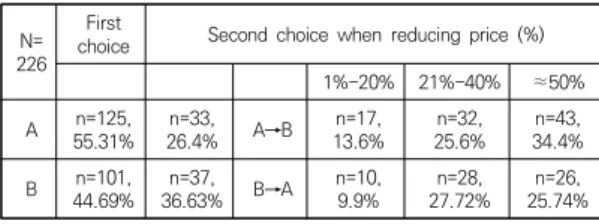
For further research, in the third part of the questionnaire, the price adjustment is also assumed. The choice of participants (for A/B clothing products) has changed. When the price of B is reduced by 1% - 50%, 73.6% of participants (who have chosen A the first time) will alter their choice, and 26.4%  will stick to their ideas.  When the price of A is lowered by 1% - 50%, 63.37% of the participants (who have chosen B the first time)  will alter their choice, and 36.63% of them still choose B. With the gradual reduction of prices, some participants (9% - 34.4%) have changed their choices, whether they initially chose a or B. It shows the importance of price in consumer decision-making, and consumers are more likely to choose products with price advantages than products with more environmentally friendly materials.

At the end of the questionnaire, when the participants were informed that "A 'recycled clothing' may be more conducive to environmental protection, in line with sustainable economic development, B 'non-renewable clothing' may aggravate the environmental problems caused by industrial pollution, clothing production surplus,

"most of the participants (190, 84.07%) chose A.

It can be seen that the implication of environmental awareness will have a further profound impact on consumer decision-making.

5. Conclusion

Environmental pollution is becoming more and

(8)

more serious. Fortunately, more and more consumers begin to pay attention to this topic.

As far as clothing industry is concerned, increasingly researchers are committed to the sustainable development of the clothing industry.

This paper reviewed the literature and conducted online questionnaire surveys and individual in-depth interviews starting from characteristics of recycled clothes. This paper attempts to understand how the commodity value of recycled clothes reflecting consumers' cognition, attitude, and decision-making about recycled clothes. The study contributes to the literature on recycled clothes by enhancing the understanding of the effects of consumers' perceived value. In particular, it is meaningful that this study focused on recycled clothes made from textile waste generated in the clothing industry. It is also meaningful that this empirical study compared differences in consumer perceptions, attitudes, and behaviors by type. It is also meaningful that this empirical study compared differences in consumer perceptions, attitudes, and behaviors by type.

According to the research results, in the premise of not affected by other factors, most consumers are more inclined to green clothing products. For example, young people are more likely to purchase recycled clothing products than older people; The gender difference is not apparent in the choice of recycled clothing. The background of participants impacts the choice of recycled clothing products, and it is not a simple linear proportional relationship. For recycled clothing, emotional value, social value, cognitive value, and environmental value are important factors, but they all positively impact product attitude. However, generally speaking, the improvement of people's cognition and emotional awareness of sustainability can not automatically transform into purchasing behavior, and people's yearning for a better environment can not directly reflect in the purchase of clothing products. For

example, high-level participants and elderly people have a strong desire for "a good environment", but they will not choose more social and ecological values that are beneficial to the environment, which will affect the attitude and behavior of consumers to a certain extent, and can play a regulatory role in a certain sense.

However, there is no inevitability and causal relationship.

This study provides a new perspective on the regulatory role of the characteristics of recycled clothes in consumer behavior. However, consumer behavior is a complex and broad field, and further research is needed to explain how the characteristics of recycled clothes exert their influence. This study also faces some limitations and challenges, such as geographical limitations and the type of investigators. In future, the research can promote the questionnaire in more regions (countries, provinces, and districts) according to different population characteristics;

Besides questionnaire survey and literature review, more research methods should explore.

Finally, the future research can also consider other factors related to recycled clothing consumption or other areas conducive to the development of green clothing products, such as the research on the whole green environmental protection and ecological clothing recycling industry system, such as recycled fabrics and material reuse, for sustainable development of clothing industry.

References

[1] H. Glen & H. S. Anastasia. (2020). Improving recycling of textiles based on lessons from policies for other recyclable materials: A mini review. Sustainable Production and Consumption, 23, 42-51.

DOI: https://doi.org/10.1016/j.spc.2020.04.005 [2] L. Kefu. (2013). Research on Mechanism of Consumer

Innovativeness Influences Green Consumption Behavior. Nankai Business Review, 16(04), 106-113.

DOI:10.1108/NBRI-11-2013-0041

(9)

[3] P. S. Chand, M. K. Nair & K. T. Shankar. (2020).

Circular Economy and Re-Commerce in the Fashion Industry. Hershey : IGI global.

DOI: 10.4018/978-1-7998-2728-3

[4] G. Yan. (2013). Research on the recycling and recycling of waste clothing in UNIQLO based on corporate social responsibility. Shandong Textile Economy, (09), 11-14.

DOI:CNKI:SUN:SDFJ.0.2013-09-00

[5] K. Olga, A. Gulnara, K. Sergey, A. Arman, T. Medet &

K. Zauresh. (2019). Ecological Feasibility of Applying Technology in Recycling Garment and Knitwear Production. Environmental and Climate Technologies, 23, 291-309.

DOI: 10.2478/rtuect-2019-0069

[6] Ü. Burçin, Ç. Pinar & Ç. Ahmet. (2020). Waste in Textile and Leather Sectors. United Kingdom : IntechOpen.

DOI:10.5772/intechopen.90014

[7] G. Yan. (2014). Research on the concept, principle and hierarchical structure management of "zero waste". Textile guide, (10), 28-30.

DOI:CNKI:SUN:FZDB.0.2014-10-006

[8] N. Olive. (2016). Designing Sustainable Fashion: Role of Psychosocial Factors of Fashion Consumption and the Challenges of Design. Indian Journal of Science and Technology, 9(15).

DOI:10.17485/ijst/2016/v9i15/91980

[9] B. Zhang, Y. Zhang & P. Zhou. (2021). Consumer Attitude towards Sustainability of Fast Fashion Products in the UK.  Sustainability, 13(4).

DOI: https://doi.org/10.3390/su13041646

[10] K. Inhwa, H. J. Jung & Y. Lee. (2021). Consumers’

Value and Risk Perceptions of Circular Fashion:

Comparison between Secondhand, Upcycled, and Recycled Clothing.  Sustainability, 13(3), 1208.

DOI: https://doi.org/10.3390/su13031208

[11] M. M. Wagner & T. Heinzel. (2020). Human Perceptions of Recycled Textiles and Circular Fashion.  Sustainability 2020, 12(24), 10599.

DOI:https://doi.org/10.3390/su122410599

[12] W. Stahel. (2016). The circular economy. Nature, 531,  435–438.

DOI: https://doi.org/10.1038/531435a

[13] O. Rahman, B. Fung & Z. Chen. (2020). Young Chinese Consumers’ Choice between Product-Related and SustainableCues - The Effects of Gender Differences and Consumer Innovativeness.

Sustainability, 12, 3818.

DOI: https://doi.org/10.3390/su12093818

[14] D. M. Marieke, (2015). Convergence and divergence in consumer behaviour: implications for global advertising. International Journal of Advertising, 22, 183–202.

DOI: https://doi.org/10.1080/02650487.2003.11072848

[15] M. Lascity & M. Cairns. (2020). Complicated Green Advertising: Understanding the Promotion of Clothing Recycling Efforts. Westminster Papers in Communication and Culture, 15(2), 44–62.

DOI: https://doi.org/10.16997/wpcc.384

[16] H. M. Abraham. (2013). A Theory of Human Motivation, Dublin Ireland : Martino Fine Books.

ISBN 13: 9781614274377

[17] M. Kemmelmeier, G. Król & Y. H. Kim. (2002).

Values, economics, and proenvironmental attitudes in 22 societies. Cross Culture Research, 36, 256–285.

DOI: https://doi.org/10.1177/10697102036003004 [18] K. Lee. (2009). Gender Differences in Hong Kong

Adolescent Consumers’Green Purchasing Behavior.

Journal of Consumer Marketing, 26(2), 87-96.

DOI:https://doi.org/10.1108/07363760910940456 [19] K. Lee. (2008). Opportunities for Green Marketing:

Young Consumers. Marketing Intelligence&Planning, 26(6), 573-586.

DOI: https://doi.org/10.1108/02634500810902839 [20] P. Aspers. (2008). Labelling fashion markets . International

Journal of Consumer Studies, 32, 633-638.

DOI: https://doi.org/10.1111/j.1470-6431.2008.00724.x

하 로 요(He-Luyao) [정회원]

․ 2011년 6월 : 후베이미술학원(湖北美 术学 院), 미술교육과 수채화.

․ 2014년 3월 : 이탈리아 볼로냐국립미 술원, 패션디자인과.

․ 2019년 9원 ~ 현재 : 한국 국민대학 교 테크노디자인 전문대학원, 스마트 경험디자인학과 (박사과정)

․ 관심분야 : 패션디자인, 인터랙션 디자인

․ E-Mail : [email protected]

반 영 환(Pan-Young Hwan) [종신회원]

․ 1991년 2월 : 한국과학기술원 산업공 학과(공학사)

․ 1993년 2월 : 한국과학기술원 인간공 학(공학석사)

․ 1999년 8월 : 한국과학기술원 인간공 학(공학박사)

․ 2006년 9월 ~ 현재 : 국민대학교 테크 노디자인전문대학원 교수

․ 관심분야 : 인터랙션 디자인, 사용자 경험(UX)

․ E-Mail : [email protected]

수치

Fig.  1.   The  display  of  different  gender  at  four  levels As  can  be  seen  from  Fig
Fig. 3.  The display of different education experience at  four  levels

참조

관련 문서

This study was carried out to analyze factors influencing Korean consumers' attitude and buying behavior on the green products.. The research model was

The purpose of this study is to examine the relationship among marketing mix factors, motivation for watching, relationship quality, and consumption

As for the relationship of obesity level to clothing shopping orientation, the underweight boys made up the largest brand-oriented group, and the

Korea also objected to one expert due to his employment and objected to other proposed experts due to their prior statements or participation in risk assessments related to the

As with storage, it’s critical to consider the access patterns of your workload, and also to consider if other non-database solutions could solve the problem more

The “Asset Allocation” portfolio assumes the following weights: 25% in the S&P 500, 10% in the Russell 2000, 15% in the MSCI EAFE, 5% in the MSCI EME, 25% in the

The areas included in the survey are the consumers’ food consumption patterns (with regards to food choices, nutrition, health, etc.); food purchase and

Finally the reason for the cosmetic consumption tendency dependent on the containers used was proposed.. According to a statistical report, a quarter of