• 검색 결과가 없습니다.

Beach-Lifeguard Considerations for Individuals with Disabilities: A Literature Review

N/A
N/A
Protected

Academic year: 2021

Share "Beach-Lifeguard Considerations for Individuals with Disabilities: A Literature Review"

Copied!
9
0
0

로드 중.... (전체 텍스트 보기)

전체 글

(1)

Beach-Lifeguard Considerations for Individuals with Disabilities:

A Literature Review

Jaehwa Kim

1

, Hyemin Kim

2*

1

Professor, Department of Sport Science, Soonchunhyang University

2

Researcher, BK21 Plus, Pusan National University

장애인을 위한 해양 라이프가드 고려사항: 문헌연구

김재화

1

, 김혜민

2*

1

순천향대학교 스포츠과학과 교수,

2

부산대학교 BK21플러스 연구원

Abstract Beach lifeguards in Korea are unprepared to perform the rescue and safety management for individuals with disabilities. There is no lifeguard training that offers information regarding the rescue of individuals with disabilities. The purpose of the study was to conduct literature review and determine significant issues related to beach lifeguard and provide suggestions for lifeguard training programs and water safety for individuals with disabilities. Databases (i.e., CINAHL Plus with Full Text, ERIC, MEDLINE, SPORTDiscus with Full Text) were used to search research articles and organizational documents. To find relevant documents, search terms such as water safety, lifeguard, drown prevention were used. Data were content analyzed to identify key issues. Based on the literature review, five critical issues regarding rescue of individuals with disabilities, drown prevention, and water safety were drawn and discussed in the article.

Key Words : Lifeguard, individual with disabilities, drown prevention, water safety, literature review 요 약 한국의 해양 라이프가드들은 아직 장애인을 위한 구조 및 안전 관리를 수행할 준비가 되어있지 않다. 더욱이 대부분의 라이프가드 훈련들이 장애인 구조에 관한 정보 혹은 훈련이 제공되지 않고 있다. 본 연구의 목적은 문헌 검토 를 실시하여 장애인을 위한 해양 라이프가드, 수상 안전관리와 관련하여 주요 이슈와 문제점을 찾아내는 데 있다. 데이 터베이스(e.g., CINAHL Plus with Full Text, ERIC, MEDLINE, SPORTDiscus with Full Text)를 사용하여 연구논 문과 해양안전과 관련한 국가/민간단체들의 문서들을 검색하였다. 사용된 검색어 혹은 키워드는 물 안전, 구조 요원, 익사 방지 등이 있었다. 주요 이슈를 파악하기 위해 수집된 문서내용을 분석(내용 분석법)을 실시하였다. 결과는 내용분 석결과를 토대로 장애인 구조(rescue), 익사방지 및 수상안전과 관련된 중요한 다섯 가지 이슈들을 도출할 수 있었다.

주제어 : 라이프가드, 장애인, 익사방지, 수상안전, 문헌연구

*This work was supported by the Soonchunhyang University Research Fund

*Corresponding Author : Hyemin Kim([email protected]) Received May 31, 2019

Accepted August 20, 2019 Revised August 7, 2019

Published August 28, 2019

1. Introduction

Beach is one of the favorite spots of summer

vacation for everyone. However, for individuals

with disabilities and their families, water activities

primarily on the beach can be overwhelming

(2)

because of inadequate disability accessibility in Korea[1]. Individuals with disabilities have a right to access to public beach. The Discrimination Act[2] ensures that people with disabilities have equal access to public services such as public accommodations, employment, transportation, local government services, and telecommunications.

Further, individuals with disabilities seem to need more attention by beach lifeguards. The risk of drowning is higher among individuals with disabilities than those without disabilities due to their limited physical and mental function.

According to the Korean health statistics in individuals with disabilities[3], the rate of unintentional drowning among individuals with disabilities(2.9 per 100,000 population) was almost twice as high as individuals without disabilities(1.3 per 100,000 population).

A beach lifeguard is a crucial person to ensure the safety and rescue of individuals with and without disabilities on the seashore. However, the beach lifeguard in Korea appeared to be unprepared to perform their tasks when it comes to lifeguarding individuals with disabilities.

Further, the limited physical and mental function of individuals with disabilities makes it even more difficult for the beach lifeguard to perform a rescue. A recent study found that there was no lifeguard training that offers information regarding how to rescue individuals with disabilities based on the their physical and mental limitations[4]. In addition, no policy requires training related to individuals with disabilities. Scarcity of a study regarding this concern is prudent. The need for infusing information related to individuals with disabilities into lifeguard training program is essential.

Therefore, the purpose of the study was to determine critical issues regarding beach lifeguard and provide suggestions for lifeguard training programs and for parents/guardians to improve water safety of their members with disabilities.

Research questions were as follows: (a) what are

the issues and suggestions related to lifeguarding individuals with disabilities? and (b) what are the issues and suggestions related to improving water safety for individuals with disabilities?

2. Method

Systematic review procedure was followed by recommendations from the Cochrane handbook for systematic reviews of interventions[5]. Systematic literature review is a deliberate and structured research method that analyzes and provides the findings presented in the past studies. In addition, it provides a level of evidence of the research methodology, which is an important measure of the reliability and generalization of the findings to the field of interest[5]. Study method and procedure are described below in search strategy, eligibility criteria, screening of citation, and data extraction.

2.1 Search Strategy

Articles were accumulated from electronic databases and a search engine. Databases were Google Scholar, CINAHL Plus with Full Text, ERIC, MEDLINE, SPORTDiscus with Full Text and the search engine was Google. A library and information science expert was involved in this process of selecting the databases for the present investigation.

Search terms or keywords were determined based on the discussion between principal investigator and the library and information science expert.

Then articles and organizational documents were searched using the selected terms and information relevant to the study topic was extracted. Examples of the search terms were “Water Safety,” “Lifeguard,”

“Drowning Prevention,” “Beach,” cross “Individuals with Disabilities,” People with Disabilities,”

“Children with Disabilities,” “Students with

Disabilities,” “Special Needs,”. The terms related

to disabilities were decided based on the 13

(3)

disabilities addressed in Individuals with Disabilities Education Act[6].

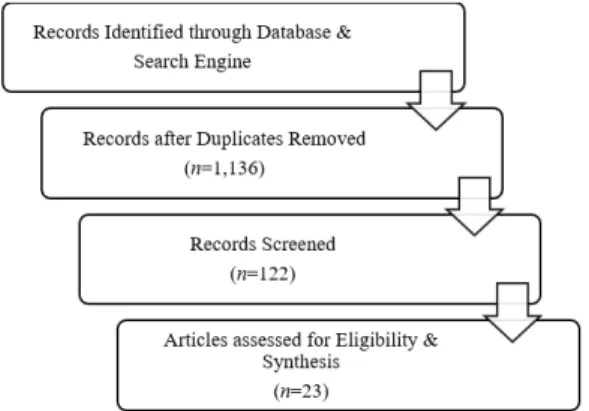
Articles searched by the terms were first selected based on the title. The chosen articles in the primary screening were assessed once again, and the articles matching the criteria were used for the final analysis. Overall process of the systematic review is illustrated in Fig. 1.

Fig. 1. Systematic review process

A total of three screening steps were conducted, and the information from the articles that met the inclusion criteria was extracted and stored in an electronic file. The obtained information includes article title, author or organization, publication year, and original contents if available. Further, since the documents were selected through the databases, duplicates were identified and removed.

2.2 Eligibility Criteria

Articles were selected if they met inclusion criteria: (a) published in government or private organizations, institutes, and peer-reviewed journals from 1990 to 2018, (b) English written, (c) related to drowning prevention or water safety for individuals with disabilities, (d) related to lifeguarding individual with disabilities, (e) focused to 10 types of disabilities (i.e., visual impairment, hearing impairment, intellectual disability, physical disability, emotional behavioral disability, autism,

communication disorder, learning disability, and other health-related impairment, developmental disability). Each article examined involved suggestions or considerations when individuals with disabilities or their families prepare water activities at the beach or pools.

2.3 Screening of Citation

According to the handbook of a systematic review[5,7], articles relevant to the study topic were first identified by the search terms; then the identified articles from each database were combined, and the duplicates were eliminated.

This process was carried out by the principal investigator. A total of 1,136 articles(n=1,136) were located in this initial process. After this process was completed, the assessment was conducted to screen articles to ensure that the articles met the inclusion criteria. As a result of the second screening process, 122 articles(n=122) were identified.

Next, each of these articles was independently analyzed by both principal and collaborative investigator to determine whether it was specifically related to the present study topic. Articles were excluded if they did not meet the selection criteria. Only those who were independently selected by two investigators were used in this investigation. Twenty-three studies(n= 23) were finally selected.

2.4 Data Extraction

The finally selected articles were compiled into one accessible document then were content analyzed. The content analysis involved two experts who had expertise in lifeguard and pedagogy of adapted physical education for individuals with disabilities and more than five-year experience in research.

The experts were provided the articles and asked to group the information into categories.

Next, the experts met with the investigator and

(4)

compared their categorized outcomes. To finalize the categorization, there must have been a consensus between the experts. When no consensus was made by the experts, the investigator brought all the disagreement issues to the meeting. The discussion was held for each issue, and the issue was resolved upon the agreement of experts.

3. Result and Discussion

The purpose of the study was to determine critical issues regarding beach lifeguard and improvement of water safety for individuals with disabilities. Based on the results, there were six distinct issues of critical concerns to lifeguarding and improving water safety for individuals with disabilities. Each issue was presented and discussed briefly below.

3.1 What are the Issues and Suggestions for Lifeguarding Individuals with Disabilities?

Two critical issues were found to be considered as lifeguards supervise and ensure the safety of individuals with disabilities: understanding disability and effective communication, and knowledge and management of adaptive equipment.

3.1.1 Understanding Disability and Effective Communication

Lifeguards should be knowledgeable about the general characteristics of disabilities to ensure the safety of individuals with disabilities around the beach. Disability is defined as a person who has impaired physical or mental conditions that restrict his or her daily activities and social participation[8] and is categorized in 13 different types[6]. It is imperative for lifeguards to remember that each type has distinct physical, sensory, mental, behavioral, or emotional characteristics.

With no understanding of disabilities, effective

communication with individuals with disabilities might not occur.

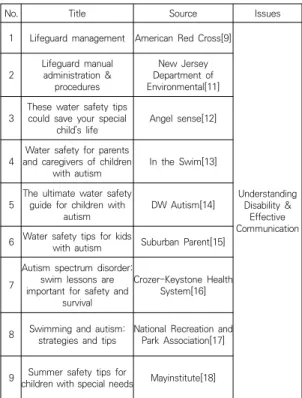
Further, ineffective communication leads them to dangerous situations such as drowning[9]. For example, individuals with intellectual disabilities seem disoriented and have difficulty following rules or verbal communication due to limited information process[10]. However, it does not mean they are not cooperative with your directions or guidance. Concise and straightforward verbal direction might help them understand better as well as physical cue or visual sign might be effective communication methods. Further, individuals with intellectual disabilities usually accompany parents or guardians. Lifeguards might come to ask their parents or guardians for help. References selected for this section is presented in Table 1.

Table 1. Understanding disability and effective communication

No. Title Source Issues

1 Lifeguard management American Red Cross[9]

Understanding Disability &

Effective Communication 2 Lifeguard manual

administration &

procedures

New Jersey Department of Environmental[11]

3 These water safety tips could save your special

child’s life Angel sense[12]

4 Water safety for parents and caregivers of children

with autism In the Swim[13]

5 The ultimate water safety guide for children with

autism DW Autism[14]

6 Water safety tips for kids with autism Suburban Parent[15]

7

Autism spectrum disorder:

swim lessons are important for safety and

survival

Crozer-Keystone Health System[16]

8 Swimming and autism:

strategies and tips National Recreation and Park Association[17]

9 Summer safety tips for

children with special needs Mayinstitute[18]

(5)

3.1.2 Knowledge and Management of Adaptive Equipment

Lifeguards are responsible for providing a reasonable accommodation for individuals with disabilities if needed. The ADA ensures equal accessibility for individuals with disabilities to public facilities such as public beach[8]. Possible accommodations can be given physical assistance or adaptive equipment so that individuals with disabilities enjoy the beach as much as those without disabilities. Helping transfer individuals with physical disabilities who are wheelchair users is a good example of physical assistance.

Further, the lifeguard should become familiar with how to use adaptive equipment such as a beach wheelchair. For individuals with physical disabilities, pushing daily wheelchairs is almost impossible because of soft sand. Narrow tires make wheelchair sink deep in the sand. However, the beach wheelchair uses four balloon tires which are much bigger and wider than regular tires[19]. The bigger and wider tires allow the wheelchair to not sink in the soft sand. Another key feature of the beach wheelchair is flotation function. The four-wheel tires are inflated with air and installed at each corner of the bottom of the chair. This physical and structural design enables the chair to float on the water with the stable position. Beach lifeguards should be aware of these possible accommodations that make it easier for individuals with disabilities to travel near the water and enjoy the beach. References selected for this section is presented in Table 2.

Table 2. Knowledge and management of adaptive equipment

No. Title Source Issues

1 Lifeguard management American Red Cross[9]

Knowledge &

Management of Adaptive

Equipment 2 Lifeguard manual

administration &

procedures

New Jersey Department of Environmental[11]

3 These water safety tips could save your special

child’s life Angel sense[12]

3.2 What are the Issues and Suggestions for Improving Water Safety for Individuals with Disabilities

Ensuring the safety of individuals with disabilities among the packed crowd at the summer beach is extremely challenging for lifeguards alone. Lifeguards do not hesitate to ask additional helps from the parents or guardians of individuals with disabilities and with their helps there are effective ways to improve the water safety of individuals with disabilities:

close supervision, learning of adapted swim, and use of specialized device.

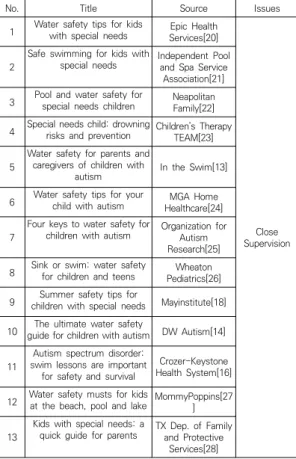
Table 3. Close supervision

No. Title Source Issues

1 Water safety tips for kids

with special needs Epic Health Services[20]

Close Supervision 2 Safe swimming for kids with

special needs Independent Pool and Spa Service Association[21]

3 Pool and water safety for

special needs children Neapolitan Family[22]

4 Special needs child: drowning

risks and prevention Children’s Therapy TEAM[23]

5 Water safety for parents and caregivers of children with

autism In the Swim[13]

6 Water safety tips for your

child with autism MGA Home Healthcare[24]

7 Four keys to water safety for

children with autism Organization for Autism Research[25]

8 Sink or swim: water safety

for children and teens Wheaton Pediatrics[26]

9 Summer safety tips for

children with special needs Mayinstitute[18]

10 The ultimate water safety

guide for children with autism DW Autism[14]

11 Autism spectrum disorder:

swim lessons are important for safety and survival

Crozer-Keystone Health System[16]

12 Water safety musts for kids

at the beach, pool and lake MommyPoppins[27 ] 13 Kids with special needs: a

quick guide for parents TX Dep. of Family and Protective

Services[28]

3.2.1 Close Supervision

Parents or guardians can be useful assistants

in the surveillance of individuals with disabilities

(6)

playing in the water. Lifeguards might ask parents or guardians to keep an eye on their children or friends with disabilities around the water. Drowning was the third leading killer among children and youth worldwide[29].

Surprisingly Children with disabilities may be drown to death even in the shallow water[30].

Thus, it is strongly recommended that children with disabilities especially autism or intellectual disabilities must stay in the water within arm’s reach of parents or guardians.

Children with autism have tendency to wander without knowing potential risks of drowning[31].

Glistening water may also be highly attractive to autistic children. If the children have pleasant experience with it, repetitive patterns of contacts are reinforced[31]. Parents and guardians make sure to teach their children dangers of water and set rules before going to the beach. References selected for this section is presented in Table 3.

3.2.2 Adapted Swim

Swimming is one of ideal ways to improve survival skills on the beach as well as develop physical and mental health among individuals with disabilities. It is well documented that benefits of swimming are positive to increase skills necessary to maneuvering on the water and enhance physical and mental health[32].

However, a regular swim class might not be as effective as an adapted swim class. In a study of Conatser[33], among regular swim instructors, no training, no experience, and no support for appropriate programs to teach individuals with disabilities were reported.

In contrast, an adapted swim instructor is qualified personnel who teaches a specially designed swim class that meets the needs of individuals with disabilities using adapted instruction methods or strategies (e.g., ono-on-one instruction, visual cue) and adapted equipment (e.g., lifejacket that help children stand upright in the water)[10]. In addition, the instructors

interact well with individuals with disabilities and have knowledge on their physical and mental limitations. Through the adapted swim, survival skills (e.g., float, tread water, rip current avoidance skill) can be taught.

An issue which deserves special mention was a rip current. A rip current is a specific type of current that flows from the shore to the sea at very high speed [34]. Rip occurs under specific conditions that the breaking waves and the wind cause a slight increase in the water level on the shore and this excess water returns to the sea in a narrow neck of water cutting through the line of breaking waves.

Table 4. Adapted Swim

No. Title Source Issues

1 Special needs water safety

Applied Behavior Center for Autism[35]

Adapted swim &

Survival skills 2 The importance of water

safety skills for children with autism

Applied Behavior Center for Autism[36]

3 These water safety tips could save your special

child’s life Angel sense[12]

4 Water safety for children with autism Indy’s Child[37]

5 Summer safety tips for children on the autism spectrum who wander

Autism Society of Texas[38]

6 The ultimate water safety guide for children with

autism DW Autism[14]

7 Water safety tips for kids with autism Suburban Parent[15]

8 Water safety musts for kids at the beach, pool

and lake

MommyPoppins[27 ]

Rip currents can be dangerous to people with

disabilities in the water. Fast returning water

carries the people to the sea away from the

shore. It is sudden that the people find out

themselves deep in the water. If individuals with

disabilities who are caught in a rip do not know

how to deal with it, they might be paralyzed by

fear and panic. In a rip current, individuals with

disabilities are strongly recommended to swim

across the current, parallel to the shore. Adapted

(7)

swimming instructors or parents make sure individuals with disabilities to understand the danger of rip currents and teach them how to manage it when it occurs. References selected for this section is presented in Table 4.

3.3.3 Use of Specialized Device

Parents or guardians should be aware of specialized equipment that helps individuals with disabilities swim in the water. For example, a specially designed ear plug will be the best choice for individuals with hearing impairments.

This ear plug can cover completely ear tube, as well as, water-protect the hearing aid device.

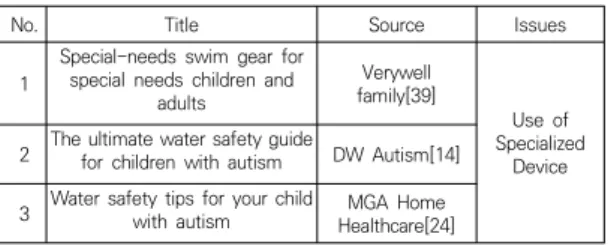
Further, children with autism might dislike wearing uncomfortable lifejacket around the water. Special needs swimsuits look like regular swimsuits but have buoyancy and enhance stability on the water. References selected for this section is presented in Table 5.

Table 5. Use of Specialized Device

No. Title Source Issues

1 Special-needs swim gear for special needs children and

adults

Verywell family[39]

Use of Specialized

Device 2 The ultimate water safety guide

for children with autism DW Autism[14]

3 Water safety tips for your child

with autism MGA Home

Healthcare[24]

4. Conclusion

The study attempted to find out critical issues regarding the lifeguards and water safety of individuals with disabilities. Five issues were identified, and suggestions was made. First, understanding physical and mental conditions of disabilities is essential for lifeguards to enhance communication with individuals with disabilities.

Second, adaptive equipment provides reasonable accommodations for individuals with disabilities.

Third, children with autism need closer attention by lifeguard as well as parents. Fourth, adapted

swim classes are an ideal way to improve survival skills. Fifth, the use of specialized device gives more positive experience of the beach for children with disabilities.

REFERENCES

[1] T. Lee & S. Ji. (2002). Study of participation of individuals with orthopedic impairments on marine sports, Journal of Sport and Leisure Studies, 18 , 663-674.

UCI : G704-000763.2002.18.2.105

[2] Discrimination Act. (2017. July 26). Public Law 14839.

[3] Ministry of Health and Welfare (2016). Causes of death . Sejong, South Korea: Ministry of Health and Welfare.

[4] K. B. Kim J. H. Lee S. G. Kim K. H. Seok & Y. S. Choi.

(2017). Improvement plan on marine lifesaving educational course in Korea: Comparison with the status of the foreign marine leisure safety education groups. In: J. L. Lee T. Griffiths A. Lotan K. S. Suh &

J. Lee(eds.), The 2nd International Water Safety Symposium, Journal of Coastal Research, Special Issue 79 , 26-29.

DOI: 10.2112/SI79-006.1

[5] J. P. Higgins. (2008). Cochrane handbook for systematic reviews of interventions. Chichester, England: Wiley-Blackwell.

[6] Individuals with Disabilities Education Act or IDEA.

(2004), Public Law 108-446. 108th Congress (Dec. 3, 2004).

[7] L. G. Portney & M. P. Watkins. (2009). Foundations of clinical research: Applications to practice (3rd ed.).

Upper Saddle River, NJ: Pearson-Prentice Hall.

[8] Americans with Disabilities Act. (1990. July 26). Public Law 101-336. 108th Congress, 2nd session.

[9] American National Red Cross. (2007). Lifeguard management . PA USA: American National Red Cross.

[10] C. Sherrill. (2004). Adapted physical activity, recreation and sport: Crossdisciplinary and lifespan (6th ed.).

New York: McGraw Hill.

[11] New Jersey Department of Environmental Protection.

(2017). Lifeguard manual: Administration and procedures.

NJ, USA: New Jersey Department of Environmental Protection.

https://www.nj.gov/dep/parksandforests/parks/docs/li feguard2_manual_administration_procedures.pdf [12] Angel sense. (2018). These water safety tips could save

your special child’s life. Angel sense [Online].

https://www.angelsense.com/blog/water-safety-tips-s

ave-special-childs-life/

(8)

[13] In the swim. (2018). Water safety for parents and caregivers of children with autism. In the swim [Online].

https://www.intheswim.com/eGuides/water-safety-for -children-autism

[14] S. Davies. (2017). The ultimate water safety guide for children with autism . DW autism [Online].

https://www.autismag.org/news/the-ultimate-water-s afety-guide-for-children-with-autism/

[15] B. S. Kathleen. (2018). Water safety tips for kids with autism. Suburban Parent [Online].

https://suburbanparent.com/features/better-homes-a nd-bodies/water-safety-tips-for-kids-with-autism [16] M. Wascavage. (2017). Autism spectrum disorder:

Swim lessons are important for safety and survival.

Crozer-Keystone Health System [Online].

https://www.crozerkeystone.org/news/news-releases/

2017/autism-spectrum-disorder-swim-lessons-are-im portant-for-safety-and-survival/

[17] C. Freedman. (2017). Swimming and autism: Strategies and tips . National Recreation and Park Association [Online].

https://www.nrpa.org/blog/swimming-and-autism-str ategies-and-tips/

[18] K. Erica. (2018). Summer Safety Tips for Children with Special Needs. Mayinstitute [Online].

https://www.mayinstitute.org/news/acl.html?id=1730.

[19] Beach Wheelchairs. (2017). Beach wheelchair annual report . Berwick, Scotland : Beach Wheelchair.

[20] Epic Health Services. (2014). Water safety tips for kids with special needs . Epic Health Services [Online].

https://blog.epichealthservices.com/6-water-safety-ti ps-kids-special-needs/.

[21] Independent Pool and Spa Service Association. (2016).

Safe swimming for kids with special needs . Independent Pool and Spa Service Association[Online].

http://www.ipssa.com/single-post/2016/12/02/Safe-S wimming-for-Kids-with-Special-Needs

[22] S. Nicolau. (2018). Pool and water safety for special needs children . Neapolitan Family [Online].

https://neafamily.com/your-family/special-needs/Poo l%20and%20Water%20Safety%20for%20Special%20Nee ds%20Children/#.XO-yC-R7mUm

[23] M. Foster. (2016). Special needs child: Drowning risks and prevention . Children’s Therapy TEAM [Online].

https://www.childrenstherapyteam.com/index.php/20 16/06/27/special-needs-child-drowning-risks-and-pr evention/

[24] MGA Home Healthcare. (2017). Water safety tips for your child with autism. MGA Home Healthcare [Online].

https://blog.mgahomecare.com/blog/2017/04/5-water -safety-tips-child-autism/

[25] V. Cecil. (2015). Four keys to water safety for children with autism . Organization for Autism Research

[Online].

https://researchautism.org/four-keys-to-water-safety- for-autistic-children/

[26] R. J. Rucoba. (2018). Sink or swim: Water safety for children and teens. Wheaton Pediatrics [Online].

http://wheatonpediatrics.pediatricweb.com/Practice- News.aspx?tArticleId=1184

[27] S. Gonser. (2016). Water safety musts for kids at the beach, pool and lake. MommyPoppins [Online].

https://mommypoppins.com/new-york-city-kids/beac hes-lakes/water-safety-musts-for-kids-at-the-beach- pool-and-lake

[28] Texas Department of Family and Protective Services.

(2018).. Kids with special needs: A quick guide for parents. Texas Department of Family and Protective Services [Online].

http://www.helpandhope.org/Parenting_Tips/Articles/

special-needs.asp

[29] World Health Organization. (2014). Global report on drowning: Preventing a leading killer . Geneva, Switzerland: World Health Organization.

[30] J. Schyllander S. Janson C. Nyberg U. B. Eriksson & D.

Stark Ekman. (2013). Case analyses of all children’s drowning deaths occurring in Sweden 1998–2007.

Scandinavian Journal of Public Health, 41(2) , 174-179.

DOI: 10.1177/1403494812471156

[31] S. J. Grosse. (2014). Aquatic safety for individuals with autism spectrum disorders. International Journal of Aquatic Research and Education, 8(3), 8.

DOI: 10.25035/ijare.08.03.08

[32] J. H. Kim & S. M. Yun. (2016). Evidence based aquatic programs for students with disabilities: Systematic literature review. Korean Journal of Physical Education, 55(2) , 689-700.

UCI: G704-000541.2016.55.2.022

[33] P. Conatser. (2007). Adapted aquatics and rehabilitation: A literature synthesis. International Journal of Aquatic Research and Education, 1(3) , 242–254.

DOI: 10.25035/ijare.01.03.07

[34] R. A. Dalrymple J. H. MacMahan A. J. Reniers & V.

Nelko. (2011). Rip currents. Annual Review of Fluid Mechanics, 43 , 551-581.

DOI: 10.1146/annurev-fluid-122109-160733

[35] Applied Behavior Center for Autism. (2014). Special needs water safety . Applied Behavior Center for Autism [Online].

http://www.aboutspecialkids.org/MediaLibraries/Abou tSpecialKids/AboutSpecialKids/Webinar%20Powerpoi nts/water-safety-webinar.pdf

[36] Applied Behavior Center for Autism. (2018). The importance of water safety skills for children with autism. Applied Behavior Center for Autism [Online].

https://www.appliedbehaviorcenter.org/blog/2018/04

/the-importance-of-water-safety-skills-for-children-

with-autism

(9)

[37] M. Loiselle. (2015). Water safety for children with autism. Indy’s Child [Online].

https://indyschild.com/water-safety-for-children-with -autism/

[38] C. Hohn. (2016). Summer safety tips for children on the autism spectrum who wander. Autism Society of Texas [Online].

http://www.texasautismsociety.org/summer-safety-tip s-for-children-on-the-autism-spectrum-who-wander/

[39] T. Mauro. (2019). Special-needs swim gear for special needs children and adults. Verywellfamily [Online].

https://www.verywellfamily.com/special-needs-swim- gear-3106239

김 재 화(Jaehwa Kim) [정회원]

․ 2007년 8월 : 한국체육대학교 특수체 육교육학과(학사)

․ 2010년 5월 : Texas Woman’s University, Kinesiology (석사)

․ 2015년 5월 : Texas Woman’s University, Kinesiology (박사)

․ 현재 : 순천향대학교 스포츠과학과 조 교수

․ 관심분야 : 특수체육

․ E-Mail : [email protected]

김 혜 민(Hyemin Kim) [정회원]

․ 2013년 2월 : 부산대학교 체육학과 (체육학석사)

․ 2016년 8월 : 부산대학교 체육학과 (체육학박사)

․ 2018년 2월 ~ 현재 : 부산대학교 BK21플러스 지역기반 스포츠문화인 력 양성사업팀 연수연구원

․ 관심분야 : 특수체육, 프로그램 개발, 통계

․ E-Mail : [email protected]

수치

Fig.  1.  Systematic  review  process
Table  1.  Understanding  disability  and  effective  communication
Table  2.  Knowledge  and  management of adaptive  equipment
Table  4.  Adapted  Swim
+2

참조

관련 문서

To address the research question, it's attempted to see if there were any significant gaps in peer relationship between an experimental group and a

Two matrices A=[a jk ] and B=[b jk ] are equal, written A=B, if and only if they have the same size and the corresponding entries are equal, that is, a 11 =b 11 , a 12 =b 12 ,

 A: # of times articles published in 2001-2 were cited in indexed journals during 2003.  B: # "citable items" (usually articles, reviews, proceedings or notes;

(i) A nonmagnetic inclusion or planar defect coincident with a wall : The need for a moment rotation (or a twist in M) across the defects is eliminated and thus the total

❑ What peer review does best is improve the quality of published papers by motivating authors to submit good quality work – and helping to improve that work through the

1.. In 2018, the PCI remains a well-received tool for businesses in Vietnam. Specifically, the latest survey collected responses from 10,681 domestic private enterprises,

The 1990 American College of Rheumatology Classification Criteria for Wegener’s Granulomatosis and Churg-Strauss Syndrome (Data obtained from ref. 12, 13).. Wegener's

In addition to the neighborhood public services they had to provide, cadres had to perform tasks sent from bureaus (ju) [局], departments(ke or chu) [科 or 處],