189
F
ORESTS
OCIETYSpatial Distribution Pattern and Association of Crowns and Saplings for Major Tree Species in the Mixed Broadleaved-Korean
Pine Forest of Xiaoxing`an Mountains, China Guangze Jin
1, Zhihong Li
1, Yan Tang
2and Ji Hong Kim
3*1School of Forestry, Northeast Forestry University, Harbin, 150040, China
2College of Life Science, Heilongjiang University, Harbin, 150001, China
3College of Forest & Environmental Sciences, Kangwon National University, Chuncheon 200-701, Korea
Abstract :
This study was conducted to evaluate spatial distribution pattern and spatial association of crowns (
≥10 m of height) and saplings (<10 m of height and
≥2 cm of DBH) for four major tree species (
Pinus koraiensis,
Abies nephrolepis,
Acer mono, and
Tilia amurensis) in the mixed broadleaved-Korean pine forest of Xiaoxing`an Mts. Vegetation data were collected in the 9 ha permanent sample plot, and the analysis adopted the point pattern analysis method. Main results are as follows; 1) crowns and saplings of major species showed clumped distribution pattern in small scale, became random distribution as the scale was increased. 2) Saplings of
Pinus koraiensisperformed poor regeneration under the crowns of
Pinus koraiensisand
Abies nephrolepis; Saplings of
Abies nephrolepisdid good regeneration under the crowns of
Pinus koraiensisand
Abies nephrolepis; and crowns of
Acer monoand
Tilia amurensishad little effect on the distribution of saplings of
Pinus koraiensisand
Abies nephrolepis. Saplings of
Acer monoand
Tilia amurensismade good regeneration under the crowns of
Pinus koraiensisand
Tilia amurensis; and the crowns of
Acer monoand
Abies nephrolepishad little effect on the distribution of saplings of
Acer mono.
Key words :spatial pattern, spatial association, point pattern analysis, mixed broadleaved-Korean pine forest
Introduction
The spatial distribution pattern of a population is mainly determined by integrative reaction of population characteristics, inter- and intra-species relation, and envi- ronmental factors (Greig-Smith, 1983), showing various features according to the spatial scale (Condit
et al., 2000; Manabe
et al., 2000). The point pattern analysis originated by Ripley (1977) has been widely used for analyzing spatial distribution pattern and inter-species association in various scales. In the study of forest com- munity, the method is employed to analyze the spatial distribution pattern of mostly tree stems (Getzin
et al., 2006; Yue
et al., 2008; Lin
et al., 2008; Hao
et al., 2007).
The branch of a tree which confronts the adjacent tree and faces unfavorable external condition usually extends toward the direction of resource availability and/or eccentric crown so as to avoid competition (Longuetaud
et al., 2008; Getzin
et al., 2008). This situation could
also be observed in the forest gap that branches of sur- rounding trees spread toward the center of the gap (Bris- son, 2001; Muth and Bazzaz, 2002). Accordingly the center of crown usually swerves from the position of the main stem of the tree, characterizing effective use of space and light resources (Ishizuka, 1984), adapting the external environment, and avoiding the competition against adjacent trees (Waller, 1986). Therefore, in the definition of tree position, the center of crown could be more representative of the position of the tree than the main stem (Umeki, 1995; Bravo
et al., 2001).
Size, arrangement, and structure of the crown play an important role in the process of tree growth (Rouvinen and Kuuluvainen, 1997). Size of crown and the arrange- ment and density of branch and leaf of various composed species in the forest stand have significant influence and dis- crepancy on condition of light, amount of litter, decom- position of organic matter, competition of root, and the condition of moisture and nutrient, making different growth, distribution, and regeneration of trees (Woods, 1984; Guo, 2002).
Even though there have been several research out- comes dealing with the spatial distribution pattern of
*Corresponding author E-mail: [email protected]
crown (Getzin and Wiegand, 2007; Getzin
et al., 2008;
Longuetaud
et al.,2008), comparative studies of spatial distribution pattern and spatial association for crown of larger scale and sapling of underneath have been hardly found, mainly due to troublesome field work. The objec- tive of this study was set to evaluate spatial distribution pattern and spatial association of crowns (
≥10 m of height) and saplings (<10 m of height and
≥2 cm of DBH) for four major tree species (
Pinus koraiensis,
Abies nephrolepis,
Acer mono, and
Tilia amurensis) in the mixed broadleaved-Korean pine forest of Xiaox- ing`an Mts.
Material and Methods
1. Study area
The field experimental study was carried out in the mixed broadleaved-Korean pine forest of Heilongjiang Liangshui National Reserve (N47° 10' 50", E128° 57' 20").
The Reserve is located in the southern part of Xiaox- ing`an Mountains, belonging to Yichun city, Heilongjiang Province. The Laingshui National Reserve extended 12,133 ha of total land area with about 1.7 million m
3of grow- ing stock and 98% of canopy coverage. The Reserve has one of the most concentrated and well-conserved patch shape broadleaved-Korean pine replaced by secondary forests after major disturbances from over-harvesting around the region (Jin
et al., 2006).
The Reserve is characterized by rolling mountainous terrain with 707.4 m of highest peak above sea level and 300 m of lowest peak a.s.l., and average slope gradient is 10~15
oC. Mean annual temperature is -0.3
oC with mean annual highest temperature of 7.5
oC and lowest temperature of -6.6
oC. Mean annual surface soil temper- ature is 1.2
oC with 100~120 frost-free days. Mean annual precipitation is 676 mm with 78% of relative humidity and 805 mm of evaporation rate (Jin
et al., 2006).
Having been rich in vegetation and community type, the forest is composed of
Pinus koraiensis,
Picea koraiensis,
Abies nephrolepis,
Tilia amurensis,
T.
mandshurica,
Acer mono,
Fraxinus mandshurica,
Ulmus laciniata,
Betula costata,
B. platyphylla,
Quercus mongolica,
Larix gme- lini,
Juglans mandshurica,
A. ukurunduense, and
A. teg- mentosum(Jin
et al., 2006).
2. Data collection
The vegetation data were collected on the permanent 300 m
×300 m experimental plot, established in the typ- ical mixed broadleaved-Korean pine forest in the year of 2005 (Jin
et al., 2006). For all woody plants
≥2 cm of DBH (for trees <10 m of height and
≥2 cm of DBH, arbitrary called saplings), we identified the species, mea-
sured DBH and height (with height pole and Vertex III Ultrasonic Hypsometer), marked with a numbered alu- minum tags, and positioned the coordinates on the plot.
For all trees
≥10 m of height (arbitrary called crowns), we additionally measured crown width for eight direc- tions of N, S, E, W, NE, NW, SE, and SW.
3. Data analysis
Of the collected vegetation data, the analysis was intensively centered on four major tree species, i.e.,
Pinus koraiensis,
Abies nephrolepis,
Acer mono, and
Tilia amurensisin the study forest. The measured values of crown width for all trees
≥10 m of height (crowns) were transformed into the coordinates and designated in the sample plot so as to estimate the central point by ArcGIS 9.2. The central point was considered as the position of corresponding crowns in the analysis.
The spatial distribution pattern of crowns and saplings for four major tree species were analyzed by employing the univariate
O-ring statistics. The spatial association for all pairs of four species and two size classes was evaluated by using bivariate
O-ring statistics. The method of point pattern analysis has been conveniently used for analyzing spatial distribution pattern and spatial association of stationary organisms. The Ripley's K- function has been most widely utilized in the study of plant population. However, because Ripley's K-function tends to embrace the information of all points for the given area, in the case of larger scale analysis, increased distance might contain the information of neighboring points. This kind of overlap calculation might bring ana- lytical bias.
O-ring statistics which counts average num- ber of points in the cirque is considered to be more efficient for analyzing spatial distribution pattern by excluding uncertainty from overlap computation (Wie- gand and Moloney, 2004).
In the univariate
O-ring statistical analysis, if the value of
O(r)is greater than the upper limit of confidence interval, then the individuals of the species are distrib- uted as clumped pattern, if the value is laid within con- fidence interval, then randomly dispersed, and if the value is smaller than lower limit, then regularly dis- persed. In the bivariate
O-ring statistical analysis, if the value of
O(r)is greater than the upper limit of confi- dence interval, then two species are positively associated with each other in the corresponding measures, if the value is laid within confidence interval, then the asso- ciation is not significant (insignificant association), and if the value is smaller than lower limit, then negatively associated.
Programita 2004 (Wiegand and Moloney, 2004) was
employed for
O-ring statistical analysis with spatial scale
of 0~100 m, acquired 99% of confidence interval from
99 times Monte Carlo simulation Results
1. Spatial distribution pattern of crowns
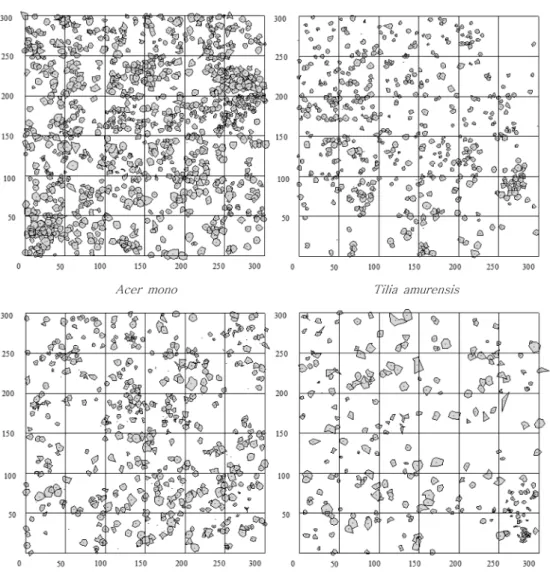
Showing considerable differences according to four major species in the number of crowns,
Pinus koraiensishad largest number of crowns (1,052 stems) in the 9 ha permanent sample plot, followed by
Abies nephrolepis(523 stems),
Acer mono(522 stens), and
Tilia amurensis(259 stems) (Figure 1).
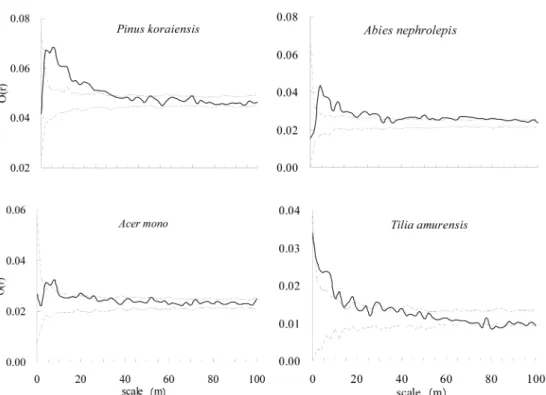
The crowns of
Pinus koraiensispresented random dis- tribution within <2 m of distance, clumped distribution in 2 m~32 m, and again randomly distributed above >
32 m of scale. The crowns of
Abies nephrolepisshowed random distribution within <4 m and clumped distribu- tion beyond >4 m of scale, appearing fluctuation in between of the two. Those of
Acer monomade clumped distribution in 4 m~10 m, and random distribution in <
4 m and beyond >10 m of scale. The crowns of
Tilia amurensisindicated random distribution within < 2 m of distance, clumped distribution in 2 m~20 m, and again randomly distributed above >20 m of scale (Figure 2). It was recognized that the crowns of
Pinus koraiensis,
Acer mono, and
Tilia amurensishad random distribution pattern in relatively small and large scale but clumped distribution pattern in the middle scale, showing small degree of aggregation.
2. Spatial distribution pattern of saplings
The total number of saplings of
Acer monoin lower story of the sample plot accounted to 945 stems, most among species, followed by
Tilia amurensis(352 stems),
Abies nephrolepis(205 stems), and
Pinus koraiensis(78 stems) (Figure 3).
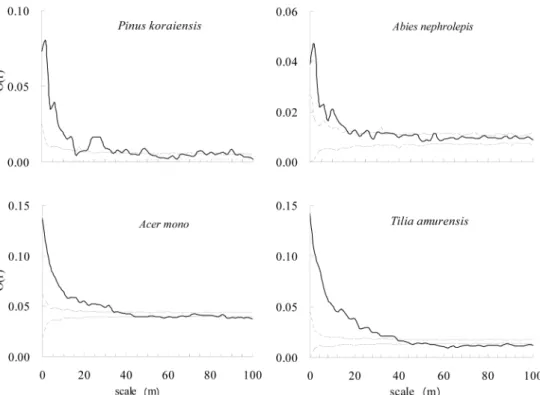
The spatial distribution pattern of saplings showed great differences according to four major species in lower story of the study forest. The saplings of
Pinus koraien-Figure 1. The distribution of crowns of major tree species at overstory in the 9ha plot.
Figure 2. Spatial distribution patterns of crowns of major tree species at overstory in the 9ha plot.
Figure 3. The distribution of saplings of major tree species in the 9ha plot.
sis
presented clumped distribution in <16 m of distance, appearing irregular fluctuation between random and clumped distribution in the scale >16 m, and the degree of aggregation was decreased as the scale was increased.
The saplings of
Abies nephrolepisshowed clumped dis- tribution within <16 m and mainly random distribution
beyond >16 m of scale. Those of
Acer monomade clumped distribution in <36 m, and showed a little changes of random and clumped distribution in >36 m.
The saplings of
Tilia amurensisindicated clumped dis- tribution within <40 m of distance, random distribution in 40 m~54 m, and regular distribution above >54 m of Figure 4. Spatial distribution patterns of saplings of major tree species in the 9ha plot.
Figure 5. Spatial associations of crowns and saplings of major tree species in the 9ha plot.
scale, and the degree of aggregation was decreased as the distance was increased (Figure 4). We found that saplings of four major species in lower story of the study forest had clumped distribution in comparatively small scale and random distribution in large distance, and the degree of aggregation was decreased as the scale of dis- tance was increased.
3. Spatial association of crowns and saplings
The association of spatial distribution of crowns and saplings in the study forest was varied by the distance scale of space. The association of two size classes in the smaller scale indicated the status of under-growth and spread of saplings underneath, and presented the influ- ence of crowns on the distribution of saplings. The spa- tial association for every pair of species and size classes were separatedly diagrammed in Figure 5.
Saplings of
Pinus koraiensisshowed negative associ- ation with the crowns of the pine in every scale, nega- tive association with crowns of
Abies nephrolepisin
< 36 m, fluctuating association in >36 m, and insignif- icant association with crowns of
Acer monoand
Tilia amurensisin every scale. Accordingly, it was noted that the advance growth for regeneration of
Pinus koraiensishardly occurred under the crowns of
Pinus koraiensisand
Abies nephrolepis, but the crowns of
Acer monoand
Tilia amurensishad little influence on the occurrence of saplings of
Pinus koraiensis.
Saplings of
Abies nephrolepispresented insignificant association in <2 m, positive association in 2 m~20 m, fluctuating association in >20 m with crowns of
Abies nephrolepis; positive association in <14 m and fluctuat- ing association in >14 m with crowns of
Pinus koraien- sis; insignificant association in 0~30 m and fluctuating association in >30 m with crowns of
Acer mono; and insignificant association in every scale with crowns of
Tilia amurensis. Saplings of
Abies nephrolepishad few problem to make regeneration under the crowns of
Pinus koraiensisand
Abies nephrolepis, but no direct influence by crowns of
Acer monoand
Tilia amurensis.
Saplings of
Acer monohad positive association in 0~10 m, insignificant association in 10~36 m, and neg- ative association in >36 m with crowns of
Pinus koraiensis; insignificant association in 0~48 m and mainly negative association in >48 m with crowns of
Abies nephrolepis; insignificant association in <20 m and fluctuating asso- ciation in >20 m with crowns of
Acer mono; and pos- itive association in 0~38 m, insignificant association in 38 m~84 m, and negative association in >84 m with crowns of
Tilia amurensis. We found that small regen- erations of
Acer monocould perform well under the crowns of
Pinus koraiensisand
Tilia amurensis, little effected by the crowns of
Abies nephrolepisand
Acermono
.
Saplings of
Tilia amurensisshowed insignificant asso- ciation in 0~2 m, positive association in 2~16 m, insig- nificant association in 16~40 m, and negative association in >40 m with crowns of
Pinus koraiensis; insignificant association in <2 m and mainly negative association in
>2 m with crowns of
Abies nephrolepis; insignificant association in <20 m and 26~40 m, and negative asso- ciation in 6~26 m and >40 m with crowns of
Acer mono; and positive association in 0~44 m, insignificant association in 44 m~56 m, and negative association in >
56 m with crowns of
Tilia amurensis. It was recognized that the regeneration of
Tilia amurensisoccurred well under the crowns of
Pinus koraiensisand
Tilia amuren- sis, but somewhat poor under the crowns of
Abies neph- rolepisand
Acer mono.
Discussion
The use of scaled quantities has been prevailed to understand ecological patterns and processes in biolog- ical population and communities. Among various eco- logical patterns and processes, disturbing character, environmental impact, and inter- and intra-species rela- tion have been functioning only in a certain spatial scale.
Accordingly, in the different scale, the spatial distribu- tion pattern would be changed due to the changed eco- logical process of the biological community (Levin, 1992).
In the mixed broadleaved-Korean pine forest, the crowns of
Pinus koraiensisand
Tilia amurensispre- sented random distribution pattern in the scale of 0~2 m, and those of
Abies nephrolepisand
Acer monoshowed the same pattern in the scale of 0~4 m, being similar to the studies of Ishizuka (1984) and Getzin and Wiegand (2007). Ishizuka (1984) reported that the crown of ran- dom distribution tree was favorable to secure wide growing space so as to absorb large amount of sunlight, and the competition for the resource of growing space made difficult for crowns of those species to adjust in small scales.
Clumped distribution pattern was detected for crowns
of
Pinus koraiensisin the scale of 2 m~32 m,
Tilia amu- rensisin 2 m~20 m,
Abies nephrolepisin >4 m, and
Acer monoin 4~10 m. Frelich
et al.(1993) suggested
three hypothesis for this kind of patch formation, i.e., 1)
the soil and topography hypothesis, 2) the distance his-
tory hypothesis, and 3) the competitive interaction hypoth-
esis. In the study area, the patch formation would be
closely related to the distance of seed dispersal, topog-
raphy, and inter- and intra-species interaction. As the
scale of distance was increased, the degree of aggrega-
tion was gradually decreased finally to show random dis-
tribution pattern, indicating clumped character in relatively small scales.
Saplings of four major species in the lower story of the forest revealed clumped distribution in smaller scale and random distribution in larger scale, being decreased the degree of aggregation with increased scale. The result was similar to the study of spatial distribution pat- tern in the mixed broadleaved-Korean pine forest of Changbai Mts. done by Zhang
et al.(2007). This situ- ation is mostly related to the seed dispersal ability of corresponding species and heterogeneity of growing environment. It was considered that large number of sap- lings were widely spread over in relatively small amount of range, owing to small size of saplings, little demand for resources, and high efficiency of sunlight absorption, compared to larger canopy trees.
Pinus koraiensisand
Abies nephrolepiswhich belong coniferous species showed clumped distribution in small scale contrary to deciduous species like
Acer monoand
Tilia amurensis. Particularly,
Pinus koraiensisshowed irregular fluctua- tion between random and clumped distribution in the middle part of scale. It is mainly because seeds of
Pinus koraiensisare dispersed by rodents and birds, but those of
Abies nephrolepis,
Acer mono, and
Tilia amurensisare scattered by wind, readily making random distribu- tion of seedlings.
The total number of crowns and saplings of
Pinus koraiensisin the 9 ha sample plot accounted to 1,052 stems and 78 stems, respectively. Saplings of
Pinus koraiensisrevealed negative association in every scale with crowns of the pine and in <36 m with crowns of
Abies nephrolepis, and insignificant association with crowns of
Acer monoand
Tilia amurensis. This situation is closely related to the regenerating capacity of
Pinus koraiensisin the canopy openings, because the species tends to be more tolerant for shade in the juvenile phase, but older the species grows larger amount of light should be needed for reaching the canopy (Wang 1995). Sap- lings of
Abies nephrolepisshowed positive association and good regenerating ability under crowns of
Pinus koraiensisand
Abies nephrolepis, which is mainly due to the high shade tolerance of the species. The analysis has indicated that saplings of
Acer monoand
Tilia amurensisdisplayed good regenerating capacity under the crowns of
Pinus koraiensisand
Tilia amurensis, but the poor capacity under those of
Acer mono, which are similar to the research result of Guo (2002) in the mixed broadle- aved-Korean pine forest of Changbai Mts.
Recently, some practices have been applied to restore and accelerate the successional progress toward the cli- max mixed broadleaved-Korean pine forest in this region by under-planting of Korean pine seedlings in the natural deciduous forest (Zhou and Chen 1994). The
understanding of species composition, spatial distribu- tion pattern, and spatial association in the mixed broa- dleaved-Korean pine forest would provide useful and essential information to induce the natural deciduous secondary forest, widely distributed in northeastern China, toward the mixed broadleaved-Korean pine for- est.
Acknowledgement
This work was financially supported by the National Natural Science Foundation of China (No. 30770350), the Natural Science Foundation of Heilongjiang (No.
ZJN0706), and Forestry Science and Technology Sup- porting Program of China (No. 2006BAD03A0702).
Literature Cited
1. Bravo, F., Hann, D.W. and Maguire, D.A. 2001. Impact of competitor species composition on predicting diam- eter growth and survival rates of Douglas-fir trees in southwestern Oregon. Canadian Journal of Forest Research 31: 2237-2247.
2. Brisson, J. 2001. Neighborhood competition and crown asymmetry in
Acer saccharum. Canadian Journal of Forest Research 31: 2151-2159.
3. Condit, R. Ashton, P.S., Baker, P. 2000. Spatial patterns in the distribution of tropical tree species. Science 288:
1414-1418.
4. Frelich, L.E., Calcote, R.R. and Davis, M.B. 1993.
Patch formation and maintenance in an old-growth hemlock-hardwood forest. Ecology 74: 513-527.
5. Getzin, S., Dean, C., He, F., Trofymow, J.A., Wiegand, K. and Wiegand, T. 2006. Spatial patterns and compe- tition of tree species in a Douglas-fir chronosequence on Vancouver Island. Ecography 29: 671-682.
6. Getzin, S. and Wiegand, K. 2007. Asymmetric tree growth at the stand level: Random crown patterns and the response to slope. Forest Ecology and Management 242: 165-174.
7. Getzin, S., Wiegand, K. and Schumacher, J. 2008.
Scale-dependent competition at the stand level assessed from crown areas. Forest Ecology and Management 255: 2478-2485.
8. Greig-Smith, P. 1983. Quantitative Plant Ecology.
Blackwell Scientific Publications. 3rd Edition. London, UK. pp. 21-36.
9. Guo, Q.X. 2002. Characteristics of canopy patches related to natural regeneration of broad-leaved Korean pine forest. Journal of Applied Ecology 13: 1541-1543.
10. Hao, Z.Q., Zhang, J., Song, B., Ye, J. and Li, B.H.
2007. Vertical structure and spatial associations of domi-
nant tree species in an old-growth temperate forest. For-
est Ecology and Management 252: 1-11.
11. Ishizuka, M. 1984. Spatial pattern of trees and their crowns in natural mixed forests. Japanese Journal of Ecology 34: 421-430.
12. Jin, G.Z., Xie, X.C., Tian, Y.Y. and Kim, J.H. 2006.
The pattern of seed rain in the broadleaved-Korean Pine mixed forest of Xiaoxing’an Mountains, China.
Journal of Korean Forest Society, 95(5): 621-627.
13. Levin, S.A. 1992. The problem of pattern and scale ecology. Ecology 73: 1943-1967.
14. Lin, Y., Ren, J.Y. and Yue, M. 2008. Population struc- ture and spatial analysis of
Betula albosinensisat taibai mountain, Northwestern China. Journal of Plant Ecol- ogy 32: 1335-1345.
15. Longuetaud, F., Seifert.,T., Leban, J.M. and Pretzsch, H. 2008. Analysis of long-term dynamics of crowns of sessile oaks at the stand level by means of spatial sta- tistics. Forest Ecology and Management 255: 2007- 2019.
16. Manabe, T., Nishimura, N., Miura, M. and Yamamoto, S. 2000. Population structure and spatial patterns for trees in a temperate old-growth evergreen broad-leaved forest in Japan. Plant Ecology 151: 181-197.
17. Muth, C.C. and Bazzaz, F.A 2002. Tree canopy dis- placement at forest gap edges. Canadian Journal of Forest Research 32: 247-254.
18. Ripley, B.D. 1977. Modelling spatial pattern. Journal of the Royal Statistical Society 39: 17-212.
19. Rouvinen, S. and Kuuluvainen, T. 1997. Structure and asymmetry of tree crowns in relation to local compe- tition in a natural mature Scots pine forest. Canadian Journal of Forest Research 27: 890-902.
20. Umeki, K. 1995. Modeling the relationship between the
asymmetry in crown display and local environment.
Ecological Modelling 82: 11-20.
21. Wang, Y. 1995. Korean Pine Forest. Northeast Forestry University Press. Harbin, China. pp. 503.
22. Waller, D.M. 1986. The dynamics of growth form. pp.
291-320. In: Crawley, M.J. (Ed.). Plant Ecology. Black- well, Oxford.
23. Wiegand, T. and Moloney, K.A. 2004. Rings, circles and null-models for point pattern analysis in ecology.
Oikos 104: 209-229.
24. Woods, K.D. 1984. Patterns of tree replacement: can- opy effects on understory pattern in hemlock-northern hardwood forests. Vegetatio 56: 87-107.
25. Yue, Y.J., Yu, X.X., Wu, J., Zhu, J.G. and Li, W. 2008.
Point pattern analysis of spatial distribution of natural secondary forest populations in mountainous area of Beijing: A case study of Wuling Mountain nature reserve. Science of Soil and Water Conservation 6: 59- 26. Zhang, J., Hao, Z.Q., Song, B., Ye, J. and Li, B.H. 2007. 64.
Spatial distribution patterns and associations of
Pinus koraiensisand
Tilia amurensisin broad-leaved Korean pine mixed forest in Changbai Mountains. Chinese Journal of Applied Ecology 18: 1681-1687.
27. Zhou, X.F. and Chen, D.K. 1994. On the forest man- agement. pp. 536-581. In: Chen, D.K. et al (Eds.), Nat- ural Secondary Forest-Structure, Function, Dynamic and Management. Northeast Forestry University Press.
Harbin, China.
(Received March 4, 2009; Accepted April 20, 2009)