인체 및 수생태 보호를 위한 지표수 우선관리대상 항목 선정기법:
CRAFT (Chemical RAnking of surFacewater polluTants)
남선화ᆞ곽진일ᆞ윤성지ᆞ정승우*ᆞ안윤주†
건국대학교 환경과학과
*군산대학교 환경공학과
Chemical Ranking and Scoring Methodology for the Protection of Human Health and Aquatic Ecosystem in Korean Surfacewater:
CRAFT (Chemical RAnking of surFacewater polluTants)
Sun-Hwa Nam⋅Jin Il Kwak⋅Sung-Ji Yoon⋅Seung-Woo Jeong*⋅Youn-Joo An†
Department of Environmental Science, Konkuk University
*Department of Environmental Engineering, Kunsan National University (Received 15 July 2011, Revised 9 October 2011, Accepted 10 October 2011)
Abstract
To prevent the overflow of various harmful chemicals, it is necessary to modify the chemical management system with an expansion to institutionally regulated substances. This modification should be preceded by selection of the priority chemicals, with a diverse chemical ranking system (CRS) applied to select the chemicals in developed countries. In Korea, a systematic CRS was used in a project related to soil and groundwater, however, it is inadequate to compare soil and groundwater CRS to that of surfacewater. In this study, a priority chemical ranking system for surfacewater was proposed through the analysis of international and domestic CRS cases. This was then applied to 161 chemicals to derive the priority list of harmful chemicals.
As a result, Chemical RAnking of surFacewater polluTants (CRAFT) is presented for the protection of human health and the aquatic ecosystem from surfacewater pollutants. The components of CRAFT are the human health toxicity, aquatic ecosystem toxicity and reliability assessment factors. Three lists were derived from the 161 priority harmful chemicals for the protection of human health, aquatic ecosystem or both. It is expected that this result can be useful to prioritize harmful chemicals for the protection of human health and the aquatic ecosystem from Korean surfacewater.
keywords : Aquatic ecosystem, Chemical ranking of surfacewater pollutants (CRAFT), Chemical ranking system (CRS), Human health, Surfacewater
1. 서 론1)
현재 국내에서 유통되고 있는 화학물질 수는 4만 여 종 에 이르며, 매년 400여 종 이상이 유입되어 꾸준히 화학물 질에 대한 국내 사용량이 증가하고 있는 추세이다(환경부, 2010b). 특히 난분해성・유해성 화학물질의 지속적인 증가 는 수질 오염을 야기하며, 이에 노출된 인체 및 수생태계 건강성 문제가 대두되고 있다. 현행 수질유해화학물질 관련 법령은 환경정책기본법, 수질 및 수생태계 보전에 관한 법 률, 먹는물 수질기준 및 검사 등에 관한 규칙, 지하수의 수 질보전 등에 관한 규칙 등이 있다. 특히 수질환경기준은 1963년 공해방지법, 1978년 환경보전법, 1991년 수질환경 보전법을 거치면서 관리 항목을 확대해왔으며, 현재 하천과 호소 지역에 대한 사람의 건강보호 기준은 17개 항목으로
†To whom correspondence should be addressed.
관리되고 있다. 그러나 일부 화학물질 항목만 포함하고 있 어 인체 건강을 위한 규제대상 항목 확대의 중요성이 부각 되고 있다(안윤주 등, 2008). 또한 미국(USEPA, 2009), 캐 나다(CCME, 2007), 호주/뉴질랜드 (ANZECC and ARM- CANZ, 2000) 등에서 수생태계 보호를 위한 화학물질 관리 를 제도적으로 반영하고 있는 것과 달리 현재 우리나라는 이에 대한 어떠한 제재도 가하지 않고 있어 수생태계 보호 를 위한 신규 항목 확대가 절실한 실정이다.
미국, 유럽, 캐나다 등 선진국에서는 이미 ATSDR (Agency for Toxic Substances and Disease Registry) SCRAM (Scoring and Ranking Assessment Model), CHEMS-1 (Chemical Hazard Evaluation for Management Strategies), EURAM (European Union Risk Ranking Method), ARET (Accelerated Reduction/Elimination of Toxics)와 같은 화학 물질 우선순위 선정 기법을 확립하여 유해화학물질 목록을 도출하여 관리하고 있다(ATSDR, 2005; EC, 1994; Hanset et al., 1999; Snydet et al., 2000; Swanson et al., 1997). 반
의 노출 경로 등을 종합적으로 고려하여 위해 우려 물질 106종을 선정한 바 있다. 2006년 환경부·국립환경과학원에 서 수행된 ‘물환경종합평가방법 개발 조사연구(III)(환경부, 국립환경과학원, 2006)'에서는 유해성, 잔류성, 배출량, 법적 관리 여부 등을 기준으로 우선순위 화학물질 275종을 선정 한 바 있다. 2007년 국립환경과학원에서 수행된 ‘우선관리 대상 토양오염물질 선정 연구(환경부, 2007)’는 토양오염 우선관리대상 물질의 우선순위를 도출하기 위한 평가 모델 인 CROSS (Chemical Ranking of Soil Pollution Substances) 를 개발하여 220개 후보물질의 인체 및 토양생태 위해도, 관심인자, 불확실성 등을 고려하여 우선순위를 선정한 바 있다(Jeong and An, 2011). 2008년 식품의약품안전청에서 수행된 ‘환경유래 인체유해물질의 식품관리우선순위 예측 을 위한 시스템 개발(식품의약품안전청, 2008)’에서는 국내 환경 배출로 인해 식품 오염이 가능한 대상 물질 103종을 Food CRS system 대상 물질로 선정한 바 있다. 마지막으 로 2008년 국립환경과학원에서 수행된 ‘지하수오염물질 우 선관리대상항목 선정 연구(국립환경과학원, 2008b)’에서는 지하수 우선관리대상 물질 선정을 위하여 CROWN (Che- mical Ranking Of groundWater pollutaNt)을 개발하여 노출 가능성, 인체독성, 생태독성, 관심인자, 타 매체 연계기준에 대한 평가인자를 고려하여 197개의 우선관리대상 후보물질 을 선정한 바 있다. 이와 같이 각각의 목적에 따라 발주된 기존 정책 지원 사업을 통해 다양한 수질유해화학물질이 도출된 바 있으나, 지표수를 대상으로 인체 및 수생태계 보호를 위한 대상 항목의 우선순위를 체계적으로 선정하는 연구는 극히 제한적이다. 따라서 지표수의 특성을 반영하고 인체독성에 중점을 둔 기존 물질 목록에 생태독성, 최근 수계배출량, 모니터링 자료, 사회적 관심 등을 추가로 고려 하여 평가 인자를 갱신하고, 우선순위 도출을 체계화함으로 서 수질 및 수생태계 보호를 위한 유해물질 관리 체계를 선진화할 필요가 있다.
본 연구에서는 기존 국내외 유해화학물질 선정 기법 사 례를 분석하여, 이를 바탕으로 국내 유해화학물질 우선순위 선정 기법 체계를 제안하였으며, 유해화학물질 161개를 대 상으로 본 연구에서 제안한 국내 유해화학물질 우선순위 선정 기법 체계를 적용하여 우선순위 유해화학물질 목록을 도출하였다. 한편 본 연구는 “수질 및 수생태계 우선관리대 상 항목 선정 연구”(국립환경과학원, 2010)의 일환으로, 인 체 위해성 기반 사람의 건강보호항목 확대를 위한 연구의 대상물질 선정에 반영되었다.
청, 2008), 지하수오염물질 우선관리대상항목 선정 연구(국 립환경과학원, 2008b)의 CROWN 등 국내외 우선순위 물질 선정 사례를 분석하였으며, 이를 바탕으로 국내 유해화학물 질 선정 기법 체계를 제안하였다.
또한 국내외 수질 및 수생태계 관리 기준 항목을 중심으 로 후보물질을 선정한 후 유해화학물질 선정 기법을 적용 하여 인체 건강 보호, 생태 건강 보호, 인체 및 생태 (종합) 건강 보호를 위한 우선순위 물질 목록을 도출하였다.
3. 결과 및 고찰
3.1. 유해화학물질 선정 기법 체계
지표수질 및 수생태계 보호를 위한 유해화학물질 우선관 리 대상항목 선정을 위하여 인체독성, 생태독성, 노출, 관심 인자, 자료 신뢰도에 대한 평가인자를 도출하여 지표수를 대상으로 하는 유해화학물질 우선순위 선정체계인 CRAFT (Chemical RAnking of surFacewater polluTants)를 구축하였 다. 본 연구에서는 기본적으로 CROSS와 CROWN에서 구축 된 평가기법을 이용하였으며, 지표수 매체의 특성을 부여하 는 평가인자(예. 수계 배출량, 폐수 이동성, 인체 건강 보호 또는 수생 생물 보호를 위한 수질환경기준)를 각각 활용하 였다. 특히 수질환경기준의 경우 수치가 기준, 권고치, 준거 치일 때 각각 자료의 신뢰성 점수를 부여하였다(Fig. 1).
3.1.1. 노출 평가 인자
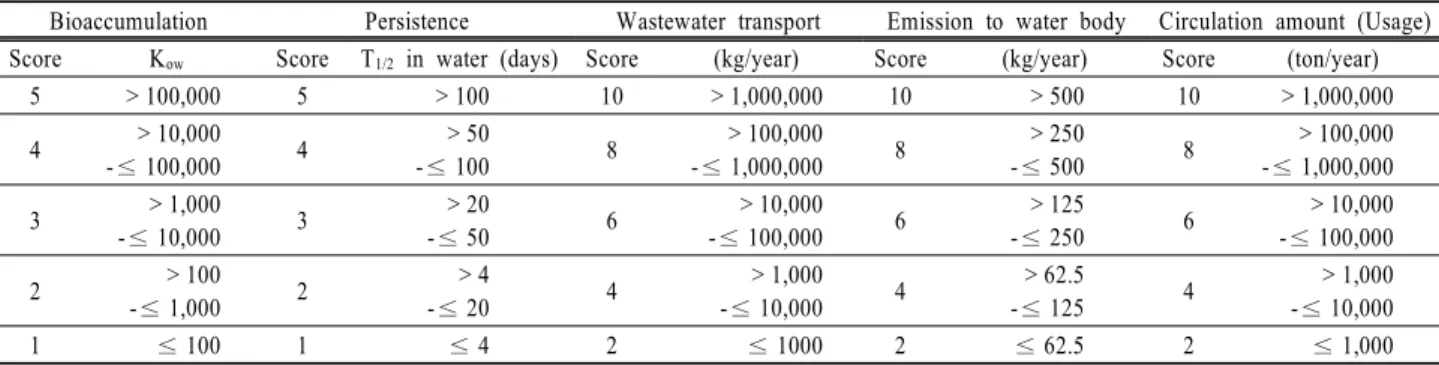
노출 평가 인자 배점은 생물축적성, 잔류성, 폐수 이동성, 수계 배출량을 중심으로, 각각 5, 5, 10, 10점을 배점하여 총 30점 만점을 부여하였다(Table 1). 생물축적성은 Estima- tion Program Interface (EPI) Suite (USEPA, 2007)에 제시 된 수서생물에 대한 Kow를 이용하였다. 기존 실험 자료에 대한 기록을 참고로 제시한 경우 해당 실측치를 우선적으 로 적용하였으며, 실측치 부재 시 예측치를 사용하였다. 잔 류성은 수체에서의 반감기를 이용하며, 실측치를 적용하나 실측치가 없는 경우 EPI Suite (USEPA, 2007)를 이용한 예측치를 사용하였다. 폐수 이동량은 인체 및 생태에 대한 화학물질의 노출과 연관되므로, 2008년도 화학물질 배출량 정보를 토대로 그 범위를 설정하고 등급 분류화하였다.
2008년도 화학물질 배출량 조사 결과(환경부, 2010a)에 따 르면, 폐수 이동량은 최고 28,007,212 kg/year, 최저 1 kg/year를 기록하였으므로, 이를 토대로 적합한 구획을 설
Fig. 1. Scheme of chemical ranking of surfacewater pollutants (CRAFT) presented in this study.
Table 1. Scoring scheme of exposure assessment factors presented in this study
Bioaccumulation Persistence Wastewater transport Emission to water body Circulation amount (Usage) Score Kow Score T1/2 in water (days) Score (kg/year) Score (kg/year) Score (ton/year)
5 > 100,000 5 > 100 10 > 1,000,000 10 > 500 10 > 1,000,000
4 > 10,000
-≤ 100,000 4 > 50
-≤ 100 8 > 100,000
-≤ 1,000,000 8 > 250
-≤ 500 8 > 100,000
-≤ 1,000,000 3 > 1,000
-≤ 10,000 3 > 20
-≤ 50 6 > 10,000
-≤ 100,000 6 > 125
-≤ 250 6 > 10,000
-≤ 100,000
2 > 100
-≤ 1,000 2 > 4
-≤ 20 4 > 1,000
-≤ 10,000 4 > 62.5
-≤ 125 4 > 1,000
-≤ 10,000
1 ≤ 100 1 ≤ 4 2 ≤ 1000 2 ≤ 62.5 2 ≤ 1,000
정하여 배점하였다. 수계 배출량은 인체 및 생태에 대한 화학물질의 노출과 연관되므로, 2008년도 화학물질 배출량 정보를 토대로 그 범위를 설정하고 등급 분류화하였다.
2008년도 화학물질 배출량 조사 결과(환경부, 2010a)에 따 르면, 수계 배출량은 최고 43,070 kg/year, 최저 1 kg/year 를 기록하였으므로, 이를 토대로 구획을 설정하여 배점하였 다. 수계 배출량 자료가 존재하지 않을 경우 사용량을 활 용하였으며, 2006년도 화학물질 사용량 정보를 토대로 그 범위를 설정하고 등급 분류화하였다. 2006년도 화학물질 유통량 조사 결과(환경부, 2008)에 따르면, 사용량은 최고 2,634,735톤, 최저 5톤을 기록하였으므로, 이를 토대로 구 획을 설정하여 배점하였다.
3.1.2. 독성 평가 인자
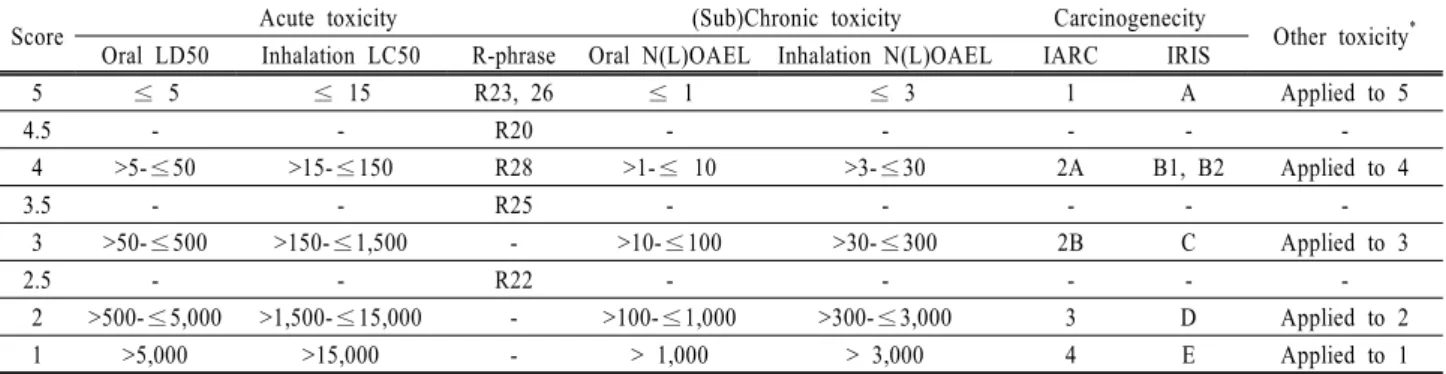
독성 평가 인자 배점은 CROWN을 참고하여 인체 독성 과 수서 생태 독성을 중심으로, 각각 20과 10점을 배점하 여 총 30점 만점을 부여하였다. 인체 독성은 발암성, 급성 독성, (아)만성독성, 기타독성을 중심으로 각각 5, 5, 5, 5점
을 배점하여 총 20점 만점을 부여하였으며(Table 2), 수서 생태 독성은 급성독성, (아)만성독성을 중심으로 각각 5와 5점을 배점하여 총 10점 만점을 부여하였다(Table 3).
3.1.2.1. 인체 독성 평가 인자
급성독성은 Hazardous Substances Data Bank (HSDB, 2010) 내 제시되어 있는 섭취와 호흡에 대한 급성독성값 반수치사량(Lethal dose 50: LD50) 및 반수치사농도(Lethal concentration 50, LC50)를 우선으로 하여 점수를 부여하였 으며, 독성값 부재 시 유럽화학물질정보시스템(European chemical Substances Information System: ESIS, 2010)의 R-phrase를 적용하였다. 두 경로에 대한 독성값이 모두 존 재하면 섭취 경로에 대한 독성값을 우선으로 하여 점수를 부여하였으며, 두 개 이상의 R-phrase가 존재할 경우 이 중 높은 점수를 적용하였다. (아)만성독성은 통합위해도정보시 스템(Integrated Risk Information System: IRIS, 2010)에 제 시되어 있는 섭취 및 호흡에 대한 (아)만성 독성자료를 수 집하여 두 경로에 대한 독성값이 모두 존재하면 섭취 경로
Other toxicity includes endocrine effects, genetic toxicity, reproductive toxicity, immune toxicity, and dermal contact toxicity.
Table 3. Scoring scheme of aquatic ecosystem toxicity assessment factors presented in this study
Score Acute aquatic toxicity (L(E)C50; mg/L) (Sub) Chronic aquatic toxicity (NOEC; mg/L) Fish, invertebrates, and algae Algae and aquatic plant Invertebrates
5 ≤ 1 ≤ 0.1 ≤ 10
4 > 1 - ≤ 10 > 0.1 - ≤ 1 > 10-≤ 100
3 > 10 - ≤ 100 > 1 - ≤ 10 > 100-≤ 1,000
2 > 100 - ≤ 1,000 > 10 - ≤ 100 > 1,000-≤ 5,000
1 > 1,000 > 100 > 5,000
Table 4. Scoring scheme of social issue assessment factors presented in this study
The No. of state regulation Incident Other properties Pollution level
Score The number Score International Domestic Score
Explosiveness, inflammability, corrosiveness,
oxidation
Score Level Lowest standard value*
10 5 6 ○ ○ 4 Applied to 4 10 Very high Upper thrice
8 4 4 × ○ 3 Applied to 3 7.5 High Twice~Thrice
6 3 2 ○ × 2 Applied to 2 5 Moderate Excess~twice
4 2 0 × × 1 Applied to 1 2.5 Low Under
2 1 0 Applied to 0
* Lowest standard value means water quality standard for the protection of human health or aquatic organisms.
에 대한 독성값을 우선으로 하여 점수를 부여하였다. 발암 성은 국제 암연구소(International Agency of Research on Cancer: IARC; WHO IARC, 2010)와 IRIS의 발암등급자료 를 이용하였다. 이때 국제기관인 IARC의 발암등급을 우선 시하여 평가하였다. 기타독성은 내분비계장애영향, 돌연변 이성, 생식독성, 면역독성, 피부접촉독성을 지표로 하여 각 영향에 대하여 1점씩을 부여하고 해당되는 독성영향의 존 재 수에 따라 점수를 부여하였다. 내분비계장애물질은 세계 생태보전기금(World Wildlife Fund: WWF; 환경부, 1999)에 서 제시하고 있는 67종에 포함되는 물질에 대하여 평가하 였으며, 돌연변이성(R46, 66), 생식독성(R60, 61, 62, 63), 면역독성(R42, 43), 피부접촉독성(R 27, 24, 38, 21)은 ESIS R-phrase를 활용하였다.
3.1.2.2. 생태 독성 평가 인자
생태 독성의 각 평가인자에 대한 독성자료는 ECOTOXi- cology (ECOTOX, 2010)를 이용하여 수집하고 이중 최저 값을 평가에 이용하였다. 급성의 경우 어류, 무척추, 조류
에 대한 점수배점체계가 같으나 (아)만성의 경우 어류/수서 식물, 무척추동물에 대하여 각각의 점수배점을 달리하였다.
어류/수서식물, 무척추동물에 대한 독성값이 모두 존재하면 어류/수서식물에 대한 독성값을 우선으로 하여 점수를 부 여하였으며, 어류/수서식물, 무척추동물에 대한 독성값이 모두 없는 경우 EPI Suite (USEPA, 2007)로부터 예측치를 활용하였다.
3.1.3. 관심 평가 인자
관심 평가 인자 배점은 규제국가 수, 사고사례, 물질특성, 오염도를 중심으로, 각각 10, 6, 4, 10점을 배점하여 총 30 점 만점을 부여하였다(Table 4). 이 때 규제국가 수는 미국, 일본 등 국외 인체 건강 보호를 위한 수질환경기준(일본환 경청, 2007; USEPA, 2009)과 미국, 캐나다, 호주/뉴질랜드 등 국외 수생생물 보호를 위한 수질환경기준(ANZECC and ARMCANZ, 2000; CCME, 2007; USEPA, 2009)에서 대상 물질을 규제 또는 관리하고 있는 국가 수를 활용하였다. 사 고사례는 국내외에서 대상물질이 수계에 노출된 사건여부를
Table 5. Scoring scheme of reliability assessment factors presented in this study
Bioaccumulation Persistence Acute aquatic toxicity (Sub)Chronic aquatic toxicity Regulation level
Score Type Score Type Score Type Score Type Score Type
1.5 Experimental value 1.5 Experimental value 1.5 Experimental value 1.5 Experimental value 4 Standard 3 Guideline 0 Estimated value 0 Estimated value 0 Estimated value 0 Estimated value 2 Criteria
1 Included in List
Table 6. Data collected in this study
Assessment factors The No. of no data Ratio (%) Half value of the highest score
Exposure
Bioaccumulation 1 0.62 2.5
Persistence 1 0.62 2.5
Wastewater transfer 61 37.89 5
Emmision to water body 61 37.89 5
Circulation amount (Usage) 76 47.20 5
Human health
Acute toxicity 7 4.35 2.5
(Sub)Chronic toxicity 1 0.62 2.5
Carcinogenecity 58 36.02 2.5
Other toxicity 6 3.73 2.5
Aquatic ecosystem Acute toxicity 0 0 2.5
(Sub)Chronic toxicity 1 0.62 2.5
Social issue Pollution level 161 100 5
한국화재보험협회(2010)와 미국화학물질안전위원회(2010)를 이용하여 평가하였다. 물질특성은 대상물질의 가연성, 폭발 성, 부식성, 산화성을 고려하여 ESIS의 R-phrase를 이용하였 다. 오염도는 수질 모니터링 자료가 존재할 때 모니터링 자 료의 최대값을 활용하여 국외 기준과 비교 평가한다. 국외 기준은 기준(standard)을 우선적으로 고려하며, 기준 부재 시 권고치(guideline), 준거치(criteria) 순으로 활용한다. 또한 동 일한 기준 존재 시 기준 중 최저치와 비교하여 점수배점을 한다. 단, 본 연구에서는 수질 모니터링 자료의 제한성으로 인해 기준 오염도를 일괄적으로 부여하였다.
3.1.4. 자료 신뢰 평가 인자
자료 신뢰 평가 인자 배점은 생물축적성, 잔류성, 수서급 성독성, 수서(아)만성독성, 규제정도를 중심으로, 각각 1.5, 1.5, 1.5, 1.5, 4점을 배점하여 총 10점 만점을 부여하였다.
이 때 규제정도는 기준(standard), 권고치(guideline), 준거치 (criteria), 수치는 없으나 물질 목록 제시를 바탕으로 평가 하였으며, 규제국가 중 기준이 하나라도 있으면 4점, 권고 치가 하나라도 있으면 3점, 준거치가 하나라도 있으면 2점 을 부여하였다. 한편 생물축적성, 잔류성, 수서급성독성, 수 서(아)만성독성은 실측치 시 1.5점, 예측치 시 0점을 부여 하였다.
3.1.5. 불확실성 평가
물질별 특성 자료의 부재는 우선순위 선정 과정의 불확 실성을 증대시킴에 따라 결과의 신뢰성을 저하시키는 주요 원인이 된다. 본 연구의 후보물질별 특성 자료 수집 시 무 자료 수 및 비율은 Table 6과 같으며, 신뢰성 증대를 위해 각 평가 인자별 최고배점의 반값을 적용하였다.
3.2. 유해화학물질 우선순위 도출 3.2.1. 유해화학물질 후보물질 선정
유해화학물질 대상항목을 선정하기 위해 후보물질은 국 내외 수질 및 수생태계 관리 기준 항목을 중심으로 통합하 였으며, 이 중 현행 환경정책기본법 수질 및 수생태계 환 경기준 17개 내에 포함된 항목은 제외하였다. 국내외 수질 및 수생태계 관리 기준 항목을 통합한 결과 총 440개 항목 이 선정되었으며, 지속적인 위해성 평가를 통한 제도적 관 리 물질 선별을 위해 IRIS에 경구 경로를 통한 발암 및 비 발암 독성 수치가 제시되어 있는 159개 물질을 본 연구의 최종 후보물질로 선정하였다. 한편 환경부·국립환경과학원 (2006)에서 발행한 ‘물환경종합평가방법 개발 조사연구(III) - 인체 및 수생태계 위해성 평가체계 구축‘ 제4장 중 생태 위해성평가를 통해 생태위해우려물질로 구리, 철, 아연이 판정된 바 있으므로, 이 중 159개 물질에 포함되지 않은 구리와 철을 최종 후보물질에 포함시켰다. 따라서 본 연구 에서 우선순위 물질 목록 도출 시 활용할 최종 후보물질은 161개로 결정되었다.
3.2.2. 유해화학물질 후보물질의 자료 구축
후보물질에 대한 노출, 인체독성, 생태독성, 관심인자 특 성 자료는 국내 실태 조사 자료, 국제적으로 신뢰성 높은 데이터베이스, 국외 인체 건강 또는 수생태 건강 보호 수 질환경기준을 바탕으로 수집하였다.
3.2.3. 유해화학물질 우선순위 도출
후보물질별 배점된 평가 인자 점수를 총합으로 인체 건 강 보호, 생태 건강 보호, 인체 및 생태 (종합) 건강 보호 를 위한 우선순위 상위 물질 목록이 도출되었다(Table 7).
8 Dieldrin* Phenol Copper 89 Dichlorobromomethane Aniline Diuron
9 2,4-Dinitrotoluene Endrin* Fluoranthene 90 Dicamba Dicamba Cumene
10 Fluoranthene 1,2,4-Trichlorobenzene Aldrin* 91 Chlorpyrifos 2,4,5-Trichlorophenoxy acetic acid*
2,4-Dichlorophenoxy acetic acid
11 Aldrin* Dieldrin* Selenium 92 2,4-Dichlorophenoxy
acetic acid
N-nitrosodi-n-propylamine 2-Chloronaphthalene
12 Selenium Heptachlor* 2,4-Dinitrotoluene 93 Methoxychlor Bis(2-chloroethyl)ether* Beryllium
13 Endrin* Toxaphene* Endrin* 94 DDE Bromoxynil Ethyleneglycol
14 Linuron 2,4-Dichlorophenol Linuron 95 Chlorodibromomethane Chlorodibromomethane Chlorothalonil 15 1,2,4-Trichlorobenzene Fluorene 1,2,4-Trichlorobenzene 96 Vinclozoline Chlorothalonil Sethoxydim
16 Phenol Triallate Mirex 97 Propylene oxide Cypermethrin 1,1,2,2-Tetrachloroethane
17 2,4-Dinitrophenol Pentachlorobenzene Toxaphene* 98 Demeton Diuron Bromoxynil
18 Mirex Aldrin* Phenol 99 Permethrin Carbaryl Butyl benzyl phthalate
19 Toxaphene* Selenium 2,3,4,6-Tetrachlorophenol 100 Carbaryl Dimethoate* Demeton 20 2,4-Dichlorophenol Metolachlor Pentachlorobenzene 101 1,1,2,2-Tetrachloroethane Molinate Dinoseb 21 Aldicarb* Linuron 2,4-Dichlorophenol 102 Bromoxynil 1,3-Dinitrobenzene Molinate
22 Methylmercury Anthracene 2,4-Dinitrophenol 103 Diuron Butyl benzyl phthalate N-nitrosodimethylamine 23 2,3,4,6-Tetrachlorophenol Thiobencarb Benzo(a)pyrene 104 Bis(2-chloroethyl)ether* Acrolein Carbofuran
24 DDT* Di-n-butyl phthalate Hexachlorobenzene 105 Molybdenum Hexachlorocyclopentadiene N-nitrosodi-n-propylamine 25 Pentachlorobenzene 2,3,4,6-Tetrachlorophenol Styrene 106 Chlorothalonil Dinoseb Cypermethrin 26 1,1,2-Trichloroethane Benzo(a)pyrene Di-n-butyl phthalate 107 N-nitrosodi-n-propylamine Carbofuran Dimethoate*
27 Benzo(a)pyrene Pyrene Aldicarb* 108 MCPA(4-Chloro-2-methy
lphenoxyacetic acid;
2-methyl-4-chloro phenoxy acetic acid)
N-nitrosodimethylamine N-nitrosodiphenylamine
28 1,2-Dichloroethan 2,4,5-Trichlorophenol Triallate 109 Imazethapyr Captan* Hexazinone 29 Hexachlorocyclohexane* Ethylbenzene 2,4,6-Trinitrotoluene 110 N-nitrosodiphenylamine Barium 3,3'-Dichlorobenzidine
30 Pyrene DDT* Endosulfan* 111 Molinate Molybdenum Molybdenum
31 Hexachlorobenzene Triflualin* Benzidine* 112 Dichlorvos Boron Nitrate
32 Endosulfan* Acenaphthene Metolachlor 113 Ethylacetate Alachlor Dichlorobromomethane
33 Ethylbenzene Hexachlorocyclohexane* Pyrene 114 Sethoxydim α-cyano-3-phenoxybenzyl 3-(2-chloro-3,3,3-trifluoro prop-1-enyl)-2,2-dimethylc yclopropanecarboxylate
Dicamba
34 Styrene 1,2,4,5-Tetrachlorobenzene Ethylbenzene 115 1,1-Dichloroethylene 3,3'-Dichlorobenzidine Diquat 35 Di-n-butyl phthalate Tributyltin oxide DDT* 116 Carbofuran MCPA(4-Chloro-2-methy
lphenoxyacetic acid;
2-methyl-4-chloro phenoxy acetic acid)
Bis(2-chloroethyl)ether*
36 Triallate Styrene 1,2-Dichlorobenzene 117 Vinyl chloride 1,1-Dichloroethylene Dichlorvos
37 2,4,6-Trinitrotoluene 1,2-Dichlorobenzene 1,2,4,5-Tetrachlorobenzene 118 Butyl benzyl phthalate Nitrobenzene Chlorodibromomethane 38 1,2,4,5-Tetrachlorobenzene Hexachlorobutadiene Methylmercury 119 Dinoseb Dichlorobromomethane Propylene oxide 39 Argentum 2,4,6-Trinitrotoluene Hexachlorocyclohexane* 120 Epichlorohydrin 2,4-Dichlorophenoxy
acetic acid
α-cyano-3-phenoxybenzyl 3-(2-chloro-3,3,3-trifluoro prop-1-enyl)-2,2-dimethylc yclopropanecarboxylate
Table 7. List of 161 priority harmful chemicals for the protection of human health and aquatic organisms presented in the study (continued)
Rank
Chemical name
Rank
Chemical name Human health Aquatic organisms Human health and
aquatic organisms Human health Aquatic organisms Human health and aquatic organisms 40 Benzidine* Simazine Fluorene 121 3,3'-Dichlorobenzidine Acrylonitrile Nitrobenzene
41 Atrazine 1,2-Dichloroethan Heptachlor epoxide 122 1,2-Trans-dichloroethylene 1,1,1-Trichloroethan MCPA(4-Chloro-2-methy lphenoxyacetic acid;
2-methyl-4-chloro phenoxy acetic acid)
42 Simazine Pendimethalin Hexachloroethane 123 2-Propyn-1-ol Demeton 4,4'-Bisphenol A
43 Iron Iron 2,4,5-Trichlorophenol 124 1,1,1-Trichloroethan Decabromodiphenyloxide Hexachlorocyclopentadiene 44 Metolachlor Argentum 1,3,5-Trinitrobenzene 125 Cypermethrin Perchlorate Imazethapyr
45 Diethyl phthalate 2,4-Dinitrophenol Triflualin* 126 Dimethoate* Diquat Decabromodiphenyloxide 46 Methanol 2,4,6-Trichlorophenol Atrazine 127 Hexazinone Imazethapyr 2,3-Dihydro-2,2-dimethyl
-7-benzofuryl[(dibutylam ino)thio]methylcarbamate
47 Ethyleneglycol Hexachlorobenzene Thiobencarb 128 Bromoform Ethylacetate Ethylacetate
48 1,2-Dichlorobenzene Fenvalerate Simazine 129 Nitrobenzene Bromoform 1,1-Dichloroethylene 49 2,4-Dimethylphenol 2,4-Dinitrotoluene 1,2-Dichloroethan 130 Diquat Bis(2-ethylhexyl)adipate Captan*
50 1,3-Dichloropropene Methylmercury Argentum 131 4,4'-Bisphenol A Ethyl paranitrophenyl phenyl phosphorothioate (EPN)
2-Propyn-1-ol
51 Methyl bromide* Heptachlor epoxide Methyl bromide* 132 Boron 4,4'-Bisphenol A Epichlorohydrin 52 Quinoline Mirex 2,4,6-Trichlorophenol 133 α-cyano-3-phenoxybenzy
l3-(2-chloro-3,3,3-trifluor oprop-1-enyl)-2,2-dimeth ylcyclopropanecarboxylate
2,3-Dihydro-2,2-dimethyl -7-benzofuryl[(dibutylam ino)thio]methylcarbamate
Ethyl paranitrophenyl phenyl phosphorothioate (EPN)
53 Fluorene Glyphosate 1,1,2-Trichloroethane 134 Captan* Picloram 1,2-Trans-dichloroethylene 54 Heptachlor epoxide Hexachloroethane 2,4-Dimethylphenol 135 Barium Thirame Bis(2-ethylhexyl)adipate 55 Chlorobenzene Methoxychlor Hexachlorobutadiene 136 Perchlorate 1,2-Trans-dichloroethylene Thirame
56 Hexachloroethane Methanol 1,3-Dichloropropene 137 Hexachlorocyclopentadiene Nitrate Perchlorate 57 Xylenes Metribuzin 2-Chlorophenol 138 Methyl ethyl ketone Carbon disulfide 1,1,1-Trichloroethan 58 2,4,5-Trichlorophenol 1,3-Dichloropropene Fenvalerate 139 Nitrite Methyl ethyl ketone Vinyl chloride 59 1,3,5-Trinitrobenzene 2,4-Dimethylphenol Tributyltin oxide 140 Decabromodiphenyloxide Methidathion Paraquat* 60 2,4,5-Trichlorophenoxy
acetic acid*
Diethyl phthalate Aniline 141 2,3-Dihydro-2,2-dimethyl -7-benzofuryl[(dibutylam ino)thio]methylcarbamate
Nitrite Bromoform
61 Triflualin* Chlorobenzene Pendimethalin 142 Furfural 2-Propen-1-ol Methidathion
62 Tebuthiuron Tebuthiuron Acenaphthene 143 Benzyl chloride Propylene oxide Boron
63 Thiobencarb Benzidine* Iron 144 Chlorite Benzyl chloride Barium
64 2,4,6-Trichlorophenol Xylenes Quinoline 145 Cyclohexylamine Thiophanate methyl Nitrite 65 2-Chlorophenol 1,2-Diphenylhydrazine 1,3-Dinitrobenzene 146 Ethyl paranitrophenyl
phenyl phosphorothioate (EPN)
Paraquat* Benzyl chloride
66 Acrylonitrile N-nitrosodiphenylamine Diethyl phthalate 147 Bis(2-ethylhexyl)adipate Beryllium Cyclohexylamine 67 1,3-Dinitrobenzene Atrazine Chlorobenzene 148 Picloram Hexahydro-1,3,5-trinitro-
1,3,5-triazine
Sodiumazide
68 Hexachlorobutadiene DDE Acrolein 149 Thirame Vinyl chloride 2-Propen-1-ol
69 Acenaphthene Chlorpyrifos Anthracene 150 Carbon disulfide Acephate Carbon disulfide
70 Fenvalerate Permethrin Xylenes 151 Paraquat* 2-Propyn-1-ol Acrylamide
71 Tributyltin oxide Malathion 2,4,5-Trichlorophenoxy acetic acid*
152 Acrylamide Benomyl Furfural
72 Manganese Methyl bromide* Metsulfuron 153 Ethylene thiourea Dichlorvos Chlorite
73 Aniline Quinoline Metribuzin 154 Methidathion Chlorite Picloram
74 Pendimethalin 1,3,5-Trinitrobenzene Methomyl 155 Sodiumazide Acrylamide Benomyl 75 N-nitrosodimethylamine Metsulfuron Malathion 156 2-Propen-1-ol Cyclohexylamine Ethylene thiourea 76 Methomyl 1,1,2-Trichloroethane 1,2-Diphenylhydrazine 157 Hexahydro-1,3,5-trinitro-
1,3,5-triazine
Sodiumazide Thiophanate methyl
이 때 인체 건강 보호를 위한 우선순위 목록은 평가 인자 중 생태독성인자 배점을 제외하였으며, 생태 건강 보호를 위한 우선순위 목록은 평가 인자 중 인체독성인자 배점을 제외하였다. 상위 30% 순위에 분포되어있는 물질은 대체로 농약류(예. Lindane, Pentachlorophenol, Heptachlor, Dieldrin, Aldrin, Endrin, Linuron, Mirex, Toxaphene, Hexachloroben- zene 등)와 금속류(Nickel, Zinc, Copper, Selenium 등)로 나타났다. 특히 국립환경과학원에서 2007년부터 연차 사업 으로 진행 중인 ‘사람의 건강보호항목 확대를 위한 유해물 질 조사 및 관리방안 도출’2차(국립환경과학원, 2008a)와 3 차((국립환경과학원, 2009) 보고서에 따르면, 4대강 유역의 수질 모니터링 자료를 바탕으로 인체 위해성 평가를 수행 하는 연구의 대상 물질인 Hexachlorobenzene, Endosulfan, Triflualin, Atrazine, Simazine, Aniline, Alachlor 등의 농약 류는 인체 건강 보호, 생태 건강 보호, 인체 및 생태 (종합) 건강 보호를 위한 우선순위 목록에서 상위권에 분포하였으 므로, 본 연구의 우선관리대상 항목 선정 과정이 적정한 것으로 사료된다.
3.3. 제한점 및 향후 방향 제시
본 연구에서 도출된 인체 건강 보호, 생태 건강 보호, 인 체 및 생태 (종합) 건강 보호를 위한 유해화학물질 우선순 위는 현재 활용 가능한 모니터링 자료의 제한성으로 인해 기준 오염도를 반영하였다. 그러나 오염도 자료의 신뢰성을 증대시키기 위해서는 모니터링 자료를 활용할 필요가 있다.
따라서 향후 이러한 문제점을 해결하기 위해서는 신뢰성 높은 분석기관별 표준화된 시험법(예. 낮은 검출한계 공통 적용 등)을 이용하여 전국 규모의 수질 모니터링 자료를 축적하여야 한다. 또한 우선순위 유해화학물질에 대해 신뢰 성 높은 수질 모니터링 자료를 활용하여 인체 및 생태 위 해성평가를 수행함으로써 현 상태의 유해화학물질의 위해 수준을 바탕으로 제도적 우선관리가 시급한 유해화학물질 을 선정하고 점진적으로 확대할 유해화학물질을 선별하는 단계가 추가적으로 필요하다. 마지막으로 부문별 우선순위 목록 중 농약류가 차지하는 비율이 높으나, 국내에서 취급 금지 또는 취급 제한된 농약류가 다수 포함되어 있다. 현 재 제도적으로 일부 농약 취급을 금지하고 있으나, 농약의 고잔류성으로 인해 취급 금지 이전 사용했던 농약이 검출
된 것으로 사료된다. 따라서 Endosulfan, Endrin, Penta- chlorophenol, Triflualin 등과 같이 국내 취급 금지된 농약 류에 대해서는 검출 지속성을 확인하기 위해 별도 지속적 인 모니터링 사업을 통해 감시할 필요가 있다.
4. 결 론
본 연구에서는 미국, 유럽, 캐나다, 한국 등의 국내외 우 선순위 물질 선정 사례를 분석하여 지표수질 및 수생태계 보호를 위한 유해화학물질 우선순위 선정체계인 CRAFT (Chemical RAnking of surFacewater polluTants)를 구축하 였다. 유해화학물질 161개를 대상으로 CRAFT의 인체독성, 생태독성, 노출, 관심인자, 자료 신뢰도에 대한 평가인자를 활용하여 인체 건강 보호, 생태 건강 보호, 인체 및 생태 (종합) 건강 보호를 위한 우선순위 목록을 도출하였다. 상 위 30% 순위에 분포되어있는 물질은 대체로 농약류로 나 타났으며, 기존 4대강 유역의 수질 모니터링 자료를 바탕 으로 인체 위해성 평가를 수행한 정부 용역 사업의 대상 물질들이 상위권에 분포하여 우선관리대상 항목 선정 과정 의 적정성이 확인되었다. 그러나 모니터링 자료의 제한성으 로 인해 기준 오염도를 반영하여 오염도 자료의 신뢰성이 감소된 부분에 대해 신뢰성 높은 수질 모니터링 자료로 점 진적으로 전환함으로써 자료의 신뢰성을 증대시킬 필요가 있다. 또한 인체 및 생태 위해성평가를 활용한 유해화학물 질의 위해 수준 파악, 취급 금지 또는 취급 제한된 농약류 에 대한 특별 관리 등의 부분이 보완된다면 본 우선순위 선정 기법은 유용한 CRS 모델로 활용될 수 있을 것으로 사료된다.
사 사
본 연구는 2010년 국립환경과학원의 “수질 및 수생태계 우선관리 대상항목 선정 연구”의 연구비 지원에 의하여 수 행되었음.
참고문헌
국립환경과학원(2008a). 사람의 건강보호항목 확대를 위한
유해물질 조사 및 관리방안 도출(II).
국립환경과학원(2008b). 지하수오염물질 우선관리대상항목
선정 연구.
국립환경과학원(2009). 사람의 건강보호항목 확대를 위한
유해물질 조사 및 관리방안 도출(III).
국립환경과학원(2010). 수질 및 수생태계 우선관리대상 항
목 선정 연구.
미국화학물질안전위원회(2010). http://www.csb.gov/.
식품의약품안전청(2008). 환경유래 인체유해물질의 식품관
리우선순위 예측을 위한 시스템 개발.
안윤주, 남선화, 이재관(2008). 인체 위해성기반 수질환경기 준 항목 확대를 위한 연구. 한국하천호수학회지, 41(1), pp. 34-42.
유럽화학물질정보시스템(European chemical Substances Infor- mation System, ESIS) (2010). http://esis.jrc.ec.europa.eu/.
일본환경청(2007). Environmental quality standards for water http://www.env.go.jp/en/standards/.
통합위해도정보시스템(Integrated Risk Information System, IRIS) (2010). http://www.epa.gov/IRIS/.
한국화재보험협회(2010). http://www.kfpa.or.kr/index.asp/.
환경부(1999). 환경자료집.
환경부(2001). 폐수배출허용기준 적용대상물질 확대지정을
위한 연구.
환경부(2003). 위해우려물질 선정 및 평가 연구.
환경부(2007). 우선관리대상 토양오염물질 선정연구.
환경부(2008). 2006년도 화학물질 유통량 조사 결과. 환경부(2010a). 2008년도 화학물질 배출량 조사 결과. 환경부(2010b). 환경백서.
환경부, 국립환경과학원(2006). 물환경종합평가방법 개발 조
사연구(III) - 인체 및 수생태계 위해성 평가체계 구축.
ANZECC and ARMCANZ (2000). Australian and New Zealand Guidelines for Fresh and Marine Water Quality, pp. 3.4-5.
ATSDR (2005). 2005 CERCLA Priority List of Hazardous Substances that will be the Subject of Toxicological Profiles and Support Document. Division of Toxicology, Washington
DC., USA.
CCME (Canadian Council of Ministers of the Environment) (2007). Canadian Water Quality Guidelines for the Protection of Aquatic Life: Summary Table. Updated December, 2007. In:
Canadian environmental quality guidelines, 1999, Canadian Council of Ministers of the Environment, Winnipeg.
EC (1994). The ARET Substance Selection Process and Guide- lines.
ECOTOXicology (ECOTOX) (2010). http://cfpub.epa.gor/ecotox/.
Hanset, B. G., van Haelst, A. G., Leeuwen, K. V., and van der Zandt, P. (1999). Priority setting for existing chemicals:
European union risk ranking method. Environmental Toxi- cology and Chemistry, 18(4), pp. 772-779.
Hazardous Substances Data Bank (HSDB) (2010). http://
toxnet.nlm.nih.gov/cgi-bin/sis/htmlgen?HSDB/.
Jeong, S. W. and An, Y. J. (2011). Construction of a chemical ranking system of soil pollution substances for screening of priority soil contaminants in Korea, Environmental Monito- ring and Assessment, DOI: 10.1007/s10661-011-2109-4.
Snyder, E. M., Snyder, S. A., Giesy, J. P., Blonde, S. A., Hurlburt, G. K., Summer, C. L., Mitchell, R. R., and Bush, D. M. (2000). SCRAM: A scoring and ranking system for persistent, bioaccumulative, and toxic substances for the north american great lakes. Environmental Science and Pollution Research International, 7(2), pp. 116-121.
Swanson, M. B., Davis, G. A., Kincaid, L. E., Schultz, T. W., Bartmess, J. E., Jones, S. L., and George, E. L. (1997). A screening method for ranking and scoring chemicals by potential human health and environmental impacts. Environ- mental Toxicology and Chemistry, 16(2), pp. 372-383.
USEPA (2007). Estimation Program Interface (EPI) Suite Version 4.00.
USEPA (2009). National Recommended Water Quality Criteria.
WHO IARC (2010). Agents Classified by the IARC Monographs, Volumes 1-100.