ISSN 1225-7591(Print) / ISSN 2287-8173(Online)
A Study on the Removal of Heavy Metal with Mg-Modified Zeolite
Jei-Pil Wang*, Gyu-Cheol Kim and Min-Seok Go
Department of Metallurgical Engineering, Pukyong National University, Busan 48513, Republic of Korea (Received August 16, 2020; Revised August 22, 2020; Accepted August 26, 2020)
...
Abstract The subject of this study is a zeolite generated as a by-product of recycling LAS (lithium-aluminum-silicate) resources, a kind of glass and ceramic produced by induction. The zeolite by-product is modified into Mg-zeolite using Mg as a cation to absorb Pb, a heavy metal generated from water pollution caused by recent industrial wastewater. An ion-exchange method is used to carry out the modification process, from zeolite byproduct to Mg-zeolite, and simultaneously absorb the Pb in the heavy-metal solution (99.032 mg/L). It is found that the sodium zeolite in the raw material residue can be modified to magnesium zeolite by reacting it with a mixture solution at 1 M concentration for 24 h. As a result, it is found that the residual Pb (0.130 mg/L) in the heavy metal solution is shown to be absorbed by 99.86%, with successful formation of a Mg-modified zeolite.
Keywords: LAS(Lithium-Aluminum-Silicate), Zeolite, Adsorption, Lead
...
1. Introduction
Since the water pollution becomes more serious among the pollution-related problems inevitably occurring in factories as a result of industrial development, many studies are currently being conducted. The main cause of environmental pollution due to the industrial wastewater from factories is the pollution by heavy metals, causing a very harmful effect on the human body. According to the report of the Ministry of Environment in 2019, the gener- ation of industrial wastewater in Korea in 2017 was 4,921,000 m
3/day [1]. The industrial wastewater requires meticulous control on account of its high concentration of pollution. The main substances contained in industrial wastewater are high concentration pollutants (i.e. heavy metals, organic compounds, mercury, acids, and alkaline detergents) [2]. Since the industrial wastewater contains a variety of harmful substances as above, a method suit- able for hazardous substances must be applied for safe treatment, and the industrial wastewater must be dis- charged only when it satisfies the standards allowed for discharge.
For the removal of heavy metals from substances con- tained in industrial wastewater, several methods have been suggested, including chemical, physical and biologi- cal methods [2]. Of them, many researchers are studying a method of using the zeolite as an adsorbent to remove heavy metal ions from the wastewater. Peric et al. (2004) conducted a study on removing zinc, copper and lead using natural zeolite as an adsorbent [3], and Kocaoba et al. (2007) conducted a study on removing cobalt, copper and nickel using natural zeolite as an absorbent [4].
The zeolite is a generic term for the minerals in which alkaline earth metals are combined with anions formed by the combination of aluminum oxide and silicate oxide, referring to crystalline aluminum silicate minerals. The zeolite contain Al, Si, O, and H
2O as essential compo- nents; and Na, Ca, K and Mg as selective components.
The zeolite is a three-dimensional inorganic polymer in which silicon and aluminum are connected through 4 cross-linked oxygen, respectively, and at this time, as alu- minum is combined with 4 oxygen, it has a negative charge. In order to offset this charge, cations such as selective components are needed. The inside of the
- Jei-Pil Wang: 교수, Gyu-Cheol Kim·Min-Seok Go: 학생
*Corresponding Author: Jei-Pil Wang, TEL: +82-51-629-6741, FAX: +82-51-629-6742, E-mail: [email protected]
larger spaces and volumes compared with other zeolite modified with cations such as Na
+, K
+, Ca
2+, and Al
3+, rapidly adsorbs organic-inorganic substances, removing even small particles [6, 7].
In this study, the zeolite generated as a by product of LAS (Lithium-Aluminum-Silicate) circulating resource was modified with Mg cations to absorb and remove the Pb contained in the industrial wastewater on the effect to mixture concentration and reaction time.
2. Materials 2.1 Experimental Materials
To prepare the zeolite used as an adsorbent in this study, the recycled resources of the LAS (Lithium-Alumi- num-Silicate) obtained from end-of-life of induction were pulverized and leached into the form of liquid. The zeo- lite contained in the solution was separated from the resi- due using a solvent extraction method. For the MgCl
2∙ 6H
2O (>98%) used for modification it to Mg-zeolite, a product from Junsei Chemical Co. Ltd (Tokyo, Japan) was used.
2.2 Experimental Method 2.2.1 Preparation of Mg-zeolite
Mg-zeolite was prepared as follows. Before the experi- ment, the residue was dried at 100
oC for 24 hours to remove moisture from it. To modify it into Mg
2+cat- ionic type, a Mg mixture solution with a concentration of 0.25 M/0.5 M/1 M was prepared using MgCl
2∙6H
2O reagent and distilled water. 5 g of the residue dried in a 1 L beaker and 500 ml of the prepared Mg mixture solu- tion of each concentration were stirred at 250 rpm for a certain period of time (12hours/24 hours) using a mag- netic stirrer. After each reaction time (12hours/24 hours) elapsed, the supernatant was discarded and it was replaced with Mg mixture solution of each concentra- tion, and this process was repeated 3 times. It was then washed several times with distilled water, the moisture
2.2.2 Preparation of experimental wastewater solution For the wastewater solution to be used for the absorp- tion of heavy metal, a wastewater solution (Pb 100 ppm) was prepared by diluting heavy metal standard reagent (Pb 1000 ppm, KANTO CHEMICAL CO. INC) solution and distilled water, and stirring it for 1 hour at 250 rpm using a magnetic stirrer.
2.2.3 Adsorption of heavy metal (Pb)
2g of modified Mg-zeolite was added to 50 ml of the previously prepared wastewater solution (Pb 100 ppm) in a 500 ml beaker and stirred at 250 rpm for 24 hours using a magnetic stirrer to measure the heavy metal content in the solution.
2.3 Analysis Method
XRD analyzer (Rigaku, UltimaIV), which is operated with 3 kw Cu-K X-Ray tube, was used to examine the phase transformation of the raw material residue and the modified zeolite, and FE-SEM (TESCAN, MIRA 3 LMH in-Beam Detector) was used to examine the size and shape of the crystal. In addition, ICP analyzer (Shi- madzu, ICPS-1000IV) was used to measure the amount of Pb in the wastewater solution containing heavy metals (Pb).
3. Results and Discussion 3.1 Analysis of raw material residue
Fig. 1 shows the phases of XRD analysis intended to confirm the existence of zeolite in the raw material resi- due. As a result of the measurement, it was confirmed that Na-zeolite, which is Na
6Al
6Si
10O
32(H
2O)
12, and β- phase spodumene of Li (AlSi
2O) were existent.
Fig. 2 shows the results of SEM analysis intended to
examine the crystal shape of the zeolite in the raw mate-
rial residue. It was confirmed that columnar crystals were
existent in the form of Na zeolite with columnar crystals
attached to it.
3.2 Modification of Mg-zeolite
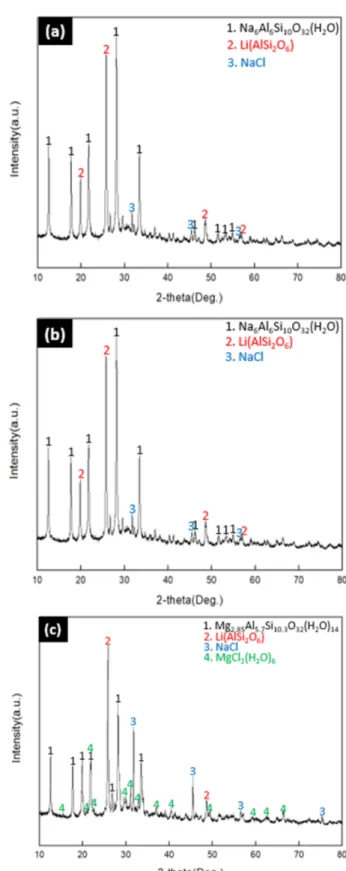
3.2.1 Modification by concentration of mixed solution In order to modify the Na-zeolite confirmed in 3.1 into Mg-zeolite, Mg mixture solution was reacted at a con- centration of 0.25 M/0.5 M/1 M for 24 hours. The results of modification were confirmed by XRD analysis as shown in Fig. 3 below.
When modified at the concentration of (0.25 M/0.5 M) in (a) and (b) of Fig 3., there was no change in the modi- fication of the zeolite in raw material residue, and the formation of NaCl could be confirmed.
However, when modified at the concentration of 1M in (c) of Fig 3, it has been modified into Mg zeolite
[Mg
2.85Al
5.7Si
10.3O
32(H
2O)
14] and the excess MgCl
2(H
2O)
6remaining after reacting with the β-phase of Li (AlSi
2O) and NaCl was existent.
The reason why Mg zeolite was modified only in Fig.
Fig. 2. FE-SEM image of the zeolite in raw material residue.
Fig. 1. XRD patterns of the zeolite in raw material residue.
Fig. 3. XRD results on the effect of mixture concentration.
(a) 0.25 M (b) 0.5 M (c) 1 M.
3(c), it can be explained by factors that affect the cata- lytic properties of zeolite. The catalyst properties and adsorption properties of zeolite are closely related, and the modified synthetic zeolites with mainly large diame- ters have excellent performance. Therefore, Mg-zeolite modified with Mg has a larger cavity and higher spatial volume ratio than Zeolite modified with other cations (Na
+, K
+, Ca
2+, Al
3+), and has high surface activity. Accord- ingly, zeolite forms a structure with anions of AlOx and SiOx in structure. At this time, cations exist for charge offset, and these cations exist inside the pores, not inside the structure. When the ratio of SiO
4/AlO
4is 2 .5 or above, the resistance to acid and the cation exchange capacity decreases, whereas when the ratio decreases to 2 or below, the hydrophilicity and positive ion exchange characteristics increases. Therefore, in the case of (a) and (b) in Fig. 3 which are relatively at lower concentration than (c) in Fig. 3, the modification to Mg zeolite did not take place. [9] Table 2 shows chemical composition according to the concentration of mixture.
3.2.2 Modification by reaction time
In order to modify Na-zeolite into Mg-zeolite at a con- centration of 1 M in which the modification reaction was confirmed in 3.2.1, a modification experiment was con- ducted by reaction time (12hours/24 hours). The modi- fied phases were examined by XRD analysis, and the results are shown in Fig. 4.
As shown in (a) of Fig. 4, when reacted for 12hours, there was no change in the modification of Na-zeolite, but β-phase spodumene of Li (AlSi
2O) was reacted with MgCl
2∙6H
2O, generating Mg
6Al
1.2Si
1.8O
6. However, the Mg-zeolite modification could be confirmed when reacted for 24 hours as shown in (b) of Fig. 4.
In the case of 12-hour reaction, Mg
2+cations were changed by reaction with lithium of spodumene, not by with zeolite, but in the case of 24-hour reaction, reaction with zeolite took place first, followed by the reaction with Na and MgCl
2exchanged from zeolite took place,
generating NaCl.
As shown in (a) of Fig. 5 examined with FE-SEM, in the case of 12hours, the shape was entangled with each other compared to the raw material residue crystals, and a small amount of columnar crystals were existent, con- firming that the crystals of zeolite were decomposed and reacted with spodumene, so they were entangled with each other. However, in the case of (b), more columnar crystals were existent than the raw material residue crys- tals, confirming that it was modified to Mg zeolite by ion exchange between Na and Mg.
3.3 Absorption test of heavy metal (Pb)
2g of Mg-modified zeolite was added to 50 ml of the
wastewater solution prepared with a heavy metal stan-
dard reagent (Pb), and stirred for 24 hours at 250 rpm
with a magnetic stirrer. After that, the content of Pb in
Fig. 4. XRD patterns on the effect of reaction time (a) 12 hours (b) 24 hours.the solution was analyzed by ICP analysis. As a result, the adsorption removal rate of 99.86% was confirmed as shown in Table 3. The zeolite is known to have better ion exchange capacity as the particle diameter is smaller. In the case of zeolite modified with Mg
2+, it had the size of 4~5 Å, which is larger than the size of 3Å in the existing zeolite, due to changes in the structure of the existing
zeolite, the nature and structural location of the cation, the content ratio of Si/Al, the presence of active metal elements, and the pH [8]. Therefore it is considered that with relatively excellent surface activity and large crystal pores, it showed high removal rate of 99.86% [10].
4. Conclusion 4.1 Modification of Mg-zeolite
1) It was confirmed that the Na-zeolite in the raw material residue could be modified into Mg-zeolite by cation exchange with a MgCl
2∙H
2O mixture solution at 1M concentration.
2) It was found that the Na-zeolite in the raw material residue could be modified into Mg-zeolite by reacting it with mixture solution at 1M concentration for 24 hours.
4.2 Absorption of heavy metal (Pb)
1) The removal rate of 99.86% was confirmed by add- ing 2g of the prepared Mg-zeolite to 50 ml of Pb waste- water solution.
2) It is considered that additional modification experi- ments are needed for adsorption removal rate that satis- fies the standards for industrial wastewater discharge.
Acknowledgment
This study was supported by the BB21+ Project in 2020 and this material is based upon work supported by the Ministry of Trade, Industry & Energy (MOTIE, Korea) under Industrial Technology Innovation Program.
No.20003877, ‘Development of eco-friendly electro- chemical recycling system for production of high purity lithium and lithium compounds’
References
8[1] Ministry of Environment: Environmental Statistics Year- book, (2019) 137.
8[2] F. Fu and Q. Wang: J. Environ. Manage., 92 (2011) 407.
Fig. 5. FE-SEM images by reaction time (a) raw specimen (b) 12 hours (c) 24 hours.
Table 3. Results of heavy metal (Pb) absorption Pb in wastewater
solution Pb after absorption
test Removal
rate
99.032 mg/L 0.130 mg/L 99.86 (%)