Manuscript received December 31, 2015, revised May 2, 2016, accepted May 27, 2016
Development of the Corrosion Deterioration Inspection Tool for Transmission Tower Members
Sangkyun Woo
*†, Inyeop Chu
*, Byongdon Youn
**, Kijung Kim
****
KEPCO Research Institute, Korea Electric Power Corporation, 105 Munji-Ro, Yusung-Gu, Daejeon, 34056, Korea
**
PLANALL Engineering & Construction Inc., 24-22 Gurodong-Ro, Guro-Gu, Seoul, 08279, Korea
***
CENITS Corporation Inc., 1107 Gasan Digital 1-Ro 233, Geumcheon-Gu, Seoul, 08594, Korea
† [email protected]
Abstract
Recently, interests for maintenance of transmission tower are increasing to extend life of structures and reduce maintenance cost.
However, existing classical diagnosis method of corrosion deteriorated degree on the transmission tower steel members, visual inspection, has a problem that error often due to difference of inspector’s individual knowledge and experience. In order to solve the problem, this study carried out to develop the corrosion deterioration inspection tool for transmission tower steel members. This tool is composed of camera equipment and computer-aided diagnosis system. We standardized the photographing method by camera equipment to obtain suitable pictures for image processing. Diagnosis system was designed to evaluate automatically degree of corrosion deterioration for member of transmission tower on the basis of the RGB color image processing techniques. It is anticipated that developed the corrosion deterioration inspection tool will be very helpful in decision of optimal maintenance time for transmission tower corrosion.
Keywords: Transmission tower, maintenance, corrosion deterioration inspection, RGB, color image processing
I. INTRODUCTION
The transmission tower is constructed and managed in various atmospheric environments during long-period of time, therefore, deterioration is occurred through the main cause of atmospheric pollution. The main member of most of the supports for the transmission tower is steel, and to minimize the deterioration, basically the method of hot dip galvanizing treatment is applied, and in the case of the hot dip galvanizing losing its original function, the painting repair is enabled additionally by the middle molding painting on the surface of the member. Generally, the deterioration of the transmission tower member not only results in the difficulty of maintenance and repair of the facility, but it also inhibits the reliability on the power supply, and becomes an important reason in reducing public safety. Therefore, to enable the economic and reliable management of the transmission tower, the condition of deterioration must be evaluated precisely, and at the same time, maintenance such as timely and rational repair and reinforcement are required.
For the transmission tower member currently under operation, the standard index for reading the deterioration level is partially set, and for the inspection method of deterioration to determine the performance of the maintenance, visual inspection is mostly performed. This visual inspection includes the irrationality of the inspector’s personal experience and own decision being greatly reacted in reading the level of deterioration in the transmission tow member. Also, quantitative analysis on the deterioration is difficult to disable efficient response to the determination of the maintenance period. To solve these problems in this study, the inspection tool for the quantitative analysis on the corrosion and deterioration level, and enabling objective
reading of the level of deterioration on the transmission tower member was developed.
II. THEORETICAL BACKGROUND AND STUDY TREND
According to the use of the transmission tower, when the hot dip galvanizing is corroded on the member, coating is performed on the surface of the steel surface to prevent additional corrosion.
This is a chemical or electrical blockage of the material and environment of the steel to prevent from corrosion. Currently, coating is the most widely used method, occupying approximately 65% of the cost for measures to corrosion. The reason that coating is widely used is because it does not require special tool for the coating to enable construction on the field, and it’s also low cost and can maintain the eco-friendly appearance. However, the durability of the coating and film are limited, therefore coating must be performed regularly after certain period.
Thus, as the importance of coat management on the steel
structure is recognized, studies on the maintenance method of
economic coating were performed. Various applicable coating
methods according to the characteristics of the exposed atmospheric
environment were set, and the service life of each costing were
evaluated to analyze the life-cycle cost to evaluate the economic
feasibility of maintenance [1]. Especially, grade was defined in
advance on the level of occurrence and progression of the
corrosion on the transmission tower, and rational method of
repair according to each corrosion grade were planned to analyze
the coating repair cost during the life-cycle, and as a result, it
showed that over 2 times the cost was added according to the
difference of repair period for each corrosion grade [2]. Therefore,
in the management and maintenance of the existing transmission tower, precise verification of the deterioration condition on the member is an important procedure to secure the safety and also the economic feasibility. In correspondence to this, various techniques were developed to inspect and diagnose the corrosion and deterioration level of the existing transmission tower and the steel structure. Basically, the evaluation standard through visual inspection on the corrosion and coating deterioration of the steel structure was established [3]-[6]. Also, the technique of using ultrasonic waves to measure the deterioration level on the painted member was introduced [7]-[9]. Moreover, for the hot dip galvanizing member, the electro-magnetic thickness tester and the handheld X-Ray fluorescence analysis system were used to effectively measure the residual thickness of the hot dip galvanizing film [10]. Especially, from the image filmed with CCD (Charge Couple Device) camera on the inspection and diagnosis site of the steel structure to image processing the deterioration such as the steel corrosion and exfoliation of the coating, techniques for the quantitative evaluation of the level of deterioration were developed to be actually applied on the inspection and diagnosis of the steel girder bridges [11][12]. Also for the transmission tower, studies regarding the reading on deterioration through HSV and Lab color space digital image processing were partially conducted [13][14].
However, the existing techniques of inspecting and diagnosing the level of corrosion and deterioration on the structure have limitations in use to be applied direction on the judgement of deterioration on the transmission tower. In other words, visual inspection is not possible for quantitative evaluation on the deterioration reading, and the residual thickness measurement using non-destructive tool has high precision in measurement, but has only sectional result on the member of inspection. Therefore, in the case of performing the inspection on the overall structure, it has the problem of low efficiency in the inspection and diagnosis work. According to these conditions, the deterioration evaluation technique through the digital image processing is recently being applied, but it was mostly on the steel girder bridges, and the image processing technology is optimized on the deterioration characteristics on the painted member, therefore, it is impossible to be applied in members treated with hot dip galvanizing coating such as the transmission tower. Also, the existing digital color image processing based transmission tower
deterioration evaluation technology that was developed is an image processing technology considering the deterioration characteristics of the hot dip galvanizing member, but in the case of performing the repair on the coating according to the elapse in the use of the transmission tower, it is difficult to provide proper inspection and diagnosis result on the deterioration condition of the painted member.
III. DEVELOPMENT OF THE CORROSION AND DETERIRORATION INSPECTION TOOL
In this study, according to the deterioration condition evaluation standard of the transmission tower by KEPCO, the inspection tool that can enable quantitative analysis on the steel corrosion and coating deterioration on the hot dip galvanizing coating and painted member of the transmission tower in use, and provide objective evaluation on the level of deterioration was planned. To utilize the RGB color value on the transmission tower member corrosion and coating deterioration to evaluate the level of deterioration on the transmission tower based on the digital color image processing, the camera equipment and the computer-aided diagnosis system of corrosion and deterioration were developed.
A. Standard of deterioration grade decision on the transmission tower
The criteria of deterioration on the transmission tower can differ according to each country or the subject of maintenance. In KEPCO, the color change characteristics on the surface of the steel according to the deterioration of the hot dip galvanizing coating and painted member of the transmission tower are used to select the member subjected for anti-corrosion coating, and the condition of corrosion is diagnosed and evaluated according to
4 · The area rate of the rust within the 1.0 m size of the is between 20~40%
5
· The steel member is shown wider than in grade 4 of deterioration level, and noticeable black
discoloration has occurred
· Area rate of rust in the 1.0 m size of the member is over 40%
· The area rate of damage within 1.0 m size of the length in the member is less than 20%
4
· Crack, exfoliation, swelling and exposure of the basic material are widely occurred on the surface of the painted member
· There are corrosion also on the basic material exposed
· The area rate of damage within 1.0 m size of the length in the member is between 20~40%
5
· Crack, exfoliation, swelling and exposure of the basic material are occurred on the surface of the painted member much wider than grade 4 of the deterioration level
· There are corrosion also on the basic material exposed
· The area rate of damage within 1.0 m size of the length in the member is over 40%
the overhead transmission operating work standard [15].
Table 1 is the standard of anti-corrosion coating in the overhead transmission operating work standard, and shows the external condition according to the process of corrosion on the hot dip galvanizing member of the transmission tower. Table 2 shows the external characteristics according to the process of corrosion on the painted member of the transmission tower, and the deterioration level is classified as 1 (good) to 5 (poor) according to each external condition to perform the diagnostic evaluation.
B. Development of the corrosion & deterioration imaging tool As shown in Table 1 and Table 2, the deterioration of the transmission tower is determined according to the rust within 1.0m of the member width or by the area rate of damage, therefore, the imaging tool of deterioration level evaluation on the transmission tower must be developed to always take the image of 1.0 m in width of the member. However, as shown in Fig. 1(a), climbing up the transmission tower and taking the image of 1.0 m in length at once is very difficult, therefore, in this study, 0.5 m of the member length was filmed in sequence as shown in Fig. 1(b) to plan the diagnosis and evaluation of the deterioration level on the transmission tower.
As shown in Fig. 1(b), the camera equipment was developed in blue rectangular frame form to automatically extract the ROI (Region of Interest) on the filmed member of the transmission tower through the image processing technology. For the width of the transmission tower member, the location was set by the
yellow marker on the right side of the rectangular frame to be processed into an image. Especially, the color chart on the left side of the rectangular frame provides the standard value of RGB for calibrating the distortion in the image according to the change in illumination.
Magnet was installed on the bottom of the rectangular frame to enable convenience in operating the camera equipment, and the digital camera support was able to be attached and detached from
(a)
(b)
Fig. 1. Camera equipment for corrosion deterioration inspection tool. (a) safety inspection scene, (b) camera equipment.
(a)
(b)
(c)
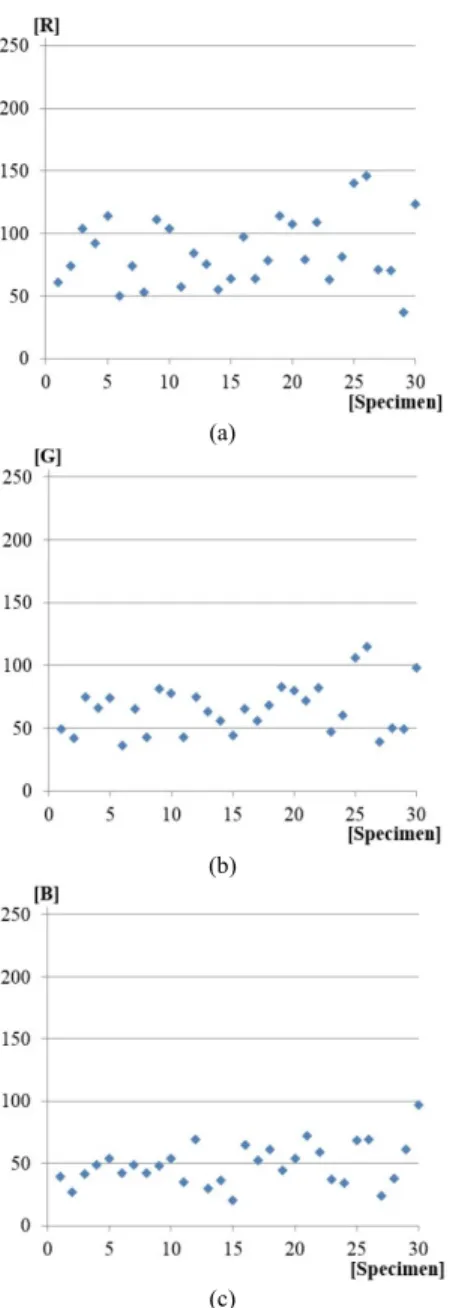
Fig. 2. RGB value of transmission tower steel member. (a) R-G Axis, (b) R-B Axis, (c) B-G Axis
Table 3. RGB value analysis of transmission tower steel member
Division Rust Painting Hot dip galvanizing
coating
R G B R G B R G B
Maximum value 146 115 97 203 181 164 161 180 170
Minimum value 37 36 20 79 95 39 45 65 81
Average 85 65 49 144 139 122 96 112 123
Variance 719 386 273 1,229 554 1,412 946 937 949
Standard deviation 27 20 17 35 24 38 31 31 31
the center of the rectangular frame. The digital camera applied on the camera equipment is attached to the vertical support in the center of the rectangular frame to take the image of the transmission tower member in the equal angle of view and ration in a certain distance, to secure the constant, standardized image of deterioration.
C. Development of the corrosion & deterioration color image processing technique
By using the discoloration characteristics of the member surface according to the deterioration of the hot dip galvanizing coating and painting of the transmission tower to perform the color image processing for the evaluation of deterioration level, the color characteristics of the rust, painting and the hot dip galvanizing coating must be secured. In this study, the deterioration image of members in 30 transmission towers in use were filmed to analyze the RGB color value of the rust, painting and hot dip galvanizing coating, and the result is show in Fig. 2 and Table 3.
As shown in Fig. 2 and Table 3, The RGB value of rust can be distinguished to the RGB value of hot dip galvanizing coating
and painting. Also, the painting applied on the transmission tower are various, including green, orange, white and ivory according to its purpose, therefore, the RGB value is dispersed widely. Fig.
3 shows the dispersion status of the RGB value on rust. Therefore, regarding the color image processing for determining the level of deterioration level on the transmission tower, the key is to use the RGB value per pixel of the deterioration image of the hot dip galvanizing coating and painting on the member in Fig. 4 to select and extract the RGB value of the rust or painting based on the Table 3 result.
D. Development of the corrosion & deterioration diagnosis system
From the deterioration image of the hot dip galvanizing coating and painted member of the transmission tower, the color image processing corrosion & deterioration diagnosis system was planned for determining the level of deterioration. Also, the system was developed to be usable in web-based Windows environment to improve the use accessibility. The development and operating environment of the corrosion & deterioration diagnosis system is shown in Table 4 and Fig 5.
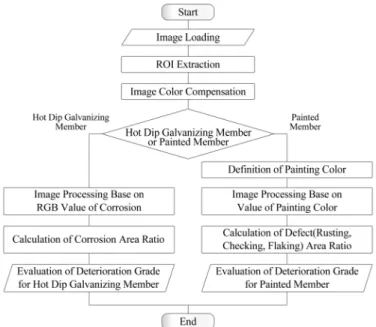
Fig. 6 shows the procedure of determining the level of deterioration on the transmission tower steel member by the color image processing based corrosion & deterioration diagnosis system. The process of determining the level of deterioration on
(a)
(b)
(c)
Fig. 3. RGB value of rusting for transmission tower steel member. (a) R value, (b) G value, (c) B value.
Fig. 5. Architecture of computer-aided diagnosis system for transmission tower steel member.
Table 4. System development and operation environment
Division Contents
Development tool · Language : C++ (MS Visual Studio 2010)
· DBMS : MS-SQL Operating environment · OS : Windows Server 2012
· WEB Server : Tomcat 7.x H/W · IBM-PC Compatible
the transmission tower steel member by the corrosion & deterioration diagnosis system is separated between the hot dip galvanizing coated member and the painted member, but the main processing procedure are the same. In other words, the deterioration image of the transmission tower steel member is taken to be inputted in the corrosion & deterioration diagnosis system, and the ROI is extracted from the image that was inputted. On the ROI, RGB chart is used to perform image calibration, and the hot dip galvanizing coated member and the painted member are divided to perform the color image processing. The area rate of rust and damage are calculated, and the level of deterioration is determined by the criteria of deterioration grade on the hot dip galvanizing coated member and the painted member.
The reason that the decision procedure of deterioration level on the hot dip galvanizing coated member and the painted member is divided is because the RGB value of the hot dip galvanizing coated member and rust are inherent, but the RGB value of the painted member exists diversely according to the applied paint. Therefore, in the color image processing for the deterioration level evaluation of the transmission tower painted member, the procedure of defining the RGB value of the paint is required, and based on the RGB value of the paint determined, to perform the color image processing, the damaged site can be processed into an image.
The cases of the result of determining the deterioration level of the hot dip galvanizing coated and painted transmission tower steel member using the corrosion & determination diagnosis system developed in this study are shown in Fig. 7 and Fig 8. As show in Fig. 7, the deterioration image of the hot dip galvanizing coated and painted transmission tower steel member acquired from the camera equipment was performed with digital color image processing to convert the rust region pixel into red and the normal region into yellow to enable intuitive recognition on the region of deterioration. Also, in the digital deterioration image, the number of pixel on the red was divided with the number of pixel on the overall deterioration image to calculate the area rate of the rust. As shown in Table 1, the grade is determined by the criteria of deterioration level on the transmission tower of
KEPCO. For the transmission tower painted member shown in Fig. 8, the damaged region of rust, crack, exfoliation and swelling from the original color of coating and painting are past processed into red to calculate the area rate, and as shown in Table 2, the grade is determined by the criteria of deterioration level.
IV. CONCLUSIONS
In this study, the evaluation technique of the deterioration condition on the transmission tower in the overhead transmission operating work standard by KEPCO was used to develop an inspection tool that can enable quantitative analysis of the steel corrosion and damage in the paint on the hot dip galvanizing coated and painted transmission tower steel member, and also evaluate the level of deterioration on the transmission tower objectively. The inspection tool was composed of the corrosion
& deterioration image camera equipment that can secure the standardized deterioration image on the transmission tower steel member, and the corrosion & deterioration diagnosis system
Fig. 6. Flow chart on the computer-aided diagnosis system of corrosion deterioration.
Fig. 7. Analysis result of corrosion deterioration for transmission tower hot dip galvanizing member.
processing the color image and evaluating the deterioration level based on the RGB characteristic value of the rust, hot dip galvanizing coating, and painting from the deterioration image of the hot dip galvanizing coated and painted transmission tower steel member.
As a result of using the developed corrosion & deterioration diagnosis system to test the decision on the level of deterioration on the hot dip galvanizing coated and painted transmission tower steel member, the area rate of rust and the deterioration level were able to be evaluated quantitatively from the deterioration image of the hot dip galvanizing coated member. Also, from the deterioration image of the painted member, damages such as rust, exfoliation and swelling were processed into color image, and the
REFERENCES
[1] Jayson L. Helsel and Robert Lanterman and Kirk Wissmar,
“Expected Service Life and Coat Considerations for Maintenance and New Construction Protective Coating Work”, CORROSION/
2008, Paper No. 08279, 2008.
[2] PPG Industries Inc., “Transmission Tower Maintenance Bottom Line Savings Through Active Maintenance”, White Paper, 2010.
[3] ASTM-D610-08, “Standard Practice for Evaluating Degree of Rusting on Painted Steel Surfaces”, ASTM International, 2012.
[4] SSPC-Vis-2, “Standard Method of Evaluating Degree of Rusting on Painted Steel Surfaces”, The Society for Protective Coatings, 2004.
[5] ASTM-D772-86, “Standard Test Method for Evaluating Degree of Flaking (Scaling) of Exterior Paints”, ASTM International, 2011.
[6] ASTM-D660-93, “Standard Test Method for Evaluating Degree of Checking of Exterior Paints”, ASTM International, 2011.
[7] David Beamish, “Using Ultrasonic Coating Thickness Gauges”, Materials Performance, 2-5, 2004.
[8] X. Zhang and F. Augereau and D. Laux and E. Le Clezio and N. A.
Ismaili and M. Kuntz and G. Despaux, “Non-destructive Testing of Paint Coatings on Steel Plates by Ultrasonic Reflectometry”, Journal of Nondestructive Evaluation Vol. 33, 2014, pp. 504-514.
[9] Paul Grosser, “Ultrasonic Detection and Measuring of Isolated or itting Corrosion”, 12th A-PCNDT 2006 Asia-Pacific Conference on NDT, Auckland, New Zealand, 2006.
[10] Yasuhiro Higashi and Takashi Sawada, “Comparative Study on Nondestructive and Destructive Methods of Evaluating Thicknesses of Hot-dip Galvanized Coatings”, Journal of Surface Analysis Vol. 20, No. 3, 2014, pp. 202-206.
[11] Expressway Research Institute Japan Highway Public Corporation,
“Development of a system for diagnosing bridge coating deterioration degree (Paint View)”, 2002.
[12] Korea Expressway Corporation, “Construction of Diagnosing System for Painting Condition of Steel Bridge”, 2004.
[13] T. Tsushima and A. Ishii and T. Iida and N. Masaoka and H.
Matsusue, “Study on Diagnostic Method for Deterioration of Members of Power Transmission Steel Tower Coated with Hot-Dip Zinc”, The Japan Society of Mechanical Engineers, No. 00-2, 2000.
[14] Junya Hasegawa and Takashi Onoda, “Judgment of the galvanizing degradation degree based on the color of digital images of power transmission tower”, The 24th Annual Conference of the Japanese Society for Artificial Intelligence, 2010.
[15] Korea Electric Power Corporation, “Overhead Transmission Operation Business Standards”, 2013.
Fig. 8. Analysis result of corrosion deterioration for transmission tower painted member.