Health-Promoting Behaviors, Health Literacy, and Levels of Knowledge about Smoking-Related Diseases among Smokers and Non-smokers: A Cross-Sectional Study
Cihat Celebi, M.Sc.
1, Ebru Calik-Kutukcu, Ph.D.
2, Melda Saglam, Ph.D.
2, Cemile Bozdemir- Ozel, Ph.D.
3, Deniz Inal-Ince, Ph.D.
2and Naciye Vardar-Yagli, Ph.D.
21
Traditional and Complementary Medicine Department, General Directorate of Health Services, Turkish Republic Ministry of Health, Ankara,
2Faculty of Physical Therapy and Rehabilitation, Hacettepe University, Ankara,
3Department of Physiotherapy and Rehabilitation, Faculty of Health Sciences, Eskisehir Osmangazi University, Eskisehir, Turkey
Background: For generations, cigarette smoking has presented an important public health concern. This study aimed to compare the health-promoting behavior, exercise capacity, physical activity level, health literacy, and knowledge level of smoking-related diseases between smokers and non-smokers.
Methods: The study included 71 smokers (mean age, 32.69±8.55 years) and 72 non-smokers (mean age, 31.88±9.94 years) between the ages of 20 and 60 years. Assessments included a 6-minute walking test (6MWT), Godin Leisure-Time Physical Activity Questionnaire, Health-Promoting Lifestyle Profile II (HPLP-II), Cardiovascular Risk Factors Knowledge Level Scale (CARRF-KL), Asthma/COPD Awareness Questionnaire, the World Health Organization Quality of Life-Bref questionnaire (WHOQoL-Bref [TR]), and Health Literacy Questionnaire (HLQ).
Results: The results from the study show that the number of coronary artery disease risk factors measured significantly higher among the smoker group members when compared to that of the non-smoker group members (p=0.001).
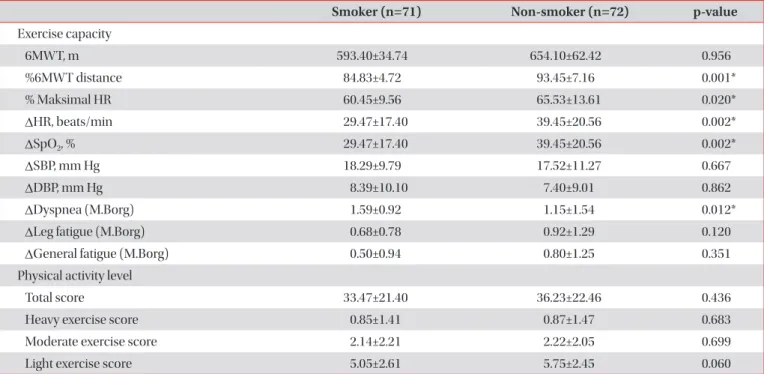
Smokers had significantly lower %6MWT distance than non-smokers (84.83±4.72 and 93.45±7.16, respectively; p<0.05).
However, there were no significant differences between the smokers and non-smokers in terms of physical activity, CARRF-KL, HLQ, WHOQoL-Bref, and HPLP-II subscales or total scores (p>0.05). Additionally, while only forty-one smokers (57.7%) were active, 48 of the non-smoker group was active (66.7%).
Conclusion: Smokers suffer greater negative effects to their exercise capacity in comparison to non-smokers. Although smokers and non-smokers have similar levels of health literacy and similar levels of knowledge about cardiovascular disease risk factors and obstructive lung diseases, health professionals could continue to further increase individuals’
awareness of smoking-related risk factors and continue to emphasize the importance of physical activity and exercise for protecting cardiopulmonary health.
Keywords: Smoking; Physical Activity; Healthy Lifestyle; Health Literacy
Address for correspondence: Ebru Calik-Kutukcu, Ph.D.
Faculty of Physical Therapy and Rehabilitation, Hacettepe University, Samanpazari, Ankara 06100, Turkey Phone: 90-03123051576 (ext.195), Fax: 90-312-3052012, E-mail: [email protected]
Received: Dec. 7, 2020, Revised: Jan. 11, 2021, Accepted: Jan. 26, 2021, Published online: Jan. 26, 2021
cc It is identical to the Creative Commons Attribution Non-Commercial License (http://creativecommons.org/licenses/by-nc/4.0/).
Copyright © 2021
The Korean Academy of Tuberculosis and Respiratory Diseases.
Introduction
Most of the World Health Organization (WHO) reports on addictive and non-addictive substances state that cigarette consumption and cigarette addiction are a major threat to public health and that more focus should be given on this subject
1. The physiological, hemodynamic, and pathological effects of cigarette consumption affect all organs and systems, leading to various systemic and inter-system problems. In par- ticular, smoking has adverse effects on pulmonary and cardiac health due to the toxic and harmful substances in cigarettes.
Cigarette consumption is considered one of the main risk factors of many chronic diseases, especially cancer, cardio- vascular diseases (CVD) and some like diseases like chronic obstructive pulmonary disease (COPD), lung cancer, asthma, pneumonia, tuberculosis, and pulmonary hypertension
2.
Cigarette exposure adversely affects quality of life in many disease groups. It has been shown that active smokers have negative symptomatic health perceptions and decreased quality of life even without active airway limitation or changes in the lungs compared to non-smokers
3. Cigarette consump- tion is also reported to decrease exercise capacity by damag- ing the vascular endothelial tissue
4.
Field observations and cohort studies have revealed a close relationship between smoking cessation skills and health lit- eracy
5,6. Low levels of health literacy are one of the reasons for the smoking cessation rate in people of lower socioeconomic status
5. Yang et al.
7found that active smokers have less aware- ness and acknowledgment of the health risks of smoking than non-smokers and former smokers.
International health associations and national health au- thorities agree that smoking is the most universal and com- mon health problem. In recent years, the Global Alliance Against Chronic Respiratory Diseases has emphasized the importance of chronic respiratory diseases among the world’s most critical health problems, and this approach is supported by Turkish governmental policies
8. Since 2006, various initia- tives aimed at reducing smoking have been implemented in Turkey, such as prohibiting the sale of cigarettes to minors, smoking in public places, and advertisements and broadcast- ing programs that promote cigarette smoking
9.
Although the health, economic, and social aspects and adverse effects of cigarette consumption and addiction have been revealed in numerous studies, there is ongoing interest among scientists and especially social science researchers re- garding why smokers persist in this behavior. In an effort to un- derstand this phenomenon, many questionnaires have been developed and dozens of non-interventional field studies, focus group interviews, and face-to-face in-depth interviews have been conducted. There are few published studies evalu- ating differences between smokers and non-smokers in terms of exercise capacity, physical activity level, access to health- related information, and their interpretation and application
of this information. Therefore, in the present study, we aimed to compare health-promoting behaviors, exercise capacity, physical activity level, health literacy, level of knowledge about smoking-related diseases, and quality of life in smokers and non-smokers. Determining the cardiovascular and pulmonary disease awareness, health-promoting behaviors, and health literacy of smokers may guide health policy-making and pub- lic health perspectives on coping with cigarette consumption.
We hypothesized that there would be significant differences in these variables between smokers and non-smokers.
Materials and Methods
1. Participants
This cross-sectional study was conducted between June 2019 and November 2019 in the Cardiopulmonary Rehabilita- tion Unit of the Hacettepe University Faculty of Physical Ther- apy and Rehabilitation in Ankara, Turkey. Sample size was calculated based on a previous study by Ergin et al.
10Based on the total physical activity scores of smokers and non-smokers in that study, it was determined that at least 63 participants should be included in each group for our study to have 80%
strength using the G*Power analysis system (G*Power, ver. 3.1, Heinrich Heine University Düsseldorf, Düsseldorf, Germany) Accounting for potential loss of up to 10%, the recruitment goal was at least 69 people in each group. This sample size calculation was performed
11. Seventy-one smokers between the ages of 18 and 65 years and 72 non-smokers similar in age and sex distribution were included in the study. Inclusion criteria for smokers were consuming at least one cigarette every day for the last year, in accordance with the WHO and International Classification of Diseases (ICD) cigarette addic- tion criteria. The inclusion criteria for non-smokers were hav- ing never smoked in their life or never smoked in the last year under the WHO and ICD cigarette addiction criteria
12. Other inclusion criteria that applied to all participants were being between 18 and 65 years of age, volunteering to participate in the research, being able to walk and cooperate, and being liter- ate. Individuals having orthopedic, neurological, and neuro- muscular diseases that could prevent walking and which may affect the tests and those with any chronic lung disease, any acute cardiovascular events, chronic heart failure, or cognitive impairment were excluded from the study.
Ethical approval was obtained from Hacettepe University
Non-Interventional Clinical Research Ethics Committee for
the study (approval date: 24 April 2019, approval number: GO
19/445). Participants in the study were informed about the
study verbally and written informed consent form was signed.
2. Assessments
The participants’ demographic characteristics were record- ed. Cigarette exposure was recorded as pack-years. Among the risk factors of CVD, advanced age (>45 years for men, >55 years for women), hypertension, diabetes, family history of coronary artery disease (CAD), smoking history, physical in- activity, hyperlipidemia, and personality type were recorded.
The number of CAD risk factors was calculated
13. Body mass index was classified. Waist and hip circumference measure- ments were made with a standard tape measure. For abdomi- nal obesity and increased risk of CAD, waist circumference cut-off values in our country were reported as >90 cm for women and >100 cm for men. Waist/hip circumference ratio was calculated
14.
1) Exercise capacity
Exercise capacity was evaluated using the six-minute walk test (6MWT), which is a submaximal field test. The test is applied in a 30-meter enclosed corridor. Due to the learning effect, it was repeated twice with a half-hour rest interval be- tween the two tests. Before and after the test, the participant’s systolic blood pressure and diastolic blood pressure measured with a manual sphygmomanometer (Erka aneroid clinic 48, Bad Tölz, Germany) and heart rate (HR) and oxygen satura- tion (SpO
2) values measured with a portable pulse oximeter (Jumper, Guangdong, China) were recorded. Perceived dys- pnea, leg fatigue, and general fatigue were also assessed using the Modified Borg Scale before and after the 6MWT. The best 6MWT distance was recorded in meters and the percentage of expected 6MWT distance was calculated (%6MWD)
15.
2) Physical activity level
The Turkish version of the Godin Leisure-Time Physical Ac- tivity Questionnaire was used to assess the participants’ physi- cal activity levels. This questionnaire includes questions about physical activity performed for at least 15 minutes during leisure time and determines how many times strenuous, mod- erate, and mild physical activity was done in the last week.
The total score is calculated using the following formula: total score=(9×strenuous activity)+(5×moderate activity)+(3×mild activity). Total scores ≥24 are classified as active; scores of 14–23 are classified as moderately active, and those ≤13 are classified as insufficiently active/sedentary
16.
3) Knowledge of CVD risk factors
The participants’ level of knowledge regarding CVD risk fac- tors was evaluated using the Turkish version of the Cardiovas- cular Disease Risk Factors Knowledge Level Scale (CARRF- KL). The scale consists of 28 questions in total: 4 about the features of CVD, 15 about risk factors, and 9 about the result of a change in risk behavior. Incorrect responses receive no points and each correct response receives 1 point, for a maxi-
mum possible score of 28. Higher score indicates a higher knowledge level
17.
4) COPD and asthma awareness level
The Asthma/COPD Awareness Questionnaire from the Turkish Ministry of Health Chronic Airway Disorders Preven- tion Control Program was used for assessment of awareness level about COPD and asthma. Items in the questionnaire are answered with “yes”, “no”, or “not sure” and the results are inter- preted by comparing the response percentages to the litera- ture. This questionnaire was used in an extensive field study on COPD and asthma in Turkey
18.
5) Health-promoting lifestyle behaviors
Health-promoting behaviors were evaluated using the Turk- ish version of the Health-Promoting Lifestyle Profile II (HPLP- II)
19. The scale measures health-promoting behaviors related to the individual’s lifestyle. The scale consists of 52 items in six subdimensions (spiritual development, health responsibility, physical activity, nutrition, interpersonal relationships, and stress management). Items are scored on a 4-point Likert-type scale: never (1), sometimes (2), often (3), and regularly (4).
The total score ranges between 52 and 208, with higher total scores indicating a more health-promoting lifestyle
19.
6) Quality of life
The Turkish version of the WHO Quality of Life-Bref ques- tionnaire (WHOQoL-Bref [TR]) comprises four subdimen- sions: physical well-being, mental well-being, social relation- ships, and environmental factors. The scale does not have a total score. Scores between 20 and 100 can be obtained for each subdimensions, and the researcher can choose which scores to use. After the raw scores are calculated, percent scores are obtained. The Turkish version has 27 questions (Item 27 is a national question) and when using this scale, the environmental area score is referred to as environment-tr.
Higher scores reflect better quality of life
20. 7) Health literacy
The Turkish version of the Health Literacy Questionnaire (HLQ) was used to assess the health literacy of the smokers and non-smokers in our study. The HLQ consists of 25 ques- tions in four subdimensions. The total score ranges from 25 to 125. Participants respond to the items using a 5-point Likert- type scale: I have no difficulty (5), I have a little difficulty (4), I have some difficulty (3), I have difficulty (2), and I cannot/
am unable (1). Higher scores indicate a higher level of health literacy
21.
3. Statistical analysis
Data analysis was done with the SPSS version 18.0 program
(SPSS Inc., Chicago, IL, USA). Mean±standard deviation values
are given for quantitative variables; percentage and frequency values are given for categorical variables. Comparisons of the smoker and non-smoker groups were analyzed using Stu- dent’s t-test (under parametric conditions), Mann-Whitney U test (under nonparametric conditions) for quantitative vari- ables, and chi-square test for categorical variables. Statistical significance was accepted at p<0.05
22.
Results
A total of 143 people (71 smokers and 72 non-smokers) were included in the study. Comparisons of the participants’
demographic and clinical data are shown in Table 1. Although the number of CAD risk factors were significantly higher in smokers than non-smokers (p<0.05) (Table 1), seven percent- age of smokers (n=5) and 9.7% percentage of non-smokers (n=7) had similar and increased CAD risk according to waist circumference cut-off values (p=0.764). Occupational status differed significantly between the smokers and non-smokers (p=0.005) (Table 1). The marital status was similar between two groups (p>0.05) (Table 1). Educational levels of the smok- ers and non-smokers are shown in Figure 1 (p>0.05). Alcohol consumption was significantly higher among smokers than those of non-smokers (p=0.026) (Table 1).
Mean 6MWT distance was similar between the smokers and non-smokers (p>0.05) (Table 2). However, %6MWD and maximum HR during the 6MWT were significantly higher in the non-smokers than the smokers (p<0.05) (Table 2).
There were also statistically significant differences between the groups in terms of changes in HR and perceived dyspnea during 6MWT (p<0.05) (Table 2). According to the Godin Leisure-Time Physical Activity Questionnaire, there was no statistically significant difference in physical activity levels
Table 1. A comparison of the demographic and clinical variables between smokers and non-smokers
Characteristic Smoker (n=71) Non-smoker (n=72) p-value
Age, yr 32.69±8.55 31.34±9.93 0.316
Sex, female/male 31/40 41/31 0.112
Height, cm 168.81±8.52 170.91±8.11 0.140
Weight, kg 71.61±14.20 67.77±13.87 0.076
BMI, kg/m
224.38±3.84 23.73±4.33 0.400
Smoking exposure, pack-years 7.57±4.17 0.31±1.23 0.001*
Waist circumference, cm 79.94±11.33 79.40±13.10 0.764
Hip circumference, cm 100.01±7.73 100.30±8.54 0.742
Waist to hip ratio 0.79±0.08 0.78±0.08 0.058
No. of CAD risk factors 2 (1–5) 1 (0–3) 0.001*
Occupational status
Retired/not employed/white-collar workers/blue-collar workers
15/0/45/11 27/3/25/18 0.005*
Marital status
Married/single/divorced 33/37/1 33/36/3 0.604
Alcohol consumption
Never drank/rarely drank/drank one alcoholic beverage per week/drank an alcoholic beverage every day
41/19/10/1 58/10/4/0 0.026*
Values are presented as mean±SD, median (min-max), or number.
BMI: body mass index; CAD: coronary artery disease; SD: standard deviation.
*p<0.05.
Figure 1. Educational level of smokers and non-smokers.
Smokers 50
40 30 20 10
Non-smokers
No.ofparticipants
0
Primary school Middle school High school Undergraduate
Master of science/doctorate p=0.397