성충동약물치료 시행에 따른 소변 중 남성호르몬의 분석법 확립
정수진·백승경·박선혜·손꽃잎·박용훈·이상기#
국립과학수사연구원 법과학부 약독물과
(Received August 6, 2013; Revised September 12, 2013; Accepted September 22, 2013)
Validation of Analytical Method for Male Sex Hormone Monitoring in Urine due to the Chemical Castration
Sujin Jeong, Seungkyung Baeck, Sunhye Park, Kkonnip Son, Yonghoon Park and Sangki Lee# Drug & Toxicology Div., Forensic Science Dept., National Forensic Service, Seoul 158-707, Korea
Abstract — "The Act on Medication Treatment of Sexual Impulse of Sex Offenders" known as chemical castration has been effective since July 2011 in Korea. According to the law, monitoring of male sex hormone in urine is enforced to request National Forensic Service more than once a month after injection of medicine designed to reduce sex impulse. We estab- lished a rapid and sensitive method for the monitoring of testosterone (T) and epitestosterone (E) in human urine by liquid chromatography with tandem mass spectrometry (LC-MS/MS). Three mL of urine was pretreated by solid-phase extraction for purification and performed enzymatic hydrolysis. The pretreated samples were extracted twice with 2 ml of ethyl acetate and n-hexane (2 : 3). The separation was applied on Thermo Hypersil GOLD C18 column (1.9µm, 100×2.1 mm). A gradient elution of methanol and water of 0.1% formic acid were used as mobile phase and the retention time was less than 10 min.
LC-MS/MS system coupled with an electrospray ionization source was performed in multiple reaction monitoring mode.
The transitions of the analytes executed as following: m/z 289→97, 109 for T and E, m/z 292→109 for T-d3 and E-d3 as internal standards. The validation results of the method were satisfactory. The limits of detection were 0.05 ng/ml and the limits of quantification were 0.1 ng/ml. This method was successfully applied to real human urine sample. The developed method will be useful for monitoring T/E ratio in urine of sex offenders.
Keywords □ testosterone, epitestosterone, sex hormone, LC-MS/MS
우리나라의 성폭력 사건은 해마다 증가하여, 2008년도 13,000 여건에서 2011년도에는 22,000여건으로 약 70%나 증가하였다.1,2) 성폭력 범죄는 특성상 재범의 위험성이 높으나 법적 대응의 실효 성 부족으로 인해 사회적 문제로 부각됨에 따라 성폭력 범죄에 대 한 보다 근본적인 대책 마련이 시급하게 되었고, 그 결과 아동 성 폭력범죄자를 대상으로 "성폭력범죄자의 성충동 약물치료에 관한 법률"이 발효되었다. 소위 '화학적 거세'라 일컬어지고 있는 이 법 률은, 유럽에서 시작되어 덴마크, 독일, 노르웨이, 폴란드, 미국 등 지에서 이미 소아 성범죄자에 대하여 법안이 시행되고 있고,3-6)우 리나라는 2011년부터, 아시아에서는 최초로 시행되는 법안이다.
성충동 약물치료란 상습적 성범죄자 중 비정상적인 성적 충동을 가진 성도착증 환자에게 주기적으로 약물을 투여하여 일정기간 성
적 욕구를 감소시켜 재범을 예방하는 것을 의미하는데, 치료가 진 행되는 동안에만 거세 효과가 나타나고 약물 주사를 중지하면 성 기능이 회복 가능하다는 점이 특징이다.7,8)성충동 약물치료는 성 충동의 원인인 남성호르몬 테스토스테론(testosterone; T)의 분비 를 억제함으로써 성범죄자의 재범 방지를 도모하지만, 약물치료를 중단할 경우 성기능이 회복된다는 점에서 치료에 응하지 않거나 오히려 남성호르몬 억제효과를 저해하는 상쇄약물(남성호르몬제, 발기부전치료제 등)을 투여할 우려가 있다. 이 법률 시행령 제14 조에는 치료명령을 받은 사람에 대해 월 1회 이상 상쇄약물 투 약여부를 검사하도록 되어있는데, 소변 등 생체시료를 국립과학 수사연구원(이하 국과수)에 송부하여 검사를 의뢰하도록 명시되 어 있다. 이에 따라 국과수에서는 상쇄약물 투약 여부 감정, 호 르몬 수치 검사 및 정신과적 치료약물 검색 등의 업무를 수행하 기 위해 새로운 감정에 대한 분석법의 개발이 요구되었다.
소변에서 남성호르몬 수치 감정은 테스토스테론과 에피테스토 스테론(epitestosterone; E)(Fig. 1)의 비율로서 외부로부터 인위
#본 논문에 관한 문의는 저자에게로 (전화) 02-2600-4916 (팩스) 02-2600-4917 (E-mail) [email protected]
종설
적인 남성호르몬제의 투약 여부를 모니터링 할 수 있다.9)생체 내에서 측정되는 테스토스테론의 농도는 나이, 물 또는 약물 섭 취, 운동량, 스트레스 등과 같은 다양한 요인에 의해 영향을 받 기 때문에 소변에서 테스토스테론의 정량 결과를 근거로 약물의 근원이 내인성인지 외인성인지를 명확하게 밝히기가 어렵다. 에 피테스토스테론은 테스토스테론의 17번째 위치의 이성질체로 소 변에서 일반적으로 테스토스테론의 농도와 비슷하게 검출되기 때문에, T/E 비율은 안정하다고 보고되어 있다.10,11)그러나 외부 에서 테스토스테론을 투약할 경우, 소변에서 테스토스테론의 배 설은 증가하지만 에피테스토스테론의 배설률은 감소하고, 결과 적으로 T/E의 비율은 증가하게 되어12) 테스토스테론 및 전구물 질의 투약여부 또한 모니터링할 수 있다.13,14)그러나 차폐제 (masking agent)로써 에피테스토스테론의 투약을 병행할 경우 T/E의 비율로서만 남성호르몬제 투약 여부를 규정하기는 어렵기 때문에, 에피테스토스테론의 절대 농도 또한 고려되어야 한다.
세계반도핑기구(world anti-doping agency, WADA)는 T/E의 비 율이 4 이상이거나 테스토스테론의 농도가 200 ng/ml 이상일 경 우는 테스토스테론을 투약한 것으로 간주하고 있다.15)
남성호르몬 분석을 위하여 방사선동위원소 분석법,16)효소면역 측정법17)과 면역센서18)를 포함한 몇몇의 면역분석법들이 발표되 었으나 교차반응 및 의양성의 위험, 간섭 물질에 의한 영향을 배 제할 수 없다는 점 등에서 정량법으로는 적합하지 않다. 소변으 로부터 스테로이드 분석방법으로서 주로 기체크로마토그래피-질 량분석법(gas chromatography-mass spectrometry, GC-MS)19)이 전 세계적으로 사용되고 있으며, 최근 동위원소 비율을 이용한 질 량분석법(isotope ratio mass spectrometry, IRMS)20,21)을 사용하 여 약물의 정확한 기원을 판단할 수 있는 분석법이 소개되었다.
또한 액체크로마토그래피-질량분석법(liquid chromatography-mass spectrometry/mass spectrometry, LC-MS/MS)을 이용하여 소변 에서 테스토스테론을 포합체 형태로 분석하는 방법 등이 보고되 어 있으나22-27)거의 도핑 테스트에 적용하고 있는 방법으로써 성 충동 약물치료자의 생체시료에 적용 가능한 극미량의 남성호르몬 분석법은 확립되어 있지 않고, 특히 성충동 약물치료는 국내 처 음 시도된 사례로써 해외에서도 화학적 거세에 따른 남성호르몬 의 수치 및 비율에 대한 문헌을 거의 찾아볼 수 없기 때문에 여 러 분석법들을 비교 검토하여 성충동 약물치료 시행에 따른 소변
중 남성호르몬의 분석법을 확립하였다. 그리고 개발된 방법에 대 한 유효화 연구를 진행하였으며, 이후 성폭력 범죄 가출소자들의 남성호르몬제 투약여부를 모니터링하기 위한 방법을 구축하였다.
실험방법
시약 및 재료
테스토스테론 및 내부표준물질로 사용된 테스토스테론-d3, 에 피테스토스테론-d3는 National Measurement Institute(Sydney, Australia)에서 구입하였고, 에피테스토스테론은 Cerilliant사 (Austin, TX, USA)에서 구입하였다. 이들 표준품은 각각 메탄올 로 1 mg/l 농도로 제조하여 표준용액으로 사용하였으며 분석 시 까지 -20oC에서 보관하였다. 시료 전처리에는 고상추출 장치(Vac.
Manifold, Restek, USA) 및 컬럼(Oasis HLB, 3 cc/60 mg, Waters, USA)을 사용하였으며, 추출 후 기기 주입을 위하여 시 린지 필터(Millipore, 0.22 µm PVDF, hydrophillic, Germany)를 하였다. 기타 약독물 추출 등의 분석에 사용한 유기용매 및 기타 시약은 시판 특급 또는 HPLC용을 사용하였다.
추출 방법
소변에서 테스토스테론 및 에피테스토스테론의 추출은 WADA 법을 일부 수정한 고상추출법(SPE)과 액체-액체 추출법(LLE)을 사용하였다. 호르몬이 검출되지 않음을 확인한 공소변 3 ml에 표 준용액 일정량 및 내부표준액으로 100 ng/ml 테스토스테론-d3및 Fig. 1− Chemical structures of (a) testosterone, CAS No.: 58-22-0,
M.W.: 288.42 and (b) epitestosterone, CAS No.: 481-30-1, M.W.: 288.42
Scheme 1− Extraction procedure of male sex hormone in urine.
에피테스토스테론-d3용액 30 µl를 넣고 고상추출장치에 장착하 였다. 고상추출용 컬럼은 메탄올 2 ml 및 증류수 2 ml를 순차적 으로 통과시켜 활성화시킨 후 시료를 적용하였다. 증류수 2 ml를 컬럼에 통과시켜 세척한 후 메탄올 2 ml를 2회 통과하여 용출한 다음 질소 가스로 농축하였다. 이 후 0.1 M 인산염 완충액(pH 6.0) 1 ml 및 β-glucuronidase(E. coli, Roche) 50 µl를 첨가한 후 60oC에서 1시간 동안 효소 분해를 시켰다. 그리고 5% K2CO3용 액 0.7 ml를 첨가하여 알칼리화 한 뒤 에칠아세테이트 : 헥산(2 : 3, V/V) 용매 2 ml로 2회 추출하여 원심분리 후 질소 가스로 농축 하였다. 얻어진 잔사에 70% 메탄올 150 µl를 가하여 시린지 필 터를 한 뒤 LC-MS/MS용 분석시료로 하였다(Scheme 1).
분석기기 및 조건
LC-MS/MS는 ABSciex사(Foster City, CA, Canada)의 Agilent 1290 infinity LC-MDS 4000Qtrap MS/MS 시스템을 이용하였다.
분석용 컬럼은 Thermo Hypersil GOLD(1.9 micron, 100×2.1 mm)를 사용하였으며, 컬럼 온도는 40oC로 유지하였다. 이동상 은 증류수에 0.1% formic acid가 용해된 용매(A)와 메탄올에 0.1% formic acid가 용해된 용매(B)를 사용하였으며, 유속은 0.3 ml/min, 주입량은 5 µl이었다. 용매 조건은 B를 20%로 분석 전 1분부터 0.5분까지 유지시키다가 55%로 1.5분 간 증가, 70%로 6분에 증가, 90%까지 6.2분까지 증가시키고 1.3분 간 유지시킨 후, 다시 0.1분 동안 초기상태로 복귀시키고 2.4분 간 유지시켜 총 분석시간이 10분이 되도록 하였다. 이온화 조건은 전기분무 이온화(ESI), positive mode를 사용하였으며, 기타 최적화 조건은 curtain gas, 20 psi; collisionally activated dissociation(CAD), medium; ion spray voltage(IS), 5500 V; heated nebulizer temperature(TEM), 600oC; nebulizing gas(GS1), 45 psi; 그리 고 heater gas(GS2), 50 psi이었다.
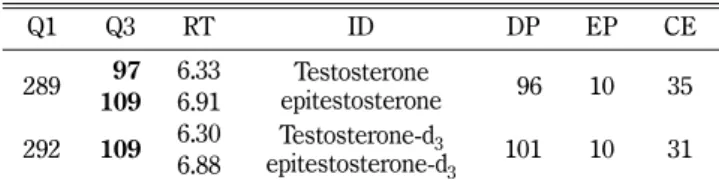
정성분석을 위하여 각 분석물질에 대하여 두개의 multiple reaction monitoring(MRM) transition을 사용하였으며, positive mode에서 [M+H]+로 이온화가 진행되었다.테스토스테론과 에 피테스토스테론은 이성질체이기 때문에 precusor-product ion이 m/z 289→97, 109로 동일하였고, 마찬가지로 테스토스테론-d3 및 에피테스토스테론-d3또한precusor-product ion으로 m/z 292→
109로 동일한 분석 조건을 확립하였으며(Table I), mass 스펙트 럼은 Table II와 같다.
분석방법의 밸리데이션
직선성(linearity)을 검토하기 위해 0.1~10 ng/ml의 농도 범위 를 설정하였다. 검출한계(limit of detection)와 정량한계(limit of quantitation)를 결정하기 위해 0.1 ng/ml 이하의 농도에서 실험 하였고, S/N 비율이 3 이상인 경우 검출한계로 정하였으며, 변이 계수(CV)가 20% 미만이고 bias가 ±20%인 경우 정량한계로 정 하였다. 정확도(accuracy)와 정밀도(precision)를 구하기 위해 저, 중, 고농도(0.4, 4 및 8 ng/ml)에서 실험하였다. 회수율(recovery) 와 매트릭스 효과(matrix effect)28)는 위에서 언급한 세 농도에서 순수한 표준용액과 추출 전 분석물질을 첨가한 공소변 추출물, 추출 후 분석물질을 첨가한 공소변 추출물을 각각 분석하여 비 교하였다.
Table I− MRM transitions and retention time of testosterone and epitestosterone
Q1 Q3 RT ID DP EP CE
289 097 6.33 Testosterone
epitestosterone 096 10 35 109 6.91
292 109 6.30 Testosterone-d3
epitestosterone-d3 101 10 31 6.88
* MRM transitions with bold font mean values for quantitative analysis.
Table II− MRM transition and mass spectra for testosterone and epitestosterone
Name MRM chromatogram Mass spectrum
Testosterone epitestosterone
Testosterone-d3 epitestosterone-d3
실제 소변 시료에서 테스토스테론 및 에피테스토스테론의 분석 시험관에 소변 시료 일정량을 정확하게 취하여 위에서 언급된 Scheme 1의 SPE 방법으로 추출하여 얻은 잔사를 메탄올에 다 시 녹여 기기에 주입하고, 측정된 크로마토그램에서 테스토스테 론 및 에피테스토스테론의 머무름시간, MRM transition 및 조
각 이온의 조각 양상을 확인하였다. 그리고 각 이온피크의 면적 을 구하여, 내부표준물질에 대한 테스토스테론 및 에피테스토스 테론의 피크 면적비를 구하였다. 이어 소변 중 테스토스테론 및 에피테스토스테론의 함량은 희석배수를 고려하여 검량선에 적용 하여 산출하였다.
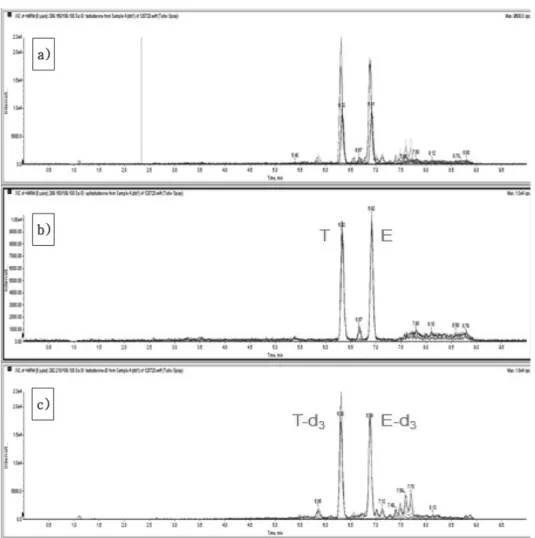
Fig. 3− (a) MRM chromatogram for testosterone and epitestosterone in blank urine sample spiked standards and internal standards, (b) chromatogram of extraction ion for testosterone and epitestosterone, (c) chromatogram of extraction ion for testosterone-d3 and epitestosterone-d3, retention time: testosterone (6.33), epitestosterone (6.91) testosterone-d3 (6.30) and epitestosterone-d3 (6.88).
Fig. 2− Confirmation of MRM chromatogram for testosterone and epitestosterone in blank urine as matrix.
결과 및 고찰
밸리데이션 결과
공소변을 위의 추출 방법에 따라 추출한 후 목적물질과 내부 표준물질의 검출에 간섭물질의 유무와 분리도를 검토하였다(Fig.
1). 테스토스테론 및 에피테스토스테론 10 ng/ml 용액 50 µl와 내 부표준물질 테스토스테론-d3및 에피테스토스테론-d3 100 ng/ml 용액 30 µl를 취하여 3 ml 공소변에 넣고 추출하여, 70% 메탄올 용매 150 µl로 재분산한 액을 공소변만을 추출하여 용해한 액과 피크 면적을 비교하였다. 테스토스테론 및 에피테스토스테론 각 각의 내부표준물질의 분리는 양호하였고, 소변 매트릭스에 의한 간섭물질이 없음이 확인되었다(Fig. 2, 3).
공소변 3 ml에 7개의 농도(0.1~10 ng/ml)의 테스토스테론 및 에피테스토스테론을 첨가하여 시험을 실시하고 대상약물의 면적 비와 내부표준물질의 면적비의 비율을 이용하여 x축은 농도, y 축은 면적비로 검량곡선을 작성하였다. 상관계수 R2이 1에서 벗 어나는 정도, y 절편 및 기울기가 95% 신뢰구간(confidence intervals)에 적합한가를 확인한 결과, R2는 0.999 이상으로 양호 하였다. 검출한계는 추정되는 최저농도를 3회 실험하여 모두가 목적이온 S/N 비율이 3 이상, 크로마토그램과 머무름 시간이 같 을 때로 결정하였고, 정량한계는 추정되는 최저농도를 5회 실험 하여 검출한계의 조건에 맞으면서 목적 농도의 범위가 20% 이 내일 때 정량한계로 결정하였다. 이 때 검출한계는 0.05 ng/ml, 정량한계는 0.1 ng/ml이었다. 기존의 GC-MS 분석법에서는 유도 체화나 고상미량추출법(solid phase microextraction, SPME)과 같은 전처리를 통해서 마이크로그램 또는 나노그램 단위의 검출 한계를 얻을 수 있었던 것과는 달리,19) LC-MS/MS법에서는 상 대적으로 쉽고 안정적으로 높은 감도의 결과를 얻을 수 있었다.
성충동 약물치료자의 경우, 소변 시료에서 낮은 농도의 남성호 르몬을 검출하여야 하기 때문에 검출한계 및 정량한계를 비교해 볼 때 GC-MS법보다는 LC-MS/MS로의 분석법이 적합할 것으 로 사료된다.
또한 공소변 3 ml에 세 농도(0.4, 4 및 8 ng/ml)의 테스토스테 론 및 에피테스토스테론을 첨가하여 5일 동안 3회 이상 반복 실
험하여 대상약물과 내부표준물질 목적이온의 면적비를 작성한 정량곡선에 적용하여 얻은 농도결과를 다음과 같은 식에 의해 편 차(bias, %)로 정확도 및 정밀도를 얻었다. 정확도는 일내(intra- day, n=5) 및 일간(inter-day, n=19)에서 5% 미만이었고, 정밀도 (CV, %)는 intra-day(n=5) 및 inter-day(n=19)에서 8% 미만으로 양호한 결과를 얻었다.
공소변 3 ml에 세 농도(0.4, 4 및 8 ng/ml)의 테스토스테론 및 에피테스토스테론을 첨가하여 3회 시험하여 얻은 측정값과 소 변을 배제한 후 농축하여 얻은 측정값에 대한 백분율로 추출효 율을 아래와 같이 구하고, 추출방법에 따라 추출하여 농축한 공 소변에 표준용액 세 농도(0.4, 4 및 8 ng/ml)의 테스토스테론 및 에피테스토스테론을 첨가하여 3회 시험하여 얻은 측정값과 소 변을 배제한 후 농축하여 얻은 측정값에 대한 백분율로 매트릭 스 효과를 확인하였다. 이 때 회수율은 84.03~93.36%이었고, 매트릭스 효과도 13% 이내로 양호한 결과를 얻을 수 있었다 (Table III).
Table III− Validation results of testosterone and epitestosterone in urine Conc.
(ng/ml)
Precision (%) Accuracy (%) Recoverya)
(%)
Matrix effectb) Intra-day Inter-day Intra-day Inter-day (%)
Testosterone
0.4 1.52 7.76 -4.17 2.66 93.36 .03.53
4.0 1.74 6.36 -0.95 2.78 92.26 .05.88
8.0 1.45 5.76 -0.12 3.02 92.95 .03.13
Epitestosterone
0.4 2.69 2.88 -0.65 1.88 92.00 .01.12
4.0 0.61 5.62 -2.10 2.82 90.33 .04.77
8.0 1.15 5.27 -1.03 3.03 84.03 12.99
a)Recovery (absolute recovery, %)=B/A×100.
b)Matrix effect(post-extraction addition)=(1-C/A)×100.
Table IV− Concentration of testosterone and epitestosterone, and T/E ratio in urine of normal person
Case
No. Sex Age T Cal. Con.
(ng/ml) E Cal. Con.
(ng/ml) T/E ratio
N10 M 26 70.4 70.6 1.00
N20 M 21 7.95 69.8 0.11
N30 M 38 28.9 28.9 1.00
N40 M 43 1.87 21.6 0.09
N50 M 45 3.69 52.0 0.07
N60 M 36 0.55 10.1 0.05
N70 M 32 3.55 43.6 0.08
N80 M 24 20.3 116 0.18
N90 M 43 33.3 32.6 1.02
N10 M 33 3.25 21.0 0.15
N11 M 42 59.9 35.8 1.67
N12 M 35 2.46 25.8 0.10
N13 M 39 1.38 17.6 0.08
N14 M 45 0.89 5.83 0.15
N15 M 29 9.79 107 0.09
N16 M 41 0.51 3.45 0.15
N17 M 37 5.32 46.3 0.11
N18 M 51 64.0 43.1 1.48
일반인 소변 시료에서 테스토스테론 및 에피테스토스테론의 분 석 결과
지원자 18명의 소변 시료에서 테스토스테론 및 에피테스토스 테론의 함량을 구하고, T/E 비율을 살펴보았다(Table IV). 일반 인의 소변 중 테스토스테론의 함량 범위는 0.51~70.4 ng/ml, 에 피테스토스테론의 함량 범위는 2.95~116 ng/ml이었고, T/E 비 율 또한 0.05~1.67이었다. 남성호르몬의 농도는 나이, 인종, 성 별 등에 의해 영향을 받기도 하지만, 개인차가 큰 것으로 보여지 기 때문에, 성폭력 범죄 가출소자들의 남성 호르몬제 투약여부 를 모니터링하기 위하여는 남성호르몬 억제제 투약 전 소변과 투 약 후 소변에 대하여 남성호르몬 수치 및 그 비율을 사전 데이 터로 관리하여야 할 것이다.
결 론
1. 소변 시료 중 LC-MS/MS 기기를 사용하여 테스토스테론 및 에피테스토스테론의 분석법을 확립하였다. 도핑 테스트를 위하 여 WADA에서 확립되어 있는 기존의 GC-MS 분석법은, 유도체 를 진행해야하는 번거로움이 있고 분석물질의 감도가 낮아 성충 동억제 약물치료 가출소자들의 소변 시료에서 극미량의 남성호 르몬을 검출하는데 한계가 있기 때문에 LC-MS/MS법에 의한 남 성 호르몬의 분석법을 개발하였다.
2. 고상추출방법으로 남성호르몬을 추출한 뒤 여액을 다시 액 체-액체 추출법을 이용하여 정제하였다. 2회에 걸친 추출법으로 인해 매트릭스의 영향이 최소화되었고, 분리능이 향상되는 결과 를 얻을 수 있었다.
3. 특수성 및 선택성(specificity, selectivity), 검출한계(limit of detection), 정량한계(limit of quantatification), 직선성(linearity), 정확도(accuracy), 정밀도(precision), 추출효율(extraction efficiency) 및 매트릭스 효과(matrix effect)를 검증하여 유효성 평가를 실 시하였다. 특수성 및 분리도는 양호하였고, 직선성도 R2=0.999 이상으로 양호하였다. 검출한계는 0.05 ng/ml, 정량한계는 0.1 ng/
ml이었고, 정밀도는 0.61~7.76%로 양호한 결과를 얻었다. 유효 화 결과 추출효율은 83% 이상으로 양호하였고 매트릭스 효과 도 87.01~98.88%로 매트릭스에 대한 영향도 양호한 결과를 얻 었다.
4. 테스토스테론 및 에피테스토스테론의 농도는 개인차가 크 기 때문에 성충동 약물치료자의 시료에서 남성호르몬을 모니 터링하기 위하여 남성호르몬 억제제 투여 전 소변과 투여 후 소변에 대하여 남성호르몬 절대농도 및 그 비율을 전반적인 사 전 데이터로 관리하여야 한다. 또한 그 밖의 남성호르몬의 농 도에 영향을 미칠 수 있는 기타 요인들, 즉 채취 시간 및 보 관 기간 등에 대하여도 추가적으로 고려해야 할 것으로 사료 된다.
감사의 글
본 연구과제는 국립과학수사연구원 과학수사 감정기법 연구개 발사업의 지원사업으로 진행되었기에 이에 감사드립니다.
참고문헌
1) 2011 범죄통계, 경찰청·한국형사정책연구원 (2012).
2) 2012 범죄분석, 대검찰청 (2013).
3) 박상기 : 소위 화학적 거세와 「성폭력범죄자의 성충동 약물치료 에 관한 법률」의 문제점, 형사정책연구학회 21, 205 (2010) 4) 허경미 : 성범죄자에 대한 약물치료명령에 관한 연구. 교정연구
49, 157 (2010).
5) 박봉진 : 성폭력범죄자의 성충동약물치료에 관한 법률의 헌법적ㆍ 형사정책적 검토. 법학연구 47, 171 (2012).
6) 이동명, 박현정 : 상습적 성범죄자처우에 관한 고찰 - 성충동약 물치료명령을 중심으로 -. 법학연구 42, 215 (2011).
7) 최종술 : 성폭력범죄자의 성충동 약물치료에 관한 연구. 법정리뷰 27, 119 (2010).
8) 조철옥 : 아동 성폭력 범죄자의 화학적 거세에 관한 고찰. 치안 정책연구 24, 105 (2010).
9) Schnzer, W., Horning, S. and Donike, M. : Metabolism of anabolic steroids in humans: Synthesis of 6β-hydroxy metabolites of 4-chloro-1,2-dehydro-17α-methyltestosterone, fluoxymesterone, and metandienone. Steroids 60, 353 (1995).
10) Korenman, S. G., Wilson, H. and Lipsett, M. B. : Isolation of 17-hydroxyandrost-4-en-3-one (epitestosterone) from human urine. J. Biol Chem. 239, 1004 (1964).
11) Brooks, R. V., Jeremiah, G., Webb, W. A. and Wheeler, M. : Detection of anabolic steroid administration to athletes. J.
Steroid. Biochem. 11, 913 (1979).
12) Dehennin, L. and Matsumoto, A. M. : Long-term administration of testosterone enanthate to normal men: alterations of the urinary profile of androgen metabolites potentially useful for detection of testosterone misuse in sport. J. Steroid. Biochem.
Mol. Biol. 44, 179 (1993).
13) Uralets, V. P. and Gillette, P. A. : Over-the-counter anabolic steroids 4-androsten-3,17-dione; 4-androsten-3,17-diol; and 19-nor-4-androsten-3,17-dione: excretion studies in men. J.
Anal. Toxicol. 23, 357 (1999).
14) Bowers, L. D. : Oral dehydroepiandrosterone supplementation can increase the testosterone/epitestosterone ratio. Clin.
Chem. 45, 295 (1999).
15) The 2013 Prohibited List : International Standard, World Anti- Doping Agency (2013).
16) Boschi, S., Deiasio, R., Mesini, P., Bolelli, G. F., Sciajno, R., Pasquali, R. and Capelli, M. : Measurement of steroid hormones in plasma by isocratic high performance liquid chromatography coupled to radioimmunoassay. Clin. Chem.
Acta 231, 107 (1994).
17) DiBenedetto, L. T., Dimitrakopolous, T., Davy, R. M. and Iles, P. J. : Testosterone determination using rapid heterogeneous competitive-binding for enzyme-linked-immunosorbent-assay in flow-injection. Anal. Lett. 29, 2125 (1996).
18) Conneely, G., Aherne, M., Lu, H. and Guilbaut, G. G. : Screening for testosterone, methyltestosterone, 19-nortestosterone residues and their metabolites in bovine urine with enzyme- linked immunosorbent assay (ELISA). Anal. chimica Acta 570, 116 (2007).
19) Zhang, Z., Duan, H., Zhang, L., Chen, X., Liu, W. and Chen, G. : Direct determination of anabolic steroids in pig urine by a new SPME-GC-MS method. Talanta 78, 1083 (2009).
20) Adam, T. C. and Ulrich, F. : The application of carbon isotope ratio mass spectrometry to doping control. Journal of Mass Spectrometry Special Issue: Sports Doping Explored 43, 854 (2008).
21) Christophe, S., Matthias, K., Giulia, B., Neil, R., Aurlien, D., Patrice, M. and Martial, S. : Longitudinal profiling of urinary steroids by gas chromatography/combustion/isotope ratio mass spectrometry: Diet change may result in carbon isotopic variations. Journal of Chromatography B 831, 324 (2006).
22) Nawed, D., James, B., Andrea, P. and Declan, N. : Detection of testosterone and epitestosterone in human hair using liquid chromatography-tandem mass spectrometry. Journal of Pharmaceutical and Biomedical Analysis 67, 154 (2012).
23) Saudan, C., Entenza, J. M., Baume, N., Mangin, P. and Saugy,
M. : Short-term stability of testosterone and epitestosterone conjugates in urine samples: Quantification by liquid chromatography-linear ion trap mass spectrometry. Journal of Chromatography B 844, 168 (2006).
24) Karila, T., Kosunen, V., Leinonen, A., Tahtela, R. and Seppala, T. : High doses of alcohol increase urinary testosterone-to- epitestosterone ratio in females. Journal of Chromatography B 687, 109 (1996).
25) Choi, M. H., Kim, K. R. and Chung, B. C. : Simultaneous determination of urinary androgen glucuronides by high temperature gas chromatography-mass spectrometry with selected ion monitoring. Steroids 65, 54 (2000).
26) Mazzarino, M. A., MariaGabriella, A., Roberto, R., Francesca, S., Raffaella, M. and Botre, F. : Urine stability and steroid profile: towards a screening index of urine sample degradation for anti-doping purpose. Analytica Chimica Acta 683, 221 (2011).
27) Konieczna, L., Plenis, A., Oledzka, I., Kowalski, P. and Baczek, T. : Optimization of LC method for the determination of testosterone and epitestosterone in urine samples in view of biomedical studies and anti-doping research studies. Talanta 83, 804 (2011).
28) Matuszewski, B. K., Constanzer, M. L. and Chavez-Eng, C. M. : Strategies for the assessment of matrix effect in quantitative bioanalytical methods based on HPLC-MS/MS. Anal. Chem.
75, 3019 (2003).