• 검색 결과가 없습니다.

Validation of a HPLC MS/MS Method for Determination of Doxorubicin in Mouse Serum and its Small Tissues

N/A
N/A
Protected

Academic year: 2021

Share "Validation of a HPLC MS/MS Method for Determination of Doxorubicin in Mouse Serum and its Small Tissues"

Copied!
5
0
0

로드 중.... (전체 텍스트 보기)

전체 글

(1)

23

마우스 혈장과 조직에서의 doxorubicin 측정 HPLC-MS/MS 방법

박정선a#·김혜경b·이혜원b·이미현b·김현기a·채수완a,b·채한정a,b

a전북대학교, 의과대학 약리학교실 및 심혈관연구소,

b전북대학교병원 기능성식품 임상시험지원센타

Validation of a HPLC MS/MS Method for Determination of Doxorubicin in Mouse Serum and its Small Tissues

Jung-Sun Park

a#

, Hye-Kyung Kim

b#

, Hye-Won Lee

b

, Mi-Hyun Lee

b

, Hyun-Gi Kim

a

, Soo-Wan Chae

a,b

, Han-Jung Chae

a,b

a

Department of Pharmacology and Cardiovascular Research Center, Medical School, Chonbuk National University,

b

Clinical Trial Center for Functional Foods, Chonbuk Hospital, Jeonju, Chonbuk, Korea

(

# equally contributed Jung-Sun Park

1#

, Hye-Kyung Kim

2#)

Doxorubicin (DXR) is a type of anti-cancer drug called an “anthracycline glycoside”. It works by impairing DNA synthesis, a crucial feature of cell division, and thus is able to target rapidly dividing cells. Doxorubicin is a very serious anti-cancer medication with definite potential to do great harm as well as great good. A liq- uid chromatography-tandem mass spectroscopy (LC–MS/MS) method was developed to identify and quantify DXR in small-volume biological samples. After the addition of internal standard (IS, 5

µ

L of 1

µ

M/ml daunorubicin methanol solution) into the serum sample, the drug and IS were extracted by methanol. Following vortex for a 1 min and centrifugation at 15,000g for 10 min the organic phase was transferred and evaporated under a vac- uum. The residue was reconstituted with 350

µ

L of mobile phase and 10

µ

L was injected into C18 column with mobile phase composed of 0.05 M ammonium acetate (0.1 M acetic acid adjusted to pH 3.5) and aceto- nitrile (40:60, v/v). The flow rate was kept constant at 350

µ

L/min. The ions were quantified in the multiple reaction mode (MRM), using positive ions, on a triple quadrupole mass spectrometer. The lower limits of quantification for Doxorubicin in plasma and small tissues were approximately 0.5 ng/mL and 0.5 ng/mL respectively. Intra- and inter-assay accuracy (% of nominal concentration) and precision (% CV) for all ana- lytes were within 15%, respectively.

□ Key words - doxorubicin, daunorubicin, HPLC-MS/MS, validation

DXR is an anthracycline antibiotic that possesses broad spectrum antineoplastic activity, and is one of the most important anticancer agents in use

1-5)

. However, clinical utility is hampered by cumulative, dose-limiting cardiotoxicity, myelosuppression, and the development of drug resistance.

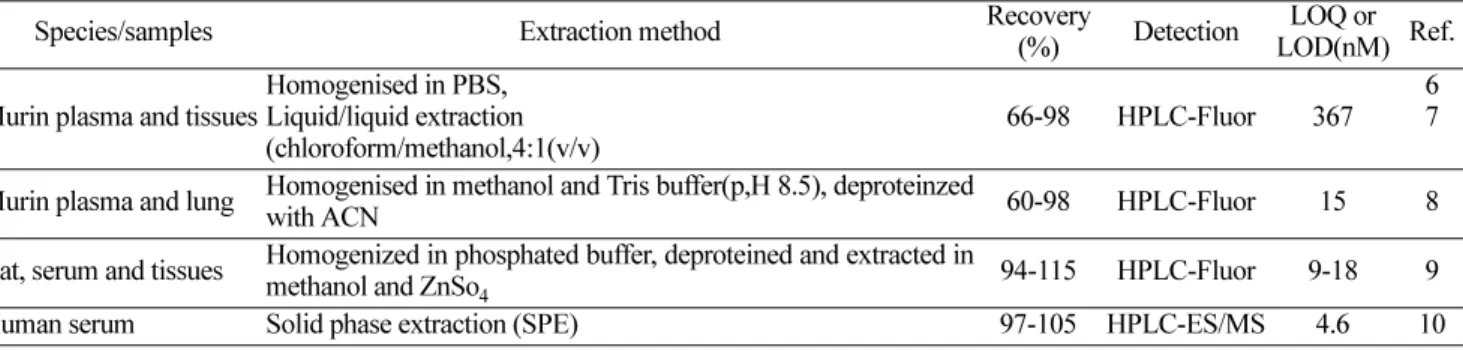
DXR is composed of an aglycone backbone linked to a daunosamine sugar through an O -glycosidic bond at carbon 7. A variety of procedures to extract, resolve,

and quantify DXR has been published

6-10)

(Table 1).

Many of these techniques are laborious and necessitate long analytical run times to achieve sufficient peak res- olution, owing to the spectral and structural similarities of DXR

11)

. Among the techniques, LC-MS/MS can per- mit and exact and efficient determination of doxorubi- cin. In this study, a simplified, rapid extraction procedure and a liquid chromatography-tandem mass spectroscopy (LC-MS/MS) method were developed to identify and quantify DXR and metabolites in plasma and tissue extracts. Tandem mass spectroscopy can permit the determination of DXR analysis and quantification in complex biological samples.

Correspondence to : Han-Jung Chae

전북대학교의과대학약리학교실 전주시덕진구금암동
32-20

Tel: 82-063-270-3092, Fax: 82-063-275-2855

E-mail: [email protected]

(2)

Materials and Methods

Doxorubicin (>99% purity) were provided by Sigma (Chatham, NJ, USA). Daunorubicin (DNR) was pur- chased from Sigma (St. Louis, MO, USA); Water, ace- tonitrile, and methanol were from Burdick & Jackson (Muskegon, MI, USA). Ammonium acetate was from J.T. Baker (Phillipsburgh, NJ, USA). All chemicals and solvents were analytical or HPLC grades unless other- wise stated.

Preparation of Samples

ICR 37 male mice were each given three times intra- venous injection of doxorubicin total dose of 15 mg/kg.

Blood samples were collected in heparinized tubes and cooled on ice at 0, 1, 2, 16, 24, 168 hour after 8-day post dose. Shortly after blood collection, serum was centrifuged at 4 and stored at -70

o

C until analysis. Tis- sues were collected at 8 days after doxorubicin admin- istration. All samples were stored at -70

o

C. Before the analysis, all samples were prepared by extraction method, as described previously

12)

.

LC/MS/MS Analysis

The analysis of DXR was performed using Applied Biosystems/MDS Sciex API 4000 triple quadrupole tandem mass spectrometers (ABI, Inc., Foster City, CA, USA) following chromatographic separation using an HPLC system consisting of an autosampler and dual pumps. HPLC system with a model 1100 Agilent (Palo Alto, CA, USA) was used. Separation was achieved by automated injection of 10 µ L samples onto a reversed

phase analytical column (an Agilent Zorbax Extend Rapid Resolution 4.6 mm×50 mm 3.5 µ m) under iso- cratic conditions at a flow rate of 400 µ L/min.

Determination of DXR Levels

The solvent for DXR extraction from plasma con- sisted of 60% acetonitrile (ACN) and 40% 0.05 M ammonium acetate, pH 3.5 and (v/v). Four hundred microliters of extraction solvent were added to 100 µ L of plasma to achieve a final concentration of 20%.

Standards and QC samples were prepared by serial dilu- tion of DXR in extraction solvent prior to the addition of blank plasma. Ten microliters of DNR, the internal standard, was transferred into each sample immediately after the addition of extraction solvent to plasma, thus achieving a final concentration of 200 nM DNR. Sam- ples were mixed, cooled in an ice water bath for 10 mins, and centrifuged for 10 mins at 15,000 g at 4

o

C.

The deproteinized supernatant was recovered and ana- lyzed immediately.

Frozen tissue samples were pulverized under liquid nitrogen using a mortar and pestle immersed in liquid nitrogen. Each tissue powders were weighed. A suffi- cient volume of mobile phase was added to each tube to achieve the desired tissue concentration. Ten microliters of the DNR standard was added per 10 microliters of DNR aliquot of tissue homogenate, producing a final concentration of 100 nM DNR. Samples were mixed briefly (<1 min) using a homogenizer (Tekmar, Cincin- nati, OH, USA), cooled in an ice water bath, and centri- fuged for 10 mins at 15,000 g at 4

o

C. The deproteinized supernatant was recovered and analyzed immediately.

Table 1. The selected examples of extraction procedures and analytical techniques for quantitative analysis of DXR in plasma or tissue samples

Species/samples Extraction method Recovery

(%) Detection LOQ or LOD(nM) Ref.

Murin plasma and tissues Homogenised in PBS, Liquid/liquid extraction

(chloroform/methanol,4:1(v/v) 66-98 HPLC-Fluor 367 6

7 Murin plasma and lung Homogenised in methanol and Tris buffer(p,H 8.5), deproteinzed with ACN 60-98 HPLC-Fluor 15 8 Rat, serum and tissues Homogenized in phosphated buffer, deproteined and extracted in methanol and ZnSo

4

94-115 HPLC-Fluor 9-18 9

Human serum Solid phase extraction (SPE) 97-105 HPLC-ES/MS 4.6 10

(3)

Method Validation

Extraction efficiencies for plasma and each tissue were determined by comparing the peak area of DXR standards extracted from tissue samples ( n 5) with DXR standards prepared in mobile phase. No statistical dif- ferences in peak area were observed for plasma or for each of the tissues examined. Standard and quality con- trol samples were prepared by extracting tissues obtained from untreated animals. Serial dilutions of DXR was added to blank tissue homogenates and pro- cessed as described above.

Results and Discussion

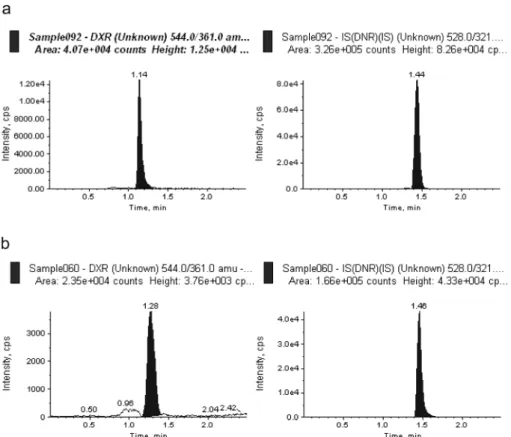
A sensitive and reliable HPLC-MS/MS method has been developed and validated for the simultaneous quantification of doxorubicin in mouse plasma and its small tissues. The respective retention times for Doxo- rubicin and the IS (Daunorubicin) were approximately 1.19 min and 1.46 min (Table 2). The quantification limit for doxorubicin in mouse plasma was 0.5 ng/mL. Stan- dard and quality control samples were prepared by extracting tissues obtained from untreated animals.

Serial dilutions of DXR were added to blank tissue homogenates and processed as described above.

To determine the intra-day and inter-day accuracy and precision, we analyzed three quality control (QC) sam- ples prepared at nominal concentrations of 0.5, 2 and 20 ng/mL for doxorubicin. Quantification was based on the ratios of the peak areas of each analyte. Validation was performed through establishing inter- and intra-day accuracy and precision of the method on QC samples.

Intra-day variability was tested on three QC samples using the same calibration curve, and inter-day variabil- ity was tested on three different days using calibration curves obtained daily. The precision of the method at each QC concentration was expressed as a coefficient

of variation (CV) by calculating the standard deviation as a percentage of the mean calculated concentration, while the accuracy of the assay was determined as the ratio (per- centage) of the mean with reference to the true value.

The precision and accuracy data for the assay are pre- sented in Table 3. The intra-day precision of the assay was less than 8.3% for each of the three concentrations of the QC samples. The inter-day precision of the assay was less than 8.8% for all the QC samples. At these concentrations, the intra- and inter-day CVs were deter- mined to be <8.8%. All mice were each given three times intravenous injection of doxorubicin total dose of 15 mg/kg. Samples were collected 8-day post dose.

Mean brain concentration of DXR is 1.23, heart is 3.19, liver is 293, spleen is 455 and lung is 141 ng/mL (Table 4). Figure 2 shows that the mean of plasma concentra- tion of DXR.

As a result, reliable quantification of doxorubicin can Table 2. Compound-dependent instrumental parameters for doxorubicin and IS

Compound Retention

time(min) Selected ion

pairs( m/z ) Declustering

potential Entrance

Potential Collision

energy Collision exit poten-

Doxorubicin 1.19 544/361 103 9.86 19.5 11.1 tial

Daunorubicin 1.46 528/321 76 9.7 22.5 10

Table 3. Results of the precision and accuracy studies for doxorubicinone in serum and tissue samples

Concentration

(ng/ml) Recovery (%, mean ± S.D., n=3) Serum Heart Liver Spleen Lung 0.5 92.8 ± 8.6 91.5 ± 0.2 96.2 ± 6.4 94.7 ± 3.1 92.5 ± 3.6

2 100.3 ± 0.

6 97.2 ± 1.3 98.2 ± 1.0 97.2 ± 1.3 99.2 ± 2.0 20 92.8 ± 0.1 99.9 ± 0.1 100.0 ± 0.

1 96.2 ± 6.4 100.0 ± 0.1 Quality control solution of DXR was prepared in blank plasma and tissues homogenates at known concentrations (v/v) or (w/v), extracted and analyzed by LC-MS/MS. The intra- (n=3) and inter-day (n=3) assay performance was determined.

Table 4. Mean tissues concentration of DXR in mice treated intravenously with total injection amount of 15 mg/kg DXR Sample Brain Heart Liver Spleen Lung Mean of concentration

(ng/ml) 1.23 3.19 293 455 141

All mice were each given three times intravenous injection of

doxorubicin total dose of 15mg/kg. Samples were collected 8-day

post dose.

(4)

be achieved over the range of 0.5 ng/mL (plasma) and 0.5 ng/mL (tissue), respectively. This method has been successfully used to study the pharmacokinetic profiles and biliary excretion of doxorubicin in mouse after a dose administration of doxorubicin. As this study of the

determination of doxorubicin in mouse, a simple and reproducible method to avoid extended homogenization steps that may promote degradation. It provides a sig- nificant increase in assay sensitivity and a considerable reduction in time of analysis. Given the structural simi- larities among the clinically-used anthracyclines, this assay and extraction procedure may be easily adapted for use with other such agents.

Acknowledgement

This study was supported by ch trial center for func- tional foods

References

1. DeVita VT, Rosenberg SA, Hellman S, Cancer, Principles and Practice of Oncology, Lippincott, Williams & Wilkins, Philadelphia, 2001.

2. Marco Ad, Gaetani M, Scapinato B. Adriamycin(NSC-123, 127): a new antibiotic with antitumor activity. Cancer Fig 1. MRM chromatograms of (a) plasma standard 2ng/ml (left: doxorubicin (DXR), right: daunorubicin (DNR) and (b) DXR and DNR in heart samples)

Fig 2. Mean plasma concentration of DXR in mice treated

intravenously with total injection amount of 15 mg/kg

DXR.

(5)

chemother, 1969; 53(1): 33-37

3. G.N. Hortobagyi. Drugs 1997; 4(suppl): 1-4

4. Lown JW. Anthracycline and anthraquinone anticancer agents: current status and recent developments. Pharmacol ther. 1993; 60(2): 185-214. Review

5. Licata S, Saponiero A, Mordente A, et al. Doxorubicin metabolism and toxicity in human myocardium: role of cytoplasmic deglycosidation and carbonyl reduction. Chem Res Toxicol. 2000; 13(5): 414-20.

6. Shinozawa S, Mimaki Y, Tomano H, et al. Determination of the concentration of adriamycin and its metabolites in the serum and tissues of Ehrlich carcinoma-bearing mice by high-performance liquid chromatography. Chromatogr. 1980;

196(3): 463-9.

7. Shinozawa,S, Mimaki, S, Tomano H, et al. Enzymatic deacetylation of N-acetylglucosamine regidues in cell wall peptidoglycan. Chromatogr.1980; 88(2): 469-79.

8. Rose LM, Tillery KF. High-performance liquid chromato- graphic determination of doxorubicin and its metabolites in

plasma and tissue. Chromatogr. 1988; 425(2): 419-23.

9. Alvarez-Cedron L, Sayalero ML, Lanao JM. High-per- formance liquid chromatographic validated assay of doxorubicin in rat plasma and tissues. Chromatogr B Biomed Sci Appl. 1999; 721(2): 271-8.

10. Lachatre F, Marquet P, Ragot S, et al. Simultaneous determination of four anthracyclines and three metabolites in human serum by liquid chromatography-electrospray mass spectrometry. Chromatogr B Biomed Sci Appl. 2000; 738(2):

281-91.

11. Chan KK, Harris PA. A fluorometric determination of adriamycin and its metabolites in biological tissues. Res Commun Chem Pathol Pharmacol. 1973; 6(2): 447-63.

12. Arnold RD, Slack JE, Straubinger RM. Jeanine Es, Robert MS. Quantification of doxorubicin and metabolites in rat plasma and small tissue samples by liquid chromatography electrospray tandem mass spectroscopy. Chromatogr B.

2004; 808(2): 141-152.

수치

Table 1. The selected examples of extraction procedures and analytical techniques for quantitative analysis of DXR in plasma or tissue samples
Table 3. Results of the precision and accuracy studies for doxorubicinone in serum and tissue samples
Fig 2. Mean plasma concentration of DXR in mice treated intravenously with total injection amount of 15 mg/kg DXR.

참조

관련 문서

A sensitive method for quantitation of glimepiride in human plasma has been established using liquid chromatography-electrospray ionization tandem mass

모유에 미치는 영향을 평가하기 위해 生 化湯 加減方을 복용하고 있는 건강한 산 모 20명을 대상으로 한약 복용 후 이행 유에 해당하는 모유를 채취한 후, HPLC 와

The objective of present study was to developed an analytical method using one-step extraction and determination of the amitraz in veterinary drugs by liquid chromatography

Previous studies have proposed several analytical methods us- ing high-performance liquid chromatography (HPLC) with an ultraviolet (UV) [3,4] or mass spectrometry (MS) [5-9]

The pur- pose of this study was to develop an efficient method of the determination of sorafenib in human plasma using tandem mass spectrometry coupled with liquid

The 16 organophosphorus pesticides were analyzed by liquid chromatography-tandem mass spectrometry (LC/MS/MS) using on-line solid phase extraction (on-line SPE) with

We conducted this study to address the absence of Korean studies investigating the efficacy of immunoassays and liquid chromatography–tandem mass spectrometry (LC-MS/MS) for

We developed a method of liquid chromatography-tandem mass spectrometry (LC-MS/MS) for detection of plasma free metanephrine (MN) and normetanephrine (NMN) and evaluated