비장둔상의 수술적 치료를 대체하는 혈관색전술의 유용
경상대학교 의학전문대학원 외과학교실
송유정∙김가정∙정상호∙정치영∙주영태∙정은정∙이영준∙최상경∙하우송∙박순태∙홍순찬
─ Abstract ─
Use of Angioembolization to Replace Operative Management for Blunt Splenic Injury
Yu-jeong Song, Ka-Jeong Kim, M.D., Sang-Ho Jeong, M.D., Chi-Young Jeong, M.D., Young-Tae Ju, M.D., Eun-Jung Jung, M.D., Young-Joon Lee, M.D., Sang-Kyung Choi, M.D.,
Woo-Song Ha, M.D., Soon-Tae Park, M.D., Soon-Chan Hong, M.D.
Department of Surgery of Gyeongsang National University School of Medicine, Jinju, Korea
Purpose: Over the past few decades, the treatment of traumatic splenic injuries has shifted to nonoperative management from surgical intervention. Although some nonoperative management failure have been reported, in most trauma centers, nonoperative management is now believed to be the treatment of choice in hemody- namically stable patients. Then, in this study, we have retrospectively evaluated our experience with traumatic splenic injury.
Methods: From January 2005 to July 2009, 150 patients with blunt splenic injuries were managed in our hospital. Patients’charts were retrospectively reviewed to analyze their treatment, the patients were grouped according to those who had been admitted before October 2006, defined as the “early group”, and those who had been admitted after October 2006, defined as the “late group”. After the patients had been divided into two group, physiologic parameters and differences between the treatments were compared.
Results: 150 patients were admitted to our hospital with blunt splenic trauma. In late group, both the surgical management rate and the nonoperative management failure rate were lower than they were in the early group.
Conclusion: We expect angioembolization to effectively replace surgery for the treatment of selected patients with blunt splenic injury and to result in fewer complications. (J Korean Soc Traumatol 2010;23:43-48)
Key Words: Blunt splenic injury, Angioembolization
� Address for Correspondence : Soon-Chan Hong, M.D.
Department of Surgery, Gyeong-Sang National University Hospital, 90 Chilam-dong, Jinju, Gyeongsangnam-do 660-702, Korea
Tel : 82-55-750-8096, Fax : 82-55-750-8732, E-mail : [email protected]
접수일: 2010년 6월 9일, 심사일: 2010년 6월 11일, 수정일: 2010년 6월 13일, 승인일: 2010년 6월 18일
I. Introduction
The spleen is the solid organ most frequently injured in blunt abdominal trauma. Over the past few decades, the treatment of traumatic splenic injuries has changed sub- stantially, moving from mostly surgical interventions to non- operative management. The benefits of splenic conservation have been well recognized and include the elimination of the risk of overwhelming post-splenectomy sepsis, as well as avoiding unnecessary surgery and the complications of laparotomy. In most trauma centers, nonoperative manage- ment is now believed to be the treatment of choice in hemodynamically stable patients. However, there are wide variations in reported rates (2~52%) (1-9) of nonoperative management failure. In numerous studies, nonoperative management failure has been associated with degrees of hemoperitoneum, the grade of splenic injury and the con- trast blush on a CT scan.(2,10,11) In 1995, Sclafani et al.
described the use of embolization in the spleen.11 Subsequent studies have reported that splenic artery angioembolization has reduced the operative management and conservative management failure rate.(5,12,13) In October 2006, our hospital has added angiographic emboliza- tion to our schema of management for blunt spleen injury.
So, in this study, we have retrospectively evaluated our experience with traumatic splenic injury. In particular, we evaluated whether the selective use of splenic arterial angiography and embolization was the safest nonoperative method offering patients the most similar efficacy to surgi- cal operations.
Ⅱ. Materials and Methods
From January 2005 through July 2009, all patients with splenic injuries admitted to our hospital were reviewed. We excluded those patients who died in the emergency room before complete evaluation could take place, and those with other severe organ injuries. Patient demographics and basic physiologic data were reviewed, including age, sex, Glasgow Coma Scale score on admission, vital signs, laboratory find- ings, complications, length of hospital stay, number of trans- fusions and other injuries. Each CT scan was also evaluated for the splenic injury grade and amount of hemoperitoneum.
All splenic injuries were graded according to the American Association for the Surgery of Trauma’s (AAST) organ injury scale (14) (Table 1). A small amount of hemoperi- toneum on a CT scan was defined as the blood of the perisplenic and/or perihepatic region and/or Morrison’s pouch. Moderate hemoperitoneum was defined as the pres- ence of blood in one or both of the pericolic gutters. A large amount of hemoperitoneum was defined as free blood in the pelvis. No formal management protocols were in place when deciding to refer a case for nonoperative man- agement. However, common factors considered when selecting patients for choice of management were hemody- namic stability, response to resuscitation, and severity of associated injuries. No formal indications were used to determine the need for angiographic embolization.
However, we selected patients that were hemodynamically stable after initial resuscitation, where the splenic vascular blush was seen on a computed tomography (CT) scan and where there had been no other intra-abdominal organ
Table 1. American Association for the Surgery of Trauma’s (AAST) organ injury scale AAST Grade Splenic injuries
Ⅰ Hematoma : subcapsular,<10% of surface area Laceration : capsular tear,<1 cm of parenchymal depth
Ⅱ Hematoma : subcapsular, 10-50% of surface area Intraparenchyma; hematoma,<5 cm in diameter
Laceration 1-3 cm in parenchymal depth not involving a parenchymal vessel
Ⅲ Hematoma : subcapsular,>50% of surface area or expanding Ruptured subcapsular or parenchymal hematoma
Intraparenchymal hematoma,>5 cm in diameter
Laceration of >3 cm parenchymal depth or involving trabecular vessels
Ⅳ Laceration of segmental or hilar vessels producing major devascularization (>25% of spleen)
Ⅴ Completely shattered spleen
Vascular hilar injury that devascularized spleen
injuries requiring operative intervention.
Statistical analysis was done using a chi-square test and by Kruskal-Wallis testing the SPSS program version 12.0.
Statistical significance was assigned for p<0.05.
Ⅲ. Results
During the study period, 150 patients were admitted to our hospital with blunt splenic trauma. Five patients died within 24 hours because of severe injuries not related to splenic injury, and they were excluded from the analysis.
The patients were grouped according to those who had been admitted before October 2006, defined as the “early group”, and who had been admitted after October 2006, defined as the “late group”.
There were 64 patients in early group with nine patients requiring immediate operative management. Two of these patients died on postoperative day two and three respec- tively, with disseminated intravascular coagulopathy. Fifty- five patients underwent conservative management, with two of these patients ultimately requiring an operation and a further patient dying suddenly of hemodynamic instability and multi-organ failure. Successful observative management was thus achieved in 52 patients. The observative man- agement failure rate was 5.45% (Fig. 1).
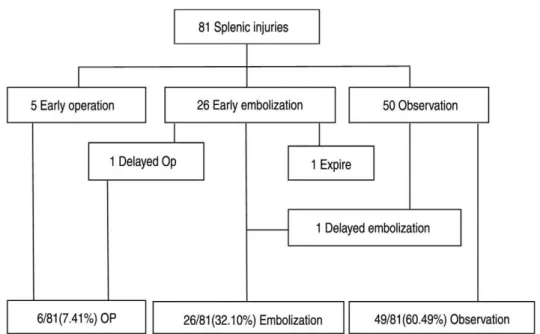
Of the 81 patients who were in the late group, five patients underwent an early operation, 26 patients under- went early embolization, and 50 patients were initially man-
aged with observative treatment. Of the 26 patients who underwent early angiography, two failed embolization and required a splenectomy. One patient recovered successfully with an operation, the other patient died before an opera- tion could take place. Of the 50 patients who underwent standard conservative management, one patient developed a
Fig. 1. Flow chart of Early group.
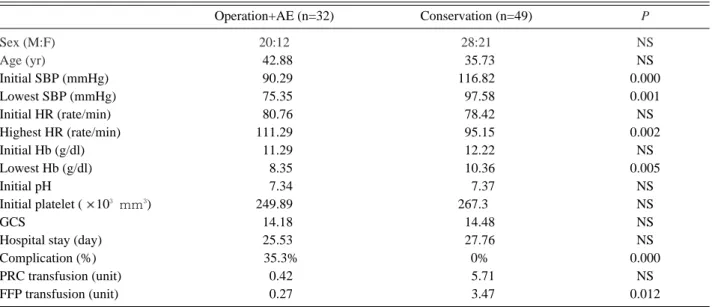
Table 2. Differences of physiologic parameters between intervention and conservation group in late group
Operation+AE (n=32) Conservation (n=49) P
Sex (M:F) 20:12 28:21 NS
Age (yr) 042.88 035.73 NS
Initial SBP (mmHg) 090.29 116.82 0.000
Lowest SBP (mmHg) 075.35 097.58 0.001
Initial HR (rate/min) 080.76 078.42 NS
Highest HR (rate/min) 111.29 095.15 0.002
Initial Hb (g/dl) 011.29 012.22 NS
Lowest Hb (g/dl) 008.35 010.36 0.005
Initial pH 007.34 007.37 NS
Initial platelet ( 103 mm3) 249.89 267.30 NS
GCS 014.18 014.48 NS
Hospital stay (day) 025.53 027.76 NS
Complication (%) 0035.3% 00% 0.000
PRC transfusion (unit) 000.42 005.71 NS
FFP transfusion (unit) 000.27 003.47 0.012
AE: arterial embolizaion, SBP: systolic blood pressure, HR: heart rate, HB: hemoglobin, GCS: Glasgaw Coma Scale, PRC: packed red cell, FFP: fresh frozen plasma
splenic artery pseudoaneurysm after five days admission and underwent splenic artery embolization. There was a 2.00% failure rate of observative management, and an 7.69% failure rate of angioembolization (Fig. 2). Ultimately, 32 patients (39.50%) needed operative management.
However, the application of angioembolization potentially prevented 32.09% of patients from undergoing an operation.
The late group patients were further divided into two subgroups: those who underwent intervention (operation and angioembolization) and those who did not (conservative management). The two subgroups revealed a significant difference in the initial and lowest systolic BP, highest HR, and follow up Hemoglobin (Table 2). Furthermore, the admission CT scans show the intervention subgroup having
significantly more hemoperitoneum and higher grade splenic injuries (Table 3).
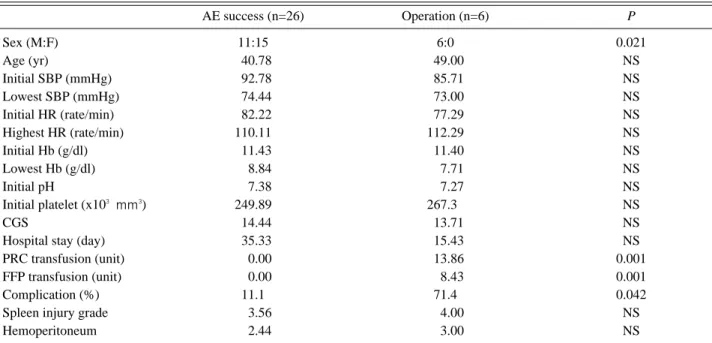
Among the intervention subgroup, patients with success- ful angioembolization had no lower complication rates and lower PRC and FFP transfusion units than patients under- going operations (Table 4).
Ⅳ. Discussion
Because of the increased risk of splenectomy, nonopera- tive management is now widely used as the standard management in selected traumatic splenic injuries. However, there is a wide variation of failure rates in the research lit- erature and a reasonable failure rate has not been estab-
Table 3. Differences of CT findings between intervention and conservation group in late group
Hemoperitoneum Splenic injury grade
Small Moderate Large 1 2 3 4 5
Operation + AE (n=32) 04 (12.5%) 02 (6.2%) 26 (81.2%) 00 (0%) 03 (09.4%) 9 (28.1%) 11 (34.4%) 7 (21.9) Conservation (n=49) 17 (34.7%) 22 (44.9) 10 (20.4%) 19 (38.8%) 25 (51.0%) 5 (10.2%) 00 (0%) 0 (0%) AE, arterial embolization
Fig. 2. Flow chart of late group.
lished. In their 2000 study, Velmahos et al.(8) reported the highest failure rate ever published (52%).(6,9) More recently, researchers have prospectively established an over- all 34% nonoperative management failure rate in blunt splenic injury.(9)
The application of angioembolization into our blunt splenic injury treatment algorithm reduced the operative manage- ment rate from 17.19% to 7.41%. The observation failure rate was reduced from 5.45% to 2%. However, these results had no statistically significant difference in our study as our overall observative management failure rate was 2.58%. Davis et al. previously documented an improved success rate for nonoperative management from 25% to 61% when patients with splenic pseudoaneurysms were embolized. 15 Dent et al. reported that embolization of splenic injuries is a useful adjunct in nonoperative manage- ment, but is only necessary in approximately 7% of patients.(13) Finally, Wei et al. reported that angioem- bolization reduced the need for operative management by 16% among the patients with splenic injury. 16 Similarly, in our late group, the application of angioembolization into our blunt splenic injury treatment algorithm reduced the need for operative intervention by 32.09%.
The main limitations of our study are its retrospective nature and the absence of a formal protocol. Because the patient cases were not driven by a prospective protocol, the
exact indications for operative management or embolization are difficult to know. Clearly, the patients selected for embolization had a higher splenic injury grade and hemo- peritoneum than those managed by observation alone.
However, except for hemodynamic instability after initial resuscitation and a suspicion of other intra-abdominal organ injuries requiring surgery, indications were not present between operative and and angioembolization cases. Dent et al. described their criteria for angioembolization as patients who meet one or more of the following criteria: persistent tachycardia despite fluid resuscitation, a splenic vascular blush on a CT scan, a severe splenic injury on a CT scan, or subsequently, a decreasing hematocrit that cannot be explained by associated injuries in an otherwise hemody- namically stable patient. In our study, angioembolization patients had no different demographics and physiologic data from operation patients. Moreover, angioembolization patients had a similar grade of hemoperitoneum and splenic injury.
However, they had lower complication rates and transfusion counts of PRC and FFP. So, our conclusion is that we expect that angioembolization of blunt splenic injuries will effectively replace operations in selective patients with less complications.
Table 4. Differences of physiologic parameters between AE success and operation group in late group
AE success (n=26) Operation (n=6) P
Sex (M:F) 11:15 6:0 0.021
Age (yr) 040.78 049.00 NS
Initial SBP (mmHg) 092.78 085.71 NS
Lowest SBP (mmHg) 074.44 073.00 NS
Initial HR (rate/min) 082.22 077.29 NS
Highest HR (rate/min) 110.11 112.29 NS
Initial Hb (g/dl) 011.43 011.40 NS
Lowest Hb (g/dl) 008.84 007.71 NS
Initial pH 007.38 007.27 NS
Initial platelet (x103 mm3) 249.89 267.30 NS
CGS 014.44 013.71 NS
Hospital stay (day) 035.33 015.43 NS
PRC transfusion (unit) 000.00 013.86 0.001
FFP transfusion (unit) 000.00 008.43 0.001
Complication (%) 011.10 071.40 0.042
Spleen injury grade 003.56 004.00 NS
Hemoperitoneum 002.44 003.00 NS
AE: arterial embolizaion, SBP: systolic blood pressure, HR: heart rate, HB: hemoglobin, GCS: Glasgaw Coma Scale. PRC: packed red cell, FFP: fresh frozen plasma
REFERENCES
01) Koury HI, Peschiera JL, Welling RE. Non-operative management of blunt splenic trauma: a 10-year expe- rience. Injury 1991;22:349-52.
02) Harbrecht BG, Peitzman AB, Rivera L, Heil B, Croce M, Morris JA Jr, et al. Contribution of age and gender to outcome of blunt splenic injury in adults: multicen- ter study of the eastern association for the surgery of trauma. J Trauma 2001;51:887-95.
03) Nix JA, Costanza M, Daley BJ, Powell MA, Enderson BL, et al. Outcome of the current management of splenic injuries. J Trauma 2001;50:835-42.
04) Wasvary H, Howells G, Villalba M, Madrazo B, Bendick P, DeAngelis M, et al. Nonoperative manage- ment of adult blunt splenic trauma: a 15-year experi- ence. Am Surg 1997;63:694-9.
05) Pachter HL, Guth AA, Hofstetter SR, Spencer FC.
Changing patterns in the management of splenic trau- ma: the impact of nonoperative management. Ann Surg 1998;227:708-17.
06) Velmahos GC, Chan LS, Kamel E, Murray JA, Yassa N, Kahaku D, et al. Nonoperative management of splenic injuries: have we gone too far? Arch Surg 2000;135:674-9.
07) Peitzman AB, Heil B, Rivera L, Federle MB, HArbrecht BG, Clancy KD, et al. Blunt splenic injury in adults: Multi-institutional Study of the Eastern Association for the Surgery of Trauma. J Trauma 2000;49:177-87.
08) Albrecht RM, Schermer CR, Morris A. Nonoperative management of blunt splenic injuries: factors influencing
success in age >55 years. Am Surg 2002;68:227-30.
09) Velmahos GC, Toutouzas KG, Radin R, Chan L, Demetriades D. Nonoperative treatment of blunt injury to solid abdominal organs: a prospective study. Arch Surg 2003;138:844-51.
10) Federle MP, Courcoulas AP, Powell M, Ferris JV, Peitzman AB. Blunt splenic injury in adults: clinical and CT criteria for management, with emphasis on active extravasation. Radiology 1998;206:137-42.
11) Sclafani SJ, Shaftan GW, Scalea TM, Patterson LA, Kohl L, et al. Nonoperative salvage of computed tomography-diagnosed splenic injuries: utilization of angiography for triage and embolization for hemostasis.
J Trauma 1995;39:818-25.
12) Haan JM, Biffl W, Knudson MM, Davis Ka, Oka T, Majercik S, et al. Splenic embolization revisited: a mul- ticenter review. J Trauma 2004;56:542-7.
13) Dent D, Alsabrook G, Erickson BA, Myers J, Wholey M, Stewart R, et al. Blunt splenic injuries: high nonop- erative management rate can be achieved with selec- tive embolization. J Trauma 2004;56:1063-7.
14) Moore EE, Cogbill TH, Jurkovich GJ, Shackford SR, Malangoni MA, Champion HR. Organ injury scaling:
spleen and liver (1994 revision). J Trauma 1995;38:323-4.
15) Davis KA, Fabian TC, Croce MA, Gavant ML, Flick PA, Minard G, et al. Improved success in nonoperative management of blunt splenic injuries: embolization of splenic artery pseudoaneurysms. J Trauma 1998;
44:1008-13.
16) Wei B, Hemmila MR, Arbabi S, Taheri PA, Wahl WL.
Angioembolization reduces operative intervention for blunt splenic injury. J Trauma 2008;64:1472-7.