E-학습 중심의 TOEIC 집중교육에 대하여
1)성 태 수*
On Intensive E-learning TOEIC Course
Taesoo Sung*
요 약
본 논문은 한 대학에서 3년에 걸쳐 실시한 토익 모의고사를 바탕으로 4주간의 집중코스와 한 학기에 걸쳐 진행 되는 상시적 토익코스의 점수 분포를 비교하고, 두 프로그램에 참여한 학생 그룹의 능력 뿐만 아니라 사용된 교수 용 교재 및 장비를 살펴본다. 해당 대학은 여름방학과 겨울방학을 이용하여 4주간의 토익 집중코스를 개설하고 있 으며, 참여 학생들은 오전 9시부터 오후 4시까지 수업에 참가한다. 또한 해당 대학은 매 학기동안 15주간의 상시적 인 토익코스를 개설해서 월요일부터 금요일까지 매일 한 시간의 수업을 진행한다. 본 논문은 EFL/ESL 교육에서 교사가 교수 자료, 교수법 및 e-학습을 효과적으로 운용하는 것이 얼마나 중요한지를 보여준다. 상시적으로 개설되 는 토익코스는 한 학기동안 75시간 수업이 진행되며, 4주간의 집중코스는 120시간 수업이 진행된다. 이 두 코스의 제한된 시간들은 학생들이 일상생활에서 의사소통을 가능하게 하는데 필요한 충분한 시간이라고 볼 수는 없다. 미 래에 학생들이 영어 학습에서 성공적인 향상을 보이기 위해서는 효과적이고 질적으로 우수한 EFL/ESL 집중코스 의 개발이 필수적이다.
▸Keyword : 집중코스, 상시코스, e-학습, 배치고사, 평가고사
Abstract
The purpose of this paper is to compare and analyze TOEIC scores of two kinds of courses opened at a university and the distribution of TOEIC scores of two groups. In addition, this paper will examine the ability of participants and the used instructional materials and equipment. The university has two kinds of TOEIC courses; one is a four-week intensive course opened in summer and winter vacations, where students participate in the classes from 9:00 a.m. to 4:00 p.m. The other is a regular TOEIC course, offering one-hour class every day from Monday to Friday during the university semester (15 weeks). This paper points out how important, the EFL/ESL teacher education, teaching materials, teaching methods and e-learning in operating more effective classes.
The intensive TOEIC course and the regular TOEIC course include 120 hours and 75 hours a semester, respectively. Unfortunately, both courses have such a limited amount of time that
∙ 제1저자 : 성태수
∙ 투고일 : 2013. 12. 19 심사일 : 2013. 12. 25, 게재확정일 : 2013. 12. 29.
* 남서울대학교 영어과 교수(Dept. of English, Namseoul University)
TOEIC Scores
The 1stTest
The
2ndTest Average 2012 Average
(n=136) 339 416 377.5
(+77) Table 1. Average TOEIC scores of the Intensive class
students of FLI from 2100 to 2012 students cannot achieve their fluent and perfect command of English. For Korean student to master English in a limited amount of both time and resources, the development of effective and qualitative EFL/ESL Intensive courses is essential.
▸Keyword : Intensive courses, Regular courses, e-learning
Ⅰ. Introduction
As of the globalization period, it has been so serious that the number of Korean people is decreasing. The birth rate of Korean is now 1.2. It means the market in Korea has been shrinking, and even leading companies try to cooperate together with the other famous ones. Under this situation, it is getting harder and harder for the seniors at colleges and universities to get jobs. To solve the problem, the Koreans have two options. They had better accept the immigrants to keep the market size in Korean, or sell the more Korean products to the other countries. Although "Globalization" has been discussed for more than 20 years, they finally need to communicate at least in English with neighbors even in Korea. Therefore "Activity in English" for the third graders at elementary schools started "drastically," but the Korean companies won't be able to wait until they grow up. The companies in Korea badly want to hire people who can communicate in English. It is very common for the personnel departments or sections in Korean companies to ask job-seekers about the scores of the Test of English for International Communication (TOEIC). Therefore, the TOEIC is not only a kind of English proficiency tests, but has also held the sociality in Korean society. The possibility of the success for the students after graduation is sure, to some extent, to be related to the higher TOEIC scores to get jobs and their prospective future.
At this point, intensive EFL courses themselves have just been spreading lately and has been developed for general need of English proficiency. It has been obvious that some groups studying English
with intensive EFL courses got the better scores on the Test of English for International Communication (TOEIC). The data based on the TOEIC scores are introduced and analyzed in this paper. Thus we will compare the TOEIC scores of the intensive courses with those of the non-intensive permanent courses, and present a case of the intensive EFL courses attempted in FLI of NSU.
II. Data Analysis of TOEIC scores at FLI from 2010 to 2012
The research site of this study was the intensive TOEIC classes opened in FLI of NSU. Analyzing the average score differences of the Test of English for International Communication (TOEIC) among the intensive class students of FLI of NSU, it is obvious that the TOEIC average scores of these intensive TOEIC class students are higher than those of the other permanent TOEIC class students. The average scores these intensive class students took are at least over 472 points.
TOEIC has been utilized as a standardized test
for the senior students to pass before graduation at
NSU since 2004. The following data shows TOEIC
score transition of both the intensive class students
and the permanent class students opened in FLI of
NSU from 2010 to 2012. The following data included
their scores.
Highest 750 820 785
Lowest 90 90 90
2011
Average
(n=142) 380 502 441
(+122)
Highest 615 785 700
Lowest 120 255 187.5
2010
Average
(n=107) 284 576 430
(+292)
Highest 550 830 690
Lowest 75 195 135
TOEIC Scores
The 1stTest
The
2ndTest Average
2012
Average
(n=136) 326 342 334
(+16)
Highest 625 615 620
Lowest 70 140 105
2011
Average
(n=142) 357 307 332
(-50)
Highest 680 705 692.5
Lowest 125 75 100
2010
Average
(n=107) 272 267 269.5
(-5)
Highest 485 560 522.5
Lowest 80 80 80
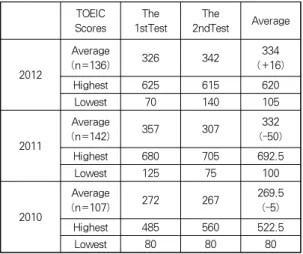
Table 2. Average TOEIC scores of the Permanent class students of FLI from 2100 to 2012
Comparing with these data for the three years (presented in Table 1 and Table 2 from 2010 through 2012), the average score range of the intensive class students is between 90 and 785 points, and that of the permanent class students is between 105 and 620 points. The average differences between the lowest and the highest are 695 points and 515 points, respectively. In 2012, the average score of the permanent class students is between 70 and 625 and its average score is 43.5 points lower than that of the intensive class students. In 2011 and 2010, also, it is 109 and 160.5 points lower than that of the intensive class students. When the students start their own classes whether it is a permanent class or an intensive class, their TOEIC scores are very similar. We can see the scores 339
(2012), 380(2011) and 284 (2010) in the intensive class, but the permanent class shows the scores of 326 (2012), 357 (2011), and 272 (2010). Thus, there are not so big differences in the English proficiency among the students at the beginning of their classes whether they are in the intensive classes or in the permanent classes. However, there exists to be a little difference in the level of achievement at the end of their coursework.
Noticeably, the intensive class students show the much higher level of achievement than the permanent class students.
Figure 1. Distribution of the Intensive TOEIC class students’ scores in 2010, 2011 and 2012.
Figure 2. Distribution of the Permanent TOEIC class students’ in 2010, 2011 and 2012.
Table 1 and Table 2 are shown as in Figure 1 and
Figure 2, respectively. The blue parts of the data
represent the first test and the red parts, the second
test. The average difference between blue bars and
red bars in Figure 1 is higher than that in Figure 2.
III. Differences among students at FLI based on various teaching approaches
“Table 1” chose both non-native speakers and native speakers as instructors. Whereas, the instructors of “Table 2” were all native English speakers. The instructors used Sisa Program for the TOEIC preparation in class, and extensive reading materials. In case of the permanent classes, students attend just one-hour class every day from Monday to Friday. They are taught reading skill three times a week and listening skill twice a week.
Not only do they not have any textbooks arranged in advance but they are also divided into two levels.
This two-level system might have a potential drawback in that the level-systems divided into much more levels are in general preferred and considered to be more efficient. This means that some students more proficient at language skills should work at the same class with others less proficient on the relative basis. It takes a semester (16 weeks) to complete this permanent course. After completing this course, most students were not improved and received lower scores even in 2010 and 2011.
On the other hand, let us here examine the intensive classes which were much more systematic.
The instructors of the intensive classes, native speakers, were the same as those of the permanent classes. They taught listening parts. Some Korean teachers also taught English grammar parts and reading parts. They used an e-Learning software to build students' vocabularies (up to 6,000 out of 12,000 words). Of the classes scheduled from 9 a.m.
to 4 p.m., students had two-hour grammar classes, two-hour listening classes, and two-hour reading classes. .The instructor used the workbook of the TOEIC Preparation, and explained the correct answers. After taking the TOEIC pretest as a placement test before this program, students were
divided on the base of three-level system. Every class has the number of 15 persons. The evaluation scale assigned 40% to the e-Learning, 20% to the final tests, 20% to the handouts, and 20% to the class participation.
The participants who took part in the regular TOEIC course of Foreign Language Institute in 2010 showed the following grades. They took tests twice before and after the course. We have made a correlation analysis in order to figure out the difference between the result of pretest and that of posttest..
Type of Test Pretest Posttest
Pretest 1 .604***
Posttest .604 1
Table 3. The result of Correlation Analysis of TOEIC Grades of Regular Course in 2010
* p <.05, ** p <.01, *** p <.001
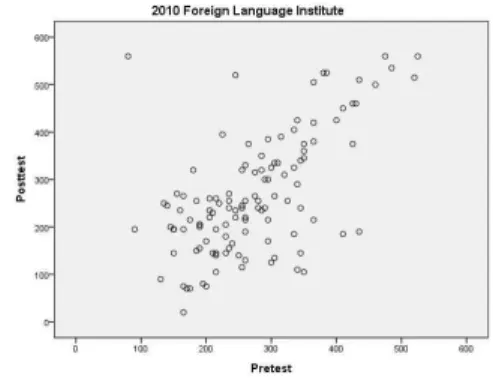
Table 3 shows that correlation between the pretest and the posttest is meaningful (r=.604, p<.001). This correlation can be represented as the following Figure 3:
Figure 3. Distribution of Regular Course Scores of the pretest in 2010 (horizontally) and the
posttest in 2012 (vertically)
As illustrated in Figure 3, the group of the
students in upper levels appears to show high
correlation; whereas, the group of the students in
low levels shows low correlation. In the following,
Table 4/ Figure 4 for regular course in 2011, Table 5/ Figure 5 for regular course in 2012 show the similar results to Table 3/ Figure 3 for regular course in 2010. Thus, though Table 4 and Table 5 show the meaningfulness between the pretests and the posttests, Figure 4 and Figure 5 show low correlation on the whole.
Type of Test Pretest Posttest
Pretest 1 .677***
Posttest .677 1
Table 4. The result of Correlation Analysis of TOEIC Grades of Regular Course in 2010
Figure 4. Distribution of Regular Course Scores of the pretest in 2011 (horizontally) and the
posttest in 2012 (vertically)
Type of Test Pretest Posttest
Pretest 1 .638***
Posttest .638 1
Table 5. The result of Correlation Analysis of TOEIC Grades of Regular Course in 2010
Figure 5. Distribution of Regular Course Scores of the pretest in 2012 (horizontally) and the
posttest in 2012 (vertically)
The participants who took part in the intensive TOEIC course of Foreign Language Institute in 2010 showed the following grades. They took tests twice before and after the course. We have made a correlation analysis in order to figure out the difference between the result of pretest and that of posttest..
Type of Test Pretest Posttest
Pretest 1 .642***
Posttest .642 1
Table 6. The result of Correlation Analysis of TOEIC Grades of Intensive Course in 2010
Table 6 shows that correlation between the pretest and the posttest is meaningful (r=.642, p<.001). This correlation can be represented as the following Figure 6:
Figure 6. Distribution of Intensive Course Scores of the pretest in 2010 (horizontally)
and the posttest in 2012 (vertically)
As illustrated in Figure 6, the groups of the students in upper levels and in mid-levels show high correlation, which is distinguished from the low correlation in low levels. In the following, Table 7/
Figure 7 for intensive course in 2011, Table 8/
Figure 8 for intensive course in 2012 show the
similar results to Table 6/ Figure 6 for intensive
course in 2010. Thus, through Table 7 and Table 8,
we can find the meaningful correlation between the
pretests and the posttests. Figure 7 and Figure 8
show high correlation on the whole.
Type of Test Pretest Posttest
Pretest 1 .706***
Posttest .706 1
Table 7. The result of Correlation Analysis of TOEIC Grades of Intensive Course in 2010
Figure 7. Distribution of Intensive Course Scores of the pretest in 2011 (horizontally) and
the posttest in 2012 (vertically)
Type of Test Pretest Posttest
Pretest 1 .710***
Posttest .710 1
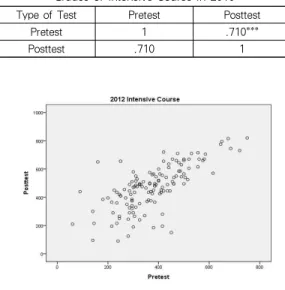
Table 8. The result of Correlation Analysis of TOEIC Grades of Intensive Course in 2010
Figure 8. Distribution of Intensive Course Scores of the pretest in 2012 (horizontally) and the
posttest in 2012 (vertically)
In all Figures, each bubble shows a point where the grade of the TOE1C pretest (horizontally) and that of th TOEIC posttest (vertically) meets.
In Figure 3, Figure 4 and Figure 5, received from the regular course students in 2010, 2011, and 2012. all bubbles are scattered around. This points out that there are somehow some limitations in regular courses. whether they are on students, on instructors or any other things such as teaching methods and materials.
Figure 6, Figure 7, and Figure 8 are the outs, obtained from the TOEIC pretests (horizontally) and the posttests (verticallly) of intensive course students in 2010, 2011, and 2012. The bubbles are floated around the mid-percentages as well as the high percentages in general.
IV. Conclusion
The above data prove that the TOEIC scores of the intensive course students and the permanent course students were almost the same over the years, when the students took the pretest before each course started. However, it is clear that the better results among the intensive course students were not coincident. The differences between the intensive courses and the permanent courses depend on how intensively the instructors manage their classes, using some more appropriate materials and applying the multi-level system which distributed the students to the tailored classes.
We believe in the benefits of intensive English programs. Indeed, the intensive programs are a good alternative for students who want to improve their English skills, especially in Korea where students are not provided with many opportunities to practice the language. However, many intensive English programs do not include all the skills (reading, listening, speaking, and writing) in their syllabus.
Still, we should consider intensive English programs as a great alternative for students to improve their English skills because they get more classes of English per cycle and because students are more motivated to use only English in these classes.
Intensive English programs should be more
promoted since there is a need for improving student's level of English. When students participate in intensive programs to improve their English, they receive authentic and constant input.
In consequence, they absorb the new material since they have to frequently reinvest and reuse it.
Moreover, the possibility to improve their skills is increased considering the fact that students are constantly working and manipulating the language.
They also can have a positive experience from the intensive program because of the fact that they are getting more comfortable with the language and that they are more aware of their progress in English.
참고문헌
[1] Foreign Language Institute, NSU., 2010, 2011, 2012,.
TOEIC Score DATA.
[2] http://www..nsu..ac.kr/
[3] Cross, D., “ A practical handbook of language teaching.
Cassell ”: Prentice Hall, 1992..
[4] Li, Ping & Zhihong Lu, "Individualized Instruction in Large Classes of Integrated English in CALL Environments," Theory and Practic in Studies, 2(11), pp.
2277-2283, 2012.
[5] Norton, B., & Toohey, K., "Changing perspectives on good language learners," TESOL Quarterly, 35(2), pp.
307-322. 2011.
[6] Simpson, O., "Motivating learners in open and distance learning: do we need a new theory of learner support?,"
Open Learning, 23(3), pp. 159-170, 2008.
[7] Rivers, W. M., & Temperley, M. S., "A practical guide to the teaching of English: As a second or foreign language," Oxford: Oxford University Press,1978.
[8] Stanley, K., "Video series for language learners."
Retrieved September 5, 2004, form the World Wide Web: http://people,mcpcc.edu/ ~skh6004e.
저 자 소 개